Showing posts with label Bill Clinton. Show all posts

Wednesday, 12 August 2015

Interesting times for the world. Or a Chinese curse at least

What we tend to forget about economics, is that it takes a long time for changes to work their way through. A long time, that is, relative to political careers.

Ronald Reagan, enthusiastically supported and followed by Maggie Thatcher, began to dismantle economic regulation in the 1980s. The process culminated in the repeal of the US regulations (the Glass-Steagall Act) that prevented any individual bank providing both retail functions, such as current accounts or personal loans, as well as much riskier investment services, in 1999. The repeal was initiated by Republicans, but backed by President Clinton, so no party is blameless in this sorry episode.

That means that over nearly twenty years, the structure of regulation that had been set up in the wake of the great crash of 1929, and which had prevented any bank failures in the States for half a century, was deliberately dismantled. Because the process took so long, a lot of people could claim credit for the prosperity apparently generated as a result: Reagan, Bush, Clinton and little Bush in the US, Thatcher, Major and Blair in the UK.

These leaders seemed sound managers of their own nations’ and the world’s economy. But that’s because the eventual consequences of the deregulation were only incubating below the surface. Apparent success was being furthered by a wild drive for increasingly risky financial gambling, building up a mountain of unreal value which had, eventually, to collapse.

In 2008 it did. As a result, in Britain blame for the failure tends to be assigned to Gordon Brown, Prime Minister at the time; in the US, although the crisis began to break at the tail end of the Dubya Bush presidency, Obama was in office as it spiralled out of control, and he had to take the steps needed to restore stability. For which he can then be blamed or praised, depending on taste.

It feels to me as though we’re about to see a similar phenomenon. For over twenty years now, the West has been watching the Chinese economic miracle with amazement. At times when our economies have struggled to grow by 2 or 3%, China has seen growth of nearer 10%, year after year after year. Some economists warned that the rate was too high, and could not be sustained in the long run. Indeed, a time of reckoning would come, when this house of cards too would fall.

If you keep saying that for several years, and the growth just keeps happening, eventually you sound like the boy who cried wolf. A belief becomes established that the good times will continue indefinitely, and that those claiming otherwise are merely doom sayers.

Sadly, the reality is simply that it just takes economic phenomena that long to become manifest. In recent times, we’ve seen increasing signs of weakness in the Chinese economy. There has been a steady decline in growth so that, though still high by Western standards, it has now fallen to around the 7% level (though some suspect that the true figure is lower: facts aren’t always easy to come by in China). The trend is firmly downwards.

Economic Growth in China: the International Monetary Fund view
In the last few months, there have been interest rate adjustments, share suspensions and now, for two days in succession, devaluations of the currency (the first of them trumpeted as a “one-off” measure).

It’s beginning to feel as though the wheels may be coming off the bus, as some economists were warning years ago. Once again, we have been lulled into false security by the fact that such processes take so long. Once they start to unravel, they can slide fast and be acutely painful for a long time – look at Greece.

The comparison with Greece is an interesting one. Because the Greek economy is a sideshow, in the global scale of things. China, on the other hand, is the world’s second economy. If it gets into trouble, Greece is going to look like a gentle dip in the smooth running of the international financial system. It’s encouraging that voices are already being raised in the US to protect its economy against the possible effects of a Chinese downturn. They need to be heeded.

As far as I can tell, it’s an urban myth that “may you live in interesting times” is a Chinese curse. It does, however, look as though we may be about to enter some interesting times. And the cause may well be a curse from China.

Wednesday, 25 February 2015

Strange how the fascination with dynasties continues...

It’s amazing how difficult it is for us to rid ourselves of belief in the power of “blood” as the main determinant of anyone’s qualities. We all know it isn’t true, but we still somehow believe that mere birth will make someone better qualified than anyone else to lead, or to rule, or just to lord if over everyone around.

I mean, look at Prince Charles. You want proof that high birth doesn’t guarantee high qualities? Look no further.

The prejudice clings on even in a country where deliberate steps were taken to put an end to this preposterous notion. “No Title of Nobility shall be granted by the United States” claims the Constitution of that fine nation. And yet the sixth president, John Quincy Adams, was the son of the second, John Adams. Just as Benjamin Harrison, the 23rd, was the grandson of William Henry Harrison, the ninth. Even the two Roosevelts, though not closely related, were distant cousins.

The dynasty that never fulfilled its promise was the Kennedys. Bobby and Ted both held high office, under or in the wake of their brother JFK, but both were cheated of going further by death: in Bobby’s case his own, in Ted’s that of Mary Jo Kopechne, drowned when he drove off a bridge at Chappaquiddick.

These instances of keeping things in the family weren’t always bad. John Quincy Adams, for instance, strikes me as rather a fine fellow. He was defeated at the end of his second term by a cruel, bigoted and authoritarian successor, Andrew Jackson, the man who drove the Cherokees and other native Americans away down the “trail of tears” and had far less than enlightened views of the role of African Americans (he felt slavery was right for them). 

Undeterred, Adams got himself elected to Congress where he served 17 years, up to his death. And he appeared as a lawyer for the (successful) defence of the rebel slaves of the Spanish ship Amistad when their case went to the Supreme Court.

William Henry Harrison.
Distinguished only by the shortest presidency
And having a grandson who also achieved the office
Many of these blood relatives, however, were a pretty sorry bunch. William Henry Harrison’s presidency was distinguished only by being the shortest ever (32 days until his death from pneumonia); his grandson Benjamin’s presidency is undistinguished by anything at all.

But when it comes to sorry dynasties, we have to come forward to the present day for the sorriest. With Jeb Bush declaring his interest in the presidency, we have in prospect for the first time ever a candidate who is not merely the son of a President but the brother of another. And yet the father was unprepossessing in office, the brother lamentable.

Now this kind of thing can happen in a monarchy, as in Britain. George III lost his mind by the end of his reign; he was succeeded by his vainglorious, self-indulgent son George IV; and then by a younger son, William IV, who though slightly brighter, was never going to set the Thames alight.

Surprisingly like the Bush bunch.

Now, that this can happen in a monarchy is sad but understandable. But in a strongly established republic? With two or three hundred million people to choose from? It seems amazing.

What’s particularly striking is that every presidential election between 1980 and 2004 – seven of them – had at least one Bush or Clinton on one of the tickets, running either for President or for Vice President. And 1992 pitted one of each against each other: Bush the father against Clinton the (erring) husband.

Well, if Jeb Bush gets his way, and Hillary Clinton gets hers, 2016 could see a re-run of that battle of the dynasties. Proof if any were needed that, whatever the Constitution says about actual titles, notions of aristocracy run as deep in the US as they do anywhere else.

Hillary Clinton: a more inspiring representative of dynastic politics
Besides, she's not really a member of the dynasty
To be fair, one of the possible outcomes would again prove that this kind of dynastic politics doesn’t always have to be bad news. A Hlllary presidency could be a great result, and not just because she would be first woman president, after the first African American, but because Hillary is even brighter than the other half of the Clinton duo – and in any case, she wasn’t a Clinton by birth, only by marriage.

Which naturally brings to mind the old story about the couple. Skip it if you know it, but in case you don’t, it bears repeating here.

The Clintons were filling up with petrol – gas, I should say – at some miserable filling station in the wilds of Arkansas. Bill was struck by the strange looks passing between his wife and the station attendant.

Once they were back on the road, he asks what that was all about.

“Oh, we dated for a while back then when we were in High School,” she explains.

Bill laughs.

“Well, just think what a different life you’d have had if you’d married him! You wouldn’t have got to the White House.”

“Oh,” replies Hillary, “if I’d married him, he’d have been its occupant.”

Sunday, 12 October 2014

Healthcare: choice is what you really want. Or so the politicians assure you

For years now, British governments – sadly, Labour as well as Conservative – have attempted to convince us that what we really need in healthcare is free choice.

The argument goes like this. Everyone wants to be sure that the care they’re receiving is the best available. And they can only tell if they’re given the information they need; and once they know which the best choice is, they need the right to exercise it.

What this leaves out of account is that at the moment you need care, there’s every chance that you’re sick, which is hardly the best position to be in if you’re trying to make an informed choice. Why, you might even be unconscious. I’ve known people whose qualities of judgement wouldn’t be harmed by being unconscious – they vote UKIP, for instance – but usually, being out of it doesn’t make us more judicious.

Their relatives might be in a better position to take a decision, but if they’re worried, borderline panicky, they may not be the best judges either.

What about a GP? There’s someone who might be able to help. But one doesn’t always have the luxury of waiting to call between 8:30 and 9:00 the following day, only to be told that the first available appointment is on Thursday week.

The reality is that, faced with a medical emergency, we don’t waste a lot of time making a choice. Or rather, we make the choice on purely pragmatic grounds, without taking medical performance into account.

For instance, I’ve taken people into Accident and Emergency on several occasions. How did I choose the A&E department? Simple. It was the closest.

The L&D: unprepossessing entrance but a centre of excellence
And also my closest A&E department
As it happens, I’m proud of our local hospital, the Luton and Dunstable. It scores highly on most comparative reviews of quality. It’s launched some exciting and innovative initiatives, such as “silent wards”: instead of cutting back on expenditure on administrative staff, it’s taken on large numbers of ward clerks, so that nurses can be freed to concentrate on nursing. Phones and faxes, as well as printers, are looked after by the clerks, behind closed doors. Each nurse has an assigned nursing assistant and looks after ten patients, who don’t even have bells – since nurses are constantly moving round their ten beds, they get to patients more quickly than if bell pushes were in use.

The result? The elimination of bells, phones and faxes, means that wards have a quieter, more restful atmosphere. Restfulness is a major contributor to healing. That enhances the effect of more frequent contact with a nurse.

So I’m perfect happy with the L&D. But what if I’d been told that Milton Keynes (40 minutes away) was even better? Or the great university hospital at Addenbrooke’s in Cambridge (an hour and a quarter)? Would I really have taken a friend or relative in pain to one of those hospitals instead of getting them to hospital in under a quarter of an hour?

To ask the question is to answer it.

Many others answer it the same way. 95% of all hospital treatment for Luton residents is provided by the L&D. What really is the choice? Or more to the point, offered the choice, Luton residents choose to be treated at their local hospital. After all, where else is it as convenient for their friends and relatives to visit them?

It was fascinating to be given a striking illustration of these ideas at a seminar I attended last week, on Clinical Audit. Dr Kevin Stewart, Clinical Director of the Clinical Effectiveness and Evaluation Unit at the Royal College of Physicians, told the story of Bill Clinton’s heart attack.

The ex-President began to suffer severe mid-chest pain while walking in New York with Hillary Clinton who had to make a swift choice. Did she log on to the internet and check the published information on comparative performance of New York cardiologists? She did no such thing. She phoned one cardiologist – one who happened to be languishing in 137th place in the league tables.

On what basis did she pick that particular physician?

She knew him. Personally. His number was in her phone.

As we all know, he saved Bill Clinton, so he can’t have been that bad.

The essential point is that when we make choices of medical care, they’re as often as not arbitrary. So all that fuss about choice is just that: a lot froth, designed to whip up some support among certain voters who are currently in good health and lack the imagination to realise that, in an emergency, they wouldn’t exercise their right to choose anyway.

Choice is a lot cheaper than the real question. Which is care quality. If we could guarantee excellent care, in all hospitals, at all times, choice would be entirely irrelevant.

It’s a lot easier to pledge choice. Even if it would never be exercised.

Monday, 20 January 2014

It’s Martin Luther King day in the United States, a nation which even a man with a dream like his, could hardly have imagined would have a black President within half a century of that great speech.

Not of course that it really does. Funny how we all accept that someone who’s half black is black, whereas the fact that he’s half white doesn’t make him white.

In any case, in the Presidency of Obama, it seems appropriate to mark Martin Luther King with a few thoughts about the first ever black head of state, in that part of the Western world that used to be considered the preserve of whites.

That head of state was not Obama, though like him he was part black. Which made him, like Obama, entirely black, of course. Black ancestry, it seems, is just far more powerful than white, so the slightest trace of the former wipes out any effect that could have been exerted by the latter.

The earliest white state with a black ruler was the newly created Italian dukedom of Florence, rich financially from centuries of banking, culturally from being the cradle of the Renaissance. And the black leader, back then in the sixteenth century? The first Duke, Alessandro de’ Medici, nicknamed ‘Il Moro’, the Moor.

He was, it seems, the son of a Medici Pope, Clement VII.

The son of a Pope? I hear you gasp. Yes, yes, those were lax times. Catholic priests were sometimes less than irreproachable in their sexual behaviour, hard though that may be to believe these days.

I say ‘it seems’ he was the son of that Pope, because he was passed off as the child of a different Medici so he could be treated as legitimate. These days, people tend to treat that story as no more than a smokescreen.

And his mother? A mixed race serving woman in the household.

In other words, a great Florentine family was indulging, nearly three centuries earlier, in the same practices as Thomas Jefferson applied in Virginia, when he fathered several children by his slave Sally Hemings. They were light enough in complexion to pass for white, but naturally, like Alessandro and Obama, they were black all the same.

Alessandro de Medici, the Moor
Remember, a bit black is black
Things didn’t work out too well for Alessandro. Seems he suffered from Bill Clinton syndrome and couldn’t turn down the opportunity for a sexual adventure if one presented. His cousin, Lorenzino (popularly known as Lorenzaccio, and the ‘accio’ ending in Italian never means anything good), invited him over to enjoy the favours of his sister (Lorenzaccio’s, not Alessandro’s). And then bumped him off. 

Sad. At least Obama seems well above all that kind of stuff. Shame Clinton wasn’t. What a presidency his might have been, without all that impeachment mess.

Still, these are gloomy thoughts Americans shouldn’t be contemplating on a public holiday. Have a great MLK day, cousins across the pond. Have a dream in his tribute. And a ball.

Monday, 20 August 2012

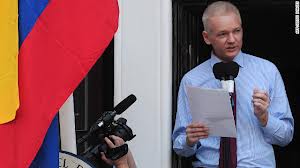
Julian Assange: tragic hero for our times

By tradition a tragic hero is a man (less frequently a woman) with the qualities for greatness, brought low by some flaw in his personality: Macbeth undone by overweening ambition, Othello loving not wisely but too well.

Julian Assange has to his name an accomplishment at least as notable as the victories won by those two heroes: through Wikileaks he has revealed abuses of power to a world that only guessed at them and was shocked by their extent.

Julian Assange addressing the world from the Ecuadorean Embassy in London
and getting a breath of (relatively) fresh air
Today he is up against difficulties that have led to his painting himself as a victim of persecution, a champion of free speech facing martyrdom for his beliefs. Prometheus taking on the gods, Mandela unbowed before the State. And when Assange appealed to word opinion yesterday, he even spoke out as a family man, a father denied the company of his children.

Yes, it’s an attractive self-image. 


And yet, and yet. The immediate cause of his difficulties is somehow not quite that noble. The flaw in his character isn’t quite the grand failing of a Cassius plotting against Caesar or a Lear giving away wealth and power out of love. No, it’s a failing much more appropriate to our time. The fatal flaw not of a Hamlet but of a Bill Clinton, another man who might also have been great without it.

He couldn’t keep his trousers zipped.

Which, come to think of it, rather relativises that stuff about the poor persecuted family man.

The irony of it all is that without being a legal expert, without even having seen the full evidence, but just based on the pretty extensive rehearsing of it in the media, and on my knowledge of how difficult a rape charge can be to prove, I’d have thought he had every chance of getting the accusations against him dismissed. Both those women in Sweden at some stage consented, so the issue is merely whether they were later forced to go beyond what they had consented to. And that’s their word against his.

With a good lawyer, he could surely beat that rap, couldn’t he?

I’ve been pointed to an article by Naomi Wolf that makes some pretty powerful points undermining the case against Assange. What it doesn’t do is challenge the standing of the Swedish judicial system. Now, I’m sure there are terrible miscarriages of justice in Sweden, just as there are everywhere, but given the choice, I’d be more inclined to take my chance on the Swedish system than on the British.

I’ve read some material about the Swedish attitude towards extradition to non-EU countries. It seems to me that the US would have some difficulty getting Assange extradited. More trouble, at any rate, than they would face in Britain. After all, the Brits constantly ship people off to the States for trial, even for crimes not committed in the US. It’s as though Uncle Sam has only to name someone over here for him to be sent over there.

Seems odd that Assange is so reluctant to try his luck in Sweden.

Unless, of course he has knowledge about his case which he hasn’t yet shared with us. Something that tells him that he shouldn’t be too confident about winning in Stockholm. If that’s so, it would be lovely to find out. Perhaps some internet site with a mission to disclose confidential information might tell us some day.

In the meantime, we have a curious spectacle. A man who wants to be seen as a whistleblower of historic stature is perhaps not being altogether candid about his own quandary. A man who is doing so much to protect his freedom is forced to live in a single room in a building he can’t leave. A man whose path to the reputation he covets is blocked by his apparent inability to master his appetites.

Yep. That seems to fit the bill. All the qualities that would make a tragic hero for our times.