Showing posts with label Selfridges. Show all posts

Thursday, 29 November 2012

Self-exposure

Less than a week to go before I give up my current London-based job. 

An end to commuting will be a huge relief. On the other hand, there are a few aspects of travelling into the capital that I shall miss.

At the end of the journey, for instance, I walk past the front of Selfridges with its flamboyant and (as I’ve remarked before) sometimes startling window displays. So it was quite fun this morning to see the window-displayers making a display of themselves while a colleague waited with a camera outside to record the.

It was a wonderful case of exhibitors exhibiting themselves, what I’d like to call self-exposure, though not perhaps in the sense usually meant.

I liked the staff’s air of joy, of celebration. Why, they even had bottles though, by the look of them, sadly empty. Nine o’clock may be a little early for a drink but I’m of the school of Dorothy Parker: ‘three be the things I shall never attain, envy, contentment and sufficient champagne.’
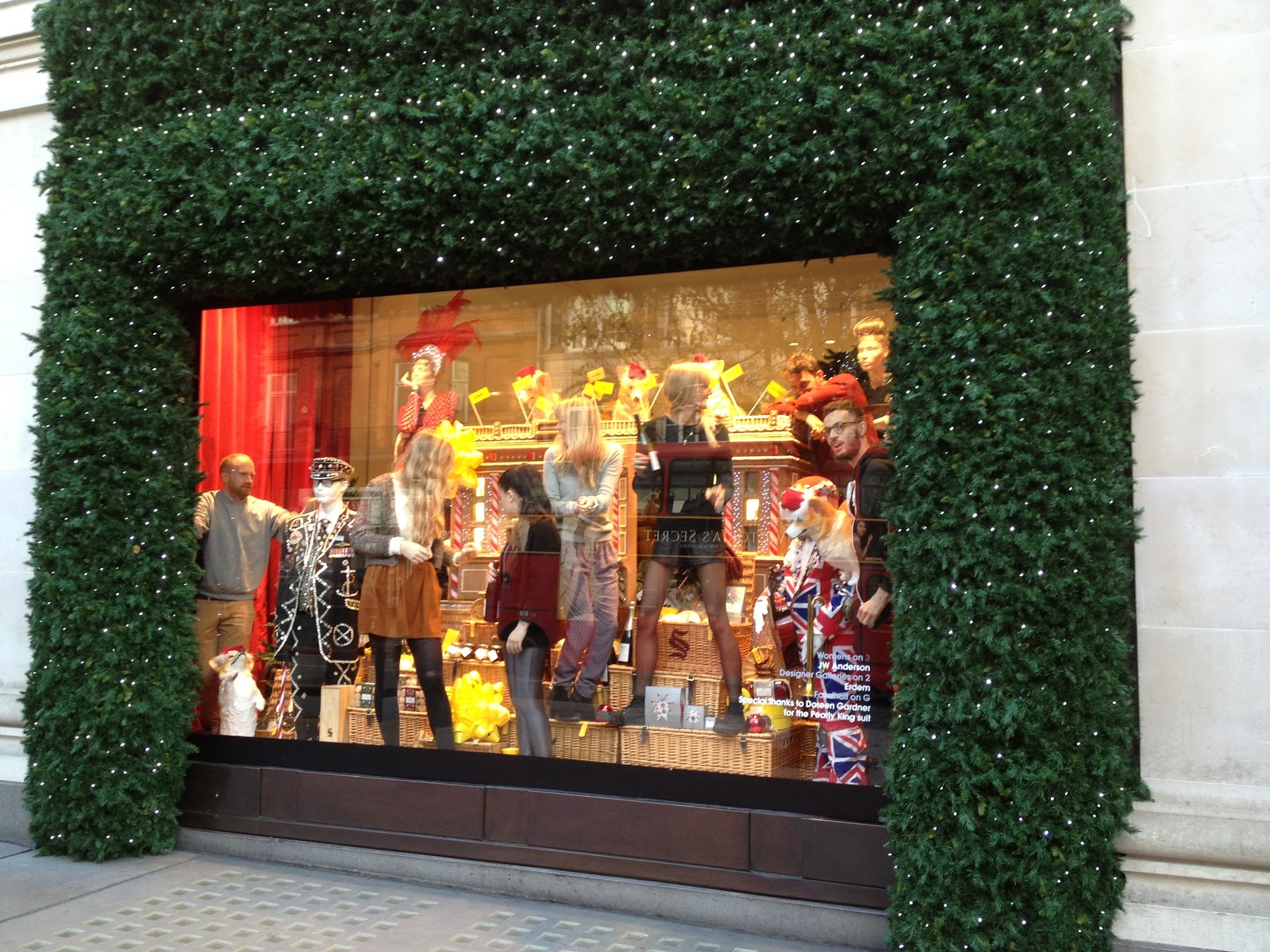

Display staff self-displaying

The sight that struck me most this morning, however, came at the beginning of the journey. 

Anyone who expects rigorous respect for the truth at all times had better be ready for disappointment. The most you can generally hope for is to have the more egregious lies exposed from time to time. Say, Dominique Strauss-Kahn’s contributions to the feminist cause or Tony Blair and Dubya’s irrefutable intelligence on Iraqi weapons of mass destruction.

So it’s lovely to see a lie – well, OK, an untruth – displayed with its own refutation right underneath it. Not for the first time, the platform display at Luton station provided a wonderfully revelatory sight today.

The deceiver exposes the deception
The 8:15 running on time, it told us. And just below, even more prominently, it declared the time to be just short of 8:18. Tell me that’s not another glorious example of self-exposure.

Wouldn’t it be great if politicians came equipped with similar displays?

‘When I say protecting essential services I actually mean all services except the ones I’m cutting and on which you depend.’

‘When I say I’m willing to seek a compromise with the President, I mean a compromise that he makes to me.’

‘When I say I want to guarantee peace and prosperity, I mean I want to wage war in poor countries.’


Wouldn’t that be useful? Perhaps the people who run Luton station could help them choose the right devices.

Thursday, 11 October 2012

Fashion and mental health. And an afterthought on the Law Society

For me, the words ‘Louis Vuitton’ conjure up a sense of the diaphanous, the enticing, the luxurious. Inevitably, I picture a catwalk with women of beauty impossible to believe parading clothes nobody could conceivably wear.

That makes it all the more arresting to walk past the Selfridges department store in London’s Oxford Street these days, on my way to the office. Over the main entrance there now stands a larger-than-life size moulded statue of a woman.

A baleful figure dominates the main entrance to Selfridges

Hers is a striking presence. A little short on allure. Fairly long on grimness. A grandmother it seemed to me, but perhaps not the kind I imagine bouncing a grandchild on her knee. Unless that grandmother had previously been swallowed by a wolf. Not a grandmother, in short, I’d particularly want to meet on my own in a dark back street.

So imagine my growing perplexity when I found whole regiments of figurines of the grandmother arrayed in ranks and linked to the famous fashion brand
.

A regiment of grandmothers
This turns out to be the latest Louis Vuitton display in one of London’s more elegant establishments. The forbidding lady is there to help promote their gracious products.

Seemed odd to me. Where were the supermodels with their air-brushed skin? Where the long golden hair tastefully arranged around the swan-like neck? Where the shapely legs revealed to mid-thigh?

The image the Vuitton marketers had chosen seemed wholly out of tune with the products they want to advertise. Surely they need to cultivate an association with charm and desirability?

Now imagine a woman who gradually becomes aware that some of the ideas floating in her head, which go as far as a sense of the obliteration of her self, are not merely original and intriguing, but pathological. That her moods are not only strange, but deeply out of joint. That what she took for focus might be more like obsession.

And with that awareness comes a sense that she needs treatment. So that, at the age of 48, she decides that what she needs to do is to admit herself, voluntarily, to a mental hospital. For life.

That’s what happened to the Japanese artist Yayoi Kusama. Her home for the last 35 years has been a mental hospital. She has also declared that the only thing preventing her killing herself has been her art. A hallmark of that art is that she frequently uses just two colours, often in a pattern of polka dots.

She also happens to have worked extensively in fashion.

So maybe it’s not so surprising after all that Louis Vuitton has formed a partnership with her, recently sponsoring an exhibition of her work, and then using her vision to underline their latest display at Selfridges.

Because that sculpture isn’t of a nameless grandmother. It’s Kusama’s self-portrait. And it’s no accident she’s in a polka-dot dress. Nor, perhaps, is it by chance that her expression’s so grim. What is there to smile about after all?

When I finally worked all that out, it put a wholly different complexion on my reaction to the display. First of all, I felt ashamed of my ignorance. But secondly it strengthened something that had already begun to bubble up from the marketing man inside me: perhaps it isn’t such a bad promotional campaign in any case.

I hate to confess to two different forms of ignorance in a single blog post, but sadly without a label to guide me, I find it hard to distinguish Dior from Lacoste, Yves Saint Laurent from Louis Vuitton. And those languid maidens whose absence had struck me so forcefully are the stock in trade of them all. They're commonplace. But no-one else, to my knowledge, has ever chosen as its image a woman in her eighties glowering out on an uncomprehending world from the pain of mental illness. Now that image I'll remember. And that means I won
’t forget Vuitton either.

The display at Selfridges disturbed me, but isn’t that better than leaving the passer-by indifferent? It made me take a look for the story behind it. And it made me write a blog post on the subject.

For that, I feel I owe an apology to Selfridges for having misunderstood its message. And some grudging admiration to Luis Vuitton for what turns out to have been a smart idea, because of its originality.

But above all, I
’m under a debt of gratitude to Yayoi Kusama, for reaching out from the troubled isolation of her soul to speak to me so powerfully. 


Postscript. Another take on advertising.

If there’s a profession that needs to improve its brand image, I think most of us agree it would be lawyers. So I loved the ad I saw on my station platform this morning.

A joke at their own expense,
but I don't think the lawyers meant it
What would most of us see in this image? Surely infidelity, jealousy, fury. A domestic tragedy in preparation. 
What does the Law Society see? A business opportunity.

Yep. That’s just the kind of image lawyers need to be promoting.

Monday, 16 May 2011

Fish have rights too

Judging by its window display, the prestigious department store Selfridges in London’s Oxford Street, is proud of the principled stand it has recently taken. ‘We don't sell endangered fish’ they proclaim with obvious confidence in their moral credentials.

Selfridges sides with the fish. Or does it?
That's all very well and fine, but I'm not sure that things are quite so clear cut. After all, we're entitled to ask: they don’t sell endangered fish – what?

In fact, what do endangered fish generally buy?

I suppose they might want to equip themselves with some kind of security system, to mitigate the dangers they face. And if they did, why should we refuse to supply them the protection they crave? Don’t they have rights too, to live in safety?

Is it time to launch a counter-campaign? Or possibly an over-the-counter campaign?

My modest proposal for a possible slogan: not so self-righteous, Selfridges.