Showing posts with label Universal Credit. Show all posts

Monday, 25 December 2017

Season's greetings. From somewhere else

Merry Christmas to you all! Christians, non-believers, believers of any faith or none – enjoy the Christmas break!

This is the time of year when I remember the wonderful experience my wife and I had in the predominantly ‘Indian’ part of Luton, the town where we live: one 24 December, we saw a queue that seemed to be made up of both Muslims and Hindus outside a (halal) butcher and Danielle, who talks to anyone, asked what the they were waiting for.

“Turkeys,” they replied, “naturally. People all around us are celebrating. Why wouldn’t you expect us to celebrate too?”

That’s the spirit in which I wish you a merry Christmas.

We’ve certainly been having a great time. For the first time, as far as I can remember – and I’ve had 64 Christmases – we went somewhere we could enjoy it on a beach. And that’s precisely what we did today, wandering along a glorious strip of golden sand as the Atlantic beat the shore next to us – and our feet: we didn’t swim but we certainly walked through the surf. What’s more, on the way back we were treated to sunset too, a most satisfactory way to wrap up Christmas Day.


A fine way to end Christmas Day
This was on Cofete Beach, on Fuerteventura in the Canaries. The name itself was part of the pleasure: it reminded us of one least harmful of Donald Trump's blunders, his tweet which read precisely Despite the constant negative press covfefe.” 

Alternatively, it sounds like a waiter offering a choice of hot drinks: Coffee? Tea?

Either way, the name's fun and the place is better.

Now I know that my friends from the Antipodes – or friends who spent time down there – have all had the experience of Christmas on a beach. But to us it was new and delightful.

We had the meal, as befits a Catholic country, yesterday: the tendency is to celebrate Christmas Eve rather than the day itself. We didn’t have turkey but that wasn’t as new to us as the setting: we haven’t had that particularly dull meat for a great many years. Instead, we drove to restaurant (selected from Trip Advisor, of course) in the heart of Fuerteventura's main nature reserve.

There, surrounded by desert scrubland, bathed in sunlight and warmth, we had a leisurely meal of local specialties, cooked in olive oil and flavoured delicately with herbs. I hate to sound so unpatriotic, but we really didn’t miss the turkey at all.


Substitute for turkey. And much to be preferred
But it isn’t just the sun, the sea and the flavours that make me pleased to be here. I’m also glad to get away from the depressing atmosphere of Brexit Britain for a few days. In particular, and I feel embarrassed to use such a clichéd, indeed Dickensian, term in connection with Christmas, but it’s wonderful to be away from the humbug of its being a Christian festival in a Christian country.

Britain is far from a Christian country in religious practice, with barely one in twenty of the population regularly attending a church service. Nor, and this is far more important, is it a Christian country in its values: just in the last week we’ve read of a young man dying of cold in a Birmingham street and the children of the poor having a far higher likelihood of being hospitalised for conditions which shouldn’t require hospitalisation at all, such as asthma.

Children of the poor. Those who we should be protecting above all others. Children!

Most recently, there’s been the news that landlords are beginning to evict people on benefits, as a result of the introduction of the new system of Universal credit, which is leading to many failing to keep up their rent payments. Homelessness will rise. As though there weren’t far more than enough already.

Until we address those issues, until in fact we wean ourselves from belief in austerity, I don’t see how Britain can claim to uphold anything resembling Christian values. Christmas is just an excuse for binge drinking, binge eating and binge spending. Its Christian content has long since been lost and a secular celebration seemed more appropriate, or at least more honest.

So it’s good to be away from that pretence without foundation. Though sun, lovely beaches and delicious food help too. We’ve enjoyed our Christmas.

And it’s in that spirit too that I wish you as much fun this season as we’ve been enjoying.

Wednesday, 25 October 2017

The joys of simplicity, revealed in the blessings of universal credit

Simplicity is so much to be preferred to complexity, isn’t it?

Britain had a real mess of a system for providing benefits – what other people call social security – to people who need them. To mention just the main ones, there was housing benefit and invalidity benefit and unemployment benefit and, just to confuse everything, even tax credits in employment, to boost the earnings of the low paid.

Who had a right to which? For how long? And under what conditions?

So it made sense to put an end to this chaotic mess. Replace this whole raft of multiple criss-crossing benefits and replace them with just one, tailored to the individual. Why, we could call it universal credit and have it replace all the rest.

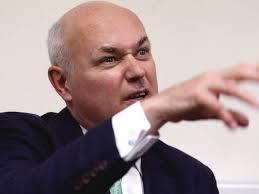
Iain Duncan Smith
A remarkable track record. To which he keeps adding
It was the brainchild of one Iain Duncan Smith. He made his name as leader of the Tory Party, taking over after its disastrous general election defeat by Labour in 2001. However, in 2003 he lost a vote of confidence of his MPs, convinced as they were that he could not lead them to success, and resigned. But he refused to go into his long goodnight as he might have done, instead reappearing as the minister responsible for benefits under David Cameron.

You don’t remember Cameron? Don’t worry. He was immensely forgettable. He enjoyed a brief and ill-deserved moment in the limelight as British Prime Minister before returning to the far more merited obscurity from which it’s unfortunate he ever emerged.

In the meantime, Duncan Smith got his chance to introduce universal credit.

A brilliant idea, as I said before.

Except that a brilliant idea in the hands of a Tory Minister, in a government wedded to austerity, is unlikely to look as generous on closer scrutiny as it sounds on the surface. So it turned out with this one. As this enlightened minister made clear in an article for the favourite paper of the Tory party, the Daily Telegraph (or Torygraph as those of us of another persuasion like to call it):

By restoring the incentive to work and ensuring that work always pays, universal credit is the strongest statement of this Government’s commitment to helping people get the security of a good job.

See the sleight of hand? “Incentive to work” is Tory doublespeak for “we’re going to make this so mean that no one could possibly live on it so they’ll be forced to take a job, however dismal”. A “good job” in this context is Toryspeak for “a reduction of one in the unemployment figures”.

Just to avoid any possible doubt, Duncan Smith also explained that “our reforms are forecast to save a total of nearly £50 billion cumulatively across this Parliament.”

Saving money. Always a welcome message for the recipients of state benefits, who know it means a major effort of generosity on the part of government.

Duncan Smith brought to the task of designing universal credit all the flair he’d shown in leading his party.

It’s taken five years to build the system. It’s being trialled right now in several local council areas. The results have been eloquent: there’s been a huge increase in dependence on food charities and in rent arrears. One food bank, according to Patrick Butler in the Guardian has reported a 97% increase in demand.

Meanwhile with that pesky housing benefit out of the way, councils are reporting huge increases in rent arrears. One council, the Guardian again tells us, reports dramatic figures:

Southwark said that although just 12% of its social housing tenants were on universal credit, they have built up £5.8million in rent arrears. The average universal credit household £1,178 in arrears, compared with £8 credit for the average council rent across the borough.

That’s why they call it universal: it spreads joy everywhere. Not just the tenants who can enjoy piling up rent arrears, and celebrate the fact down at their local food bank, but the council who sees its rent income falling.

As Duncan Smith so eloquently put it, he was building “a system that supports people to secure independence for themselves and their families.”

The wonderful thing is that, although he was sacked by Theresa May, our soon-to-be-former Prime Minister who replaced David Cameron (remember him now?) he keeps popping up and speaking out on the subjects he cares about. Most notably, he’s terribly keen on Britain getting out of the European Union. Just the other day, I heard him on the BBC explaining why Britain had nothing to fear from Brexit and everything to hope for.

It’s extraordinary, with his track record, that there are still people out there prepared to listen to him.

And, still more difficult to understand, believe him.

Thursday, 26 November 2015

Tory U-turns: a matter of relief, but with questions of responsibility and irresponsibility.

George Osborne, Chancellor of the Exchequer in Britain’s Tory government, produced a spending review on 25 November that does a complete U-turn on two heavily trailed and highly unpopular measures.

On his way to making those announcements, he repeated the claim he’s advanced frequently in the past, that any difficulties the economy is facing are the fault of the previous Labour government. As his opposite number, the Labour spokesman on Finance, John McDonnell, pointed out, there comes a time when you have to stop blaming your predecessors and take responsibility yourself. Osborne has, after all, been in office for five and a half years. Back in 2010, he set targets by which to judge him, in particular eliminating the structural deficit in government spending by 2015, which he spectacularly failed to hit.

At the 2015 election, he persuaded a large number of voters to give him another chance to hit his targets by 2020, though it again looks as though he won’t make it. Indeed, I believe one prediction we can make about 2020 with some confidence, is that the Tories’ woes will not have been vanquished, and they’ll still be blaming them on Labour. Osborne, it seems, is never responsible.

Part of his irresponsibility will be continued austerity policies. And that’s despite the two U-turns he has just announced.

The first U-turn concerned cutting tax credits, vitally necessary to a great many people for whom the Tories claim to speak – the striving working poor. The Opposition parties and others had mounted a major campaign against the cuts. It’s a measure of the opponents’ success that they were able to convince a great many voters of their case, and a further measure of that success that Osborne, wily politician with well-tuned antennae, simply abandoned his proposal.

Osborne: a wily politician but not so hot on responsibility
Secondly, he has dropped plans for further cuts to the police, a position made deeply unpopular by the Paris terror attacks.

Smart moves by a clever operator. And most welcome: I supported the opposition to both cuts, and it’s with sincere relief that I greet their abandonment. But there’s no reason to reduce the pressure on Osborne, all the same. For two reasons.

Firstly, it would be deeply foolish to think that he isn’t going to sneak them back in. That’s already happening with tax credits. That particular support is being phased out to be replaced by the new system of Universal Credit – which Osborne has already cut. So as people are moved over to the new arrangements, many will face cuts of £2000 a year and more – around 10% of their earned income – that we were complaining about before.

So the opposition has to continue. Otherwise all we’ll have bought is a little time.

And secondly, there’s the justification Osborne has used for his U-turns. The Office for Budget Responsibility has revised its forecasts of future government revenue. It is on the strength of those forecasts that the government felt it could afford to reverse its cuts. But the Guardian was absolutely right to quote the comment by the great American economist, J K Galbraith, on the subject:

The only function of economic forecasting is to make astrology look respectable.

George Osborne has taken a gamble on the economy turning out as the forecasters have suggested it might. Not on money in the bank, but on money he hopes to see flow in later.

Now I’m very much in favour of seeing growth stimulating increased government revenue, so that the constant cuts associated with austerity can end. But it strikes me that a government that is constantly quoting little common place phrases of everyday life as though they constituted analysis of an economic policy for a nation – “the country has maxed out its credit card”, “we inherited an economy on the brink of bankruptcy”, “we’re fixing the roof while the weather’s good” – would at least admit that it’s taken to spending today, money it has at best an uncertain chance of earning tomorrow.

It’s particularly striking in this context that the Office for Budget Responsibility doesn’t have a good track record in economic forecasting. Of course, it doesn’t have to take responsibility for any budgetary decision taken by the government.

But then, it seems George Osborne doesn’t feel the need to either. And he’s taking those decisions. With cheerful irresponsibility.