Thursday, 26 March 2015

Israeli and British thrillers: the good and the bad

Did you watch Prisoners of War, or Hatufim if I can allow myself to use the Hebrew name without the Hebrew characters? This was the original on which the American series Homeland was based.
Yoram Toledano and Ishai Golan in Hatufim
The US series had some excellent actors, but they had to make up for a painful thinness of plot. A Marine sergeant returns from eight years in terrorist captivity and, seemingly within days, he’s in Congress and frontrunner to be the next Vice President? Really? In the Israeli series, the equivalent character is seen scanning Jobs Vacant columns, looking for something he can go for after seventeen years (not merely eight) out of the employment market – years in which his friends have built careers.

In addition, in Ishai Golan Hatufim offers one of those truly memorable characters, ambivalent, vulnerable, terrified, courageous. The series would be worth watching just for him.

The only original spark that Homeland was the equivalent character, played masterfully by Claire Danes as a brilliant spy struggling with mental illness. She's great, but is that enough to support four seasons? I found it couldn’t get me through two.

Hatufim, on the other hand, compels from beginning to end, through two fine seasons (and there were no more). Who’s up to what? Who’s on whose side? Who’s gone over to the enemy, who’s stayed loyal? We’re forced to reconsider our judgements again and again, and not by artificial devices, but in ways that remain completely coherent with the overall narrative. Nor is the enemy entirely bad, with plenty of sympathetic characters (to be fair, as in Homeland), as well as a completely dire one, introduced in powerfully horrific fashion at the beginning of season 2.

So good was Hatufim, that I turned to the next Israeli series broadcast on the BBC with high expectations. Hostages ( Bnei Aruba) sadly disappointed them.


Hostages: no way to spend a quiet evening at home
The acting, I should say, was excellent and the series had Hatufim’s strength in creating atmosphere. Those two factors were compelling enough to keep me watching to the end. But the plot! My dear. It was as weak as Homeland. The event that kicks off the action is the kidnapping, in their own home, of the whole family of a leading surgeon who is slated to carry out a minor operation on the Israeli Prime Minister. The aim of her abductors? That she kill her patient on the operating table.

Throughout the series, a central theme is that the would-be assassins are able to watch the surgeon wherever she goes, such is their skill and their support from inside the security services. With such power, it’s hard to understand why they don’t just bump off the Prime Minister themselves, instead of going for a risky abduction that can (and does) go wrong, and relying on a proxy to act for them.

The answer is that was what it took to generate material for ten episodes.

More tedious still, characters keep being left in positions where they could phone the police or otherwise call for help. And somehow they never do. “Why,” I wanted to ask the producers, “do you demand that viewers believe that people taken captive in their home, and presented with an excellent opportunity to contact the police, would fail to do so?”

Again the answer is that the series wouldn’t have lasted beyond two episodes, and they needed ten. But I have to say that “because we need to keep the series going” strikes me as a poor justification or implausible plot devices.

On the theme of strong and weak plot devices, did you see Broadchurch?

Season 1 was extraordinary television. It proved in a British-made series what the Scandinavians had shown before: you don’t need a string of bodies to generate real tension in a thriller – just one will do.

The study of the impact of a violent death on a small community made excellent viewing, especially the way suspicion, leading to persecution, can fall unjustly on individuals whose only offence is to be different from those around them. And a particular atmosphere was created by the decision not to let even the actors know at the outset who the perpetrator was: it seems that making the revelation a shock to the actors made it all the more shocking to the audience.

Such was the success of season 1 that the producers had to make a season 2. Alas. It’s Homeland compared to Hatufim. Instead of gripping thriller we had meandering soap, at least as concerned with who bedded whom (and whether they still were) than with the central criminal concern – to which another one was added, presumably to give us more to get excited about, though the reality is that it just blurred the focus.

All this against the background of court proceedings which pit two allegedly outstanding lawyers against each other, one of whom conducts such a lamentable case that the eventual verdict becomes inevitable (note that I don’t mention which one: you’ll get no spoilers from me – the series spoils itself perfectly adequately on its own).


Broadchurch. Olivia Colman was superb as ever.
And whatshisname was OK
The only redeeming feature? The performance of Olivia Colman, incapable of taking on any part without investing it with a quality beyond most other actors.

If you haven’t seen Hatufim or season 1 of Broadchurch, then you could do a lot worse than to watch them. Hostages or season 2 of Broadchurch? Only watch them if the only alternative is re-runs of Jeremy Clarkson in Top Gear.

Tuesday, 24 March 2015

Plenty to laugh about, but a bit to regret, in fine entertainment by a tragic genius

There’s some satisfaction in a talented individual receiving some recognition in his lifetime, rather than none at all. Particularly if the talent in question is more like genius. But it has to be sad if that lifetime was short, and mostly consumed generating works that should have won acknowledgement but didn’t, with triumph coming only in its last few weeks.

This is the sad background of The Magic Flute, the first piece that gave Mozart really widespread popular acclaim. Its premiere was on 30 September 1791, and such was its success that it reached 100 performances just over thirteen months later. But Mozart had died nearly a year before, on 5 December 1791, without reaching his 36th birthday, just over two months after the opera opened.

That, however, is the saddest thing about it. Otherwise the opera is an extraordinary piece of almost Monty Pythonesque fun and silliness. We have a fairy tale, complete with beautiful princess who falls in love at first sight (of course) with the dashing prince who sets out to rescue her. As for him, he doesn’t even wait till first sight to fall for her, instead being captured by just looking at her picture.

In parallel, we have a clown in the form of a bird catcher, a loveable rogue and fool, always getting into trouble, whose only aim is to find a woman who can be his mate. Does he find one? Is he going to have to marry the old lady he meets? Or will she turn out to be the gorgeous young woman of his dreams? You’ll not get a spoiler from me, though I will reveal that his name is Papageno and there’s a female character called Papagena.

No spoiler! But this is Papageno and Papagena
from the Welsh National Opera production

They have some pretty good songs, too.

And just who’s the adversary the dashing prince must take on to rescue the princess? Could it be the wicked sorcerer who has abducted her, or is he really the good and generous leader of an order devoted to the pursuit of nature, reason and wisdom? Is her mother really the wretched parent deprived of her child, or is she the wicked Queen of the Night? Is the opera about a rescue from the clutches of a kidnapper, or is it about the triumph of reason over the forces of darkness? Or the conflict of freemasonry (good, for Mozart) against the Catholic Church (not so good)? 

Who knows. It could be any of those things or none of them.

That’s how tense it gets. Imagine. We were on the edges of our seats.

One of the things I particularly like about this opera is that Mozart wrote for actual, real people. Individuals. His friend whose company would put it on in his own theatre, who wrote the libretto and was the first Papageno. The rest of the cast, made up in part of actors who could sing a bit, for whom Mozart had the orchestra playing the tune so they could sing along to it; singers for whom he had the orchestra playing a true accompaniment while they found the tune themselves; and some outstanding singers for whom Mozart wrote devilishly difficult bits, including what’s generally thought of as the hardest aria for any soprano (written for his sister-in-law).

Queen of the Night, in the Welsh National Opera production
And, boy, is that aria by the Queen of the Night extraordinary to hear.

So we had a great evening when we went to see the Welsh National Opera perform The Magic Flute at Milton Keynes theatre. Even the set was good, all pale blue sky with fluffy white clouds, which reminded us of a Magritte painting – an impression made all the stronger when we saw the male singers in bowlers.

Magritte Bowler-clad men and fluffy skies
Male singers in the Welsh National Opera production of
The Magic Flute
The voices were excellent, the whole performance well-paced and wittily staged. A great way to spend a few hours.

I only wish Mozart could have seen a little more of his great success.

Sunday, 22 March 2015

Luci's Diary: I'm getting to like the place.

Luci's Diary. In which she seems to be settling in and learning her way round the new place. And its occupants.


March 2015

Well, I seem to have fallen on my four feet. Or at least my new owners’ four feet. 

Things are OK.

These two both have grey tops. I’ve learned that this means they’re incredibly ancient. That has its plusses and its minuses. Not so good for playing, like the little people in my last family, but a lot easier to get your own way with. In fact, I’ve been told I shouldn’t call them owners. I should think of them as domestics. But they like to boss me around and, hey, since they feed me, and don’t expect me to feed them, I play along with it, doing what they say. 

Some of the time.

One of the first things they did when we got here was take me into the garden. Outside, would you believe. Just big open sky above me. Which anything could come out of. 

Still, it’s got fences round it. I suppose that makes it reasonably safe. Took a while, all the same, before I got comfortable. By yesterday, though, when the sun came out, and it was quite warm, I actually got quite glad to lie in it. Till the woman came out and told me to get off the vegetables. No idea what she meant – it was just a patch of brown earth, but she seemed to think it was important. It was no skin off my snout though, so I got out like she asked.

The man keeps giving me orders too, but he’s got the concentration of a goldfish (well, that’s what I’ve been told, though to be honest I don’t really know what a goldfish is). He tells me to do something, or stop doing something, and then gets buried in one of his books or his laptop computer, so I just get on with whatever I was doing anyway.

Silly thing that laptop, by the way. After all, it takes up his lap. The woman keeps saying I’m a lapdog, which is fine with me, but that means the lap’s mine. Walking on his keyboard, I find, is generally a good way of getting his attention. He gets a bit shirty, but he usually makes me some space.

So, yes, I’m settling in. Though there was a bit of an odd thing during the first few days. I had this growing sense that the three of us weren’t alone in the place. There were odd noises from time to time, and a passing scent that certainly wasn’t either of them. They’d say strange things too.

“He must be out in the garden, sulking.”

“Yes, and coming in at night when there’s no chance of meeting Luci, having a bite to eat, sleeping in the front room and getting out again in the morning.”

Imagine my horror when I was confronted one day, inside the house, by this enormous cat. A gigantic beast. I gave him the bark, of course, and then – I really don’t know what came over me – I dashed at him, instead of hiding behind the sofa like I should have done: he must have outweighed me three or four times over.

To my amazement, he made a beeline for the garden door. And ran straight through it! I’ve not yet worked out how he did that. There was a great clattering sound as he went, and the woman pushed me through the door myself later, telling me I’d soon learn how to do it, but it still beats me. How do you get through a solid door? I don’t mind learning, but she’s going to have to show me again.

Later on I met the same cat in the garden. And my natural caution once more abandoned me, as I went after him, dong some of my best barking. He disappeared over the fence.

But a few hours later he was back in the house. One of the owners was saying “I’ve shut the cat flap,” and this time he didn’t decamp. Instead he tried to hide from me, on one of the chairs under the big table. I was dancing around the chair, jumping up at him, until he reached out one of his paws and gave me such a biff on the nose! It suddenly occurred to me that the rumbling sound he’d been making wasn’t to do with playing, it was him growling. 

Weird. No kind of growl I’d have recognised.

And then an even stranger notion began to grow on me. This wasn’t an intruder – he belonged here. The owners were talking to him, trying to stroke him on the chair he seemed rooted to.

“Now, come on Misty, Luci’s nice. You just need to get to know her. She’s not going anywhere, you know.”

Eventually, he came off the chair, and I decided to treat him with a bit more respect. Especially if he’s here to stay. And all the more so since he packs a heck of a wallop in that paw of his. 


Sometimes he feels like playing. And sometimes he just doesn't
Sometimes he doesn’t mind playing, and that’s fun. But sometimes he’s had enough, and boy, does he let me know it. He makes a funny sort of low howling sound and comes after me, both front paws flailing. I find the best thing to do when that happens is to lie somewhere and look unthreatening. That usually makes him stop.

He can be quite nice, then. It was he who explained that the humans weren’t owners, they were domestics. I’m sure he’s right, but I’m happy to pretend otherwise. He also explained about the man having the concentration of a goldfish, and that you can get away with biting him.

That’s proved useful. Usually the woman gets up in the middle of the night and lets me out for a pee. But if she doesn’t, all I have to do is find the man’s elbow and gnaw on it a bit. That wakes him up quite quickly. And instead of batting me with a paw, like Misty would, he takes me downstairs to let me out.

A good arrangement.

It was Misty who told me about keeping a diary too. He’s had one for ages. Long before I was around.

I think I’ll do the same. This is an interesting place where lots of things happen. More than enough to fill a diary.

Though, quite honestly, I don’t need any more mysterious intrusions into the household. OK with Misty: he’s proved great fun, when he’s in a good mood. But that’s quite enough, thanks. The owners do keep letting other people in, which is a pain – they’re all so big. It makes you wonder what the point is of having walls around the place, and fences round the garden, if you don’t stop strangers wandering inside them.

Still, none of them has stayed long. There’s only the man and the woman and – joy and fun! – Misty. If that’s how things remain, I’ll have nothing to complain about. 

And this diary will be a happy place.

Friday, 20 March 2015

Enlightenment doesn't mix well with elitism

Though he was a son of the emperor, the young prince Ashoka was far from the line of succession. But he was respectful of the Ministers so, when his father died, they backed him to inherit the throne. He carved his way to there through human flesh, it is said, with some recounting that he killed 99 of his 100 brothers and half brothers, sparing only one.

Indeed, it is said that he rid himself of the legitimate heir by tricking him into a pit of live coals. To deal with any further adversaries, he even set up a torture chamber called the heavenly hell, because of its beautiful exterior hiding horrifying deeds. He waged war, too, extending the empire he now controlled, until it extended across the Indian sub-continent, from the Hindu Kush to Bengal, and down to the extreme south except for some parts of what we now call Tamil Nadu and Kerala.

His final battle was at Kalinga. And as he walked across the battlefield afterwards, he had an epiphany. How could 100,000 have died in this way, and though his orders? 150,000 people be deported? Suddenly, he could bear it no more.

He converted to Buddhism and devoted the rest of his reign to the cultivation of virtue, within himself and for his people. He became one of the most glorious and saintly of rulers the world has ever seen, and Buddhism had its golden period of growth though much of East Asia in consequence of his actions. Sadly, however, his great and good Empire survived only fifty years after his death.

Now much of this is just wonderful legend, written long after his life, by people with an axe to grind, most of them Buddhists. The story of his early bloodthirstiness is particularly questionable, since it suits anyone wanting to prove the depth of a conversion, to stress how sinful and vicious the man converted was beforehand. With no written records of his personal history from the time, we can assume that much of this is little more than embroidery.

However, there are written records of his rule. Because he ordered huge pillars to be set up around his Empire, many containing edicts for wise rule. There were more at one time, but only nineteen still survive intact, with fragments of others.

One of Ashoka's Pillars
What do we find among these edicts?

… the king abstains from (killing) living beings, and other men and those who (are) huntsmen and fishermen of the king have desisted from hunting. And if some (were) intemperate, they have ceased from their intemperance as was in their power; and obedient to their father and mother and to the elders, in opposition to the past also in the future,by so acting on every occasion, they will live better and more happily.

The killing must stop.

It is my desire that there should be uniformity in law and uniformity in sentencing. I even go this far, to grant a three-day stay for those in prison who have been tried and sentenced to death. During this time their relatives can make appeals to have the prisoners' lives spared. If there is none to appeal on their behalf, the prisoners can give gifts in order to make merit for the next world, or observe fasts.

So there had to be due process, and justice had to be tempered by clemency.

Contact (between religions) is good. One should listen to and respect the doctrines professed by others. Beloved-of-the-Gods, King Piyadasi, desires that all should be well-learned in the good doctrines of other religions.

“Piyadasi”, meaning “one who looks with kindness upon everything”, was one of the nicknames of Ashoka.

This was all happening in the third century before our era. And here’s a ruler who recommends not just the negative toleration of indifference for other faiths, but the positive, active toleration of studying them and learning from them.

Too enlightened to last? Indeed it was. And who overthrew this regime? Why, representatives of the Brahmin caste, the wealthiest and most powerful, the elite of Indian society.

A world in which all were treated with respect, regardless of caste, even regardless of faith? Where was the mileage in that, if you held sway over others? Why would you accept the implicit restriction on your power to act according to your will, accountable to no one or your actions?

So they put an end to it.

So it has always been, down the ages. And so it is today. As Thomas Piketty shows in his great book on growing inequality, Capital in the 21st Century , after the great egalitarian trend triggered by two world wars, a huge depression and the Russian Revolution, we have over the last thirty years, witnessed the reaction from wealthy elites. Initially spearheaded by Ronald Reagan and Margaret Thatcher, this movement has set out to roll back the gains for the ordinary people, while ensuring that the financial elite consolidates its power and extends its wealth.

Just as happened when the gentle Buddhist regime set up by Ashoka was brought to its brutal end.

Wednesday, 18 March 2015

And now, a nice shiny – glittery indeed – election budget

Yesterday was Budget day, here in Britain.

The government presented its financial plans for the sixth, and last time, in the five years this parliament has lasted: a new one is due to be elected on 7 May.

There is only on purpose for the first four years of budgets of any Tory government, and this is a Tory government, with some minor concessions to its junior partners or, to use the technical term, fig leaves in the Liberal Democrat Party. That purpose is to look after its paymasters. The Tory Party’s owners, in fact. The large businesses and wealthy individuals who have bought the Party by funding its every move to win and hang on to power.


George Osborne: pouring on the snake oil
Those budgets have helped achieve that goal, increasing poverty for a great swaths of people at the financial bottom of society, while equally those who already own and take the most to add still further to their wealth. Today, Chancellor of the Exchequer George Osborne boasted that living standards overall are higher than when his government too office, which is strictly true: he has managed, after five years, to get back to and slightly above the position in which his predecessors left the country in 2010. But in contrast to this sluggish growth, for the top 1% of society, it has been spectacular. Inequality has increased by leaps and bounds.

After five budgets to help its friends, now the Tories need a budget to try to secure a win in May. They don’t have a lot to play with, so what they’re handing out is modest: a little tax help on savings, some help of first-time buyers of houses, some loosening of taxation on earned income. And a small reduction in the duty on beer, so at least we can drown our sorrows more cheaply (well, as long as beer’s our tipple).

These are moves that help a large number of people, but still a minority: people in a position to save, to dream of buying a house, and of course to hold down a job. And the tax measures help the wealthy not just the poor. In fact, as the BBC's Paul Lewis shows, they help people with incomes of £43,300 to £120,000 a year more than twice as much more as those on £11,000 to £41,865. Those on under £10,000 pay no tax so gain nothing at all.

Presumably the calculation is that the poorest often don’t vote at all, and even if they did, probably wouldn’t vote Tory. So the proposals are aimed at people in the middle whom they hope, and need, to win.

The point about the measures isn’t to provide a lot of help. It’s to look encouraging. Glitter, in other words, not gold. Perhaps the best illustration of that aspect came in Osborne’s speech. In the autumn, he had announced that austerity would have to continue another five years. Today he announced that some good economic news meant it might end a year earlier. In other words, he’d painted a dismal picture of further battering pain, and hoped to win brownie points today by announcing that it would last less long than he’d previously threatened.

So we should feel grateful to the man who assaults us in the street, knocks us to the ground, and steals our wallet, if he then gives us back a couple of banknotes.

Sadly, we have quite a lot of voters who are prepared to give the mugger the benefit of the doubt this way. The great question is how many are there, and will they swing the result on 7 May? It’s going to take a fight to stop them.


Postscript

I particularly enjoyed the statesmanlike comments of Nigel Farage, leader of the Xenophobes of UKIP, to the BBC. He assured us he’d seen no sign of policies from the government to eliminate the deficit. He said it smugly, but then he’s always smug.


Farage: statesmanlike. As always
On the other hand, I’ve never heard him come up with a coherent policy to eliminate the deficit himself. Or any part of the economy. Or, indeed, on any other matter.

Monday, 16 March 2015

The joy of a new puppy. Even for an (older) cat.

It’s odd to have a puppy in the house again. Odd but pleasurable, though in the case of Misty, our cat, the pleasure took pretty well a week to be felt.

She’s called Lucy. Though it seems I’m not allowed to spell her name like that. Her original owner was Hungarian and gave her the name Luci – it’s a specialty of the Hungarian language that it makes even the simplest things more complex, or even incomprehensible: in Budapest I found it easier to read the occasional sign that appears in Russian, than the Hungarian, and I don’t speak Russian.

All I know about Russian is that “nyet” is something we should be saying more often to Putin, with little expectation that he’ll listen.

But I digress.

Luci has all the quiet reticence you’d expect of a four-month old dog. I took her for a walk at lunch today, so in the early afternoon she was blessedly quiet and asleep next to me on the sofa. At 4:00, however, she woke up, but in the sense that a previously dormant volcano wakes up. She decided that she had energy to expend.

She wasn’t actually bouncing off the walls, but she certainly did some bouncing off me: she invented an excellent game which consisted of jumping on to the sofa, getting a bit of momentum going along its length, leaping on to my chest and bouncing off back to the floor, at which point she would race round the back of table in front of the sofa, to be able to start the whole enthralling process over again.

When she got tired of bouncing off me, she decided it was Misty’s turn. Which takes me neatly to the subject of his reaction to all of this.

The first time he became aware of her presence in the house, on coming downstairs after an innocent day’s sleep on our bed last Sunday, he reacted like a NATO soldier whose vehicle has been hit by an IED. Post-traumatic stress disorder doesn’t begin to cover it. He was out of the cat flap and we didn’t see him till the next day.

Over the next few days. he kept well clear of the house. He’d come in late at night when he was sure not to meet anyone, gobble some food and find himself somewhere quiet to rest. The next morning, it was another snatched meal and out once once more.

On the rare occasions we could get near him before he decamped, we’d stroke him and pet him. I even went so far as to explain to him that, though a nuisance, Luci had many fine redeeming features, but he wouldn’t hear of it.

Finally, on Friday, we caught him indoors and shut the cat flap. He was stuck. The introduction would have to take place.

The effect on Luci was electrifying. She’d seen so little of him that she’d even started barking at him, as an intruder, on the few occasions when their paths crossed – not something that helped cement a budding friendship. But now he was indoors, in her space, and staying.

She’s smart. You could almost see her saying to herself, “just a minute – I’d better revise my notions – he isn’t an intruder, he belongs here. So I don’t need to chase him out. Instead – I can play with him. Brilliant!”

Misty in his magnanimity had retreated to a chair under the dining table, where he stayed sulking behind a fold of the table cloth. So Luci took to racing round and occasionally darting in to bark at him. In a friendly way, mind. This was playing, not guarding.

Eventually, Misty had to react. A growl. A hiss. And eventually a strike to the head – but, we quickly noticed, with a velveted paw, no claws showing.

Luci was impressed, but not terrified. She fled but came back within minutes. And, funnily enough, something happened inside Misty. Her obvious interest in him must have been a little flattering, after all. 

Luci having a sniff. And Misty putting up with it

Within a while, he was sniffing her. She, naturally, returned the compliment in spades. But, as soon as he felt she was going over the top, out came the paw, and Luci would be batted away; sometimes there’d be more growling and a hiss or two, just to emphasise the point.

But Misty’s sulking was over. He’s returned to the house, to reclaim his own territory. He’s even been to sit on our laps, despite Luci’s presence on the same sofa. And what’s been most interesting has been to watch him training her: he’s never hurt her, but he’s found it easy to communicate his displeasure. Misty’s rising eight, he’s a steady fellow with habits he doesn’t intend to see overthrown. So he tells her when she’s being too boisterous.

But he’s come to like her. He’ll rub himself against her if she behaves, purring as he does it. And she, as I said, is a quick study. She knows what he won’t tolerate. It doesn’t stop her pushing the limits and getting batted for her pains, but what child was ever otherwise? When reprimanded, however, she backs off fast. Misty no longer has to prolong the chastisement.

"Play with me, Misty, play with me"
Odd, as I said, having Luci with us. But pleasurable, and all the more so now that all of us are sharing the pleasure.

Even Misty, though he’d never admit it.

Saturday, 14 March 2015

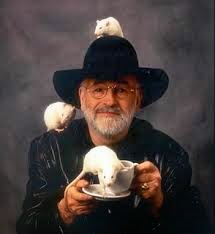
Terry Pratchett lives on

“Tell me, captain…” the Patrician of the city of Ankh Morpork asks his newly appointed police captain, someone who is known to bear certain birth marks and to have an uncanny way of inspiring loyalty in his fellow citizens, to the extent that some have recognised in him a King returned to his city after centuries of absence, “this business about there being an heir to the throne… What do you think about it?”

“I don’t think about it, sir. That’s all sword-in-a-stone nonsense. Kings don’t come out of nowhere, waving a sword and putting everything right. Everyone knows that.”

Why, indeed, should we be that excited by the prospect of the King returning? What’s so wonderful about Kings? Charles I? He drove us so crazy we actually took his head off. Henry VIII? A tyrant whose reign so nearly 2000 executions a year, one in every 1500 people. Charles III, hovering int he wings? Hardly tyrannical, but hardly inspirational either.

That’s what Terry Pratchett did so well, in more than achieving the programme he outlined to BBC’s Desert Island Discs in 1997: “I think I write – I hope I write – entertaining books that are good value for money.” Did I say achieving? He hugely overachieved it.

Terry Pratchett: educating and charming us
Sadly gone, but his voice and laughter live on
In that same interview he explained how he’d come to write the Discworld novels, as parodies of fantasy which questioned the very assumptions of fantasy writers – actually, we’re not that keen on the return of the King, Tolkien – but far more fundamentally put our own lives, back here on Earth, under the microscope.

I wrote it as an antidote to what I call the “belike he will wax wroth” school of fantasy. At that time, there was a lot of fantasy written by the people who had been influenced by the people who had been influenced by the people who had been influenced by Tolkien. And it was getting a little bit silly and everything was recursive and everything was feeding off itself and I just decided to create a world which was clearly ridiculous, designed to look ridiculous, but make certain the people reacted like people do in the twentieth century. That automatically became funny because they didn’t react like cliche fantasy characters, they had ideas of their own. Much to my surprise, what started off as a parody of fantasy became a fantasy series in its own right.

The exchange I quoted above, between the newly promoted Captain Carrot and Havelock Vetinari, Patrician, comes from the end of Men At Arms, one of my many favourites in the series. A little earlier, Carrot in his earnest enthusiasm for police work in the city, had expressed it rather neatly to Vetinari:

‘Do you know where the word “policeman” comes from? It means “man of the city”, sir. From the old word polis.’

‘Yes. I do know,’ replies the Patrician, who knows as much as Pratchett about words, and a lot more than Carrot.

Indeed, he makes the point himself at the end of their interview, calling Carrot back as he is about to leave the room.

‘You’re a man interested in words, captain. I’d just invite you to consider something your predecessor never fully grasped.’

‘Sir?’

‘Have you ever wondered where the word “politician” comes from?’

It does all us citizens no harm occasionally to remember that ultimately politicians and policemen are men of our city. However much, and however often, they may disappoint us.

Pratchett’s way of teaching such lessons without didacticism, and with a witty smile, appeared even in books ostensibly aimed at children. For instance, I shall wear Midnight.

I’m suspicious of the notion of evil. But the world today seems to be suffering from a level of cruelty it’s hard to call anything else. At its most extreme there’s the cruelty in action of ISIS, ritually beheading or burning its victims, even using a child to shoot one.

There is however a more indistinct kind of evil, a greyer cruelty, usually expressed in words (though who knows when it might turn to deeds). It’s embodied by such as Jeremy Clarkson believing himself entitled to bully anyone who irritates him; more seriously, it’s expressed by parties of the hard right (or even the ostensibly more moderate right) who casually inflict suffering on others not for what they’ve done, but for who they are: lone parents, gays, immigrants, the disabled, the ill.

Sadly, there are those who line up with the perpetrators of this evil. Jihadi John in Syria. The hundreds of thousands who backed Clarkson, preferring entertainment to the rights of employees not to be assaulted by a star. The millions who put their weight, and their votes, behind UKIP.

“… there are those,” writes Pratchett in I shall wear Midnight, “who would rather be behind evil than in front of it.”

True in the Discworld, and just as true on Earth. Pratchett’s answer is that of his central character, Tiffany Aching. When the moment comes in the novel that she lays down what needs to happen next, she even manages to get her audience laughing.

“That’s good, Tiffany thought; laughter helps things slide into the thinking.”

That’s Terry Pratchett. He has us laughing. And that slides things into our thinking. Things that need to be there.

Yesterday, a tweet appeared in Terry Pratchett’s account. It was from his own Discworld character, Death, who always speaks in capitals.

"AT LAST, SIR TERRY, WE MUST WALK TOGETHER."

A petition has been launched to ask Death to let us have Pratchett back. Well, it’s sadly unlikely to succeed. But at least his voice rings on among us. And for that, amid laughter rather than tears, we can be grateful.