Showing posts with label Dreyfus Affair. Show all posts

Wednesday, 27 March 2019

Nations divided against themselves

Have you read Robert Harris’s novel An Officer and a Spy?

Great book. From an idea suggested by Harris’s friend Roman Polanski, who’s about to release the film, to be called J’accuse, with a screenplay also written by Harris.

Imagine a young man, married with two children under three, from a wealthy background and pursuing a military career full of promise, thanks to his intelligence and devotion to duty. This is Captain Alfred Dreyfus of the French Army.
J'accuse:
the novelist Emile Zola's ringing denunciation of the Dreyfus scandal
Now the title of Polanski's film from Harris’s novel
Without warning, he’s arrested for treason. The accusation is that he sold his country’s military secrets to its sworn enemy, Germany. The major piece of evidence against him is a handwritten note reconstituted from a waste paper stolen from the German embassy by a cleaner who is also a French agent. One handwriting expert says it wasn’t written by Dreyfus, another that it was. This is enough to condemn him in light of the most damning testimony of all: the captain is a Jew.

This is the story that Harris tells. He’s written a novel but sticks closely to the historical events. The protagonist of the book, and the hero of the story, is Colonel Georges Picquart. He wasn’t unduly fond of Jews, but he hated the idea of a traitor at large in the French Army, as he hated the idea of an innocent man suffering a terrible sentence in his stead.

Because that’s the cruel twist of this tale: Dreyfus had nothing to do with the treason. Picquart discovered the real spy and denounced him. But the establishment couldn’t bring itself to admit its error, far less when the innocent victim of its miscarriage of justice was Jewish. So they preferred to let Dreyfus rot on Devil’s Island. Why, they even ensured that the real culprit, a Major Esterhaze, was acquitted at his court martial.

Picquart, meanwhile, faced persecution nearly to the point of death: I don’t want to spoil the novel for anyone who hasn’t read it, but the French Army went so far as to try to send Picquart on a mission which would almost certainly have led to his death. But he fought on for a cause which must often have seemed hopeless.

Harris is an excellent writer of gripping novels, in particular of the spy or thriller variety, and And Officer and a Spy is in my view his best. So I’m enjoying rereading it. But it isn’t just a good read. It’s also a curious mirror to our own time.

France was torn apart by the Dreyfus Affair. The nation was divided into Dreyfusards and anti-Dreyfusards. The debate was long and often vicious, with anti-Semitic riots and even some deaths in (then-French) Algeria.

There have been no riots in Britain over Brexit, but the divisions are as heartfelt as in the Dreyfus Affair. The two sides are as diametrically opposed, the hopes of unity are as forlorn, the chances of compromise are as vanishingly feeble.

Compromise? What compromise could there have been over Dreyfus? Could he have been exonerated but left in gaol – perhaps under slightly less inhumane conditions – in order not to upset the anti-Dreyfusards? Surely he was either guilty and rightly condemned, or innocent and needing to be released (as he eventually was).

And how’s Brexit different? Britain either stays inside the EU or it leaves. There may have been endless debate over what kind of Brexit might be adopted, but any form means the country leaving the EU. Like Dreyfus being left in gaol: whether under softer or harder conditions, and for a longer or shorter time, it would still have left an innocent man being punished for someone else’s offence. Ironically, the argument for a softer kind of Brexit is often presented, often by no less a person than Labour’s Jeremy Corbyn, as a way to avoid upsetting the Brexiter, or more exactly anti-Immigrant, vote – just like keeping Dreyfus in gaol would have been a way of appeasing anti-Semites.

The big difference between the two conflicts is that the Dreyfus case is over 120 years old. We know today that no compromise would ever have made sense between the two sides. One side had the issue broadly right – Dreyfus was innocent and needed to be released – and the other was deeply and perniciously wrong – it couldn’t bring itself to believe that the Jew wasn’t a traitor to France.

And a century from now? I suspect people will be looking back and wondering how Britain could have been so misled as to leave the EU for a generation before rejoining on less favourable terms. The Brexiters, like the anti-Dreyfusards, will be seen as bigoted and profoundly deluded.

But what a pity if it takes so long, and at the cost of so much damage, for that truth to be recognised.

Saturday, 8 December 2018

J'accuse revisited for our time

When he saw all the books his friend Roman Polanski had on the subject, the author Robert Harris asked the film maker, ‘have you ever considered doing a film on the Dreyfus Affair?’

That was back in 2012. According to Harris, Polanski told him that he’d wanted to for a long time but had never found the right way it. Inspired, Harris, author of major bestsellers such as Fatherland and Enigma, set to work at once.

The Dreyfus affair tore France in two in the late 1890s. On the one hand, there were the ‘anti-Dreyfusards’ who were convinced that a young officer, Alfred Dreyfus, convicted of espionage and drummed out of the French Army before being exiled to Devil’s Island off South America, where he was held in conditions close to torture, deserved his fate.

On the other hand, were the ‘Dreyfusards’ who believed that the conviction of Dreyfus was based on rigged evidence. Ultimately, they felt, it reflected the fear of a solid, Catholic and often royalist establishment that hated the changes that were being forced on French society and identified their source as the sinister figure of the ‘outsider’ – men such as Dreyfus, an ambitious Jew from a family that had the gall to be prosperous.
An excellent novel and an excellent history
The brilliant perception of Harris in writing a superb and compelling novel – An Officer and a Spy – was to frame it as a thriller and present the story not through the eyes of Dreyfus, but those of Georges Picquart.

Why a thriller? Harris tracks the painful process of establishing who had really been selling military secrets to the Germans. And still was, since one of the consequences of Dreyfus’s conviction was that the real spy was left free to continue his treasonable work. These are the elements of a great thriller, and Harris wrote a fine one while sticking closely to well-documented and closely researched historical evidence.

Why Picquart? He may not have been an anti-Semite but he certainly wasn’t particularly fond of Jews. But what he had was a powerful sense of justice and of his duty. An army officer, he was transferred into intelligence where he was tasked with tying up the loose ends of the framing of Dreyfus. But, unfortunately for his superiors, who went right up into the government, the closer he looked at the case, the more convinced he became that Dreyfus was innocent and a Major Ferdinand Walsin Esterhazy was the real culprit.

Picquart was subjected to pressure to the point of persecution. His liberty and even his life were threatened. But he battled on and ultimately Dreyfus was released while Esterhazy escaped into exile in England. He spent the rest of his life in Harpenden, just seven miles from where I live now. Though that’s not why we moved here.

As well as his novel, Harris also delivered a script to his friend in 2013. Polanski was delighted. Though the action was to be set in Paris, the financial conditions were better for making the film in Poland, so the director headed there in 2014 to start planning the film.

Sadly, as you know, Polanski has problems of his own, chiefly with the law back in the US over having sex with a thirteen-year old, in the scandal that led some to suggest he make a film to be called Close Encounters with the Third Grade. Once Polanski had travelled from France to Poland, the US authorities could launch extradition proceedings against him, which they promptly did. Eventually, the proceedings failed, but in the meantime the film project had suffered serious delay.

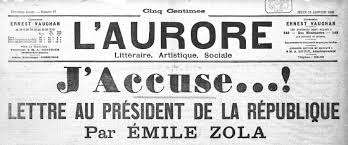
In the meantime, France had introduced new tax incentives for film makers. After further delays to wait for certain actors to be available, filming started in Paris this year and the film is due for release in 2019. Polanski changed the title to J’accuse, the famous headline printed above an open letter novelist Emile Zola wrote denouncing the case against Dreyfus.

The celebrated headline over Zola's open letter to the
 French President, denouncing the anti-Dreyfusard conspiracy
The film might prove topical. After all, roll on nearly twelve decades from the Dreyfus affair and we find, in Britain, a nation just as irreconcilably divided over a major question of the times. Brexit has shattered British society from top to bottom and neither camp can see any merit in the other.

But because there is division, does this mean the truth is somewhere in between, in the middle ground between Brexiters and Remainers? Some might think so. But, in the Dreyfus case, was justice somewhere in the middle ground between Dreyfusards and anti-Dreyfusards?

The answer’s obvious. Dreyfus was not guilty of the charges against him. His treatment was indefensible. It even gave cover to the real criminal, Esterhazy.

There isn’t a half-way house, the sides are irreconcilable. You can’t release Dreyfus and keep him in prison. You can’t play a key role in Europe and turn your back on it.

Worse still, as we look back on the affair now, it’s clear the anti-Dreyfusards were driven by the worst of motives. They hated the Jew, the man whose presence in their army questioned their primal beliefs about the nature of France. They saw those who came to Dreyfus’s defence as despicable, because they put belief in the rights of man over the authority of the establishment and the grandeur of France. And they were happy to spread and believe lies to support their stance.

In the same way, Brexit has been based on lies deliberately spread and willingly believed. Brexiters are driven by hostility to outsiders, to those who arrive from abroad and work harder and often with more talent than they do. They must know, because after two years of debate it’s hard to deny the evidence, that there is no form of Brexit that will not leave Britain economically worse off than staying in the EU. But Brexiters are prepared to pay that price for the sake of ‘taking back control’, sometimes and revealingly expressed as ‘taking back control over our borders’, in other words making sure they can keep out people who look different or speak differently from them.

If only it were their economic wellbeing they were sacrificing to this goal. We live in a world in which the greatest powers are run by autocrats – Russia has had the authoritarian Putin in power for a generation, China’s Xi Jinping is turning increasingly dictatorial in a nation which is emerging as the great power of our century, and the United States has elected a narcissistic adolescent president once and may do so again.

What counterweight is there? Only Europe which, beset by populists and xenophobes, is struggling to maintain an oasis of democracy and human rights. And that’s the aspiration that Brexiters are setting out to undermine.

It’s not hard to imagine a film maker and a writer twelve decades from now turning their attention to the Brexit debacle. I think they’ll have little doubt that, like the anti-Dreyfusards, the Brexit camp got things desperately wrong because they were driven by base motives. Remainers, like Dreyfusards, fought a long battle for a more generous, more open and more equitable society.

At least, I can imagine that conversation if there is still a space in the world next century where liberal thinking is possible. Which I very much hope. Though I don’t think anyone can guarantee it.

Thursday, 9 October 2014

Fiction and lies; good and bad

One of the more curious quirks of the human mind is the way we distinguish between lies and fiction.

We know fiction is untrue. We expect it to be untrue. We don’t want it to be true. In fact, there’s even a psychological mechanism, suspension of disbelief, that allows us to enjoy the untrue narrative we’re reading or watching, because at one level we believe it – we get into the story – while at another we know perfectly well that it’s impossible to believe.

This even leads to curious paradoxes, such as our rejection of inappropriate actions by fictional beings. In Lord of the Rings, for instance, if Sauron had decided that his behaviour was reprehensible, chosen to retire, backing Aragorn for King and handing over the keys to Dark Tower to Gandalf before heading for a small cottage by Lake Nurnen, we might have had trouble going along with the narrative. 


Sauron may be a fictional character, but we understand how he should behave, and that isn’t it.


Sauron's lidless eye.  "This dark lording fair takes it out of you.
Time to put my feet up. Fancy a cuppa?"
 I don't think so.
Just to add a further twist, as we know what to expect from certain fictions, a good writer can achieve comic effect by making a character behave against nature. 

Terry Pratchett has a vampire character, Otto von Chriek, who has taken the pledge and forsworn the drinking of blood (the “b-vord”, in his Germanic accent, as he prefers to call it). Otto proudly wears the black ribbon of vampires who are on the wagon. To distract him from his addiction, he has become a photographer, which is awkward since vampires can’t handle bright light. He therefore carries a small phial of animal blood around his neck, so if his flash causes him to turn into a pile of dust, it will break and let the blood out to reconstitute him.

Layers upon layers, you see. There are no vampires, but we know how vampires should be; we know that light turns them into a pile of dust; we know it only takes a drop of blood on that dust for them to resuscitate; because Pratchett has stuck to these conventional characteristics of the vampire, he can take liberties with others and create a wonderful comic figure for us.

So fiction may not be true, but it does have rules. Which is perhaps what distinguishes it from simple lying.

Those rules are particularly strict when it comes to historical novels. The basic events described have to be as accurate as possible. The best exponents of this genre therefore put a lot of effort into making sure they are as well informed as they can be, given what’s known about the period in which they set their book. Hilary Mantel’s books about Thomas Cromwell are compelling not just because they are a fine telling of a gripping story, but because we know she’s gone out of her way to get the factual basis right. Of course we realise that she can’t possibly know what Cromwell said to Henry VIII in private, or how he felt about his wife and family, but we allow Mantel licence in that area – we suspend disbelief – because she’s so rigorous elsewhere.

The same is true of Robert Harris’s An Officer and a Spy, a masterly novel on the Dreyfus affair and its finest figure, Colonel Georges Piquart. If you haven’t read it, read it soon: it’s a great and enthralling piece of fiction supported by fact.

Then, however, we get another kind of writing which is far less honourable. The kind that claims the same kind of adherence to fact as Mantel and Harris espouse, but fails to live up to it.

“All rituals, science, artwork, and monuments in this novel are real,” claims Dan Brown at the beginning of The Da Vinci Code. And then proceeds to lay before us a stream of undiluted tripe. The Priory of Sion was a secret society founded in 1099, he claims, when in fact it was a hoax set up in 1956. There are 666 panes in the Louvre pyramid, the number of beast, according to Brown; in reality, there are 673. Extraordinarily, at one point his characters take the London tube at Temple station, to travel to King’s College, London. Which is right next to Temple tube. No other station is closer.

The Da Vinci code's claim to factual advice
doesn't stop it being unadulterated drivel
This isn’t playing with the rules of a genre, as Pratchett does, it’s flouting them. You make a Mantel type claim about respect for fact, and then deliberately break it.

To me that no longer feels like fiction. It’s simply lying. And I’ve had nothing but contempt for Brown since I realised that’s what he’d done.

Why am I talking about this now? Because something came up the other day to remind me of this particular kind of lie.

We recently watched the 1996 film Fargo and the series of the same name that was spun off from it. Each episode of the series starts with a claim that echoes the one made at the start of the film:

This is a true story. The events depicted took place in Minnesota in 2006. At the request of the survivors, the names have been changed. Out of respect for the dead, the rest has been told exactly as it occurred.

That’s rubbish. The events are completely fictional. Fargo’s claims are just as false as The Da Vinci Code’s. Which is infuriating. 


However, what infuriates me is not that I can’t forgive the creators of Fargo for being so free and easy with the distinction between fiction and lying, but because I can’t write them off for it as I did Dan Brown.

And why can’t I feel as ill-disposed towards them?

Because Fargo
s good. And The Da Vinci Code’s drivel.


Fargo. Outstanding. A lie's a small price to pay
Ultimately, that’s the reality. Fiction? Lies? The only distinction which matters is quality. If it’s well put together, fiction can be forgiven anything, even if it strays over the boundary into falsehood.

Fargo’s good enough. But Dan Brown never wrote sufficiently well to merit that kind of indulgence.