Showing posts with label Spooks. Show all posts

Friday, 4 December 2015

Nicola Walker: another fine actor playing strong women's roles

Every now and then an actor, sometimes one who’s been around a while without quite becoming a household name, seems to be everywhere and in everything.

It happens in Hollywood. There was a time when directors seemed to be queuing up to have Meryl Streep in any film they made – and, indeed, any actor of note wanted to play opposite her.

The Meryl Streep case makes another point about this phenomenon: it tends to happen most often with female actors. And what’s true of Hollywood is even truer of the small screen in Britain.

Take Olivia Collman. She appeared in Peep Show in 2003, I suspect with no suspicion that the series would run on until 2015. She was good and she was spotted. She was given a steadily increasing number of parts. And then suddenly, from about 2010, she seemed to be in a string of outstanding productions, such as Rev, Mr Sloane and Broadchurch (well, let’s say outstanding for season 1 of Broadchurch and draw a discreet veil over season 2).

Now the same thing seems to be happening to Nicola Walker. She had a secondary part in Four Weddings and a Funeral way back in 1994, and a good but short run in Spooks, before becoming a TV fixture thanks to Last Tango in Halifax, hardly classic cinema, but nonetheless gently entertaining. And certainly her performance was excellent, as a woman who managed to combine both strength and fragility.

But just recently she’s come into her own in two fine series, Unforgotten and River.

In the first, she plays Detective Chief Inspector Cassie Stuart, leading a murder investigation triggered by the discovery of a skeleton in the basement floor of a demolished building. This seems to be a theme that’s doing the rounds at the moment: the device was also used in From Darkness which, despite having another excellent female lead actor, Anne-Marie Duff, is far less good than Unforgotten.
Nicola Walker as Cassie Stuart in Unforgotten
with Sanjeev Bhaskar who's excellent as her number 2
Walker perfectly creates Cassie Stuart’s character, who avoids any macho attempt to impose her will on her subordinates but, nonetheless, has enough confidence in her judgement to back it and insist on its being followed, without actually throwing her weight around. The interplay with the other police officers is beautifully handled: her unaggressive but resolute behaviour achieves results, if sometimes at the expense of irritation among her colleagues who don’t at first believe she’s right, and are irritated by the work she generates for them.

Most notably, for a while she’s alone in believing they are dealing with a murder and that they can solve it.

The series brings together a whole string of fine actors, playing well-defined and fascinating characters – some old, from the generation of the young man whose skeleton has been discovered, others in mid-career, including the police. It’s an engaging story, well structured and played out. And Nicola Walker puts in a great performance in another of those fine, strong female roles that are beginning to become more common – she’s strong, but can be deeply upset by some of the harrowing information he discovers. And that makes her all the more convincing.

As for River, its basic premise is brilliantly intriguing. Cleverly, given the attraction to British audiences of what’s come to be known as ‘Nordic Noir’ – the highly original thrillers that come this way from Scandinavia – the lead role of Detective Inspector John River is played by Swedish actor Stellan Skarsgård. So we have a Swedish detective working for the Metropolitan Police – Nordic Noir in London.

The series uses the character of River for a strikingly ingenious play of sanity within insanity. River suffers from a psychiatric condition which leaves him seeing, and indeed conversing at some length and even physically interacting – he has a number of fights – with dead people who had some kind of relationship with him, such as murder victims. He remains an outstanding detective either despite this mental illness, or perhaps even because of it.

The series handles this theme with great intelligence. It ensures that he never learns anything from any of these ghosts that he didn’t already know. Indeed, there are some lovely moments when a ghost will say something like “well, what did you think?” when he discovers something that the ghost never told him. That way, the spectator can accept that the ghosts are creations of his own mind.

In River, Nicola Walker is Detective Sergeant Jackie ‘Stevie’ Stevenson, his dead former partner – a partner in the professional, police sense, though as the series progresses we begin to suspect that either or perhaps both of them might have been interested in a relationship that went further than that.

Walker plays the role with the same skill and panache as she brought to Cassie Stuart in Unforgotten, but for the development of a completely different character. Stevie is a woman from an extended family in the criminal underworld, so by going into the police, she was something of a black sheep. That background makes her tough, self-reliant, funny, with a great love for popular music and fast food, and a strong streak of street wisdom.

Deeply hidden in that background there lies a secret that also gave her character a certain vulnerability. It came out in her last investigation, just before her death. The series has us following River through the process of investigation that leads to his discovering what lay behind her death, and does it  in a way that keep us interested, entertained and often amazed.

Two fine series. With great, strong female characters. Both played by Nicola Walker – and I promised last time I wrote on this subject that I’d talk about her.

My promise is kept. Now over to you to enjoy the series, if you haven’t already.

Tuesday, 25 November 2014

Ask not on whom the spooks spy – they spy on you

It was great to hear Lord Carlile, the former independent reviewer of UK terrorist legislation, talking to the BBC the other day. It was sheer nonsense, he pointed out, to believe that the security services could possibly spend their time checking on all our e-mails and internet activity. As if they had the time, he suggested, while they were engaged in the already daunting task of tracking down terrorists.

That sounds perfectly plausible. Of course the security services can’t possibly be randomly checking up on all of us, all of the time. But if anyone’s inclined to take comfort from that fact, I strongly suggest they think again. And consider how police states work.

Take a look at the Third Reich, the Soviet Union, perhaps most striking of all, East Germany. They worked on the basis of denunciation. Individual citizens denounced others. The details they supplied worked their way through the system to the Gestapo, KGB or Stasi. And those august institutions took a look into the matter.

This meant they weren't trawling the whole population, seeking out backsliders. They were focusing on specific individuals.


Protecting you – or just keeping tabs on you?
That’s what people who retain their quaint attachment to the notion of human rights find objectionable in the British government’s recent moves, to take to itself greater powers to act against individuals it suspects of not being quite nice. Because abuse of power doesn’t take place against masses; it takes places against individuals picked out of the mass.

Granting the security services the right to carry out mass surveillance grants them the right to target any individual. With governments who are increasingly arrogating to themselves the right to choose which individuals to target, it’s particularly worrying to see the security forces so effective at spying on anyone it chooses.

Our present government, here in Britain, is so thoroughly awful that I find it painfully hard to say anything relatively cordial about it. But, just for the sake of fairness, I have to admit that, while it would no doubt like to see its opponents vanish from the scene, it probably feels it ought to stop short of ushering in a fully-fledged police state to achieve that desirable goal.

But what if someone with fewer scruples – perhaps I should say, even fewer scruples – came to power, such as UKIP? Do you think they would hesitate to use profoundly anti-democratic methods against their opponents?

The process would work like this. They would start, with the full support of large numbers, by targeting minorities with undesirable proclivities – Islamist terrorist suspects, for instance, or illegal immigrants. From there, it would be easy to slip towards action against all devout Muslims and then all Muslims, or towards the immigrant friends of illegal immigrants, and then to all immigrants, and finally to anyone who sympathises with immigrants.

From sympathisers with immigrants, it’s a short step to embrace anyone who has no sympathy for the enlightened views of UKIPers. And when I say “embrace”, I’m not thinking mother and child, I’m thinking boa and rodent.

Our main aim has to be keeping them well away from power in the first place. But, just in case they get anywhere near it, perhaps we ought to do what we can at least to ensure that they don’t find a huge, well-oiled machine at their disposal to spy on us all.

Because don’t forget, as Lord Carlile made clear, just because the machine can spy on all of us doesn’t mean it will. Oh no. The truth of the mater is that, because the machine can spy on us all, it can spy on just anyone.

And that could be you.

Saturday, 25 January 2014

Spooks: what becomes of them?

Old soldiers never die, according to the old song, they just fade away.

It must be even worse for spies. What do they turn into? A near lifetime spent tracking opposition sleuths, and being counter-tracked by them, crawling through the Moscow sewers gun in hand to save the world from the most powerful and nefarious organisation it has seen (practically unbeatable by anyone other than a single man with a light Scots brogue), and then – what? A retirement bungalow in Surbiton amongst neighbours who’ve swallowed the story of a career in the Ministry of Transport, and who keep issuing invitations to unbearable bridge evenings where they lose contracts by not drawing trumps?

It’s probably just as well that the reality of a spook’s life doesn’t generally involve much defusing of timers on nuclear bombs, with seconds to spare, but far more checking through e-mails ordering take-away pizzas to find out whether they reveal a nefarious pattern (other than a dislike of anchovies and a preference for capers), or listening to phone calls for minicabs in the hope that they represent something other than a desire to get from central London to Dulwich after the last showing of Casino Royale.

In other words, it isn’t a lot more interesting than spending a career in the Ministry of Transport.

Still, there must be the elite few who live on the edge throughout their careers, and then have to fade into retirement. They fight their fights necessarily in the shadows, and then vanish into obscurity. They hide behind assumed identities and then slide into anonymity.

Take James Bond. Look at his appearance in his heyday:


James Bond in his prime and his most glamorous role
 And look what he’s become:

The same in his latter-day role of grumpy old man
Just your common or garden pensioner, isn’t he? The kind you might expect to meet in a Glasgow pub, wittering on about taxation or Scottish independence. Which is what he mostly does, these days, come to think of it.

So it’s great to come across one spy who has gone from the glamour of that profession into the profession of glamour.

Anna Chapman, née Kushchyenko, was part of a sleeper cell of Russian agents in the US. How glamorous is that? Leading a daily life based on an elaborate fiction while all the time maintaining readiness to spring into action when called on by the fatherland to do her duty. Even in an enemy, that level of dedication has to be pretty inspiring.

Anna Chapman in her role as Mata Hari
As, of course, does the ingenuity of the people sent to track her and her associates down. Step by step they unravelled the web of deception, tracked down the network of links, and identified the individuals. In June 2010, the FBI swooped. They arrested Anna and her nine associates. Within a couple of weeks, she was back in Russia, her whole devious plot foiled, and her life of glamour over.

Except that she’s just shown that it isn’t. She’s back. And not so much in work that is glamorous, as in the promotion of glamour: she’s launched her own fashion range. On her dress designs, the Guardian commented, ‘the biggest shock is they’re actually quite good.’


The Anna Chapman fashion look
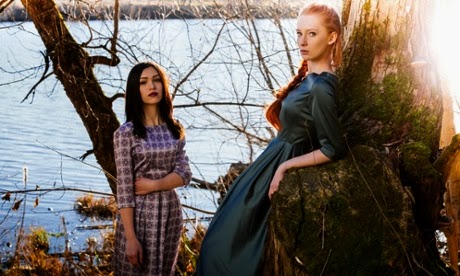
I'm told it's called 'modern modesty'
Well, well, well. So one former spy hasn’t faded yet. She's gone from fashioning networks to storming the world of fashion. 

Can’t see it catching on in the shadow lands inhabited by James Bond, though. To say nothing of Smiley’s. Not sure that ‘modern modesty’ was quite their style.