The more things change, the French say, the more they stay the same.
We should salute the courage of the Japanese people who have just voted, massively it appears, to break with a consensus that has kept a single party, the Liberal Democrat Party or LDP, constantly in in office since 1955 with only a single eight-month interlude in 1993-1994.
While we’re in the business of saluting them, we ought also to acknowledge the extraordinary patience they showed in sticking with the LDP for so long, through thick and thin, mostly thin since the 1990s. It’s a tribute to the forbearance of the Japanese that they held back from delivering the LPD a bloody nose until yesterday.
That’s when it all changed. Official results aren’t in yet, but it looks like the new Democratic Party of Japan or DPJ is going to emerge with over 300 out of 480 parliamentary seats while the LDP will be reduced to little over 100. This is pretty much the reverse of the position of the two parties before the election.
So it sounds like a breath of fresh air. The people have spoken. Perhaps the new Prime Minister will speak for the people.
At least, that’s how things feel until you look at the detail. Just who is Yukio Hatoyama, the Prime Minister elect?
Well, through his father’s side of the family, he’s the great grandson of a former Speaker of the Diet (Parliament), the grandson of a former Prime Minister and founder of the LDP, and the son of a former Foreign Minister. Nor did his mother lack significance: her family founded the Bridgestone tyre company.
There’s an even more amusing aspect to all this. Yesterday’s Prime Minister, Taro Aso, has resigned as leader of the LDP, recognising his responsibility for the crushing defeat. A well-placed candidate to take over from Aso is Kunio Hatoyama, who is – wait for it - Yukio’s younger brother. The two of them worked together to set up the DPJ but then fell out, at which point Kunio went back to the LDP and eventually made it into government. As things now stand, the two brothers may find themselves as respective leaders of the government and the opposition. Aren’t family values wonderful?
On the other hand, it’s hard to believe that our worthy Yukio Hatoyama has the ideal background to be a new broom or a voice for the people. As hard as it is to believe the same thing of David Cameron, leader of the British Conservative Party, who of course claims he will be those very things. As hard as it is to believe that a camel can be persuaded to pass through the eye of a needle, I suppose. But then David Cameron is so self-sufficient, he might just be able to oil the camel for the job. Who knows whether Hatoyama may not be just as unctuous.
Anyway, let’s offer at least qualified congratulations to the Japanese. They’ve made a change. It’s going to be interesting to see whether it turns out to be just more of the same.
Monday, 31 August 2009

Friday, 28 August 2009
Second-best place
In John le Carré’s Little Drummer Girl, there’s a moment when Joseph tells Charlie ‘after dinner, as your personal Mephistopholes, I shall take you up a high hill and show you the second-best place in the world. You agree? A mystery tour.’
‘I want the best,’ she said, drinking her Scotch.
‘And I never award first prizes,’ he replied placidly.
Of course not. A first prize can’t be surpassed. And when you’ve reached the pinnacle, why would you go on looking?
A place I’ve visited frequently in recent months is at the top of only a relatively small hill. And all it does from there is run down in a gentle valley. The top is open ground with heather bushes, but it soon runs into woodland, and at the bottom there are stands of silver birches.
‘I want the best,’ she said, drinking her Scotch.
‘And I never award first prizes,’ he replied placidly.
Of course not. A first prize can’t be surpassed. And when you’ve reached the pinnacle, why would you go on looking?
A place I’ve visited frequently in recent months is at the top of only a relatively small hill. And all it does from there is run down in a gentle valley. The top is open ground with heather bushes, but it soon runs into woodland, and at the bottom there are stands of silver birches.

Heather in the foreground, the valley sloping down into the distance
Pretty, you may feel, but not special. Hardly a second prize.
But the place has a couple of qualities that make it magical. The best is the calm. Early in the morning or during the week, almost no-one goes there, and the valley sides are just high enough to shut out noise: it’s one of the few places where you can get away from the sound of traffic, and that’s particularly rare in England. If you’re lucky and there are no planes overhead, all you’ll hear is a little birdsong and the sounds of insects, and even that seems muted.
Of course, my ears have been around nearly six decades, and that may help soften the sound, but I think even people with more acute hearing would find the place restful.
Another charm is that it’s a heat trap. It’s just deep enough and sheltered from the wind, so even if it’s fresh on the tops, in the valley it’s warm. Somehow, the place is also something of a light trap: if there’s any sunshine, it fills with it and everything glistens.
So a few minutes there can give you a sense of peace hard to achieve anywhere else.
The place is on Cannock Chase, the stretch of open country near our home in Stafford. The valley itself is called Cherry Tree Slade, a name that appeals to me greatly. The first part has a gentle irony, today at least, as I’ve not seen a cherry tree anywhere nearby. As for the word ‘slade’, that comes from an old English term for valley, which conjures up the roots of England lost in a mystic and, given our weather, no doubt misty past.
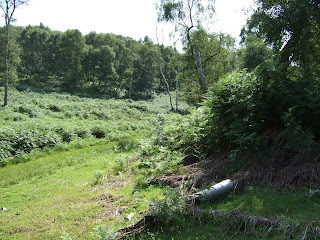 In the heart of Cherry Tree Slade
Le Carré was talking about the Acropolis. I can’t pretend that the view down Cherry Tree Slade can rival the one from the Parthenon for drama (though I suppose smoke may have spoiled many Athenian views recently). It does however have another quality that gives it a different but precious value: it can act as a balm for tiredness or stress.
That makes it worth a second-best place designation in my book.

Birches at the bottom of the Slade
Wednesday, 26 August 2009
Ashes, no sackcloth
A female colleague of mine once said to me that the difference between men and women is that ‘men think sport matters’.
It’s certainly true, and I make the admission with some shame, that I do tend to get a bit wrapped up in the fortunes, or more commonly the misfortunes, of England teams in international sport. Well, I’m not that fascinated by the silly game with the round ball which involves twenty men running up and down a field, with little pattern or sophistication, trying to get the ball past a goal keeper at one end or the other. Even there, though, I suspect I would be delighted by an England triumph, but since that hasn’t happened since I was thirteen – the 1966 World Cup – I really don’t have much way of knowing what it would be like.
Also let’s be clear that outside athletics and the other Olympic events, it’s England that interests me, not Great Britain. There may be people who identify with Britain, but to me it’s an amorphous structure artificially imposed on the real units with which we actually identify: England, Wales, Scotland or Ireland (OK, OK, Northern Ireland: I know that citizens of the Irish Republic like to make a big deal out of their technical independence from the rest of us).
This means that while I may gently tease people from the north of England (a Northumbrian is just a Scotsman with the generosity beaten out of him, for instance), I still feel that Northerners belong in some real sense to the same tribe as I do – these are brothers not merely cousins. Scots on the other hand are another nation and therefore deserve more deference from me (which doesn’t stop me teasing them a little too: know the one about the Scotsman who found a lost pay packet in a phone box, stuffed with cash and the accompanying pay slip? He burst into tears when he realised how much tax he’d paid).
The consequence is that while I’m moderately pleased when the Scotsman Andy Murray does well in that rather dull game with the rackets (just how often can you watch a serve – a return – a volley without eventually going outside to watch the grass grow instead?) I don’t feel the same visceral pleasure as when the England rugby team trounces the French (a splendidly frequent occurrence in recent years) or an England cricket team beats the Aussies (which happens far too seldom, making each occasion particularly joyful).
As it happens, England has just achieved a remarkable victory over Australia, and in the greatest competition between the nations, the battle for the Ashes. I know that some of my select band of readers have the misfortune to live in one of those benighted nations where cricket is not played, so for their benefit, here is a brief summary of the workings of an ‘Ashes series’ – the oldest sporting competition in the world.
The first time Australia beat England at cricket, back in 1882, an English newspaper announced the death of English cricket and declared that ‘the body will be cremated and the ashes taken to Australia’. Ever since, with brief breaks for tedious external unpleasantness like a couple of world wars, England and Australia have played each other for the Ashes every two years (strictly speaking, there are two and a half years between a contest in England and the next in Australia, and eighteen months between a series in Australia and the next in England. This is because cricket is a summer game and we were injudicious enough to set up Australia in the Antipodes where, against all sense or reason, they have their summer in the winter months).
You have to imagine my teeth firmly gritted and the great difficulty I have in writing these next words. Overall, the Australians have outperformed the English, taking 31 series against England’s 29. Those relatively close figures mask the fact that over the last fifty years, Australia have won just under twice as often as England.
The Ashes are won or lost in a series of five matches, and each of those matches is played to the noblest and most demanding format of cricket: over five days. Many have derided a game that can last five days and still end in a draw. Two of the recent matches did just that. One of them was actually particularly good: England’s last and weakest two batsmen (batters if you’re Australian or a follower of that offshoot game, baseball) hung on at the end of the final day, resisting everything the Australians could throw at them, to rescue an unlikely draw from what had looked up to then like a clear and crushing Australian victory.
That draw gave England the opportunity to win the series and take back the Ashes. England won in 2005, the last time they were played for at home, but when they got down to Australia in 2006-2007, they were systematically taken apart – beaten five-nil. Not so much a defeat as a crushing, contemptuous extermination. So this time round, with two draws and a victory apiece, the last match was the opportunity for England to regain the Ashes and perhaps restore a little credibility. Few of us England supporters felt confident, however: we knew just how good England was at snatching defeat from the jaws of victory.
Well, this time it didn’t happen, and it was Australia that fell apart instead. A solid but not overwhelming victory: as the England captain, Andrew Strauss, the well-deserved man of the match and indeed of the series, put it, ‘when we were bad, we were very bad, and when we were good, we managed to be just good enough.’ Yes. And he might have added this was not one of the great Australian sides of the past. A mid-strength England beat a slightly under mid-strength Australia. But who cares? A victory’s a victory, and in sport it isn’t taking part that matters, it’s winning.
And to some of us, it matters a great deal.
It’s certainly true, and I make the admission with some shame, that I do tend to get a bit wrapped up in the fortunes, or more commonly the misfortunes, of England teams in international sport. Well, I’m not that fascinated by the silly game with the round ball which involves twenty men running up and down a field, with little pattern or sophistication, trying to get the ball past a goal keeper at one end or the other. Even there, though, I suspect I would be delighted by an England triumph, but since that hasn’t happened since I was thirteen – the 1966 World Cup – I really don’t have much way of knowing what it would be like.
Also let’s be clear that outside athletics and the other Olympic events, it’s England that interests me, not Great Britain. There may be people who identify with Britain, but to me it’s an amorphous structure artificially imposed on the real units with which we actually identify: England, Wales, Scotland or Ireland (OK, OK, Northern Ireland: I know that citizens of the Irish Republic like to make a big deal out of their technical independence from the rest of us).
This means that while I may gently tease people from the north of England (a Northumbrian is just a Scotsman with the generosity beaten out of him, for instance), I still feel that Northerners belong in some real sense to the same tribe as I do – these are brothers not merely cousins. Scots on the other hand are another nation and therefore deserve more deference from me (which doesn’t stop me teasing them a little too: know the one about the Scotsman who found a lost pay packet in a phone box, stuffed with cash and the accompanying pay slip? He burst into tears when he realised how much tax he’d paid).
The consequence is that while I’m moderately pleased when the Scotsman Andy Murray does well in that rather dull game with the rackets (just how often can you watch a serve – a return – a volley without eventually going outside to watch the grass grow instead?) I don’t feel the same visceral pleasure as when the England rugby team trounces the French (a splendidly frequent occurrence in recent years) or an England cricket team beats the Aussies (which happens far too seldom, making each occasion particularly joyful).
As it happens, England has just achieved a remarkable victory over Australia, and in the greatest competition between the nations, the battle for the Ashes. I know that some of my select band of readers have the misfortune to live in one of those benighted nations where cricket is not played, so for their benefit, here is a brief summary of the workings of an ‘Ashes series’ – the oldest sporting competition in the world.
The first time Australia beat England at cricket, back in 1882, an English newspaper announced the death of English cricket and declared that ‘the body will be cremated and the ashes taken to Australia’. Ever since, with brief breaks for tedious external unpleasantness like a couple of world wars, England and Australia have played each other for the Ashes every two years (strictly speaking, there are two and a half years between a contest in England and the next in Australia, and eighteen months between a series in Australia and the next in England. This is because cricket is a summer game and we were injudicious enough to set up Australia in the Antipodes where, against all sense or reason, they have their summer in the winter months).
You have to imagine my teeth firmly gritted and the great difficulty I have in writing these next words. Overall, the Australians have outperformed the English, taking 31 series against England’s 29. Those relatively close figures mask the fact that over the last fifty years, Australia have won just under twice as often as England.
The Ashes are won or lost in a series of five matches, and each of those matches is played to the noblest and most demanding format of cricket: over five days. Many have derided a game that can last five days and still end in a draw. Two of the recent matches did just that. One of them was actually particularly good: England’s last and weakest two batsmen (batters if you’re Australian or a follower of that offshoot game, baseball) hung on at the end of the final day, resisting everything the Australians could throw at them, to rescue an unlikely draw from what had looked up to then like a clear and crushing Australian victory.
That draw gave England the opportunity to win the series and take back the Ashes. England won in 2005, the last time they were played for at home, but when they got down to Australia in 2006-2007, they were systematically taken apart – beaten five-nil. Not so much a defeat as a crushing, contemptuous extermination. So this time round, with two draws and a victory apiece, the last match was the opportunity for England to regain the Ashes and perhaps restore a little credibility. Few of us England supporters felt confident, however: we knew just how good England was at snatching defeat from the jaws of victory.
Well, this time it didn’t happen, and it was Australia that fell apart instead. A solid but not overwhelming victory: as the England captain, Andrew Strauss, the well-deserved man of the match and indeed of the series, put it, ‘when we were bad, we were very bad, and when we were good, we managed to be just good enough.’ Yes. And he might have added this was not one of the great Australian sides of the past. A mid-strength England beat a slightly under mid-strength Australia. But who cares? A victory’s a victory, and in sport it isn’t taking part that matters, it’s winning.
And to some of us, it matters a great deal.
Saturday, 22 August 2009
US Healthcare: a master class in black propaganda
It’s been fascinating to watch the great US healthcare debate from this side of the Atlantic. The exciting bit for us in England is when the opponents of reform decide to attack Barack Obama's proposed reforms by trashing the NHS. They point to refusal of treatment to NHS patients, on the grounds of their age or their general health status. That kind of thing has certainly happened, and there’s been plenty of noise about it in England too. The loudest scandals have tended to be about the so-called ‘postcode lotteries’ which lead to people in some areas being refused treatments that are available in others. Sometimes however the cases have been hard to criticise: there are far too few livers available for transplant, far too many people waiting for one; does it really make sense to put one into a patient who seems incapable of breaking with his alcoholism?
But justified or not, there have certainly been many instances of refused treatment in the NHS. What makes the whole debate ironic, however, is that US critics of such incidents seem to ignore the status of US healthcare as the past master of treatment refusal, whether because you have no insurance or, even worse, because your insurance company finds some devious way to claim that your policy doesn’t cover the particular treatment you need.
This is a perfect illustration of the fact that a propaganda campaign doesn’t have to be true to be effective. This campaign has already achieved a first success: Obama has dropped his intention to give the Federal government responsibility for the reformed healthcare system. However remote its connection with the truth, the campaign has won popular support sufficiently widespread to become difficult to resist.
In England, ministers and health professionals have been queuing up to defend the NHS against the attacks from the States. They’ve been pointing out that the English healthcare system costs little over half as much as the American, but life expectancy in England is 78 years against 77 in the US, and the under 5 mortality rate in England is 6 per 1000 while in the US it’s 9 per 1000. But I'm far from convinced that they're making the right points strongly enough. As someone who’s spent 25 years around (though never in) healthcare, mostly with the NHS, I feel strongly about this subject. So here’s my view, for what it’s worth.
Incidentally, I love the expression ‘for what it’s worth’ applied to an opinion. ‘In my humble opinion’ is much too obviously false humility. ‘For what it’s worth’ sounds self-deprecating, though fundamentally it’s just as arrogant: after all, if you don’t think your opinion’s worth mentioning, you don’t mention it.
But let's get back to the main subject.
It’s true that English expenditure on healthcare is about 8.3% of Gross Domestic Product compared to 16% in the US. So US healthcare is certainly a great deal more expensive. Wouldn’t it be interesting to find a measure of what they’re getting for their money?
Comparing life expectancy strikes me as perfectly useless as a way of measuring healthcare effectiveness. The figures for the two countries are pretty much the same but, in any case, many other factors than healthcare influence life expectancy. A major factor has to be diet, which is more to do with health ing eneral than with healthcare.
The infant and child mortality rate doesn’t feel any more useful to me. It’s true that infant mortality (neonates and up to one year of age) has been falling much more slowly in the US than in other advanced economies and the problem needs to be addressed. However, I again feel it’s influenced by many more factors than just the effectiveness of the healthcare system.
So is there no measure of what the Americans are getting for all those extra bucks they’re spending?
Well, I came across a recent study which I think makes some pretty effective points. In Measuring the health of nations: updating an earlier analysis, Ellen Nolte and Martin McKee compare preventable deaths in nineteen nations in 2002-2003 with the figures from a previous study of 1997-1998. Preventable deaths are those that could have been avoided by providing suitable treatment. In the five years between the two studies, the US fell from sixteenth out of nineteenth to – nineteenth. Last. As with infant mortality, the US is improving its performance, but much more slowly than other advanced nations. For example, the UK with its maligned NHS went from 130 avoidable deaths per 100,000 to 103, whereas the US went from 115 to 110.
Now that really is a telling measure. Look at it another way: if the US could perform as well as the average of the nineteen countries, it could save 75,000 lives a year; if it could get up to the level of the three best, it could save over 100,000 lives a year.
9/11 cost just over 3000 lives and it reverberates with us today. But failure to treat the sick is causing 30 times more deaths than 9/11. Again and again. Year after year.
The US delivers what is often the best healthcare in the world. But it has the most expensive healthcare system. And that system is in effect killing the equivalent of a medium-sized town each year.
It may seem suprising that its defenders prefer to concentrate on the problems of the NHS. Though when you think of how propaganda works, it's not really that surprising.
For a summary of the study, see:
http://www.commonwealthfund.org/~/media/Files/Publications/In%20the%20Literature/2008/Jan/Measuring%20the%20Health%20of%20Nations%20%20Updating%20an%20Earlier%20Analysis/1090_Nolte_measuring_hlt_of_nations_HA_01%202008_ITL%20web%20%20pdf.pdf
But justified or not, there have certainly been many instances of refused treatment in the NHS. What makes the whole debate ironic, however, is that US critics of such incidents seem to ignore the status of US healthcare as the past master of treatment refusal, whether because you have no insurance or, even worse, because your insurance company finds some devious way to claim that your policy doesn’t cover the particular treatment you need.
This is a perfect illustration of the fact that a propaganda campaign doesn’t have to be true to be effective. This campaign has already achieved a first success: Obama has dropped his intention to give the Federal government responsibility for the reformed healthcare system. However remote its connection with the truth, the campaign has won popular support sufficiently widespread to become difficult to resist.
In England, ministers and health professionals have been queuing up to defend the NHS against the attacks from the States. They’ve been pointing out that the English healthcare system costs little over half as much as the American, but life expectancy in England is 78 years against 77 in the US, and the under 5 mortality rate in England is 6 per 1000 while in the US it’s 9 per 1000. But I'm far from convinced that they're making the right points strongly enough. As someone who’s spent 25 years around (though never in) healthcare, mostly with the NHS, I feel strongly about this subject. So here’s my view, for what it’s worth.
Incidentally, I love the expression ‘for what it’s worth’ applied to an opinion. ‘In my humble opinion’ is much too obviously false humility. ‘For what it’s worth’ sounds self-deprecating, though fundamentally it’s just as arrogant: after all, if you don’t think your opinion’s worth mentioning, you don’t mention it.
But let's get back to the main subject.
It’s true that English expenditure on healthcare is about 8.3% of Gross Domestic Product compared to 16% in the US. So US healthcare is certainly a great deal more expensive. Wouldn’t it be interesting to find a measure of what they’re getting for their money?
Comparing life expectancy strikes me as perfectly useless as a way of measuring healthcare effectiveness. The figures for the two countries are pretty much the same but, in any case, many other factors than healthcare influence life expectancy. A major factor has to be diet, which is more to do with health ing eneral than with healthcare.
The infant and child mortality rate doesn’t feel any more useful to me. It’s true that infant mortality (neonates and up to one year of age) has been falling much more slowly in the US than in other advanced economies and the problem needs to be addressed. However, I again feel it’s influenced by many more factors than just the effectiveness of the healthcare system.
So is there no measure of what the Americans are getting for all those extra bucks they’re spending?
Well, I came across a recent study which I think makes some pretty effective points. In Measuring the health of nations: updating an earlier analysis, Ellen Nolte and Martin McKee compare preventable deaths in nineteen nations in 2002-2003 with the figures from a previous study of 1997-1998. Preventable deaths are those that could have been avoided by providing suitable treatment. In the five years between the two studies, the US fell from sixteenth out of nineteenth to – nineteenth. Last. As with infant mortality, the US is improving its performance, but much more slowly than other advanced nations. For example, the UK with its maligned NHS went from 130 avoidable deaths per 100,000 to 103, whereas the US went from 115 to 110.
Now that really is a telling measure. Look at it another way: if the US could perform as well as the average of the nineteen countries, it could save 75,000 lives a year; if it could get up to the level of the three best, it could save over 100,000 lives a year.
9/11 cost just over 3000 lives and it reverberates with us today. But failure to treat the sick is causing 30 times more deaths than 9/11. Again and again. Year after year.
The US delivers what is often the best healthcare in the world. But it has the most expensive healthcare system. And that system is in effect killing the equivalent of a medium-sized town each year.
It may seem suprising that its defenders prefer to concentrate on the problems of the NHS. Though when you think of how propaganda works, it's not really that surprising.
For a summary of the study, see:
http://www.commonwealthfund.org/~/media/Files/Publications/In%20the%20Literature/2008/Jan/Measuring%20the%20Health%20of%20Nations%20%20Updating%20an%20Earlier%20Analysis/1090_Nolte_measuring_hlt_of_nations_HA_01%202008_ITL%20web%20%20pdf.pdf
Wednesday, 19 August 2009
Tempus edax rerum
Time is the devourer of things. Though sometimes it just nibbles, while at others it takes big bites.
Janka, our dog, enjoys nothing more than running for a ball. Not even eating. We never gave her a chance to find out about sex, but I think she would still have preferred the ball. So if we don’t take a ball out with her, she’ll find one, and if she can’t find one, she’ll bring a stick for us to throw instead.
Danielle’s been warning me for some time that Janka’s beginning to get on a bit in age. I was sceptical – after all, Janka’s not eight yet, and these dogs have a life expectancy of fourteen to sixteen. Besides she was dashing about all over the place, and would outrun me whenever we went out together. Old? I kept wishing I was that fit.
But this is a subject Danielle knows more about than I do. A couple of months ago Janka’s back legs started to go. She in the early stages of arthritis or dysplasia, and it’s sad to see the effect. One of her worst character traits – deliberately trained into her by my sons, with my tacit connivance because I found it hilarious – was her habit of barking and jumping up all over us when she saw us again after a long absence (e.g. an hour). Today – she can’t do it. The legs won’t take the strain. It’s a high price for a small improvement in behaviour.
Janka, our dog, enjoys nothing more than running for a ball. Not even eating. We never gave her a chance to find out about sex, but I think she would still have preferred the ball. So if we don’t take a ball out with her, she’ll find one, and if she can’t find one, she’ll bring a stick for us to throw instead.
Danielle’s been warning me for some time that Janka’s beginning to get on a bit in age. I was sceptical – after all, Janka’s not eight yet, and these dogs have a life expectancy of fourteen to sixteen. Besides she was dashing about all over the place, and would outrun me whenever we went out together. Old? I kept wishing I was that fit.
But this is a subject Danielle knows more about than I do. A couple of months ago Janka’s back legs started to go. She in the early stages of arthritis or dysplasia, and it’s sad to see the effect. One of her worst character traits – deliberately trained into her by my sons, with my tacit connivance because I found it hilarious – was her habit of barking and jumping up all over us when she saw us again after a long absence (e.g. an hour). Today – she can’t do it. The legs won’t take the strain. It’s a high price for a small improvement in behaviour.

Smelling the heather on Cannock Chase: a pleasure more sedate, suitable for a lady no longer in her prime
And the saddest thing of all?
She still brings us balls or sticks to throw; she’s clearly as passionate as ever about chasing them. But the last time we indulged her, she was out of action for a couple of hours after her return home – stretched out on her rug, stiff and in pain. So now it has to be ‘no’, at least until the anti-inflammatory treatment does its stuff, and even then it’s going to be a lot more sparing.
We’ve watched her go from an energetic young girl to an elderly lady with her infirmities in the space of a few weeks.
And doesn’t something like that happen to us all? We age in spurts – only a little, year after year, and then all of a sudden a big decline in a few months. I can’t make up my mind whether it’s a curse or a mercy: on the one hand, we maintain a certain strength, a certain fitness for as long as possible by having our deterioration come suddenly; on the other, the abrupt drop is a shock and a sorrow.
But regular or irregular, it comes on ineluctably, as sure as it may be slow. Time is the devourer of things. Ovid certainly got that bit right.

More pleasures for the elderly: at least she can still paddle when it gets warm
Postscript on the same theme: my fellow blogger Bob Patterson has a great picture making the point that time slips by – more tempus fugit, perhaps, than tempus edax rerum, but the two are related – at http://anotherdayat.blogspot.com/2009/08/reading-t.html.
Monday, 17 August 2009
Semi-evolved or poorly designed?
Many people believe that man is the peak of evolution, or creation, depending on their point of view. But it seems to me that actually the species is only partly developed, neither quite one thing nor another, but somewhere between the two. Take walking upright, for instance. We can’t really walk on all fours any more, but we haven’t completely mastered walking about on two legs, which is why there’s so much lower back pain around. We seem to be in transition, basically a work in progress.
Now that’s fine if you accept evolution. A creationist, however, would have to believe that this halfway house is the result of design. Don’t get me wrong: I fully accept that you can argue that there is evidence for design out there: the eye, for instance, seems to have been designed for seeing. It’s just that, as I’ve suggested before*, I’m not sure you can call the design ‘intelligent’.
All this was brought home to me again recently when I learned about the concept of a ‘cytokine storm’.
Cytokines are molecules in the body which alert our immune cells – T-cells and macrophages – to the presence of infection and guide them to its source. They also stimulate those cells to produce more cytokines. It’s obviously a powerful mechanism, but a dangerous one because it’s based on a positive feedback loop: the more cytokines there are, the more get produced.
We’ve all experienced positive feedback. It can happen in electronic music when the mike picks up sound from the speakers, feeds it back through the amplifier, and back out of the speakers, louder still, setting the cycle off again. Quickly we find ourselves deafened by a high-pitched wail till someone has the presence of mind to break the loop or cut off the power.
The body generally controls the cytokine feedback loop with specific inhibitors. But from time to time the process gets out of control leading to the explosion known as a cytokine storm. It’s particularly likely to happen when the immune system is dealing with an unusually virulent infection. In those circumstances, a paradoxical situation arises: those with the strongest immune systems, the fittest people, have the worst reaction. A strong immune system out of control is more dangerous than a weak one.
A notable example was the Spanish flu pandemic of 1918-1920 which led to between 50 million and 100 million deaths worldwide. The infection killed not just the young and old, as you’d expect in any flu epidemic, but also a high proportion of 20 to 34 year olds. Because it triggered a cytokine storm, the strongest were often the most vulnerable: young women in particular, and many soldiers thinking they’d got safely home from the killing fields of the Great War, were struck down as their powerful immune systems filled their lungs with macrophages and their lives were literally choked out of them.
The immune system on which they depended and which generally works so well, turned against them, killing those it should have protected. An ugly paradox. And if you’re looking for design, this one certainly seems flawed, wouldn’t you say?
Strangely enough it’s a flaw I know well from my own work, in software development. I work with astonishingly bright people, who come up with complex designs to make sure software calculates its results exactly right. Sometimes this involves combining many different sources of data to build new material for further cycles of processing. Often we only have small sample sets for testing, and that may hide problems that will arise when volumes become big. A full-scale environment may lead to the equivalent of a cytokine storm, with data generating data until memory overflows, disks fill and the system crashes.
Inadequate data is only one explanation of problems with testing. Another may be incomplete documentation, as brilliant designers aren’t always the best documenters. The specification may not be good enough, and that makes QA’s task all the more difficult: testers have to try to work out why a system isn’t functioning properly without full and unambiguous information about what it should be doing in the first place.
All these are problems of design.
Now what are things like in human development?
The lower back pain problem I mentioned before does sound like a bit of a bug, doesn’t it?
And then look at the documentation. The great religious works of the world, not least the Bible, are shot through with ambiguities, gaps, sometimes downright contradictions. How can you build a proper test programme against them?
And that leads to the cytokine storm. Full scale testing would have revealed the problem. But it never happened, did it, and with incomplete documentation, how could QA have done better?
By all means believe in design rather than evolution. But it needs to be a lot more rigorous, and contain a lot fewer flaws, before you can call it intelligent.
P.S. Me and that flu epidemic. My grandmother was engaged to a soldier who made it through the trenches of the First World War, only to be struck down by the flu when he got home. She was distraught and within eighteen months had married another man on the rebound. My grandfather.
Without that flu death I would never have been born. To what curious chances we owe our existences.
* On intelligent and unintelligent design, see: http://davidbeesonrandomviews.blogspot.com/2009/01/intelligent-design-might-there-be.html
Now that’s fine if you accept evolution. A creationist, however, would have to believe that this halfway house is the result of design. Don’t get me wrong: I fully accept that you can argue that there is evidence for design out there: the eye, for instance, seems to have been designed for seeing. It’s just that, as I’ve suggested before*, I’m not sure you can call the design ‘intelligent’.
All this was brought home to me again recently when I learned about the concept of a ‘cytokine storm’.
Cytokines are molecules in the body which alert our immune cells – T-cells and macrophages – to the presence of infection and guide them to its source. They also stimulate those cells to produce more cytokines. It’s obviously a powerful mechanism, but a dangerous one because it’s based on a positive feedback loop: the more cytokines there are, the more get produced.
We’ve all experienced positive feedback. It can happen in electronic music when the mike picks up sound from the speakers, feeds it back through the amplifier, and back out of the speakers, louder still, setting the cycle off again. Quickly we find ourselves deafened by a high-pitched wail till someone has the presence of mind to break the loop or cut off the power.
The body generally controls the cytokine feedback loop with specific inhibitors. But from time to time the process gets out of control leading to the explosion known as a cytokine storm. It’s particularly likely to happen when the immune system is dealing with an unusually virulent infection. In those circumstances, a paradoxical situation arises: those with the strongest immune systems, the fittest people, have the worst reaction. A strong immune system out of control is more dangerous than a weak one.
A notable example was the Spanish flu pandemic of 1918-1920 which led to between 50 million and 100 million deaths worldwide. The infection killed not just the young and old, as you’d expect in any flu epidemic, but also a high proportion of 20 to 34 year olds. Because it triggered a cytokine storm, the strongest were often the most vulnerable: young women in particular, and many soldiers thinking they’d got safely home from the killing fields of the Great War, were struck down as their powerful immune systems filled their lungs with macrophages and their lives were literally choked out of them.
The immune system on which they depended and which generally works so well, turned against them, killing those it should have protected. An ugly paradox. And if you’re looking for design, this one certainly seems flawed, wouldn’t you say?
Strangely enough it’s a flaw I know well from my own work, in software development. I work with astonishingly bright people, who come up with complex designs to make sure software calculates its results exactly right. Sometimes this involves combining many different sources of data to build new material for further cycles of processing. Often we only have small sample sets for testing, and that may hide problems that will arise when volumes become big. A full-scale environment may lead to the equivalent of a cytokine storm, with data generating data until memory overflows, disks fill and the system crashes.
Inadequate data is only one explanation of problems with testing. Another may be incomplete documentation, as brilliant designers aren’t always the best documenters. The specification may not be good enough, and that makes QA’s task all the more difficult: testers have to try to work out why a system isn’t functioning properly without full and unambiguous information about what it should be doing in the first place.
All these are problems of design.
Now what are things like in human development?
The lower back pain problem I mentioned before does sound like a bit of a bug, doesn’t it?
And then look at the documentation. The great religious works of the world, not least the Bible, are shot through with ambiguities, gaps, sometimes downright contradictions. How can you build a proper test programme against them?
And that leads to the cytokine storm. Full scale testing would have revealed the problem. But it never happened, did it, and with incomplete documentation, how could QA have done better?
By all means believe in design rather than evolution. But it needs to be a lot more rigorous, and contain a lot fewer flaws, before you can call it intelligent.
P.S. Me and that flu epidemic. My grandmother was engaged to a soldier who made it through the trenches of the First World War, only to be struck down by the flu when he got home. She was distraught and within eighteen months had married another man on the rebound. My grandfather.
Without that flu death I would never have been born. To what curious chances we owe our existences.
* On intelligent and unintelligent design, see: http://davidbeesonrandomviews.blogspot.com/2009/01/intelligent-design-might-there-be.html
Friday, 14 August 2009
Overvalued wisdom
It sometimes seems to me that we’re surrounded by all sorts of sources of homespun philosophy aimed at teaching us a little wisdom. Sometimes a very little.
Nowhere is this more common than in Hollywood films. Usually the character is seen in close up and he makes some statement including the words ‘you know’ and ‘son’. I remember John Wayne in an otherwise totally unmemorable film decades ago saying ‘You know, son, your mother and I didn’t love each other when we got married. We liked each other. The love came later.’ Yeah, right. Liking is the basis for a successful marriage. Love plays no role in selecting a life partner, any more than factors such as lust and sex, which are so insignificant in life generally.
Much more recently, I remember our former and profoundly unlamented Prime Minister Tony Blair staring straight into camera and saying to us all, ‘I think I’m a pretty straight sort of guy.’ To me that just confirmed what I’ve long believed, my own piece of homespun wisdom: if you’re with anyone who feels the need to tell you how honest he is, check that your wallet is safe.
Recently I got to thinking about a piece of advice you tend to hear quite a lot, ‘live each day as though it were your last’. It sounds brilliant, doesn’t it? It seems to be saying ‘grasp the moment, live life to the fullest, don’t wait till tomorrow.’ Just the kind of intense and bold living that seems attractive to most of us.
But would it really be like that? If you actually knew that today was going to be your last?
The Roman novelist Petronius, when he learned that he had to choose between committing suicide or facing a much less pleasant death under Nero’s gentle direction, had his veins opened and sown up again. He then called his friends together for a party with music, fine food and entertaining conversation, in the course of which he drew up a new will including a full list of all Nero’s crimes and debaucheries. He then reopened his veins and died in an atmosphere of peace, surrounded by people who mattered to him and enjoying the prospect of Nero’s fury on reading the will.
I’d love to think I’d go that way too, perhaps taking out a large loan from a particularly loathsome bank (and picking just one wouldn't be easy) so that I could spend the money on a historic party in a glorious location. But I have a horrible suspicion that I would actually devote several hours to trying to track down my will, realising that it needs updating, finding a solicitor and preparing a new one. I’d then spend several hours phoning my immediate family, leaving urgent messages on their voicemail, phoning them back while they’re phoning me, getting the message that they won’t be available till later, and getting increasingly frustrated as the day wore on. I’d be phoning and e-mailing friends, constantly remembering someone else who I'd absolutely have to get hold of before the end. I’d still be desperately trying to finish things as midnight sounded and the axe fell.
And that’s the best case scenario. If you were really facing your last day, the chances are you’d either be doped up to your eyeballs in a hospital bed or sat in a prison cell sobbing your guts out.
What’s attractive about any of these scenarios?
Live each day as though it were your last? Personally, I’m going to treat that advice as just another piece of overvalued homespun to ignore. And go on living as I do now, as though no last day was ever going to happen.
Which, I suspect, is the comforting state of denial in which most of us live.
Nowhere is this more common than in Hollywood films. Usually the character is seen in close up and he makes some statement including the words ‘you know’ and ‘son’. I remember John Wayne in an otherwise totally unmemorable film decades ago saying ‘You know, son, your mother and I didn’t love each other when we got married. We liked each other. The love came later.’ Yeah, right. Liking is the basis for a successful marriage. Love plays no role in selecting a life partner, any more than factors such as lust and sex, which are so insignificant in life generally.
Much more recently, I remember our former and profoundly unlamented Prime Minister Tony Blair staring straight into camera and saying to us all, ‘I think I’m a pretty straight sort of guy.’ To me that just confirmed what I’ve long believed, my own piece of homespun wisdom: if you’re with anyone who feels the need to tell you how honest he is, check that your wallet is safe.
Recently I got to thinking about a piece of advice you tend to hear quite a lot, ‘live each day as though it were your last’. It sounds brilliant, doesn’t it? It seems to be saying ‘grasp the moment, live life to the fullest, don’t wait till tomorrow.’ Just the kind of intense and bold living that seems attractive to most of us.
But would it really be like that? If you actually knew that today was going to be your last?
The Roman novelist Petronius, when he learned that he had to choose between committing suicide or facing a much less pleasant death under Nero’s gentle direction, had his veins opened and sown up again. He then called his friends together for a party with music, fine food and entertaining conversation, in the course of which he drew up a new will including a full list of all Nero’s crimes and debaucheries. He then reopened his veins and died in an atmosphere of peace, surrounded by people who mattered to him and enjoying the prospect of Nero’s fury on reading the will.
I’d love to think I’d go that way too, perhaps taking out a large loan from a particularly loathsome bank (and picking just one wouldn't be easy) so that I could spend the money on a historic party in a glorious location. But I have a horrible suspicion that I would actually devote several hours to trying to track down my will, realising that it needs updating, finding a solicitor and preparing a new one. I’d then spend several hours phoning my immediate family, leaving urgent messages on their voicemail, phoning them back while they’re phoning me, getting the message that they won’t be available till later, and getting increasingly frustrated as the day wore on. I’d be phoning and e-mailing friends, constantly remembering someone else who I'd absolutely have to get hold of before the end. I’d still be desperately trying to finish things as midnight sounded and the axe fell.
And that’s the best case scenario. If you were really facing your last day, the chances are you’d either be doped up to your eyeballs in a hospital bed or sat in a prison cell sobbing your guts out.
What’s attractive about any of these scenarios?
Live each day as though it were your last? Personally, I’m going to treat that advice as just another piece of overvalued homespun to ignore. And go on living as I do now, as though no last day was ever going to happen.
Which, I suspect, is the comforting state of denial in which most of us live.
Subscribe to:
Posts (Atom)
