A strange set of conflicting emotions seizes a parent who has lost a child. I mean ‘lost’ in the literal sense, of ‘mislaid’.
On the one hand, there is the feeling of dread that the loss may prove permanent, for which the counterpart is of course the painful hope that it will actually turn out to be temporary; on the other hand, there’s the sense of indignation, if the child indeed turns out to have been temporarily mislaid, that he or she has put you through all that suffering. Needlessly.
The worst of it is that no child is ever responsible for getting lost. It is always the fault of the parents and any other family member present. All those other people may distinctly remember saying ‘we’re going this way – here – through this door – and down that street’; the child who got lost – or rather who the others lost – knows perfectly well that they really said ‘just go that way and we’ll follow along shortly.’
The first child specialist of this kind of phenomenon in my experience was my brother Nicky. Have you ever been to Sveti Stefan? It’s one of those wonderful places like St Michael’s Mount or Mont St Michel (incidentally, those really are two different places, opposite each other across the Channel, though few people know the smaller, English version, in Cornwall). Sveti Stefan is an island off the coast of Montenegro linked to the mainland by a causeway. It has the beauty of its equivalents in the Channel, but far better weather.
My brother got separated from us in a shop on the island. The three of us are convinced to this day that we had told him we were about to leave through the main door, but it’s amazing how one can fall for a communal self-delusion of this kind: it appears we actually told him to leave by the back door, which is what he did.
A couple of hours later, by which time we had given up searching and repaired to a café on the mainland from whose terrace we could keep an eye on the causeway, with the weight mercifully off our feet, a disconsolate but clearly disgruntled figure appeared from the gate of the town and started to trudge angrily across. For a moment that is so deeply seared into my memory, I’m amazed that I can’t remember which of my parents set out towards him, but I know that when they met it was like one of those cosmic catastrophes when galaxies collide, from whose violence the observer is only shielded by distance.
Decades later, Danielle and I had our final son. Now given the history with my brother, you might feel we should have known better, but we decided to call him Nicky too. And blow me down if he didn’t take a leaf out of the book of his uncle and namesake.
One of the three best moments took place in southern Alsace, and we really can’t blame him. I was mercifully spared the pain as I was in England, but Danielle and our middle son Michael were wandering through glorious woods towards a well-known site for visitors, the Dwarves Grotto. Nicky was in a hurry and Danielle gave him permission to go ahead, as long as he faithfully followed the arrows helpfully tacked to trees and rocks along the route.
Unfortunately, unbeknown to her, the routes and their markings had all been changed. The arrows he was following no longer led to the Grotto.
There followed a several hour period of complete panic, and I’m still grateful to Danielle for not having phoned me until it was over. Fire brigade and police came out and as night fell, so did their morale as they began to switch from optimism to grave countenances and serious whispered conversations. Suddenly, however, a couple in a car emerged from a track.
‘Who are you looking for?’ they asked.
They were told.
‘We’ve just seen him!’ they said, ‘but when we tried to talk to him he ran away.’
They turned the car and drove back into the woods, where they quickly found him again near the spot where they’d seen him. Carefully sticking to the injunction not to get into a stranger’s car, he refused to get too close until they told him ‘your mother – Danielle – sent us to fetch you.’
All was well as ended well. Nicky got to climb up into the cab of a fire engine and wear a fireman’s helmet. And Danielle never really got the full urge to strangle him: the worry had been too great and he really hadn’t been to blame.
In the second event, the urge to strangle wasn’t directed at him, but at me. I lost him on a ski slope. He’d wanted to go down a red route, but we were with his cousin who was a beginner and didn’t want to chance anything tougher than a blue one. It looked as though the two would meet at the bottom, so I went down with my nephew and let Nicky take his route on his own.
The routes didn’t meet.
Back in the apartment where we were staying, the atmosphere became increasingly frosty as the night fell. The rescue services refused to act on the grounds that it was still too short a time since Nicky had disappeared. Finally I could take Danielle’s looks, with their threat of imminent divorce, any longer and as much to escape them as in the hope of finding Nicky, I left the flat and set out to walk through the village.
And there on the central square I found him. Very dutifully he had simply stood there, in increasing cold, and refusing the help of any passersby on the grounds that his ‘daddy would soon be along to collect him.’ Very sensible of him. And he was right – though it wasn’t that soon.
But the third moment was entirely of his own doing. Chronologically, it was actually the earliest of the three. He was five. It had taken us hours to find Camber Sands, in Sussex, a lovely beach on the English south coast. We finally got there, hot, irritable and longing for some relaxation.
Nicky was gone in about thirty seconds.
We spent the next two hours wandering up and down the beach asking if anyone had seen a little boy in a yellow tee shirt and red shorts. No-one had.
It turned out that this wasn’t in the least surprising. When we finally did track him down, he was stark naked. All he was wearing was an expression of hurt innocence and surprise at our fury. ‘What on earth,’ he seemed to be saying, ‘are we expected to do, when we’re five years old, and on a beach, but to get rid of our clothes and start enjoying ourselves?’
We never did find the yellow tee shirt or the red shorts.
Tuesday, 28 September 2010

Monday, 27 September 2010
Drink safer than baggage - official
A sign at Euston Station in North London announces that there were 37 baggage-related accidents last year and 17 drink-related ones.
Am I misunderstanding the way statistics work or does this mean that whenever I get tempted to travel with luggage, I'd do better to leave my bags behind and have a few drinks instead? I'd be safer?
Just curious.
Am I misunderstanding the way statistics work or does this mean that whenever I get tempted to travel with luggage, I'd do better to leave my bags behind and have a few drinks instead? I'd be safer?
Just curious.
Friday, 24 September 2010
We knew nuttin'...
I was delighted to see an advert today for NatWest Bank’s mortgage services. They proudly claim that clients will be provided with a ‘named adviser’.
Doesn’t it make you wonder how things were before? Were their advisers nameless?
That might have been appropriate. The Financial Crash showed conclusively that the banks had little idea what their people were doing.
Seems perfectly believable that they didn’t even know who they were.
Doesn’t it make you wonder how things were before? Were their advisers nameless?
That might have been appropriate. The Financial Crash showed conclusively that the banks had little idea what their people were doing.
Seems perfectly believable that they didn’t even know who they were.
Wednesday, 22 September 2010
Curious contrasts
Two articles in the press on successive days make great reading and a fascinating contrast.
Yesterday it was the story of the imminent departure of Eric Daniels from the position of Chief Executive of Lloyds Bank, the group which was only rescued from the bankruptcy to which he led it during the recent financial crisis, by a £20 billion bale out by taxpayers.
Today, I read about the funeral service for Eileen ‘Didi’ Nearne. During the war, she was one of the agents Special Operations Executive ran behind enemy lines. Serving in France, she was captured by the Gestapo, tortured by being beaten and having her head held under water (there’s nothing new under the sun, is there, what with water boarding being all the rage today), escaped from Ravensbrück concentration camp, was captured again by the SS, talked her way out again, and was finally hidden by a priest till released by US forces.
From time to time I wonder what I would have done had I been faced, like my father and grandfather, with having to take part in war. My father was an airman who flew single plane missions, for instance dropping supplies to resistance groups in France. He often told me about the sheer loneliness of being up there, the only plane around, in the cold and dark of the night sky, with well-armed enemies below. Would my courage have been up to doing as much? I’d like to think so, but I was never put to the test.
Not that I regret it.
In one respect at least an airman was fortunate. Once he was back from a mission, he was home, surrounded by his friends, in relative safety. He could go to sleep with every expectation of making it through to the morning. Eileen Nearne couldn’t. She worked as a wireless operator from March 1944, and every time she got her equipment running, she must have wondered whether this would be the time the German radio detection service would get her location before she’d finished transmitting, and the Gestapo would come crashing through her door to capture her. That happened in July. She’d only lasted four months, and then the torture started.
Would I have had the guts to do what my father did? I don’t know. Would I have had the guts to do what Eileen Nearne did? Out of the question. I can’t imagine coping with that level of terror.
Could I have coped with the pressure Eric Daniels was under? Without wanting to be boastful, I think I have both the moral and the physical strength to make a complete mess of one our great financial institutions, just as flamboyantly as he did. Paid enough, I could probably develop the gall to go and ask the taxpayer to stump up a fortune to make up for my shortcomings. I could probably find it in me to argue that I’m justified in taking a colossal salary on the grounds that I was taking responsibility for the corporation, where ‘taking responsibility’ means cocking up and asking other people to stump up for me.
Eileen Nearne died penniless and alone.
Eric Daniels will be collecting a pension pot worth £4 million.
I spent some time thinking of a good way to conclude this piece. But what more really needs saying?
Yesterday it was the story of the imminent departure of Eric Daniels from the position of Chief Executive of Lloyds Bank, the group which was only rescued from the bankruptcy to which he led it during the recent financial crisis, by a £20 billion bale out by taxpayers.
Today, I read about the funeral service for Eileen ‘Didi’ Nearne. During the war, she was one of the agents Special Operations Executive ran behind enemy lines. Serving in France, she was captured by the Gestapo, tortured by being beaten and having her head held under water (there’s nothing new under the sun, is there, what with water boarding being all the rage today), escaped from Ravensbrück concentration camp, was captured again by the SS, talked her way out again, and was finally hidden by a priest till released by US forces.
From time to time I wonder what I would have done had I been faced, like my father and grandfather, with having to take part in war. My father was an airman who flew single plane missions, for instance dropping supplies to resistance groups in France. He often told me about the sheer loneliness of being up there, the only plane around, in the cold and dark of the night sky, with well-armed enemies below. Would my courage have been up to doing as much? I’d like to think so, but I was never put to the test.
Not that I regret it.
In one respect at least an airman was fortunate. Once he was back from a mission, he was home, surrounded by his friends, in relative safety. He could go to sleep with every expectation of making it through to the morning. Eileen Nearne couldn’t. She worked as a wireless operator from March 1944, and every time she got her equipment running, she must have wondered whether this would be the time the German radio detection service would get her location before she’d finished transmitting, and the Gestapo would come crashing through her door to capture her. That happened in July. She’d only lasted four months, and then the torture started.
Would I have had the guts to do what my father did? I don’t know. Would I have had the guts to do what Eileen Nearne did? Out of the question. I can’t imagine coping with that level of terror.
Could I have coped with the pressure Eric Daniels was under? Without wanting to be boastful, I think I have both the moral and the physical strength to make a complete mess of one our great financial institutions, just as flamboyantly as he did. Paid enough, I could probably develop the gall to go and ask the taxpayer to stump up a fortune to make up for my shortcomings. I could probably find it in me to argue that I’m justified in taking a colossal salary on the grounds that I was taking responsibility for the corporation, where ‘taking responsibility’ means cocking up and asking other people to stump up for me.
Eileen Nearne died penniless and alone.
Eric Daniels will be collecting a pension pot worth £4 million.
I spent some time thinking of a good way to conclude this piece. But what more really needs saying?
Monday, 20 September 2010
Paid more than the Prime Minister. But is it excessive?
The Health Service Journal is the trade rag of for managers in the British National Health Service. So it’s pretty much obligatory reading for anyone like me who’s working with people in that area.
Today I was struck by the headline ‘NHS has 6,500 staff paid more than PM’. Obviously this is intended to be shocking: it's a reversal of the natural order that so many NHS people should be paid more than the British Prime Minister. But surely that depends on what they do for their pay?
Now I know that many of those highly-paid healthcare staff are doctors, who can do some pretty major damage from time to time. Surely, however, no-one could be laying waste about him to quite the same extent as our present Prime Minister, David Cameron? And with such impunity?
After all, when Mahel Goel and John Roberts cut the wrong kidney out of a patient in South Wales in 2000, they faced trial for manslaughter - and though they were cleared of the criminal charge, they still faced disciplinary action by their professional body.
Cuts just as ill-advised are about to be launched by the government shortly. But what action can we take against Cameron? Wouldn't it be nice if we could get him struck off? Sadly, that remains just a dream.
If nothing else, though, we can at least stop getting worried about people being paid more than him. They may be doing less damage. Perhaps the real scandal is that he's still being paid so much.
Today I was struck by the headline ‘NHS has 6,500 staff paid more than PM’. Obviously this is intended to be shocking: it's a reversal of the natural order that so many NHS people should be paid more than the British Prime Minister. But surely that depends on what they do for their pay?
Now I know that many of those highly-paid healthcare staff are doctors, who can do some pretty major damage from time to time. Surely, however, no-one could be laying waste about him to quite the same extent as our present Prime Minister, David Cameron? And with such impunity?
After all, when Mahel Goel and John Roberts cut the wrong kidney out of a patient in South Wales in 2000, they faced trial for manslaughter - and though they were cleared of the criminal charge, they still faced disciplinary action by their professional body.
Cuts just as ill-advised are about to be launched by the government shortly. But what action can we take against Cameron? Wouldn't it be nice if we could get him struck off? Sadly, that remains just a dream.
If nothing else, though, we can at least stop getting worried about people being paid more than him. They may be doing less damage. Perhaps the real scandal is that he's still being paid so much.
Saturday, 18 September 2010
Travel can be miserable, but it can also sprinkle some smiles
Now that I’m working in London again, I’m getting reacquainted with one of those wonderful big-city customs, commuting on an underground railway.
At the end of the working day, I have to get from Kentish Town to Euston.
Now follow this carefully: it’s terribly gripping. You see, Euston Station is on both the Bank and the Charing Cross branches of the Northern Line, even though it isn’t at the point where they meet (that, of course, is at Camden Town). That means that I can get either a Charing Cross train or a Bank train.
Am I blessed by the gods or what?
But the drama doesn’t stop there. If it’s a Charing Cross train, I have three stops to go – Camden Town, Mornington Crescent and Euston. But if it’s a City train, I only have two – the train doesn’t go through Mornington Crescent. And it’s completely in the laps of gods.
How exciting is that?
Of course, there isn’t a great deal that’s joyful about travelling on the London Tube. Just like the New York Subway or the Paris Metro, it’s noisy, crowded and dirty. People jostle you at the ticket barriers. They behave infuriatingly by pushing past you on the escalators, or they behave unconscionably by getting in your way when you’re trying to get down the escalators quickly. Generally, and I’m no exception, they sit or stand around looking like the embodiment of misery, as though up in there in the light and air, life is sweet, but down here in the growling bowels of London, it’s nasty, brutish and short.
So it’s all the more heartening when you come across the occasional exception.
There was the man who was reading Private Eye, the satirical magazine, and laughing out loud at each new titbit. I haven’t taken a look at Private Eye for years; maybe it’s time to start again.
Then there was the woman who was reading Terry Pratchett’s The Fifth Elephant and smiling as she turned the pages. That’s the way to read Pratchett, to bring a little light into a place of darkness and discontent. Especially that book. You don’t know it? Get a copy today. It feels like a child’s adventure story in a magical world, and it works well that way, though I could have done without the chase and fight sequence: Pratchett went through a phase of putting those into one novel after another, and they never work – I can’t follow the description of the blows to this part of the head or that bit of the legs, the leap from the bridge or out of the boat, which villain is crouching in the reeds and which is waiting on the bridge – I can’t picture the scene, and just find myself turning the pages to find out what devilish ploy the protagonist is going to use to get out of trouble at the end.
But a Pratchett novel is far more than an adventure story, and The Fifth Elephant is an incisively insightful presentation of the behaviour of a large minority community with customs that define it and which it protects – see the Jews or the Moslems of our own world. The whole is painted with both love and humour, making for a seductive combination.
There was I thinking that commuting on the tube was just going to be a new chore in an overloaded day. Something to be suffered and got through as best I could. Turns out there are odd moments available even down there in those unpromising surroundings which could make it much more than that.
I suppose I shouldn’t have been surprised. It’s these flashes of contact with other people that add spice to any kind of travel. Today I’m about as far from London and the Northern Line as I can be without leaving the Kingdom, and not just geographically – a little market town not far from Edinburgh, where my granddaughter lives (and her parents too).
In the queue in the shop this morning, a grandmother pulling coins out of her purse to pay for some buns, commented ‘I hope I’ve got enough money’.
‘Puir granny,’ said her granddaughter.
Grandmother and shop assistant burst into laughter.
‘Och, ne’er you worry about your granny,’ said the shop assistant, ‘she’s got plenty of money.’
Granny spluttered. ‘Don’t you be minding anything your aunty Vee says’ – everyone’s an aunty or an uncle in these warm-hearted little towns – ‘she talks complete rubbish.’
A pleasant change from the London tube. Or is it just the same thing in a different guise?
At the end of the working day, I have to get from Kentish Town to Euston.
 |
| So that you can follow the action. Feeling the excitement? |
Now follow this carefully: it’s terribly gripping. You see, Euston Station is on both the Bank and the Charing Cross branches of the Northern Line, even though it isn’t at the point where they meet (that, of course, is at Camden Town). That means that I can get either a Charing Cross train or a Bank train.
Am I blessed by the gods or what?
 |
| Part of the joy of work in London |
How exciting is that?
Of course, there isn’t a great deal that’s joyful about travelling on the London Tube. Just like the New York Subway or the Paris Metro, it’s noisy, crowded and dirty. People jostle you at the ticket barriers. They behave infuriatingly by pushing past you on the escalators, or they behave unconscionably by getting in your way when you’re trying to get down the escalators quickly. Generally, and I’m no exception, they sit or stand around looking like the embodiment of misery, as though up in there in the light and air, life is sweet, but down here in the growling bowels of London, it’s nasty, brutish and short.
So it’s all the more heartening when you come across the occasional exception.
There was the man who was reading Private Eye, the satirical magazine, and laughing out loud at each new titbit. I haven’t taken a look at Private Eye for years; maybe it’s time to start again.
Then there was the woman who was reading Terry Pratchett’s The Fifth Elephant and smiling as she turned the pages. That’s the way to read Pratchett, to bring a little light into a place of darkness and discontent. Especially that book. You don’t know it? Get a copy today. It feels like a child’s adventure story in a magical world, and it works well that way, though I could have done without the chase and fight sequence: Pratchett went through a phase of putting those into one novel after another, and they never work – I can’t follow the description of the blows to this part of the head or that bit of the legs, the leap from the bridge or out of the boat, which villain is crouching in the reeds and which is waiting on the bridge – I can’t picture the scene, and just find myself turning the pages to find out what devilish ploy the protagonist is going to use to get out of trouble at the end.
But a Pratchett novel is far more than an adventure story, and The Fifth Elephant is an incisively insightful presentation of the behaviour of a large minority community with customs that define it and which it protects – see the Jews or the Moslems of our own world. The whole is painted with both love and humour, making for a seductive combination.
There was I thinking that commuting on the tube was just going to be a new chore in an overloaded day. Something to be suffered and got through as best I could. Turns out there are odd moments available even down there in those unpromising surroundings which could make it much more than that.
I suppose I shouldn’t have been surprised. It’s these flashes of contact with other people that add spice to any kind of travel. Today I’m about as far from London and the Northern Line as I can be without leaving the Kingdom, and not just geographically – a little market town not far from Edinburgh, where my granddaughter lives (and her parents too).
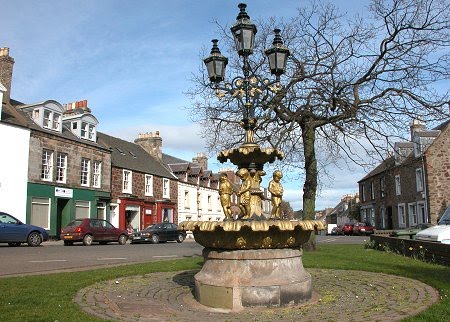 |
| East Linton, near Edinburgh. A different world |
‘Puir granny,’ said her granddaughter.
Grandmother and shop assistant burst into laughter.
‘Och, ne’er you worry about your granny,’ said the shop assistant, ‘she’s got plenty of money.’
Granny spluttered. ‘Don’t you be minding anything your aunty Vee says’ – everyone’s an aunty or an uncle in these warm-hearted little towns – ‘she talks complete rubbish.’
A pleasant change from the London tube. Or is it just the same thing in a different guise?
Thursday, 16 September 2010
Welcome to the NHS reform merry-go-round.

When I first began to work in healthcare in England, I got caught up in the so-called ‘Griffiths reforms’ of the mid-eighties which moved responsibility for managing hospitals away from geographical organisations known as Health Authorities and to the hospitals themselves.
Within a couple of years, the transformation was complete. Acute (short-stay) hospitals were more or less responsible for their own destiny, with other services run by just under 200 District Health Authorities, each responsible for about 250,000 patients.
Although this measure had been brought in by the administration of Mrs Thatcher, the government (which meant her) decided a while later that reform hadn’t gone far enough. So it introduced the concept of GP (General Practitioner) fundholding, which meant that GPs – or at any rate GP practices – or at least some of them – would hold the funds that paid for hospital care and purchase services from them.
This led to a reversal of the ‘Christmas Card test’. Up to that time, generalists would send hospital doctors a Christmas card each year in the hope that they would remember the gesture when it came to choosing which GP’s patients to treat first. After the introduction of GP fundholding, the traffic was reversed, with hospital doctors sending GPs Christmas Cards in the hope that they would remember them when it came to referring patients for acute care.
One of the benefits of the system was that GPs could provide some of the services themselves, such as minor surgery, so they could divert some of the funds they were receiving to pay for such care, into their own practices.
I’m sorry, I mean of course that it gave them an opportunity to provide services more efficiently on behalf of their patients.
When Labour got into power in 1997, they moved to put an end to this system. It was costing too much and favouring certain patients over others: those who had a fundholding GP could expect preferential treatment, and certain GP practices simply didn’t have the means to set themselves up as fundholders. So instead we got Primary Care Trusts (PCTs; originally they were Boards but soon they became Trusts – that’s how exciting the blistering pace of reform became.) There were about 300 of them, covering over 150,000 patients each.
To compensate GPs for the loss of earnings from fundholding – sorry, to make up for the loss of a means to help improve healthcare delivery – the government put in place nice new contracts that guaranteed them a fair remuneration, of about five times the earnings of ordinary mortals. Nothing to worry a banker, who makes us much in a year as a normal man in 50, or 100, or sometimes even 200, but nonetheless nothing to be sneezed at.
Then the government decided that there were too many PCTs, so in 2006 they brought the number down to 150 covering some 300,000 patients each.
Now of course we have an exciting new government that wants to do things differently. It wants to get back to GPs calling the shots in acute hospital care. I’ve heard it said that this may not be unrelated to the fact that the wife of the present Minister is a GP herself, but you can imagine how shocked I am that anyone should utter a thought so cynical.
The beauty of putting the GPs back in the driving seat is that it’ll make decisions much more local, much closer to the people affected. Obviously, you can’t get right down to the most local level of all – a single GP. I mean, how do you manage things like major organ transplants at the level of the individual generalist? In some years, he or she might not order a single one. To be honest, even one practice may be a bit too small. It looks like we’re going to have to work at the level of consortia of practices.
In fact, the government thinks we could probably work with about 500 Consortia covering 100,000 patients each, although the British Medical Association has announced that to get the proper coverage, we’re going to need about 100 Consortia, each handling about 500,000 patients. Obviously, in the BMA’s approach it’s hard to see just how the much-vaunted localism will be achieved.
We’ll probably end up compromising on about 200, rather like the number of District Health Authorities and somewhere between the first number of PCTs and the final number.
It’s great how these things keep going round and round. It gives the old hands like me a sense of familiarity, a sense that we recognise the landscape. Again.
The thing to admire in all this coming and going is the consistency. Through all these reforms, there have run some unvarying golden threads:
- Each is designed to do away with the obscene inefficiency of the previous system, and to deliver better care at lower cost
- Each of them costs a fortune to implement
- Each of them has been deemed a complete waste of money by the next lot, even when the next lot is just the same lot following a change of mind.
- The next initiative is designed to usher in a golden age of better care for less money.
The doctors, of course, always end up with a smile on their faces. And aren't smiley faces just what we expect in a fairground?
Subscribe to:
Posts (Atom)
