Tuesday, 29 April 2014

Carthage Deleted, the Tea Party and UKIP

Imagine a distant ancestor of the present US Tea Party, in flowing toga and discourse, before the Roman Senate. He’s just reached the end of an impassioned speech in favour of small government, and therefore in opposition to the bill on today’s order paper, “Port of Ostia: main sewer (Finance) Enablement Bill”.

“The people of Ostia have lived for generations without an improved sewer. They deserve to spend their hard-earned money how they want and not see it used to boost the egos of the Consults. Besides, Ostia is famous for its distinctive smell and we don’t want it to lose that attraction.”

Before he sits down, however, he has one last thought to share.

“Ceterum censeo Carthaginem esse delendam”, he proclaims.

Wikipedia rather boringly translates that statement as “I consider that Carthage must be destroyed”. What it really means is: “oh, by the way, let me just add that Carthage needs to be destroyed.”

Or, since he used the word “delenda”, we might even say “deleted.”

Rather like the Tea Party today, that senator’s faction, led by Cato the Elder, got its way in the end, by dint of repeating those words whether they were relevant or not to the matter in hand. Military power was deployed to destructive purpose and Carthage copped it. 


Only traces remain of what was once the grandeur of Carthage
Outline of streets – but note the Roman pillars marching across them
Carthage, the great sea power centred near present-day Tunis, had become Queen of the Western Mediterranean and a painful thorn in Rome’s side. Indeed, had a couple of battles gone the other way, we might have seen a Carthaginian Empire instead of a Roman one. Deluded figures like the British journalist Toby Young wouldn’t be insisting that kids be taught Latin in his harebrained “Free School”, but Phoenician.

Carthage had fought three wars with Rome and demonstrated a nasty way of bouncing back from each defeat: raising some more cash, recruiting some more men, deploying another army. Cato wasn’t going to have any more of that. This time the Roman army swept into North Africa, won several battles and finally sacked the city.

And when I say sack, I mean sack. Those whom they could they massacred in the streets; the rest they got by setting fire to the houses. Then, the legend assures us, they tore brick from brick and ploughed salt into the ruins. The kind of thing that Hitler would have approved of as a “final solution.”

Having visited the remains of the old city of Carthage today, I can testify that they did a thorough job. The ploughing of the salt bit, to stop anything growing back, has run its course: I saw poppies and buttercups growing on some Carthaginian tombs, but still, all that could be seen was the outline of tombs. At the citadel, there are some remnants of house walls, indicating the layout of a few metres of streets, but that’s about it.


The ploughed salt has gone: poppies and buttercups flourish
in these traces of tombs from ruined Carthage
Fortunately, we try not to do things quite that destructively these days, even if it means pulling out of Afghanistan without the Taliban being beaten and, indeed, with every prospect of its coming back to power within a couple of years. The idea of tearing down Kandahar brick brick and ploughing salt into the ruins isn’t one we generally favour, I’m glad to say, though I’m not sure that the Taliban might not do it if the tables were turned.

What has survived to our days is the politician’s habit of repeating the same old formula over and over again until, perhaps by the soporific effect of repetition, voters are lulled into thinking that it makes sense.

For example, in Britain today we have the spectacle of Nigel Farage of the so-called United Kingdom Independence Party who refuses to state a policy on any matter whatsoever bar one. The party’s 2010 manifesto? He hasn’t read it and he doesn’t agree with it. His economic policy? His tax policy? He has nothing to say about anything so dull. Why, even on immigration he has no concrete proposal: he just doesn’t like it.

So Farage has gone one better even than Cato the Elder. He doesn’t merely tack the same formula on to all other statements of policy: as an economy, he dispenses with the statements of policy and just sticks to the formula: “it’s time to delete the EU.” Or at least Britain’s part in it.

Just like Cato, it’s a policy that’s wholly destructive. Unlike Cato’s policy, it’s unlikely to achieve the party’s aim: far from giving the UK independence, since it would make Britain still more dependent on the US. But like Cato’s monotonous refrain, it’s sadly gaining traction in certain quarters, with UKIP at 30% in the polls for the forthcoming European elections.

Proving that a widespread inability to see through a demagogue is another trait that has survived in good form down the ages. Unlike poor old Carthage.

Monday, 28 April 2014

The African way: just right for a holiday

One of the main benefits of a holiday is to get away from the breakneck pace at which we spend so much of our lives. And from the pressure of deadlines.

Also, if you live in England, it’s to go somewhere with more reliable weather. Or perhaps I should say, weather that’s less reliably grey, muggy and wet.

So we’ve chosen Tunisia for a week, around Danielle’s birthday, and with three friends.

We flew into Enfidha yesterday, a large regional airport. Which felt, looked and operated exactly like any large regional airport in Europe. There was no sense of being in Africa, even though the temperature – thank God – was appreciably milder.

Once in the terminal building, everything kept working in a perfectly efficient and well-oiled way. People with clipboards approached us to check whether we were booked onto the hotel shuttle. It turns out they couldn’t find our names on their list but, hey, that happens in Europe all the time too. They accepted our booking confirmation, in any case, and told us to head outside, turn left, and take bus 2.

That’s when things started to come apart. There were fifty or sixty buses out there and no way of seeing where bus 2 ought to be. So we wandered up and down the lines until we found the one with a square of paper pasted to the windscreen with a 2 on it.

“The Hotel Sindbad?” said the driver, “We don’t go to the Hotel Sindbad.”

“Ah,” I thought, “perhaps we are in Africa after all.”

This had a certain familiarity. But one of the appealing things about Africa, in my relatively limited experience, is that things generally work out, if not always in the way you first imagined. And this was to be no different.

A colleague of the driver’s came over and launched a discussion in Arabic, in the course of which his hand gestures rather suggested he was explaining where the Sindbad was.

“It’s OK. Load your bags,” the driver told us, to my relief, an effect slightly spoiled when he went on, “we just have to wait for some other passengers.”

Fortunately I’d brought plenty to read with me, because it turned out I had plenty of time for reading. It took an hour and a half to fill up the coach. And the trip involved stopping at serval other hotels, before we reached the Sindbad. But reach it we did, safe and sound. In time. As for on time? Not so much. Luton to Enfidha airport (1200 miles) took two and three-quarter hours; Enfidha to the Sindbad (32 miles) took four hours.

But as I said, we’re on holiday. What time pressure are we really under? And the lesson was a good one. Africa’s good at teaching the value of patience, to learn the value of waiting and doing other things, instead of always chasing after the next urgent goal.


Sardine boats on the beach at Hammamet
The Medina in the background
Today we strolled in a leisurely manner along the beach into Hammamet. We wandered through the Medina, we came out and relaxed in the sunshine over mint teas.

Temperatures in the mid twenties Celsius. Good company. No time pressure. A valuable lesson in treasuring the moment which I needed Africa to teach me again. And just right for a relaxing holiday.

Taking the time:
what the chambermaids did with my tee shirt


Friday, 25 April 2014

Medical Research: is it time to fight back?

Don’t you just love medical research?

Carried out by dedicated, talented and hard-working scientists, it provides us with absolutely priceless breakthroughs in knowledge. 

For instance, it’s only thanks to medical research that we found out that aspirin was such a wonderful remedy for fevers or headaches. Or again, in my youth, that aspirin was a dangerous drug that wrecked your digestive system. And now, that it’s vital to take aspirin daily to stave off heart attacks.

I’m hoping to live long enough to see it banned again.

A godsend. A toxin. A godsend again.  Soon to be a toxin once more? 
Sadly, my unbounded admiration for medical research took a bit of a blow recently. I’ve spent years training myself to absorb at least five portions of fresh food daily. That’s vegetables and fruit, in case you’re wondering. Which is contrary to the advice of a doctor friend of mine, who advises me that two portions could take the form of a glass of wine (made from grapes) and a packet of crisps (made from potatoes, a staple of human diet, but then he is Irish).

Enough to protect health. Or is it?
I’ve given way to no such blandishments. I religiously consume my five, proper portions of fruit and veg a day, and it gives me a great sense of self-satisfaction to do it. 

And then suddenly the experts raised the bar: they announced that we need seven portions, not five.

Seven? Yes. And more vegetables, to boot, than fruit.

Despite my previous absolute confidence in medical research, I have to admit that I reacted with some scepticism to this latest move. It felt unfair, as though the goal posts were being deliberately moved. My suspicion was that i
f I took the plunge and upped my intake to seven portions a day, they would only raise the bar again to nine.

Was it time to start resisting?

“Yes,” said my wife, “particularly as they’ll move on to ban other things to make place for the extra portions. Meat. Eggs. Chocolate. Certainly alcohol.”

What a horrifying prospect. Specialists taking out of life more and more of the things that make it worth living. And all with the aim of protecting health and extending the very existence that they make so much less appealing.

So in the end they’ll extend our life expectancy to hundreds or years. Or, if they don’t, they’ll at least make it feel that way.

Tuesday, 22 April 2014

Easter message in a Christian country. That doesn't much like foreigners. Especially if they're in trouble

David Cameron did us a kindness in Britain last week, by sharing his thoughts on Easter in this essentially Christian country.

Easter is not just a time for Christians across our country to reflect, but a time for our whole country to reflect on what Christianity brings to Britain. All over the UK, every day, there are countless acts of kindness carried out by those who believe in and follow Christ. The heart of Christianity is to ‘love thy neighbour’ and millions do really live that out.

Such attitudes reflect a long tradition in this country. A thought which brings to mind a news story I read the other day.

A 25-year-old German woman, Theresa Weiss, was strapped in a seat of a Dutch air liner at Croydon last night after the immigration authorities had decided that she could not remain in England.

With her two-year-old daughter she landed at Croydon from Frankfort. After officials of the Immigration Office had investigated her passport and communicated with the Home Office, she was told she would have to return immediately.

She became hysterical and was attended by the airport doctor. It was decided that she should be taken on board the last ‘plane to Holland. While waiting for the departure of the ‘plane she escaped from her escort and ran in front of a taxi-ing air liner. One of the airport ground staff ran forward and dragged her to safety. Special Branch detectives and other police officers then took charge of her.

It was with considerable difficulty that she was urged into the ‘plane, and she was strapped into her seat, while her child was placed in charge of a stewardess.


Now as you read that story, you may have realised from some of the details that it wasn’t very recent. It isn’t. It comes from The Guardian of 17 August 1939.

That woman was a German refugee from the Nazis. The Neville Chamberlain Tory government sent her back to Holland. If she was sent on, back to Germany, one doesn’t have to be Sherlock Holmes to work out what her fate would have been. Hers and her terrified two-year-old daughter’s. 


The fate Christian Britain felt Theresa Weiss deserved
Along with her two-year old daughter
But even if the Dutch let her stay, she wouldn’t have been safe for long. Less than a year later, Holland fell to the Nazis and Theresa Weiss would have been back at their mercy. Along with the daughter who may have seen her third birthday, but I suspect never saw her fourth.

As part of his Easter message, David Cameron also spoke strongly for those who face the risk of murder for their beliefs.

And as we celebrate Easter, let’s also think of those who are unable to do so, the Christians around the world who are ostracised, abused – even murdered – simply for the faith they follow.

Britain is committed to protecting and promoting that right, by standing up for Christians and other minorities, at home and abroad.


Of course, it could be objected to me that Theresa Weiss’s misfortune occurred long before Cameron was even born. So in case anyone believes that these wonderful traditions have died, let’s glance at The Guardian of 4 August 2013.

A coroner who oversaw the inquest into the death of the Angolan deportee Jimmy Mubenga has issued a highly critical report that raises a series of concerns about the way the government and private contractors deport people from the UK.

Mubenga, 46, died after being restrained by three G4S guards on board a plane at Heathrow airport that was bound for Angola in October 2010.


It would appear that we may love our neighbours as Cameron claims, but we’d rather they didn’t come calling for help, any more now than in the 1930s. Samaritans who prefer not to cross the road. With UKIP virulently campaigning against every foreigner legally or illegally in this country, and riding high in the polls, don’t expect any great change soon.


So how open was the door? Ever?
Britain’s a Christian country. With a Christian Prime Minister. And a great Easter message.

Sunday, 20 April 2014

Ukraine: a moment of truth at Easter. On Hitler's birthday

Easter Sunday. For Christians at least, a good day, pretty much the best. 

On the other hand, this year it also happens to be Hitler’s birthday, which is not quite such a cause for celebration.

And both are relevant. The Ukrainian government – if ‘government’ isn’t too strong a word for a body whose writ is so little followed – has declared an Easter truce in its fight with pro-Russian rebels in the East of the country. This may be a generous and open-hearted gesture, or it may reflect a lack of confidence in its own forces, even to the point of not being sure that any armour it sends against rebels won’t be immediately taken over and turned back the other way.

As happened last time.

As for Hitler’s birthday, well I’ve already commented on the similarities between Putin’s behaviour and Hitler’s. In fact, more than once. I fully accept that not everyone agrees with me: I’ve had it pointed out to me that Putin’s behaviour in Crimea is no different from Thatcher’s over the Falklands.

That strikes me as a false analogy. The Falklands – the Malvinas – ought certainly to be Argentinian and will, I’m sure, be handed over some day. The objection back in 1982 was that President Galtieri sent armed forces to seize them. British possession of the Falklands may well be wrong, but Galtieri’s actions was illegal.

Such breaches of international law damage us all. Not just in the Falklands but anywhere they occur, most notably in Iraq: the West, far from being innocent, is the most frequent and flagrant perpetrator. That, however, doesn’t justify Putin who also has form in these matters: even before Ukraine, he used military force in Moldova and Georgia.

So how about the parallels between him and Hitler?

The most striking similarity is escalation.

Hitler’s first (illegal) military action was to reoccupy the Rhineland. Well, it was German territory, after all. You could argue that the Versailles Treaty, in stipulating that the Rhineland had to be left demilitarised, was unjustly limiting Germany’s legitimate rights.

Then came the annexation of Austria. Well, Austria having lost its Hungarian and Slavic populations, was a massively German nation and there was certainly huge enthusiasm for union with Germany.

Next it was the turn of Czechoslovakia. It had large pockets of German population who, rightly or wrongly, claimed their rights were being trampled on by the Czech authorities. They appealed to Germany to assist them, an entirely disingenuous appeal since they were already heavily dependent on the Nazi regime. That was the crisis that led to the Munich Agreement, in which Chamberlain for Britain and Daladier for France thought they had guaranteed “peace in our time” by agreeing to the dismemberment of Czechoslovakia, through Hitler’s annexation of the areas of majority German population.

The following spring, Hitler had occupied the rest of Czechoslovakia.

That autumn, he invaded Poland and Europe found itself sucked into the Second World War.

Now history doesn’t repeat exactly. The steps are different. But Putin is ramping things up just as Hitler did.

First it was Crimea. Well, a bit like Austria and the Germans, the population is mostly Russian-speaking and closer to Russia than to Ukraine. In fact, it only became Ukrainian through a high-handed act of Kruschev’s in 1954.

Now it’s the Russian-speaking populations of the Eastern Ukraine. Well, rather like the Sudeten Germans in Czechoslovakia, they feel aggrieved about being regarded as Ukrainians (at least, quite a lot of them do). Perhaps they feel that Russia is their mother country. And, again rather like the Sudetens, it looks as though they’re getting a lot of foreign encouragement (some of it in the form of armaments and possibly even troops without insignia) for their rebellion.

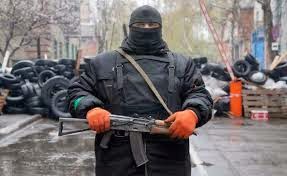
Comforting that we can count on him as a champion of freedom
Yesterday, despite the truce, there was fighting in the port of Mariupol, which left three people dead. The Russian authorities have expressed outrage. Well, I believe any citizen of the world should see this kind of killing over political matters as outrageous, but Russia clearly feels that it has a specific interest in these incidents because one side of the conflict is Russian-speaking. Which is rather like the United States feeling it has a right to speak for British citizens in trouble with the law, merely on the grounds that they speak the same language (well, pretty much the same language).

What’s next? That’s not difficult to imagine. If Eastern Ukraine is allowed to secede and join the Russian Federation, like Crimea, will Putin next annex the area of Moldova, immediately to the West of Ukraine, where he has already stationed troops in an ostensibly independent nation? From Moldova, he threatens Ukraine’s third city and most important remaining port after the loss of Crimea, Odessa.

None of this is identically analogous to Hitler’s actions, but it’s the same kind of salami-slice approach to foreign policy with the aim of gradually extending its territory. The end result would be a Ukraine so emasculated that it would barely be viable as an independent nation, leaving it liable to absorption wholesale into the Russian Federation. Rather like the rump of Czechoslovakia was taken over by the Reich.

What’s Putin’s objective in doing all this? Again, he’s made no secret of his nostalgia for the Soviet Union. It seems difficult to deny that he’s working to reconstitute it.

It wasn’t much fun last time the world was dominated by a United States glaring at a Soviet Union each in its forest of nuclear weapons. And it wasn’t fun for rather a lot of Europe. No wonder the Baltic States and Poland are concerned – they can see where this may be heading.

It doesn’t have to go there. On Thursday, Russia, Ukraine, the US and the EU met and agreed a way out of the crisis. It involved rebels giving up their occupation of public buildings, in return for an amnesty for protesters who have not committed capital offences. Clearly, it depends above all on Russia reining in its supporters in Eastern Ukraine, and them agreeing to go along with the arrangement.

Will it stick? If it does, something remarkable will have happened. Russia, on the road to aggrandisement by military means, will have drawn a line and said “no, we go no further down this road.” Putin will have pulled back from policies that seem set to push the world back towards a state of affairs that was ugly then and could be a lot uglier now.

He will have diverged fundamentally from the route that Hitler took. We might look back to this 125th anniversary of Hitler’s birth and congratulate Putin on his extraordinarily judicious behaviour.

But three died in Mariupol yesterday. And the pro-Russian protesters aren’t vacating government buildings. The omens aren’t good.

Still, it’s Easter Sunday and I mustn
’t spoil it. Have a good one, whether you believe in it or not. At least enjoy the chocolate.

Happy Easter

Saturday, 19 April 2014

Clean-cut. By a barber

I’m not of a fan of the modern institution of hairdressers. I mean, they do what they do well enough, but all the awful pretentiousness around it – the cups of coffee, the canned music, the camp discussion of the fine details of hairstyles – all leave me cold. Particularly as they seem exclusively designed to justify, if justification were possible, the scandalous prices these places charge.

Why, my dog’s hairdresser charges a lot less than they do, and Janka – that’s the dog, not the hairdresser – has a lot more to cut than I do.

Janka before and after. A lot more to cut. 
So wherever I go I look for that old-fashioned, much more basic and, in my view, more honest establishment, the barber’s. I had one in Stafford. I’m glad to say that I’ve found one in Luton too.

Clean-Cut Hairdressers in Luton
Don't be fooled – it's a barber's shop
It claims to be a hairdressers, but even the name gives the lie to that: Clean-Cut. No self-respecting hairdresser would call itself that. They always have names like A Cut Above or Hair Today – something allusively punning or otherwise aspiring to charm. 

And missing.

Clean-Cut’s a straight barber. No appointments. You turn up and take a close look at the guys (all guys) ahead of you, so you remember when it’s your turn. And you wait. That’s the downside of course: I waited the best part of half an hour today, but hey, it meant I could read the paper (is it still a paper, if it’s on a Kindle? Well, I think it is.)

When you get called over, there’s no attempt by the other guys to muscle in ahead of you. In fact, today I thought there were two in front of me, but they graciously waved me through.

“No, no, please,” they said, “go ahead.” 


It may have been because they wanted to watch the football results on the telly – that’s right, there’s no soppy canned music in Clean-Cut.

What about the cut itself?

“You want 3, 4 or 5?” he asked, forgetting that I don’t have my hair clipped any more.

“Scissors,” I informed him curtly.

“Scissors, of course,” he said, reaching for one of the two pairs carefully laid out before him.

The cut took 12 minutes. And it took place in silence, apart from absolutely necessary communication.

“Eyebrows, sir?”

“Is that high enough over the ears?”

There was no discussion of where he went on holiday last year or was planning to go this year. I didn’t find out about what had happened in the night club on Friday, and indeed I think it highly unlikely he frequents night clubs. I didn’t even discover what his elder daughter was doing in Canada, or even whether he had a daughter, in Canada of anywhere else.


A barber who gets on with it and does prattle
A gem in his profession
A blessed mercy. 

At the end of the process, my hair had been cut. Perfectly adequately in my far from humble opinion. And the charge? Rather under a quarter of what Janka’s cut cost. And, even though I have a lot less hair than she does, that’s still impressive.


Satisfies my requirements entirely
And don't knock the silver highlights –
absolutely not grey –
they took over sixty years to put in
It could even have been less. He asked me, as I came to pay, and dropping his voice as a request for such a confidence requires, whether I was a pensioner. That was slightly galling, since I like to pride myself on my youthful good looks, and don’t care to be told I don’t have them. I’m glad to say I managed to keep the disdain out of my voice when I told him I was not a pensioner, and therefore intended to pay the full fee. He smiled and accepted it.

A fine institution, the Barber’s. Long may it flourish.

Thursday, 17 April 2014

Put out fewer flags

The habit of flying national flags always strikes me as a little puzzling. Dr Johnson may have regarded patriotism as the last resort of the scoundrel. To me, when it’s expressed by a flag, it’s all slightly deluded.

At a pinch, it makes sense for people who are away from their home country. I can imagine a Kyrgyz family in Kent might fly their flag if only so that passers-by could see that a family from their great country was living there. Perfectly legitimate desire, I suppose. Though I suspect most people would just be left wondering which football team used that particular flag, followed by a sense of bemusement when they couldn’t identify it.

Don't tell, don't tell me. That's Charlton Athletic, isn't it?
I can understand flags being used for military purposes. Take the so-called authorities in Ukraine: they need their own flag to identify which armoured vehicles they still control, as opposed to the ones decorated with a Russian flag that have been taken over by rebels.

Ukrainian Armour. At least, until the flag gets changed
Ships need flags too. Without one, you wouldn’t know which nation had been selected by the owners to minimise its tax liabilities and obligations towards employees.

But flags used by civilians in their own countries? Do we really need a Union Jack outside, say, the British Home Office? Whose Home Office might it otherwise be? Do we really believe that Burkina Faso would put its Ministry of the Interior in Croydon?

And what about the private individuals who fly their national flags outside their houses? They’re telling us that someone British lives in this house. In Britain. It may be just me, but I’m not convinced that this is strikingly interesting news.

Of course, in Britain we don’t just fly the Union Jack. There are lots of flags of St George in England now, just as there are many Saltires in Scotland. Which reveals another aspect of flag-waving which isn’t particularly amusing: it’s about separating oneself off – English, so not Scots, or a Scot, so not an Englishman. As Ukraine’s discovering, people defining themselves as not part of someone else is a problem these days, not a solution.

And then there
’s the US. Take a look at a photo of the President. Or of candidates for the Presidency. Or even of many US politicians. They wear a lapel pin with the US flag on it.
Obama with a lapel pin.
Dose he need a reminder? Reassurance against the Birthers?
Now that really is extraordinary. I mean, do they expect foreigners to forget that they’re American? As they wander in behind their tanks with bankers in their wake?

Now Brits don’t stand out from the crowd like the US, either by wealth or by power. So maybe it makes sense that British politicians have started wearing lapel pins too. Not with the US flag, of course, but the Union Jack. Though given the independence of their foreign policy, it might actually make more sense if they wore the stars and stripes.

Clegg and Cameron with Union Jack lapel pins
Aping a trans-Atlantic fashion?
Now, people will tell me that the flag isn’t about identification but about pride. But I don’t wear that either. Pride is something you can have in an accomplishment: you climb a mountain, pass a test, complete a job. Those are things you can find satisfying. But your nationality? The vast majority of us get that by birth. And frankly it’s tough to find much to be proud about in getting born. In fact, I’ve never met anyone who hadn’t pulled that trick off.

Really, all this flag waving, doesn’t make sense. Serving no useful purpose. Divisive at worse. Marking a false pride at best.

Just what’s the mileage in it?