Tuesday, 4 November 2014

Do we really want to give up on privacy?

Robert Hannigan, head of Britain’s GCHQ, the equivalent and partner of America’s NSA and therefore our principal snooping organisation, has declared that there’s no “absolute right” to privacy. Since his organisation has quite a track record for invading privacy, his is probably a remark worth taking seriously.

GCHQ: protecting us. But from itself
At one level, as it happens, I think he’s right. In my view, there is no absolute right to privacy. But that’s because I don’t believe there’s an absolute right to anything. Rights are granted by people to each other or, still more frequently, wrested by one group from another who make every effort to resist them.

Not everyone believes that. People of faith, for example, might well hold that rights are a gift from God. Certainly, the signatories of the US Declaration of Independence seem to have felt that way:

We hold these truths to be self-evident, that all men are created equal, that they are endowed by their Creator with certain unalienable Rights, that among these are Life, Liberty and the pursuit of Happiness.

It all flows from the Creator, you see.

On the other hand, I think we’re probably better-advised to be guided by what people do than by what they say. And from that point of view, it’s instructive that the man who drafted the Declaration, Thomas Jefferson, was a slave-owner, as were numerous other signatories including, most notably, George Washington.

So I take with a pinch of salt the notion that Liberty is some kind of absolute right. If it were absolute, how could some men (or women) deny it to others? The US founding fathers were apparently able to alienate the allegedly unalienable.

It took a long and bloody war – still the costliest in lives ever fought by American forces – to establish that no one could be enslaved in the US. A hundred years on, it took a bitter struggle to win Civil Rights for the descendants of the freed slaves. Even today, few can pretend that American Blacks enjoy the same degree of liberty as their White compatriots.

All this confirms me in my prejudice that rights aren’t absolute, but have to be fought for and then defended.

So I agree with Hannigan that privacy isn’t an absolute right, any more than any of the others. But, though we agree on the premiss, I draw the opposite conclusion. Precisely because it isn’t absolute, the right to privacy needs to be defended, above all against such as he who would trample it if he could.

His motivation, inevitably, is the fight against terrorism. Twitter, Facebook and WhatsApp, he claims, are now “command-and-control networks for terrorists”. It is his duty to spy on what’s said on the web to keep us all safe.

It
’s all the more vital, and all the more difficult, to resist that kind of thinking now that so many seem anxious to give up their rights. As frightened as Hannigan of terrorism, and hostile to Europe, many British voters seems intent on dropping adherence to the European Convention on Human Rights – nasty foreign meddling with good British custom, championed by such as Hannigan. 

Curiously, it’s article 8 of that Convention that guarantees:

…everyone has the right to respect for his private and family life.

Nothing absolute about that guarantee, though. We can give it up, if that’s what we decide we want. But with the likes of Hannigan out there breathing down our necks, is that really what we should wish for?

Sunday, 2 November 2014

Benign racism: the most pernicious form

There’s such power in Rudyard Kipling. 

The characters in Kim, for instance, are unforgettable: the red-bearded giant of a Pathan horse dealer, Mahbub Ali; the Babu, Hurree Chunder Mookherjee, self-declared a “fearful man”, but staking his life on serving the British Raj; and perhaps one of the most endearing figures in literature, Teshoo Lama from Tibet, seeking the river that will wash him clean of all taint of sin.

To say nothing of Kim, the epitome of the lovable rogue, constantly in mischief, whether his own or other people’s, a white but able to pass himself off as any of half a dozen Indian types. At least.

And yet, the pleasure of reading Kim comes with an uncomfortable trace of embarrassment. Because Kipling constantly refers to “the Oriental” way of being or doing things, and to certain characteristics as somehow “white.” Kim, for instance, is able to resist powerful, perhaps hypnotic, suggestion and see things the way they really are, and there is a strong implication that it is his European blood that gives him the strength.

Rudyard Kipling: fine writer, but the racism's no less toxic
Besides, it was Kipling who wrote a poem about the “white man’s burden”.

Take up the White Man's burden 
 
The savage wars of peace – 
Fill full the mouth of famine 
And bid the sickness cease; 
 And when your goal is nearest 
The end for others sought, 
Watch Sloth and heathen Folly 
Bring all your hopes to nought.

Doesn’t that sound like Bush and Blair in Iraq? We fought a savage war for peace, and look what those lesser beings have done with what we gave them…

Perhaps one of Kipling’s greatest gifts was the ability to give the common soldier a voice, not something writers had tried before him. Who can forget Gunga Din?

Though I've belted you and flayed you, 

By the livin' Gawd that made you, 
You're a better man than I am, Gunga Din!

How enlightened is that? The white soldier admits that the Indian water carrier isn’t merely his equal, but his superior.

Except, except… he belted him and flayed him. And one can’t help feeling that it was Gunga Din’s darker skin that entitled the soldier, and Kipling who spoke for him, to do so. Indeed, when we look a little closer, the puzzle is solved: Gunga Din was a superior sort of man because, despite his brown skin, inside he was white:

An' for all 'is dirty 'ide 

'E was white, clear white, inside

There’s no denying the love Kipling had for India, and for Indians: it shines through powerfully in Kim. But it’s the love of a superior for an inferior. And the superior is there to rule the inferior. In the interests of the inferior, that’s Kipling’s message in The White Man’s Burden, but with a rule of iron (“though I’ve belted you and flayed you…”)

There’s something benign about the racial view propounded by Kipling. But that only makes it more pernicious. There’s nothing to wonder at in Gandhi’s swift denunciation of the notion of the 
white man’s burden as a yoke for colonial peoples.

Bas relief by John Lockwood of a scene from Kim
So when I re-read Kim recently, I rediscovered the pleasure I’d had as a child, at the spellbinding story and above all at the compelling characters, but with an acute sense of unease at the underlying message.

I suppose in a sense we’ve progressed since 1901, when the book appeared. The pretence that the Raj served the Indian people has been well and truly punctured, and the Raj itself ended; whatever the problems India still faces, and there are many, its people have made great advances since Britain left.

No ruler looks after the interests of the ruled as well as they would look after their own, if only he’d stop ruling them.

Back in Britain, we can take some satisfaction from the fact that racism is at least no longer hidden behind any kind of pernicious nonsense about its being good for the oppressed. 


When UKIP attacks Bulgarians or Romanians, it at least doesn’t pretend that it’s doing them some kind of favour. Instead, it makes it clear that it is targeting them as a group, just because they are Bulgarians or Romanians (“I was asked if a group of Romanian men moved in next door, would you be concerned? And if you lived in London, I think you would be,” said Nigel Farage to a radio interviewer).

They try to disguise their xenophobia behind an economic smokescreen: immigrants take our jobs (they don’t: they do jobs we can’t find native Brits for) although, somehow, at the same time they come here to live off our benefits (immigrants are 60% less likely to be on benefits than the native born). Underneath it all, they just don’t like people from abroad, and they know there are plenty of Brits who share their view, so they push it.

At least we can see the racism for what it is these days. Kipling disguises his poison, but in Farage it’s openly displayed. And there’s nothing benign about it: it’s wholly malignant.

It’s better to be able to recognise the toxin than for it to be hidden. Doing away with it altogether would, of course, be far better still. That would mean living in a world in which people were judged not as white or black or “oriental”, not as British or Bulgarian or Iraqi, not as Christian, Jew or Muslim, but as individuals. There’d be no space in such a world for the likes of UKIP.

Unfortunately, there might be no space for Kipling either. That would mean the loss of some great writing. Which would be sad, but if that
’s the price, it’s worth paying.

Friday, 31 October 2014

A haunting story

There’s story that has haunted me ever since I first heard it.

Goro Shimura is in his eighties and an emeritus professor from Princeton, where he held a mathematics chair for many years of a distinguished career. But back in the 1950s he was a young mathematician in Japan, at a time when that wasn’t an easy country in which to forge an international career: a pariah just ten years after the Second World War, Japan was also still reconstructing and had little to spare for abstract studies such as pure mathematics.


Goro Shimura
Still working in 2010
In 1955, another young Japanese, Yutaka Taniyama, announced a new conjecture, which is basically a good idea that hasn’t been proved. He had actually got it slightly wrong, but Shimura teamed up with him and together they put it right the following year, when it became known as the Taniyama-Shimura conjecture.

Yutaka Taniyama
Brilliant, even when wrong
I won’t even attempt to state it. It concerns a relationship I don’t fully grasp between a set of numbers I understand only as a layman, and a set of objects which are entirely opaque to me. All I’ll say is that the conjecture proved hugely fruitful, and a great deal of pure mathematics of the next three or four decades depended on it; if it was ever shown to be false, an awful lot of other work would fall with it.

In 1967, another mathematician, André Weil, revealed a curious aspect of a particular application of the conjecture: if it could be proved, that would also prove Fermat’s last theorem.

Pierre de Fermat was a seventeenth-century French lawyer, but you can’t hold that against him (he could have been a banker, after all). He was also an amateur mathematician at a time when there were no professionals, and his talents in the area would have put many professionals in the shade anyway.


Pierre de Fermat
Amateur mathematician who baffled many a professional
In 1621, one of the classic Greek mathematical texts, Diophantus’s Arithmetica was published in Latin. As we no doubt all do, when a book appears in Latin, Fermat read it voraciously, covering the pages with notes. He included a number of conjectures which later mathematicians proved, one by one, until only one remained: his last theorem.

Fermat had written about it “I have discovered a truly marvellous proof of this, which this margin is too narrow to contain.”

That was a challenge, of course. An elegant proof, but not enough space to write it down? For three and a half centuries, mathematician after mathematician attempted to reconstruct Fermat’s proof. And failed.

Then came Andrew Wiles. He was fascinated by Fermat’s last theorem, and struck by Weil’s suggestion that proving part of the Taniyama-Shimura conjecture would crack the puzzle. Coincidentally, the area to which Weil had suggested applying the conjecture was Wiles’s specialty (elliptic forms, if you must know, though for my part, knowing that leaves me none the wiser.)

He worked for six years, mostly in secret. Then in 1993, he made the dramatic announcement: he’d proved the relevant bit of the Taniyama-Shimura conjecture – and therefore Fermat’s last theorem.

But that wouldn’t have been anything like dramatic enough. Over the next few months, it began to emerge that Wiles’s proof was flawed. It wouldn’t stand up. In despair, he went back to his reasoning, working with a friend. They struggled for months, without success.


Andrew Wiles
Announcing his proof of Fermat's last theorem. A little too soon...
And then finally, in September 1994, just in time for his wife’s birthday, Wiles had an insight. He suddenly understood how he could fix the problem. As he sat down for her birthday dinner, he laid the manuscript of his paper before her: he’d got his proof. He’d demonstrated Fermat’s last theorem.

Of course, what he’d really proved was the Taniyama-Shimura conjecture.

Shimura’s comment? “I told you so”. Nearly forty years on.

And now we get to the bit that makes the story really haunting. Taniyama had no comment, because he’d been dead, by his own hand, since November 1958. 


He left a strange suicide note:

Until yesterday I had no definite intention of killing myself. But more than a few must have noticed that lately I have been tired both physically and mentally. As to the cause of my suicide, I don't quite understand it myself, but it is not the result of a particular incident, nor of a specific matter. Merely may I say, I am in the frame of mind that I lost confidence in my future. There may be someone to whom my suicide will be troubling or a blow to a certain degree. I sincerely hope that this incident will cast no dark shadow over the future of that person. At any rate, I cannot deny that this is a kind of betrayal, but please excuse it as my last act in my own way, as I have been doing my own way all my life.

A month later, his fiancée also committed suicide. Her note said:

We promised each other that no matter where we went, we would never be separated. Now that he is gone, I must go too in order to join him.

Now that, along with the brilliance of the public person, the mathematician, is what fascinates me in Taniyama’s story. 


Though I’m also drawn by Shimura’s tribute to him – a strange, almost backhanded compliment, and yet oddly enviable:

He was not a very careful person as a mathematician. He made a lot of mistakes. But he made mistakes in a good direction. I tried to imitate him. But I've realised that it's very difficult to make good mistakes.

Wednesday, 29 October 2014

Good riddance. With a little nod to UKIP, for good measure

There was a knock at the door an hour or two ago.

“We are Milena and Robert,” the couple on the doorstep told us, “we are your new neighbours.”

What could be more banal? A couple moves in. They introduce themselves. But its very banality makes the incident special for us. For they are taking over from our neighbour from hell. She left last night, and I have never felt so joyful over the presence of a removals van outside our house.

Sign of joy.
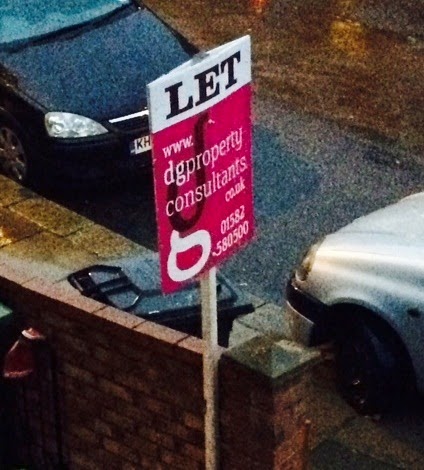
When it appeared outside the house next door
Two years we’ve had the delight of living next door to the woman I shall refer to as Kayleigh, if only because that’s her name. She was a delightful neighbour on the many occasions when she was away; alas, though she was away a lot, there were inevitably times when she’d be home, and that made her less easy to like. If we saw the lights on between a Thursday and a Saturday night, we knew we were in trouble. On one or two of those nights, she would have ‘friends’ round.

Why do I put quotation marks around the word ‘friends’? Because there was nothing particularly friendly about the way they behaved to each other. More or less from the start they’d be talking far too loudly, as though at a convention for the deaf from which hearing aids have been banned. But then as the alcohol started to kick in, to say nothing of other substances less socially acceptable, that early phase would come to resemble the pleasant calm of a busy library.

By about 3:00 in the morning, they would start sharing deepseated views about the character, temperament and behaviour of the others present. The views were, clearly, held with passion, and communicated with concision, since anything involving a verb or an adjective only seemed to require a derivative of that fine four-letter Anglo-Saxon term for the way we’re all generated.

Expressing oneself simply is an admirable stylistic aspiration, so I can only admire their talent. Although it’s also possible that simplicity was a way of life, and there really was nothing more sophisticated to be said about any of them.

By about 7:00 in the morning, the company had exhausted the entertainment to be extracted from abusing each other with increasing intensity, so things really got serious. At this point Kayleigh, who could have found employment as a fog warning siren had she been interested in having any kind of employment, would start to dominate proceedings more than ever. She would request various individuals to depart her presence, preferably on a permanent basis.

She would communicate this desire by suggesting that they go forth and procreate, if I may be permitted a euphemistic paraphrase.

Sadly, it turns out that such desire was merely a passing phase in the Kayleigh mood journey. Once most or all of her guests had gone, which would generally be between 8:00 and 9:00, she succumbed to a sense of desolation and loneliness, which she would bewail to the few who were left or, if there were none, to some unfortunate she could raise by phone. This final stage of the night’s festivities would generally continue until some time between 10:00 and midday, at which point silence would finally descend on her house.

One must, of course, be tolerant towards the customs and culture of others, even if in this instance the word ‘culture’ more aptly describes something in a Petri dish than in the great achievements of a community. But I have to confess to being bemused by Kayleigh. Those nights seemed to leave her wracked by sorrow and self-pity. I may be naïve, but it seemed to me that she wasn’t really enjoying herself all that much. Still, who am I to judge the pleasures of my neighbour?

What I could judge, of course, was the impact on ourselves as, yet again, we avoided all the inconvenience dreaming can cause. Or indeed sleeping at all. And that judgement was one that I felt was worth sharing with the police, the letting agents for the house and the landlord. Our friends on the other side of Kayleigh did the same, and by dint of keeping up the pressure, we eventually prevailed.

The turning point was no doubt Danielle’s recording of Kayleigh making it clear, in choice terms, that she didn’t wish to talk to her. Danielle got it all on her phone, which survived even Kayleigh’s throwing it into the road, providing a tribute to iPhones as well as a damning piece of evidence against the neighbour.

Hence the removals van last night, and Melina and Robert’s courtesy call today.

Poor Melina and Robert. The little front yard is already full of rubbish, partly what Kayleigh left there, partly what they’ve flung out of the house.

“The place is filthy,” they told us, as they took a brief break, still wearing their rubber gloves and knee pads. We offered them drinks (turned down, as they wanted to get on with the cleaning), and sympathy for the scale of the post-Kayleigh task.

The contact with them may have been banal. But in contrast with what came before, it was painfully welcome. A huge improvement.

Interestingly, Kayleigh is English to the core. Born here, bred here (for some value of the word “breeding”). While Melina and Robert are Polish.

Hey, UKIP: you really think it’s the immigrants that are the problem? Seems to me, we’ve got far worse difficulties with the native born. At least, with the very Kayleighs you draw on for support.

Monday, 27 October 2014

Who needs blockbusters?

“We want a story that starts out with an earthquake and works its way up to a climax,” said Sam Goldwyn, summing up his ideal vision of a film.

That sentiment came back to me when we started watching Get Low the other night. OK, so it doesn’t start with an earthquake, but pretty much the next best thing: a house aflame, blazing away. 

And then it gets going.

Now, I can’t pretend it’s one of the great classics. If you’re expecting dazzling insights into the human condition, and answers to the fundamental questions that have puzzled mankind down the millennia, Get Low is probably not for you. If, on the other hand, you like the idea of a man organising his own funeral, to be held while he
’s still alive, so that he can tell his neighbours what really happened forty years earlier, then it’s worth taking a look at. Especially if you like being entertained without being exhausted by the process.

Get Low: Robert Duvall calls in the undertaker (Lucas Black)
to plan his living funeral
We watched it at home the night after we’d been out to see Gone Girl. Bit more of a blockbuster than Get Low, but hats off to any film that can hold my attention for over two hours. The descent into hell has always struck me as a great plot device (particularly since Eyes Wide Shut, one of the best examples of the genre), and this one comes with a hymn to a master manipulator thrown in – what could be better? 

Well, actually, what would be better is a film that didn’t strain credibility quite so much. I do like a touch of verisimilitude with my fantasy, and in Gone Girl it was as gone as the girl.

So it was a pleasure to try another non-blockbuster, Bottle Shock. This tells the story of that great moment in wine history, the 1976 tasting contest when a panel of Frenchmen gave the top prize for both red and white wine to Californian vintages over French ones. A great story, so how could the film truly fail? Especially when you include Alan Ryckman in the cast. 


Actually, he was almost as good as the real star of the film, the wine: Rickman was wonderful as the Brit cold-shouldered by the French and distrusted (or disrespected) by the Americans. As he falls for the allure of the Napa Valley.

Two great stars, a fine combination:
Alan Rickman: a louche Englishman enjoys Napa Valley's best
And Bottle Shock has another attractive characteristic, just like the classic wine film, Sideways, that taught me to appreciate that prince of grapes, Pinot Noir. The thing about such films is that they prompt you to watch them accompanied by the ideal enhancement to the pleasure, a good bottle. That’s how we got the most from Bottle Shock: as well as the film we indulged in a little good Beaujolais, a drop or two of a fine Rioja. It was only a pity we didn’t have something special from the Napa Valley, to celebrate its success in its own vintage.

Still, it was a good evening. And it rather proved that, though the odd blockbuster’s worth seeing, it can be just as much fun to watch something far less well known. 


Especially when the experience is properly lubricated.

Saturday, 25 October 2014

Be afraid of Ebola. Very afraid. And ashamed.

Ebola’s terrifying, isn’t it? Well, I think it is anyway.

Not because there’s any serious chance I’ll ever catch it, far less die of it. No. My terror is caused by what Ebola tells us about ourselves.

First of all, it appals me that politicians and journalists, two sets of people most of us claim to distrust more than others, can still whip up such a panic in such a short time. We don’t believe these guys when they talk about the economy or war, so why do we believe them when they tell us to be frightened of a disease?

Secondly, it’s profoundly shaming that we worked up no concern about the disease while it only affected West Africans. Now that there seems to be a chance that a few people could be infected in Europe or North America, we are taking it seriously. Indeed, far too seriously.

A courageous victim: Dr Craig Spencer fought Ebola in Guinea
Now his neighbours are panic struck
We seem to have gone from indifference to panic without pausing at any sensible place in between. So our nations failed to come up with the finance needed to fight the disease properly in West Africa. But now, since Dr Craig Spencer came back to New York infected with Ebola, contracted fighting the disease in West Africa, people living in the same block are telling us they’re fearful of infection from touching door handles or lift buttons.

Thirdly, we’re still showing the same indifference to the fate of West Africans. Far more have died of malaria since the outbreak of the crisis than have died of Ebola, but we don’t show the same sense of urgency over malaria as we do over Ebola. Indeed, how many of us know that one of the consequences of the crisis is that large numbers of West Africans will die of other conditions? With health systems at breaking point, with little capacity to handle Ebola and next to none for anything else, stroke or heart attack victims face an uphill battle to be treated.


Ebola in Sierra Leone: a health service at breaking point
No capacity to treat other conditions
Fourthly, Ebola is far from the most serious threat facing us. A handful of Americans or Europeans has been infected, while thousands of our citizens have been killed on our roads. And yet we react calmly to the carnage of the car.

This strikes me as perhaps the most terrifying aspect of our reactions to Ebola. It belongs with our attitudes towards terrorism. Boy, is that working for the people who want us terrified. Britain is gaily giving up civil rights to protect itself from people who might have travelled to Syria to fight with ISIS. So far, such people have killed not a single person in Britain – and yet we should allow the government to overrule Europe Human Rights Courts decisions to protect ourselves from them?

In the US, the paradox is still more obscene. Just yesterday, there was yet another school killing, in Seattle. Fortunately, this one caused fewer deaths than most have in the past: the perpetrator and one of his victims died at once, four other students were hospitalised, three of them in critical condition. That one shooting spree has caused mayhem at the same scale as Ebola has in the US so far. And there are a lot more guns around than there are Ebola carriers.

There have also been a lot more deaths caused, each and every year, by firearms in the US than have been killed even by terrorism. You want to help protect US citizens? Terrorism and Ebola are serious, but more serious still are the car and the gun. ISIS? Certainly target it. But start with the NRA – it does far more damage to the US population.

That’s what I find terrifying about the Ebola crisis. It reveals how cockeyed our priorities are. How easily we’re distracted from things that really matter. How easily our attention is captured instead by far less serious threats.

And notice what ISIS and Ebola have in common: they’re about risk coming from abroad. That nasty strange part of the world so many are telling us to distrust, even fear these days.

Yes. Ebola reveals a lot about us that’s worryingly ugly.

Friday, 24 October 2014

An honourable man who restores faith in politics

I know there are many people who regularly get up at 6:00 in the morning, and I have a great deal of admiration for them. For me, however, it’s one of those purgatorial experiences that I usually associate only with the pain of an early-morning swim. People keep assuring me that such swims do me a lot of good, and I believe them, though given the way it feels, that does take quite an act of faith.

Today, however, I was up at that time of day without fear a cold wetting. Two friends had invited me to attend a Rotary Club breakfast.

Now I love doing things I’ve always sworn I’d never do. Wear a tie. Work in business. Live in Luton. There
’s a kind of perverse enjoyment in breaking my vows to myself. I never actually swore never to have anything to do with the Rotary Club but I’m convinced that if anyone had suggested, even a few years ago, that I’d attend one of their events, I’d have laughed in their faces. But when invited by friends I admire as well as like? Of course I went.

In any case, the guest speaker was worth getting up for. He’s the kind of man who can single-handedly restore one’s faith in politics and make one realise that it can be an honourable profession.

He’s not my MP, as I live in Luton South, but he represents the constituency next door, Luton North. His name’s Kelvin Hopkins and he impressed me. Now, I may be in the same party as he is (the Labour Party – of course – what other?) but that doesn’t necessarily mean I agree with everything he says. His mentor in politics was the late Tony Benn, and Benn often infuriated me.

Kelvin Hopkins MP, outside the Palace of Westminster
It was well worth meeting him. And highly refreshing.
For instance, I’m not as keen as Hopkins on renationalisation of the railways. I remember the old British Rail, and my memories are far from uniformly fond. I see no reason to rush back to those far from good old days. On the other hand, I certainly agree that the State should have the right to compete for rail franchises and, when it runs one superbly following the failure of not one but two private companies, as happened on the East Coast line, it should be left to go on running it.

What I liked about Hopkins, however, was his attitude. He talked about his own school days when, as someone from a relatively prosperous background, he would turn up in class comfortably dressed and properly fed, and perform well, for which he would be rewarded. Classmates turned up hungry and dressed in rags, underperformed, and were punished for it.

“Being punished for being unfortunate,” according to Hopkins, is simply unacceptable. And it is that kind of conviction, he told us, that drives him in politics.

Nor was it only his general principles that impressed me. Hopkins also behaves at a personal level in a way that deserves respect. Even the arch-Conservative Daily Telegraph called him a “saint”, when it emerged during the recent parliamentary expenses scandal that hadn
’t fiddled anything.

In his own view, however, Hopkins had done nothing saintly. He had merely behaved as “an ordinary human being”. The message struck me powerfully: how low have we sunk when ordinary behaviour seems saintly to us?

What I’m sure about is that listening to him left me feeling that politics could, and should, be both clean and admirable.

That was worth getting up at 6:00 for. It left me feeling much better. Without even involving a plunge into cold water.