Sunday, 5 November 2017

Transient's diary: end of the epic

Transience, as the word itself implies, comes to an end. Ours has. We’re back home, and a home transformed, if not quite as completely transformed as was planned, but more of that later.

Like all good operations – and I’m thinking of D-day, for instance, as an example of comparable scale – the enterprise got under way the day before the main action. With my impeccable sense of priorities, I wanted to make sure that the house was reconnected with phone, WiFi and, above all, a service to run both our TVs. Because we now have two TVs, but more of that later too.

So I was in the house the day before making sure that the engineer knew what to do. For instance, when I told him we wanted a TV connection in our new bedroom, on the new top floor, he did that teeth-sucking thing so many technicians like.

“Ooh, I don’t think I can do that,” he assured me with obvious satisfaction, “the only way I could get a cable in would be by drilling a hole through the window frame. It can’t come through the wall, you know, it’s covered in tiles and if I tried to drill, they'd shatter.”

“What about using that cable, then?” I asked pointing to the cable end sticking out just where we wanted the TV.

“Oh, I don’t know what that’s for. Is it for a satellite?”

“No. It’s the connection the electrician put in for us.”

“Oh! You mean got it put in special, like?” 

The tone was "why didn't you tell me before? Perhaps before getting my hopes up that I'd get away quickly?"

I showed him the other end of the cable, he tested both ends, and lo and behold, it worked. So we have the second TV.

What was good is that I also came round to feed Misty, the cat, for the last time of his cruel separation from us. I was delighted to see that he was already inside the house. He’d been outside before. So he’s mastered the new pet flap! A great relief.

I have to call it pet flap, by the way, because the girls, Luci and Toffee, think it’s a small dog flap and Misty thinks it’s a cat flap, and it doesn’t pay to put any of them out.

They were with me, by the way, the girls. Misty was delighted to see them, so the reunion went swimmingly, as they all gathered on the patio, inspecting the pet flap and each other.

A household reunited
The move itself happened the following day. Danielle realised that this was the fifth time in just seven years we’d used the same Polish removals company, such has been our sad nomadic existence since we reached Luton. This will have been the last, partly because we don’t want to keep bobbing about like that, but partly also because our Poles – the hardest-working, most skilled removals men we’ve ever worked with – have decided to go home. Ah, Brexit, Brexit: the gift that never stops costing.

The manager of the removals team agreed to put up our new bed for us (new bedroom, new bed). But then he decided that he had to go to another job. I suspect that he took a look at the flat pack kit and realised how long it was going to take. 

I didn’t.

IKEA stuffs not that hard. Its a bit like the model aircraft kits I used to build as a child: you take it a step at a time and follow the instructions. Its just that with a bed it takes a tad longer.

Bed-building under way.
Why the carpet? See below
Use a carpet or it will end in tears
Who am I to query Swedish wisdom?
I bet it would have taken our Pole less time than it took me, but that still would have been a few hours. In my able hands it was a five-hour job and left me exhausted. Still, it was eventually done, meaning that we could spend our first night back in the new room, right up at the top, and wake up to a view of a clear blue sky over the tops of the houses behind us.

Satisfaction
No picture of the bed collapsed, because it hasn't. Yet.
What we weren’t able to do, through lateness and tiredness, was make use of the new TV (I told you I’d come back to it). The idea is to be able to watch TV from in bed. That means that when we’re put to sleep by some contemporary fairy tale or another – perhaps something based on the premise that, against all experience, all it takes to be a successful US president is honesty and decency, we wouldn’t have to wake up again to brush our teeth and make our way to the bedroom.

Ingenious, right? Well, we shall test it tonight.

And what about the completeness of the transformation? Well, there are a few minor bits and pieces still to deal with. Like the installation of a fire sprinkler system. The building contractor was adamant we didn’t need one. The building inspector says otherwise. So walls on which the paint has barely dried will have to be channelled out again, for electric power and water. But this time we’re not moving out.

Anyway, when was a building job ever completed without the odd hiccough and setback? Never, you tell me, and I agree. And, after all, I know that soon this too will end.

Saturday, 4 November 2017

National characteristics of the French and English show that words matter

You’ve got to be careful with words, haven’t you?

In my youth, a depressingly long time ago, the person who managed workshops at conferences was a ‘chairman’. It wasn’t a satisfactory title: not gender neutral and perhaps too redolent of direction or even authoritarianism. The attempt to address the gender problem with the term ‘chairperson’ never took off properly, and wouldn’t have addressed the autocratic side anyway.

That left the situation unsatisfactory. It was, therefore, interesting to discover at a conference I attended recently, that the new accepted term is ‘moderator’. That’s not bad since it suggests that the job is to make sure everybody gets their say, that the discussion remains open and courteous, and that excess is avoided. The only trouble is that it seems to imply that the discussion at such events tends to be highly animated and therefore requiring moderation. The reality, in my experience, is that quite a few of the attendees are dealing with emails or checking text messages, when they’re not catching up on sleep (many conference folk are really there fore the extra-curricular activities, and they tend to be well-lubricated as well as long drawn out).

As often as not, the chairman – sorry, moderator – finds no takers when asking for questions at the end of a presentation and has to move on to the next speaker or come up with a question her or himself.

Curiously, the French use the word ‘animateur’ in this context, which seems far more appropriate. They’ve apparently understood that it’s more animation these discussions need, not more moderation. The French seem far closer to the nub of the problem, in other words.

France and Britain: so much in common down the centuries
But some differences in temperament
Odd, though, isn’t it? The French are looking for more animation. The English for moderation.

Is that a reflection of national temperament, would you say? You know, garrulous over-excited English people need to be calmed down. Unlike their French counterparts, well known for being self-effacing and phlegmatic.

I don’t know. Something about that explanation feels wrong to me. Perhaps I need to work on it a little more.

Thursday, 2 November 2017

Evidence-base medicine: the case against

No sooner had I finished a post extolling the merits of evidence-based medicine (EBM) than I found my certainty that it was unquestionable being decisively questioned by an outstanding presentation at the same conference. 

That was a challenging but refreshing experience.


Trisha Greenhalgh
an authority on evidence-based medicine and a challenging patient
Trisha Greenhalgh is Professor of Primary Care Health Sciences at Oxford University. That makes her a leading authority in this field. In fact, she was awarded the Order of the British Empire in 2001 for her work on evidence-based medicine. So when she speaks out about its limitations, she commands attention – certainly mine.

Not that she advocates turning our backs on evidence. She simply calls for us to make more use what she calls “patient evidence”. The “old-fashioned clinical method” asks a key question:

What do I know about this patient: her history, the examination, test results, how she reacted the last time she took this drug, her beliefs, her family circumstances, etc. And given all that, what evidence do I need?

Without knowledge of the patient, the clinician may well pick the wrong evidence. Greenhalgh feels that clinicians don’t apply “old fashioned clinical methods” anything like often enough, as became clear after her own hospitalisation following a serious bicycle accident. Here’s what happened as she subjectively perceived it:

I was riding my racing bike along the towpath. I was going about 20 miles an hour.

Something caught in my front wheel. The bike somersaulted into the air. I came down heavily on the concrete, landing on my arms and the back of my head.

I was very dazed. Both my arms were deformed and useless. My fingers were numb. My helmet was split.


This was converted by the hospital into the following objective narrative:

55 yr old female fell off her bike

The hospital chose to apply a guideline for an older woman at danger of a fall. 

The fractures to both her arms led to seven operations over four months. But after six months she had wasting of both hands, together with heaviness, clumsiness and hyperreflexia (excessively pronounced reflex reactions) in the legs.

The guideline didn’t provide for any kind of diagnostic testing to the spine but eventually an MRI scan was carried out, revealing a displacement of two discs in her cervical spine (the neck).

In passing, let me say that an American in the audience pointed out that in the States the spinal examination would certainly have been carried out (“and billed”, cried a voice in a distinctly English accent). But, as Greenhalgh made clear, it should have been carried out in Britain too. 

NICE, the National Institute for Health and Care Excellence, provides a guideline which includes an algorithm for Selection of adults for imaging of the cervical spine. It calls on staff dealing with “adults presenting to the emergency department who have sustained a head injury” to check on the presence of any of a series of risk factors, including “dangerous mechanism of injury (fall from over 1 metre or 5 stairs)” or “ejection from a motor vehicle”.

A bike is not a motor vehicle, but surely the key condition is the ejection. And since the bike rose high in the air, she fell from over a metre. Her point is that it takes judgement to decide which guideline to apply. It isn’t a simple mechanical process.

She decided to have surgery. But it seems that some “self-proclaimed experts in evidence-based medicine” told her:

You didn’t need that operation. Randomised clinical trials have shown that in cervical disc lesions, surgical groups didn’t do any better than conservatively managed groups.

She stressed that:

They said this without taking a full history, without asking what the examination or MRI findings were, and without acknowledging the inclusion/exclusion criteria for the trials.


Yep. Got to agree with Greenhalgh on that one
As an authority in the field, she dug out the trial report. It specifically excluded patients with obvious muscle wasting, from which she was suffering, or who had undergone a whiplash-type of injury.

Things got worse when she needed to treat the acute pain she suffered after the operation. The specific question was whether she should use an opioid-based analgesic or a non-steroidal anti-inflammatory drug (NSAID). The evidence-based view was:

Patient advised not to take NSAIDs for one month following surgery: “some evidence of delayed healing of bone repairs, and risk of bleeding is higher in the post-op period”

The evidence that NSAIDs slowed healing was from a 2011 study.

It was based on work on just 12 subjects.

All of whom were rats. And I don’t mean politicians. Rodents with long tails.


Greenhalgh, formerly an elite athlete, had plenty of experience of taking NSAIDs, even after bone fractures, with no evidence of delayed healing. As for opioids, she had taken them with some severe adverse reactions in the past, including itching and vomiting.

As she pointed out, the conclusion had to be:

In this patient, given the history, clinical picture and equivocal nature of the evidence, the benefit-harm balance is in favour of NSAIDs...

Her presentation reached two conclusions. One, she rightly maintained, was uncontroversial. Clinicians should ask themselves:

Is the management of this patient in these circumstances an appropriate (‘real’) or inappropriate (‘rubbish’) application of the principles of EBM?

The second conclusion is far more controversial and more interesting:

If we practice patient-focused, individualization of the evidence (also known as real EBM) we will often find that more research is not needed.

Perhaps the uncertainty in science is
inherent.

Perhaps we need to return to old-fashioned clinical method and use EBM
less comprehensively…

A challenging conclusion indeed. But if it stops clinicians allowing their view of the patient to be blinded by a mountain of not necessarily relevant evidence, that has to be good news for us all. Any of us might some day be patients.

Not that this means the need for evidence is less strong. Only that the application of evidence has to be guided by the real condition of the patient. Surely all clinicians would make that condition the starting point for medicine?

Wouldn’t they?

Tuesday, 31 October 2017

Transient's diary, weeks 11 and 12

So close and yet so far…

The house is nearly ready. The new bedroom has painted walls as well as a floor and a view.
Blue walls, wooden floors, and a view:
our bedroom just needs a bed
The new bathroom upstairs has bathroom fittings.


New bathroom looking good
If they can replace the leaky toilet
and turn the water back on
Fresh paint is on the walls of the new staircase.


Great pale green staircase
Just needs a carpet
What more could we ask for?

Well, I suppose water in the upstairs bathroom would be good. In the new shower room downstairs, too, come to that. But, hey, we’re nearly there. The stair carpet’s ordered. The new carpet for the living room has already been delivered. And the kitchen was finally finished this morning.

We’re sticking with the removal van’s arrival on Saturday, and that’s that.

Anyway, a rite of passage has occurred. For the first time since we moved out in August, the whole household gathered in the old place, indoors, in daylight, this Sunday. Ever since he’s been on his own in the place, our cat Misty has been most chary about coming indoors: it was a mess and often full of strangers, and few people are stranger than builders. He preferred to keep out of the way, hanging out, we suspect, in a neighbour’s house and only appearing at night, in the garden, when we came to feed him.

But on Sunday, the toy poodles Luci and Toffee were able to get together with him, share the joy of reunion, and start exploring the place.


Gathering of the clans.
Note the new pet flap in the background, being examined
The joy didn’t last too long for Misty. He quickly remembered why he’d always found Toffee an annoyance: she followed him everywhere, pushing him around when she could to try to get him to play with her, or smelling him in inappropriate places. Eventually he retreated behind a ladder and had to defensive action with a paw to keep her away.


Misty chastises Toffee
“Great to see you, but clear off now you irritating little tyke”
Still, at least that too is part of normal life, now close to being re-established. Indeed, it was because of normal life that we were there at all on Sunday: a house must be cleaned and when it has had builders in it for twelve weeks, it needs cleaning on a massive scale.

We were there for ten hours on Sunday (though I would slope off from time to time to walk the dogs). But for Danielle that took her total to 32 hours in three days (the first two of which, sadly, I had to be away on business. In Sicily). And we’ve had two wonderful Polish women put ten hours each. But the pace still isn’t clean.

Ah well. I’m looking forward to moving back in. But I suspect there’ll be a fair dose of purgatory mixed in with the pleasure, at least initially.

Sunday, 29 October 2017

Good combinations

Certain pairings just seem to work, don’t they? Fish and chips, for instance. Or spinach and egg. And, of course, gin and tonic.

The same is true, or ought to be, about kids and dogs. It isn’t always. Our dogs, Luci and Toffee, are toy poodles, which means they’re smaller than our cat. He’s a big cat, admittedly, but hey, he’s a cat. The domestic kind. Not a leopard or anything.

Providing my readers with a sense of scale:
Toffee with our cat, Misty
And yet I saw a child – and not the tiniest but a seven or eight-year-old  burst into tears the other day and rush into his dad’s arms when he was approached by Toffee, the smaller of the two. She thinks that kids were only placed on earth for her entertainment. She balances that apparently egotistical view by the belief that her only purpose in life is to entertain kids. So if she sees one she runs joyfully over and tries to leap all over them.

Leading in some case, most strikingly in the one I mentioned, to deplorable results.

So when three kids came rushing up to us in the park today and asked to play with Luci and Toffee, I explained carefully that Luci was timid and wouldn’t want to play, but that Toffee would be only too pleased.

“If you run away from her,” I told them, “she’ll run after you but she’ll never catch you. Basically, she’ll run with you. She won’t bite you but, if you let her, she might lick you to death.”
The joy of being chased by Toffee
Potentially never-ending as she never catches up
To my delight, and even more to theirs (and I’m including Toffee here), these kids were bolder than some, and quicker on the uptake than most. They took off and let Toffee chase them. They screamed a bit, much like the screaming you get on a school playground at break time – with nerves certainly, but with a lot more pleasure mixed in – which only added to the fun.

One of them even worked out a way to persuade Luci to play a little – by chasing her, rather than expecting Luci to do the chasing.

Go about it right and even Luci can be got to play
And, as I warned them, the only real danger with Toffee was being licked to death. A danger heightened when your big brother (I assume that’s what he was) is egging Toffee on.

Toffee being over-affectionate
And is that a failure of sibling protection?
W C Fields may once have said (or it seems it may have been said about him) that, “a man who hates dogs and children can’t be all bad”. Oh, well. At least children and dogs can get on just fine if they learn to overcome their fear.

And have a lot more fun with each other than Fields ever gave either.

Friday, 27 October 2017

Healthcare: doing the right thing and finding the right words to say it

Every now and then a conference – and I’m at one now – is enlivened by masterful presentation, brimming with insights on vital matters, the whole sharpened and enhanced by intelligent use of humour.

Such was the talk given by Walter Ricciardi, President of the Italian National Institute of Health. It was entitled From evidence to action in health policy making: a mission impossible? His subject was how senior clinicians concerned with the strategic direction of health, and convinced of the value of practising evidence-based medicine (the theme of the conference) could work with politicians in government to take the necessary decisions.


Walter Ricciardi
Witty, insightful and spot on about the need to get it right – and say it right
I’m keen on evidence-based medicine. That may sound like a trivial statement: who wouldn’t be? Well, you might be surprised how often medical decisions are taken on the basis of a clinician’s gut feel, or confidence that years of experience are enough, rather than evidence. Worse still, they’re often taken on the basis of politics: for instance, the UK government has made funds available to allow GP practices to stay open later, without putting in place any kind of process to check whether the move leads to any of the desired effects – most notably reducing attendances at Emergency Departments of hospitals.

The reason why Ricciardi feels this kind of discussion is vital now is the well-known observation that demand for healthcare seems to keep climbing uninterruptedly, as the population of the advanced economies ages and the technology available for care increases in sophistication (and cost). As he suggested, there has to be a limit to the amount society can sensibly be asked to invest in healthcare.

That reminded me of a presentation I attended some years ago, when one of the speakers pointed out that, on present trends, the USA would be spending 100% of its GDP on healthcare by the end of this century. That’s clearly impossible – something has to go into schools and roads and things, to say nothing (this is the USA we’re talking about, after all) about defence. So what is the maximum US citizens will accept? 50%? Surely that’s too high. 30%? It’s hard to imagine. 20%? If so, things are urgent indeed: they’re already spending 18%.

That’s without even providing full healthcare coverage for the whole population.

Limiting healthcare expenditure, wherever the limit lies, means that at some stage we’re going to have to start denying care. That’s where evidence-based medicine comes in. There are a great many treatments that could be denied without doing patients any harm – indeed, where the denial would do them good.

At one end of the scale, prescribing antibiotics for viral conditions harms us all and does no good to the patient.

At the other end, intense and highly expensive interventions for a patient with a fatal condition can wreck the end of a life and incur huge waste.

We have to start finding a way to avoid this kind of wasteful, if not downright harmful, way of practising medicine.

That’s where Ricciardi turned up the humour a notch or two. He suggested that the people who understand the issues have a vocabulary of 140,000 words; the general public, and he included politicians in that category, a mere 7000.

I don’t know where those numbers came from. Frankly I find them highly questionable. In fact, I’m inclined to ask, where’s the evidence? However, the underlying point is worth making: specialists in medical information need to find a way of communicating the case for some of these notions more effectively to the population. They need to persuade politicians of the need for action, and help the politicians find the words to express their decision in a way voters will accept.

At this point he made a point I found particularly amusing, though he may have meant it seriously. He referred to Jean-Claude Juncker, President of the European Commission, as intelligent and honest. It was wonderful to see how the English in the room all started in their seats and shuddered: Juncker is viewed as a figure of derision in England. He’s disliked in a great many countries, but it was striking how much stronger the English reaction was.

He went on to quote Juncker as saying, “we know what to do. We just don’t know how to get elected afterwards.”


Jean-Claude Juncker: a smart and honest politician?
Not according to the English, but are they right?
Now, that really is both honest and true. The things that need doing are tough to make popular. A politician that does them may indeed find it hard to win office again.

There’s an excellent example in Ricciardi’s own country, Italy: the Italian government has taken an extraordinarily courageous decision, to make childhood vaccinations compulsory. The anti-vax movement has reached dangerously high levels, with herd immunity being lost and long-vanished diseases like measles and mumps making an appearance again. The government took the action necessary, based on the mass of evidence available: the potential harms of the vaccinations are less serious and less common than those of the diseases they eradicate.

But will they have persuaded the voters that the decision was right? Popular anger in response to the measure was intense and widespread. We’ll see in next year’s elections how well the government has done in taking popular opinion with it.

It’s important to practise evidence-based medicine. But it’s just as important to find the words to explain what you’re doing. The former is what we have to do but, without the latter, the politicians who do it will be unable to stop their achievements being unravelled by their successors.

Wednesday, 25 October 2017

The joys of simplicity, revealed in the blessings of universal credit

Simplicity is so much to be preferred to complexity, isn’t it?

Britain had a real mess of a system for providing benefits – what other people call social security – to people who need them. To mention just the main ones, there was housing benefit and invalidity benefit and unemployment benefit and, just to confuse everything, even tax credits in employment, to boost the earnings of the low paid.

Who had a right to which? For how long? And under what conditions?

So it made sense to put an end to this chaotic mess. Replace this whole raft of multiple criss-crossing benefits and replace them with just one, tailored to the individual. Why, we could call it universal credit and have it replace all the rest.

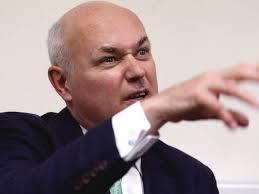
Iain Duncan Smith
A remarkable track record. To which he keeps adding
It was the brainchild of one Iain Duncan Smith. He made his name as leader of the Tory Party, taking over after its disastrous general election defeat by Labour in 2001. However, in 2003 he lost a vote of confidence of his MPs, convinced as they were that he could not lead them to success, and resigned. But he refused to go into his long goodnight as he might have done, instead reappearing as the minister responsible for benefits under David Cameron.

You don’t remember Cameron? Don’t worry. He was immensely forgettable. He enjoyed a brief and ill-deserved moment in the limelight as British Prime Minister before returning to the far more merited obscurity from which it’s unfortunate he ever emerged.

In the meantime, Duncan Smith got his chance to introduce universal credit.

A brilliant idea, as I said before.

Except that a brilliant idea in the hands of a Tory Minister, in a government wedded to austerity, is unlikely to look as generous on closer scrutiny as it sounds on the surface. So it turned out with this one. As this enlightened minister made clear in an article for the favourite paper of the Tory party, the Daily Telegraph (or Torygraph as those of us of another persuasion like to call it):

By restoring the incentive to work and ensuring that work always pays, universal credit is the strongest statement of this Government’s commitment to helping people get the security of a good job.

See the sleight of hand? “Incentive to work” is Tory doublespeak for “we’re going to make this so mean that no one could possibly live on it so they’ll be forced to take a job, however dismal”. A “good job” in this context is Toryspeak for “a reduction of one in the unemployment figures”.

Just to avoid any possible doubt, Duncan Smith also explained that “our reforms are forecast to save a total of nearly £50 billion cumulatively across this Parliament.”

Saving money. Always a welcome message for the recipients of state benefits, who know it means a major effort of generosity on the part of government.

Duncan Smith brought to the task of designing universal credit all the flair he’d shown in leading his party.

It’s taken five years to build the system. It’s being trialled right now in several local council areas. The results have been eloquent: there’s been a huge increase in dependence on food charities and in rent arrears. One food bank, according to Patrick Butler in the Guardian has reported a 97% increase in demand.

Meanwhile with that pesky housing benefit out of the way, councils are reporting huge increases in rent arrears. One council, the Guardian again tells us, reports dramatic figures:

Southwark said that although just 12% of its social housing tenants were on universal credit, they have built up £5.8million in rent arrears. The average universal credit household £1,178 in arrears, compared with £8 credit for the average council rent across the borough.

That’s why they call it universal: it spreads joy everywhere. Not just the tenants who can enjoy piling up rent arrears, and celebrate the fact down at their local food bank, but the council who sees its rent income falling.

As Duncan Smith so eloquently put it, he was building “a system that supports people to secure independence for themselves and their families.”

The wonderful thing is that, although he was sacked by Theresa May, our soon-to-be-former Prime Minister who replaced David Cameron (remember him now?) he keeps popping up and speaking out on the subjects he cares about. Most notably, he’s terribly keen on Britain getting out of the European Union. Just the other day, I heard him on the BBC explaining why Britain had nothing to fear from Brexit and everything to hope for.

It’s extraordinary, with his track record, that there are still people out there prepared to listen to him.

And, still more difficult to understand, believe him.