Sunday, 6 September 2020

The difference a real leader has made to Labour. And to the Conservatives

Boris Johnson, technically the UK Prime Minister, though many suspect he’s a puppet in the hands of his chief adviser Dominic Cummings, enjoys a reputation for wit in both senses of the word: intelligent to the point of brilliance, and endowed with a charming sense of humour. 

It’s becoming increasingly clear that this claim is tenuous ion both counts.

Don’t take my word for it. Toby Helm, in the Observer, quotes a senior Tory on Johnson’s performance against Opposition leader Keir Starmer, at Prime Minister’s Questions this week.

That’s, a senior Tory. A leading figure from Johnson’s own party.

I thought it was as bad a performance as I have seen from a prime minister in that environment. He has a problem, which is, fundamentally, that he doesn’t have the qualities to do the job properly. He doesn’t work hard enough, he is not on top of the detail, he doesn’t have a clear vision and sense of direction on most issues, and he is being found out.

Helm admits that this is at “the harsh end of the spectrum” but assures us that “such assessments of the prime minister and his government are not uncommon these days inside the party”.

Johnson (left): mercilessly exposed by Starmer


This rather gives the lie to the notion that Johnson is particularly bright. As the great inventor Thomas Edison pointed out, “genius is one percent inspiration and ninety-nine percent perspiration. Great accomplishments depend not so much on ingenuity as on hard work.” Few people any longer suspect Johnson of perspiring very much over his job.

Indeed, it feels as though he leaves the hard work to Cummings, another self-proclaimed genius. But with the government having to engage in U-turn after U-turn on policy this summer, it seems clear that Cummings isn’t a lot of good either. 

Nor should we forget that Cummings is the man who tried to justify one of several lockdown breaches by claiming that he drove to a beauty spot to test whether his eyesight was up to driving. This statement is wrong in so many ways that I’m not going to waste space listing them. Let’s just say that, as an excuse, it leaves ‘the dog ate my homework’ sounding like a glowing exemplar of truthfulness and plausibility.

What about Johnson’s sense of humour? Thoroughly rattled by Starmer’s questioning, he accused the Opposition Leader of being a supporter of the IRA. As Starmer promptly replied, he’d spent five years of his career prosecuting IRA members and working with the intelligence service in tracking them down. That left Johnson’s comment looking as dumb as it was ill-humoured. When Johnson needed a witty response, he came up with nothing better than ill-informed abuse.

To make things worse, called on by the Speaker of the Commons to withdraw his statement, Johnson refused, showing he didn’t even have the guts to admit he’d been wrong.

“He is being found out,” as Toby Helm’s senior Tory told him. “He doesn’t have the qualities to do the job properly”. Yep. Johnson was highly effective at winning the Prime Ministership. He’s totally out of his depth trying to carry out the duties that go with the post.

What’s interesting, though, is that he’s being found out not just because of his own (or possibly Cummings’) string of inept actions. He’s also being found out because he’s facing a Leader of the Opposition worthy of the title.

Labour has, in effect, been without a leader for over ten years. Gordon Brown, irascible and undisciplined, committed error after error on his way to electoral defeat in 2010. Ed Miliband, his successor, was no better, and Jeremy Corbyn gave Johnson the easiest ride he could hope for to a thumping Parliamentary majority.

Indeed, the 2019 election was a staggering instance of a battle of midgets: a clash between two men, Johnson and Corbyn, horribly alike in their sense of entitlement to high office, and equally similar in their unsuitability for it. Johnson was certainly the nastier of the two, but he was the less lamentable campaigner. So he won.

The question is what Britain had done to deserve two such deplorable leaders of its two main parties. Maybe it was Karma for Brexit.

Now, though, Labour has a real leader. He’s running circles around Johnson, whose flaws are at last being revealed for all to see.

Of course, the battle is by no means over. It’s four years until the next election. And the Conservative Party, though it’s short on principle, is very long on what it takes to win and hold power. The disquiet over Johnson in the Tory Party less than a year since he led them to spectacular success, suggests he won’t be leading them into the next election.

Who’ll take over? It’s impossible to guess. At the moment, the front runner is Rishi Sunak, the Chancellor of the Exchequer. But the Tory Party likes to destroy early front runners, and as the man in charge of the nation’s finances, Sunak has a bad time ahead – dealing with the economic impact of Covid and Brexit is likely to overwhelm him with bad press.

The encouraging sign for Labour? Starmer’s skill in dealing with Johnson suggests that he’ll cope with his successor too. Even a change in leader may not save the Tories at the next election.

Though Labourites need to remember that such a hope is only possible because, at last, we have a professional politician as leader.

Thursday, 3 September 2020

They shall not pass! Resisting a Trump coup

 Right about now, something terrible is happening in America. Society is one tiny step away from the final collapse of democracy, at the hands of a true authoritarian, and his fanatics. Meanwhile, America’s silent majority is still slumbering at the depth and gravity of the threat.

Grim reading. It comes from a piece signed by ‘Umair’ who claims to speak for a group of “survivors and scholars of authoritarianism”. Speaking for people who’ve already taken refuge from authoritarian regimes, his message is, ‘we’ve been there and we know the signs’.

The signs include Trump’s incitement of violence and backing for it, as when he defended the young supporter charged with murdering two people in Kenosha. Trump also uses federal agents without name tags to disappear opponents off the streets, without warrants and without accountability.

Now I’ve long been aware of Trump’s authoritarian temptation. But I hadn’t thought that he’d already taken the US to the very brink. What finally opened my eyes to the imminence of the danger was that this piece, passed to me by a friend in the US, wasn’t going to be the only warning of approaching authoritarianism I received that day. My wife also sent me an article from the New Yorker which was just as stark.

The journalist quoted Steven Levitsky, co-author of How Democracies Die, who told him:

I don’t normally like to make these comparisons, but this sort of encouragement of violence for political purposes is worryingly similar to what the Fascist movement did in Europe during the nineteen-twenties and nineteen-thirties.

We try to avoid comparisons with Hitler, since they’ve become threadbare from over-use. Besides, while there’s no saying how far Trump might go in brutalising groups he hates, such as immigrants, he doesn’t seem intent on mass murder yet. That might change, of course. After all, there’s a track record of ethnic cleansing in the States. 

Take the trail of tears, for instance. This was the forced expulsion under President Andrew Jackson of 60,000 law-abiding Cherokee and other Native Americans from the South-East. Around 15,000 died. 

A great many Americans persist in viewing Jackson as a democrat. Who knows what an authoritarian might do.  

Still, Trump hasn’t gone that far yet. So people often compare him to Mussolini rather than Hitler. For my part, though, perhaps partly because I live in Spain, I see a closer parallel to Francisco Franco.

Is Franco the right Fascist model for Trump?


In one respect, Trump has nothing in common with Franco. The Spaniard was a soldier, at one time Europe’s youngest general since Napoleon. Trump went to exceptional lengths to ensure he never had to serve in uniform. Franco, for all his many faults, was a man of proven physical courage.

Trump is far keener on the military these days, now that he can order soldiers into harm’s way without having to share their fate. Why, he even tried to send the Army to intervene against civilian protesters back in June. Military leaders refused the order, but who knows what orders they might obey in the future.

This could be a key issue after the presidential election in November. Trump has made it clear that he intends to challenge the result if he’s defeated. Ultimately, it may come down to having to force him out of the White House, and that might require the Army.

But would it act?

If Trump wins the support of the Army to hold onto power illegally, then he will have become a new Franco. The Spanish dictator’s authority derived only from force of arms. He won a bitter, three-year civil war and then ruled for a further 36 years, dying peacefully in his bed, never held to account for his crimes. These were outstanding: nearly 500,000 dead in the Civil War, 50,000 executed in the years that followed it, along with 250,000 gaoled in brutal conditions, leading to numerous more deaths.

Franco was extraordinarily lucky. Two generals, both better placed than he to lead the movement, were killed in separate and almost certainly accidental air crashes. The Republicans, Franco’s enemies, also did him a great service by killing (executing or assassinating, depending on your point of view), the leader of the Falange, the Spanish Fascist movement.

Franco purged the Falange further himself, until it became an organisation led by mediocrities and sycophants. At that point, and not before, he took it over and made it Spain’s only legal party.

This is one of the great points of similarity between Trump and Franco. Neither of them believed in much. Franco’s slogan was ‘Spain, united, great and free’, with ‘free’ being used in a special, Francoist meaning, which has echoes in Trump’s ‘Make America Great Again’. Especially as greatness escaped them both. Franco may have had a stronger faith than Trump, but both used religious institutions to advance their power: the Roman Catholic church for Franco, Protestant fundamentalism for Trump.

Otherwise, neither Franco nor Trump had any particular ideology. Neither was Fascist by conviction, only by opportunism: they would draw on the support of Fascists, and they’d be happy to use Fascist methods, but only as suited their personal ambitions.

In other words, Franco was above all a Francoist, just as Trump is above all a Trumpist. That is the key to understanding both men.

Not that they’re any less dangerous for being driven by unbridled ambition rather than any system of principles. Franco was ruthless in inflicting his terror on Spain. We’ve seen Trump’s brutality already, while he still accepts some constraint from law. What would he do freed of those legal limitations?

That’s where we’re heading. It seems clear to me that if he wins this year’s election, the chances of there being another in 2024 diminishes sharply. He has already talked about serving twelve years in power, and maybe we should learn to take his pronouncements of that kind seriously.

Even if he’s beaten in the presidential election, will he go? And if he decides not to go, where will the Army stand?

That is where we shall have to see whether Trump’s complete transformation into the new Franco can be stopped or not.

It was chastening to receive two warnings of where the US is heading in the space of a single day. Warnings we need to take seriously. Because if the would-be authoritarian isn’t blocked now, it may well be too late afterwards.

When Franco made his bid for power, the other side would cry “they will not pass”. But they did pass. What a tragedy if the US lets their Franco pass today as Spain’s did back then.

Blocking him means his defeat in November. A massive defeat. So decisive that there’s no way it can be questioned.

Tuesday, 1 September 2020

Treason and other matters for flushing down the pan

It's funny what our subconscious can sometimes dredge up.

This morning I woke with a few odd words of a bit of verse rattling around in my mind. Something about ‘treason’, made to rhyme with ‘reason’. That’s all I could remember, but it’s great to have the web so readily to hand, isn’t it? How on Earth did we get by before we had access to it?

The best thing is that tracking the words down taught me a bit more about their author, John Harington, than I knew, or even guessed, before.

It turns out that Harington was one of those great but obscure benefactors of humanity, whose contribution is immeasurable and by no means adequately recognised.

He invented the flush toilet.

A contribution of inestimable benefit to mankind:
Sir John Harington’s flushing toilet


His aim, as he explained, was to ‘make unsavoury Places sweet, noisome Places wholesome and filthy Places cleanly’.

This was back in the England of Elizabeth I, as you may have spotted from the language. One of her 102 godchildren, Harington made a flush toilet for her, but she was apparently unimpressed. She was perfectly happy with her ‘closed stool’,  basically just a wooden piece of furniture with a lid to shut out smells (I imagine not terribly well), a seat and a chamber pot.

Of course, Elizabeth didn’t have to empty the pot.

Harington’s invention didn’t enjoy the success one might have hoped for it. Flush toilets, with the salutary addition of an S-bend, finally began to be more broadly adopted in the eighteenth century. But Harington did have one installed in his own home. He also wrote a book on the invention, A New Discourse upon a Stale Subject: The Metamorphosis of Ajax

Ajax is a pun on ‘a jakes’, a slang term of the time for a privy.

Unfortunately (for him), he didn’t stick exclusively to the subject of the jakes. A book about excrement and related matters lent itself far too easily to commentary on politics. Or it certainly did back then. Probably today as well. After all, the politicians we’re blessed with today seem at least as likely to leave us navigating the contents of a sewer as any others in the past. However, in a spirit of strict political neutrality, I’m going to refrain from mentioning, in this context, either Trump or Johnson (or should that be Dominic Cummings anyway?)

In his book, Harington had a go at the Earl of Leicester, a bit of an insensitive move on his part, since it was a subject on which the Queen was highly sensitive. After her death, a letter from Leicester to her, the last he wrote before he died, was found in her bedside table, marked in her own hand, ‘his last letter’.

Still, Elizabeth must have had a soft spot for this godson of hers (presumably not as deep a one as for Leicester), since all she did was banish him from court for a while. It wasn’t the first time that had happened to him. He must have been relieved not to have suffered a worse fate.

Sir John Harington
Wit and benefactor to humanity


As for myself, shamefully unaware of his substantial contribution to human happiness, it was his quickness and wit on political matters that that I’d always found appealing. Cynicism has a justifiably bad press, but sometimes, if it’s reasonably gentle, it can add just the touch of spice that turns a mere comment into a joy. If it’s as insightful as it’s barbed, that makes it all the more memorable, and certainly memorable enough to rattle around my brain as I wake from sleep one morning.

Here, with no further ado [but please imagine a drum roll], is Sir John Harington on the matter of treason:

Treason doth never prosper, what’s the reason?

Why, if it prosper, none dare call it treason.

Friday, 28 August 2020

If this is disloyalty, we need more of it, not less

It had to happen, I suppose. Eventually a different narrative had to emerge. And, since the original one wasn’t particularly believable, the alternative was likely to be a lot more plausible.

Corbyn: cheated of victory by disloyal critics?
Or saved as long as possible from himself by those critics?

His supporters’ account of what happened in the two elections for which Jeremy Corbyn was leader of the Labour Party, runs something like this.

In 2017, he came tantalisingly close to winning the election, gaining the biggest single increase in popular vote of any Labour leader since the war. He was cheated of victory by the deliberate and treacherous behaviour of a number of Labour Party staff and members, led in particular by thoroughly disloyal Members of Parliament.

Just another 2500 votes would have given Labour the victory.

Then, in 2019, those same disloyal staff, MPs and members, conspired to undermine him further, willing to lose the election to Boris Johnson, as the price for driving Corbyn from the leadership.

It was a never particularly convincing story.

That’s first of all for a question of principle. Call me old fashioned, but I believe that occupying the leadership isn’t simply a matter of honour or even authority, it’s also a matter of responsibility. The first responsibility for a defeat is the leader’s. Any attempt to attribute blame to someone else is scapegoating to avoid personal accountability.

Secondly, the Corbynist explanation also fits the facts badly.

While Labour surged in the popular vote, that was less to do with Corbyn’s success, and much more to do with the continuing collapse of the Liberal Democrats as a rival party of the centre-Left.

Surge or not, Labour was still nearly 2.5 points behind the Tories in the popular vote, and ended up with 55 fewer Parliamentary seats. To set Labour’s achievement in 2017 in context, it lost then with 40.0% of the popular vote. Back in 1970, it also lost, but with 43.1%. In a first-past-the-post, constituency-based system, winning the popular vote only wins an election if it’s spread geographically the right way.

That’s where the tale of the 2500 for victory votes fails. The votes would have had to be in exactly the right constituencies, and that’s not something any campaign can engineer. Indeed, a smaller switch to the Tories, of exactly the right votes in the right places, would have given them a Parliamentary majority. The reasoning is meaningless.

As for the effect of the disloyal staff and members in 2019, with an extra two and a half years in charge, the Corbynists had greatly reinforced their control of the party machine. Internal opposition to Corbyn was far less powerful in 2019 than in 2017, and yet the defeat was far greater.

Patrick Heneghan.
Disloyal or working to stop Corbyn making things worse?


Which is what makes the new narrative more plausible. It comes from Patrick Heneghan, previously Labour’s executive director for elections and campaigns. He’s one of the former Labour staff accused of disloyalty by Corbyn supporters. By his own admission in the Huffington Post, he did indeed engage in action in direct opposition to the leader’s instructions.

He was part of a group that defied Corbynist instructions to defund a number of constituency campaigns in 2017. And which campaigns were listed for defunding? Why, they were all constituencies held by Labour MPs who had been critical of Corbyn.

In other words, the leader was deliberately jeopardising attempts to beat the Tories, because that mattered less to him than eliminating internal opposition to his rule.

Now, it’s true that some of those MPs were sitting on large majorities. But, since many of those seats were indeed lost in 2019, it’s clear they were by no means as safe as they might have appeared. Besides, the leader was trying to redirect the funds into campaigns for seats occupied by his loyalists, with majorities just as large.

So Heneghan and his group surreptitiously set up a separate fund, away from the leadership’s control, to funnel finance to the MPs Corbyn wanted defunded. And indeed the seats were held.

This is quite a statement, because it suggests that Corbyn’s relative success of 2017 – losing less badly than expected – was at least in part down to ‘disloyal’ staff disobeying his instructions and properly funding certain campaigns against his wishes.

With this in mind, it’s pretty obvious what happened in 2019. People like Heneghan could no longer influence events. A lot of the MPs opposed to Corbyn had been muzzled or had left. Indeed, the Deputy Leader, Tom Watson, had decided to leave Parliament altogether. So suddenly the bridle that had prevented him doing far more damage in 2017 was gone. And, unsurprisingly, the damage was far greater.

Why, we even lost Tom Watson’s former seat.

In this account, it wasn’t the supposed disloyalty of the staff that caused the disaster of 2019. It was because that supposedly disloyal group could no longer prevent it. It was they, and not Corbyn, who had limited the defeat of 2017; with their influence weakened in 2019, the defeat became a rout.

While the ‘disloyal’ group was able to influence things, losses were contained. When its influence waned, losses soared.

I don’t know about you, but that suggests to me that ‘disloyalty’ of this kind, to the Corbyn faction, was all that saved Labour in 2017. The disaster of 2019 was because ‘disloyalty’ of that kind was no longer in a position to save the party from Corbyn.

Or, putting it more positively, maybe loyalty to the party as a whole required disloyalty to Corbyn while he was leader. 

Corbynists won’t agree, but I can’t help finding that explanation of the facts far more convincing than theirs.

Wednesday, 26 August 2020

First Birthday

How a year can whip by. Or last an age…

When it’s just one sixty-seventh of your life, as in my case, it seems little more than the blink of an eye. But when it’s the whole of your existence, it’s everything. Nothing could be longer.

That probably makes it a real mercy to be pretty unaware of the passage of time in your first year. Otherwise it might seem painfully long. But it’s fine if you just enjoy each day as it comes, testing your increasing powers and resources as you go, as most of us do at that age. It’s only a shame that you’re unlikely to remember any of it later, since when else are you going to be that carefree?

First Birthday party
The cake was such fun. Especially when I could pick the fruit off it

At any rate, it was a great pleasure, and a privilege, to be able to attend the first birthday celebration of my granddaughter Matilda. And to wish her well on the second year that she’s just starting. There’ll be a lot of fun for her. Though there might also be a little pressure.

That’s the problem with life. It’s full of expectations. At first, it’s mostly other people who have them. Later on, you have them yourself, which is even more painful.

In Matilda’s case, for now, it’ll be mostly other people’s.

Poor thing. We were all so pleased when she mastered the art of crawling. She does it now with what can only be called aplomb. Great skill. To say nothing of speed.

But, I’m sorry to say, Matilda, adults are fickle. We’ll soon be expecting you to do that thing called walking instead. And once you’ve mastered that, it’ll be running that we’ll demand. Just be thankful that, for the moment, you’re not being asked to do it the other way around. Once you start work, you’ll meet plenty of people who’ll claim that nothing could be further from their minds but, in fact, demand that you run long before you walk.

And then there’ll be language too. For the moment, it’s pretty clear that you understand English well. We ask you to do things, and you do them promptly. If they’re things you want to do. We’re not fooled, you know: when you fail to do things, it isn’t down to your not understanding us, but to your deciding we can wait. Until you’re good and ready. Or even longer.

Why, you’ve even started to produce some words yourself. I keep hearing ‘yes’, at least at the ‘ya’ level. You don’t bother with ‘no’ because you have gestures for that and, boy, are they unambiguous.

We’ve heard something that sounds like ‘Mummy’ and a series of sounds that could be taken for ‘papa’ too, at least in the form ‘baba’, but that’ll do just fine.

Your grandmother and I are also certain that we heard you say ‘granddad’ a couple of times but, hey, we’re hardly impartial observers. Every else denies it. They may be right, but I like to think they aren’t.

You should, of course, keep on making the great progress you’ve already shown in language. The bad news, though, is that you’re about to face a challenge in this already difficult area.

You live in Spain, you see. You’ve probably noticed that lots of the people you meet make sounds that aren’t like those your parents and grandparents produce. By your reaction, you know very well that they mean well, and it wouldn’t surprise me that you understand them too already, since you’re bright enough. But here’s the thing: you’re going to have to start mastering those sounds yourself, as well as English ones.

Are you ready for that? Learning Spanish too? Everyone will tell you what a great advantage that’ll be for you, and they’re right. But it’s another task you have to take on, another challenge that you have to face.

And that’s the thing about life generally. It’s always that way. You get a challenge, you rise to it. And what’s your reward? You get to face another challenge, usually harder than the last one.

You don’t know about climbing mountains yet, but you will, since there are plenty near where you live. And the thing about climbing them is that you see a slope ahead of you leading to a crest, and you expend so much energy to get to the top of it that you feel you can’t go another step. And what do you find? That far from being at the top of the mountain, you’ve just got another slope with another crest ahead of you.

Still, if you press on you do get to the top in the end. And that’s a great feeling. In fact, so good a feeling that you can end up looking for more mountains to climb just to enjoy that feeling again.

You don’t yet about metaphors, or a metáforas, but that was one of them.

A year is long in the short time you’ve had so far. You’ve started another one now, and it won’t feel quite as long. But, boy, it’s going to contain a lot to learn, a lot of mountains to climb, and a lot of achievements you can take satisfaction from.

Enjoy all of it. It’ll be fun to join you at your second birthday party, where we can celebrate all your new accomplishments. And I’m looking forward to helping you enjoy quite a few more birthdays after that.

Just a year ago. But it feels like an age


Monday, 24 August 2020

Disappearing Toffee

 It was all misunderstanding, it turns out, in the end.

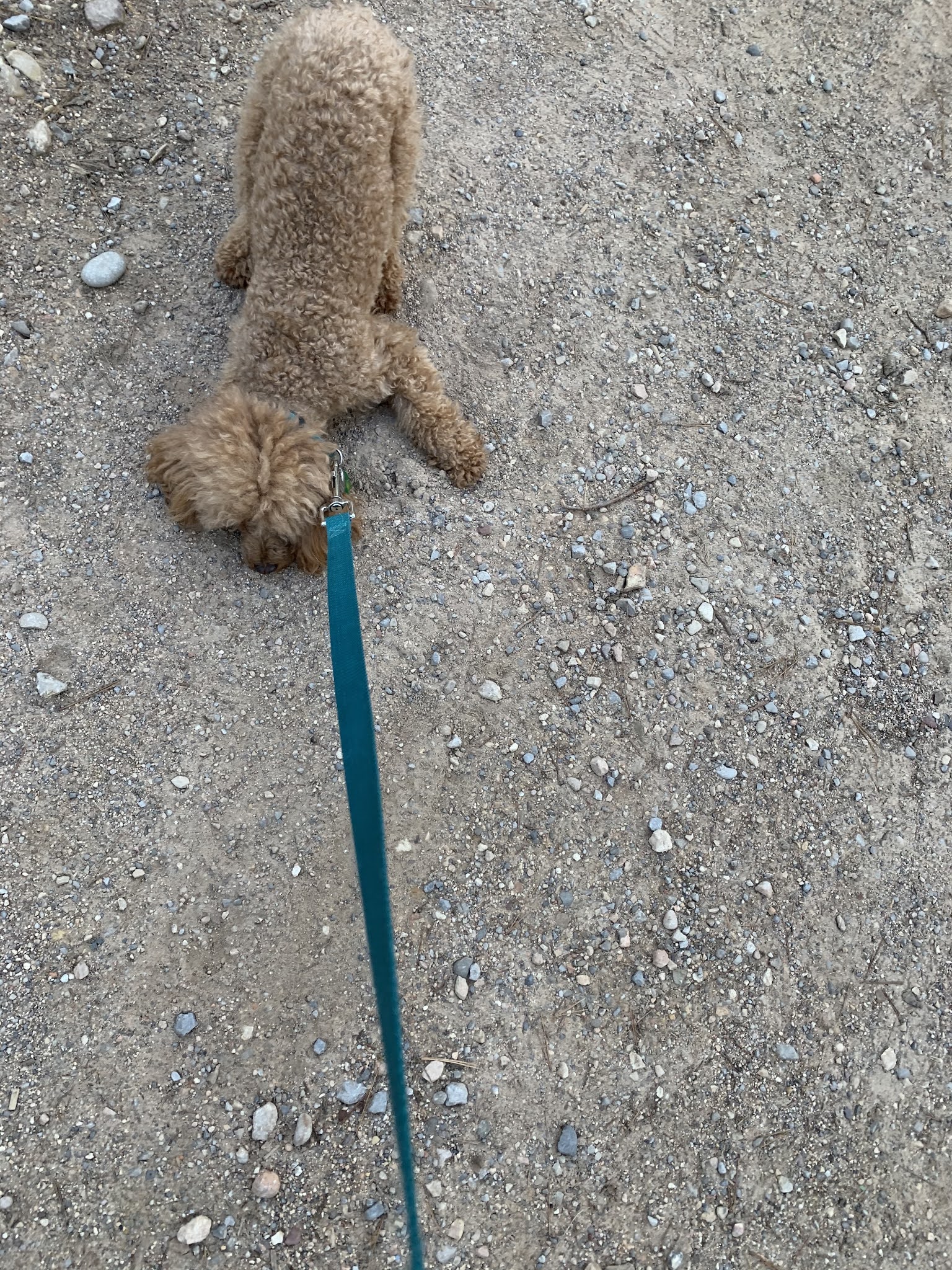
Toffee, our toffee-coloured toy poodle, doesn’t just like to walk around the woods with me. In fact, she would probably prefer not to have to walk around the woods anything like as much as I make her. But when she does have to, she wants to be able to check interesting things out.

Toffee walking in the woods


You know, get underneath that bush from which a curious smell is emerging.

Or stop to investigate carefully another dog’s pee from a large rock on the path, because there are a lot of questions to answer about that kind of thing: I mean, was it a big dog? A fierce dog? A male dog or a female like Toffee herself?

As well as all those interesting considerations, there’s the more urgent matter of whether it was there quite a while ago or just recently. Because that can make quite a difference to how we behave going forward: advancing breezily with never a worry in the world, or much more cautiously and with apprehension.

Above all, whatever our investigations lead to, there’s one vital task which we’re certainly going to carry out: Toffee must leave her own calling card on top of the stranger’s. That’s the quickest bit: crouch down, quick spray, move on. Job done.

The thing about all that is that it takes time. And if I don’t stop and wait until she gets to the end, there’s a terrible chance that I’ll be out of sight by the time she’s finished. And then what is she to do?

I reckon she ought to be able to smell the way that I’ve gone. Especially since Luci’s there too. But it seems it’s not that simple. Toffee likes to work by line of sight. If she can see us, she can follow us. If she can’t see us, well, she can’t work out where we’ve gone.

Talking about Luci, who’s the other toy poodle, she couldn’t be less like Toffee in this regard. I mean, they both show entirely justified care of other dogs around and about. Especially big ones. They have that much in common at least.

Toffee and Luci together
So similar and yet so different


Luci always has been afraid of other dogs, but then she’s always been more timid. In fact, when she first joined us, she came from a family who’d never taken her out on a walk. She was scared even of going outside. A place with no ceiling? With no walls around her to keep her safe? And we expected her to like it? She would regularly make a dash for home.

Eventually, though, she adapted and now she enjoys her walks at least as much as Toffee does.

Toffee was much bolder right from the start. She used to go right up to other dogs and see if they’d like to be friends. To be fair, none of them ever bit her, but a few of the bigger ones trampled her a couple of times. Not always deliberately, mind you. When there’s such a lot of you, sometimes you can lose control over where every single bit of you is, and when you’re as small as Toffee, that bit might right on top of you.

So she’s learned to be as wary of other dogs as Luci. But not, unfortunately, in the same way. Luci always knows where we are. Even if a large dog shows up, and Luci disappears into the undergrowth, she’s always keeping an eye on us so that, once the hazard has passed, she can reappear next to us, even if we’ve kept moving down the path.

That’s a useful skill that Toffee sadly doesn’t have. As I said, if she gets a bit too far from us, whether avoiding another dog or simply because she’s stopped to investigate something interesting, she forgets to keep an eye on where we are, so she can’t automatically find us afterwards.

I reckon that’s what happened the other day. Once she’d finished with her business, she looked up for Luci and me and couldn’t see us. So she did a sensible thing: she took the path I usually take to get home from that place.

Unfortunately, that wasn’t the path I’d taken that time.

The result? A missing dog situation.

Stupidly I didn't follow my instinct and look for her on my usual path, where Toffee had actually gone. Instead, I walked up and down and around the place I’d last seen her, calling her and whistling, in increasing trepidation.

It took half an hour before I finally decided to try out that other path.

I met a couple coming the other way, with two large dogs (you understand that ‘large’ is a relative term, and I’m applying a toy-poodle scale). I asked them if they’d seen a little orange poodle, but they hadn’t.

Disappointed, I turned back the way I’d come. But then the man called out: “is this your dog?”

“No,” I replied, thinking he’d seen Luci, who had as usual decamped into the undergrowth when she’d seen the large dogs, but about whom I wasn’t worried, “that’s the black one. I’m looking for the orange one.”

“But this one is orange,” he said.

I went back to take a look. And, joy unconfined, it was indeed Toffee!

Well, the joy was rather one-sided. Toffee wasn’t ready to forgive me for what she clearly regarded as an abandonment. She has a way, when she’s fed up with being overwalked, of lying down in the path and refusing to move, until I pick her up. She did that several times on the way home, but each time I took her in my arms, she wriggled to be put back down again.

You want me to keep going?
Then you can pick me up and carry me


The message was clear.

“No, I don’t want you carrying me. You’re the one who walked off and left me all alone in the woods. Where anything could happen to me. I don’t like you any more.”

Fortunately, it didn’t last. It took a while, but by the afternoon she’d relaxed enough to be friends again. And, as usual, took her siesta lying next to me on the couch.

Friends again


All’s well as ends well, I suppose. But I’m going to be taking things a lot more carefully on our future walks…

Saturday, 22 August 2020

The Hitler lesson that doesn't breach Godwin's Law

 Godwin’s law states that any online discussion, if it goes on long enough, will eventually include a statement comparing someone to Hitler or his actions. So you’re talking about some particularly unpleasant political leader, for instance, and he’s known to have used excessive force against his opponents, maybe the army against protestors, and someone points out that this is an act worthy of Hitler.

The effect is to end any useful conversation in the thread.

This is because generally what people are comparing others to is the most infamous and obscene of Hitler’s deeds, the Holocaust. That’s the deliberate, planned extermination of all the 12 million Jews of Europe, together with homosexuals, Romanies and other minority groups.

The emphasis is on ‘deliberate’. There wasn’t even a pretence at ethnic cleansing by physically displacing people. It was, from the time of the Wannsee Conference of January 1942 when the ‘final solution’ (i.e. the mass murder of the Jews) was adopted as official policy of the Nazi state, a clear intent to wipe out a people by mass murder.

That was a crime so heinous as to be without precedent and, indeed, unique to this day (let’s hope it stays so). So comparing any other act to it is obviously nonsensical, and almost certainly a ludicrous exaggeration.

However, though the Holocaust is obviously Hitler’s most shameful crime, it was by no means his only toxic act. Others were less sickening but deeply threatening all the same. And there’s no reason why we can’t compare the behaviour of other politicians to them.

Trump and Hitler 
A comparison to the worst crime is inappropriate or at least premature
But stealing power with a minority? That works. And it’s frightening


The Guardian journalist David Smith recently quoted a US politician, talking about Trump:

The Democratic Congressman Jim Clyburn, whose endorsement of Biden was critical to his nomination, told the Axios website in March: “I used to wonder how could the people of Germany allow Hitler to exist. But with each passing day, I’m beginning to understand how. And that’s why I’m trying to sound the alarm.”

He’s absolutely right to do so.

One of the terrifying actions Hitler took prior to the Holocaust, and an action that would ultimately make the Holocaust possible, was his seizure of power.

He never won a majority of the German electorate. He peaked in the election of July 1932, when the Nazis took just over 37% of the vote, making them the biggest party in Parliament, though without a majority. When elections were held again in the same year, in November, the last free multi-party elections before the Nazis fell from power, their share fell to just over 33%.

But that didn’t stop him from being called on to form a government. Once in power, of course, he had the means to ensure that no free elections would be called again. When elections were held in March 1933, after months of terror directed against the left, the Nazis still only managed just under 44% and still had no Parliamentary majority. But then, in November 1933, the Nazis were the only legal party and took 92% and, surprise, surprise, 100% of the seats.

So Clyburn is right to point to the dangers now facing the US. Just like in Germany in 1932, a vocal and apparently solid – one’s inclined to say solid from the neck up – minority of voters persist in supporting a dangerous autocrat, despite his proven incompetence, mendacity and corruption.

It’s extraordinary that anyone can support Trump despite those proven charges against him. We’ve seen his inept handling of the pandemic. We’ve seen his use of a pardon to protect a convicted criminal who stayed loyal to him. We’ve seen him lying about the extent of his support. But despite all that, there is a large minority that continues to back him.

That’s all it took to get Hitler into power too.

Once he’d got there, Hitler immediately set about dismantling the apparatus of democratic accountability that might have prevented him retaining power.

And isn’t that exactly what Trump is attempting to do now? He’s even trying to demolish one of the oldest institutions in the US, the postal service, to prevent people being able to cast votes by mail.

Now that is a valid parallel with the behaviour of Hitler. You don’t have to pretend that Trump is a man who wants to launch a new Holocaust – that’s not the similarity. What makes him like Hitler is his utter conviction, against all the evidence, that he’s the man to lead the US. And the unscrupulous means he’s prepared to use to cheat his way into holding onto power.

What happens later it’s hard to say. Except that, Holocaust or not, it didn’t work out well for Germany, did it? And the rest of the world had to pay a huge price too.

US voters have a serious responsibility in November. Jim Clyburn is right to underline the fact.

And that’s no breach of Godwin’s Law.