Sunday, 7 November 2021

Show time and a time for words

It was an evening of firsts.

The minor one was my first theatre visit in Spain. We used to be keen theatregoers in London years ago, but rather lost the habit after moving abroad. And, certainly, given how slow our progress towards mastery of the language has proved (mastery! Id settle for mere competence), we haven’t been at all since arriving in Spain.

But the really important first was Matilda’s. It was this granddaughter’s first time in a theatre anywhere. In any language. 

Matilda luxuriating in her theatre seat
Now, since Matilda’s two, you can probably guess that we weren’t there for one of the great classic plays of the Spanish renaissance. No rolling cadences, no rhyming couplets. Which is just as well, since I’d have probably understood even less of it than Matilda. Instead we got an excellent performance, with a wide range of characters even thought there were only two actors. Highly talented actors, both of them, but just two.

It was curious. There was plenty of what I suppose one can think of as entirely transparent marionette play. You could see the actors holding the marionettes and moving their hands or heads around with little rods in their back, but they did the voices and the movements so well, that it was easy to suspend belief and accept that we were really watching the characters represented.

The story conveyed a universal and important message. The central character, played by the woman actor as human not a puppeteer – and she was a woman, not a girl, though again it was easy to believe in her as a girl – had lost the capacity for excitement. She spends the day hunting for excitement in all sorts of places, meeting all sorts of other characters, but never tracking excitement itself down.

On the other hand, at the end of this day of questing, she realises that she’s had a tremendously exciting time. So clearly she’s found plenty of excitement in the process of failing to find excitement. A clever, witty paradox, full of subtle meaning and intelligent reflections on life. An excellent lesson to communicate to young kids – I think Matilda was the youngest – which the show did particularly well for being performed so skilfully. 

Matilda’s attention wasn’t held the whole time. But it kept coming back to the stage. And I think the magic of sitting with an audience in a large, darkened area while everyone focused on the brightly-lit stage – the magic of the theatre, in fact – communicated itself to her. It helped, too, that though the action of the story lasts a day, the performance lasted an hour. Intelligent writing by people who understand the concentration span of young children.

The fascination of the theatre
How much did Matilda understand? Well, it’s long long been known that kids understand language far, far sooner than they can produce it themselves. This is now entirely clear with her in English. She’s so good at doing what we ask her to do, and with alacrity, that we’ve smartened up to the fact that when she doesn’t, it’s not because she hasn’t understood the instruction – I’m sorry, this being Matilda, I should have said request – but that she has chosen not to comply.

I don’t know, by any direct means, how well her Spanish is advancing. Probably a lot better than mine (see above). In term time, on weekdays, she spends six hours at school and, while for part of that time she’s asleep, for most of it she’s active and focused, in an entirely Spanish environment.

That school strikes me as an extraordinary institution. I suppose many in England would be inclined to see it as merely child care. And so it is, in a sense. But it’s childcare provided by qualified teachers, doing intelligent work: the kids work with plants to learn about the environment, they draw, they paint, and of course they work on language. Immersion language teaching. And all for free.

Indeed, some of Matilda’s first words were Spanish. ‘Hola’ is what she says to strangers in the street, generally causing them to dissolve in delight when she does. To this day, and even with her English-speaking family, ‘agua’ is the word for water and what she asks for when she’s thirsty. On the other hand, when she wants a drink with more flavour, the word is ‘juice’.

There was no doubt she was saying ‘more’ when she felt we hadn’t given her enough food, even though the word came across more as ‘mare’ or even, a little, as ‘may’. But just a couple of days ago, a clear, definitive ‘more’ emerged. Not only is she learning the language, shes learning to to produce it correctly. 

She’s also beginning to combine words as well, as so ‘no agua’ tells us clearly that the thirst is quenched, thank us very much, and it’s time to move on to catering to her other requirements.

That’s quite interesting, as it happens, because ‘no’ in Matilda’s vocabulary is clearly English, with a nice round ‘o’ to rhyme with ‘sow’. Yes, on the other hand, is ‘si’.

Now I know I shouldn’t read too much into any of this, but you know how it is with humans. We see symbolism of deeper truth everywhere we look. I’m no exception.

Affirmation in the language of a proud nation that has nonetheless understood, after a horrible civil war and 40 years of dictatorship, that its future of peace and democracy is best secured in association with its neighbours in the European Union. And that the small loss of national sovereignty is a small to pay for the benefit.

While negation is expressed in the language of sad little Brexitland, sure that it’s still a global power though that slipped through its hands over half a century ago. The voice of a declining nation that is only now beginning to contemplate the wretched consequences of its 2016 decision. The nation that left the very Union to which Spain contributes and from which it benefits.

At two, Matilda seems to have got all that pretty much right.

Thursday, 4 November 2021

Anthem for an anniversary

For today’s anniversary, I thought we needed a poem. So here’s one that seems to work. It’s called Anthem for Doomed Youth.

What passing-bells for these who die as cattle?
Only the monstrous anger of the guns.
Only the stuttering rifles' rapid rattle
Can patter out their hasty orisons.
No mockeries now for them; no prayers nor bells;
Nor any voice of mourning save the choirs,
The shrill, demented choirs of wailing shells;
And bugles calling for them from sad shires.

What candles may be held to speed them all?
Not in the hands of boys, but in their eyes
Shall shine the holy glimmers of goodbyes.
The pallor of girls' brows shall be their pall;
Their flowers the tenderness of patient minds,
And each slow dusk a drawing-down of blinds.

Manuscript of Anthem for Doomed Youth
held by the British Library in London

It’s one of Wilfred Owen’s powerfully moving pieces against the horror he experienced fighting in the trenches of the ‘Great War’, which wasn’t great. It was also known as the First World War, though it wasn’t really the first either (but I’m not going into that here).

Why do I think it’s remarkable? Well, to start with, it strikes me as one of the most finely built poems I’ve ever come across. It has the classic structure known as a sonnet, fourteen lines, often divided – for instance in French – into two quatrains (four-line bits) and two tercets (yep, that’s right, three lines each). This one follows the more English format of an octet (eight) and a sextet (six), but I’m not sure I like the term sextet, because it may seem to suggest something else.

I meant a six-instrument jazz ensemble, of course. What were you thinking of?

The first line of each section is a question, with the rest providing an answer, which is neat. But then Owen, in parallel, has a second structure that splits the poem into equal parts: the first seven lines are about the front line, the last seven about the home front, introduced by the reference to sad shires – the counties of Britain grieving their losses.

Overall, the poem is about the barbarity of the special kind of death meted out in the trenches, which receives none of the solemn ceremony of church services. There are no passing bells, no candles held by boys, no traditional prayers. Indeed, what prayers there are – he uses the word orisons – are pattered out hastily by the stuttering rifles and the monstrous anger of the guns.

In any case, Owen rejects all those ceremonial gestures as mere mockeries, in the face of the reality of the war. It makes no sense. It’s worth nothing. So all those lives snuffed out will be marked only by the holy glimmers of goodbyes in boys’ eyes, in the pallor of girls’ brows, and in the tenderness of patient minds.

And every time evening slowly falls, it will be like the drawing down of window blinds, traditionally a sign of mourning in English homes. 

Even the words he uses underline the pity of his message. The first line ends with the word ‘cattle’. In a war poem, you might expect it to rhyme with ‘battle’, but battle is about strategy and maybe glory, and Owen wants nothing to do with either. Young men who die as cattle aren’t doing it for honour, nor are their deaths providing honour to anyone.

It’s just like the bugle. The bugle can be the instrument that calls soldiers on to the glory of war. In Owen’s poem, it merely provides a sad lament from unhappy homes to men who can never hear it.

I’ve barely scratched the surface. If you spend a few minutes looking at the sonnet, you’ll probably find more richness concealed in those mere fourteen lines. It’s that wealth that makes Owen outstanding, It also makes me think of the preface he’d begun to write, for a collection of poetry that was never published before he died, but was found in the papers he left behind. In it he claimed:

Above all I am not concerned with Poetry.
My subject is War, and the pity of War.
The Poetry is in the pity.

The poetry is in the pity. And the savage pity of this poetry is that on 4 November 1918, which is why today’s the anniversary, Wilfred Owen was killed by the monstrous anger of guns. Another week and he’d have survived until the armistice, on the 11th.

“My subject is War, and the pity of War.” Could he have found poetry in peace? We never found out because he never got the chance to show us. 

All he left us with was poetry filled with the pity of war to remember him by.


Wednesday, 3 November 2021

All Hallows, or a monster for the day after Halloween

I had an unusual experience on All Saints’ Day. Or All Hallows day, to give it its older name, which at least has the merit of explaining why the day before – the eve of All Hallows – is called ‘Halloween’. 

All Hallows is the day for all saints, or rather all other saints, the ones that haven’t been officially recognised by the Catholic Church. Which means, in Christian theology, anyone who died in whatever the Church regards as a State of Grace. 

Most Catholics are pretty certain that this goes for all their dead relatives. Even when they were rotten crooks, bullies and serially cheated on their partners throughout their lives. Nothing but good of the dead, is the old saying, so we all know, or at least claim, that the dead – well, our dead anyway – were uniformly good.

In many Catholic countries, All Hallows is when people visit cemeteries to pay their respects to dead relatives. Here in Spain, the day is a public holiday. So nobody has any excuse for not popping down to the cemetery and showing Granddad José María or Auntie Inmaculada Concepción that they still care.

With me, my visit to a dead man happened by accident, without a plan. I know they say, “fail to plan, plan to fail”, but the other saying is “If you want to make God laugh, tell him about your plans.” I know that comes from the Gospel according to Woody Allen, but it has an air of sanctity about it (unlike Allen himself), so it seems more appropriate to All Hallows.

I was out with the dogs, up near where we’re staying in the hills to the north of Madrid. This area does autumn much more seriously than our home region near Valencia. So we’d had three days of rain and dropping temperatures.

But on the morning of All Hallows, the sun came out, the clouds cleared, and the only traces of rain were ephemeral streams criss-crossing my path, and they only made the landscape, usually so dry, more attractive than ever.

At a junction of two paths, I had an experience worthy of the poet Robert Frost. Should I go down the road less taken, as he did? Well, I decided I would. Especially as, unlike Frost, I’d been down the other one before, had the chance of trying the second one, and felt like a change.

Palacio Canto y Pico
Also known as ‘Franco’s House’
Soon I saw an imposing building on a hill ahead of me. Which I recognised. It was what I’d always thought of as ‘Franco’s House’. So it turns out I was, indeed, remembering a dead man on All Hallows. Unfortunately, that wasn’t one of the dead I might have wished to respect, but the man who’d been dictator of Spain for nearly forty years. The caudillo as he liked to call himself. That translates roughly as ‘chieftain’, a fine expression of the primitive and brutal nature of his regime.

The house was a villa in the hills to which he could retreat, if he needed a break from the cares of office and the stress of despotic rule. I’d never seen it close up, so I walked towards it.

I got relatively close. Half a kilometre away or so. But there was a fence and I decided not to go through it. I could have, since it was a holy fence – not in the sense of sacred, just in the sense of containing many holes – perhaps the right word is hole-y. I decided I’d walked far enough – the dogs agreed – and was as close as felt appropriate for a man with such bloodstained hands

Back at home, however, I discovered that the full story is, as so often, more complex. The house is called the Canto y Pico mansion. It was built by a Spanish nobleman, the Count of Almenas, in 1922. He wanted somewhere to hang his extensive collection of paintings. He’d married money and could afford the gesture, though things turned tougher when his wife died. He even had to sell some pictures.

He lived in his mansion for twenty years, except for the three years of the Spanish Civil War, which he spent in London – oddly, the city of his birth (not that he’d lived there long). However his son, a politician of the right, didn’t get away, and was murdered by his enemies in the early months of the war. The father was distraught. There was still a granddaughter to whom he could have left the house, but he chose instead to bequeath it, on his death in 1947, to the caudillo.

I don’t think Franco ever lived there. I suspect he would have visited the place at least once, if only because he was the kind of man to gloat over his defeated enemies, and the house had for a while been the command headquarters of a Republican army fighting the Franco rebels. 

Franco’s granddaughter and her husband lived there for some years from the end of the seventies. I say ‘granddaughter’ but she may not have been. Franco took a wound to the groin during colonial warfare in Morocco, and it’s possible he no longer had the equipment to father a daughter: the gossip is that her natural father was Franco’s brother with a prostitute, who later died.

The house was eventually sold to a company that may be about to turn it into a hotel, after twenty of years of disputes about the licences needed in a protected region. It’s empty now and in a bad way. It’s been looted – I mentioned that the fence is holy or hole-y. A fire destroyed any works of art that still left.

A sad place with an unfortunate history, with Franco as only a minor element. The association for the protection of heritage in the Madrid region rightly points out that referring to it as ‘Franco’s House’ doesn’t do justice to the ups and downs of its misfortunes. So, to my relief, I hadn’t really been paying my respects to a rotten old dictator. Instead, I simply needed to revise my view of a building I knew well as a landmark but whose real nature I’d misunderstood

A valuable lesson from a casual walk on All Hallows.

Friday, 29 October 2021

Cry havoc and let slip the dogs of grandparenting

It’s not the first time we’ve been accompanied on a grandparenting visit by Luci and Toffe, the poodles who kindly allow us to share their home with them, in return for regular deliveries of food. 

Grandparenting visits take us to Hoyo de Manzanares, in the hills north of Madrid, to see, and help care for, two grandkids, and their overworked parents. We took Luci and Toffee on the current visit. And this is the first time that Matilda, who has now reached the advanced age of two years and two months, has felt fairly comfortable with them. 

They have, indeed, become a new source of fun for her. Well, I say ‘they’, but it’s really Toffee that has absorbed her attention. Luci’s a little older and a great deal more cautious. She’s clearly spent enough time with Matilda and her brother Elliott, who has now attained the ripe old age of six months, not to feel that they’re in any sense strangers. But she still prefers to hang back a bit, and not get too close to those strange creatures, human puppies, with their unpredictable behaviour.

Toffee knows no such reticence. “Human puppies?” she says, “Give me more of them. You can never have too many. Especially if they’re ready to play.”

Granddad enjoying a little quality time with Elliott
Toffee sees no reason why she shouldn't be involved
Well, Elliott maybe needs a little while to really get into those games. It might be helpful if, say, he knew how to walk. Matilda, on the other hand, is nearly ready for them. She’s just a trifle nervous still. After all, Toffee does rather like to think of herself as an assault poodle, despite being smaller than our cat, and maybe that colossal size, at the level of her heart and soul, despite her diminutive physical size, communicates itself to Matilda.

Even so, there was a breakthrough on this visit. On the very day of our arrival, Matilda was introduced to the sheer joy of walking Toffee on her lead. Even when she got tired – and Toffee too, since on walks her small size sometimes overwhelms her huge heart – we put Matilda in her buggy with Toffee on her lap. Joy! Matilda didn’t so much gurgle her delight as express it in sudden bursts of laughter. She laughed out loud, in fact. Or lolled, as I suppose we should say these days.

Toffee joy for Matilda
Elliott was less excited by events 
at the other end of his (shared) buggy
Both children now attend the local infant school. “At six months?” I hear you cry. Yep, the Spanish like to start them young. Matilda’s already in her second year, the last at the present school. Next year, when she’ll be a big girl of three, it’ll be time to move on to the next stage of her education, the infant/primary school. 

Her present school goes to extraordinary lengths to make sure the children have a learning experience that includes a high proportion of fun. At one point, as I’ve described before, they issued all the kids with flour and everyone got covered with the stuff, starting with the teacher. Another time, they’d brought in a huge collection of leaves for the children to play, presumably with the aim that they learn what autumn’s all about (or otoño: one of the great benefits of this kind of school to immigrant families like our own is that the kids are immersed in the language from a very young age).

After the school Halloween party
Matilda and Elliott with Mamama
(as well call grandma) and Daddy
Today, the last weekday before Halloween, the whole school was given over to the kids having fun as skeletons, ghouls, zombies or anything else monstruous enough to be associated with the eve of that great Christian festively, All Souls’ Day. It always amuses me that Halloween, this import from the US with its far more widespread attachment to Christianity than Europe generally shows, has converted a solemn festival dedicated to our dead and departed into a major children’s day of witches, undead and various ghosts, straight out of the pages of a comic strip.

Is the Bible really still as important to the American soul as Marvel comics?

The result of this active and celebratory day is that the children came back pretty exhausted. Matilda was off for a swimming lesson later, but in the meantime she needed to rest a little, to get her breath back. And what better way to do that than to have granddad read her a story (in Spanish, no less)? And how could it possibly be better than if, as well as granddad sitting on the chair to read Matilda her story, they were also accompanied by Toffee and Luci?

A quiet moment for Matilda
with Granddad, Toffee and Luci
I’m glad we brought the dogs with us this time. Their presence feels like a perfect ingredient to ensure the trip’s. A real enhancement to the grandparenting mission.


Thursday, 21 October 2021

My father's war: I keep on tracking

For the centenary of my father Leonard’s birth, on 15 September, I spent some time trying to piece together his experiences in World War 2.

The way I left things then, he’d not long turned nineteen, and was living in London after having escaped Brussels, where he’d spent his childhood, just ahead of the invading army of Nazi Germany. In London, he’d witnessed the great air battles of the Blitz from the ground, while waiting to be called for service in the Royal Air Force, for which he’d volunteered. That only happened “after November 1940”, according to records of the War Office (yes, the euphemistic term “Defence Department” wasn’t yet in use).

He was young and he’d watched planes dogfighting over London. Fighter pilots were glamorous and flavour of the month. “Never in the field of human conflict,” proclaimed Winston Churchill in tribute to the pilots who’d defeated the Luftwaffe’s attacks, “was so much owed by so many to so few.” It was probably inevitable that my father would set his sights on flying fighters himself.

First, however, he had to get through basic training. That wasn’t easy. Brought up in a French-speaking environment, his English was sometimes a little stilted and eccentric. Queuing for his uniform with other recruits, he gave his build as “slender”.

The sergeant in front of him turned to the next one along. 

“Did you hear that? We’ve got a young gentleman here who’s ‘slender’. How are we going to cope with him?”

Slender in uniform
Miserable in basic training
It was the start of several hellish weeks for Leonard as, in his own account, the air force deliberately broke down his personality and then rebuilt it in its own image. The process brought him close to suicide.

There was some light relief. He registered himself as an atheist, even though in truth he was more of an agnostic. It meant he’d never be bothered about attending Sunday services. Four of his fellow recruits, however, thought they’d be clever and registered themselves as Muslim. They were woken at dawn the next day and marched out into the freezing cold where four prayer mats had been laid out.

“Mecca’s that way,” a sergeant told them, “get on with it.”

Four of the swiftest conversions to Christianity took place immediately afterwards.

It surprises me that basic training took so long, but it isn’t until 22 February 1942 that Leonard makes an entry in the RAF ‘Pilot’s Flying Logbook’ I inherited from my mother. It records initial training at a flying school near Cambridge, in a Tiger Moth, the iconic biplane still in use for training in the forties.

On 19 April, he took his first solo flight.

Then there’s another long gap, but one that’s easier to explain. The US had joined the war following the Pearl Harbor attack the previous December. Where before US support to Britain had been limited and discreet, now it was open and rapidly scaling up. Leonard was sent to the US Naval Reserve Aviation Base at Detroit. 

I wish I’d asked him about his crossing of the Atlantic, where undefeated German U-boats still prowled. At any rate, I know he made it safely.

Joane Nowiaki from Detroit

There was, inevitably, a girl in Detroit. Joane Nowiaki, a winningly appropriate name for a part of the US with a significant Polish population. She sent him a picture of herself with best wishes for Christmas and the New Year, so clearly however deep or not the relationship had been, it at least survived even his departure from Detroit.

For by the autumn of 1942, Leonard was gone. He told me he fell ill at Detroit. I don’t know what he had, but it kept him out of action for several weeks. When he asked to restart his pilot training, he was told that he was too far behind. Instead he was transferred to a course for bomber navigators.

“I was disappointed,” he told me, “but I think they were right. They realised before I did that I’d be a far better navigator than I’d ever be a pilot.”

The last entry in his ‘Pilot’s Log Book’ is dated 24 August 1942. His new ‘Flying Log Book’, for navigator training, has a first entry on 20 September. By then he was in Canada, at London, Ontario.

It was there that he and and a group of fellow airmen, returning from a training mission, decided it would be fun to bomb a car driving across a frozen lake. Not with live bombs, of course. The plane had no toilet so the men relieved themselves into cardboard cylinders. They lent out of an open door on the plane and flung urine-filled cylinders at the car, as the pilot brought them down as low as he dared. 

I suppose that’s what one might call young men pissing around. An interesting object lesson in one of the lesser-known dangers of warfare: what happens when you give young men powerful weapons to play with. Leonard was 21 at the time, and I’m sure his fellow trainees would have been of much the same age.

There is, by the way, no record in his log book of this event.

There was, of course, another woman. This was Leslie Lister. Leslie and Joane: either would have made his existence profoundly different, and denied both my brother and me ours.

Leslie Lister from London, Ontario
The front page of the log book records Leading Aircraftsman LAM Beeson’s certification as a navigator on 30 December 1942. That’s a little over two years after his service started. Is that a tribute to the care the RAF took training its personnel, even in wartime, or a sad example of British slowness in reacting to a national emergency? You decide.

In any case, training was far from over. There’s another long gap, part of it covering his return to England. In May, training starts again. He’s now with 196 Squadron. So Leonard is flying large planes, Stirling bombers, though bombing was a small element of his training. Instead, it focused on the squadron’s main task: dropping supplies to resistance groups, ferrying paratroops or towing Horsa gliders. 

A key event occurred on 20 July: Leonard’s first flight with Flight Sergeant (later Pilot Officer) W L Marshall as pilot. He was in the Royal Australian Air Force, seconded to the RAF in England (“they had dark blue uniforms, which went down really well with the girls,” my Dad told me, a little wryly, I felt).

Royal Australian Air Force men in 196 Squadron
(Australian War Memorial photo)
Posing in front of one of the Stirling bombers
W L Marshal is third from the right in the back row

He told me how crew selection had gone.

“They brought a bunch of us together,” my father explained, “pilots, navigators and radio operators. ‘Sort yourself into crews’, they told us. Eventually, there were just three of us left in the room. I walked over to Marshall and said, ‘it looks like we’ll be flying together’. Then we went across to the radio operator and told him the same.”

The crew worked well despite that inauspicious start. Only Leonard’s and one other completed the war without a loss.

Training flights went on into 1944. Then, on 5 February 1944, they got really serious. “No I” reads the log book entry, for his first mission, . “Low level op. – France”. They took off at 20:40, so it was the first of many night missions.

Bombing cars with urine-filled cylinders was a thing of the past. Finding girlfriends in Detroit or in London, Ontario too. It had taken over three years, but now things had become very real.

But that’s caught me right up. That’s as much as I can reconstruct of his war time life before going into action. 

The rest of the story of Leonard’s war service I’ve told before.

Sunday, 17 October 2021

Maid in America

In season 2, episode 1 of The West Wing, we get a flashback to the time when Josh Bartlett, President for most of the series, is beginning his run for the White House. He tells a poorly attended meeting in his home state of New Hampshire that:

Today, for the first time in history, one in five Americans living in poverty are children. One in five children live in the most abject, dangerous, hopeless, backbreaking, gut wrenching, poverty. One in five. And they're children. 

That’s as good a reason as any to vote Democrat in the US. Because surely nothing can be so shameful as that desperate, “gut wrenching” poverty, in the world’s biggest economy. It’s true that there are twelve nations with a higher Gross Domestic Product (basically national income) per head, topped by oil and gas rich Qatar. Still at 13th, the US GDP is three and a half times the world average.

That’s at purchasing power parity, in other words taking account of variations in cost of living around the globe.

Somehow, such high income per head suggests that no one ought to be poor in the US. But they are. Boy, they are.

That’s what makes watching the Netflix series Maid so interesting. And I say “interesting” advisedly. It might even be fascinating. But for me at least, it’s hard to describe it as enjoyable for a great deal of the time. Harrowing would come a lot closer to the truth.

Margaret Qualley as Alex with Rylea Nevaeh Whittet as Maddy
It’s based on an autobiographical account by Stephanie Land, Maid: Hard Work, Low Pay, and a Mother's Will to Survive. The central character, Alex, superbly played by Margaret Qualley, escapes an abusive relationship with her two-year old daughter, Maddy. To be honest, the series is worth watching just to see Rylea Nevaeh Whittet, who was then four, playing the child – her performance is outstanding.

There’s also poignancy in Margaret Qualley being the daughter of Andie MacDowell who is also her mother in the series. Mother and daughter playing mother and daughter works wonderfully well. It adds to the poignancy of watching the show.

The trouble is that Alex falls between many, many stools. The abuse didn’t leave her injured, so she didn’t feel she could go to the police. All sorts of doors to benefit payments or housing are therefore closed to her. There are forms of assistance she can get if she has a job, but without the assistance, it’s hard to find work.

Throughout the series, there’s a powerful sense of how the poverty trap, once you’re caught in it, leaves you paralysed, with few if any ways out. If nothing else, any escape requires, as a minimum, completion of a huge amount of paperwork, and for that, all sorts of criteria have to be met. Assistance is given grudgingly and made extremely difficult to obtain.

I think that’s what I found most painful to watch. The sense that you’re offered no way of breaking the cycle. That the poverty, as Bartlett says, really is “abject, dangerous, hopeless, backbreaking” and “gut wrenching”.

As the title suggest, she finds work as a ‘maid’, the euphemism for a cleaner. It’s work and it allows her to earn an income, of sorts. But even that it is minimal, and it puts her at the mercy of a great many people, whether bureaucrats, employers or clients. Stephanie Land powerfully challenges the notion that all it takes is hard work to make it in the States. As the title of her autobiography suggests, she worked extremely hard, but that left her in acute poverty.

On top of these difficulties, there’s the ex-partner with whom she also has to contend. That involves lawyers, who are either far too expensive, or of limited value.

Not all of the difficulties are external, of course. There is a brutal honesty to the story and, without wanting to give any spoilers, I can tell you that there were many occasions when I shouted out “why the heck did she do that? All she had to do was” ... something else. But that some of the injuries are self-inflicted doesn’t reduce my compassion for her, especially as I couldn’t help feeling that had she been living more easily, in more comfort and above all, more security, she probably wouldn’t have inflicted them on herself.

At the risk of issuing a slight spoiler, let me tell you – in case everything I’ve said so far sounds too bleak to tempt you to watch the show – that the writer now has a bestseller to her name, with a highly successful TV series made from it. So you can probably guess that Maid didn’t leave me feeling suicidal.

But it did give me a powerful insight into that strange paradox: how does a nation as wealthy as the United States have an appallingly high number of people living in the most abject poverty?

And, worst of all, why are so few people getting serious about doing anything much about it?

Thursday, 14 October 2021

Retired or just tired again

Retirement, they say, is a time of quiet relaxation and restful contemplation of life. I’ve discovered, however, that it doesn’t have to be that way. 

Don’t get me wrong. I’m not complaining. I’m just tired. That’s because I’m not sure I’ve ever been busier than I am now. It doesn’t matter that most of the things we do are for pleasure. They’re just as exhausting.

Take walking, for instance. That seems to be our main form of exercise these days. It takes me back to my schooldays, when one of my main pastimes was walking on Dartmoor. Moor walking, we called it, and I’ve never done more walking.

These days I’m not quite up to the distances I did then. It’s one thing to be seventeen, another to be four times that age. Sadly, it doesn’t give you four times the energy. Where once I walked 25 or 30, these days I’m doing well to manage 15 or 16, and even that’s a cheat: the 25 or 30 were miles, in England, the 15 or 16 are kilometres, in Spain.

Still, it keeps me in form. I know that because afterwards my feet hurt, my back feels bent out of shape and my legs are stiff. As a good Puritan Englishman, I know that if it hurts that much, it must be doing me good.

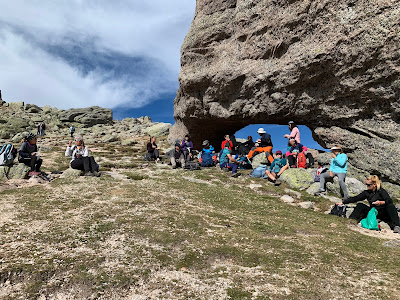
We’ve just got back from four days of hiking in the spectacular mountains of North Eastern Spain. Not the Pyrenees. The mountains we visited are rather lower, though you could have fooled my legs.

Caves are great

So are strangely eroded rock faces

Clouds can do curious things too

Water can be impressive...

... especially in lakes

Walking in glorious landscape was the principal, certainly the ostensible, reason for the trip. We got plenty of that. But to be honest, just being with the group was pleasure enough. That’s down to the organiser, Javi as he’s known (pronounce that initial J like the final sound in ‘loch’ and the V as a B, and you won’t be far off). You may remember him. He’s skilled at bringing together people, most of whom are a delight to know.

Javi, our intrepid leader
And the team (most of it)
It was the company that made the trip

What’s more, almost all were Spanish. The four days with them constituted a serious immersion course. We’re immigrants keen on assimilation, so it was great to get that boost to the slow progress we’re making in learning the language. 

Are you familiar with Murphy’s Law? The general principle that if something can possibly go wrong, it will? If, for instance, you drop a piece of bread on the floor, it’s bound to fall buttered side down. There’s a great story about all that.

“Just what is Murphy’s Law?” a schoolkid asks a teacher at a dining table.

“I’ll show you,” says the teacher. 

He quickly butters a slice of bread and throws it across the room. It falls to the floor. But it falls butter side up, not down.

“Now that,” says the teacher, “is Murphy’s Law.”

Murphy’s law hit us when our coach boke down. That was the coach that got us to the lovely province of Soria in the first place, and then took us each day to the start of our walks. As far as the walking was concerned, that didn’t matter, since there are plenty of great hikes and we went for one close to where the coach had failed. 

The far bigger problem was that this was the day of our great lunch, the one booked in a restaurant famous for its lamb stew. Since the hotel where we were staying didn’t enjoy or, sadly, deserve the same high reputation for its cooking, we really didn’t want to miss that meal.

Fortunately, this is Spain, and such problems are merely small flaws in the bountiful tapestry of life, whose splendid colours and joyful patterns minor inconveniences only underline. Eventually, another coach showed up and took us to the restaurant. We were late, but ‘late’ is a concept that needs careful interpretation in Spain.

I haven’t yet entirely freed myself of the Anglo-Saxon definition of ‘morning’ as ending at 12:00 noon (“12 pm” as it’s often called these days, a curious usage since “pm” means after 12:00). In Spain, “morning” seems to mean “up to the time when I have lunch”. Now a lot of Americans regard 12:00 as the appropriate time for lunch (some even start earlier), and many in England would go for a time around 1:00. Spanish restaurants don’t even open that early. I once tried to book a table at 1:30 in a restaurant that claimed to open then, only to be asked whether we could make it 2:00 instead.

Still, even the Spanish reckon the morning’s over, and lunchtime well and truly arrived, by 2:00. Certainly by 2:30. So showing up at 3:30 rather pushed the definition to its limits. Or beyond.

It also meant that we finished lunch at just before 7:00. Again, I know that I’m only applying alien (i.e. Anglo-Saxon) habits here, but that I feel is beginning to stray into what I would call dinner time. 

Long table for the long lunch
Of course, to the Spanish, that’s far too early for dinner. But it would pose a different existential question: with lunch ending so late, how would we get time for a siesta before bedtime?

Besides, we still had a duty to perform that day. Like last year, we had to collect sloes to make the traditional drink of Patxarán, which involves steeping the fruit in aniseed liquor. It was getting dark. So we had to be quick with the sloes.

Quick sloe hunt
No one felt like dinner that evening, so instead there was a group singalong. I have to say that my sons, always delightfully supportive to their poor father, long ago made it clear to me that I was completely wrong to think I sang badly. The truth was far worse than that. 

I had a term’s singing classes at school. At the beginning of the following term, I turned into one of the longer corridors in the school and spotted my singing teacher appearing at the other end. I’ve never seen anyone execute so smooth, graceful or rapid an about-turn and disappear back up the side corridor he’d emerged from. 

I got the message.

So I didn’t stay for the sing-song, fine though the voices were. Instead I wrote my first draft of this post. And then turned in. I knew next day was going to be the toughest of the lot. One of those walks where you struggle uphill for ages, only to find yourself at the bottom of the steepest climb of all. In this case, a fine little peak with a good scramble over rocks at the top.

Top of the world (well, locally at least)
Still. I felt at the top of the world when I got there. The wonderful views, in excellent company, took my breath away. Just like getting there left me breathless.

Ah, the joys of quiet retirement.