Showing posts with label Coronavirus. Show all posts

Friday, 14 August 2020

Corona: not just the problems we knew about

Corona just means crown. We use the word for things that have, or seem to have, a crown. There’s a corona around the sun. There’s a corona around the particularly nasty virus we talk about so much these days. And, of course, there’s a corona on every crowned head, by very definition.

So spare a thought for poor Spain. Like England, it’s struggling with both the health and the financial impact of the virus. Its strict lockdown to protect public health worked a lot better than the weaker measures in Britain, but the damage to the economy has been painful. Though, oddly, England has damaged its economy even more seriously, while controlling the pandemic less well. But then, England has Cummings and Johnson.

Today, however, cases in Spain are increasing once more at a depressing rate, and lockdown measures are having to be reintroduced. Just as they are in England. Although in England they seem to be targeting the Midlands and the North first of all, as though the Conservatives want to punish traditional Labour areas for having the audacity to vote for them instead.

Spain has an additional element of suffering. It’s also having to cope with Corona problems of the other, more ancient variety. The ones associated with the Crown. Especially since its previous occupant, Juan Carlos I, erstwhile King and now King emeritus, decided to do a bunk, fleeing abroad to some destination that has yet to be made public.

Juan Carlos I: ex-King who did a flit, and who knows to where?


His flight was precipitated by the ongoing investigation of his financial affairs. In particular, the judicial authorities find that his bank accounts in Switzerland raise a number of questions they’d like answered (yes, the understatement is deliberate).

This is sad, because Juan Carlos was the designated successor to the dictator Franco but, instead of maintaining the dictatorship, he oversaw an orderly transition to democracy. A referendum adopted the new constitution, still in force today, less than three years after the dictator’s death.

What’s more, not three years after that, when a coup against the new regime was launched by disaffected members of the paramilitary police and the army, Juan Carlos spoke out powerfully against it, rallying the nation to the cause of legitimate government. That ensured the coup’s failure.

Guardia Civil Colonel Antonio Tejero invading Parliament


Now, I’m a bit of a cynic and I share the misgivings of many over the length of time it took the King to come out with that statement. The initial attack against the Parliament took place just before 6:30 in the evening and the King’s broadcast went out at 1:14 in the morning. He recorded it around an hour earlier, but even that was six hours after the coup was launched.

There are those who say he knew in advance that it was going to happen, and only came out firmly in opposition once it became clear not enough of the army supported it. I don’t know how true or false that is. It is interesting, however, that there are those doubts, and that even as long ago as 1981 there were therefore some suspicions clouding the admiration felt towards the King by the Spanish people.

Which may have been a harbinger of what has happened now.

Even so, there are over 600 streets and squares called after Juan Carlos I across Spain. I am, indeed, in one of them now, as I write this piece from the flat near Madrid my one-year-old granddaughter inhabits and kindly shares with her parents (and, right now, us).

Today, a number of councils are facing motions from the Left suggesting it may be time to change the names of those streets and squares.

The government, too, led by Pedro Sánchez, a Socialist but on the Right of his party, is having to fight off moves from his coalition partner, from parties on whose parliamentary support he relies, and even from Socialist colleagues, to review the legal position of the Crown in Spanish politics. It is an offence, for instance, to insult the King, though that could be changed simply by new legislation. More problematic, the King can’t be held accountable for his acts either, and to change that would require a constitutional amendment.

Not the moment, Sánchez argues.

Ah, yes. He has a lot on his plate. Spain is closing down discos and bars again as the scourge of the virus builds again. The country has a shattered economy to rebuild. And now it has the distraction of a monarchy with a former King who’s beginning to look as toxic as the virus.

It amazes me that in today’s world we still have regimes led by men entitled to deference by right of birth. That strikes me as something to fix, so I’d like to see all three questions addressed at once. And perhaps in Britain as well as Spain.

But I can see how it makes the uphill struggle that Spain already faces even steeper and longer than it already was.

So spare my adopted nation a little sympathy…


Postscript: when the military knows how to respond to a coup

On the night of the coup, 23 February 1981 (so the event is referred to as 23F), the only city that was taken over by the military was the one where we live now. Let me quickly say that the two things aren’t causally connected. It’s just that the military region of Valencia was commanded by the general who supported the coup most actively.

Things went reasonably smoothly for him, until he sent tanks out to the airport at Manises, to get the air force unit there to join in. He got a dusty reply from the colonel in charge, according to the story a minister of the time later told:

“I have a Mirage on the runway with its engines running and armed with air to ground missiles. If the tanks heading for the base don’t turn around and pull back I’ll order it to take off and attack them. And I have another Mirage fighter ready on the runway just in case.”

The tanks retreated.

Tuesday, 7 July 2020

The great Bill Gates conspiracy. A bit of context

In my previous post about the strange case of the Bill Gates conspiracy theory, I talked about those curious aspects of it that are, when all’s said and done, common to all such theories.

They’re impervious to lack of evidence. The fact that there’s nothing at all to prove that Gates is engaging in some sinister plot against the whole of humanity only shows how clever he is at covering his tracks.

Equally, no contrary evidence has any value. Any story showing that it simply isn’t true that Gates is doing any of these things, or even that they’re actually impossible in the present state of technology, are obviously wicked inventions by his acolytes, insidiously fed out to the gullible individuals who believe his protestations of innocence.

Well, as I said, this is the stock in trade of any conspiracy theory. But there is another specific aspect of the Gates story that’s worth looking at. That’s the global context in which it has emerged. Which is almost enough to make me want to launch a conspiracy theory of my own.

Look around the world today.

In China, we have Xi Jinping. He has had the constitution of his country changed so that he can remain in power more or less indefinitely. He’s been in the news recently for the way he has, at a legislative stroke backed by violent police power, wiped out the partial liberties that Hong Kong had enjoyed before.

More sickening still, around a million Uighur people, Muslims from Western China, are being held in what the regime calls re-education camps, and anyone else calls concentration camps. The figure of a million is a bit of a guess and the real figure may be much higher: the regime isn’t particularly forthcoming with the statistics.

Meanwhile, in the United States we have a Donald Trump for whom nothing matters other than his own advancement. He works to divide people, he advances racism, and he incites violence from some of the most despicable individuals in the country. And all the time, he has presided over the worst economic collapse the nation has known at least since 1929, and the deaths by Coronavirus of over twice as many Americans as were killed in the whole of the Vietnam war.

His own incompetence contributed to both those disasters.

Turning to a less significant country (but don’t tell its conservative voters – they like to think otherwise), we have Boris Johnson in Britain. He has in recent weeks defended, and ultimately failed to take any action over, Coronavirus lockdown breaches by his chief adviser, Dominic Cummings, and one of his Ministers, Robert Jenrick. Again, the mortality due to the virus in the UK is far higher than in might have been, entirely down to the incompetence with which Johnson has addressed it.

Top right: Mark Zuckerberg, the enabler
Then, clockwise: Trump, Putin, Bolosonaro, Xi, Johnson


And the list goes on. Brazil has Jair Bolsonaro, a man presiding over the devastation of his country by Coronavirus, and who, after months of denying there was a problem, and refusing to wear a mask, has now tested positive himself. Or Vladimir Putin in Russia who has gone down the Chinese road, of a constitutional amendment to keep him in power for a lot longer, and who is almost certainly involved in a real conspiracy, to try to influence the US Presidential election through dirty tricks on social media.

Talking about social media takes us, of course, to the dominant figure in that world. Mark Zuckerberg continues to refuse to act against hate speech and incitement to violence on Facebook. There are allegations that the massacre of the Rohingya in Burma was promoted through Facebook. And Zuckerberg can play his role, unaccountable to anybody, and free from any kind of control, regulation or sanction. He is one man, elected by no one, and running on his own authority a communications system that feeds information, or disinformation, to 2.6 billion people around the world.

So we we see these characters at work across the globe. Some of them are preparing conspiracies. That’s likely to be true of Putin, and his people will use the means provided by Zuckerberg. But others aren’t even trying to work conspiratorially. We know what Trump’s up to, we have a pretty good idea what Xi Jinping’s doing too.

And in this world, we pick on Bill Gates? Because he correctly predicted that pandemics might be more serious than war? And contributed money to combating the present one?

Why, it’s almost as though someone were trying to deflect attention from some real villains. Distracting us because theyre working to a hidden agenda we know nothing about. Spreading disinformation, perhaps through Facebook, so we don’t look at the people who really deserve our suspicion and distrust.

Curious, isn’t it? Is it just a coincidence that Gates conspiracy theorists are putting this kind of stuff out right now? Or is it something more sinister?

Monday, 6 July 2020

The great Bill Gates conspiracy

We live in a time of conspiracy theories.

Of course, most times have had their conspiracy theories. The power of anti-Semitism in the early twentieth century spread rumours of an international plot of Jewish financiers to take over and run the world. There was even a remarkable document, the Protocols of the Elders of Zion, explaining how this was going to be carried out.

Unsurprisingly, the document turned out to be a forgery. Equally unsurprisingly, that didn’t stop the conspiracy theory being believed. It is of the essence of a conspiracy theory that once you’ve been bitten by one, nothing will shake your confidence in it. Not even discovering that a key element is false. And if evidence for it is lacking, that only demonstrates how dastardly devious the conspirators are, in hiding all trace of their nefarious activity.

In the same way, any evidence against the theory is obviously fake news, put about by members of the conspiracy to fool the ingenuous and naïve.

You see, it isn’t the people who believe the conspiracy theories who are gullible, for accepting as true allegations with no evidence to back them. The gullible ones are the rest of us, without the acuity to realise that absence of evidence isn’t the same as evidence of absence. To say nothing of our being so innocent as to accept the truth of obviously fabricated so-called evidence against the theory.

Well, not a theory. The truth. Or even the Truth, with an initial capital letter.

Melinda and Bill Gates


The target of today’s favoured conspiracy theory is, rather oddly, the Microsoft founder, Bill Gates.

The Bill and Melinda Gates foundation has put $300m into fighting Coronavirus. You might think that people threatened with infection by the virus might be grateful for the gesture. I’m sure most are.

He also warned in a 2015 Ted Talk, that the great threat to life in the next decades would be from a virus, not from war. You might think that people would admire him for his prescience. I’m sure most do.

But not the conspiracy theorists.

To them, this is just part of his smokescreen for his real agenda. He wants the pandemic to spread – indeed is responsible for that spread, which is why he knew about it so early – so that a vaccine, developed with his money, can be injected into people – and with it a microchip allowing the Gates foundation to establish control over the people vaccinated.

There are other even wilder accusations around, and if you want to catch up on them, you can do so here.

As Bill and Melinda Gates point out, “we are just giving money away, we write the cheque...” They don’t develop the vaccine. They certainly won’t be administering it to anyone.

Besides, there isn’t a vaccine yet, and there may never be. More to the point, to my knowledge, there is no chip capable of controlling a human being into whom it has been injected.

Why, there isn’t even any evidence that the virus was deliberately developed by anyone, let alone Bill Gates, as the conspiracy theorists keep claiming.

Now, I’m not saying that there are no conspiracies. There are. Indeed, it could be useful to look at a real one, to get a better idea of how it differs from the fake variety.

In March 2018, two characters travelling on Russian passports but in names it seems were not their own, showed up in Salisbury, in Southern England. They were there again the next day. They later claimed that they had been so impressed by the cathedral on their first visit that they decided to return from London at the first opportunity.

Not long after, a former Russian Intelligence officer, Sergei Skripal, and his daughter fell seriously ill, with poisoning by the agent Novichok, of which there are significant stocks in Russia. Skripal had been a double agent, revealing Russian secrets to Britain.

Traces of Novichok were later found in the hotel room in London used by the Russians. And they were later fairly reliably identified as being longstanding members of Russian military intelligence.

The Skripals both recovered from the poisoning, though they were dangerously ill for a time.

Now none of this meets the high standard of a criminal trial, which is proof beyond reasonable doubt (a great criterion, although it hasn’t always stopped innocent defendants being convicted). But Russia’s never going to admit to involvement in the case, or release the agents involved for interrogation and trial in Britain, so we’re not going to get the evidence for that kind of rigorous test.

But on the weaker test of balance of probabilities, it does feel to me as though someone in the Russian state ran a conspiracy to wipe out a man Russia views as a traitor.

Now this story is a wonderful illustration of what a real conspiracy looks like.

First of all, you find out about them. And not just in the form of loose, vague allegations, but with real and convincing, even if only partial, evidence.

But the second characteristic is even more striking. It’s incompetence. The Russian agents failed in their mission. Indeed, when two uninvolved British citizens found and handled the flask that had contained the Novichok, they both fell sick, and one of them died.

In other words, the agents missed their target but hit two people with whom they had no quarrel.

That’s the way most conspiracies go. Inept people within it deliberately or unintentionally let the secret out. And they generally don’t do very well.

That’s one of the things that strikes me most about conspiracy theorists. They massively overstate the intelligence of conspirators. They regard the plots as sinister because they think the plotters ingenious, when in reality they’re like the Skripal agents.

Well, all I can say to conspiracy theorists is, every time you think a brilliant conspiracy is being directed against you, remember the Skripal case. The Russian state’s pretty sophisticated. And look what a pig’s ear it made of that one.

Then think of Watergate. Or the Weapons of Mass Destruction myth for Iraq. Conspirators aren’t as smart as you imagine they are.

The steel magnate Andrew Carnegie once said that the man who dies rich, dies disgraced. And gave away his money.

If Bill Gates is following that example, wouldn’t it be nice if we could just congratulate him, rather than spin a web of unfounded and deeply implausible conspiracy allegations around him?

Saturday, 27 June 2020

The keys to an unsolved mystery

After a few weeks, I feel the trauma of the experience has receded enough for me to tell this story.

It all started a little while before the lockdown. Remember those times? When we thought we could handle objects on supermarket shelves with no threat to life? When we used to shake people’s hands? Chat to them without masks? We were in the little town of Manises, not far from our home outside the fine old city of Valencia.

We were there to complete the latest round of formalities that Spanish residents have to go through, in order to obtain some document, whose precise nature I can no longer clearly remember, though it was doubtless immensely important and an essential ingredient for a happy life in 21st century Spain.

On the other hand, it may have been to pay some tax or other. That’s another activity that’s popular with the Spanish bureaucracy.

We took the opportunity to wander around the place a little and find out what it offered in the way of exciting amenities. This was useful, because we had only been there in the evenings to play badminton (another receding memory, still banned in these Coronavirus times). We hadn’t seen much of the rest of the town.

Then we returned to the car. Only to discover that the keys had vanished. Both of us had seen them go into Danielle’s bag. Neither of us had seen them come out. We’d been to few places where they could have been expected to fall from the bag. In fact, really the only place was the tax office (yes, I think it was that). We went back, but there was no sign of the key. We tried the police, but they hadn’t had anything handed in either.

So we had to accept the inevitable. Neither of us had ever lost a key before, but now we somehow had. It was a sad record to break but, hey, life is full of things that just happen.

Getting the car back was a little awkward, involving a return trip home by taxi to collect a spare car key, with the help of our neighbour, who holds a copy of our house keys. But it was done in time, and we quickly ordered another key for the car.

Two weeks later, it still hadn’t arrived, but the lockdown had. The garage shut down. We couldn’t collect the new spare key even when it did arrive.

Fast forward 100 days to the end of the strict ‘confinement’ we crawled though in Spain.

The glorious day eventually came when we could return to the beach. And with friends. Things weren’t quite back to normal, so if we had travelled in the same car as the friends, we would all have had to wear masks. So we took two cars. Which turned out to be quite fortunate.

Because after a seven or eight kilometre walk through a nature reserve and along a beach, we got back to the cars, only to discover again that the keys were no longer in Danielle’s bag. We all searched. We took everything out of the bag, turned it upside down and shook it. No keys fell out.

We went back over the walk, with no greater success.

It seemed extraordinary. Having never previously lost a key in our lives, we had now managed to lose two in just over three months. I won’t hide it from you: it was a pretty depressing discovery.

To misquote Oscar Wilde, to lose one key may be regarded as a misfortune, to lose two looks like carelessness.

Our friends were immensely kind. They took us first to the garage. The new key was available, but not usable, since it has to be programmed first. We had to find a way to get the car to the garage, which isn’t easy without a working key. While there, we ordered yet another key, to make sure we had a spare again.

Then our friends took us home, which at least didn’t take them too far out of their way: they live just half a dozen doors away from us. We walked disconsolately indoors. Danielle decided to get something out of my bag.

And found – the car keys.

It remains a complete mystery how the keys moved from her bag into mine. But somehow they did. We’ve decided that this is an enigma we’re never going to solve. Any more than the mystery of how it never occurred to any of the four of us on that walk to look in my bag for the keys, after not finding them in Danielle’s.

Another lift from our friends enabled us to collect the car. And the very next day, we had a call from the garage. The new key had turned up just 24 hours after we’d ordered it, unlike the previous one which took at least two weeks. So we couldn’t cancel it.

Three of a kind: an insurance policy


I’ve been back to the garage and got both new keys programmed and usable. So we now have three keys for the car.

Which may be just as well. With our track record, a bit of an insurance policy against key loss feels like a good investment.

Thursday, 25 June 2020

The thing about lying is that it works

The very people who most complain about lying politicians, seem to be the most inclined to believe their lies.

Trump’s supporters, in particular, went along with his slogan about ‘draining the swamp’. That suggested that it was Washington DC that was the breeding ground of all the ugliest and most dangerous lies. Now, since Trump has been in place, with a mandate of sorts to drain that swamp, he has massively raised the level of mendacious toxicity of the very swamp he occupies, which is clearly his most suitable habitat.

Hardly a day goes by without his coming up with some new lie. The latest was to nearly double the number of attendees at his Oklahoma rally, and to claim he was satisfied with the outcome, despite his obvious expression of crushed dejection.

Trump defeated by the poor turnout in Oklahoma
Hope for us all in November


Despite all that, some people keep on backing him. They swallow the lie.

The same is true in Britain.

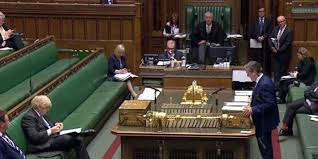
In my view, Keir Starmer, as leader of the Opposition, had much the better of his exchanges in Parliament with the Prime Minister, Boris Johnson, at Prime Minister’s Questions (PMQs) on the 24 June. Above all, Starmer took the approach so many of us have demanded from our politicians for years or decades: calm, well-informed, moderate. He offered praise for where things had been done well in combating Coronavirus, and then focused on a genuine problem on which he called for clarity from the government.

Keir Starmer, on his feet, questioning
Boris Johnson, left


In other words, like the American voters who wanted the swamp drained, he rose to the challenge many UK voters have set politicians.

He asked:

Yesterday, the Government announced the next stage of easing lockdown restrictions. If that plan is to work—and we want it to work—we need an effective track, trace and isolate system. The Prime Minister promised that a world-beating system would be in place by 1 June. The latest figures from yesterday’s press conference hosted by the Prime Minister show that 33,000 people are estimated to have covid-19 in England. The latest track, trace and isolate figures show that just over 10,000 people with covid-19 were reached and asked to provide contact details. I recognise the hard work that has gone into this, but if two thirds of those with covid-19 are not being reached and asked to provide contact details, there is a big problem, isn’t there?

Did the Prime Minister respond in kind? Did he heck. Here’s what he said:

On the contrary. I think that the right hon. and learned Gentleman has been stunned by the success of the test and trace operation. Contrary to his prognostications of gloom, it has got up and running much faster than the doubters expected. They are getting it done—Dido Harding and her team have recruited 25,000 people and so far they have identified and contacted 87,000 people who have voluntarily agreed to self-isolate to stop the disease spreading.

In other words, he gave a purely old-style politician’s answer: on the attack, and dodging the question altogether. As Starmer pointed out:

The Prime Minister just has not addressed the question I put to him. I was not asking about those who have gone into the system—the 10,000—or those who have been contacted; I was asking about the two thirds of the 33,000 with covid-19 who were not reached. That is a big gap.

Clear, simple and focused on the key matter. If only 10,000 are being tested then, on the government’s own figures of 33,000 infected, two-thirds are not being reached. This is bad news. And Johnson’s response? He went back on the attack: “I hesitate,” he claimed without hesitation, “to accuse the right hon. and learned Gentleman of obscurantism. He is misleading on the key point.”

The accusation of misleading is serious in Parliamentary terms and the Speaker had to call on him to withdraw it.

The exchange moved on to the matter of the tracking app, promised for 1 June, then abandoned, now promised again, using commercial software, perhaps some time after September.

Boris Johnson was having no criticism on that front:

I wonder whether the right hon. and learned Gentleman can name a single country in the world that has a functional contract tracing app—there isn’t one.

Strangely enough, the right honourable and learned Gentleman Keir Starmer certainly could name one:

Germany. It had its app working on 15 June and it has had 12 million downloads—I checked that overnight.

So now the decks were cleared for Johnson to move from the lie circumstantial to the lie direct:

I am afraid that the right hon. and learned Gentleman is completely wrong, because no country in the world has a working contact tracing app.

Faced with a clear, verifiable fact, Johnson merely resorted to denial. A blatant, easily refuted lie.

And here’s the sad thing. He won’t be called on it.

Many have demanded that politicians find more honest ways of doing their job, for instance denouncing Blair for lying over Iraq.

They claim to want them more straightforward and thorough.

They called for less aggressive exchanges between them, more focused on solid, reliable information.

Yet a large number of them will rally to Johnson now. They will claim he bested Starmer. They’ll praise his style instead of denouncing his lies.

My only hope? That in neither the United Kingdom nor the United States will they constitute a majority.

So we really can drain the swamp and move to a healthier brand of politics.

Saturday, 6 June 2020

Governments losing against Coronavirus: it's no coincidence

“One of the things that makes novels less plausible than history, I find,” says a character in Tom Stoppard’s play Night and Day, “is the way they shrink from coincidence.”
We do try to reject coincidence. “This happened after that other thing happened, so it must have been that other thing that caused this one.” Post hoc ergo propter hoc, the Romans used to say, after that so because of that.
And yet there really are things that are simply coincidence, in the sense that they happen together, or after each other, purely by chance.
London had a population climbing towards seven million over the decade I was a student there (yep: I was once the proud owner of ten University of London student cards). And yet I hadn’t been there many years before I had my first experience of meeting people I knew, without arrangement, on the street. It happened to me several times over the period I lived there.
What? The chances of meeting any particular person out of 6.5m is, naturally, 6.5m to 1. And yet I several times met individuals I knew?
We are not intuitively good at handling statistical reasoning, as the psychologist and economist Daniel Kahneman has pointed out. I had a wide network of acquaintance, which immediately increased the chance of meeting any one of them by chance. And it was not as though I only ever crossed the path of one other person in any one day – on the contrary, commuting from home to work or to college brought me close to hundreds or even thousands of people (hence the difficulty of maintaining social distancing today).
Take that into account, and the probability of meeting someone I knew was significantly higher than I might have imagined. Certainly, high enough for it to be perfectly reasonable that it should happen several times over a ten-year period. Particularly when you consider that most frequently the encounters were in places which act like people-funnels, such as the main railway stations.
In fact, the most surprising such event I witnessed was just last year, as I was catching up with a Turkish friend, Muharrem, who was about to enter Victoria Station ahead of me. I found him in lively conversation, in Turkish, with a woman. After she had left, Muharrem explained to me, “she’s one of the most famous novelists in Turkey, and I met her when I was working at a library where she came to give a talk”.
Despite this kind of experience, we do shrink from coincidence. Indeed, that shrinking becomes a weapon in the armoury of people trying to build certain kinds of argument. They might, for instance, say:
“My friend Sally took that medication. And exactly two years, five months and 17 days later, she had a series of terrible migraines. Coincidence? I think not.”
It’s a great debating trick, because it establishes in advance that only the most naïve and credulous people could possibly respond, “well, actually, yes, I reckon it probably is a coincidence.” As, of course, it is.
After all, Sally probably took other things than that medication before getting her migraines. If anything that happened before them could be regarded as a potential cause, might it not have been the chocolate she had the day before, or the overindulgence in wine, or the fact she drove through a polluted neighbourhood? After that so because of that isn’t an argument, it’s a sloppy and unreliable way of reasoning.
To establish that there’s more than chance at play, we have to show some causal connection between the two incidents.
To take a different example, naturally chosen entirely at random, consider lousy government. Faced with a major and fatal pandemic disease, a lousy government fails to take it seriously. It may attempt to put in place measures to protect its healthcare workers, and even promise to do so, and then take far too long and under-deliver. It may, rightly, identify track-and-trace as the best way to combat the virus, promise to put a system in place and then fail to meet its own deadline.
Or lousy government might just be far too glib in attitude. It may be scornful about simple and effective measures like wearing masks. It may pay lip service to other measures, such as social distancing or quarantining, while flouting them itself and turning a blind eye to infringements by friends or supporters. It may be halfhearted about its lockdown measures and end them too soon.
Now which governments around the world have been most guilty of some or all of these kinds of behaviour?
Why, the governments Trumps United States, Johnsons UK and Bolsonaros Brazil. Which makes it fascinating to look at the latest figures published by Worldometers. Imagine which are the governments with the highest numbers of deaths due to Coronavirus:
The three nations with the worst Coronavirus death totals
Note that Johnson's UK has the worst death rate per million

A coincidence? I think not.

Friday, 5 June 2020

Coronavirus lockdown release: phase 2 cotinued

We continue our slow climb out of lockdown here in Spain. It’s a relief, but tinged with anxiety, since there are signs of an increase in infections, and in daily deaths, as the restrictions are lifted.

The other uptick is in Opposition attacks on Government over its handling of the infection in the early stages. The Opposition claims that the government knew a lot earlier about the seriousness of the crisis than it has admitted, making its failure to take action sooner intolerable to the Conservatives.

Personally, I like the administration led by Pedro Sánchez and his Socialist Party. Its handling of the crisis since that early stage has been outstanding. However, I suppose as a supporter of democratic process, I can hardly object to an Opposition holding Government to account for its earlier errors, however much I may prefer the latter to the former.

Otherwise, how could I possibly demand that the Labour Opposition in Britain hold the Cummings government, and its figurehead leader Johnson, to account there? That’s a demand that needs to be made all the more strongly, now that Britain has officially racked up a performance worse than Spain’s, in deaths per million, despite having had the examples of both Italy and Spain to learn from.

At least in Spain we’re continuing to emerge from lockdown. Now, it may not last if infections keep climbing. So we’re taking advantage of freedom today, for fear that it might be curtailed by a new lockdown tomorrow. That means doing as much as possible, as soon as possible.

Museo de las Bellas Artes, Valencia
For instance, after having our first haircuts in three months, we headed for the Valencia Museum of Fine Arts, now visitable again. That’s an opportunity that hadn’t been taken up by many, so we met only one other visitor during our time there.

I’ve been there a couple of times before. However, I realised on this visit that I’d seen only a small fraction of the collection. That’s because previously I started, as one might expect, on the ground floor, which is just room after room of religious art from the fifteenth, sixteenth and seventeenth centuries.

Obviously, many people whose opinions I respect love this stuff. I’m afraid I quickly find I’ve had a surfeit of nativities, even more quickly of Mary weeping over Christ’s body, most quickly of all over martyrdoms, flagellations of Christ and crucifixions. In fact, three or four pin-cushion Saint Sebastians are usually about as many as I can stand before I head for the exit.

Why on Earth, in a religion like Christianity, focused as it’s supposed to be on loving one’s neighbour and turning the other cheek, are so many of its followers quite so obsessed with suffering, torture and death?

Still, there were a couple of paintings in this part of the Museum that I enjoyed.
Saint Sebastian cared for by Saint Irene
by Vrancke van der Stockt
I liked a Saint Sebastian who, far from being a pin cushion, seemed to be dying – or, more likely, already dead, given the shock and grief of Saint Irene who was looking after him – from a single arrow wound. A tribute, I felt, to the lethal power of even one arrow. No tribute at all, though, to the shooting accuracy of the Roman legion, a whole execution squad of which had been assigned to dealing with him. Did the rest all miss, then?

Adam and Eve by Matthias Stom
The other one I liked was of a strangely stylised – almost surreal – painting of Adam and Eve holding a fruit, oddly elongated upwards. I wondered whether the artist was perhaps a member of a strange heretical sect of which I hadn’t previously heard, which believed that the fruit of the tree of the knowledge of good and evil, the tree from which they weren’t supposed to eat, was a pear and not an apple?
Was it a pear they tasted?
Look at it. It’s obviously a pear.

Incidentally, while on the subject I can’t resist passing on this thought from the outstanding eighteenth century thinker, Denis Diderot, who commented that the Christian God is a father who attaches great importance to his apples, and very little to his children.

But back to the Museum of Fine Arts. For the first time in three visits, rather than giving up and leaving after having a glut of the religious paintings, I let myself be persuaded by Danielle to take a look at the other floors. And what a joy that was. On the upper floors, I discovered the collections of more recent paintings, that were far more to my taste.

Perhaps the most famous painter from Valencia is Joaquín Sorolla. Why, the main station in the city is even called after him. And the Museum has some excellent examples of his work. One, I thought at first glance was of a cricketer, given his all-white clothes.
Sorolla's painting of a cricketer?
Not, the son of a friend
But cricket has never really caught on in Spain, and this turns out to be a rather eye-catching portrait of José Luis Benlliure López de Arana, son of Sorolla’s friend, the sculptor Mariano Benlliure.
The Fly
A charming surprise to discover it
Even more striking was a painting by a contemporary of Sorolla’s, Cecilio Plá. It’s called The Fly and includes a smile that charms by its cheekiness, within a pose that mystifies by the way it reveals all the more by being partially hidden.

So, all in all, it was a rewarding visit. What can I saw about Phase 2 of our lockdown release? Just ‘so far, so good’.

Of course, that’s what the man said as he passed the 52nd floor of the Empire State Building, having fallen from the top. Let’s hope we’re heading towards a better fate than awaited him.

Saturday, 30 May 2020

World beaters in the coronavirus death stakes

These are exciting times.
Three nations are competing hotly for position in the Coronavirus stakes. Italy, where I was born, led all three in deaths per million of the population for a while, but Spain, where I now live, overtook it, while Britain, and I am a loyal subject of Her Most Gracious Britannic Majesty – well, relatively loyal – was always lying third.
Top places in Europe for Coronavirus deaths per million

But a week ago, Britain caught up with Italy, and since has moved ahead. And now it’s closing fast on Spain: just 18 deaths per million behind today. First place in Europe is within reach. But, of course, the UK has an unfair advantage: it’s led by mini-Trump, Boris Johnson.
With a Trump, a Johnson or a Bolsonaro in charge, a nation is a guaranteed world-beater in the Coronavirus death stakes.
These leaders are special. 
Bolsonaro, Johnson, Trump
Swamp dwellers competing in the virus death stakes

Bolsonaro’s devil-may-care attitude towards the virus has even earned him the title ‘Killer’. He’s got his nation into second position behind Trump in infections and is moving strongly up the deaths-per-million field.
Trump is, of course, exceptional. His outstanding skill in invective is only rivalled by his capacity for non-delivery. He promised a wall between the US and Mexico, but apart from a few short stretches, it’s just not happening. It’s hard to choose between relief at the failure of a lousy idea, or scorn at his failure to honour his pledge.
Twitter has now started issuing a few warnings about whether Trump’s Tweets can really be entirely relied on for accuracy. He’s turned livid against the social media giant. He wants the law changed to prevent this kind of uppity behaviour. To him, saying what you like – correction, what he likes – is freedom of expression, but pointing out that it’s false is treacherous bias.
Interestingly, mini-Trump in England has many of the same traits.
For instance, he too has a remarkable track record of failures. As Mayor of London, there was his Garden bridge across the Thames, now cancelled at great cost to the taxpayer. There was also his ingenious plan for new buses, now terminated, because they too were excessively expensive. Then there were the three water cannon bought second hand from Germany, eventually sold unused for scrap.
His behaviour in the pandemic has been the same. He plucks commitments out of the air – so many tests per day by such-and-such a date, achieved only on the deadline, for one day, with fiddled stats; now there’s the track, trace and isolate system to be in place by 1 June, which few experts believe will happen.
But he’s going ahead with further relaxation of the lockdown, even though case numbers are still growing at far too high a rate.
Like Trump, he’s sure his entitled group has an inherent right to be treated differently from the rest of us. It’s an attitude he’s had since childhood, as a letter home from his school housemaster makes clear: “I think he honestly believes that it is churlish of us not to regard him as an exception, one who should be free of the network of obligation which binds everyone else.”
This has led to the ongoing scandal concerning his chief adviser, Dominic Cummings, who broke the very lockdown rules he was instrumental in drawing up.
Cummings and his wife drove their child 260 miles up the country when she was ill with Coronavirus and he was likely to be carrying it, as was later confirmed to be the case. Their explanation is that with both of them potentially ill, they were worried about childcare for their son and wanted to get him to where Cummings’ parents lived.
But plenty of others have faced similar childcare problems and suffered the difficulty of dealing with them, without breaking the lockdown rules.
Let’s be clear how he broke those rules: they might have infected any number of people on the way. They might have infected their son. And when they got there, they might have infected his parents, who as older people were in a high-risk group.
It’s no surprise that many MPs, including Conservatives, have been deluged with furious letters from voters demanding that Cummings be fired.
Instead, Johnson and several of his Ministers defend his actions as the behaviour of a loving parent. So is a parent facing childcare problems who doesn’t break the rule insufficiently loving of his child?
Indeed, isn’t anyone who follows the rules, just a mug? After all, it’s clear the rules were made to be broken.
Sadly, what not everyone realises, is that they’re only made to be broken by the Johnson coterie. Dominic Cummings, yes; the rest of us, no. So Johnson and his government have closed ranks around Cummings. Why? Is this great loyalty from Johnson? One of his fellow Conservative MPs had a different explanation for the Guardian“This is a cabinet of fools led by a hollow narcissist who is nothing without his Svengali.”
Yep. We’ve seen Johnson’s track record of ideas as Mayor of London. He’s not good at coming up with any that work, is he? Cummings was key in winning the Brexit referendum for the Leave side. And his brilliantly simple slogan, ‘Get Brexit Done’, took Johnson to a landslide victory over a Labour leader who could only waffle on the Brexit issue.
Remember Trump claiming he wanted to ‘drain the swamp’? It strikes me the swamp has never been so murky as since he took office in Washington. As in Brasilia with Bolsonaro. Or in Westminster with Johnson.
Perhaps it really is time to drain the swamp. But starting with the man who dreamed up the slogan, Trump, and his disciples, led by Johnson and Bolsonaro. After all, given the way the US, Brazil and the UK are performing in the Coronavirus mortality stakes, it’s a matter of life and death.
And I’m using that hackneyed expression literally.

Friday, 22 May 2020

Beach walking out of the lockdown in Valencia

One of the things about emerging from Lockdown is that things you once took for granted now feel special.
Today, that was a visit to a beach near us, south of Valencia. It was the first since the lockdown began to the ease. Indeed, it was the first since just before the lockdown started.
Striding along the beach at El Saler
Taking people to that beach with its miles of golden sand is pretty much a fixture on our list of things to do with visitors. On Saturday 14 March, we went there with friends who’d been staying with us for that week. We enjoyed the visit though, already, the atmosphere was turning tense. 
We’d booked a table for lunch in a nearby village, for paella, since both the beach and the village are in the middle of rice fields. That means that rice-based paella’s a specialty.
The restaurant had, however, had to cancel our reservation. All cafés, bars and restaurants had been ordered to close in response to the coronavirus epidemic. So the shared paella, another item that appears high on our list of things to do with visitors, was off the table. Literally.
What was worse, we knew that the day after next Spain was going into full lockdown. France, where our friends were from, was talking about lockdown and already considering quarantining anyone arriving by air. Indeed, it wasn’t even certain that air travel would be allowed to continue, which was bad news since they were due to fly back the day after our beach walk.
So there was apprehension in the air. It didn’t stop us enjoying our time on the beach, but it did introduce some worrisome notes.
Even sadder, once our friends from France had gone, two friends from England were due to follow them to our place. They, intelligently, had already cancelled, however. Had they set out they might have found themselves trapped somewhere between their home and ours and, at best, having to make a difficult emergency return to the UK.
Unfortunately, however, that meant they didn’t get a beach walk at all.
Should we have gone out this morning? Well, the authorities differ on the matter. The leading local paper claims that, in phase 1 of emergence from lockdown, and Valencia is in phase 1, you can drive to different places in the same province to have some exercise there.
Others say no, you can only travel to specific places, such as restaurants, to meet small numbers of friends and have a coffee or a meal with them, outdoors and strictly respecting social distancing. I can see how that makes sense: if people all travel to the same place, there’s a risk that they’ll end up congregating in unsafe numbers.
The fear at the moment is that the end of lockdown will lead to a new surge in Covid cases and deaths.
Well, we decided to choose the interpretation of the regulations which suited us best. And it worked out fine. There were people in the nature reserve behind the beach, and on the beach itself, but few enough of them for distancing to be easy. Everyone seemed to understand that, as people approached each other, one or other would swerve away from the sea – a beach walk, naturally, involves being barefoot in the surf – and exchange polite greetings from a safe distance as they passed.
The nature reserve behind the beach,
with a black-winged stilt (I'm reliably told) flying over the water
Two of the people we met were in official uniforms and carrying guns. Since they said nothing, we decided we clearly weren’t committing any desperately serious offence.
And it was glorious out there. The air warm enough to be a delight but not yet hot enough to be uncomfortable. Miles of sand disappearing southwards to a distant town. Limpid water we could paddle through, which reached out to deep blue at the horizon.
Just as we remembered it when we were there with our French friends back in March. Except warmer. Just as we would have enjoyed it with our English friends had they been able to make it. And a joy after ten weeks deprived of the pleasure.
So today’s walk, and this post, are dedicated to Marie-Line and Bernard from France, who were there on 14 March, and to Sue and Tim from England who had to cancel their trip, but we hope will join us soon.
At least we’re all safe from the Coronavirus so far. That makes the sacrifice a price worth paying. Let’s hope things stay that way.
So that we can indulge ourselves in other beach trips and, who knows, a wonderful local paella again, before too long.

Sunday, 17 May 2020

Coronavirus: the Immortals have spoken

Académie Française
Preserving a legacy. If necessary, in aspic

“Don’t put your elbows on the table.”
“Don’t chew with your mouth open.”
“Use the right spoon.”
Ah, the making of the middle class. All those rules. All those do’s and don’ts.
With rather more don’ts than do’s, of course.
And in language too. Never start a sentence, let alone a paragraph, with a conjunction. Never split an infinitive, a stricture I’m trying hard to learn to finally stop being ruled by. Oh, and never end sentences with prepositions, of course.
I’ve recently been listening to an American linguist, John McWhorter. He points out how little sense many of these rules make and how they vanish in time anyway.
For instance, in German today, ‘there’ isn’t the same in ‘stay there’ (‘bleib dort’) and ‘go there’ (‘geh dorthin’). That distinction, between ‘dort’ and ‘dorthin’, used to exist in English too, between ‘there’ and ‘thither’.
“I want to go there,” infant tells mother.
“Now, my dear,” replies mother, “you know that should be ‘go thither’.”
Yes, well, it wouldn’t happen now, would it? But I bet late Renaissance parents would have said something like that, as they tried to make their kids speak English proper, like.
Why do these things vanish? Chiefly, McWhorter claims, when many people start learning the language as adults. Up to the age of twelve or fourteen, children have a capacity to master a language with all its weird peculiarities; beyond that age, they lose it. Imagine foreigners arriving in England and having to learn the language. Viking invaders, say, who settled, ‘married’ local women (the quotation marks are because such arrangements weren’t always consensual) and realised they had to speak English if they wanted to communicate with their kids or most of the people around them.
“Runnest? Runneth? You expect me to learn to say that? Screw that for a game of soldiers. If you insist I’ll add an ‘s’ in the third person singular, though beats me why I bother, but all the rest will just be ‘run’. OK, pal? Happy with that? If not, just remember which one of us came in awe-inspiring boats sweeping across the North Sea, with a bunch of the most fearsome warriors of the Middle Ages. With fire and sword to make it clear to you that we were staying. Come to think of it, I’ve still got the old battle axe somewhere. Should I fetch it? Ah, now you see the sense in the way I conjugate verbs. Good man. Sensible fellow.”
A good basis for protecting middle-class values: use the right spoon
And in German, the basis for a little gender conflict too

One of the niceties of language that vanished from English over those centuries was grammatical gender. As McWhorter points out, it’s somewhat laughable that German treats spoons as masculine, knives as neutral and forks as feminine. I challenge any German to provide a logical reason for the distinction. What, items of cutlery might have gender clashes?
English has done away with all but biological gender. Houses, truth, postboxes, knives, forks and spoons are all genderless. One less useless thing to learn…
But Old English, as a good Germanic language, did have grammatical gender. I’m sure rigid grammarians tried to get speakers of the language to remember the gender of lots of nouns for genderless things. The Vikings, speakers of Old Norse which had its own somewhat different genders, basically couldn’t be bothered to learn a new system and discarded it.
All this to show that languages change. The rigid rules are senseless. Eventually, they go.
But in French, they don’t go easily. A valiant rearguard action will always be put up to prevent their loss. And there’s a prestigious national institution to lead the fight.
It’s called the Académie Française. It was founded by the Cardinal Richelieu who gave the Three Musketeers such a bad time. Its forty members are so important they’re referred to as the ‘Immortals’. My father liked to quote a film I’ve never been able to track down, in which a character is elected to the Academy and, gazing at his reflection in his new uniform, declares “me voilà donc immortel jusqu’à la fin de mes jours” – “so here I am, immortal until the end of my days”.
The Academy issues regular decrees on the French language to ensure that it isn’t allowed to decline into ignominious pauperisation or, as the rest of like to say, change. If it means mummifying the language or preserving it in aspic, then theyre the ones to do it.
Years ago, they announced the verb for to land, ‘atterrir’, literally to come to earth, could be used for the moon too, so you didn’t have to say ‘alunir’, to come to the moon.
Though you could.
Similarly, an ‘Alpiniste’ could go climbing in mountain ranges other than the Alps. You weren’t an ‘Himalayiste’ or ‘Caucasiniste’ depending on which mountains you tackled.
The Immortals have issued a decree on the Coronavirus related disease. It is permissible to refer to it as ‘Covid’, even in French. But it’s important to understand the word’s feminine. Apparently, too many French people have been treating it as masculine, as with most loan words from English. Think of those quintessentially French terms such as ‘le parking’, ‘le brownie’ or ‘le weekend’, where the form ‘le’ for ‘the’ is masculine.
So why is Covid feminine? Because the gender of a compound term, and Covid is a compound of CoronaVirus and Disease’, takes its gender from the principal component. And that principal term, according to the 7 May issue of the Academy’s ‘Dire, ne pas dire’ (‘Say, don’t say’) collection, is the word ‘disease’. Disease in French is ‘la maladie’, where ‘la’ is feminine. 
So the whole term must also be feminine.
La Covid, then, not le. The Immortals have pronounced.
Vive la France, I say. Vive le français too, come to that. But I’m so relieved those Vikings decided they couldn’t be bothered to learn Old English grammatical gender.