Showing posts with label Tom Stoppard. Show all posts

Sunday, 12 July 2020

It takes a child

The thing about kids is the way they can amaze you.

To be honest, I’ve never been terribly good with children who can’t yet speak. 

‘Yes,’ I tend to feel, ‘I can see that you have something terribly important to tell me, but what exactly is it?’ 

Or, just as exasperating: 

‘I really do want to tell you everything I can about that fascinating [delete as appropriate] puddle/stretch of sand/breaking wave/odd looking insect/open flame/other (please specify), but I have no language to tell you it in that you’ll understand.’

The philosopher Wittgenstein once claimed that, ‘whereof we cannot speak, thereof we must remain silent’. A writer I far prefer, the playwright Tom Stoppard turned that around, into ‘whereof we cannot speak, thereof we are by no means silent’.

During her recent visit to us, my new granddaughter Matilda demonstrated clearly that Stoppard was right and Wittgenstein mistaken. It’s easy to be highly communicative without words. She had no difficulty at all letting me know how she felt about things (or people, including me) or what she wanted to do next.

Danielle is my wife but during that visit, it was much more relevant to think of her as Matilda’s grandmother (or Mamama, as she’s called, this being the customary name for ‘grandma’ in her native Alsace). Mamama has a laugh one can only call explosive. At one time, in a cinema in Strasbourg, a student of hers approached us at the end and said, “I was at the other end of the cinema, but I thought it must be you laughing like that”.

Matilda gives us a laugh
as her Granddad gives her a shoulder ride


Matilda has now picked up Mamama’s laugh. And she’s decided it’s something to deploy at every possible opportunity. For instance, when both of them went to the local baker’s, she started laughing at the woman behind the counter, who found it so irresistible, that she laughed back. Delighted with her success, Matilda laughed still harder. That got another client going, so Matilda turned her attention to her. Before long, the whole shop was laughing with the baby in her pram.

It was when she started using that laughter on me that I first noticed its seductive power. And, in an excellent example of communication without words, I quickly realised that she wasn’t laughing at me, but with me. Or, at least, since I wasn’t actually laughing when she started, inviting me to laugh with her.

It worked. Of course.

Slowly, I began to pay a little more attention to her other expressions. I discovered that even when she wasn’t laughing at me, she was often smiling. This slightly astonished me. After all, what with being so uneasy with a child I couldn’t talk to, I’d tended to hang back a bit. I mean, her parents and her Mamama were paying her plenty of attention. I rather assumed she didn’t need me to do much.

The occasional hug. A kiss or two from time to time. Maybe a bit of a walk or a shoulder ride. That felt like probably the appropriate level. I hoped Matilda would be pleased with the little I was doing, as a kind of bonus to the real attention she was getting from everyone else, but didn’t expect any particular further acknowledgement of my role in her life. Or, indeed, even of my presence.

And then I realised that she was turning a dazzling gaze on me from time to time, followed by a brilliant smile if I made any kind of response. A wave. A word. Frankly, even a smile back.

Amazing. I suddenly realised I could, after all, establish a relationship with this young girl. One that we could both enjoy.

Matilda telling Granddad she likes the playground


So I started doing other things. Making odd sounds. Hiding behind a chair and suddenly appearing. Planting noisy kisses on her legs, her belly or her neck (which always produced a wonderful, if whimsical reaction: she would turn her head away, but press herself closer to me so I could do it again). 

I even found myself sharing my orange juice with her.

Matilda sharing Granddad's orange juice


The reward was smiles. Occasionally, I even got that newly mastered trick of hers, an outright laugh. Or even better, a chortle, which was much funnier.

Ah, yes. Non-verbal communication. It works all right.

An astonishing insight. Hidden from me only by the veil of adulthood.

It turns out it’s child’s play.

Matilda makes it clear:
just have fun and the smiles will follow


Saturday, 6 June 2020

Governments losing against Coronavirus: it's no coincidence

“One of the things that makes novels less plausible than history, I find,” says a character in Tom Stoppard’s play Night and Day, “is the way they shrink from coincidence.”
We do try to reject coincidence. “This happened after that other thing happened, so it must have been that other thing that caused this one.” Post hoc ergo propter hoc, the Romans used to say, after that so because of that.
And yet there really are things that are simply coincidence, in the sense that they happen together, or after each other, purely by chance.
London had a population climbing towards seven million over the decade I was a student there (yep: I was once the proud owner of ten University of London student cards). And yet I hadn’t been there many years before I had my first experience of meeting people I knew, without arrangement, on the street. It happened to me several times over the period I lived there.
What? The chances of meeting any particular person out of 6.5m is, naturally, 6.5m to 1. And yet I several times met individuals I knew?
We are not intuitively good at handling statistical reasoning, as the psychologist and economist Daniel Kahneman has pointed out. I had a wide network of acquaintance, which immediately increased the chance of meeting any one of them by chance. And it was not as though I only ever crossed the path of one other person in any one day – on the contrary, commuting from home to work or to college brought me close to hundreds or even thousands of people (hence the difficulty of maintaining social distancing today).
Take that into account, and the probability of meeting someone I knew was significantly higher than I might have imagined. Certainly, high enough for it to be perfectly reasonable that it should happen several times over a ten-year period. Particularly when you consider that most frequently the encounters were in places which act like people-funnels, such as the main railway stations.
In fact, the most surprising such event I witnessed was just last year, as I was catching up with a Turkish friend, Muharrem, who was about to enter Victoria Station ahead of me. I found him in lively conversation, in Turkish, with a woman. After she had left, Muharrem explained to me, “she’s one of the most famous novelists in Turkey, and I met her when I was working at a library where she came to give a talk”.
Despite this kind of experience, we do shrink from coincidence. Indeed, that shrinking becomes a weapon in the armoury of people trying to build certain kinds of argument. They might, for instance, say:
“My friend Sally took that medication. And exactly two years, five months and 17 days later, she had a series of terrible migraines. Coincidence? I think not.”
It’s a great debating trick, because it establishes in advance that only the most naïve and credulous people could possibly respond, “well, actually, yes, I reckon it probably is a coincidence.” As, of course, it is.
After all, Sally probably took other things than that medication before getting her migraines. If anything that happened before them could be regarded as a potential cause, might it not have been the chocolate she had the day before, or the overindulgence in wine, or the fact she drove through a polluted neighbourhood? After that so because of that isn’t an argument, it’s a sloppy and unreliable way of reasoning.
To establish that there’s more than chance at play, we have to show some causal connection between the two incidents.
To take a different example, naturally chosen entirely at random, consider lousy government. Faced with a major and fatal pandemic disease, a lousy government fails to take it seriously. It may attempt to put in place measures to protect its healthcare workers, and even promise to do so, and then take far too long and under-deliver. It may, rightly, identify track-and-trace as the best way to combat the virus, promise to put a system in place and then fail to meet its own deadline.
Or lousy government might just be far too glib in attitude. It may be scornful about simple and effective measures like wearing masks. It may pay lip service to other measures, such as social distancing or quarantining, while flouting them itself and turning a blind eye to infringements by friends or supporters. It may be halfhearted about its lockdown measures and end them too soon.
Now which governments around the world have been most guilty of some or all of these kinds of behaviour?
Why, the governments Trumps United States, Johnsons UK and Bolsonaros Brazil. Which makes it fascinating to look at the latest figures published by Worldometers. Imagine which are the governments with the highest numbers of deaths due to Coronavirus:
The three nations with the worst Coronavirus death totals
Note that Johnson's UK has the worst death rate per million

A coincidence? I think not.

Wednesday, 5 February 2020

The Media: be careful what you wish for. Or complain about

You cannot hope to bribe or twist
(thank God!) the British journalist. 
But, seeing what the man will do 
unbribed, there’s no occasion to.

Journalism attracts a lot of criticism for its seamier side. 

Just as ferocious as this verse by Humbert Wolfe from the 1920s is the powerful 1931 denunciation by then Tory Prime Minister, Stanley Baldwin, of the press barons who were, in his view, seeking:

…power without responsibility – the prerogative of the harlot throughout the ages

Clearly, the British press has had a lousy press for a long time.

For a contrary view, the journalist Guthrie in Tom Stoppard’sNight and Day tells us:

I’ve been around a lot of places. People do awful things to each other. But it’s worse in places where everybody is kept in the dark. It really is. Information is light. Information, in itself, about anything, is light.
The Press: even the best can be irritating or infuriating
but would we really be better off it without it?
Information is light. Indeed it is. If you want a counter-example, just take Saudi Arabia. There too there was annoyance with a journalist, Jamal Kashoggi. So he was assassinated inside the Saudi Consulate in Istanbul. Five Saudis have been sentenced to death and three to long prison sentences for the crime, all of them junior figures.

The suspicion is that they are scapegoats for a crime ordered far higher up in Saudi government, quite possibly by the Crown Prince Mohammad Bin Salman himself. But with strict censorship in place in Saudi, there’s no way those suspicions can be tested there by public debate in the media, any more than they can by the government-controlled courts.

In Britain, there have been two significant events concerning the media this week. First, the government excluded certain outlets from a press briefing, a move which at least was met with resistance by other journalists, who walked out. The British journalist can, it seems, also behave in a principled way.

The second significant event was the announcement that the government is looking at changes to the licence fee system that finances the BBC. Whatever those changes are, and however plausibly they may be justified, it’s clear they will lead to a reduction in funding.

Nicky Morgan, Secretary of State for Digital, Culture, Media and Sport, has made it clear that:

As the world around us changes, our laws must change too. It will require the BBC to be innovative and to move with the times.

When the government starts telling the BBC that it needs to move with the times, it’s hard not to suspect that what it’s asking for is a move towards considerably less scrutiny of what government is doing.

That suspicion would be less strong if the government hadn’t already done so much to reduce scrutiny in the past. In the autumn, with the debate over Brexit raging in the House of Commons, Boris Johnson decided that Parliament should be prorogued. Suspending it in that way would indeed have greatly reduced the inconvenient oversight of government that Parliament was insisting on. Fortunately, the move was eventually judged to be illegal in the courts.

Today, with a more than comfortable majority in the House of Commons, Johnson no longer has to worry about parliamentary scrutiny. So now he’s rounding on the Press and the BBC.

Anyone interested in preserving an open society based on democratic values, should be opposing his moves. But there we have a problem of our own creation. The Left has been vociferous in its denunciation of the BBC and of the Press generally, contemptuously written off as the ‘MSM’ (mainstream media). That only plays into Johnson’s hands.

There’s no doubt that the BBC could be improved in many ways. That’s even truer of the Press: things certainly haven’t progressed much since Humbert Wolfe penned his lines and Stanley Baldwin denounced the Press Barons.

But “they say things I disagree with” isn’t a good enough basis for attacking the media. Especially when the effect isn’t really to drive them towards reform, but merely to reinforce attempts to muzzle them completely. When a right-wing government with autocratic inclinations is preparing a hole for the media, it would be a good idea for the Left not to help dig it any deeper.

Just remember: “Information is light. Information, in itself, about anything, is light.”

Things are a lot worse in the dark.

Thursday, 24 January 2019

They order these things better in the US. Or possibly not

It is said that at its foundation, it was hoped that Canada would combine French culture, with the British political system and American knowhow. Unfortunately, the country has managed to bring together American culture, the French political system and British knowhow.

Ah, American knowhow. The country’s celebrated for it. As well as its culture of service. And generally it fully deserves both reputations. But, as I discovered on this trip across the pond, not always. 

Imagine, for instance, an increasingly cashless society. Even the smallest purchases can be made by card. An ice cream, a taxi, a meal. So much more convenient than having to carry cash, which you can do nothing about if it’s stolen, and which supports a whole parallel economy evading tax. Clearly the way to go in the future.

But that’s not the States. That’s Sweden. I made the mistake of drawing out a little Swedish cash on an early trip to the country and two years on it’s still just burning a hole in my wallet.

In the US, on the other hand, I went to one restaurant which refused to take anything but cash. A fine restaurant but just what are they up to? Back in England, that kind of behaviour would excite suspicions of money laundering.

Then there was the Café that claimed it took cards, until it came to paying.

“I’m so sorry, our card machine is down,” they sorrowfully announced. Though I’m not sure the sorrow was authentic. Fortunately, there was an ATM nearby; less fortunately, it was one of those that indulges in the scandalous practice of charging you for access to your own money.

But it wasn’t either of those experiences that provided me the most powerful insight into the occasional technological and service blips in US life.

I had to get from New York to Austin, in Texas. And things weren’t looking good. A major snowstorm had been threatened for the North Eastern states. There were snowploughs travelling up and down the streets. The buses even had snow chains on their back tyres.

Would my plane take off at all? These were anxious moments.

It was with some relief that I discovered that the weather forecast had been less than accurate, at least for New York. A friend suggested that this might be an effect of the partial government shutdown – staff were perhaps not turning up at the meteorological service. I can just imagine juniors who’ve missed a pay cheque getting together in the office and saying, “hey, let’s give the New Yorkers a shock, shall we?”
New York. At the time the worst snow was forecast
I travelled out to the airport feeling superior to my colleagues stuck in Boston. This is a bad frame of mind. I try not to be superstitious but I can’t help a slight queasiness when I get a little too cocksure. That strikes me as a bit of a lightning conductor for bad Karma.

And so it proved.

As we were boarding, the pilot announced that he wanted us in our seats fast as we needed to be moving away from the stand by eight o’clock. And we rose to the occasion. We were all seated in minutes, well before his deadline. 

At which point, he sat on the stand for a further 25 minutes.

Eventually, he began to taxi towards the runway. In, I’d have to say, rather a lackadaisical way. There were frequent stops, as though the plane was running out of breath. The engines frequently whined, as though trying to reach high speed, while in fact moving at what felt more like a walking pace.

In time, however, we reached the runway. Or rather, not in time. The pilot came back on the PA system.

“We tried our best,” he told us, never a statement that encourages listeners to expect a happy continuation, “but we’re one minute too late. We can’t now get to Austin within the maximum flying time permitted. We have to go back and wait for a new crew.”

Which we duly did. Waiting with different degrees of patience in the terminal building for a further four hours. We took off at 2:00 in the morning, six hours late – a delay significantly longer than the flight itself.

For someone who travels by air a lot in Europe, this came as a disagreeable reminder of times gone by. It’s been many years since I experienced such a delay on a flight, except for circumstances well beyond the control of the airlines – terrible weather or someone flying a drone near the airport, for instance.

We tried to get rest on the flight. Which put me in mind of a line from Tom Stoppard’s Night and Day:

Sleeping on planes – you know. Ruins the complexion. From the inside.

Somehow, that sentiment seems to encapsulate things perfectly. Sleeping on a flight just gnaws away at you, and it is indeed from deep inside you. Not a comfortable way to spend time.

And not the most glowing tribute to the levels of service provided by a US airline.

Still, it was only a discomfort. And a useful object lesson in the fact that it isn’t just severe weather that disrupts air travel but human ineptitude – in this case, running services on far too tight a margin for safety – can be just as lamentable. 

And it even happens in the US.

But I’m not complaining. I don’t live in Yemen, or Syria, or Venezuela. I know nothing of real suffering. What I went through was an inconvenience not a tragedy. Besides, it was a pleasantly ironic insight into things transatlantic.

So, if anything, I’m grateful…

Sunday, 1 April 2018

Older so younger

“The photograph is younger,” says one of the characters in Tom Stoppard’s Professional Foul, to which another replies “it must be an old photograph… How odd… Young therefore old. Old therefore young. Only odd at first glance. The second glance is called linguistic analysis.”

One of the things we discovered while we were clearing out our former flat in Kehl, in Germany, was the huge collection of photographs we’d never weeded, let alone sorted or mounted anywhere. A lot of them are old. And therefore young. Which is odd if you’re not into linguistic analysis.

One of them in particular brought me up short. 
Was I ever so young? Were they?
Ah, the joys of an old photograph
My first thought was to wonder whether I was ever so young.  Which is another odd thought, isnt it? After all, I remember having been a kid. But, hey, this all about that kind of oddness.

At the time I didn’t think of myself as that young. Those two lads, real bundles of fun except when they were real bundles of exasperation, also marked a rite of passage for me. With the arrival of the first of them, it was finally borne in on me, conclusively and undeniably, that I was no longer part of the younger generation. I’d had a stepson for a couple of years by then, but here were two members of a generation younger than mine to whose existence I’d actually contributed (or so my wife assured me, at least).

It was not before time, I have to admit. I was thirty when my first son was born and should already have reconciled myself to being inexorably moving towards middle age. But it took the actual arrival of my kids to bring the truth home to me.

Being reminded of all that by the photo came as a surprise, but by no means an unpleasant one.

But what was most striking about was the arithmetic I soon enough started doing.

That young man who didn’t think of himself as young, has long since stopped being young at all. Long, long since. I’ve lived more than as long again as I’d lived at the time the photo was taken.

As for the two lads – why, they’re 35 and 33 today. Which makes them just older than I was in that photograph.

All very odd. And nothing to do with linguistic analysis. Just with the passage of time and the formation of old, old memories.

Pleasantly brought back by the discovery of an old photograph.

Monday, 4 May 2015

For a birthday present, no problem with this hard problem

It was my birthday back in January, but theatre tickets to popular plays are notoriously hard to book. It was my wife’s birthday in late April, much closer to today. And it’s my youngest son’s birthday in a couple of months’ time.

The upshot of all this was that a pair of longstanding friends of ours, one of whom is also godfather (a lay godfather, I should stress) to my son, decided to mark those three birthdays by taking us all to the National Theatre in London last Saturday. It was an inspired gift, particularly as the play they chose was Tom Stoppard’s The Hard Problem.

Stoppard is one of the finest English-language playwrights of our time. It’s nearly ten years since he last wrote a play, but now he’s come up with another classic.

Tom Stoppard has crafted another outstanding play
There was a time when he used to write plays that were brilliantly witty, crackling from start to finish with clever interplays of ideas and characters that were larger than life, to the point of being caricatures: think Rosencrantz and Guildenstern Are Dead or The Real Inspector Hound.

But he was also concerned with matters of political justice, of human rights, and came up with powerful denunciations of authoritarianism in all its Machiavellian slyness (Professional Foul) or the corruption of dictators (Night and Day). These were still plays of ideas, but the characters were more rounded and more human.

Then came a play like Arcadia which was nothing short of searing. The ideas are still vital, but the tragedy of a young girl and a young love gives the tale a poignancy that adds a dimension beyond the cerebral.

Now we have The Hard Problem. And humanity is on full display. Nine characters intertwine through love, or at least lust, through hierarchy, between superiors and subordinates or between tutors and students, or through differing outlooks. The “hard problem” is the issue of mind and matter: in a universe, increasingly viewed by many as containing only matter, what can produce thought?

Alan Turing, in his notion of the “imitation game”, suggested that if a machine appears to be thinking, then we must assume it is thinking. In this view, we’d have to say that we build simple thinking machines, made of electronic components, whereas we are ourselves much more complex thinking machines, made of organic matter. The difference is one of sophistication, and power, but not one of essential kind: machines are machines.

There is a reference to the ideas explored by Turing who, specifically, built chess-playing machines.

Leo Computers compute. Brains think. Is the machine thinking?

Amal If it’s playing chess and you can’t tell from the moves if the computer is playing white or black, it’s thinking.


But the central character, Hilary, sees thing differently.

Hilary: It’s not deep. If that’s thinking. An adding machine on speed. A two-way switch with a memory. Why wouldn’t it play chess? But when it’s me to move, is the computer thoughtful or is it sitting there like a toaster? It’s sitting there like a toaster.

Leo So, what would be your idea of deep?

Hilary A computer that minds losing.


It’s vintage Stoppard, challenging received notions, proposing another point of view, and doing it with sparkling humour. But it never concludes, never tries to force us down a particular avenue. Our group sat spellbound for 100 minutes (with no interval), though to us they felt like 30, and came out moved and thoughtful – nothing like a toaster.

Moved, incidentally, because though the ideas are vital, they aren’t the only hard problem. Hilary has her own: a child to whom she gave birth at 15 and who was taken from her, given up for adoption, immediately. A child she tries to keep in touch with through prayer. And then there’s the linked problem of coincidence, if there are coincidences, and how does one handle them well, with delicacy and love, even when they have to be directed to a man whose existence seems devoid of either?

There’s plenty of Arcadia here and not just Rosencrantz and Guildenstern. Sometimes explicitly:

Leo Why? Why are you wasting my time with this fan dance? Are you in love with her?

Hilary She’s in love with me.

Leo
(taken aback) Well! Finally, something I understand.


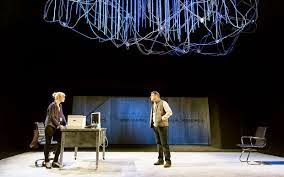
The Hard Problem:
Hilary (Olivia Vinall) confronts Leo (Jonathan Coy)
Always, and pervasively, we have that Stoppard wit to keep us amused as well as stimulated and affected. One of my favourites came when Amal, the hedge fund manager, talked about “watching the market bet on water flowing uphill and flying pigs farting Chanel No. 5.” That struck me as smartly summing up the behaviour of financial markets at their rational best.

An excellent play. Well worth seeing. So a fine birthday present.