Showing posts with label UK. Show all posts

Monday, 23 March 2026

Unintended consequences, or the West's blunder in Iran

As war rages in Iran, it’s worth pausing to imagine a different kind of leadership.

Smoke over Tehran following an Israeli attack on 13 June 2025
By Mehr News Agency, CC BY 4.0, from Wikimedia Commons
Think of it as a kind of fantasy exercise — like fantasy football — assembling the best possible team, while knowing it won’t be perfect.

So let’s imagine a leader of Iran not simply appointed by a bunch of religious figures, backed by armed groups whose main role is suppressing opposition. The leader we’re looking for owes his position to the support of the country’s secular parliament. And among the pledges to which he owes his election is putting an end to power built on brutal repression. Equally, he’s committed to working to limit the power of the clergy over wider society.

On the positive side, he’d be set on improving social benefits across Iranian society, ensuring that poorer Iranians, in towns and countryside alike, have the jobs and land they need to prosper. To fund that kind of programme, he’d use the revenue generated by Iran’s immense oil industry as well as by a progressive taxation system, in which the wealthiest contribute a greater share to government spending than the poor.

He needn’t be some kind of secular saint. What might his faults be? I suspect that in his hurry to achieve his laudable goals he might want to take emergency powers and would ask them to be granted to him by the very parliament that put him in office. That would reduce parliamentary authority. He might even go further and start to act against people who oppose him, leading to fracturing in his support.

So by no means a perfect leader. Even one who might in the long run prove the architect of his own downfall. But wouldn’t that be preferable to what both the Iranians and we, citizens of other countries, are having to deal with today?

Well, that was actually no fantasy. What I’ve been giving you is a thumbnail picture of Mohammad Mossadegh. He was Prime Minister of Iran, for a little under two and a half years, between 1951 and 1953. 

Mohammad Mossadegh
Public domain picture from Wikimedia Commons
This was the time when the British Empire was going into its terminal decline. India had already won its independence. The fifties would be when, in the phrase of British Prime Minister Harold Macmillan, a wind of change began to blow through Africa as colony after colony in that continent left the Empire too.

Iran was never a colony. Most of its oil, however, was controlled by the Anglo Iranian Oil Company (AIOC, which later became British Petroleum and today is known as BP). The British government had a controlling stake in the company so, in effect, Britain held undue authority over Iranian affairs.

When Mossadegh decided to nationalise the oil industry, to deliver the revenues he needed for his ambitious social programmes, the news was badly received in London. Declining power though it was, Britain still had the capacity to do damage, and it also had close ties with the power that was growing to replace it, the United States. The British put a blockade on Iranian oil and, with the Americans, persuaded Saudi Arabia to step in and increase production so the West wouldn’t suffer as a result. 

The effect was massive. Iran’s oil revenues collapsed, Mossadegh’s programme was doomed to failure, and the Iranian people condemned to poverty. As opposition grew, Mossadegh found himself becoming increasingly dictatorial in his moves to hold on to power. 

Now the American CIA, far better resourced than Britain’s spy agency MI6, began to take the lead role. Supported by Britain, US intelligence agents organised and funded a movement against Mossadegh. In August 1953, it succeeded, he was brought down, and with that, Iran returned to rule by the Shah — but now more dependent than ever on Western support.

In return, the western powers regained control of the oil.

It would prove to be a decision with long and far-reaching consequences.

A rare opportunity, to move towards a stable, secular and at least slightly democratic system in Iran, was lost. Over the next 26 years, the Shah steadily increased his power. That became particularly significant after the oil shock of 1973, when a surge in oil revenues seemed to put the Shah in a stronger position than ever. The growth in wealth gave him unprecedented power, allowing him to pursue rapid and far-reaching modernisation.

But the pace of change unsettled Iranian society. Economic disruption, social tensions, and growing opposition forced the regime to rely increasingly on repression to maintain control.

Even so, he could not hold the line. Opposition spread across the country, and in the end the army, though still intact, would not act decisively to keep him in power. In 1979, it was his turn to fall.

What replaced him?

Well, another Mossadegh regime might have been something to celebrate. But that wasn’t to be. Instead, out of the many currents that had opposed the Shah, many of them secular, it was the one led by the leading cleric, Ruhollah Khomeini, that took power. Iran was converted into a theocracy, the Islamic Republic. 

A few months later, supporters of the new regime had seized the US embassy in Tehran. Embassy staff were held hostage for 444 days, well over a year.

Within a year of the embassy seizure, Iran was at war with Iraq. It was a horribly bloody war that would last eight years. Despite Iraq’s powerful military, at the time still being armed by the US (who’d be fighting it themselves within twenty years), Iran emerged badly hurt but having lost no territory – effectively a victory from the Iranian point of view.

Khomeini died in 1989 and was succeeded by Ali Khamenei, who would rule for the next 37 years until he was killed at the outbreak of the present war. 

He headed a nation shaped and militarised by the war with Iraq and steeped in anti-American feeling, to which was added hostility towards Israel. It’s his nation which, despite the loss of its leader, is now putting up far stronger resistance to American and Israeli forces than many expected.

The war has inflicted severe damage on Iran and caused major disruption to the global economy, driving up oil prices and restricting the supply of key products such as fertiliser and helium.

Led by Donald Trump and Benjamin Netanyahu, the United States and Israel appear to have entered the conflict without a clear and agreed set of objectives. So far, the gains are hard to discern.

And the tragedy is that it’s hardly the West’s first error over Iran. It flows from its much earlier mistake. The blunder made 73 years ago. 

Ousting Mossadegh in 1953 certainly benefited oil interests in Britain and the United States. But the price of those short-term gains has been a long chain of consequences — from the Shah’s increasingly repressive rule, to his overthrow, to the establishment of a far more rigid regime — leading to yet another destructive conflict today.

It’s impossible to know what would have happened if Mossadegh had been left in place. There would, I’m sure, have been serious problems. But would they have been as bad as what has actually happened?

I seriously doubt it.


Monday, 11 September 2023

September 11, half a century on

On the 11th of September, thoughts obviously go to those in the US marking with sorrow the terrible attacks of 9/11 on New York and Washington. Twenty-two years later, I naturally feel great sympathy for them when I think how, driving along a road in Britain a friend of mine and I received a call from a colleague who asked, “have you heard about the plane flying into one of the Twin Towers?”, and the feeling of sickness that came when I realised this wasn’t the first line of a joke with a punchline behind it.

Of course, the sense of sickness deepened when I realised another plane had flown into the second tower. To say nothing of the three more planes converted into terrorist weapons.

Still, it’s important to remember that this isn’t the only act of appalling violence associated with 11 September. Indeed, this year marks an important anniversary, the half century, of another. Fifty years ago, on the 11th of September 1973, a group of Chilean officers led by Augusto Pinochet, rose in revolt against the democratically elected government of Salvador Allende.

Pinochet and his fellow mutineers had decided that they knew best what was good for their country and were better qualified than any civilian to achieve it. Their insurrection opened a seventeen-year period of dictatorship that cost at least 3000 opponents their lives. The bodies of 1000 have never been discovered.

It was an event that casts credit on no one. Obviously, there’s nothing but shame for the brutal dictators themselves, not just for their cruelty, but also because they seized power in a military coup, an act that denies a fundamental principle of military life, respect for the chain of command, which should have left them subordinate to the President. He was killed in the presidential palace when it was bombarded by units of his own air force.

La Moneda, the Chilean Presidential Palace
under attack from ground and air on 11 September 1973
There’s plenty of shame for plenty of others too. Three years earlier, soon after Allende was elected, the then commander-in-chief of the Chilean armed forces, René Schneider, was assassinated. He had championed what came to be known as the ‘Schneider doctrine’ that you could choose a military career or a political one, but you couldn’t combine the two.

While the US for a time denied all involvement in overthrowing Allende’s government, documents made public since make it clear that the death of Schneider had been orchestrated by the American CIA. Then CIA chief at the time, Richard Helms, convened a top-level meeting after Schneider’s death. The Agency chiefs sent a congratulatory cable to the CIA station in Chile, stating that, “a maximum effort has been achieved,” and that “the station has done excellent job of guiding Chileans to point today where a military solution is at least an option for them”. 

It took another three years, but in time with vital support from the CIA, the coup imposes a ‘military solution’ and launched the seventeen years of repression Chile then suffered.

Nor did Britain cover itself with honour. In 1998, after the end of his dictatorship, a human rights violation case was opened against Pinochet by a Spanish magistrate, Baltasar Garzón. The case turned on an interesting principle, of universal jurisdiction, which said that for this kind of charge, action could be taken anywhere in the world against a former head of state, even if an amnesty had been granted in his home country. Pinochet was held under house arrest for eighteen months in the UK, in the course of which former Prime Minister Margaret Thatcher, always an admirer of the bloodstained dictator, spoke out in his favour, as did former US President George H W Bush. But the most deplorable act was that of a centre-left, Labour government, when the Home Secretary Jack Straw released Pinochet on health grounds. 

Pinochet left in a wheelchair but stood up from it as soon as he was back on the ground in Chile and greeting his well-wishers. 

With such a depressing trail of cowardly and unethical acts all along the way, it’s no surprise that in the US and Britain we prefer to focus on 11 September 2001 than 11 September 1973. We ought, however, to pay more attention to what happened in Chile. That’s particularly the case given that its wounds have still not wholly healed.

Here's what Beatrice Ávalos, a Chilean educator interviewed by the Spanish newspaper El País, suggests for this anniversary:

Perhaps the harshest effect in the years that followed the military coup was establishing a rift between Chileans and Chileans, raising some up and attacking the humanity of others. My proposal would be that we might use the rest of the year to heal that rupture by reaffirming our commitment to both political and social democracy, recognising the legitimacy of many of our differences. I would propose that opponents in the National Congress issue a joint statement expressing a vigilant commitment to democracy and to human rights; and that in every place where we work and live we offer each other our hands on the 11th of September, looking at each other and making a powerful pledge of ‘never again’. 

Now, isn’t that an excellent proposal?

Thursday, 25 June 2020

The thing about lying is that it works

The very people who most complain about lying politicians, seem to be the most inclined to believe their lies.

Trump’s supporters, in particular, went along with his slogan about ‘draining the swamp’. That suggested that it was Washington DC that was the breeding ground of all the ugliest and most dangerous lies. Now, since Trump has been in place, with a mandate of sorts to drain that swamp, he has massively raised the level of mendacious toxicity of the very swamp he occupies, which is clearly his most suitable habitat.

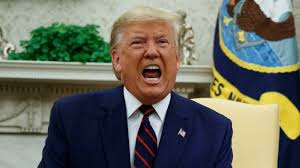
Hardly a day goes by without his coming up with some new lie. The latest was to nearly double the number of attendees at his Oklahoma rally, and to claim he was satisfied with the outcome, despite his obvious expression of crushed dejection.

Trump defeated by the poor turnout in Oklahoma
Hope for us all in November


Despite all that, some people keep on backing him. They swallow the lie.

The same is true in Britain.

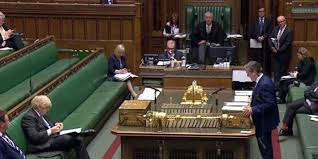
In my view, Keir Starmer, as leader of the Opposition, had much the better of his exchanges in Parliament with the Prime Minister, Boris Johnson, at Prime Minister’s Questions (PMQs) on the 24 June. Above all, Starmer took the approach so many of us have demanded from our politicians for years or decades: calm, well-informed, moderate. He offered praise for where things had been done well in combating Coronavirus, and then focused on a genuine problem on which he called for clarity from the government.

Keir Starmer, on his feet, questioning
Boris Johnson, left


In other words, like the American voters who wanted the swamp drained, he rose to the challenge many UK voters have set politicians.

He asked:

Yesterday, the Government announced the next stage of easing lockdown restrictions. If that plan is to work—and we want it to work—we need an effective track, trace and isolate system. The Prime Minister promised that a world-beating system would be in place by 1 June. The latest figures from yesterday’s press conference hosted by the Prime Minister show that 33,000 people are estimated to have covid-19 in England. The latest track, trace and isolate figures show that just over 10,000 people with covid-19 were reached and asked to provide contact details. I recognise the hard work that has gone into this, but if two thirds of those with covid-19 are not being reached and asked to provide contact details, there is a big problem, isn’t there?

Did the Prime Minister respond in kind? Did he heck. Here’s what he said:

On the contrary. I think that the right hon. and learned Gentleman has been stunned by the success of the test and trace operation. Contrary to his prognostications of gloom, it has got up and running much faster than the doubters expected. They are getting it done—Dido Harding and her team have recruited 25,000 people and so far they have identified and contacted 87,000 people who have voluntarily agreed to self-isolate to stop the disease spreading.

In other words, he gave a purely old-style politician’s answer: on the attack, and dodging the question altogether. As Starmer pointed out:

The Prime Minister just has not addressed the question I put to him. I was not asking about those who have gone into the system—the 10,000—or those who have been contacted; I was asking about the two thirds of the 33,000 with covid-19 who were not reached. That is a big gap.

Clear, simple and focused on the key matter. If only 10,000 are being tested then, on the government’s own figures of 33,000 infected, two-thirds are not being reached. This is bad news. And Johnson’s response? He went back on the attack: “I hesitate,” he claimed without hesitation, “to accuse the right hon. and learned Gentleman of obscurantism. He is misleading on the key point.”

The accusation of misleading is serious in Parliamentary terms and the Speaker had to call on him to withdraw it.

The exchange moved on to the matter of the tracking app, promised for 1 June, then abandoned, now promised again, using commercial software, perhaps some time after September.

Boris Johnson was having no criticism on that front:

I wonder whether the right hon. and learned Gentleman can name a single country in the world that has a functional contract tracing app—there isn’t one.

Strangely enough, the right honourable and learned Gentleman Keir Starmer certainly could name one:

Germany. It had its app working on 15 June and it has had 12 million downloads—I checked that overnight.

So now the decks were cleared for Johnson to move from the lie circumstantial to the lie direct:

I am afraid that the right hon. and learned Gentleman is completely wrong, because no country in the world has a working contact tracing app.

Faced with a clear, verifiable fact, Johnson merely resorted to denial. A blatant, easily refuted lie.

And here’s the sad thing. He won’t be called on it.

Many have demanded that politicians find more honest ways of doing their job, for instance denouncing Blair for lying over Iraq.

They claim to want them more straightforward and thorough.

They called for less aggressive exchanges between them, more focused on solid, reliable information.

Yet a large number of them will rally to Johnson now. They will claim he bested Starmer. They’ll praise his style instead of denouncing his lies.

My only hope? That in neither the United Kingdom nor the United States will they constitute a majority.

So we really can drain the swamp and move to a healthier brand of politics.

Saturday, 6 June 2020

Governments losing against Coronavirus: it's no coincidence

“One of the things that makes novels less plausible than history, I find,” says a character in Tom Stoppard’s play Night and Day, “is the way they shrink from coincidence.”
We do try to reject coincidence. “This happened after that other thing happened, so it must have been that other thing that caused this one.” Post hoc ergo propter hoc, the Romans used to say, after that so because of that.
And yet there really are things that are simply coincidence, in the sense that they happen together, or after each other, purely by chance.
London had a population climbing towards seven million over the decade I was a student there (yep: I was once the proud owner of ten University of London student cards). And yet I hadn’t been there many years before I had my first experience of meeting people I knew, without arrangement, on the street. It happened to me several times over the period I lived there.
What? The chances of meeting any particular person out of 6.5m is, naturally, 6.5m to 1. And yet I several times met individuals I knew?
We are not intuitively good at handling statistical reasoning, as the psychologist and economist Daniel Kahneman has pointed out. I had a wide network of acquaintance, which immediately increased the chance of meeting any one of them by chance. And it was not as though I only ever crossed the path of one other person in any one day – on the contrary, commuting from home to work or to college brought me close to hundreds or even thousands of people (hence the difficulty of maintaining social distancing today).
Take that into account, and the probability of meeting someone I knew was significantly higher than I might have imagined. Certainly, high enough for it to be perfectly reasonable that it should happen several times over a ten-year period. Particularly when you consider that most frequently the encounters were in places which act like people-funnels, such as the main railway stations.
In fact, the most surprising such event I witnessed was just last year, as I was catching up with a Turkish friend, Muharrem, who was about to enter Victoria Station ahead of me. I found him in lively conversation, in Turkish, with a woman. After she had left, Muharrem explained to me, “she’s one of the most famous novelists in Turkey, and I met her when I was working at a library where she came to give a talk”.
Despite this kind of experience, we do shrink from coincidence. Indeed, that shrinking becomes a weapon in the armoury of people trying to build certain kinds of argument. They might, for instance, say:
“My friend Sally took that medication. And exactly two years, five months and 17 days later, she had a series of terrible migraines. Coincidence? I think not.”
It’s a great debating trick, because it establishes in advance that only the most naïve and credulous people could possibly respond, “well, actually, yes, I reckon it probably is a coincidence.” As, of course, it is.
After all, Sally probably took other things than that medication before getting her migraines. If anything that happened before them could be regarded as a potential cause, might it not have been the chocolate she had the day before, or the overindulgence in wine, or the fact she drove through a polluted neighbourhood? After that so because of that isn’t an argument, it’s a sloppy and unreliable way of reasoning.
To establish that there’s more than chance at play, we have to show some causal connection between the two incidents.
To take a different example, naturally chosen entirely at random, consider lousy government. Faced with a major and fatal pandemic disease, a lousy government fails to take it seriously. It may attempt to put in place measures to protect its healthcare workers, and even promise to do so, and then take far too long and under-deliver. It may, rightly, identify track-and-trace as the best way to combat the virus, promise to put a system in place and then fail to meet its own deadline.
Or lousy government might just be far too glib in attitude. It may be scornful about simple and effective measures like wearing masks. It may pay lip service to other measures, such as social distancing or quarantining, while flouting them itself and turning a blind eye to infringements by friends or supporters. It may be halfhearted about its lockdown measures and end them too soon.
Now which governments around the world have been most guilty of some or all of these kinds of behaviour?
Why, the governments Trumps United States, Johnsons UK and Bolsonaros Brazil. Which makes it fascinating to look at the latest figures published by Worldometers. Imagine which are the governments with the highest numbers of deaths due to Coronavirus:
The three nations with the worst Coronavirus death totals
Note that Johnson's UK has the worst death rate per million

A coincidence? I think not.

Wednesday, 13 May 2020

Laughing at us, not with us

Benjamin Franklin came up with many pithy sayings that have become proverbs, such as, “It takes many good deeds to build a good reputation, and only one bad one to lose it”.

Every time I see someone in the British media or politics talking about some aspect of the nation being “the envy of the world”, I cringe.

It’s been said about the National Health Service, where it had some validity until ten years of austerity starved Britain’s favourite institution until it could no longer deliver what the nation needs.

It’s been said about the justice system, despite Britain being the nation where it’s hardest to defend against a libel suit, where the Birmingham Six could be wrongly condemned and the family of Stephen Lawrence denied justice for his murder.

It’s been said about the Army, though it sent soldiers tramping across the Falklands in boots so bad they fell apart on the way.

Still, in some areas Britain had a fine reputation. For instance, for its sense of humour, which God knows we need more than ever. Or, despite Brexiter claims, in international negotiations, where the UK tended to get its own way in the EU (much to the annoyance of France), as Bobby McDonagh, once Irish ambassador to the UK as well as having worked many years with the EU, made clear in the Guardian in July 2019:

British influence in the EU went well beyond that available to most member states. The UK’s impact was exceptional due to several factors. The quality of its civil servants. The effectiveness of its coordination mechanisms. The reach of its diplomacy. The potency of its networking. The admiration for its pragmatism. The predominance of the English language.

Meanwhile, the reputation Britain enjoyed for administrative skill, pragmatism and diplomacy, was enjoyed by the US for its knowhow.

I’ve always enjoyed the story of a Canadian politician who said that, when his country was founded, it hoped to combine French culture with the British political system and American knowhow. Sadly, it had in fact combined the French political system with American culture and British knowhow.

US knowhow gave the US a huge advantage over Japan in World War II. It had the capacity to build war material at a colossal rate, replacing losses and extending their advantage, at a time when Japan could no longer build either ships of planes.

The Moon landing was another staggering achievement. Second in getting a man into space, they were nonetheless first in putting a man on the Moon (the series For All Mankind gives an entertaining and insightful view of what might have happened had they been second).

When it came to doing things right, it made sense to look at what was happening in the US. And when it came to doing the right thing, at least in politics and administration, you could do a lot worse than turn to the UK.

Both nations built those reputations over years of careful, competent work. Now they’ve lost them.

Not improving US standing in the world


Trump has spent his presidency undoing Obama’s good work before him, on global warming, on international relations and on medical preparedness for epidemics, particularly relevant today. Nothing, however, has shown up his unfitness for the job so much as his handling of the pandemic itself. Many have died because of his slowness to act. Now, many more will die as he forces the nation to open to business too soon, against the advice of his experts, and for no better reason than that he needs the economy to be booming to secure re-election.

In other words, his electoral interests matter more to him than the primary duty of all national leaders, to protect their people. He’s indifferent to the suffering of others. That, incidentally, seems to me to be the textbook definition of a sociopath.

They may be laughing at you these days,
rather with with you...

In the UK, Johnson’s focus was on completing Brexit, with the simplistic slogan, “Get Brexit Done”. It ignored any of the details of how a Brexit would look or the impact it would have. But Johnson isn’t a details man.

His failure to grasp detail is particularly stark in the pandemic. He had several weeks’ warning and much to learn from countries hit earlier. But like Trump, the Prime Minister is more concerned with holding his post than with carrying out its duties. Why, he even failed to attend five meetings of the emergency committee preparing for the epidemic when there was still time to act.

This week, as he announced that it was time to relax the lockdown and send many people back to work, it emerged that he’d made no arrangements to ensure their safety. Laughably, he made it sound as though they should go in on Monday, when in fact the relaxation was planned for Wednesday. Nor could he make clear how they should get there, by their own means or public transport.

This led to the German newspaper <i>Die Zeit</i>, one of many foreign media shocked by Johnson’s behaviour, to comment acerbically, “the government is now trying to pretend that it has the situation under control.”

Far from being the envy of the world, Trump and Johnson have made the US and UK objects of ridicule and pity. British comedy enjoys high international fame, but right now people are laughing at us, not with us. It will be a long way back for both nations to the reputations they once enjoyed, with no guarantee they’ll get there. 

But who’s to blame? They didn’t vote themselves into office, after all.

If you plan to vote for Trump, you’re not making America great. You’re contributing to preserving an administration the world sees as incompetent and which will cause the deaths of tens of thousands of your compatriots.

If you plan to vote Conservative in Britain, you’re trying to preserve a government which is making the country a laughing stock and the most dangerous in Europe for Coronavirus.

We often get the governments we deserve. And if we don’t vote for a better one, we deserve the one we have.

Even if its bad deeds confirm, as Benjamin Franklin pointed out, our justified but lousy reputation.

Saturday, 2 May 2020

If you want lies, you'll get liars

It’s a lazy, easy accusation against politicians to say they all lie. In reality, many politicians only lie because it works. They’ve understood that enough voters want to hear their lies and believe them, which makes the right lies, told well, the quickest way to get power and to hang on to it.

The American journalist and writer H L Mencken summed up the process quite neatly, starting with a point I’ve felt for a long time: politicians – perhaps I should say most politicians – have no special aptitude for government, only an aptitude for getting into government.

The government consists of a gang of men exactly like you and me. They have, taking one with another, no special talent for the business of government; they have only a talent for getting and holding office. Their principal device to that end is to search out groups who pant and pine for something they can't get and to promise to give it to them. Nine times out of ten that promise is worth nothing. The tenth time is made good by looting A to satisfy B. In other words, government is a broker in pillage, and every election is sort of an advance auction sale of stolen goods.

I’m not sure about its never being possible to satisfy B without looting A. After all, if US healthcare hadn’t been allowed to keep festering, and the British NHS hadn’t been repeatedly hacked at, for the last ten years, wouldn’t both A and B have benefited from better services in our present pandemic?

Perhaps I’m a little less cynical than Mencken. Or am I just less realistic?

What interests me most, though, is Mencken’s reference to the process of finding people who “pant and pine” for a promise that is unlikely to be kept. Isn’t that the incentive for politicians to lie? Or, put it in other words, if you want politicians to lie to you, isn’t it likely that you’ll end up with lying politicians?
Vote for lies and you'll get liars
On both sides of the Atlantic, we are saddled, for now, with political leaders for whom the lie seems to be as natural as breathing. At the start of the Coronavirus crisis, the UK Prime Minister claimed that the NHS was fully prepared for any eventuality. As well as the impressive rate of growth of deaths generally in the UK, the number of deaths of healthcare workers denied adequate protective equipment, proves how entirely false that statement was. Johnson’s good at thanking front-line staff for their courage and selflessness, less good at protecting them.

Trump’s lies have been more barefaced still, and compounded by irresponsible ignorance. Having suggested that injecting disinfectant might protect against the virus, whereas it’s much more likely to kill you, he attempted on the following day, to pass off the comment as “sarcasm”. That’s even though hundreds of millions have been able to see him on TV making the remark without the slightest hint of sarcasm.

At least a large minority of Americans seem happy to maintain their trust in Trump despite his being caught repeatedly in easily exposed lies. In the UK, the position is worse: a majority of the electorate still believes in Johnson, however often he shows he can’t be trusted. They “pant and pine” to be told what they want to hear, especially in the atmosphere of fear that comes with a crisis,  when it’s comforting to believe government is looking after you,

Most recently, the UK government has made a number of unrealisable promises, just as Mencken warned. One was that the UK would be carrying out Coronavirus tests at a rate of 100,000 a day by the end of April. By the 29th, we had reached some 81,611, though that included people receiving more than one test in a day.

Then suddenly, on the 30th, the day of the deadline, the UK reached 122,347. A brilliant success. The Health Secretary manfully and modestly claimed it as a triumph not for himself, but for the Health Service. A matter for celebration, in any case.

Sadly, a lot of people, anxious to believe whatever they’re told by the government, will take that as gospel. But when we look at the detail, we see that those 122,347 tests actually only affected 73,000 people. Mark Twain once commented that:

Carlyle said “a lie cannot live.” It shows that he did not know how to tell them.

Indeed. Most people understood that 100,000 target to mean 100,000 people tested, but if you do enough repeat tests on the same people, you can get there with just 73,000 people. Dexterous sleight of hand.

A still more curious fact is that 39,000 of those tests weren’t actually carried out on the 30th. They were sent to people who had ordered them. Who knows when the tests will be used? Or whether they’ll be used at all?

So people actually tested on the last day of the month may have been under 40,000.

That reminds me of one of the classic lies: “the cheque is in the post”.

How about “the test is in the post”?

Believe it if you want. But if you do, you’ll only be asking to be deceived again. And right now, a lot of people are dying.

Tuesday, 7 April 2020

Coronavirus: the truth. So far as we know

They say that the first casualty of war is truth. There’s no reason why the war against Coronavirus should be any different.

Generally, the problem is that governments are lying about what’s going on. You know, claiming to have shot down more planes than the enemy ever had, or claiming that a retreat is a strategic withdrawal to more defensible positions. Today, though, the mist over the truth is just the lousiness of the information.

For instance, we’ve been counting total numbers of infected cases. But we know that no country has the means to test every one of its citizens. So how can we know what the true figure is?

The number of infections in Germany is currently at about 70% of the number here in Spain. But the number of deaths stands at about 12%. Is that simply because they’re testing much more widely, and therefore identifying far more cases than don’t lead to death?

I’ve seen conflicting estimates of the true number of Spanish cases. Some authorities say they should be four times higher, others twenty times. Four times or twenty? How do you get anywhere near the truth with that kind of variation?

The same is true of the number of deaths. Some countries don’t count deaths in certain contexts. Maybe someone died outside a hospital and wasn’t tested. So they’re not included in the figures. On the other hand, if someone with CVid dies they may be counted as one of the deaths, even though they had underlying conditions, one of which may have been the real cause of death.

There are certain phenomena that are particular to certain nations. For instance, in the UK death figures can be reported over several days. The number of deaths reported for one day may therefore climb later.

In Spain, too, there’s a problem with weekends, when reporting may be delayed. That means figures may be low for Saturdays and Sundays, but exaggerated on Mondays. And that may or may not happen. 

That’s how exciting this all is.

Still, perhaps one can make a couple of assumptions, just as long as one remembers that they are assumptions and they are open to challenge as any assumption is.

The first is that however bad the figures may be, within a single country, they’re likely to be just as bad any day as they are on any other – or just as good. So if the case figures are a twentyfold underestimate on one day, then they’re likely to be a twentyfold underestimate on another. That means that comparing the figures over time may at least give a view of where we’re heading.

The second assumption is that the figures for a single day can jump about a bit. They may be up or down by chance. So it’s best to look at what happens over several days or a week.
Coronavirus cases (left) and deaths (right), by day, in Spain
Rolling seven-day average as dotted line
The black line marks the lockdown-start date
In the graphs, I’ve shown the daily figures for cases and deaths in Spain. I’ve also included a trend line based on how the average for the previous seven days has been changing. The trend line only starts on day seven, because no seven-day average can be counted before. The black line marks the day on which the Spanish lockdown began in earnest, 16 March.

Both lines show an uptick right at the end, but remember what I said about not putting too much weight on a single day’s figure. In any case, they’re for a Monday, so it’s possible they reflect late reporting at the weekend. Still, it’s possible there’s a real uptick. The lesson is that both figures can start growing again, whatever the prior trend may show.

That trend itself is at least a little encouraging. It does look as though both lines may at last be dipping. The deaths have not dropped as much as the cases, but that’s to be expected: patients dying today were probably first counted as cases a week ago.

It has, however, taken three weeks of strict lockdown to get here. Far stricter, for instance, than in the UK. As strict as Italy, where the figures also seem to be showing a tendency to drop.

This is, however, only the start of the drop. How long will it be until we get to figures so low that we can sensibly think about relaxing restrictions?

The Spanish government has started planning for that moment and one decision has already been taken: work regarded as non-essential, currently suspended, will start again on 11 April. But when will parks reopen? Or schools? Or bars and restaurants? That’s still unclear, but we do know that Wuhan, where the epidemic started, is only just beginning to relax, after eleven weeks of lockdown.

What this says to people in other countries is that lockdowns aren’t quick fixes. This is a long battle; restrictions have to be tough; they have to be in place for a longer period than any of us would like; and they can only be removed gradually.

Still, if we can trust the Spanish figures at all, they do seem to work.

Eventually.

Monday, 23 March 2020

The Walking Dead, or has Sanders done a Corbyn?

‘Dead man walking’ is an overused expression. But I can’t help feeling it fits Bernie Sanders perfectly. Barring some kind of miracle, the only thing that stops his campaign for the presidency being over, is that he won’t admit it.

An analysis in the New York Times rang a bell with me:

While Mr. Sanders has not ended his bid, he has fallen far behind Mr. Biden in the delegate count and has taken to trumpeting his success in the battle of ideas rather than arguing that he still has a path to the nomination.

Supporters of Jeremy Corbyn, soon to be ex-Leader of the Labour Party, led us into two general election defeats. The second, in December, was crushing. His supporters now claim that he ‘won the debate but lost the election’.

How much worse would the defeat have been had we lost the debate too?
Lost causes both. However well read the campaigns may have been
All this reminded me of a note a friend of mine posted online some weeks ago.

I had been wondering how Momentum had been able to do so many things in the General Election that the Labour Party could not or did not do.

A friend in Momentum told me to read "Rules For Revolutionaries" by Bond and Exley.


My first reaction was, “if it’s an idea from Momentum, it’s probably best to stay well away from it”. Momentum is a faction inside the Labour Party that was set up specifically to back Jeremy Corbyn. So it shares responsibility for his failure.

When I expressed my scepticism, however, my friend responded that I should perhaps read the book. That was a reasonable reply, so I did – or rather, I listened to it, my preferred way of getting to know books these days (haven’t tried it? I suggest you do. You can listen while doing something else, which is particularly welcome if the something else is housework).

The book’s by Becky Bond and Zack Exley and it’s a fascinating read (or listen). It’s an American study, so it’s hardly about anything anyone in Europe would recognise as revolutionary. It’s about basic reforms, radical only for the States, such as healthcare free at the point of care or university education without fees.
Many intriguing ideas
It focuses above all on organisation and tactics, drawing heavily on the authors’ experience of the 2016 Bernie Sanders campaign. 

They have some excellent ideas. The biggest is the extensive use of volunteers, rather than paid staff. Volunteers can recruit others who can recruit still more, creating a spreading network of supporters actively working for your candidate.

The other, related to it, is to raise your money from huge numbers of small donations. That’s been very much a keynote of both of Bernie’s presidential campaigns, and it’s impressive: it leaves him beholden only to ordinary voters and not to the huge corporations or lobbying organisations that have been toxifying Washington politics for at least a century and a half.

Not all of this is directly transferable to the UK. For instance, a curse and an advantage of US politics is the primary election.

It’s a curse, as the Democrats are discovering now, because it leaves a party squabbling with itself as candidates vie for the nomination, while Trump sits in the White House trying to look presidential.

The advantage is that it gives candidates a long time to connect with voters to listen to their concerns and to communicate a response.

We have no such institution in Britain. Arguably, we should. I think it most unlikely that Corbyn would have led Labour into the last election if Labour voters, and not just members, had been consulted. But for the moment, we don’t.

However, it is perfectly imaginable that we organise discussions with voters about principles. For instance, in Corbyn Labour has had a leader who was a Brexiter without the guts to admit it. Without that handicap, the Party could have spent the time after the referendum explaining to its supporters that Brexit would harm their lives, even if they had voted for it. That might have kept enough voters on side to win an election, and even have built support to reverse the Brexit result.

So some of Bond’s and Exley’s proposals could certainly be applied in Britain. But surely not by Momentum. Bond and Exley are all about recruiting huge networks of volunteers and empowering them to campaign as they see fit. That means delegating authority, and accepting the small number of inevitable failures for the sake of the far greater overall gain.

Momentum, to give you an idea of how the faction operates, sent out a ballot to its members over the Labour leadership election. Did it delegate the choice to its members? Did it heck. It called on them to either accept or reject only one option, the politburo’s.

Sorry. Momentum has a National Coordinating Group. However it behaves, it’s not actually called a politburo.

None of this, though, is the biggest problem with the book. The real problem is that it was written by people associated with a losing campaign. The book drops a hint as to why Sanders lost.

Becky Bond wrote Rule 4 of the Rules for Revolutionaries. That’s ‘Fighting Racism must be at the core of the message to everyone’.

She describes a public meeting at which candidates were asked to react to the call ‘Black Lives Matter’. My transcription of the audio is:

… his [Bernie’s] response to protestors was to declare, “black lives of course matter. I spent fifty years of my life fighting for civil rights and for dignity.” Then he continued, “but if you don’t want me to be here, that’s OK. I don’t want to outscream people.”

It was in this way that Bernie missed a crucial, early opportunity to put race at the centre of the message to everyone.


One of the most remarkable aspects of Bernie Sanders’ campaign, particularly the current one, is his inability to gain traction amongst black voters. Like Bernie, Corbyn’s response to accusations of anti-Semitism, was to point at decades of campaigning against racism.

More fundamentally, however, Bond’s account of this moment provides a glancing reference to a much more serious problem that the book fails to address: it doesn’t matter how well you organise if the candidate’s no good. And he’s no good if he can’t put together a winning coalition of voters.

That’s Corbyn, but it’s also Sanders. Not only can Bernie not mobilise black voters, he can’t break out of the narrow circle of those who share his views. Here’s the New York Times again, with comments that apply as strongly to Corbyn:

Mr. Sanders proved unable to expand his base well beyond the left or to win over African-Americans in meaningful numbers. He failed to heed warnings from traditional party leaders, and even from within his campaign, about the need to modulate his message and unify Democrats.

Sanders rejects what he sneeringly refers to as the Democrat ‘establishment’, which makes it surprising that hes angered by the failure of the centre and right of the Democratic Party to rally behind him. In the same way, Corbynists in Labour denounce anyone else as ‘Blairites’ or ‘Red Tories’. 

That doesn’t matter too much if the objects of their contempt are fellow Labour members. We voted for the Party anyway, despite Corbyn. But outside the Party, there was nothing like Party loyalty to oblige the huge numbers who mistrusted Corbyn to stick with him in spite of their aversion. So they voted against.

It can be invaluable to have clever organisational methods. Great campaigning tools are even more valuable. But if your candidate isn’t prepared to reach out to voters who don’t already share his views, well, he’s doomed before he starts.

Bernie. Jeremy. Walking dead both.

Friday, 27 December 2019

Not good for the Pope. Not good for Britain either

One thought can easily conjure up unrelated memories, can’t it?

I was reading about the present Pope the other day, and it brought to mind memories of the Falklands War. Or perhaps I should say Conflict, since war was never declared. And perhaps I should say Conflict over the Malvinas, to give the Spanish name for those islands, since that’s what the Argentinians call them.

What’s the link to Pope Francis? The Conflict brought to an end the military dictatorship in Argentina. That, incidentally, is why I always think the Argentinians won, even if they didn’t keep the islands: they got rid of one of the bloodiest and most brutal dictatorships in their troubled history, while we were stuck with Thatcher for another seven years, followed by further Tory government under John Major for another five after that.

It wasn’t just the supposed ‘victory’ in the Falklands that kept Thatcher in power and gave her a landslide election win the following year. She was helped by Labour having a brainstorm and going into that campaign led by the hard left, which played right into her hands. Sound familiar? Yes, just because we made that mistake 36 years ago doesn’t mean we’d learn from it and avoid it this year.

Francis, then Jorge Bergoglio and head of the Jesuit order in Argentina, lived through the dictatorship and its “dirty war”. Indeed, the darkest era in his past is that he may have contributed to two priests being tortured by the regime.
Esther Ballestrino
A significant influence on Pope Francis
A woman who played a major role in Bergoglio’s development was Esther Ballestrino. She headed the lab where he worked when he was still a chemist and hadn’t decided to become a priest. In 1977, her son-in-law and her pregnant sixteen-year-old daughter were abducted and tortured by the regime. In the absence of any news of them, Ballestrino joined with other women in founding the ‘Mothers of the Plaza de Mayo’ who would gather every week, demanding information, outside the presidential palace on that square in Buenos Aires.

Eventually, her daughter was released. But Ballestrino kept turning out with the other protestors. Unfortunately, the group was inflltrated by a man called Alfredo Astiz, from Naval Intelligence, nicknamed the ‘blond angel of death’. When the group published an advertisement listing the names of the ‘disappeared’ – the people abducted and about whose destiny no information was available – Astiz arranged for five women, including Ballestrino, to be arrested. They were tortured and eventually loaded, heavily drugged, onto a ‘death flight’: a plane that took them out to sea where they were dropped, hands and feet bound, out of the back of the aircraft.

So Esther Ballestrino died, one of the great sorrows in Pope Francis’s life.

And what memory did this conjure up in me?

I was conflicted over the Falklands War – conflicted over the Conflict. It strikes me as ridiculous that a group of islands off the coast of Argentina are possessions of a country, Britain, nearly 13,000 kilometres away. On the other hand, I loathed the Argentinian junta and deeply disliked the way they decided they could use military force to solve a territorial dispute. Above all, I disliked their obvious contempt for the views of the local population.

The use of military force and the trampling of the rights of the local inhabitants? It felt far too much like what the Israeli government does to Palestinians.

In any case, I can only be pleased with the way things worked out for Argentina, giving them a far more important victory than anything on the battlefield could have achieved: it freed them from a particularly nasty regime.

At the time, however, I remember being regularly sickened by the news. There was a day when I arrived in London from the suburb where I lived at the time, and caught sight of a startling headline in the local paper, the Evening Standard. The Argentinian cruiser Belgrano had been sunk by a British submarine, leading to the deaths of several hundred young conscripts. My stomach churned over that massacre, and even more over the gleeful celebration right-wing papers engaged in over it.
The Sun delighting in the deaths of conscript sailors
Then there was the recapture by British troops of the island of South Georgia. They took the surrender of the Argentinian garrison there. It was commanded by – Lieutenant Commander Alberto Astiz. Yes. The blond angel of death.

Both Sweden and France wanted to question him for the murder of some of their nationals. But the Thatcher government, pleading the Geneva Convention, had him questioned by a British policeman and, when Astiz refused to answer any questions, decided to release him and send him home.

So a torturer and murderer was treated with kid gloves, while the young conscripts on the Belgrano were sent to their deaths with callous indifference.
Alfredo Astiz, torturer, murderer, released by Thatcher
Funny to be reminded of all that by a book talking about Pope Francis. Funny but no fun. To me, that act of the Thatcher government ought to be remembered in perpetuity as a moment of glaring shame in the history of Britain.

Astiz was at last sentenced to life in prison in 2011. By the Argentines. Who again emerge from this sorry story, as they did from the war, with more honour than a deeply flawed Britain.

Saturday, 14 April 2018

Mission accomplished: déjà vu

It’s always a little sad to see someone who really can’t be expected to know better, take credit for completing a job when they’ve barely even started. Worse still, they may have started down the wrong route. A child, say, who carefully paints all the parts of his new model before assembling it, only to find they no longer fit together afterwards.

Or the US President who claims to have achieved his objective when he has achieved nothing – or, worse still, achieved the opposite of his intent.
Dubya in 2003
That was my first thought when I heard that Donald Trump had claimed ‘mission accomplished’ following the US-French-British missile strikes on Syria. It was exactly the same claim as made by Dubya Bush back in 2003, giving me a thoroughly dire sense of déjà vu. That followed the invasion of Iraq and the toppling of Saddam Hussein. Dubya clearly felt he’d achieved a major success, a view that looks jaded fifteen years on, with fighting still raging in the region and the only winners in Iraq being the West’s great bogeyman, Iran.

That didn’t stop Trump making the same claim for his missile strikes. And I suppose he was right in the most limited possible sense: he gave the world notice of his intention to use missiles against Syria, and he has indeed used missiles against Syria. If that was the extent of his mission – to demonstrate the military power at his disposal – then I suppose the mission was indeed accomplished.
Donald Trump in 2018
One might imagine, however, that such an action ought to deliver more than that, however. More than allow Trump a feel-good macho glow (Macron of France, too, I suppose, though whether May enjoys machismo it’s hard to say – but then, little surprises me about her any more). Generally, one would expect the use of massive military force to advance some cause or another, beyond the purely personal. 

Topple President Assad, maybe? 

End the suffering of Syrian civilians after seven years of civil war? 

At least ensure that chemical weapons would not be used against them again?

Maybe that last goal may be achieved, though I think it would take a brave man to assert it. We shall see. And even if it, it’s unclear to me that being killed or crippled is that much less unpleasant by artillery fire than by chemical weapons.

As for overthrowing Assad or ending the war, it would take a high degree of naivety to believe that the missile strikes will have achieved that much. Or even that bringing Assad down, however desirable in itself, would do any more in Syria’s current crisis than the equally attractive overthrow of Saddam did in Iraq.

Perhaps there’s one negative benefit the strikes have produced: they seem not to have destroyed any Russian equipment or inflicted any Russian casualties. That suggests that we may have avoided a third world war for now.

No. It’s hard to believe that these strikes have done anything very much, except persuade people in the west that, because something had to be done about the chemical attacks, it was legitimate to just about anything, which is what has now been done.

That may have made Trump, Macron and May feel better about themselves. Which I suppose is a benefit of sorts. Though they’re unlikely to have done anything for the Syrians or, indeed, for anyone in the West.

Still, Mission accomplished. Again. In some sense of the expression.

Friday, 27 October 2017

Healthcare: doing the right thing and finding the right words to say it

Every now and then a conference – and I’m at one now – is enlivened by masterful presentation, brimming with insights on vital matters, the whole sharpened and enhanced by intelligent use of humour.

Such was the talk given by Walter Ricciardi, President of the Italian National Institute of Health. It was entitled From evidence to action in health policy making: a mission impossible? His subject was how senior clinicians concerned with the strategic direction of health, and convinced of the value of practising evidence-based medicine (the theme of the conference) could work with politicians in government to take the necessary decisions.


Walter Ricciardi
Witty, insightful and spot on about the need to get it right – and say it right
I’m keen on evidence-based medicine. That may sound like a trivial statement: who wouldn’t be? Well, you might be surprised how often medical decisions are taken on the basis of a clinician’s gut feel, or confidence that years of experience are enough, rather than evidence. Worse still, they’re often taken on the basis of politics: for instance, the UK government has made funds available to allow GP practices to stay open later, without putting in place any kind of process to check whether the move leads to any of the desired effects – most notably reducing attendances at Emergency Departments of hospitals.

The reason why Ricciardi feels this kind of discussion is vital now is the well-known observation that demand for healthcare seems to keep climbing uninterruptedly, as the population of the advanced economies ages and the technology available for care increases in sophistication (and cost). As he suggested, there has to be a limit to the amount society can sensibly be asked to invest in healthcare.

That reminded me of a presentation I attended some years ago, when one of the speakers pointed out that, on present trends, the USA would be spending 100% of its GDP on healthcare by the end of this century. That’s clearly impossible – something has to go into schools and roads and things, to say nothing (this is the USA we’re talking about, after all) about defence. So what is the maximum US citizens will accept? 50%? Surely that’s too high. 30%? It’s hard to imagine. 20%? If so, things are urgent indeed: they’re already spending 18%.

That’s without even providing full healthcare coverage for the whole population.

Limiting healthcare expenditure, wherever the limit lies, means that at some stage we’re going to have to start denying care. That’s where evidence-based medicine comes in. There are a great many treatments that could be denied without doing patients any harm – indeed, where the denial would do them good.

At one end of the scale, prescribing antibiotics for viral conditions harms us all and does no good to the patient.

At the other end, intense and highly expensive interventions for a patient with a fatal condition can wreck the end of a life and incur huge waste.

We have to start finding a way to avoid this kind of wasteful, if not downright harmful, way of practising medicine.

That’s where Ricciardi turned up the humour a notch or two. He suggested that the people who understand the issues have a vocabulary of 140,000 words; the general public, and he included politicians in that category, a mere 7000.

I don’t know where those numbers came from. Frankly I find them highly questionable. In fact, I’m inclined to ask, where’s the evidence? However, the underlying point is worth making: specialists in medical information need to find a way of communicating the case for some of these notions more effectively to the population. They need to persuade politicians of the need for action, and help the politicians find the words to express their decision in a way voters will accept.

At this point he made a point I found particularly amusing, though he may have meant it seriously. He referred to Jean-Claude Juncker, President of the European Commission, as intelligent and honest. It was wonderful to see how the English in the room all started in their seats and shuddered: Juncker is viewed as a figure of derision in England. He’s disliked in a great many countries, but it was striking how much stronger the English reaction was.

He went on to quote Juncker as saying, “we know what to do. We just don’t know how to get elected afterwards.”


Jean-Claude Juncker: a smart and honest politician?
Not according to the English, but are they right?
Now, that really is both honest and true. The things that need doing are tough to make popular. A politician that does them may indeed find it hard to win office again.

There’s an excellent example in Ricciardi’s own country, Italy: the Italian government has taken an extraordinarily courageous decision, to make childhood vaccinations compulsory. The anti-vax movement has reached dangerously high levels, with herd immunity being lost and long-vanished diseases like measles and mumps making an appearance again. The government took the action necessary, based on the mass of evidence available: the potential harms of the vaccinations are less serious and less common than those of the diseases they eradicate.

But will they have persuaded the voters that the decision was right? Popular anger in response to the measure was intense and widespread. We’ll see in next year’s elections how well the government has done in taking popular opinion with it.

It’s important to practise evidence-based medicine. But it’s just as important to find the words to explain what you’re doing. The former is what we have to do but, without the latter, the politicians who do it will be unable to stop their achievements being unravelled by their successors.