Showing posts with label Dunkirk. Show all posts

Wednesday, 27 January 2016

The bulldog spirit: is it a match for a disrupted train?

The British are at their best in adversity, we are constantly assured.

Or, at least, we assure ourselves.

That, we all reckon, was the Dunkirk spirit. When things are as bad as they can be, the dogged British character comes to the surface and sees us through: little boats depart from the Channel ports and bring the troops back from under the mouths of the German guns. Powerful stuff. Even though, as Churchill pointed out, “wars are not won by evacuations.” However well executed.

The doggedness was at its most truly admirable during the Blitz. London and other cities weathered the bombs. The population refused to be panicked or even cowed.

On a much smaller scale, within my own lifetime, Londoners just kept living their lives right through the IRA campaign of the 1980s. Incidentally, the memories of that time always leave me smiling when I hear Americans denouncing terrorism as the most heinous of crimes – the IRA was kept going with funds from the US, and there was plenty of self-righteous resistance from across the Atlantic whenever the British authorities tried to extradite a known terrorist.

Funny how being attacked yourself changes your viewpoint – it somehow relativises everything, even in a country that likes to despise moral relativism.

On a far smaller scale still, I had the opportunity to watch the British soul in adversity the other night when my train home was delayed two hours, on a forty-minute journey. The cause was a suicide on the line ahead.

First of all, it was curious to see how our attitudes – my own included – altered towards the suicide. At first, I felt bad about his death. What drove him to such despair? What a lamentable fate.

That was good for half an hour. The compassion started to wear thin after that, so by the time we reached the hour mark, nerves were being rubbed thin. None of us said it in so many words, but from our comments, more and more of us were beginning to harbour feelings along the lines of “inconsiderate bastard. Why didn’t he choose some other method? Or at least, top himself outside the rush hour?”

The ice had, by then, been broken between us. The reserve that keeps British train travellers firmly locked in their own concerns, focused on their phone or their tablet, had dissolved, and the conversation had become general. Ah, yes, I thought to myself, now we shall see that grand old thing, the British sense of humour, or at least British stoicism, sustaining us in our hour of need.

What a shambles, someone remarked.

“They’re all complete incompetents,” replied another. 

“Look at their Twitter feed!” added a third, pointing at his phone, “it reckons there may be delays on lines out of St Pancras. Might be? What a shower. Why dont they do something about it instead of making fatuous comments?

Right. So that was the shape of things. Patience growing a little threadbare.

I wasn’t quite sure what anyone felt the executives of Thameslink trains should have done. Foreseen the suicide and warned us before we caught the train? Cancelled all the trains? I could imagine how well that would have gone down. Perhaps they should have parked the inconsolable guy on a siding somewhere, and maybe offered to shoot him themselves, in a decent and humane manner, somewhere no services would have been disrupted?

We were in the foremost carriage. One passenger started shouting through the door to the driver’s compartment, demanding information about what was happening.

“Other trains keep shooting past us. Why didn’t you tell us this was going to happen and let us get another train?”

The driver came out and looked at him, completely nonplussed.

“I told you whatever I could, as soon as I got told myself. How could I have known it was going to be this bad?”

“It’s hopeless,” replied the passenger, apparently building up quite a head of anger, “you’ve told us nothing useful. You’ve just left us sitting here without information.”

“You want me to tell you each time I’m at a red light?”

Red light at night. No passenger's delight
But not a lot anyone can do about it
A few minutes later, when we stopped again in the middle of nowhere, he cranked up the public address system again.

“Ladies and gentlemen,” he announced helpfully, “we are stopped at a red signal. I don’t know how long we’ll be here.”

The passenger who’d been complaining cursed under his breath.

Another train went whizzing by on the track next to ours, making that wonderful and inspiring sound we all associate with railway travel at its best.

“Look, look!” cried several passengers, “it’s happening again. Other trains keep going past. Practically empty.”

I’m not quite sure what they wanted the driver to do. Flag the other train down? Hitch our train to it? Or just decide to ignore the red signal?

Eventually we got to my station and I left the train. I paused to wish the remaining passengers good luck. There were a few wry smiles, but mostly just groans.

Alas. Not quite so phlegmatic, these particular Brits, as their reputation suggests. Not quite so undaunted in adversity. Hardy the spirit of the Blitz.

How have the mighty fallen.

Thursday, 21 May 2015

A desolate anniversary. But perhaps one from which we can take some spirit.

21 May. If you’re British, French or Belgian, it’s a good moment to surprise, consternation, disarray and loss.

Not many years before this day 75 years ago, two of the victors of World War One, Britain and France, had been dictating terms to their humiliated foe, Germany. Now, in 1940, French and British armies with some remnants of Belgian units, were facing an abyss of utter disaster.

The Western Front in the Second World War hadn’t followed the pattern of the First. After eight months of sporadic but limited fighting, Germany had launched an offensive into France. One of the best tank commanders ever, Heinz Guderian, made sure they didn’t get trapped into trench warfare again by leading a long, powerful, and rapid attack to cut off a large group of his enemy. French and British reeled in front of him, in disorganised retreat towards the coast.

It took just eleven days to leave some 400,000 Allied soldiers with their backs to the English Channel, pinned down by 800,000 Germans. The British Commander, Lord Gort, decided that there was no way of breaking out, and started planning an evacuation – without telling his French allies.

Of the Channel ports that could have been used, Boulogne fell to the Germans and Calais was surrounded. In any case, the best to use was Dunkirk, with a good harbour and the longest beach in Europe. Churchill ordered full-scale evacuation to begin on 26 May.

British troops being evacuated from Dunkirk
Two key players now step onto the stage. One was Guderian’s immediate superior, Gerd von Runstedt, who, afraid of a counter-attack and the marshy nature of the terrain, issued the so-called “halt order”, confirmed by Hitler. This overruled Guderian and obliged him to stand still for three days when he might have wiped out the British and French forces as fighting units.

To this day, no one understands the reasons for the order, but it was a turning point: had the British Expeditionary Force, the army that had been sent to France, been destroyed, Britain might have been unable to fight on.

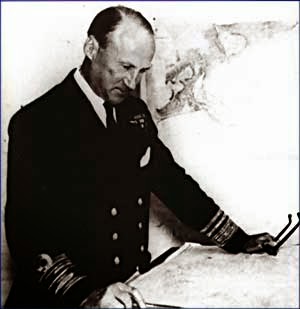
The second key figure is less well-known than he deserves. Admiral Bertram Ramsay had retired from the Royal Navy in 1938, possibly over the lack of preparations for the coming war. However, when fighting broke out, Churchill talked him back. He took command of Dover-based operations, so he was in charge of the Dunkirk evacuation.
Bertram Ramsay: logistical genius
The experience turned him into an expert in the logistics of major amphibious operations. He handled the landings in North Africa, Operation Torch, the landings in Sicily, Operation Husky, and finally, his crowning achievement, the landings in Normandy on D-Day in 1944, where he had overall command of the Allied naval forces.

This was a time before computers, and all orders had to be typed by hand. There were 5000 sets of orders for D-Day, and it’s a tribute to Ramsay’s organisational ability that the operation went so smoothly (the only hitches were those inflicted by the Germans): ships picked up the right troops, equipment or supplies, and delivered them to the right place as expected.

Back at Dunkirk, he organised the long convoys of ships, naval and civilian, big or small, that travelled across the Channel to pick up the soldiers, from the harbour or the beaches. The little ships have become legendary: they were often privately owned boats that travelled across and ferried soldiers out to the larger naval vessels to travel back across the Channel. 311 out of 693 British boats were little ships, and 170 out of the 226 lost in total.

Little ships at Dunkirk
In the end, 338,000 soldiers were brought to England. Not all the French were left behind: 100,000 were evacuated. They, however, were for the most past then shipped back to France to continue the defence of their country, generally only meaning that they were killed or captured a little later than they would otherwise have been.

The British forces evacuated formed the core of a renewed army that could continue the war, to its final victory. Their return therefore left the country breathing a sigh of relief, though Churchill made it clear there was no cause for celebration: “we must be very careful not to assign to this deliverance the attributes of a victory. Wars are not won by evacuations.”

And let’s not forget another group of Frenchmen: 35,000 stayed on fighting, as a rearguard, allowing the evacuation to continue until 4 June. Many were killed, the rest captured. Their sacrifice made the rescue of British forces possible. As did the brilliance of Admiral Ramsay. And the ineptitude of Runstedt and Hitler. Of such strange mixtures of heroism, ingenuity and incompetence are narrow escapes made.

The experience also gave us what we have come to know in Britain as the Dunkirk spirit, a refusal to accept defeat, a willingness to pull something out of the fire whatever the odds, in order to fight again another day.

It’s particularly important for us in the Labour Party as we contemplate the wreck of our hopes in the face of the debacle the Conservatives handed us two weeks ago. Oh, well. Those lads at Dunkirk on 21 May 1940 faced a prospect even bleaker than ours. And in the end their side that came out on top…