Showing posts with label Winston Churchill. Show all posts

Saturday, 25 November 2023

The luck of a Churchill

The devil’s in the detail, they say. Again and again I have to admit that’s true, when I’m trying to refresh my knowledge of history, as I do for my podcast, A History of England. But sometimes it’s also in the detail that I find the most fun.

The greatest pleasure can be in the personal anecdotes. Especially when they concern historical giants whose main achievements are familiar to us. That’s the case, for instance, of the strange strokes of luck in Winston Churchill’s early life.

Cartoon of Churchill by ‘Spy’ (Sir Leslie Ward), 
in Vanity Fair, September 1900 
National Portrait Gallery D45032

Churchill didn’t bother with university but went straight into the army. Once there, he was constantly demanding to be sent into combat, even though the unit to which he’d been assigned wasn’t due any action. He had himself seconded to a different regiment so that he could take part in fighting on the northwest frontier of British imperial holdings in India. He did the same when he accompanied a military expedition into Sudan. 

Often, he’d only be allowed to join this kind of mission at very considerable expense to himself. He covered his costs with his pen – it turns out that in Churchill’s case, the pen may have been mightier than the sword, but he proved good at wielding both together – writing articles for the press at the time, or books, which enjoyed considerable success, about his experiences afterwards. 

This worked well for him when Britain went to war against the Boer republics in South Africa. He pleaded to be allowed to go and eventually, after much badgering by him and lobbying by his supporters, was allowed out there, but only at his own cost. That he covered by persuading the Morning Post newspaper to pay him £250 a month for a four-month assignment. In modern terms, that’s close to £40,000 a month or over £150,000 in total, a sum most of us would regard as very welcome.

Early in his stay in South Africa, he was on an armoured train that was ambushed by Boer troops. He immediately got stuck into the job of getting the train and the wounded out of there, something he did highly effectively, but which was hardly the work of a newspaper correspondent.

At the end of the engagement, he was captured and held at a prisoner of war camp in Pretoria. However, within weeks he’d escaped. That’s all a bit controversial, since he left behind two others who’d been planning to escape with him. Did he leave them behind? Or were they slow at getting their act together? It now seems that he probably did nothing wrong, but one at least of his fellow prisoners apparently never forgave him for going without him.

He was now wandering through tough territory, on his own, trying to get to the port of Lourenço Marques, today Maputo, in the then Portuguese territory of Mozambique. That was 280 miles (450 km) away.

He eventually decided he could take no more of struggling along the road without proper food or shelter, and knocked at the door of a house near a mine. And that’s where luck struck for him. The man who opened the door to him was an English mine manager called John Howard. Once Churchill abandoned the ludicrous cover story he’d invented to try to explain what he was doing alone and dishevelled on the road at night, and admitted what he was really up to, Howard agreed to help. 

A first piece of luck.

Howard called in another Englishman, Dan Dewsnap, from Oldham near Manchester, who lowered Churchill down a mine shaft with plenty of provisions. 

He stayed for a week until they were able to get him onto a train where he could hide among goods being taken to the Portuguese port, on behalf of another Englishman, Charles Burnham. The train trip was due to last 16 hours but in fact took more like 64, with frequent stops and holdups. Later Churchill talked of his luck in avoiding discovery during any of them, but the real luck was that Burnham had decided to travel on the train with him and distributed bribes judiciously to make sure it got through the various blocks without over-zealous scrutiny of the cargo.

A second piece of luck.

Before he left England, Churchill had been selected by the Conservative Party to stand in a by-election in Oldham. He was beaten though he did reasonably well. He was back from South Africa in time to stand there again in the 1900 general election. At a public meeting, he told the story of the help he’d received in South Africa from Dan Dewsnap, from Oldham, the town which Churchill hoped to represent in parliament and where he was speaking. 

‘His wife’s in the gallery,’ a voice shouted out from the audience.

It’s hard to say how much that helped Churchill's election chances, but it felt like a good omen. Dan Dewsnap had assured him that, after his 1899 defeat, ‘they’d all vote for you next time’. Surely, he’d win the seat on his second attempt?

He did. However, the swing in voting to Churchill between 1899 and 1900 had been only 6%. That’s nothing historic. So much for ‘they’d all vote for you’ – it was far fewer than ‘all’. 

Then again, that had been enough. Who needs more than enough? He was in and that was all that mattered.

His third piece of good luck.

His victory in Oldham launched Churchill’s career in politics. As it happens, it would really take off following the next general election, in 1906. At which he won a different seat, and not as a Conservative, but as a Liberal.

That, though, is another story. And it, too, involved a good share of luck. Perhaps I can tell that one too, some time.


Thursday, 19 March 2020

Coronavirus: fighting the war and facing an enemy together

So it’s going to be war.
Soldiers from the Spanish 'Military Emergency Unit' (UME)
deploy outside the main station in Valencia
The leaders of nation after nation have assured us that what we’re going into now is war against Coronavirus. Which neatly covers two of the horsemen of the Apocalypse, War and Pestilence. Coronavirus itself provides us with Death, but since shops are still being restocked at the moment, Famine hasn’t put in an appearance yet. Long may it stay that way.

Curiously, that was a remark made by one of Danielle’s aunts, who lived through the Second World War. 

“We have enough food, but otherwise, it’s just like back then,” she told Danielle.

War. Both my grandfathers had their lives profoundly affected by World War One. Both served, in different ways: my paternal grandfather in the artillery, my maternal grandfather in gaol, as a conscientious objector. Both displayed admirable courage and both paid a high price – my paternal grandfather carried shrapnel in his hand until the day he died.
My mother Leatrice, my grandfather Nat and, well, me (a while back)
Nat served two years in Dartmoor Prison as a pacifist
Leaders have taken to using the vocabulary of war too. Pedro Sánchez, Prime Minister of our adopted nation, Spain, declared the other day that “we shall leave no one behind”. It’s an encouraging thought, especially in the light of the idea that Boris Johnson was toying with in the UK, of letting people become infected to build ‘herd immunity’, though his experts calculated this might leave up to 500,000 dead.

Rather a lot not merely left behind, but left in the ground.

It’s ironic, too, that the US is dragging its feet over combating the epidemic. The notion of ‘leaving no one behind’ is one I associate with the US marines. Odd to see that nation having to be dragged into awareness of the threat, against a spirit of denial to which Trump clung as long as he could.

The Spanish Prime Minister’s commitment to leave no one behind reminded me of my parents’ description of life during World War 2. My father served in the air force, my mother was secretary to a Labour MP. She told me how moved, and how strengthened, she was, by a speech of Winston Churchill’s. It included the words:

We shall go on to the end. We shall fight in France, we shall fight on the seas and oceans, we shall fight with growing confidence and growing strength in the air, we shall defend our island, whatever the cost may be. We shall fight on the beaches, we shall fight on the landing grounds, we shall fight in the fields and in the streets, we shall fight in the hills; we shall never surrender.

He made the speech in May 1940 at a time when the possibility of surrender was very much in the air. Hearing the Prime Minister declare that “we shall never surrender”, she said, stiffened her resolve and that of most of her compatriots. There were, of course, the profiteers and the black marketers, but overall the nation pulled together. A sense of solidarity for a time overcame extreme individualism.
My father Leonard, with his mother and his father, also Leonard
My father is in his RAF uniform for service in World War 2.
My grandfather served and was injured in World War 1.
The spirit of war. With grandparents who experienced World War One and parents who lived through World War Two, I had always expected as a child that I would, on reaching adulthood, have to face it myself. It’s been not just a pleasure but a relief that I never have.

Until now, at any rate. It’s a bit of a surprise, and not without a grain of excitement, to be facing my own war this late in my life. And, at least, it isn’t one in which man is being called on to kill man.

Which doesn’t mean it isn’t lethal. As with any war, we go in not knowing how many will die. We don’t even know whether we ourselves will make it through – any more than my father did. It took him a long time to understand how he survived when so many of his friends didnt. 

This war, like any war, is a harrowing experience.

On the other hand, if we can recapture the spirit of solidarity, it won’t be entirely bleak. If we all pull together, if we show we can serve a common goal with at least patience and some courage, what a welcome change that will be in societies more divided than they have been for decades.

It strikes me that Italy, Spain, France and a number of other countries are beginning to get things right. Social distancing, unnatural and painful though it may seem for a species that thrives on social contact, is probably the best way to beat the epidemic.

We’re going into battle with an intelligent strategy. We’re going in together. We’re going to suffer losses, but may be uplifted by our sense of common purpose.

Because that too is part of war, probably the best part, as well as an essential ingredient of our top shared objective.

Beating this damn thing.

Thursday, 26 September 2019

Boris Coup: Day 30

It’s facing a crisis that most truly brings out the character of a politician. For better in some cases. For far worse in others.

Lincoln became a man for the ages in the American Civil War, and spoke of the battle he was leading to ensure that “government of the people, by the people, for the people shall not perish from the earth”.

Churchill won his stature in the world, and his place in history, by the way he faced the threat of Nazi invasion. My mother, who lived through the period, told me how, at a time when voices were being raised to talk peace terms with the Germans, it built the morale of the nation, and personally sent a tingle down her spine, to hear him declare, “we shall never surrender”.

Then there’s Boris Johnson, following his defeat by the Supreme Court, and facing hostile MPs. In particular, he faced criticism from women MPs worried about the threats to their safety that flow from just the kind of inflammatory language Johnson uses, and just the kind of far-right fanatics he encourages. He gave us, “I have never heard so much humbug in my life”.
BoJo lashing out in parliament
Not a pretty sight
Yes. Perhaps not quite so impressive as the other two. Not his finest hour. Hardly a display of self-control and nobility of character. But that’s Boris, on day 30 of his coup attempt, now painfully unravelling before his eyes. He’s starting to sound ever nastier, more willing than ever to lash out at anyone who stands in his way.

A lot of that is calculation. He knows that there are voters out there who value just that kind of brutality. They like to convince themselves that this is strength, not understanding that real strength wins its arguments by winning supporters, and doesn’t need to humiliate or crush its opponents.

Playing to that audience, however, has its dangers too. Trump’s playing that game in the US. It may not work there: although his antics strengthen his standing with his most convinced supporters, they’re not attracting voters from the centre. With an intelligent campaign, and the right kind of candidate, the Democrats can win those votes, leaving Trump with only his core, and defeated.

Unfortunately, things are not that straightforward in Britain. If Johnson can hold a core vote similar to Trump’s, of around 40%, that will probably be enough under the UK system to win him a parliamentary majority. If the election is delayed, he may have enough time to discredit himself, as the consequences of Brexit sink in. But for now, both the weak leadership of the Labour Party, and its apparent readiness to allow an election early, are setting up the conditions for a BoJo win.

So he remains unrepentant, refusing to apologise for his intemperate outbursts, partly no doubt because he’s angry at what happened to him in the Supreme Court, partly because he thinks it prepares the ground for him to win an election.

Another principle attributed to Lincoln, probably incorrectly, is that you can fool all the people some of the time, you can fool some of the people all of the time, but you cannot fool all of the people all of the time.

Words that could have been written for BoJo. Who does, indeed, seem to be intent on fooling just enough of the people, just enough time to get himself into Downing Street with a majority to back him.

However unpleasant he reveals himself to be on the way.

Tuesday, 3 July 2018

Britain going rudderless to the chasm

Leadership is hard to define. But it’s easy to recognise when you see it. And easy to spot when it’s missing.

Take Winston Churchill pronouncing perhaps the four most important words of his career: ‘We shall never surrender’. They sent a shiver up the spine of my mother when she heard them in 1940.

‘We were alone against the Nazis,' she told me. 'We knew a great many people near the top of government wanted to open peace talks. Churchill’s words told us the fight would go on.’

My mother never voted for Churchill in her life. But she recognised this act of leadership for what it was.

A counter-example? George W. Bush paralysed in a classroom of children when told his country was under attack on 9/11. And then taking longer to get to ground zero in New York than it took Bill Clinton, though Clinton had been in Australia at the time of the attack and there was a ban on international flights into the US for several days afterwards.

No wonder Dubya struck that pose on the deck of an aircraft carrier, under a  ‘Mission Accomplished’ banner, after US troops had brought down Saddam Hussein. Having failed to show leadership when called on to do so, he needed to ape it later to try to make up.

Britain today is on the brink of the most serious step since watching the breakup of its Empire in the 40s and 50s. The EU has given the country access to a huge free trade area since 1973, and with that access has come investment, trade and jobs. In less than nine months, it is due to leave and there is still no clear vision of what future it will face.

The uncertainty is itself a factor in the country’s economy. Companies, with no indication of how Brexit will look, are beginning to plan for its being abrupt and violent – a hard Brexit where Britain leaves with no agreement in place for continuing trade with the EU or, indeed, with other countries. Investment plans are going on hold or even reversed, with plans to transfer production to other countries.

The impact on jobs and the economy generally is likely to be massive.

Why are we in this position? Because Theresa May as Prime Minister, though she claims to preside over a Cabinet, is in fact doing little more than refereeing a constant battle between a group of warring ministers. Some seem more than ready to accept a hard Brexit, if only as a way to break completely from EU regulation, whatever the cost. Others favour different levels of ‘soft Brexit’ where Britain continues to accept some parts of EU regulation in return for some of the benefits.

May keeps her position unclear, ostensibly because she doesn’t want to reveal her hand during negotiations, though most of us suspect that she actually has no definite position. She’s trying to hold the ring between diametrically opposed contestants, and therefore refuses to pick a side of the argument.

All she claims to want is to keep as many as possible of the benefits of EU membership, such an open border between the United Kingdom and the Republic of Ireland (which is remaining in the EU) and ‘frictionless trade’ with the EU. In return, she wants to accept little or no regulation by the EU.

It’s not surprising she feels this way. To accept almost any degree of EU regulation might be regarded as remaining the EU ‘by stealth’ and a ‘betrayal of the will of the people’ expressed in the referendum vote for Brexit. On the other hand, the benefits of membership are vital. She’s trying to square a circle, trying to take benefits without obligations, a position the EU has already rejected. They claim, correctly, it’s an attempt to have one’s cake and eat it.

May: she may be doing her best but no one knows what it is.
So it's not good enough.
No leader she
Whatever May’s approach is, leadership it ain’t.

Opposite her is Jeremy Corbyn, leading the Labour Party. His position is equally difficult. There is a trend in the Labour Party, mostly in its leftmost reaches (from which, as it happens, Corbyn emerged) that opposes EU membership. It’s an odd tendency that seems never to wonder why it ends up sharing platforms with the far right. If you’re agreeing with people with whom you have nothing in common, it’s worth asking whether you might have gone wrong somewhere.

If you have odd bedfellows, it might be because you’re in the wrong bed.

But there are other more practical problems emerging for Brexiters of the left. Most notably, they’re in a minority in the Labour Party.

Even Corbyn’s biggest trade union backer, Unite, is now questioning whether Brexit really is good for its members’ health. They can see the jobs going, along with the workers’ rights the EU imposed on the essentially right-wing British regime. They’re beginning to demand that Corbyn endorse an explicit pro-EU stance.

This is an embarrassment to Corbyn, who needs Unite support but has been as assiduous as May in avoiding any clear position on Brexit. He’s caught between his roots in left-wing Brexitism and the unpleasant realisation that the majority of Labour, and even of his fan base, increasingly backs staying in the EU.
Corbyn with his pal McCluskey of the Unite Trade Union
But Unite members are beginning to ask for more from Corbyn.
He's not giving it. No leader he
So he’s as paralysed as May. Unable to take a stand on Brexit. Unable to lead his party or nation either towards a hard or soft Brexit, or towards remaining in the EU.

Again, I say, whatever that is, it ain’t leadership.

The worst of it is that a government as weak as May’s could fall. Rumours reach me that we should prepare for an election in October. That might leave Corbyn in number 10, with just five months to Brexit day and everything to negotiate. He might, at last, be forced to take a position.

I have friends who claim he would choose to stay in the EU rather than accept a hard Brexit. That would be a courageous position to take: he too would be assailed by Leavers high and low accusing him of betraying the will of the people. Would he really do that? It might be easier, politically, just to claim it wasn’t his fault that the Brexit was hard, and that he had no choice but to accept it.

That would be followership, of course, not leadership. But if nine months out, he still can’t even say that remaining in the EU might be an option, how can we be sure that he would just weeks before the fatal day?

Either way, what’s certain, is that Britain stands on the brink of a historic decision. And in neither of the parties likely to be in government to make it do we see any sign of leadership on the question. Just when the country needs it more than usual.

Not a prospect to inspire much confidence.

Thursday, 4 January 2018

Attlee: a quiet celebration of a quiet man

It’s far from inappropriate that the anniversary on 3 January passed quietly. It was the anniversary of a quiet man. A modest man, a shy man, but the architect of some of the more remarkable achievements Britain has seen.

There are some things about Clement Attlee that are incontrovertible, a matter of historical record. He was born on 3 January 1883. He led the Labour Party into a wartime coalition with the Tories, under Winston Churchill, in 1940. And, five years later, he led Labour to its first spell in government with a parliamentary majority.

Other issues are more open to interpretation.

It was a key factor in Britain’s war effort that the country was led by a national government – in which Labour played a major role. Indeed, Attlee was described as ‘home front Prime Minister’ since Churchill’s key contribution was on the international scene, above all in securing US support. And yet it must have taken extraordinary courage to join a coalition with the Conservatives just nine years after a previous Labour leader, Ramsay MacDonald, had split the party and reduced its parliamentary strength to just 50 by doing the same thing.

What was a betrayal in 1931 was essential in 1940. Labour’s role as the voice of the downtrodden and of workers had to be laid aside for a while, to ensure the very survival of a country in which that voice could be heard at all. The mood was perfectly captured in a cartoon by David Low, showing Labour having to turn away from its appointed task for a while, to focus on something more urgent – but it would be back.
Labour leading 'our democratic institutions' in the shelter
But only for a time
In 1945, triumphantly, it was.

Again, few would dispute that major reforms were achieved by the 1945 government Attlee led. Indeed, many would argue that it was the greatest reforming government Labour has formed. The welfare state was launched, with both universal social security – independent of means, available to wealthy and poor alike – alongside the NHS were key pillars of the post war consensus. They’ve survived to this day, though they’re increasingly battered now.

He also ensured that India achieved independence, persuaded as he was that it was time. By doing so, he set in train the process by which the British Empire would be dismantled over the next twenty years.

Other aspects of Attlee’s time in office are more controversial. One was the secret drive to build a British Atom bomb, once it became clear that the US was not going to continue the wartime practice of sharing nuclear secrets with the UK. Another was his determination to preserve British colonial power in certain colonies, even through the use of military force, around Africa, for instance, or in Malaya. What he felt about India he didn’t necessarily feel about every part of the Empire.

Is that inconsistency? Or a willingness to compromise? A readiness sometimes to be pragmatic which led him sometimes to do things we might admire, and sometimes to do things that we might not like so much?

Still more controversial is his attitude towards the left of the Party. Before Attlee formed his government, one of his most outspoken critics was Nai Bevan, clarion voice of the Labour left. It is a tribute to Attlee’s breadth of vision that he invited Bevan to join the government and gave him the opportunity to build the NHS. But the differences remained as powerful as ever and, indeed, Bevan eventually resigned from the government in its dying days, an act for which Attlee may never fully have forgiven him.

The tale of his relations with Bevan give a measure of Attlee. He was a conciliator, and that allowed him to able to lead a government which contained both Bevan to the left and Ernest Bevin to the right. It was all the stronger for it.

As well as the left and right of his own party, Attlee could also work with the Conservatives, as he showed in the wartime coalition. Indeed, he could fight the Tories – though not an outstanding public speaker, his powerful response to the vicious attack launched on him by Churchill during the 1945 campaign was a major factor in giving him the victory – but that didn’t stop him cooperating with them when necessary.

I’m not convinced that someone like that would find it easy to forge a career in the present Labour Party. Given the chance, he became arguably Labour’s most successful leader. But would we give him that chance today?

Ah, well. At least I raised a glass to him on his birthday. A quiet celebration in memory – nostalgic memory – of a quiet man who achieved so much.

Far more than many who are a great deal noisier.

Sunday, 3 January 2016

Americans and their words

The reason I find the occasional eccentricities of their English baffling is that Americans often make excellent use of the language. 

Here’s the opening of John Grisham’s The Litigators:

The law firm of Finley & Figg referred to itself as a “boutique firm.” This misnomer was inserted as often as possible into routine conversations, and it even appeared in print in some of the various schemes hatched by the partners to solicit business. When used properly, it implied that Finley & Figg was something above your average two-bit operation. Boutique, as in small, gifted and expert in one specialized area. Boutique, as in pretty cool and chic, right down to the Frenchness of the word itself. Boutique, as in thoroughly happy to be small, selective and prosperous.

Except for its size, it was none of these things.


Better written than one might expect
Why do I like this writing?

Firstly, I find it refreshing that Grisham breaks a couple of my own taboos. Repetition, for instance, as in using the word “firm” twice in quick succession. I go out of my way to avoid such repetition. He’s also relaxed about the passive (“was inserted”) which I try to avoid, on the grounds that active verbs are more dynamic. Or so I’ve been taught.

Secondly, the simplicity of the style is engaging. “Two-bit”, “pretty cool” – the language is everyday and familiar. The last three sentences don’t even have a main verb. And Grisham avoids pompous words. Indeed, the only moderately recherché word is “boutique”, but its Frenchness and slightly high-flown tone make his point. You might perhaps quibble about “misnomer”, not perhaps a common term, but it’s hard to imagine anything to replace it without a long and clumsy periphrase.

This understated style is an ideal I pursue. It feels like no style at all, letting the reader apparently straight through to the meaning underneath.

It’s only simple in appearance, however. Those last three sentences represent a classic trick of rhetoric, the rule of three ending in a cadence. Compare it with the Churchill speech:

Never in the field of human conflict
was so much
owed by so many
to so few.


It’s a powerful device of the best orators. And Grisham even closes by including a second set of three within the first: “small, selective and prosperous.”

Then he opens a paragraph with a short, punchy sentence that undermines everything he has said before. It all adds up to an effective hook to draw the reader into the rest of the book. Which, incidentally, I enjoyed.

If your taste is for something more elevated, you could do worse than turn to Carl Sandburg. He was a poet but also the author of a fine biography of Lincoln. He describes a young Civil War soldier discovering the body of another that had been left for a year sitting apparently at ease against a tree, and tells us:

He had interrupted a silence where the slants of silver moons and the music of varying rains kept company with the one against the tree who sat so speechless, though having so much to say.


The use of the word “slants” is a poet’s touch: it’s unclear that there’s such a thing as a “slant”, but perfectly clear what he means. In addition, the sentence has a single comma, dividing the long flow of description of the physical scene from the last few words – another cadence – that add a new dimension to the scene and make it representative of far more than itself.

Americans make use of the language as well as any English speaker. That’s why I find it difficult to understand the bizarre turns of phrase they sometimes adopt.

Why do they visit with, or meet with, people? You can hardly meet or visit anyone without them, can you? So what’s wrong with simply visiting or meeting them?

They can be clever about filling gaps in the language. British English has no expression corresponding to French “bon appétit.” The Americans have turned to “enjoy”, a generally transitive word used intransitively, to make up for this deplorable lack. I’ve adopted it with enthusiasm.

I wish they’d come up with some way of expressing the distinction between “connaître” and “savoir” in French, or “kennen” and “wissen” in German: it’s the difference between knowing a person and knowing a fact. The absence of a distinction in English allows us to play on words, as in “I know about him, but I don’t know him”, but the language is still poorer for not marking this real distinction.

Similarly, it’s an irritating gap in English that we have no single word for the opposite of “behind”. The French have “devant” to go with “derrière”, the Germans have “vor” as they have “hinter”. All we have is the laborious circumlocution “in front of.” With their creative approach to language, I’d have expected the Americans to come up with a bright translation for “vor” or “devant”. But they’ve done the opposite. They’ve used “in front of” as a template, to give us the equally ugly and unwieldy “in back of”, as an alternative to “behind.”

A disappointing lack of imagination, if I may be allowed the criticism.

Still, it’s nothing like as awful as the expression I came across the other day. I was informed that something had been “based off of” something else.

Now, with an expression that is essentially an image – “based” is being used metaphorically – there ought to be some link to the reality behind it (or in back of it?) If you’re off it, you’re certainly not using it as a base.

As for off of, whatever is the point of the second preposition? If something’s off its base, what more need be said? Surely it’s off your head to add that “of”? Or off of it.

Wednesday, 5 August 2015

Grim anniversary, of exceptional terrorism. By the West.

This is an excellent time to pause and think about terrorism.

We in the democracies rightly fear terrorism and want to do everything we can to prevent further terrorist outrages. We’d like to get into a position where no one any longer resorts to terrorism, because they realise that it cannot succeed and will always be defeated.

Sadly, however, our own nations are responsible for one of the worst ever acts of terrorism the world has seen. It was carried out with impunity – none of those responsible was ever made to answer for it – and it proved successful, which might rather encourage than discourage others down that route.

We’re at the seventieth anniversary of the dropping of an atomic bomb on the city of Hiroshima, on 6 August 1945. It had a population of perhaps 350,000 at the time. Between 100,000 and 150,000 died, the vast majority civilians.

The A-bomb dome in Hiroshima
Stark and poignant memorial to a horrifying act of war
The deliberate killing of civilians for political ends is pretty much the textbook definition of terrorism.

Of course, the defenders of the decision to drop the bomb argue that they were not intending to kill civilians. There were indeed military targets in the city. But that’s a bit of a sophism. If you use the most massively destructive weapon ever developed against a city of a third of a million people, you know you’re going to kill a lot of them. If you were trying to take out Field Marshal Shunroku Hata, who was stationed at Hiroshima, and perhaps his general staff, would you really need to destroy 70% of the city’s buildings and so much of the population?

Hata, by the way, didn’t die in the bombing.

In any case, the way military authorities in the democracies described this kind of action – the same terms were used for the bombing of German cities – was that they were designed to break the spirit of the civilian population. The idea was that with that spirit gone, the enemy nations would have to give up the fight. 

Isn’t that a bit of a giveaway? It sounds terribly like the kind of objective a terrorist movement might set itself.

President Truman, despite being one of the better holders of the position, declared on the occasion of the Nagasaki bombing, three days later: “I realize the tragic significance of the atomic bomb ... It is an awful responsibility which has come to us ... We thank God that it has come to us, instead of to our enemies; and we pray that He may guide us to use it in His ways and for His purposes.”

So we have appeals to divine justification for our use of a terrifying weapon.

What’s more, its use succeeded. Most authorities agree that the bombing of Hiroshima and of Nagasaki brought the war to a rapid close. Churchill believed that the bombing saved a million American lives and half that number of British ones. He was estimating casualties on the basis of having to invade the main Japanese islands, but many who claim that there were other ways to win the war without using the bomb or invading, estimate that the resulting Japanese casualties would have been still worse.

So the message is clear. If you’re powerful enough and can be sufficiently devastating in your action, you can get away with terrorism. You can achieve your aims by it. And, what’s more, God might even be on your side.

Not the best message to put out there. Not one that’s doing us much good today.

Monday, 15 June 2015

Magna Carta: we can all celebrate the anniversary, even if we don't all understand it the same way

Anniversaries are the moment when the present chooses to reinterpret the past to suit its purposes.

800 years ago, on 15 June 1215, England’s leading landowners met at Runnymede, on the Thames, to the West of London. To hold land was, at that time, to hold huge power – it was, indeed, the only road to power. Land produced rent and, out of that rent, the owners could fund small armies, personally loyal to themselves.

The Magna Carta Monument at Runnymede
On that day, they met to cut down to size one of their number. They had all accepted that it was important that one should have authority over all of them but, though he might hold the title of King, they didn’t feel that was something he ought to let go to his head. He had to remember that he was ultimately just one of them, and he maintained his pre-eminence only with their consent.

The holder of that position in 1215, King John, was weak, and his peers, the barons, took advantage to extract concessions from him about just what a King might or might not do. They wanted rights guaranteed in writing, over his signature. In particular, they denied him the right to act against them at will, and they insisted that any of their number only be convicted of a crime if tried by a jury of his peers.

No free man shall be taken, imprisoned, disseised [dispossessed], outlawed, banished, or in any way destroyed, nor will we proceed against or prosecute him, except by the lawful judgment of his peers or by the law of the land.

To no one will we sell, to no one will we deny or delay, right or justice.

The words “his” and “peers” are important in this context. The barons weren’t concerned with the rights of women. And they weren’t interested in “the people” – they were interested in their peers. 

But the present imposes its own interpretation on the past. What happens if you extend the meaning of “free man” beyond the narrow ranks of the barons? Then the Great Charter (literally Magna Carta) becomes a statement of basic rights of all Englishmen (and possibly Englishwomen).

By the seventeenth century, the view was taking hold that the English had always enjoyed certain liberties, but they’d been trampled on by foreigners forcing their way into the country (echoes of our own times). In this case, the foreigners were the Normans who conquered the place in 1066. This is a view which conveniently ignores the fact that the English – Anglo-Saxons – had themselves been invaders only a few centuries earlier, when they’d usurped the lands of the Celts.

In this view, what the barons obtained from John was a restatement, or reinstatement, of those primordial English rights. And Englishmen everywhere began to demand that they be recognised, including those fine Englishmen who set up the colonies in North America. When their representatives met in Congress in 1766 to protest a new tax imposed on them from Britain, the Stamp Act, they called on the authority of the Great Charter:

The invaluable rights or taxing ourselves, and of trial by our peers, of which we implore your Majesty’s protection are not, we most humbly conceive unconstitutional; but confirmed by the Great Charter of English Liberty.

Sadly, George III took a more jaundiced view of the Great Charter, and refused his loyal subjects in the thirteen American colonies the protection they required, losing their loyalty in consequence, and, after a disastrous war, the colonies too.

The tradition, however, persisted. Nearly 750 years after the signature of the Charter, Franklin Delano Roosevelt assured us in his 1941 inaugural:

The democratic aspiration is no mere recent phase in human history. It is human history. It permeated the ancient life of early peoples. It blazed anew in the middle ages. It was written in Magna Carta.

Five years later, in his “Iron Curtain” speech, Winston Churchill declared:

We must never cease to proclaim in fearless tones the great principles of freedom and the rights of man which are the joint inheritance of the English-speaking world and which through Magna Carta, the Bill of Rights, the Habeas Corpus, trial by jury, and the English common law find their most famous expression in the American Declaration of Independence.

The Great Charter itself
And then we get to David Cameron. He told the anniversary celebration at Runnymede:

Why do people set such store by Magna Carta? Because they look to history. They see how the great charter shaped the world, for the best part of a millennium, helping to promote arguments for justice and for freedom.

Sadly, he also declared that “here in Britain ironically, the place where those ideas were first set out, the good name of human rights has sometimes been distorted or devalued.” This is his justification for trying to repeal the Human Rights Act, which guarantees the Charter’s rights, and others besides, for every one of us.

The view that this is the spirit of the Charter may be ahistorical, but quite a few of us rather like it. As did Roosevelt and Churchill.

Cameron, it seems, disagrees.

As I said. Anniversaries are moments when we respect not the contemporary significance of events, but the significance that we draw from them today. Cameron, I suppose, has a right to his own. It’s just sad that it has to be so idiosyncratic.

Not to say more than a little worrying.

Thursday, 21 May 2015

A desolate anniversary. But perhaps one from which we can take some spirit.

21 May. If you’re British, French or Belgian, it’s a good moment to surprise, consternation, disarray and loss.

Not many years before this day 75 years ago, two of the victors of World War One, Britain and France, had been dictating terms to their humiliated foe, Germany. Now, in 1940, French and British armies with some remnants of Belgian units, were facing an abyss of utter disaster.

The Western Front in the Second World War hadn’t followed the pattern of the First. After eight months of sporadic but limited fighting, Germany had launched an offensive into France. One of the best tank commanders ever, Heinz Guderian, made sure they didn’t get trapped into trench warfare again by leading a long, powerful, and rapid attack to cut off a large group of his enemy. French and British reeled in front of him, in disorganised retreat towards the coast.

It took just eleven days to leave some 400,000 Allied soldiers with their backs to the English Channel, pinned down by 800,000 Germans. The British Commander, Lord Gort, decided that there was no way of breaking out, and started planning an evacuation – without telling his French allies.

Of the Channel ports that could have been used, Boulogne fell to the Germans and Calais was surrounded. In any case, the best to use was Dunkirk, with a good harbour and the longest beach in Europe. Churchill ordered full-scale evacuation to begin on 26 May.

British troops being evacuated from Dunkirk
Two key players now step onto the stage. One was Guderian’s immediate superior, Gerd von Runstedt, who, afraid of a counter-attack and the marshy nature of the terrain, issued the so-called “halt order”, confirmed by Hitler. This overruled Guderian and obliged him to stand still for three days when he might have wiped out the British and French forces as fighting units.

To this day, no one understands the reasons for the order, but it was a turning point: had the British Expeditionary Force, the army that had been sent to France, been destroyed, Britain might have been unable to fight on.

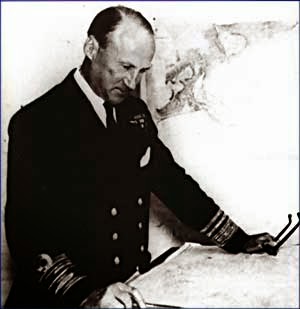
The second key figure is less well-known than he deserves. Admiral Bertram Ramsay had retired from the Royal Navy in 1938, possibly over the lack of preparations for the coming war. However, when fighting broke out, Churchill talked him back. He took command of Dover-based operations, so he was in charge of the Dunkirk evacuation.
Bertram Ramsay: logistical genius
The experience turned him into an expert in the logistics of major amphibious operations. He handled the landings in North Africa, Operation Torch, the landings in Sicily, Operation Husky, and finally, his crowning achievement, the landings in Normandy on D-Day in 1944, where he had overall command of the Allied naval forces.

This was a time before computers, and all orders had to be typed by hand. There were 5000 sets of orders for D-Day, and it’s a tribute to Ramsay’s organisational ability that the operation went so smoothly (the only hitches were those inflicted by the Germans): ships picked up the right troops, equipment or supplies, and delivered them to the right place as expected.

Back at Dunkirk, he organised the long convoys of ships, naval and civilian, big or small, that travelled across the Channel to pick up the soldiers, from the harbour or the beaches. The little ships have become legendary: they were often privately owned boats that travelled across and ferried soldiers out to the larger naval vessels to travel back across the Channel. 311 out of 693 British boats were little ships, and 170 out of the 226 lost in total.

Little ships at Dunkirk
In the end, 338,000 soldiers were brought to England. Not all the French were left behind: 100,000 were evacuated. They, however, were for the most past then shipped back to France to continue the defence of their country, generally only meaning that they were killed or captured a little later than they would otherwise have been.

The British forces evacuated formed the core of a renewed army that could continue the war, to its final victory. Their return therefore left the country breathing a sigh of relief, though Churchill made it clear there was no cause for celebration: “we must be very careful not to assign to this deliverance the attributes of a victory. Wars are not won by evacuations.”

And let’s not forget another group of Frenchmen: 35,000 stayed on fighting, as a rearguard, allowing the evacuation to continue until 4 June. Many were killed, the rest captured. Their sacrifice made the rescue of British forces possible. As did the brilliance of Admiral Ramsay. And the ineptitude of Runstedt and Hitler. Of such strange mixtures of heroism, ingenuity and incompetence are narrow escapes made.

The experience also gave us what we have come to know in Britain as the Dunkirk spirit, a refusal to accept defeat, a willingness to pull something out of the fire whatever the odds, in order to fight again another day.

It’s particularly important for us in the Labour Party as we contemplate the wreck of our hopes in the face of the debacle the Conservatives handed us two weeks ago. Oh, well. Those lads at Dunkirk on 21 May 1940 faced a prospect even bleaker than ours. And in the end their side that came out on top…

Saturday, 29 November 2014

A denunciation of injustice. From a surprising source.

How inspiring it is, and how refreshing a change, to hear a voice raised in defence of the poor and against the social injustice they suffer at the head of the wealthy. How much more impressive still when that voice speaks in tones of thunder, from the mouth of one of the wealthiest in the land. And how particularly encouraging when it speaks from within the ranks of government, where it can influence the direction of the country and drive forward a solution to the problems it denounces.

The strange perversion of Tory politics still continues, and the influence of wealth is daily exerted to prove—and with great success—how uneven is its distribution.

Indeed. So true. So necessary to be said. And here’s an abuse that particularly needs to be denounced:

We see the curse of unregulated casual employment steadily rotting the under side of the labour market.

Yes. As Ed Miliband has put it for the Labour Party, it’s time to do away with the zero-zero society, where many struggle on zero-hour contracts, technically employed but with no guarantee of either work or pay, while at the other end of the scale, the wealthiest pay zero taxes.


Opposing the curse of casual employment, underemployment,
unprotected employment
The impact of such injustice is particularly cruel on the young, but that in turn damages the future of the whole of society:

Thousands of children grow up not nourished sufficiently to make them effective citizens, or even to derive benefit from the existing educational arrangements.

Not that this voice speaks for the Labour Party. More, in his own own terms, for a radical, liberal position. Though, as he points out himself, there’s no reason to make any distinction, on this kind of question, between such views and those of Labour.

No true classification can be made in the abstract between Liberals and Radicals, or between Radicals and Labour representatives.

No, all three trends knew what needed to be done, and agreed on the approach to be taken:

Two clear lines of advance open before us: corrective, by asserting the just precedence of public interests over private interests; and constructive, by supplying the patent inadequacy of existing social machinery.

Solving these problems won’t be easy, and the burden will be heavy. But just as the aim is to tackle injustice, so the way we set about it must be just. And that has financial consequences, which have to be fairly shared:

Sacrifices will be required from every class in the population; the rich must contribute in money and the poor in service, if their children are to tread a gentler path towards a fairer goal. A fiscal system which prudently but increasingly imposes the necessary burdens of the State upon unearned wealth will not only be found capable of providing the funds which will be needed, but will also stimulate enterprise in production

Indeed. Service for all, and graduated tax on wealth. That will ensure the necessary resources are available, and that the solution will be equitable.

Isn’t it extraordinary that such views could be expressed at the highest level of government in Britain?

Unfortunately, and certain stylistic aspects of these quotations may have been given it away, the statements aren
’t recent and these views weren’t expressed by a member of the present government. Nor by a member of any Conservative government – though they were the opinions of one of the most emblematic figures of British Conservatism. At the time, however, Winston Churchill was not a Conservative, but a Liberal and about to take up a position as President of the Board of Trade in Herbert Henry Asquith’s great reforming government before the First World War. Presumably as part of his bid to be deemed worthy of that post, he published this article, which has come to be known as The Untrodden Field, in 1908.

Churchill in his Liberal days
A clarion call for radical reform
You may feel sad that such an outspoken champion for the victims of social injustice should in the end have joined the Conservatives, the very party he denounced here. Rejoined, in fact: he abandoned the Conservatives to join the Liberals in the 1900s, only to abandon the Liberals in the 1920s and return to Tories (you may remember his comment, “anyone can rat, but it takes a certain ingenuity to re-rat.”)

What’s far sadder is that nearly 107 years after Churchill penned that article, so many of the abuses remain to be overcome and indeed are being daily intensified by the political heirs of its author.

Tuesday, 14 October 2014

When UKIP and the Tories attack human rights legislation, whose interests are they serving?

What makes the appeal of UKIP truly curious is that it’s not only toxic, it’s completely incoherent.

It keeps telling us not to trust Westminster politicians. Vile bunch, the lot of them. Always lining their own pockets and corruptly working in their own interests.

In their next breath UKIP tells us that the burning question of our time is to get us out of the European Union, to repatriate powers.

To Westminster.

Do they actually listen to what they’re saying?

Behind this device there is a profound dishonesty. Firstly, because Nigel Farage, leader of UKIP, is one of the few Members of the European Parliament to refuse to submit his expenses claims to the scrutiny of an independent audit. It seems that what he’s been doing may not stand up to detailed examination. Interesting: the man who denounces both the EU and the cupidity of MPs, would rather we didn’t look too closely at how he spends the money he takes from the EU Parliament.

Secondly, because UKIP, followed in this by the Tories, tend to make no distinction between the EU and other European institutions. So, for instance, they like to direct many of their attacks against the European Convention on Human Rights.


European Convention on Human Rights
Sponsored by Churchill, drafted by Brits
Pause for a moment to think about that. The Tories and UKIP are successfully making “human rights” a term of abuse. Lots of people, all of them as far as I can determine human, think it would be a good thing to get rid of legislation protecting rights that come simply by virtue of belonging to humanity.

Interestingly, when the Tory government launched its most recent attack, it appealed to the spirit of Churchill to stiffen resolve against this devious piece of European skulduggery. It failed to point out that it was backed by Churchill, who used British lawyers to draft it.

Nigel Farage went one step further in the descent into dishonesty, claiming that getting rid of Britain’s adherence to the ECHR wasn’t enough, we had to go a step further and leave the European Union altogether. As he knows, the Convention has nothing to do with the EU, but was adopted by the Council of Europe. That’s a larger and older body than the EU that oversees the European Court of Human Rights, charged with enforcing the Convention.

But what the heck, when you’re fooling people, why worry about mere truth?

Who needs the ECHR anyway? Interestingly, the answer is all of us.

One of the phenomena that has most marked the times we’re living through has been the unbridled behaviour of corporations. In a world where the drive for profit is increasingly unregulated, it can bring disaster on us all, as it did most spectacularly when the banks crashed in 2008.

Back in 1986, two individuals decided to take on one of these corporations. Helen Steel and David Morris began distributing leaflets about McDonald’s, making some damaging allegations against the company (some of which, though not all, were later judged to be true).

David Morris and Helen Steel, defendants in the McLibel case
They lost the case but won the battle
Britain has draconian libel laws. In particular, the burden of proof in a libel case is on the defendant, who has to show that any allegations made are true. This can be costly and difficult to do. And libel defendants do not receive legal aid in Britain.

So McDonald’s brought a libel case, as it had against a number of major media outlets, expecting the defendants to cave as the outlets had, and therefore to win a quick victory.

Three other defendants did indeed apologise, but not Steel and Morris. What followed was the longest trial in British history After ten years, some of the allegations were deemed not to have been proved, so Steel and Morris lost. However, McDonald’s realised that the McLibel case had done them far more damage than the original hand-distributed leaflets ever could, let it be known that it would not be collecting the £40,000 of damages awarded to it.

Now it strikes me that being able to stand up to the ever-increasing might of corporations like McDonald’s is essential for all of us, and likely to become even more important in the future. So resisting the corporations and such bad law as British libel legislation actually matters. And who ruled that Steel and Morris had been denied natural justice?

Why, the European Court of Human Rights. In 2005.

Its ruling was given against the British government. Today that government is calling for legislation to allow ministers to overrule judgements of the court.

It strikes me that we need to resist that suggestion. I’d rather like to see Ministers reined in, not gaining more power. Which is what the rhetoric of men like Farage suggests too.

But with them it’s only rhetoric. He’s at least as keen to see the authority of the Court curtailed. In favour of the very Westminster politicians he’s so quick to deride.

Then, of course, he’s planning to get himself elected a Westminster politician too, next May. And his party likes to take large donations from the corporate world. Besides, as we’ve seen, he likes to be less than candid about certain things. So, in a twisted way, his hostility to European legislation makes a lot of sense.

As long as you realise he’s just as self-serving as the worst politicians he denounces.

Monday, 1 September 2014

From humourless Thatcher to paranoid Cameron

During last Friday’s ‘Reunion’ programme on BBC Radio 4, former Sun jounralist Wendy Henry told Sue MacGregor about the time she met Margaret Thatcher.

I went to Downing street to interview her, and I’m a little ashamed to say that I lost control of the interview around about the third minute... She just spoke on and and on and I remember desperately sitting there thinking “Oh my God, what am I going to get out of this?”

Then I made the fatal mistake of trying to inject a bit of humour, I suppose probably very sort of tasteless humour. We were talking about Ireland and conflict and things like that, and I said, “Oh well, I know how we can solve the problem.”

She went “Oh, really?”

I said, “Yes, if we take the IRA and put them on the Gaza strip, and we take the PLO and we put them on the Falls Road, we’ll have solved the problem.”

There was a deathly silence and she said “Right, well, I think this interview is finished” ... so I slunk off.


Wendy Henry’s joke wasn’t that amusing, so the funniest part of the interview is Thatcher’s response: grim, self-important and above all humourless. It amazes me that a country like Britain which prides itself on its sense of humour still insists on sanctifying her. She was so dour, so dull, so unbendingly solemn.

Not all Tory Prime Ministers were like that. Winston Churchill was famed for his banter. When Manny Shinwell, a fine figure of the radical socialist Left, asked Churchill if he could borrow twopence to phone a friend, Churchill apparently offered him four pence with the words “phone all of them”.

It’s not as though Churchill was any less courageous than Thatcher. He led the country at a time of far worse danger to it, and it was his combination of courage and humour that made him so admired.

If we could face them with a smile, why are we so panicked today?
Thatcher faced risks too, redoubtable enemies even though they were not as dangerous as the Nazis. It might have been her lack of humour stopped her seeing how risible was the most ludicrous measure she adopted against them. 

She argued that terrorists ought to be denied the “oxygen of publicity.” Now one can argue against this proposition. One can argue that it implies a restriction of a fundamental right, freedom of speech. One can argue that it is better to hear what the terrorists have to say than to leave them in the dark to hatch ever more desperate plots. But even if one agrees that they should be denied publicity, one can’t argue is that it makes any kind of sense to allow their words to be heard, though not their voices.

That was the situation Thatcher created. In 1988, she banned leaders of organisations associated with terrorism from being heard on broadcast media. So for six years we had the ridiculous sight of people like Gerry Adams or Martin McGuinness being interviewed on TV with an actor dubbing the words they were speaking. Words but not voices? Was that denying them the oxygen of publicity?

That was only the most laughable act against the IRA. Far less funny were the repeated attempts to crush them by military force, which created martyrs and gave the movement momentum, or the use of deeply anti-democratic actions, such as detention without trial, which also attracted new support for the cause. None of these were specifically Tory, incidentally: Labour was just as guilty of them.

If the troubles came to an end, it wasn’t ludicrous restrictions on broadcasts or administrative measures taken in flagrant contradiction of democratic principles that beat the IRA, it was outstanding intelligence operations leading to deep penetration of paramilitary organisations, and action to alleviate the difficulties of the minority in Northern Ireland, so that the IRA was denied the pool of disaffection from which it recruited.

Now roll forward nearly twenty years.

Britain once more faces a terrorist threat. Indeed, there hasn’t been a moment since the Good Friday agreement when we haven’t faced such a threat. And what has been the reaction of government, and indeed of much of the people? Churchillian good humour and a courageous stand to protect the very rights the terrorists threaten? Sadly, anything but.

No, it’s back to authoritarian measures. Worries that young Britons who have travelled to the Middle East to join organisations such as the Islamic State, might come back as hardened jihadists, is leading to a popular wish to deny them entry to the country. That’s denying British citizens entry to Britain. And on mere suspicion.

That undermines the very foundation of what citizenship means.

Certainly some of those banned, if these powers are adopted, will be wholly innocent of any offence or even the intention of committing an offence. The fact of banning even real jihadists will whip up sympathy for them and probably for their cause. The move will be as counter-productive as detention without trial was in Northern Ireland.

And what threat do we face? We used to have IRA attacks in London every couple of months. We have yet to see a single attack by Isis. IRA members could travel to the rest of the UK without passports and without any kind of check. Isis members coming back from Iraq will be known to the security services. It’s hard to see how this can be as serious a threat as Thatcher faced, let alone Churchill.

It’s time to grow a little courage. See the threat for what it is. Prepare for it, arm ourselves against it (above all with more of the kind of intelligence that beat the IRA), but don’t give up our fundamental principles in panic at it.

And above all – find that old Churchillian sense of humour. Laugh a little. Overcome fear. And only then dig in.