Showing posts with label Liberal Democrat. Show all posts

Thursday, 23 January 2020

Thinking of choosing the hard left? You'll end up with the hard right

According to a leftie who keeps on at me on Twitter, the problem for Labour is that the 2019 election merely represents a continuation of its decline over many years now, with the 2015 result an anomalous blip in that downward trend.
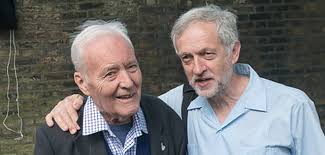
Tony Benn and Jeremy Corbyn: architects of Labour misfortunes
That stance got me interested in taking a longer-term view of British politics. So I looked at percentages of the popular vote in eleven elections over the forty years between 1979 and 2019. Clearly, the relative strengths of the two main parties, Labour and the Conservatives, would be of interest. It struck me, though, that it might also be useful to set them in the context of the overall landscape of parties of the broad right (the Conservatives, but also the hard right parties of today or their earlier embodiments, Brexit Party, UKIP, the British National Party) or of the broad left (Labour, the LibDems and their earlier forms, the Alliance or Liberals, the Greens or Ecology Party, the SNP and Plaid Cymru).
How the left (broadly) performs against the right
compared with Labour alone
What emerges is a curious picture. The ‘left’, in this broad definition (orange line), consistently outperformed the ‘right’ (black line) except in 2015. That surge for the right was principally down to UKIP’s 12.6%; the Conservative result was still an anaemic 36.8%.

With either proportional representation or some arrangement between the constituents of the ‘left’, the ‘right’ would have had a majority of the popular vote for only two years out of the last forty.

Now popular votes don’t necessarily translate into Parliamentary majorities. But if big enough, they can deliver victory, and the ‘left’ tends to be significantly ahead of the ‘right’ most of the time. That suggests that if Labour, the SNP, the Liberal Democrats and the Greens could have pulled together, the Tories would have been out of power for most of the last 40 years, instead of in power for 27 of them.

Interestingly, Labour alone (red line) only outpolled the combined right for three elections – unsurprisingly, the three when Blair was leader and in government. The leftie on Twitter, and others of his ilk there or on FaceBook, are also constantly assuring me that Blair was the lowest of the low and worthy of nothing but contempt. However, if we’re interested in keeping the Tories out of power, it’s worth remembering that he was the only leader in four decades able to ensure that Labour could do that on its own.

For the rest of the time, it would have had to work in partnership with others to oust the Tories. That’s clear from the second graph comparing Labour’s performance (red line) directly with the Tories’ (blue line). Again, only under Blair did Labour outperform the Tories. Otherwise, we’re consistently behind.
Labour performance alone against the Conservatives
Interestingly, the worst results are not under Corbyn. The worst of all, naturally, is 1983. Then Labour was led by Michael Foot, although Tony Benn, the deputy leader, was the main architect of our overwhelming defeat.

Since then, our lowest percentages of the popular vote came in 2010 and 2015. The Tories, however, were down then too, winning by small margins. Looking instead at the gap between Labour and the Tories, the worst elections of all were 1983 and 2019, Benn’s and Corbyn’s. Indeed, it is Corbyn’s greatest achievement to have gifted the Tories their second-highest vote share in that forty-year period. The only higher result was Maggie Thatcher’s first win in 1979.

The significance is that her victory was the first in a series. Johnson’s was the fourth in a row for the Tories, and the first time since the nineteenth century that any party has increased its Parliamentary representation in a fourth election victory.

Corbynists always said that Jeremy would do something remarkable. He has. Although I’m not sure this is what they meant.

This takes us to the nub of the problem for the hard left. One told me recently that whatever we learned from the 2019 election, we should not on any account ‘abandon the programme’. For Corbynites, no compromise is possible on Corbynist policies. That makes any hope of collaboration with other parties impossible. And that, as the last eleven elections demonstrate, means that the right would continue to outperform us.

Above all, with the kind of programme championed by Corbynites now or Bennites in 1983, we ensure not just a Tory win, but a colossal one. Why does this happen? Because Bennites and Corbynites want Labour to mirror their views, not those of the electorate. And the electorate has no time for their policies.

In the current leadership election, we need to choose a leader who reverses that. We need a leader who listens to the voters and goes to them with a programme that they can endorse, even though that means compromise, even giving up on some cherished policies. That way we can win back Labour voters. And if, in addition, we can compromise enough to attract other parties to our banner, why, we could kick the Tories out for a generation.

The alternative is to choose Bennite or Corbynite orthodoxy.

And we know what that gets us: the likes of Maggie or Boris.

Friday, 31 May 2019

Old school unspooked

It isn’t really a spoiler to talk about the end of The Italian Job, is it? It’s become a classic. The coach teetering on a cliff edge, its back wheels over a sheer drop, its front wheels still on the road. The bullion robbers are at one end, the bullion itself at the other on a wheeled trolley. If they try to move near it, the gold rolls away towards the back of the bus, threatening to plunge the whole coach into the abyss.

“Hang on lads, I've got a great idea,” says Michael Caine.
I've got a great idea
And the film ends. With absolutely no suggestion of what the idea might be. Or whether there is any possible outcome other than the coach going over the cliff, taking the gold and the gang with it, or at the very least, the gold.

Len McCluskey is one of Britain’s most powerful trade union leaders. One of the keys to his grip on power is the ruthless way he protects it. Challenged for re-election to his post as leader of the Unite union by a fellow official, Gerard Coyne, he ensured that his rival was dismissed from his union role the day before the election. McCluskey won by a narrow margin, with his vote less than half what he had obtained the previous time.

Even more appalling was that the turnout for the election was just over 12%. McCluskey won with a 4% margin over his adversary, among fewer than one in eight of the union members, but the power that gave him was immense.
McCluskey: unrepentant, unspooked, unrepresentative
For instance, look at what happened to the defeated candidate. Coyne sued for unfair dismissal, but McCluskey had the financial clout of the union behind him and could bring up legal firepower far in excess of what his rival could afford. Eventually, Coyne dropped his case.

In the US in the nineteenth and well into the twentieth century, party bosses held sway over city neighbourhoods or even whole cities. They controlled huge funds and used them to offer favours to supporters, whether in the way of jobs or housing or other forms of wealth, to ensure their continued support – or to keep them under control by threatening to withdraw it. They were unprincipled, ruthless and effective.

One of the more famous of the Republican Party bosses was Mark Hanna. He said, “in politics, there are only two things that matter. One is money. I can’t remember the other one.”

McCluskey’s use of his financial clout reveals how true that remains today.

It’s highly ironic. Hanna was a man of the right. McCluskey a man of the left, head of the union which is a huge contributor to the Labour Party. But both men were political bosses, ruthless in their pursuit of power and their crushing of opponents. Both belong to that Old School of politics in which sheer brute power is all that counts, and money provides it.

In particular, McCluskey is ruthless in his support for Jeremy Corbyn as leader of the Labour Party. McCluskey is indeed believed to favour rule changes so that there would always be someone from the same left-wing current in the party, in any future election for leader. In other words, he wants Corbyn kept in his post and, even when he finally goes, he wants to do all in his (considerable) power to ensure he’s succeeded by someone out of the same mould.

This is curious. Because McCluskey’s stated aim is to see a government in office in Britain that will legislate genuine Socialist policies. And yet the man he’s backing to lead the party has taken it to a constant loss of standing in the polls and, only ten days ago, to its worst performance in a national election in nearly 120 years.

So why did I start by talking about The Italian Job? Not because McCluskey is as interesting a character, and certainly not because he’s as entertaining, as that rip-roaring film. No. It was because he told TV presenter Robert Peston, “my message to the Labour Party is don’t be spooked by these euro elections”.

We in Labour have long laughed at the poor third party, the Liberal Democrats, while we contest the position of top dog with the other big player, the Conservatives.

Well, the latest polls have the Conservatives, thoroughly discredited after their lamentable performance over Brexit, on just 19% of the vote – a disastrous level.

And Labour, who should by now have a 20-point at lead at least, are level-pegging with them. Just behind the hard right Brexit Party, itself behind – the Liberal Democrats. For now at least, they are in poll position.

“Don’t be spooked”? Well, no, one shouldn’t be. Spooking means panicking which never serves a useful purpose. But that’s not what McCluskey means. What he’s saying is “stay firm, stay the course”. In other words, just keep going as you are, however clear it may be that youre on a hiding to destruction.

That’s why I thought of the Italian job. “I’ve got a great idea”. While the whole bunch of us wait to go over the cliff.

Taking all the gold we fought so hard for, down into the depths with us.

Monday, 27 May 2019

Aftermath of a rout: calling time on Corbynism?

Question: what’s worse than a politician who sacrifices political principle to attract a few more votes?

Answer: a politician who sacrifices his principles and doesn’t even get those votes.

Despite being technically leader of the Labour Party, Jeremy Corbyn has spent three years avoiding all leadership on Brexit, the biggest political question of his generation. He has, instead, tried to attract both sides of the debate, explaining that he wants Labour to be the party of both Leavers and Remainers. Apparently, he thinks he has only to express the wish for it to be so.

Unfortunately, and only Corbyn fans will be surprised by this discovery, attempting to please both sides of a bitter debate only puts both off.

Conservative collapse, Labour rout
Those who back Brexit have deserted Labour for the Brexit Party, which came top in last week’s elections to the European Parliament.

Those who oppose Brexit, and there are far more of them among Labour supporters, have abandoned Labour to vote for openly and actively anti-Brexit parties. Encouragingly, for those of us on the Remain side, though none of those parties individually outscored the Brexit Party, taken together they came well ahead of the total anti-EU vote, covering both that party and UKIP.

As for Labour, across the country it came third behind the Brexit Party and the Liberal Democrats.

Of course, Labour’s was not the worst performance of the night. The Conservative Party came fifth. It notched up the lowest popular vote it has had in its history, since its foundation in 1834. Both the big parties are in desperate trouble, with a mountain to climb to win back voter trust.

But, if Labour did less badly than the Conservatives, it nonetheless had a historically awful result.

The Labour Party first presented candidates in a national election in 1900. By 1910, at its fourth election, its share of the vote was struggling towards 10%. In 1920, its fifth campaign, it leaped forward to over 20%. It never fell below that level again until the European Election campaign of 2009. That was the tail end of the government led by Labour’s Gordon Brown. He was a good statesman, notably in the major steps he took towards eliminating child poverty, but he was a lousy politician, finding it hard to build empathy with voters. He achieved 15.2% of the popular vote in 2009 and was roundly, and rightly, criticised for that lamentable performance.

So it’s an extraordinary testimony to the Corbyn era that, in these most recent elections, he managed to reduce Labour’s proportion of the popular vote to an even lower level than Brown did: just 14.6%. The lowest level since 1910. It’s worse even than 1931, when Labour split after its leader, then Prime Minister Ramsay MacDonald, entered into a coalition government with the Conservatives. At the General Election that followed, Labour was reduced to 52 MPs, but it achieved over twice the percentage of the popular vote that Corbyn clocked up last week.

That’s not as impressive as the Conservatives, achieving their worst result in 185 years, but it’s still remarkable: Labour’s weakest performance for 119 years.

What makes this particularly ironic is that Corbyn’s supporters like to point to the increase in the popular vote Labour achieved under Corbyn in the General Election of 2017. It was the biggest increase since the end of the Second World War (though, and they sometimes seem to forget this, he didn’t actually win). His fans attribute that growth in support entirely to him.

I have to admit that I was surprised by the 2017 result. I had expected him to be crushingly defeated. Because I got it so wrong, a sense of shame kept me quiet at the time over what I believed had actually happened. Corbyn was still an unknown quantity that many felt offered them hope. He was also up against one of weakest campaigners I’ve ever seen, Theresa May, our soon to be ex-Prime Minister.

In addition, the Liberal Democrats had done themselves potentially irreparable damage by joining a coalition with the Conservatives in 2010, making them complicit in much of the harm inflicted on Britain in the name of austerity. At the time, I thought it might take a generation for them to come back.

Well, last week normal service resumed. Corbyn is no longer an unknown figure. Voters have seen him and they don’t like what they see. Weak and vacillating, he no longer inspires trust or hope. The damage I expected Corbyn to inflict in 2017 he did instead in 2019. Why, he even pulled off the extraordinary feat of making the Liberal Democrats electable again, only four years after the end of their coalition with the Conservatives, not twenty as I’d expected.

After nearly nine years of austerity, with millions dependent on charity to avoid hunger, the NHS withering for lack of investment, and the most vulnerable driven to despair by benefit cuts, Britain has never needed Labour in government more. But Corbynism has almost certainly left it unelectable.

Corbyn could and should go. He’s trying to change position to back a new referendum on Brexit, but after three years of resisting the proposal, will anyone think him sincere?

A leader who has failed as he has enjoys no right to cling on. The problem, however, is that Corbynistas still have a death-grip on the party. It’s not enough to part with Corbyn, if the Corbynistas can simply impose another of their inept favourite sons on Labour. It’s not clear how we do it, but we need to prise their fingers off Labour, or give up on it altogether.

Which would force anyone looking for a progressive alternative to turn to the Liberal Democrats. The Greens might be preferable, but the Lib Dems seem closest to power. On the other hand, they’re tainted by their association with the Conservatives. Can we trust them not to play the same trick on us again?

Well, we may not have much choice. If Corbynism continues to strangle Labour, what else can we do? We might just have to take our chance on Liberal Democracy.

Interesting times ahead.

And not in a good way.

Friday, 3 May 2019

Spain and England, a leader and a ditherer, a victory and a defeat

It’s been an interesting few days, watching a general election in my new home country, and local elections in my old one.

In the former, Spain, the right was routed. It’s true that the hard nationalist party Vox won 24 seats in the new parliament. This was presented as a lurch to the right by some in the foreign press, but the reality is that where the two main parties of the right had 167 seats in the previous parliament, now all three together – including Vox – have only 147.

Essentially, therefore, the election redistributed the votes of the right and then cut them back. It’s as though the hard wing and the more liberal wing of British conservatism broke off to form their own parties, and all three parties were returned with a total of fewer MPs than the Conservatives previously held on their own.

So it was a conclusive victory for the left. In particular, it was a major success for the incumbent Prime Minister, Pedro Sánchez, who gets to form a new government. Under the Spanish proportional system, he won’t be able to do so alone – he doesn’t have an overall majority – so he’ll have to come up with accommodations and agreements with other groupings. But he should be able to do some good.
Sánchez: the leader who won
My prediction? That’s exactly what he’ll do – some good. It won’t be enough for those on the left who believe all we need to achieve a Socialist utopia, is to elect a Socialist and have him wave a magic wand. That Sánchez won’t do, any more than Tony Blair did in Britain. I only hope that the result won’t be that Spain in turn has to suffer another ten years of conservative rule, and learn the hard way that demanding too much of your allies can let in your opponents, who give nothing at all and, indeed, take a great deal.

What about the elections in England?

Brexit continues to poison the atmosphere there. And the first victim has been the Conservative Party. Theresa May promised to deliver Brexit and has spectacularly failed to do so. The party was punished in the local elections, losing 1334 seats, over a third of those contested that it held before the election.

It’s normal for a party in power for nine years to lose local council seats. But on this scale? That’s a rout.

And yet it wasn’t quite the rout it should have been. The Labour Party, the official Opposition, should have been romping home. The seats lost by the Conservatives should have fallen to them. But they didn’t. Instead, Labour too lost 83 councillors – far fewer but a massive loss when it should be winning big against a government party in such disarray.
Corbyn: the ditherer who lost
Labour’s led by a man entirely after the heart of those who hanker for a magic wand. His supporters view him as a socialist and a man of principle. Neither claim seems particularly supported by the facts.

Those supporters like to claim that Labour, by not taking a position either for or against Brexit, has become the party of both those who believe in remaining in the European Union and those who want to leave. In other words, Corbynism refuses to back the EU and, instead, takes a non-committal line. As it admits itself, it does so in the hope of not putting off Leave supporters.

It’s not clear to me that sitting on the fence in this way is a principled position. On the contrary, it strikes me as the rankest opportunism, of just the kind that Corbynists like to allege against Tony Blair.

Nor does it seem to me to be particularly socialist. Opposition to the EU is a key view of the right, and especially the far right, anti-internationalist, xenophobic and insular as it is. What on earth is a socialist doing in that company?

In any case, this opportunist, electoral calculation isn’t paying off. As was predictable and predicted. By trying to please both sides of a deep divide, you end up pleasing neither.

The local election results make the point. Brexiters see Corbyn taking a lukewarm stance so they don’t vote Labour; they see May failing to deliver and don’t vote Conservative; so they stay home and vote for no one. Meanwhile, Remainers see Corbyn refusing to back the EU, so they too either don’t vote or vote for a party that explicitly endorses their stance – the Liberal Democrats, the biggest winners in this election, with a gain of 703 council seats, and the Greens, the second biggest, gaining 194 seats.

Corbyn’s paying the price for his lack of integrity.

The contrast between my two homelands is powerful. A real leader, with clear positions, won the Spanish general election. A fence-sitter, dithering on the great question of his time, lost the English local elections.

Oh, for a British Sánchez to lead Labour. Oh, for the chance to win a victory like his. And oh, for the chance to watch the wishful would-be wand wavers leave the scene.

Tuesday, 19 February 2019

The Seven: Magnificent? Or misguided?

The departure of seven MPs from the Labour Party is not the most significant political news of the last few days.

That was a poll published by the anti-racist group Hope not Hate which found that over two-thirds – in fact, 68% - of British voters felt that no party represented their views or interests.

Followers of Jeremy Corbyn in Labour will deny that, convinced as they are that the policies on which he secured significant support in the last general election are massively popular. That denial is part of a broader state of mind that denies anything that seems to conflict with their world view. They seem to forget that though he won far more votes than expected, he still lost that election, coming second in a competition where there is no sliver medal.

What they also deny is that times have changed. Back in 2017, Corbyn was the new kid on the block. He seemed to have a fresh message, to have come from a different mould that produces most politicians. Above all, he seemed honest, principled and courageous. Two years on, little of that remains.

He brought a great many people into the Labour Party, the vast majority of them opposed to Brexit as well as attracted by his stance. But then he spent eighteen months trying to hide his true position on Brexit, which left his reputation for honesty in tatters. And when he finally made a few grudging remarks on the subject, he revealed that he was indeed, as many had suspected, a Brexiter. He has yet to confirm that with a vote in parliament – so far, his Brexit voting record is unblemished – but many of his erstwhile supporters haven’t waited for that, but are already drifting away, disappointed.

Opposite him is Theresa May, chasing an impossible dream of a compromise Brexit deal which will allow her somehow to hold together the battling wings of her Conservative Party. She ducks and weaves and fails to deliver. The result is a growing lack of confidence in her, so that her fellow MPs only resisted voting her out for fear of provoking a general election in which their own seats might be in danger.

In other words, the leaders of both main parties are trying to be all things to all men, and failing, as always happens in these cases, to be anything to anyone.

It’s not at all surprising, therefore to see both parties in a race to the bottom in the polls. They are currently neck and neck on 37%, a level of popularity that, in the past, would have guaranteed defeat in a general election, were it not that the other lot are doing just as lamentably.

In the light of this fine track record it is, if anything, surprising that only two-thirds of the electorate feel let down by both main parties. Certainly, it’s hard to deny – well, if you’re not a Corbynista it’s hard to deny it, but they can deny anything – that the political system is broken and badly needs fixing. The departure of the seven MPs might trigger a political realignment that could be a first step towards that repair.

Certainly, that’s what they seem to hope. And they may be right.
Seven MPs quit Labour: but will they be magnificent champions?
It’ll only happen if they can draw some more MPs to them. Seven is far too few. Maybe less than a handful of Tories from the left of the Party, though it’s hard to see how you can really build a Centre-Left movement with the Tories – look at the disastrous damage that Nick Clegg inflicted on his party by trying to play that game. Above all, they need thirty or forty more Labour MPs.

If they reach a critical mass, they may pull the trick off. Then they may indeed emerge as the Magnificent Seven. The pioneers with the courage to break free from tribal loyalty, to set the political system on a new and more hopeful course.

But if they don’t, they’ll just be seven lonely voices clamouring in the desert. They’ll look as though they had merely jumped before they were pushed, which is hardly a path to the moral high ground. And it will be remembered about them that they may have damaged the best hopes of success of the anti-Brexit movement: as anti-Brexiters, they may have made their stance look anti-Labour.

It’s all down to timing. If they’ve got it right, they’ll look like champions. But if they’ve got it wrong, they’ll simply turn into an obscure footnote in history.

Quite a gamble. Times are going to be interesting...


Monday, 24 December 2018

A leading Liberal: my part in his ascent

It must have been 1985.

One of the issues of the day was whether American cruise missiles should be stationed at Greenham Common, ostensibly a Royal Air Force base, in reality entirely under the control of the US. By then, the base had been under siege from a women’s camp for three years, to protest the stationing of cruise missiles, potentially nuclear armed.

The women’s camp was a curious phenomenon. A year or two earlier, Danielle and I visited it with our eldest son, then around ten. She wanted to stay the night but the women at the first gate we visited had to gather in conclave to vote on whether he could stay or not. Was he a boy or a man? A man, you see, couldn’t possibly stay. Obviously, there was no question of my being allowed to.

I didn’t point out that neither age nor gender would be respected by a nuclear exchange if one happened, that I would be just as dead as they would, and that I took as dim a view of that prospect as they did. But I certainly thought it.

At the time we were living in Witney, in Oxfordshire. It had an active peace group. It may have been my unsatisfactory experience at Greenham that spurred me to get involved with the group for a little while. Only a little while, because I was soon going to have to move to another town following the first of three redundancies that have peppered my career (I was also fired on a separate occasion for extreme tactlessness). On this occasion, the redundancy was caused by the company going broke. A year or two later, I rang the ex-owner and asked him how he was doing.

‘I’m managing to keep my nose just below water,’ he assured me, ‘it doesn’t hurt as long as I don’t try to breathe.’

In the short time I could work with the Witney Peace Group, I became heavily involved in organising a public meeting to be addressed by the leaders of the three main British parties. This didn’t go down well with the local Labour Party, an organisation that has difficulties enough in a constituency where Conservative majorities tend to be over 20,000. Since Witney Labour had been a key player in setting up the Peace Group, they understandably resented this interloper turning up and providing a platform for the Tories and Liberal Democrats.

Oddly, far being put off by their anger, it clearly impressed me by its firm stand on principle, because I joined the Labour within weeks of moving from Witney.

In the meantime, Witney Labour somewhat grudgingly agreed to go along with the public meeting. It was, in the end, quite a success. A couple of hundred people showed up. They heard three speakers.
Olive Gibbs during her stint as Lord Mayor
Charm. Humour. Passion
Olive Gibbs spoke for Labour. A former Lord Mayor of Oxford – just ten miles away – one particular action of hers had particularly impressed me: she adopted a Japanese orphan soon after the end of the Second World War, at a time when Japanese people in general were not particularly popular in the West. Of course, it was the war waged between Japan and the West that had produced the most orphans.

Olive spoke with extraordinary passion, as she always did. She came across as highly principled but also hugely likeable – and admirable.

For the Conservatives, we had Ray Mawby, MP for Banbury. He was an obscure politician and rather deservedly so. That makes it appropriate that I can’t remember a word he said. Indeed, the only really significant fact that I know about him is that, after his death, it was revealed that he’d spied for a long time for Czechoslovakia when it was under Communist control. I suppose that only further confirms my long-held belief that, with their powerful state and rigid application of inhumane law, the Communists were a lot closer to Conservative thinking than some imagine.
Ray Mawby.
Conservative MP. And Communist Spy
And then there was the Liberal.

I saw him before I realised I had. Driving home from work in Oxford, I saw a car drawn up on the roadside. A fit and good-looking man was changing a tyre while a sylph-like and attractive woman was leaning against the car, as though her role was purely decorative and she was good at it.

It was only when he showed up at the house of our friends the Wilskers – whom I’ve mentioned before – that I realised that the person I’d seen was the rising star of what was then the Liberal Party, Paddy Ashdown, MP for Yeovil. Ex-military, ex-diplomat, ex-spy. A great background to talk about cruise missiles.

The Wilskers didn’t particularly like mirrors, so they didn’t have one in the house. That created a problem for Ashdown, after he’d washed the grime of the tyre-change off. It was amusing to watch him trying to find a window in which he could see his reflection. He wanted to comb his hair and check his tie. Which was ironic, because as soon as he started to speak at the meeting, he took off his jacket, loosened his tie and tousled his hair.
Paddy Ashdown
Pyrotechnics as a speaker. Highly entertaining
But that was his style. Excellent contact with the audience. He smiled where Olive had been earnest and Mawby simply solemn. He sparkled and amused and entertained. It was pure pyrotechnics and it was extraordinary.

As it happens, I don’t remember what he actually said, but I do remember how he said it. It was impressive and the impression has stayed with me. That’s how you deliver a political message if you want to take your audience with you. Well, that or Olive’s way. Her way was just as remarkable.

It nearly didn’t happen. Paddy Ashdown tried to get out of the meeting so that he could go on the TV programme Any Questions which wanted him for that evening; I was grateful to him for having turned them down – as I imagine he was grateful to the programme for inviting him back the following week.

Four years later, the Liberals merged with the Social Democrats to become today’s Liberal Democrats, and Ashdown became their first leader. I’m not convinced that his appearance at the Witney Peace Group public meeting did much to help him on his way. But, hey, who knows?

As for the sylph-like woman who couldn’t change a tyre, she would shortly be named as the other figure in a scandal that would engulf Ashdown and earn him the nickname Pantsdown. Which stuck with him until his death a couple of days ago. Apparently, at the height of the scandal, his voicemail message invited callers to leave a message ‘after the high moral tone’.

Well, I didn’t really know him. But I enjoyed the brief contact between his life and mine. And I was sorry to hear that his had ended.

Saturday, 7 July 2018

The NHS at 70. And my mother at nearly 94.

The NHS celebrated its 70th birthday last week. And my mother is due to celebrate her 94th this coming week.

The two aren’t unrelated.

My mother is part of a diminishing band of people born before Britain had its National Health Service. Indeed, she played a peripheral role in its creation. She reached adulthood during the Second World War, and decided to throw her lot in with the Labour Party which, at the time, had never formed a government with a parliamentary majority.

It must have been a challenging time to be with Labour. Under the leadership of its first Prime Minister, Ramsay MacDonald, the party had entered a coalition government with the Conservatives. That action was widely perceived as a betrayal. The punishment had been dramatic, rather as with the Liberal Democrats when they betrayed their voters in the same way nearly 80 years later: Labour had been reduced to a rump in parliament.

By the time my mother became involved, it had increased its number of MPs substantially, but still had only a third the force the Conservatives could muster. And it was back in coalition again. This time, however, that step was widely seen as a proof of statesmanship, since the country was at war. Indeed, the Labour leader Clement Attlee had played a significant role in making sure that the Conservatives would have to select Churchill, and not one of the appeasers of Hitler, to lead any government he would join.

My mother, as I mentioned recently, took a job as secretary to a Labour MP and the reformist Fabian Society. That too was was a challenge: in those pre-#MeToo days, young women were simply warned to be careful with some of their bosses, who were of course almost exclusively men. 

‘Careful, that one has wandering hands,’ they’d be told.

The onus would be on the women to avoid the hands, rather than on the men to withdraw them. It will probably come as no surprise that some of those who couldn’t control their urges had control of significant departments of state.

In her work, my mother wasn’t at the centre of power, but she was on the edges of that centre. She saw how Labour worked with the Conservatives towards victory in the war. And then she was actively involved in the campaign for victory in the peace. At the 1945 election Attlee’s Labour finally won a parliamentary majority, in a landslide victory over Churchill’s Conservatives.

It was that government which launched the NHS in 1948.


Health Minister Aneurin Bevan visiting a patient in Trafford, Manchester
on the first day of the NHS, 5 July 1948
Unfortunately, that’s not the only link between my mother and the health service. She has been occupying a bed in one of the great teaching hospitals of the NHS for two weeks now with no sign of her being discharged. She is unresponsive, spends most of her time asleep and, even when she does open her eyes, seems not to recognise any of us, relatives or friends, who come to visit her.

It was only three weeks ago that I had lunch with her for the last time, in her favourite Oxford restaurant. We both knew she was getting weaker, that she was spending an increasing proportion of her time asleep, that she was losing some of the acuteness of her conversation. But a real exchange was still possible: she and I talked about her favourite subject, history, and also about politics and the fact that Labour is again in a difficult state today.

Yet it was only days later that she started the precipitous decline that led to her present condition. Will she recover? Who knows. At the moment there’s little sign of it. My wife and I took our youngest son and his fiancée over to see her two weeks ago, and then she was alert enough to recognise us all and to wish the engaged couple well with their wedding, even though she was already having trouble finishing some of her sentences. I saw her again with my brother a few days later, and sentences seemed beyond her reach, though at least there was still recognition.

Today, that too has gone. I can’t help feeling that I’ve said goodbye to her already, in those earlier visits. Physically, she survives and continues to eat and drink a little, but my mother, the sharp, sometimes exasperating, but always intellectually bright woman I’ve known for 65 years, is already gone. Or at least away, with no certainty she’ll come back.

So I’m not sure whether she’ll see her 94th birthday. She may survive until it happens, but is it really a birthday if one isn’t conscious of it? All that kind of thing, I fear, is behind us.

The story is not without its more comforting side. She is in no pain. She is being looked after by a group of people, both physicians and nurses, who strike me as highly committed and professional but, above all, humane and focused on helping people. My mother has been in pain for many years; I’m glad to say that she seems now to be out of all pain and at peace.

For that I’m deeply grateful. And all the more so because at no point has anyone asked for any kind of payment for all this. The fundamental principle of the NHS, still one of the best-loved institutions in Britain, remains: as when the Attlee government founded it, the NHS prides itself on being free at the point of care. You need help? They provide it. And no one asks for a credit card first.

The great old NHS that my mother worked to make possible keeps doing what it does best: looking after patients as well and as kindly as it can. And today it’s doing it for her.
My mother in happier times with, I believe, my brother

Wednesday, 14 June 2017

An election of all the losers

Who needs a “none of the above” option on a ballot paper? Certainly not the British electorate. It has found a way of delivering that verdict using just the classic old “pick one candidate” form.

The 8 June election was the one everyone lost.

The poor old Liberal Democrats won only a handful more seats, taking their total to 12. That’s far behind the glory days when after two generations of hard work, they peaked at 57 under Nick Clegg, becoming a real force in British politics. Unfortunately, Clegg took them into coalition with the Conservatives, securing himself a cabinet seat on which to park his bum, but turning his party into mini-Tories. Why would anyone vote for a Tory lookalike when they can choose the real thing instead? It’s going to take a long time yet to come back from the car crash the Lib Dems created for themselves under Clegg – who lost his own parliamentary seat on 8 June.

Then there was UKIP. This is the far-right United Kingdom Independence Party which used to be led by Nigel Farage. He made clear what “Independence” meant in his book: he spoke at the Republican Party congress in the US and disappeared up Donald Trump’s fundament at the earliest possible opportunity after the Donald took the White House. Farage is a perfect expression of the Brexit spirit: it removes us from dependence on all those shifty Europeans, instead making us completely subservient to the Trumpiverse.

In one of the better pieces of news from the election, UKIP saw its vote fall from 3,881,099 to 593,852. Essentially a wipeout, and it couldn’t happen to a more deserving bunch.

Then there was the Scottish National Party. It reached previously unimaginable heights of success in 2015, taking 56 out of the 59 seats in Scotland, reducing the Conservatives, Liberal Democrats and Labour to just one seat each. There was, inevitably, only one way for the SNP to go but the extent of its fall was impressive: a loss of 21 seats, leaving it still the largest party north of the border, but much chastened. That was the price of insisting on another independence referendum at a time when the electorate had become tired of the subject.

The fate of the Conservative Party was a joy to behold. Theresa May went for an unnecessary election to convert her small majority into a much larger one. “Strong and stable” was her mantra, repeated to the point of nausea; in the event, she lost her majority altogether, leading to her scrabbling to find a little provisional stability by a pact with Northern Ireland’s pious and bigoted Democratic Unionist Party. That means fumbling to form an enfeebled government within which her own position is substantially weaker.


Theresa May promised strength and stability
but ended up feeble and fumbling
And finally, there was Labour. Most people, and I was very much of that number, expected the leader Jeremy Corbyn to run a weak campaign and take the party to its worst result since 1935 or at least 1983. Well, we were all wrong. Corbyn found an inspiring dynamism that I didn’t expect him to produce and the party did far less badly than expected. It had a huge surge in its popular vote (but even the unhappy Tories achieved an increase, if a far smaller one). Disappointingly, the surge only delivered Labour 32 more seats, leaving it just four ahead of the number it took from the defeat of 2010. However, the 2010 score had one great advantage over that of 2015: it was close enough to a majority to make the victory at a future election a realistic prospect. We are, at least, back in that position again.

In many ways, Labour emerged strongest – or at any rate, least injured – from the election. There’s no denying that it was defeated, but it is on the way up where all its main rivals are on the way down. That’s encouraging but mustn’t lead to complacency. There’s still a mountain to climb: Labour needs twice the growth – 64 additional seats – to secure a parliamentary majority at the next election than it achieved at this one.

That’s going to need some brilliant, inspiring and effective opposition over the next few years. Perhaps not many years: minority governments tend not to last long. But for that time, long or short, we’re going to need to see Corbyn at his best, the dynamic figure who emerged from the election campaign, to consolidate the party’s position today and prepare to take the huge step remaining to get back into office.

In fact, it means winning the confidence of a far bigger tranche of the electorate. So, next time, unlike this one, voters don’t go for “none of the above”. And we don’t see another election of all the losers.

Wednesday, 19 April 2017

UK General Election: the real action starts the day after

Exciting times for us in Britain, as we head for another, and rather premature, general election.

Well, moderately exciting. There is a general sense that the actual result may be a bit of a foregone conclusion. But that’s only based on the most recent polls suggesting the government has a lead of around twenty points. That’s only the polls – there’s many a slip twixt cup and lip, even if in this case it would need to be more of an avalanche than a slip.

Indeed, without an avalanche to knock them back, the Conservatives may well be winning by a landslide. Perhaps that’s the most exciting aspect of this campaign: if we can’t block Theresa May’s re-election, can we at least limit its scale and prepare for a Labour comeback in the future? We shall see. The election’s on 8 June. One certainty in this campaign is that a fierce debate will start the following day.

Theresa May. Going to the country
At a time that suits her...
How about the timing of the election?

In 2010, the Liberal Democrat Party, for a long time the conscience of the Centre-Left, frequently sniping from the Left of the Labour Party on civil rights issues, amazed us all by going into coalition with the Conservatives. This put them in partnership with a party that stood against practically everything the Liberal Democrats claimed to believe. They claimed they’d influence the government to enact some of their measures but in fact, and unsurprisingly, pulled that trick off very seldom. Instead, they were simply dragged along behind their dominant partners until their inevitable and richly deserved punishment at the polls in 2015, reduced from 57 MPs to just 8.

Of their losses, 27 went to the Conservatives: after all, if you have to choose between two members of a coalition, you might as well go for the senior partner.

One of the few things they did achieve was the 2011 Fixed-term Parliaments Act. This was designed to put an end to the custom of Prime Ministers calling elections when it suited them (generally when they saw the best chance of being re-elected), forcing them instead to go to the end of the five-year maximum term for which a Parliament can last. It would take a two-thirds majority of the House of Commons to overturn the measure and allow an election to be called early.

In the event, the vote was 522 to 13 which, in case you don’t want to do the maths, does constitute a two-thirds majority.

Odd, isn’t it? The vast majority of MPs voted for the election, even though a great many of them are at serious risk of losing their seats. Sound like turkeys voting for Christmas? The reasoning seems to be that you must never let the other side think you’re afraid of facing an election. Political machismo, it seems, comes first, even at the cost of letting the Prime Minister play the system to her advantage.

It also shows another accomplishment of that sad coalition government between 2010 and 2015 failing at its first test.

Ah, well. At least we’re now only seven weeks out from clearing the political air. By then we should know some of the questions that have been troubling us for the last couple of years.

Can Labour put up any kind of reasonable showing against the government?

Has the electorate swung massively over to the Conservatives?

What are the prospects for rebuilding a progressive alternative?

A new phase of interesting times starts on 9 June.

Friday, 9 December 2016

The Prerogative of the Harlot

“Power without responsibility — the prerogative of the harlot through the ages”.

Ringing words from Conservative Prime Minister Stanley Baldwin in 1931 (though they were written by his cousin, Rudyard Kipling). He was denouncing the Press Barons, influencers of events answerable to no one for the consequences. However, the denunciation applies with equal force to a great many others.
Baldwin (right) said it
Kipling (his cousin) wrote it
Take, for instance, a former boss of mine.

He’d founded the company I joined, basing himself on one brilliant product idea. It was, indeed, that brilliance which drew me in. It didn’t take long to discover, however, that the brilliance had stopped with the initial idea. There had been a short period of growth of the business, but then the company had stagnated, and now it was well into the inevitable next phase, decline.

That meant that radical change was needed. That’s what I thought I’d been brought in to undertake. Within a year, it became clear I was doomed to fail.

Nothing happened in the company without my boss’s say-so: no modification of the product, no phase of development work, no sales decision, no sales presentation even. Indeed, his domination of every aspect of the company was such that a naïve observer might have supposed any failure was down to him.

Not so. I was assured on the best of authorities, indeed the only authority that mattered at all in that business, that my boss knew exactly what needed to be done and was straining every sinew to make it happen. Sadly, he was surrounded by people of crass incompetence. Worse than incompetence. Some of the errors were so flagrant that they seemed deliberate, positive and treacherous against the business. Software developers who took unforgivable shortcuts or simply made elementary errors. Sales staff who demanded information and shared it with potential customers even though that could only put them off ordering from us. People like me who had the gall to question his every move and prevented him achieving the progress his efforts merited.

In fact, he exercised autocratic authority, but the responsibility for any failure was down to anyone but him. Power without responsibility. It was a harlotry I couldn’t bear and I left. Though, to be fair, had I not jumped I would certainly have been pushed soon after.

This was all petty stuff. A few people were inconvenienced in their careers. An insignificant company faded towards well-deserved oblivion. A man prey to an authoritarian streak was presiding over the collapse of unearned ambitions.

Now, though, consider a much more substantial backdrop for such behaviour.

A by-election in a massively safe Conservative seat, Sleaford and North Hykeham, has just elected another Conservative. No surprise there. What is more concerning is that Labour, which came second in the General Election eighteen months ago, came fourth this time around. Vernon Coaker, a Labour MP, commented that in the by-election, “everything was about Brexit”.

Indeed. In another by-election, in Richmond a week earlier, the Liberal Democrats had overturned a huge Conservative majority by firmly opposing Brexit. It is the issue of the day. But Labour, sadly, has no coherent position on it. At best, it criticises the government’s handling of the Brexit process. But it seems to have no clear position on the substantive issue: are we for or against Brexit? Will we only accept a soft Brexit – in which we stay in the Single Market or at least the Customs Union – or a hard Brexit in which we cut all such ties?

No one knows because no one in the leadership is saying.

So we drift from catastrophe to catastrophe. The Sleaford result was completely in line with national polls, which put the Conservatives well up on their General Election result and Labour well down.

Now it’s possible to be as naïve as I was about my boss. Some of us might conclude that if Labour is unable to develop any kind of leadership over the one great question that is agitating the minds of voters, then that’s down to the leadership. Or, more to the point, its lack of leadership.

Again, though, that view turns out to be wrong. The backers of the present leader, Jeremy Corbyn, never tire of telling us that he’s outstanding. The problem is he’s let down by those, like the Parliamentary Labour Party, or others who have no confidence in him and who are therefore ‘red Tories’ or ‘Blairites’. On their shoulders and their shoulders alone lies the blame for Labour’s parlous position.

Corbyn and his circle of admirers insist that they have a mandate from the membership. That allows them to dictate our way forward while we just have to swallow our objections and get on with helping them achieve a glorious future for the country. If glory escapes them, however, be sure that it isnt down to them. They have power within the Labour Party, you see, but no responsibility.

The prerogative of the harlot through the ages.

Saturday, 3 December 2016

A triumph for the LibDems. A defeat for the Tories. A warning for Labour

It’s always satisfying to see a Tory government being given a bloody nose. 

It’s even more satisfying when it’s a victory for those who don’t accept the Brexit verdict as irrevocable. 

And it’s best of all when it’s administered to an unpleasant individual of thoroughly toxic views.

All that happened this week.

Zac Goldsmith ran an unpleasant Tory campaign to be Mayor of London last year, calling on racist and Islamophobic notions to try – and, fortunately, fail – to beat Labour’s candidate, Sadiq Khan, whose name is probably enough to explain the racism and Islamophobia. Not to justify them, of course, but certainly to explain why an unprincipled candidate would resort to them. 

This year, he resigned from the Conservative Party and from Parliament to precipitate a by-election in his constituency of Richmond Park, where he ran as an independent against the government’s decision to build a new runway at nearby Heathrow airport.

The Liberal Democratic candidate, Sarah Olney, a strong supporter of continued membership of the EU, chose not to campaign on the airport but to focus on Brexit instead. To widespread surprise (including my own), she snatched the seat from Goldsmith, converting his majority of 23,000 votes into her own of nearly 1900.

An excellent result.


The defeated candidate (for local MP and London Mayor)
and the victorious LibDem
If I have a quibble it’s that we had to depend on the Liberal Democrats to win this victory. The main party in opposition to the Tories is my own, Labour. It should be the one challenging the government, and all the more so since the Liberal Democrats were in coalition with the Tories between 2010 and 2015. That was both a betrayal of principle and counter-productive: it reduced the party’s presence in Parliament from 62 to eight. The Richmond Park result may suggest that things are turning around for the LibDems (though one win doesn’t make a resurrection)but it certainly reflects a Labour failure.

Why do I say that?

If Sarah Olney’s win owed a great deal to the LibDems’ position against Brexit, undoubtedly the biggest question for the vast majority of voters, her party was able to make it their own because Labour’s silence on the subject has been deafening. 

Why is it so quiet? Silence is always hard to interpret, but occasionally it gets broken. John McDonnell, a close ally of the party’s leader Jeremy Corbyn, recently described Brexit as an “enormous opportunity”. This seemed to confirm a suspicion many of us felt that the Labour leadership wasn’t particularly comfortable with the party’s official policy of backing continued EU membership. 

Meanwhile, siren voices on the right of the Labour Party are calling on us to address anxieties over immigration in Labour’s traditional voter base. Again, this provokes suspicion, in this case that we are being urged to move rightwards, to counter the challenge presented by the extreme anti-EU and xenophobic United Kingdom Independence Party, UKIP. As another of Corbyn’s allies, Diane Abbott, recently pointed out – correctly – Labour can’t win by being UKIP-lite. If people want UKIP policies, they’ll vote UKIP. Labour doesn’t beat them by accommodating them, but by explaining that turning against foreigners won’t address any of the real problems affecting our supporters, which are poverty, insecurity and joblessness. Instead, we need to tackle the causes of economic decline – not least of which is the decision to leave the EU.

That’s hard to do if you’re not too sure about the EU yourself. Hence the silence.

The problem is that silence isn’t leadership and leadership is what voters are crying out for. Labour isn’t doing leadership right now. There was recently a Parliamentary vote, on a motion advanced by the Scottish National Party, to investigate Tony Blair’s role over the Iraq War and his possible misleading of Parliament at the time.

There are two positions one can legitimately take on the issue. 

The SNP’s would be that Blair behaved unconscionably and needs to be held to account by Parliament. 

The majority Labour position, with which I agree, isn’t simply one of “hands off our former leader” but rather argues that the problem was that Blair had far too much authority, allowing him to commit the country against its will. So it was an institutional issue, not a personal one, and it needs to be tackled at that level. That ties in, for instance, with the calls for Parliament and not just the present Prime Minister to have the final say over Brexit.

A third position is illegitimate. That’s to have nothing to say on the matter. It’s striking that all three of Corbyn, McDonnell and Abbott stayed away from Parliament at the time of the debate.

Silence, like over the EU.

Nature abhors a vacuum. Similarly, voters abhor silence. While it stays quiet and on the fence, refusing to lead, the group that technically controls the Labour leadership leaves the Party vulnerable to attack by those who flow in to fill the political vacuum – whether from UKIP or from the LibDems.

So the Richmond result isn’t just a victory for the LibDems. It isn’t just a black eye for the Tories. It’s also a serious wake-up call to Labour.

The leadership needs to make up its mind: start leading, on the issues that matter to the electorate, or see our support continue to erode. Otherwise – please just stand aside and let someone else take over. 

Someone who has something to say. 

Someone whos prepared to get out in front and lead.
-->