Thursday, 1 December 2016

Parting of the ways with my oldest friend

The one benefit of a boarding school, from a kid’s point of view, is that you’re with your friends all the time. They’re within walking distance. There’s none of that phoning their parents to check whether they can come over and establishing when is convenient for both families. You just pop round, convenient or not.

The first step, of course, is to make some friends at the school.

Fortunately, when I showed up at the boarding school I attended – Dartington, now sadly closed – I found myself quickly thrown into the company of one boy of my age. In fact, he was a couple of months younger, which was a shock to me: I was used to being the youngest in my group. He also had a name that struck me as weirdly spelled: Alasdhair (pronounced Alastair).

We had a number of interests as well as our relatively young age in common. We both liked languages, for instance, and we shared an interest, passing as it turned out, in physics. However, it was neither of those things that first formed a bond between us.

One of my earliest memories of Alasdhair was cycling with him to a poetically named village near the school, Landscove. Isn’t that evocative? Coves are things you get on the coast. What’s one like when it’s inland?

It turns out, nothing special. Landscove is in Devon which is known for its hills. That made it a struggle to get there on our bikes. It was little reward for the effort to discover that it was a pretty little village but with nothing to distinguish it from any of the others around.

Alasdhair was fortunate in having his mother, Barbara, and sister, the equally strangely-spelled Shellagh (pronounced Sheila), living at the school. Shellagh and Barbara were as charming and fun as Alasdhair and it was balm to my soul to be adopted by them. They offered me a welcome which I’m sure I outstayed by repeatedly visiting their flat in the evenings to enjoy the atmosphere of family life while away from mine.

But inevitably I spent most time with Alasdhair himself. We listened to comedy radio programmes, in particular I’m sorry I’ll read that again, featuring the team that went on to launch Monty Python along with the one that launched another TV programme, The Goodies. We cultivated our taste for science too, notably by stealing rather a lot of wire at one point, laying it around the roofs of the school and using it to run an illicit radio station. Fortunately, we were caught before we ran out of enthusiasm for becoming DJs.

We also tried fermenting potato juice and then breaking into the chemistry lab where we tried to distil the product into vodka. Our pains yielded a lot of broken lab equipment and a tasteless, murky liquid with absolutely no intoxicating effect.

What else did we do? We walked on Dartmoor until our feet felt like lead. We bored our contemporaries by talking about relativity theory without understanding it. We maintained a friendly rivalry over linguistic ability, which I probably edged over him in French, but he won hands down overall by also learning German.

I don’t want to give the impression that we lived in each other’s pockets, because we certainly didn’t. We each had our own circle of friends, his significantly larger than mine; our orbits simply intersected more often than most and we had too much in common not to keep gravitating towards each other.

After school, we kept up our bond by making for London to study Physics. We both got involved with the radical left and took our eyes off the study ball with the result that neither of us covered ourselves in academic glory, though he got closer to it than I did. We lived with some other friends in glorious squalor, in one of the poorer neighbourhoods of the unfashionable east of the city. We even took in a group of young West Indians we met locally, which led to some interesting and colourful experiences, not always with the most successful of outcomes.

After college, our ways parted, as he made for the States and I stayed in Europe. Even so, we spoke or wrote from time to time and met occasionally. We went skiing together, with the woman, Danielle, who became my wife and another who didn’t become his, and we spent time together in Danielle’s home region of Alsace, enjoying the life, the food and the drink of the three countries that join there, France, Germany and Switzerland.

We met in England too. On one occasion he, his first wife and I met in Oxford for a picnic. We started by shopping for delicacies – smoked salmon and smoked ham, melon, salads, French bread, white wine – after which we faced a characteristically English mishap, when the heavens opened and threw down a deluge which looked apt to drown us.

Fortunately, we found a gloriously English solution. In South Parks Road there is a cricket ground with a graceful wooden pavilion and, in those days, the grounds weren’t fenced off from the road. We repaired (quickly) to the terrace of the pavilion and found all we needed: a table and benches under shelter. The picnic was all the more memorable for taking place within a metre or two of dense downpour from which we were fully protected.

In later years, I was sorry to hear that his marriage had ended, but delighted by the pride he took in his children’s progress and the joy that gave him. I was pleased too by his second marriage, to Becky Villarreal, an event I know brought him solace in what turned out to be the last few months of his life.

For he remarried not long after learning that he was suffering from stage 4 cancer, the disease that had much earlier killed his mother. Cancer has no stage 5, unless we use that term for death. Even so, his doctors held out a meagre hope of giving him another year or two of life.

It really was a meagre hope and on 4 November, it ran out.
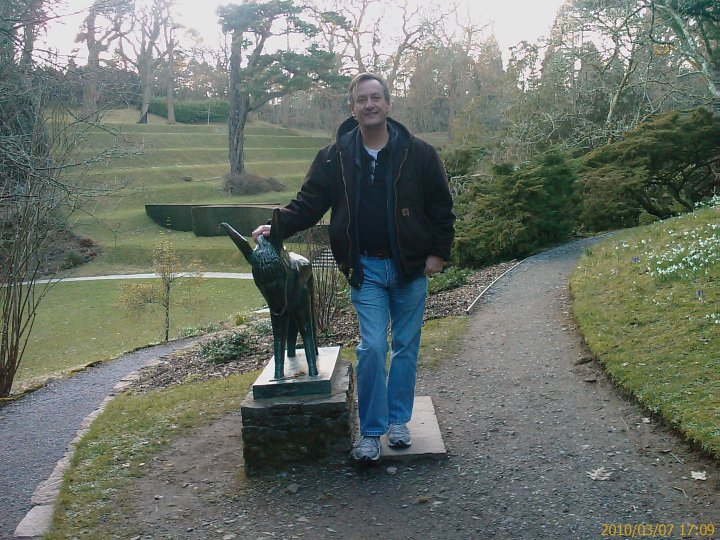

Alasdhair Campbell, 1953-2016
in Dartington Hall Gardens, one of his favourite places
Of all friends with whom I still maintained contact, Alasdhair was the one I’d known well longest. Though the contact was more tenuous in later years, it had never been broken; but because it was tenuous, its ending feels all the more unreal. I certainly haven’t accepted it yet, and still expect to write to him or hear from him at any time.

It’s a particularly strong feeling when I visit Oxford, as I still do frequently, and see the cricket ground and its pavilion. That leaves me smiling with pleasure at the memory of our picnic and ruefully at the fence that prevents any repetition of it. I feel it too whenever I travel by air, as it reminds me of the many long journeys Alasdhair used to take for work and which he would commentate on facebook. Indeed, it is on a plane that I’m writing this testimonial now.

Odd that he’s not around any more. Terribly unfair. And poignantly sad.

Tuesday, 29 November 2016

Sheffield's trees: a maze worthy of Kafka

Have you been following the scandal that I like to think of as Sheffield-street-tree-gate? No? You don’t know what you’re missing.

Let me start by giving a little background. This may seem a bit of a roundabout way of setting the context, but bear with me – it will make sense in time.

It’s his novel The Trial that made an adjective, Kafkaesque, out of Kafka’s name. In it, the protagonist K (and, no, the choice of that single letter is unlikely to be mere coincidence) comes under investigation for a crime without ever being told what it is. And yet, even if he doesn’t know what crime he’s accused of, he somehow knows that he’s guilty – a neat way of expressing the universal sense of guilt, over the harm that each of us has somehow done. In The Ballad of Reading Gaol, his contemporary Oscar Wilde said “each man kills the thing he loves.”

As any of us would, K does try to deny his guilt. But the policemen who arrest him make it clear there’s no point:

”Our authorities, as far as I know, and I only know the lowest grades, don’t go out looking for guilt among the public; it’s the guilt that draw them out, like it says in the law, and they have to send us police officers out. That’s the law. Where do you think there’d be any mistake there?”

“I don’t know this law,” said K.

“So much the worse for you, then,” said the policeman.


Near the end, K explains his predicament to a priest.

“But I’m not guilty,” said K. “there’s been a mistake. How is it even possible for someone to be guilty? We’re all human beings here, one like the other.”

“That is true,” said the priest, “but that is how the guilty speak.” 


Kafka's Trial: a vortex that sucks us in and grinds us down
The Sheffield street-tree scandal concerns the activity of a private company, Amey’s, that has been contracted by Sheffield City Council to look after its trees. It has started by felling a number of them, and in one particularly notorious incident, showed up at 5:00 in the morning, demanding that residents move their cars or have them crushed by falling trees. Two women aged 71 and 70 found themselves arrested for the first time in their lives when they tried to prevent the felling, prompting protests from Nick Clegg, the local MP, who denounced “scenes you’d expect in Putin’s Russia.” I suppose that, given the President Elect’s admiration for Vladimir, one might be tempted to add “or Trump’s America”.

This is the same Clegg who, as leader of the Liberal Democrats, made a pact with the devil by entering a coalition with the Tories. That kept David Cameron in power for five years with nothing achieved for himself but the reduction of his parliamentary presence from 62 to 8. 

But I digress. 

The Save Sheffield’s Trees group told the Guardian that if Ameys people “blitz the city’s trees in the first five years of their 25-year contract, they can spend the next 20 years with much lower maintenance costs”. I suppose some will see that view as unduly cynical. Not implausible, though, is it?

Another person arrested over the battle of the city’s trees is a Green Party member, Simon Crump. He apparently was held by the police for eight hours, but he believes it took that long because the police simply couldn’t find the right charge to bring against him in their computer.

“It was quite Kafkaesque,” he informed Helen Pidd of the Guardian. “I was being imprisoned because they couldn’t work out what to charge me with.”

He’s right. And no doubt, whatever it was the police thought he’d done, he was guilty as charged. 

Kafka would have been proud.

Sunday, 27 November 2016

Misty's diary: coping with a puppy – principle and practice

Well, I told them. And when they didn’t listen, I showed them. I hope they’ve learned their lesson.

The domestic staff have introduced a new dog – or rather, far worse, a new puppy – to the household. I told them how badly I felt about that when they showed up with that little tyke Luci. I know I’ve got used to her and we basically get on OK now, but that’s no excuse for keeping on doing it. They can’t be in any doubt what a dim view I take of such proceedings on their part.

They went ahead anyway. The new thing’s about the size of a medium rat but with less meat on it, and apparently goes by the name “Toffee”. I’d warned them what would happen so when they blithely went on and did it, I acted on my warning. I vanished. I was gone. Vamoosed. Into the garden, over the fence and far away.

It’s true that the little Luci saw things differently.

“But you’re still coming back for your food, aren’t you?”

Well, of course I was coming back for food. You’ve got to eat, haven’t you? I mean, what does she think? How naïve can she be?

Still, mustn’t be too hard on her. She’s young and doesn’t get it. What I was doing by disappearing was taking a stand on principle. What I was doing by coming back for my food was taking appropriate action in practice. Principle is great but practice really has to come first.

After all, a principle stand makes you feel good about yourself, and boy do you need that when there’s a new puppy in your life. But not getting your feed can leave you feeling strangely thin, which must be a most bizarre feeling (I imagine) and would rather undo any good done by the stand on principle.

Anyway, I made my point. But you do have to show tolerance towards the benighted. So after a while I came back and hung around the house a bit, just to show them I didn’t hold grudges, and could be magnanimous towards the afflicted. Of course, I got a bit afflicted myself, by that Toffee-thing – it kept running at me and trying to nip my ears or my belly, worse than Luci when she was small – Luci was never that young, anyway – so I had to resort to some of the old tricks that I hoped were behind me for good, like hopping up on a dining chair under the table cloth, and laughing at her.


Safe on a dining chair:
out of reach but able to keep a baleful eye on puppy antics
Still, she seems less sensitive to that kind of behaviour than Luci was. She keeps coming back for more. Toughy-toffee, I say. Still, there’s nothing much a good cuff around the ear with velveted paw won’t cure, and for the few things it won’t there’s always just a gentle reminder administered with the very ends of my teeth. Delicate they are, my teeth, but if I say so myself, pleasingly sharp too.

I’m gratified to say that she seems to be a quick learner, that Toffee. The smallest of implied bites produces a little squeal and then a welcome cessation of annoying attention. Welcome peace.

What I don’t know, though, is why it’s always me that has to train these new arrivals. I did a good job with Luci, but you know how it is: a good job, well done is only ever rewarded by another even bigger job to take on. And toughy-Toffee’s certainly going to be a challenge.

Still, she has at least one weak point. I’ve never seen anyone like her with food. Once she’s got her head buried in a bowl of the stuff there’s no getting it out any more. I watched the domestics literally struggle to get a bowl away from her. She’s like a silent version of one of those ghastly vacuum cleaners they use on their carpets, though with her it only works with food bowls. Hers, Luci’s, anyone’s she can get her nose into.

I’m just glad my food’s up high, where I can get it but Luci can’t. It’s way out of Toffee’s reach. Long may it stay so.

Because if she ever got to it, I’d end up as hungry as if I’d disappeared in practice as well as in principle.

Friday, 25 November 2016

Do you believe the NHS is safe with the Tories? How Thatcher's behaviour exposed that lie

“The NHS is safe with us,” Thatcher told the nation – well, the Tory Party Conference, but we were all listening – in 1982.

It can take some time – in this case, over three decades – but eventually the truth will out, and the lie is exposed. At least, if you have a newspaper as effective as the Guardian to do the exposing.

It was three years ago that we discovered from papers published under the thirty-year rule, that back then Thatcher’s government had considered a proposal to end free Higher Education and to introduce vouchers to pay for school education, freeze benefits and, most toxic of all, to overthrow the founding principle of the NHS that healthcare should be free at the point of care, replacing the service by one based on insurance. As the paper containing the proposal pointed out, “This would of course mean the end of the National Health Service.”


As quoted in the Guardian: the killer phrase in the 1982 proposals
In her memoirs, Thatcher said, “I was horrified when I saw this paper. I pointed out that it would almost certainly be leaked and give a totally false impression … It was all a total nonsense.”

The government dropped the proposals after what her then Energy Secretary, Nigel Lawson, described as “the nearest thing to a cabinet riot in the history of the Thatcher administration.”

What has now emerged, from newly-published Treasury papers of her then Chancellor of the Exchequer, Geoffrey Howe, is that Thatcher didn’t give up on the proposals herself but kept working on them with him. As he noted, “the prime minister has arranged a series of meetings with the main spending ministers to discuss the follow-up to the discussion in cabinet” on the proposals. Among other things, the discussions were to look into replacing some public services by “more efficient alternatives from the private sector.”

If Thatcher was horrified, it was clearly about the fact that the ideas “would almost certainly be leaked” rather than about the ideas themselves.

Now roll on thirty or more years.

There has been constantly extending privatisation of health services in England with little evidence that they provide better quality. In fact, they don’t even seem to be able to generate levels of profit that would persuade the private companies to keep delivering them – several major contracts have already had to be cancelled.

Meanwhile the NHS is facing an unprecedented level of financial crisis. The 2015/16 year was the second in a row which saw the service in England in deficit – and with three times the level as the year before. The much respected health think tank, the King’s Fund, comments:

The scale of the aggregate deficit makes it clear that overspending is largely not attributable to mismanagement in individual organisations – instead it signifies a health system buckling under the strain of huge financial and operational pressures. The recent strategy of driving efficiencies by cutting the tariff has placed disproportionate strain on providers and is no longer sustainable.

That reference to a “recent strategy” reveals that the problem has been caused by deliberate policy. The government is putting the NHS “under the strain of huge financial and operational pressures”. Unbearable strain, you might say. .

Is this an unfortunate consequence of a misguided policy? Or is it merely the continuation by other means of an approach already launched scouted over three decades ago by Thatcher? An approach that would necessarily lead to “the end of the National Health Service”?

It hardly matters how we answer those questions. What’s clear is that the notion that the “NHS is safe” with the Tories is just sand in the eyes of those too tired or too greedy to resist their propaganda.

Why, you might as reasonably believe that Tories will keep the poor safe.

Tuesday, 22 November 2016

Our age of political dilettantism...

Ken Loach is a great film maker. I could perhaps have done without the hackneyed story line of The Wind that Shook the Barley, but The Navigators or Sweet Sixteen are masterpieces as is, in a different genre, The Angels’ Share.

So I have great admiration for him in film, the area where he does outstanding work.

A scene from Sweet Sixteen: film-making is what Loach does best
Sadly, however, he’s recently decided to speak out on politics. Here his performance strikes me as rather more underwhelming. In fact, it strikes me as a pity that he’s wandered into this field at all – forbearance might have suited him much better.

He was quoted in the Guardian saying, “The deselection of MPs is presented as a threat [but] it is not a job for life. Labour party members have the right to be represented by someone they choose.”

Labour Party members, and I speak as one myself, have no such right. We shouldn’t try to arrogate it to ourselves. Our right is to select a candidate. Our duty is to try to choose one who is the best placed to represent the interests of those most requiring protection in the system in which we live. In other words, we should select candidates who, if elected, will be particularly good at representing those the Labour Party is committed to serve.

That doesn’t necessarily mean representing their views, but their interests. But it doesn’t mean representing them – voters and, above all, the least privileged of voters – not the membership of the Labour Party.

To me, the lesson of Loach’s foray into Labour politics seems that it’s probably better not to let amateurs (like him or, indeed, like me) call the shots. Which makes it all the more frightening to contemplate the other great political amateur of the day. He, sadly, hasn’t just made some silly statements about politics, but has been elected to the most powerful political office in the world, the Presidency of the United States.

Elected, that is, not by winning a majority of voters – he received 1.7m votes fewer than his opponent Hillary Clinton – but by dint of winning a majority in the electoral college that ultimately chooses the president. That makes him president-elect but it doesn’t make him the choice of the people, even though he speaks as though he had the authority such a mandate would give him.

Another popular vote that he certainly didn’t win was that of the British electorate. In Britain, he has all the authority – unfortunately – that holding the world’s most powerful office confers. He holds no authority to speak for Britain. So it was amusing in a dry kind of way when Donald Trump told the British government that it ought to appoint Nigel Farage as British ambassador to the States.

It was no surprise that Trump should make that particular choice. Farage leads the United Kingdom Independence Party, UKIP, a thoroughly toxic organisation which uses xenophobia for a cover for what is actually downright racism. He is, in other words, a man very much after Trump’s heart.

What was more surprising was that Trump seemed to feel that his election, which will mean a huge change in personnel in Washington, would lead to a similar night of the long knives in London. Above all, he felt he had a say in the process.

In a long and not always salutary history – British behaviour towards the Americas left a lot to be desired, for instance, and there were far more deplorable incidents elsewhere – Britain has at least developed a reasonably sophisticated way of dealing with bumptious fools in diplomacy. liked pleased with the Prime Minister and Foreign Secretary's response to Trump’s suggestion for a new ambassador.

“There is no vacancy,” they said.

From opposite ends of the political spectrum, Loach and Trump illustrate the same point, that amateurs do best to keep out of politics.

Loach is a man of huge talent. He ought to focus on the area where he shines. Trump, of course, is talentless.

Perhaps he could just sink into deserved obscurity at the earliest opportunity?

Monday, 21 November 2016

Drive people to despair and they do desperate things

Many of those US blue-collar workers, the natural constituency of the Democratic Party, who voted for Trump were driven by anger and frustration. Many find that even holding down two or three jobs, they still can’t make ends meet. Feeling let down by the system as it is, and feeling that the leaders they previously trusted are simply part of that same system, they turned to a more radical alternative.

In Britain, seven million people are now in precarious employment. They are in jobs in which they have no guaranteed hours, but they still have to make themselves available, with no assurance that they will be given anything to do or any pay for doing it. Others are given workloads that are all but impossible to clear, or require multiple hours of unpaid overtime to finish. It’s become easy and the norm for companies that hit any kind of financial problem to shed staff, so executives who have failed to achieve their own, often deeply unrealistic targets, can make others take the fall for their poor decisions.

We haven’t yet had a Trump in Britain. What we have had, however, is nearly seven years of government by the Conservative Party, alone (now) or as the dominant partner in a coalition (up to 2015). In its early days, it liked to claim that “we’re all in this together”. Now, under new management, the government claims to want to assist the “just about managing” or “JAMs”, the very people driven to desperation in the States, the ones who have to swim with all their strength to keep their noses just below water.

A new study shows, however, that without a major change of course, life for the JAMs is likely to get harder to the tune of £2500 a year less income by 2020. For all the pledges, desperation is set to increase for the already desperate.

If that kind of despair gave us Trump in the States, it’s likely to have as damaging an effect in Britain too. Or in France, where Le Pen lies in wait, or the Netherlands, where Geert Wilders is the likely beneficiary, or in a host of other countries where the far right is building a head of steam.

As American voters will discover over the next four years, the sad truth is that the leaders who come up with the simple answers – “get out of the European Union”, “drain the swamp”, “build a wall” – only make matters far worse for the very group that puts them in power.

What’s the alternative?

It has to be a leadership as radical and inspiring as Trump’s, but genuinely committed and not merely committed in words, to addressing the problems of those who are suffering such hardship today – and far worse hardship tomorrow. Unfortunately, in most countries those who should be providing that kind of leadership seem, like Hillary Clinton, to be tied to the system that creates the problem and unable to inspire confidence in those they ought to be representing.

The Democrats in the US are facing a particularly toxic Republican in the White House, whose party controls both Houses of Congress and will entrench a majority that shares its views in the Supreme Court.

The Socialist Party in France has led a failed government and is now expected to go down to comprehensive defeat in elections next year.

In Britain, the unions inflicted on the Labour Party a leader, Ed Miliband, who was likeable and intelligent, but could never convince voters that he could be Prime Minister. Now a majority of Labour’s membership has elected Jeremy Corbyn, not once but twice. He too seems likeable and intelligent; he certainly has a radical message but seems not to be getting it through to anything like sufficient numbers: Labour is languishing ten to fourteen points behind the Conservative Party, far too wide a margin to be attributed to the simple and now notorious inability of polling organisations to achieve accuracy.

Homelessness, on the rise in Britain, as is the use of food banks
Worse off by £2500 a year, by 2020. That represents around 10% of the median income in Britain today. A drop of that scale will drive up homelessness, hunger and disease among people who are already struggling. That is the price being paid by those least able to pay any price at all.

And it’s the price of Labour’s failure to win traction in the electorate. It underlines the urgency of addressing that problem today. For a lot of people, not just in Britain but across the developed world, tomorrow may be far worse.

As the election of Trump demonstrates.

Friday, 18 November 2016

There are lies, damned lies and straight bigotry. Then there are right-wing campaign pledges

How appropriate it is that ‘post-truth’ has been selected by the Oxford Dictionaries as the new word of the year.

It doesn’t refer to what happens after the truth. The ‘post’ means beyond the time a notion was relevant, as in ‘post-modernism’, the concept which expresses the baby-boomer conviction that modernity ended with their youth. After all, we invented sex, as Philip Larkin pointed out:

Sexual intercourse began 
In nineteen sixty-three 
(which was rather late for me) – 
Between the end of the ‘Chatterley’ ban 
And the Beatles' first LP.

Post-truth is our current period in which truth is merely an optional, and not particularly desirable, adjunct to political discourse. There was a time when one felt politicians made unrealistic promises, or promises that were far-fetched aspirations rather than real deliverables, but avoided downright lies.

Not any more.

In Britain, the point was made powerfully during the Brexit campaign. Supporters promised leaving the EU would release £350m a week for the NHS. They knew the EU didn’t cost £350m a week and that any funds would be needed for other purposes, but that didn’t stop them.

Once they’d won their campaign, they simply announced that well, no, the money wouldn’t actually be available. But who cared? The point was to win, not to deliver.

The other side was as bad, of course. They claimed the economy would collapse if the electorate voted for Brexit. Because that didn’t happen many Brexiteers are now trumpeting the success of Britain outside the EU. That’s before the country’s even started the process of leaving. It also ignores the timelag, measured in months or even years, that economic change requires to make its effects felt.

Many have pointed to the links between Brexit and Trump’s campaign in the States. Rightly. Even if post-truth is their only common feature.

Let’s take one of Trump’s more toxic pledges. He promoted building a wall along the US-Mexico border to keep immigrants out. Now, though, Trump is admitting that stretches of his ‘wall’ would be more accurately described as ‘fence’. Much of that fence is already in place and it doesn’t work.

But he also had less vile ideas, even if he expressed them with ugly violence. ‘Drain the swamp’ is a brutal way of putting it, but who would oppose the underlying idea, of ending corruption and the power of naked money in Washington?

What, though, has Trump done since his victory? He has appointed four members of his immediate family to his transition team. One of them, Jared Kushner, is the son of Charles Kushner. In 2005, Charles was in federal prison on 18 counts of tax evasion, witness tampering and making illegal campaign donations.

Now, that’s not a reason for turning on his son: I don’t believe in visiting the sins of the father on the next generation. No, where the story turns ugly is when we come to Governor Chris Christie of New Jersey, a keen Trump supporter who was expected to chair his Transition team. He had, however, been the very US Attorney who prosecuted Charles Kushner, describing his jailing as a “great victory for the people of New Jersey”. 

I like to picture the scene as Christie found himself in meetings with the son of the man he had jailed with such gloating triumph, and realised the victim’s son was going to have a major say over his political aspirations. The arrangement would prove career-limiting for Christie, who soon had to make his excuses and leave.

Kushner And Trump
The power behind the throne alongside its occupant?
He wasn’t the only one to go. An ally of Christie’s, Mike Rogers, previously a national security adviser to Trump, was the next out, followed on Wednesday of this week by Kevin O’Connor, another man close to Christie, who’d been leading on Justice matters in the Transition team.

So Trump has started the process of draining the swamp by appointing his son-in-law and giving him the power to settle old scores.

Meanwhile, he’s also appointed Steve Bannon Chief Strategist and Senior Counsellor. Bannon owes his reputation to promoting White Supremacist views on his Breitbart website, mouthpiece for the ‘alt-right’ (another candidate term for Oxford Dictionaries’ word of the year, as a less offensive synonym of ‘crypto-fascist’).

As well as his track record for racial harmony, Bannon brings in a flavour of high finance, as a former Goldman Sachs executive. In other words, he represents precisely the kind of arrogant banking interests that made the swamp Trump claims to want to drain.

It seems that Trump didn’t really intend to drain the swamp any more than he planned to build his wall. But then, that wasn’t the purpose of the exercise, was it? Like the £350m a week for the NHS, this wasn’t a policy, just a trap for votes. It achieved its purpose not by being delivered itself, but by delivering a victory to the campaign that voiced it.

Truth? Who needs it when victory is more easily gained without? This is the post-truth epoch.

Oh well. These things are temporary. Perhaps someday we can make ‘post-far-right-lies’ the new term of the year.