Showing posts with label Benjamin Franklin. Show all posts

Wednesday, 13 May 2020

Laughing at us, not with us

Benjamin Franklin came up with many pithy sayings that have become proverbs, such as, “It takes many good deeds to build a good reputation, and only one bad one to lose it”.

Every time I see someone in the British media or politics talking about some aspect of the nation being “the envy of the world”, I cringe.

It’s been said about the National Health Service, where it had some validity until ten years of austerity starved Britain’s favourite institution until it could no longer deliver what the nation needs.

It’s been said about the justice system, despite Britain being the nation where it’s hardest to defend against a libel suit, where the Birmingham Six could be wrongly condemned and the family of Stephen Lawrence denied justice for his murder.

It’s been said about the Army, though it sent soldiers tramping across the Falklands in boots so bad they fell apart on the way.

Still, in some areas Britain had a fine reputation. For instance, for its sense of humour, which God knows we need more than ever. Or, despite Brexiter claims, in international negotiations, where the UK tended to get its own way in the EU (much to the annoyance of France), as Bobby McDonagh, once Irish ambassador to the UK as well as having worked many years with the EU, made clear in the Guardian in July 2019:

British influence in the EU went well beyond that available to most member states. The UK’s impact was exceptional due to several factors. The quality of its civil servants. The effectiveness of its coordination mechanisms. The reach of its diplomacy. The potency of its networking. The admiration for its pragmatism. The predominance of the English language.

Meanwhile, the reputation Britain enjoyed for administrative skill, pragmatism and diplomacy, was enjoyed by the US for its knowhow.

I’ve always enjoyed the story of a Canadian politician who said that, when his country was founded, it hoped to combine French culture with the British political system and American knowhow. Sadly, it had in fact combined the French political system with American culture and British knowhow.

US knowhow gave the US a huge advantage over Japan in World War II. It had the capacity to build war material at a colossal rate, replacing losses and extending their advantage, at a time when Japan could no longer build either ships of planes.

The Moon landing was another staggering achievement. Second in getting a man into space, they were nonetheless first in putting a man on the Moon (the series For All Mankind gives an entertaining and insightful view of what might have happened had they been second).

When it came to doing things right, it made sense to look at what was happening in the US. And when it came to doing the right thing, at least in politics and administration, you could do a lot worse than turn to the UK.

Both nations built those reputations over years of careful, competent work. Now they’ve lost them.
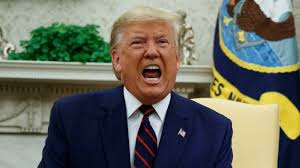
Not improving US standing in the world


Trump has spent his presidency undoing Obama’s good work before him, on global warming, on international relations and on medical preparedness for epidemics, particularly relevant today. Nothing, however, has shown up his unfitness for the job so much as his handling of the pandemic itself. Many have died because of his slowness to act. Now, many more will die as he forces the nation to open to business too soon, against the advice of his experts, and for no better reason than that he needs the economy to be booming to secure re-election.

In other words, his electoral interests matter more to him than the primary duty of all national leaders, to protect their people. He’s indifferent to the suffering of others. That, incidentally, seems to me to be the textbook definition of a sociopath.

They may be laughing at you these days,
rather with with you...

In the UK, Johnson’s focus was on completing Brexit, with the simplistic slogan, “Get Brexit Done”. It ignored any of the details of how a Brexit would look or the impact it would have. But Johnson isn’t a details man.

His failure to grasp detail is particularly stark in the pandemic. He had several weeks’ warning and much to learn from countries hit earlier. But like Trump, the Prime Minister is more concerned with holding his post than with carrying out its duties. Why, he even failed to attend five meetings of the emergency committee preparing for the epidemic when there was still time to act.

This week, as he announced that it was time to relax the lockdown and send many people back to work, it emerged that he’d made no arrangements to ensure their safety. Laughably, he made it sound as though they should go in on Monday, when in fact the relaxation was planned for Wednesday. Nor could he make clear how they should get there, by their own means or public transport.

This led to the German newspaper <i>Die Zeit</i>, one of many foreign media shocked by Johnson’s behaviour, to comment acerbically, “the government is now trying to pretend that it has the situation under control.”

Far from being the envy of the world, Trump and Johnson have made the US and UK objects of ridicule and pity. British comedy enjoys high international fame, but right now people are laughing at us, not with us. It will be a long way back for both nations to the reputations they once enjoyed, with no guarantee they’ll get there. 

But who’s to blame? They didn’t vote themselves into office, after all.

If you plan to vote for Trump, you’re not making America great. You’re contributing to preserving an administration the world sees as incompetent and which will cause the deaths of tens of thousands of your compatriots.

If you plan to vote Conservative in Britain, you’re trying to preserve a government which is making the country a laughing stock and the most dangerous in Europe for Coronavirus.

We often get the governments we deserve. And if we don’t vote for a better one, we deserve the one we have.

Even if its bad deeds confirm, as Benjamin Franklin pointed out, our justified but lousy reputation.

Wednesday, 4 July 2018

The fine British tradition of wishing Americans well on Independence Day

Best wishes to all my American friends, this fourth of July.

I say that with complete sincerity, even though I’m British, and the celebration is of American independence from Britain. In fact, by wishing them well on this day, I’m merely perpetuating a tradition fully rooted in Britain. It stretches back to the time of that breach, nearly two and a half centuries ago.

The names of many of the leaders of the American side in that struggle still resonate today. Men like George Washington, Thomas Jefferson, Alexander Hamilton or Benjamin Franklin, though we draw a delicate veil over the inconvenient truth that the first two of those champions of liberty were slave owners, and the other two endorsed a constitution which allowed them to continue.

Their opposite numbers in Britain are far less well remembered. Maybe some retain a vague sense that there were two William Pitts, the elder and his son the younger, and even maybe that they both became Prime Minister. Some still recall the name of Edmund Burke, if only as the father of modern Conservatism. And there may even be those who remember the great wit and maverick, rival of the younger Pitt, Charles James Fox.
Pitt the Elder, Pitt the Younger, Charles James Fox, Edmund Burke
If I had to pick four figures who stand out as extraordinary from that period of British history, it would certainly be those. And they stand head and shoulders above those who prosecuted the war against the Americans, most notably King George III and his Prime Minister, Lord North.

What did those four have to say about British action against the colonists?

In 1775, even before the Declaration of Independence was issued, the elder Pitt, by then Earl of Chatham, by then already suffering from his final illness, came into the House of Lords to call for conciliation of the colonists:

We shall be forced ultimately to retract. Let us retract while we can, not when we must.

On 12 June 1781, his 22-year old son, by then a Member of Parliament himself, made his own heartfelt declaration about the conflict in America to the House of Commons:

It is a most accursed, wicked, barbarous, cruel, unnatural, unjust and diabolical war… Where is the Englishman who on reading the narrative of those bloody and well-fought contests can refrain lamenting the loss of so much British blood shed in such a cause, or from weeping on whatever side victory might be declared?

The British blood whose loss he lamented was being shed on both sides – like most of his contemporaries, he saw this fight as pitting British subjects against British subjects.

Charles James Fox said something similar, speaking presciently to denounce Lord North’s behaviour towards the colonists in October 1775. He was:

the blundering pilot who had brought the nation into its present difficulties ... Lord Chatham, the King of Prussia, nay, Alexander the Great, never gained more in one campaign than the noble lord has lost—he has lost a whole continent.

In a pamphlet of April 1777, Edmund Burke was even blunter in his denunciation of British government policy:

When any community is subordinately connected with another, the great danger of the connection is the extreme pride and self-complacency of the superior, which in all matters of controversy will probably decide in its own favour…

They have been told that their dissent from violent measures is an encouragement to rebellion. Men of great presumption will hold a language which is contradicted by a whole course of history.
General rebellion and revolts of an whole people were never encouraged, now or at any time. They were always provoked.


The government had provoked the uprising against its rule. But it wasn’t an uprising against Britain, only against certain British leaders. Burke, Irish born and therefore aware of what oppression from London could feel like, knew what he was talking about and backed an opposition that would have hoped to do things differently had it been in office.

It was indeed the short government in which he held ministerial office that ultimately forced the King to recognise American independence.

It’s not the outlook of the men who waged a brutal and futile war in North America, but that of these outstanding figures, that I’d like to emulate.

And it’s in the spirit that I wish all my American friends a happy July the fourth.

Wednesday, 17 February 2016

So it all comes down to that?

In Britain, we’re moving closer to what will certainly be a historic decision for the nation: a referendum on whether to remain a member of the European Union.

Such a lot is riding on it. Should Britain remain part of the world’s largest trading block, with all the clout that provides, but at the cost of the reduction in sovereignty it implies? Or should it leave, on the grounds that it would be better off maintaining its freedom of action, knowing that it can arrange more advantageous arrangements for itself in bilateral negotiations with individual other nations?

These are momentous matters, and they deserve to be treated with seriousness.

Even among supporters of continued membership, there is a broad consensus that much is wrong with the EU. In particular, a great many people feel that the right to free movement of labour has opened British borders to too many immigrants, and there’s a general suspicion that many of them arrive to take advantage of the British benefit system – even though it’s far from the most generous in Europe.

The concern about immigration is strongest on the right, but many on the left have taken it up on the basis that they ought to reflect the views of their electors, even if they don’t share them. Since the EU guarantees freedom of movement, the EU debate therefore focuses increasingly on the question of immigration. That means that the other issues, of national sovereignty or whether human rights and democracy are best defended inside or outside, become far less prominent.

Cameron with Donald Tusk, President of the European Council
The negotiations continue. But make little progress
Unfortunately, in his attempt to renegotiate the terms of British membership of the EU and persuade sceptical voters that he has improved them sufficiently to justify a vote to stay in, David Cameron has run into a brick wall on the right to free movement of citizens throughout the Union. It’s viewed as a fundamental right, and to be defended above all in a structure that guarantees freedom of movement to goods and capital – if they can move freely, why not people too?

So instead Cameron has been striving to have benefits rules changed, on the basis that if immigrant rights to benefits can be reduced, then immigration itself will fall. So, the Cameron argument runs, if we obtain agreement from the EU to let us reduce benefits for migrants, then it will be possible to persuade sceptical voters to back continued membership.

As a result, from being concerned with the great and lofty question of Britain’s position in the world, the EU debate has focused more and more on immigrant access to benefit payments. All in the hope that if the British government can win back the authority to cut them for EU migrants, it will win round voters unconvinced that the price of high immigration levels is worth paying for EU membership.

Even that is proving difficult for David Cameron to achieve in his negotiations. Boris Johnson, Mayor of London, and ostensibly a Conservative ally of Cameron’s though also a contender to replace him as leader, is refusing to come out unequivocally in favour of the EU and is calling on the Prime Minister to come up with a better deal for Britain.

But Cameron has little to play with, and is scrabbling for a few more concessions as the time to finalise the deal approaches. The latest point of contention is the refusal of a group of four nations, Poland, the Czech Republic, Slovakia and Hungary, to go along with Cameron’s demand for the right to cut British child benefit payments to immigrants whose children are living abroad.

Migration Watch, the leading anti-immigrant organisation, calculates the value of those payments as £55 million a year. “£1m a week,” as the organisation proclaims in tones of horror.

For the current financial year, the government deficit is projected to be £69billion. Or £1.3 billion a week. Well over a thousand times more.

And on that figure, a thousand times smaller, the future of Britain in the EU and the world may hang?

It’s never a bad thing to give the last word to Benjamin Franklin, so let’s.

For the want of a nail the shoe was lost,
For the want of a shoe the horse was lost,
For the want of a horse the rider was lost,
For the want of a rider the battle was lost,
For the want of a battle the kingdom was lost,
And all for the want of a horseshoe-nail.

Saturday, 15 November 2014

Charm and its effect, even late in life

Anne-Catherine de Ligniville, Madame Helvétius, known as Minette, was reputed to be quite a character, as well as being married to one of the more controversial thinkers of eighteenth-century France. 

Claude-Adrien Helvétius was denounced as an atheist, his book burned by the public executioner. Even his name has a story: he was called Helvétius because he came from a family with the surname Schweitzer, which they presumably regarded as altogether too Germanic. Helvetic means the same as Swiss, so they simply latinised the name, making it sound much grander and less Teutonic. 
Minette. Turned a few heads but not everyone approved
Madame Helvétius was, apparently, quite a looker, and as contemporaries might have put it, no better than she should have been. 

I’ve always had a soft spot for Abigail Adams, wife of the second US President John Adams, and in my humble opinion the more interesting half of that partnership.

To be more truthful, there’s nothing in the least humble about that opinion. I hold it with complete conviction. I have no qualms about putting it out there, right here.

What I can’t deny about Abigail is that she was of somewhat Puritan stock. Rural Massachusetts, don’t you know. Late eighteenth century. They liked things just so.

Abigail met Minette while she was in France with John, during one of the latter’s diplomatic missions on behalf of the emerging American nation. The senior American diplomat was Benjamin Franklin and it was at a dinner he gave that Minette, who was highly fond of him, met Abigail, who didn
’t become in the least fond of her. Franklin told Abigail that Minette was a “genuine Frenchwoman, wholly free from affectation or stiffness of behavior”, and:

… one of the best women in the world. For this I must take the Doctor’s word; but I should have set her down for a very bad one, although sixty years of age, and a widow. I own I was highly disgusted, and never wish for an acquaintance with any ladies of this cast. After dinner she threw herself upon a settee, where she showed more than her feet. She had a little lap-dog, who was, next to the Doctor, her favorite.”
Abigail Adams
"I must study politics and war that my sons 
may have liberty to study mathematics and philosophy.”
I'm a fan of hers, but she was none of Minette's

I have to confess that, attached as I am to her, these views of Mrs Adams’ don’t make me think any the less well of Madame Helvétius. 

Apparently many others, and not just Franklin, thought rather highly of her at the time. A generation before Franklin, another thinker had found her fascinating. Bernard le Bovier de Fontenelle had been the grand old man of French science, in a life that in the end fell only one month short of a century long.

When he met Madame Helvétius, he was already in his late nineties.

"Ah, madame," he is said to have remarked, "if only I were eighty again.”

Not sure why I’ve devoted a post to that story, except that it’s Saturday afternoon. What time would be more suitable for a gentle anecdote? Especially in a blog devoted to random views.

Monday, 11 March 2013

If the people don't, who'll defend rights against government abuse?

A pincer movement is a much more effective form of attack than a simple frontal assault.

That no doubt is the reason we’re facing a two-pronged movement against civil rights in Britain at the moment.

One prong is being run by the government and takes the form of legal moves to introduce secret trials, held in private and with the defence denied access to the prosecution evidence.

The other prong is still more insidious in that it is based on whipping up a popular movement. Spearheaded by the right wing of the Conservative Party and its sniping opponents even further to the right in UKIP (United Kingdom Independence Party), it takes the form of a campaign against the Human Rights Act. A measure of its relative success is that it has managed to make ‘human rights’ sound like a bad thing – an extraordinary piece of doublespeak, fully worthy of Orwell’s 1984.

The pressure for closed trials is ostensibly based on the need to keep certain types of evidence hidden from certain types of defendant, mainly evidence obtained by the intelligence services, used against presumed terrorists. Just how serious the issue is was made clear by the former Labour Cabinet Minister Jack Straw. In a debate on the bill on 4 March, he told the House of Commons that in certain circumstances certain types of information have to remain concealed, in order to protect secret sources. If secrecy could not be guaranteed, the evidence could not be used and a terrorist might walk free and offend again. Straw went on:

‘If we had explained how we had ended up in such a situation by saying that information had to be provided in its entirety in open court in all circumstances, people would have said, “Thanks very much, but my relative, wife or child has just died.” That is the dilemma and it is not abstract—it is absolutely real.’

That immediately reminds me of Benjamin Franklin: ‘those who would give up essential liberty to purchase a little temporary safety deserve neither liberty nor safety.’ Britain at its best decided to put certain freedoms above protecting life – if not, it would not have fought on against Nazi Germany in June 1940, at a time when many even in government favoured surrender, in a war that in the end cost nearly half a million British lives.


Jack Straw
Once a radical, now keen on secret trials

That however isn’t the most shameful aspect of Straw’s statement. The truth, as Henry Porter pointed out in the Observer this weekend, is that the effect of revealing evidence in open court in terrorist cases has not been to free terrorists, but to embarrass the government and force it to pay damages for having behaved illegally. No wonder government wants to conceal this kind of information. 

Porter reminds us that Straw told parliament in 2005 that Britain had not been involved in rendition and torture of terror suspects; in 2009, his successor David Miliband had to admit that the statement was untrue and apologise for it. 

That’s what secret courts are about: not so much to protect us from terrorists but to protect government from embarrassing disclosures of its own bungling or criminal acts.

Which brings me to second prong of the attack, against the Human Rights Act. The popular movement against it points to the criminals who hide behind its provisions, and many do – but then criminals have always been good at abusing rights. That doesn’t mean we should do without them.

Article 6 of the Act guarantees that ‘everyone is entitled to a fair and public hearing within a reasonable time by an independent and impartial tribunal established by law’ (my emphasis). Later, it specifies that a person accused of a crime is entitled ‘to be informed promptly, in a language which he understands and in detail, of the nature and cause of the accusation against him’ and equally ‘to examine or have examined witnesses against him’

The US constitution is remarkable for its conciseness, its ability to express fundamental rights much more succinctly than most such legislation. Coincidentally, as it is Article 6 of the Human Rights Act, it is the Sixth Amendment of the US Constitution that deals with the right to a fair a trial:

‘In all criminal prosecutions, the accused shall enjoy the right to a speedy and public trial, by an impartial jury of the State and district wherein the crime shall have been committed, which district shall have been previously ascertained by law, and to be informed of the nature and cause of the accusation; to be confronted with the witnesses against him; to have compulsory process for obtaining witnesses in his favor, and to have the Assistance of Counsel for his defence.

The fact that the same rights are guaranteed on both sides of the Atlantic does rather suggest that they’re regarded as fundamental generally in democratic societies.

So why do so many citizens in Britain oppose the Human Rights Act? Especially when the government is busily trying to bring in legislation that undermines one of its most significant articles. Have some of my compatriots suddenly decided that they don’t need protection from government misdeeds and that the two-pronged attack therefore deserves to succeed?

Odd. They don’t usually show such touching confidence in the good faith of their rulers.

Monday, 28 January 2013

Let's get out of the EU just like we got away from the US

To be chief of staff to Tony Blair is a bit like being keeper of the curious compounds to the Borgias, so I’m not always inclined to regard Jonathan Powell with relaxed confidence. Nevertheless, he spent a while in diplomacy – another of those jobs not always marked by its qualities of straightforwardness and frank speaking – so he probably knows a bit about how one state ought to handle their relationship with others.


Powell: probably an authority but, hey, a Blairite. Lock up the spoons.

So it was interesting to read Powell’s paper in Monday’s Guardian about David Cameron’s long-awaited speech on Britain’s relationship with the European Union. As he argues, the speech was designed to win Cameron an immediate boost in short-term popularity, and it seems to have worked: the latest polls show him 3 or 4 points closer to the Labour opposition than he was before.

However, as Powell says, Cameron’s made any such gain at the cost of launching a five-year campaign over whether Britain stays in the EU or not.

Cameron has said he will only campaign to stay in the EU if he is first able to renegotiate the terms of Britain’s membership. Until he pulls off that fairly improbable feat, he’ll presumably have to hold his peace; and if he fails, as seems likely, what will he do? He claims to be a convinced Europhile: would he have to argue against his conviction?

In the meantime, the Eurosceptics will be under no restraint to silence their increasingly virulent attacks on British membership. On the contrary, they’ll take encouragement from Cameron’s having declared open season on the EU.

So our membership of the EU is at risk. The Eurosceptic current in the population is delighted. They see the millions it costs us to be members but somehow miss the hundreds of millions in additional trade it provides us; they see the way it forces us to let Johnny Foreigner in but don’t see that new arrivals are less inclined to claim benefits than native Brits and do jobs we can’t persuade anyone else to take on; they see that the Union imposes legal restrictions on us but don’t see that the same provisions guarantee us rights, including the opportunity to live and work in any of 26 other countries.

Now there’s nothing new about this kind of unenlightened thinking. Most peoples, but the Brits more than many, love to focus so much on the shortest of short terms that they lose track of the long-term advantage they’re giving up. Funnily enough, I’ve just been reading some more about one of the more obtuse instances of Britain behaving that way in the past.

Back in the eighteenth century, Britain fought a bunch of wars against those perpetual party-poopers from across the Channel, the French. Given the opposition, the Brits naturally won, but it cost a bit.

‘Blimey,’ they said, ‘who can we get to pay for this?’

So they took a look across the Atlantic and saw those enterprising colonists making money out in America. ‘I know,’ they said, ‘we’ll tax them.’

Sadly, the Colonists didn’t see things quite the same way. ‘Raise your own bloody money,’ they said, ‘we’re taking our ball away and won’t play any more.’

I read recently about John Adams of Massachusetts and Ben Franklin of Pennsylvania heading a delegation to visit the Lords Howe, one brother an Admiral, the other a General, in New York. Classic, isn’t it, that Britain was represented by two sprigs of the nobility, old Etonians, occupying their top positions thanks to their birth, because their talent certainly wouldn’t have got them there?

John Adams was worried about the likely behaviour of the Howes, but was astonished and delighted by the smooth courtesy and polished charm the two gentlemen displayed over dinner. Again, perfect isn’t it? Their descendants combine urbanity and incompetence in just the same measure.


Admiral Howe: not a lot of cop militarily, apparently
But he doesn't look a bundle of laughs either, to be honest

The discussions led nowhere and within days the Howes were in action against the colonists, winning crushing victories. However, each time they whipped the dastardly Yanks, the Howes went back to their charming dinners for another month or so, while their opponents slipped away and regrouped ready to attack again when the opportunity presented. And isn’t that appropriate too? Cameron wins his little skirmishes and then relaxes on his laurels while the war slips away from him.

Now Cameron 
isn’t an eighteenth-century general. Or even an admiral. And the EU isn’t a set of British possessions. But the North American colonies turned into the most powerful and prosperous nation on earth, and Britain’s short-term approach ensured that it would be no part of that. All for the sake of a little money they needed right then, and didn’t get anyway, and for want of a strategy properly elaborated and consistently applied, they turned their back on pretty cracking opportunity, the best they probably ever had.

Today, Cameron is looking at the possibility of working more closely with one of the world
’s biggest economic blocs, one likely to grow still more powerful in the future. He has deliberately adopted an approach that will marginalise Britain from it. He’s done that for the sake of an uncertain short-term gain. 

That feels like exactly the kind of respect for tradition that we appreciate in Britain.

‘That men do not learn very much from the lessons of history is the most important of all the lessons of history’ said Aldous Huxley. He was British. He was well placed to know.

Saturday, 7 January 2012

Coming down to earth

If Christmas is a family time, we did it right this year. We saw my mother and my brother; we had our granddaughter with her parents in the run up to Christmas; and at various times over the Christmas and New Year period our other two sons and one of our charming daughters-out-law.

It was only on Monday that our daughter-out-law left, to start a new job in Madrid, proving that jobs can be found in Spain despite the much trumpeted unemployment. One son went on Wednesday, the other on Friday, so the wind-down after Christmas has been tapered, not brusque, making the transition back to work, which I found painful this year, easier than it might have been.

Now, though, we’re back to our own devices, with little to show for the festive period but a large number of bottles for recycling and some kilos to lose.

One lasting legacy of the family visit is a recommendation my son Michael made to listen to a great podcast series: The History of Rome by Mike Duncan. This is the internet at best: somebody who has nothing to gain by it has simply prepared and delivered a history of Rome in dozens of bite-sized episodes, with just the right level of detail to be informative while remaining entertaining. 

Listening to this excellent series I was particularly struck by the history of Etruria. It was the home of the Etruscans, a nation of extraordinary wealth and culture. And indeed power: in the early years of the city, Rome was ruled by Kings and the last of these were Etruscan.

Many centuries later, in a struggle with another and equally ruthless imperial power, Benjamin Franklin would tell his fellow revolutionaries, ‘We shall hang together or we shall hang separately.’ The Etruscans were hanged separately. They wouldn’t bury their differences and they paid the price. 

Take Veii, once their wealthiest city, their jewel, not ten miles north of Rome. Never heard of it? Nor had I, or if I had, I’d forgotten. Today it’s part of a village in the Rome municipal area. With some fine ruins. 

I can imagine the scene, just before the slaughter of the population when Veii fell to the Roman siege (the soldiers broke in through the sewers, demonstrating that for all their love of honour, Romans valued success still more). I picture a worthy citizen, not realising that he would meet a violent death within a few hours, declaring ‘Veii has always stood proud and wealthy, the greatest of the Etruscan cities, and we’re certainly not giving up our independence to them, far less to those upstarts from down the road who’ve had the temerity to send an army against us.’

The rest, as they say, is history. Etruscan has vanished as a language. The people of Etruria were completely assimilated into Rome, speaking Latin and playing their own part in Roman life within a few generations.


Veii: not a lot left. The price of standing aloof?
Over the Christmas period, the British Conservative Party moved ahead of Labour in the opinion polls. 

That statement may seem unrelated to what came before, but bear with me: I shall explain.

That Conservative lead is particularly bad news for Labour. In mid-term, an Opposition needs to be building up a good lead in the polls if it’s to win the next election: there tends to be a swing back to the incumbents in the final stages, so the Opposition needs a cushion. Being behind is pretty desperate.

What caused the Conservative surge? 

On 10 December the Daily Mail referring to a historic moment the day before, told us ‘Defiant Cameron stands up to Euro bullies...’ This was the historic moment when Cameron vetoed changes to EU treaties so that the whole organisation could get behind attempts to solve the Eurozone crisis.

Others less inclined to see Cameron as a latter day Titan taking on the erring gods have taken exception to the word ‘veto’. Usually a veto, as they point out, stops something happening. This veto meant that 26 countries would go ahead and do it anyway, but without Britain. 

I sometimes wonder whether Cameron only realised that afterwards. Because as soon as he’d cast his vote, he told our EU enemies, sorry partners, that they couldn’t hold their discussions in EU buildings - you know, ‘if you’re not going to play by my rules, I’m taking my ball away.’ Later on, Britain backtracked from that position - civil servants, who are professionals after all, probably pointed out that this might not be the best way to make friends and retain some influence among people whose support we might need again some day.

But the virulence of Cameron’s initial reaction does rather suggest that he caught himself by surprise, doesn’t it? I can see him saying ‘well, you can’t do that because I’m saying ‘no’, so there, now what you are you going to do, eh, don’t look so clever now, do you? What do you mean? You’re going to go ahead and do it anyway? What without us? You’re going to ignore my veto? Well - if that’s the way you want to play it, you can’t use these nice offices then...’

In Britain though we tend not to think about the after effects of this kind of gesture but prefer to concentrate on the gesture itself. People loved it. ‘Standing up to to the Euro bullies’. Wonderful stuff. And it got him a tick up in the polls. Ahead of the opposition. Brilliant.

That got me thinking of other times in history when people have struck out on their own and told their partners to get stuffed. The Italian city states, for instance. Our daughter-in-law, when our granddaughter’s family came to stay with us, gallantly stood in a queue at the National Gallery for four hours so that we could all go and see an exhibition of paintings by her long-time favourite, Leonardo da Vinci. 

I particularly liked the pair of fabulously beautiful portraits of Ludovico Sforza’s wife and mistress. I often wonder how each of them must have felt about the other picture. And I can just imagine Sforza saying ‘Milan isn’t just an Italian city. It’s a proud and powerful centre with a long history of its own. We’re not going to be sucked into some kind of bogus unity with the rest of the peninsula.’ But while Leonardo was there, the French turned up and sacked the place, and over the next few centuries, Italy was regularly the playground of invading armies.

Leonardo's Lady with an Ermine: Ludovico Sforza's mistress
Culture, wealth, sophistication - but they were no protection against the French
One of the places I particularly liked in Alsace, where we used to live, was the Haut Koenigsburg, a fine castle beautifully and inaccurately restored by the German Kaiser Wilhelm (Alsace is like that: what country it’s in depends not just on geography but also on history). Why did the castle need restoring? Because it had been overrun a Swedish army. Swedish for crying out loud. Why the Swedes? Because until all those little German princedoms finally got together and sank their differences, Germany, like Italy, was a wonderful place for other countries to fight their wars.
Like Veii and the other cities of Etruria, the proud little Italian and German States were hanged separately because they wouldn’t hang together. 
Well, the Conservatives have drifted back behind Labour again. Not by much, but still behind. It’s as though after the excitement of the veto that never was, cold reason has reasserted itself. Ater all, nothing has changed. The French and the Germans haven’t surrendered to us. The economy is still dire. Unemployment is still rising.
It’s a bit like us taking out our empty bottles and resolving to lose those extra kilos. After the warm glow of the festive season we’ve had to come back to earth. Reality once more exerts its sobering influence.

Thursday, 1 December 2011

Time to chill


You have nothing to fear but fear itself Franklin Roosevelt told us. And in that spirit I have to say that little frightens me quite as much as how frightened we seem to be these days.

It’s doing us a huge amount of damage. We’re all worried sick about the Italian economy, so the fearful people with enough money to make a difference start trying to unload Italian bonds, so the yield rises, so it becomes more expensive for the Italian state to service its debts, so the economy gets worse. And yet, at root, the problem is only fear. If we all just said, ‘hey, it’s the Italians, it’s part of their charm,’ and had another glass of Barolo, the problem would be well on the way to resolution.

Exactly the same is true of terrorism. There was lots of fear last week about the fact that the passport officers would be on strike on Wednesday, opening our borders, or so it was claimed, to all sorts of sinister characters. There were calls for passport officers to lose the right to strike.

The 9/11 bombers got into the US through fully-staffed passport control checkpoints. What on earth difference did they make?  The bombers who attacked London on 7/7 2005 were born and bred in this country. They didn’t even need to go through passport control.

Besides, 7/7 cost 52 lives, and there have been no other deaths from terrorism in Britain since. Over that period, nearly 12,000 people have been killed on the roads. So if you’re concerned about saving lives, shouldn’t you start by banning cars rather than limiting the right to strike?

In any case, none of that is the point. The right to strike may be immensely irritating when it’s exercised, but it’s still a fundamental right. Before it was recognised as fundamental, we lived in societies which were significantly uglier than today’s – the occasional inconvenience seems a price well worth paying to block any move back towards those times.

I never tire of quoting Benjamin Franklin, who was bang on the money when he said ‘he who would give up a fundamental freedom for a little temporary security deserves neither freedom nor security’.

This constant striving for safety is bound to fail anyway. I recently quoted Eliza Manningham Buller, former heady of the British Security Service MI5, from her second Reith lecture of 2011. Let’s look at what she said in the third:

‘It’s important to keep a rational perspective on terrorist risk. Bin Laden must have known that 9/11 would make this especially difficult, for at least two reasons: the endless images of the horror, recycled and replayed round the clock by the 24 hour media, and the unrealistic view that society can become risk free. The world is full of risks and dangers, only some of which can be reduced.’

That’s right. Anyone who wants to live in a risk-free world shouldn’t be in this world at all.

So if you’re scared about terrorism, just remember it’s extremely unlikely to affect you. Worried about car crashes? Don't, you're probably not going to be involved in one. As for anxiety about the Euro, bear in mind that stoking up the general sense of panic may make the very thing you fear more likely.

Not perhaps an answer to our woes,
but a great palliative
So my advice? Relax. Chill. Open that bottle of Barolo and set about emptying it. You may do the Italian economy some good, and yourself a lot more.