Showing posts with label Boris Johnson. Show all posts

Wednesday, 9 September 2020

Entitled and above the law

Any Brits not yet sure they want Donald Trump beaten in this November’s presidential election, need only look at their own Prime Minister.

Trump has been positioning himself as the law ’n’ order President. That, though, hasn’t stopped him backing people who use or threaten violence against others, just as long as the perpetrators support him and the victims don’t. In other words, he upholds the law insofar as it suits him.

The British government is now proposing to break the agreement it made with the EU less than a year ago, covering arrangements for trade within Ireland. To preserve an entirely open border between Northern Ireland and the Republic, the agreement allows that there may be tariff differences between Northern Ireland and the rest of the United Kingdom.

Oddly enough, Johnson was warned when he reached the agreement that this was what it implied. Perhaps it took him seven months to work out that this really, really was the case, and now he’s flailing around looking for a way out. As I’ve pointed out before, Johnson isn’t anything like as bright as his admirers like to claim he is.

But he can’t just blame his relative dumbness for this latest action. There’s also something far more serious. Johnson simply does not see himself as governed by the same rules as anyone else. Questioned about the government’s willingness to breach its own agreement, the Northern Ireland secretary Brandon Lewis explained to the House of Commons.

Yes, this does break international law in a specific and limited way.

Trump and Johnson share more than bad hair

“Your honour, I only burgled one house at a time, so my crime was specific and limited and therefore not to be regarded as really bad,” sounds like a highly original approach to a criminal defence. I’m not sure it would really fly, though.

There is an important rule in legal practice in Britain, as I’m sure in many other jurisdictions. If a lawyer advises a client that the action they plan to take is illegal, and the client goes ahead with it anyway, the lawyer is obliged to stop acting for the client. It was entirely appropriate, therefore, that the most senior lawyer in the British Civil Service, Jonathan Jones, Head of the Government Legal Service, resigned after advising the government that its plans were illegal, a view that had been confirmed by external legal advice too.

Interestingly, it isn’t only civil servants who advise government on the law. There are two politicians who act as law officers, the Attorney General and the Solicitor General, both of them government ministers. It was, indeed, Suella Braverman who overrode Jones’s advice.

Why’s that so interesting? Well, she and the Solicitor General are bound by the same rules as Jones. They too should have advised Johnson that what he was proposing was illegal, and then resigned if went ahead anyway. Instead, Bravernman has made herself complicit in the law-breaking.

The issue of whether a breach is specific and limited is a distraction, of course. That isn’t what this behaviour is about. What matters isn’t the nature of the action, it’s who’s behind it. Trump-like, Johnson believes that any illegal behaviour is just fine, so long as it’s he and his friends who are behind it.

That’s hardly new, as it happens.

David Cameron and Boris Johnson (middle of front row)
in their Bullingdon Club days


When he was a student at Oxford, Boris Johnson, like David Cameron who was Prime Minister from 2010 to 2015, was a member of the Bullingdon Club. Its members were wealthy and entitled and behaved with contempt for others and for normal standards. They would engage in vandalism which, in any ordinary person, would have been regarded as criminal. According to an article in the Guardian from not long before Johnson became Prime Minister:

Boris was one of the big beasts of the club. He was up for anything. They treated certain types of people with absolute disdain, and referred to them as ‘plebs’ or ‘grockles’, and the police were always called ‘plod’. Their attitude was that women were there for their entertainment.

Student days, you might say. He’s moved on. Well, maybe that’s true for some people. Others, though, develop lifelong character traits at that time. The Bullingdon Club reinforces a sense of entitlement and impunity, and that does seem to have stayed with Johnson ever since.

Earlier this year, while the UK was in Covid lockdown ordered by the government itself, one of its most senior members, Johnson’s chief adviser Dominic Cummings, repeatedly breached the rules he helped craft for others. Johnson’s reaction? He defended Cummings and kept him in post.

Cummings is Johnson’s friend. He seems to be Johnsons puppet master. Special considerations apply to him.

Johnson still sees the world as when he was a student. Law is for other people. Obeying it, or having friends obey it, is entirely optional.

It’s a central tenet of Trumpism. It’s alive and thriving in Johnson. If Trump goes, Johnson may find the atmosphere turns just a tad chillier towards illegal action in political office.

Abusive, corrupt power exercised by entitled individuals is at stake on 3 November. The election held that day is in the US. But its repercussions will extend far further.

Friday, 14 August 2020

Corona: not just the problems we knew about

Corona just means crown. We use the word for things that have, or seem to have, a crown. There’s a corona around the sun. There’s a corona around the particularly nasty virus we talk about so much these days. And, of course, there’s a corona on every crowned head, by very definition.

So spare a thought for poor Spain. Like England, it’s struggling with both the health and the financial impact of the virus. Its strict lockdown to protect public health worked a lot better than the weaker measures in Britain, but the damage to the economy has been painful. Though, oddly, England has damaged its economy even more seriously, while controlling the pandemic less well. But then, England has Cummings and Johnson.

Today, however, cases in Spain are increasing once more at a depressing rate, and lockdown measures are having to be reintroduced. Just as they are in England. Although in England they seem to be targeting the Midlands and the North first of all, as though the Conservatives want to punish traditional Labour areas for having the audacity to vote for them instead.

Spain has an additional element of suffering. It’s also having to cope with Corona problems of the other, more ancient variety. The ones associated with the Crown. Especially since its previous occupant, Juan Carlos I, erstwhile King and now King emeritus, decided to do a bunk, fleeing abroad to some destination that has yet to be made public.

Juan Carlos I: ex-King who did a flit, and who knows to where?


His flight was precipitated by the ongoing investigation of his financial affairs. In particular, the judicial authorities find that his bank accounts in Switzerland raise a number of questions they’d like answered (yes, the understatement is deliberate).

This is sad, because Juan Carlos was the designated successor to the dictator Franco but, instead of maintaining the dictatorship, he oversaw an orderly transition to democracy. A referendum adopted the new constitution, still in force today, less than three years after the dictator’s death.

What’s more, not three years after that, when a coup against the new regime was launched by disaffected members of the paramilitary police and the army, Juan Carlos spoke out powerfully against it, rallying the nation to the cause of legitimate government. That ensured the coup’s failure.

Guardia Civil Colonel Antonio Tejero invading Parliament


Now, I’m a bit of a cynic and I share the misgivings of many over the length of time it took the King to come out with that statement. The initial attack against the Parliament took place just before 6:30 in the evening and the King’s broadcast went out at 1:14 in the morning. He recorded it around an hour earlier, but even that was six hours after the coup was launched.

There are those who say he knew in advance that it was going to happen, and only came out firmly in opposition once it became clear not enough of the army supported it. I don’t know how true or false that is. It is interesting, however, that there are those doubts, and that even as long ago as 1981 there were therefore some suspicions clouding the admiration felt towards the King by the Spanish people.

Which may have been a harbinger of what has happened now.

Even so, there are over 600 streets and squares called after Juan Carlos I across Spain. I am, indeed, in one of them now, as I write this piece from the flat near Madrid my one-year-old granddaughter inhabits and kindly shares with her parents (and, right now, us).

Today, a number of councils are facing motions from the Left suggesting it may be time to change the names of those streets and squares.

The government, too, led by Pedro Sánchez, a Socialist but on the Right of his party, is having to fight off moves from his coalition partner, from parties on whose parliamentary support he relies, and even from Socialist colleagues, to review the legal position of the Crown in Spanish politics. It is an offence, for instance, to insult the King, though that could be changed simply by new legislation. More problematic, the King can’t be held accountable for his acts either, and to change that would require a constitutional amendment.

Not the moment, Sánchez argues.

Ah, yes. He has a lot on his plate. Spain is closing down discos and bars again as the scourge of the virus builds again. The country has a shattered economy to rebuild. And now it has the distraction of a monarchy with a former King who’s beginning to look as toxic as the virus.

It amazes me that in today’s world we still have regimes led by men entitled to deference by right of birth. That strikes me as something to fix, so I’d like to see all three questions addressed at once. And perhaps in Britain as well as Spain.

But I can see how it makes the uphill struggle that Spain already faces even steeper and longer than it already was.

So spare my adopted nation a little sympathy…


Postscript: when the military knows how to respond to a coup

On the night of the coup, 23 February 1981 (so the event is referred to as 23F), the only city that was taken over by the military was the one where we live now. Let me quickly say that the two things aren’t causally connected. It’s just that the military region of Valencia was commanded by the general who supported the coup most actively.

Things went reasonably smoothly for him, until he sent tanks out to the airport at Manises, to get the air force unit there to join in. He got a dusty reply from the colonel in charge, according to the story a minister of the time later told:

“I have a Mirage on the runway with its engines running and armed with air to ground missiles. If the tanks heading for the base don’t turn around and pull back I’ll order it to take off and attack them. And I have another Mirage fighter ready on the runway just in case.”

The tanks retreated.

Tuesday, 21 July 2020

Truth, fact and fiction

I love the expression ‘in my humble opinion’. That’s because it isn’t just wrong. It’s wrong in so many different ways.

After all, how can an opinion be humble or proud? Or pretty much anything other than right or wrong, well-founded or fanciful? The holder of the opinion may be humble, but if so, why advance the opinion anyway? Surely putting forward an opinion at all shows a certain confidence in it, if not downright arrogance?

Anyway, in my humble opinion, the two best pieces of TV I’ve watched in recent months are Unbelievable and Unorthodox. The fact that both titles are negative adjectives may be unnerving but is certainly unintentional.

Merritt Wever and Toni Collette as the detectives in Unbelievable
Fictionalised versions of real characters


Unbelievable
is based on a compelling account of police work, led by two women detectives, on a serial rapist, with the linked story of a young woman whose rape complaint wasn’t believed by far less bright cops.

Unorthodox is drawn from the novel, built around her experiences, of a woman who broke free from an Orthodox Jewish community in New York, and the difficulties she faced both in her earlier existence and in coming to terms with the new one.

Shira Haas in Unothodox
The lake scene is one of the most poignant in the series


Both are works of fiction based on historical fact. This is not a spoiler, but there is a strand in Unorthodox to do with music which does not correspond to the real character’s history. But it’s powerful and engrossing, so it’s a welcome addition to the story. And it certainly doesn’t detract from its psychological truth.

Similarly, in Unbelievable, the names of the female protagonists have been changed. In the case of the young rape victim, this is principally to protect her identity. In the case of the two outstanding detectives, it is because though they are drawn from real figures, they differ from them in certain ways, and the invented names recognise the extent to which they are fictional creations.

Libby Hill recently ran an interview on Indiewire with Susannah Grant, co-creator of Unbelievable. The article’s worth reading in its entirety, but for now I’m going to focus on just a single sentence, because it struck me so forcefully. This is Hill’s opening, a quote from the novelist Madeleine L’Engle:

Truth is what is true, and it’s not necessarily factual. Truth and fact are not the same thing.

Facts can be used to mislead. It is fact, for instance, that UK Prime Minister Boris Johnson recently announced £5 billion of infrastructure expenditure as a key element in the government’s response to the economic crisis associated with the Coronavirus pandemic. It’s also a fact that when US President Franklyn Roosevelt had to respond to the economic crisis precipitated by the crash of 1929, he called it the ‘New Deal’.

Unsurprisingly, Johnson called his initiative a New Deal too.

The parallel with Roosevelt’s unprecedented and colossal programme in the 1930s is impressive. Or so it seems, until we add a further fact. Johnson’s New Deal represents 0.2% of British GDP, while FDR’s amounted to around 40% of the US economy.

A fact without context gave us a fiction that communicates a falsehood.

Unbelievable, on the other hand, took facts as a starting point, but then built a fiction around them which conveyed important truths. It used the fiction to illustrate the horror and distress of rape, the pain of the victim disbelieved, and the contrast between the slapdash work of an inept policeman and the tireless and exhaustive work of two excellent ones.

In other words, a good fiction can communicate an important truth, while simple facts, as in Johnson’s case, can be used to deliver a falsehood.

This all put me in mind of one of my favourites writers of all time, Denis Diderot, the French novelist and philosopher of the eighteenth century. He was a remarkable writer, and his novels sparkle and amuse even today (if you don’t know it, you should try Jacques the Fatalist, one of the greatest comic novels of all time). Strangely, he admired Samuel Richardson, an English writer whose novels are stodgy and cloyingly sentimental with a touch of sadism thrown in. Diderot was heavily influenced by him, which is odd, since his books are lighter, more compelling and above all funnier.

There was a sharp debate in Diderot’s day about the relative truth of history and the novel. This was a time when historians were not above inventing speeches to put in the mouths of the major figures they were dealing with, on the grounds that, though no one knew what Julius Caesar or Charlemagne had said on a particular occasion, this is the kind of thing they might have said. But even without such downright invention, much history is necessarily speculative – based on documentary evidence perhaps, but filling in gaps by interpretation.

Diderot directly addresses Richardson on this subject:

Oh Richardson! I will go so far as to say that the truest of histories is full of lies, and your novel is full of truths. History paints a few individuals; you paint the whole human race… The human heart, which has been, is and always will be the same, is the model you copy… I will go so far as to say that history is often a bad novel; and the novel, as you have made it, is a good history. O painter of nature! It is you who never lie.

I love that notion. Fiction can be more truthful than fact. “Truth and fact are not the same thing,” as Madeleine L’Engle so sharply put it.

To see how valid that is, watch Unbelievable and Unorthodox if you haven’t already seen them. And tease out the truths in these and other fictions, of screen or page.

Then listen to the allegedly factual statements of Donald Trump, Xi Jinping, Vladimir Putin or even mini-Trump Boris Johnson, with a seriously large pinch of salt.

Tuesday, 7 July 2020

The great Bill Gates conspiracy. A bit of context

In my previous post about the strange case of the Bill Gates conspiracy theory, I talked about those curious aspects of it that are, when all’s said and done, common to all such theories.

They’re impervious to lack of evidence. The fact that there’s nothing at all to prove that Gates is engaging in some sinister plot against the whole of humanity only shows how clever he is at covering his tracks.

Equally, no contrary evidence has any value. Any story showing that it simply isn’t true that Gates is doing any of these things, or even that they’re actually impossible in the present state of technology, are obviously wicked inventions by his acolytes, insidiously fed out to the gullible individuals who believe his protestations of innocence.

Well, as I said, this is the stock in trade of any conspiracy theory. But there is another specific aspect of the Gates story that’s worth looking at. That’s the global context in which it has emerged. Which is almost enough to make me want to launch a conspiracy theory of my own.

Look around the world today.

In China, we have Xi Jinping. He has had the constitution of his country changed so that he can remain in power more or less indefinitely. He’s been in the news recently for the way he has, at a legislative stroke backed by violent police power, wiped out the partial liberties that Hong Kong had enjoyed before.

More sickening still, around a million Uighur people, Muslims from Western China, are being held in what the regime calls re-education camps, and anyone else calls concentration camps. The figure of a million is a bit of a guess and the real figure may be much higher: the regime isn’t particularly forthcoming with the statistics.

Meanwhile, in the United States we have a Donald Trump for whom nothing matters other than his own advancement. He works to divide people, he advances racism, and he incites violence from some of the most despicable individuals in the country. And all the time, he has presided over the worst economic collapse the nation has known at least since 1929, and the deaths by Coronavirus of over twice as many Americans as were killed in the whole of the Vietnam war.

His own incompetence contributed to both those disasters.

Turning to a less significant country (but don’t tell its conservative voters – they like to think otherwise), we have Boris Johnson in Britain. He has in recent weeks defended, and ultimately failed to take any action over, Coronavirus lockdown breaches by his chief adviser, Dominic Cummings, and one of his Ministers, Robert Jenrick. Again, the mortality due to the virus in the UK is far higher than in might have been, entirely down to the incompetence with which Johnson has addressed it.

Top right: Mark Zuckerberg, the enabler
Then, clockwise: Trump, Putin, Bolosonaro, Xi, Johnson


And the list goes on. Brazil has Jair Bolsonaro, a man presiding over the devastation of his country by Coronavirus, and who, after months of denying there was a problem, and refusing to wear a mask, has now tested positive himself. Or Vladimir Putin in Russia who has gone down the Chinese road, of a constitutional amendment to keep him in power for a lot longer, and who is almost certainly involved in a real conspiracy, to try to influence the US Presidential election through dirty tricks on social media.

Talking about social media takes us, of course, to the dominant figure in that world. Mark Zuckerberg continues to refuse to act against hate speech and incitement to violence on Facebook. There are allegations that the massacre of the Rohingya in Burma was promoted through Facebook. And Zuckerberg can play his role, unaccountable to anybody, and free from any kind of control, regulation or sanction. He is one man, elected by no one, and running on his own authority a communications system that feeds information, or disinformation, to 2.6 billion people around the world.

So we we see these characters at work across the globe. Some of them are preparing conspiracies. That’s likely to be true of Putin, and his people will use the means provided by Zuckerberg. But others aren’t even trying to work conspiratorially. We know what Trump’s up to, we have a pretty good idea what Xi Jinping’s doing too.

And in this world, we pick on Bill Gates? Because he correctly predicted that pandemics might be more serious than war? And contributed money to combating the present one?

Why, it’s almost as though someone were trying to deflect attention from some real villains. Distracting us because theyre working to a hidden agenda we know nothing about. Spreading disinformation, perhaps through Facebook, so we don’t look at the people who really deserve our suspicion and distrust.

Curious, isn’t it? Is it just a coincidence that Gates conspiracy theorists are putting this kind of stuff out right now? Or is it something more sinister?

Thursday, 25 June 2020

The thing about lying is that it works

The very people who most complain about lying politicians, seem to be the most inclined to believe their lies.

Trump’s supporters, in particular, went along with his slogan about ‘draining the swamp’. That suggested that it was Washington DC that was the breeding ground of all the ugliest and most dangerous lies. Now, since Trump has been in place, with a mandate of sorts to drain that swamp, he has massively raised the level of mendacious toxicity of the very swamp he occupies, which is clearly his most suitable habitat.

Hardly a day goes by without his coming up with some new lie. The latest was to nearly double the number of attendees at his Oklahoma rally, and to claim he was satisfied with the outcome, despite his obvious expression of crushed dejection.

Trump defeated by the poor turnout in Oklahoma
Hope for us all in November


Despite all that, some people keep on backing him. They swallow the lie.

The same is true in Britain.

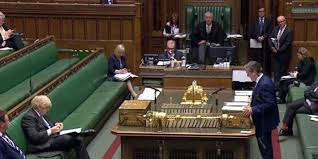
In my view, Keir Starmer, as leader of the Opposition, had much the better of his exchanges in Parliament with the Prime Minister, Boris Johnson, at Prime Minister’s Questions (PMQs) on the 24 June. Above all, Starmer took the approach so many of us have demanded from our politicians for years or decades: calm, well-informed, moderate. He offered praise for where things had been done well in combating Coronavirus, and then focused on a genuine problem on which he called for clarity from the government.

Keir Starmer, on his feet, questioning
Boris Johnson, left


In other words, like the American voters who wanted the swamp drained, he rose to the challenge many UK voters have set politicians.

He asked:

Yesterday, the Government announced the next stage of easing lockdown restrictions. If that plan is to work—and we want it to work—we need an effective track, trace and isolate system. The Prime Minister promised that a world-beating system would be in place by 1 June. The latest figures from yesterday’s press conference hosted by the Prime Minister show that 33,000 people are estimated to have covid-19 in England. The latest track, trace and isolate figures show that just over 10,000 people with covid-19 were reached and asked to provide contact details. I recognise the hard work that has gone into this, but if two thirds of those with covid-19 are not being reached and asked to provide contact details, there is a big problem, isn’t there?

Did the Prime Minister respond in kind? Did he heck. Here’s what he said:

On the contrary. I think that the right hon. and learned Gentleman has been stunned by the success of the test and trace operation. Contrary to his prognostications of gloom, it has got up and running much faster than the doubters expected. They are getting it done—Dido Harding and her team have recruited 25,000 people and so far they have identified and contacted 87,000 people who have voluntarily agreed to self-isolate to stop the disease spreading.

In other words, he gave a purely old-style politician’s answer: on the attack, and dodging the question altogether. As Starmer pointed out:

The Prime Minister just has not addressed the question I put to him. I was not asking about those who have gone into the system—the 10,000—or those who have been contacted; I was asking about the two thirds of the 33,000 with covid-19 who were not reached. That is a big gap.

Clear, simple and focused on the key matter. If only 10,000 are being tested then, on the government’s own figures of 33,000 infected, two-thirds are not being reached. This is bad news. And Johnson’s response? He went back on the attack: “I hesitate,” he claimed without hesitation, “to accuse the right hon. and learned Gentleman of obscurantism. He is misleading on the key point.”

The accusation of misleading is serious in Parliamentary terms and the Speaker had to call on him to withdraw it.

The exchange moved on to the matter of the tracking app, promised for 1 June, then abandoned, now promised again, using commercial software, perhaps some time after September.

Boris Johnson was having no criticism on that front:

I wonder whether the right hon. and learned Gentleman can name a single country in the world that has a functional contract tracing app—there isn’t one.

Strangely enough, the right honourable and learned Gentleman Keir Starmer certainly could name one:

Germany. It had its app working on 15 June and it has had 12 million downloads—I checked that overnight.

So now the decks were cleared for Johnson to move from the lie circumstantial to the lie direct:

I am afraid that the right hon. and learned Gentleman is completely wrong, because no country in the world has a working contact tracing app.

Faced with a clear, verifiable fact, Johnson merely resorted to denial. A blatant, easily refuted lie.

And here’s the sad thing. He won’t be called on it.

Many have demanded that politicians find more honest ways of doing their job, for instance denouncing Blair for lying over Iraq.

They claim to want them more straightforward and thorough.

They called for less aggressive exchanges between them, more focused on solid, reliable information.

Yet a large number of them will rally to Johnson now. They will claim he bested Starmer. They’ll praise his style instead of denouncing his lies.

My only hope? That in neither the United Kingdom nor the United States will they constitute a majority.

So we really can drain the swamp and move to a healthier brand of politics.

Friday, 12 June 2020

The history is bad enough, we don't need the monuments

Pulling down statues? Oh, it’s a controversial question in Britain today.

The Prime Minister has said that removing statues of celebrated men of the past is in effect lying about our history. But, like so much that Johnson says, thats simply false. The history is there with or without the statues. No one is suggesting rewriting it. Statues arent about recording history, they're about honouring people who helped make it.

Why honour those responsible for some of its most shameful moments?

The demand to rid the country of statues to our most discreditable historical figures comes chiefly from the Black Lives Matter movement. I support their general aims, and in particular their desire to free ourselves of those blots on the urban landscape, though I would like to see it go a little further.

Edward Colston's statue drowned
Black Lives Matter protestors dump slave trader's monument


Would I have backed the tearing down and dumping in Bristol harbour, of the statue of Edward Colston? I don’t know. It might have been better to have the City Council remove it by democratic decision. But, in purely pragmatic terms, it’s probably easier for Councillors not to put it back in place, than it wold have been to take the initial decision to get rid of it.

Maybe the protestors did the Councillors a favour.

Certainly, the streets of Bristol are cleaner for not having the statue there. I remember clearly the shock I had on seeing it for the first time. I hadn’t previously known anything about him, far less that he had a public monument. Discovering that he did left me speechless. How, I thought, could we honour a man who was a major figure in the Transatlantic slave trade? He may have been a benefactor to Bristol, London and other places, but some at least of his wealth came from slavery. Doesn’t that mean that whatever worthy cause he funded, and however much he gave, what he was handling was the filthiest of dirty money?

Let’s be clear. The slave trade in which Colston prospered believed that men and women could be treated as cargo. It took 12-12.8 million free men and women, captured either in slave raids or as a result of African wars in which Europeans had no legitimate interest, and transported them across the Atlantic. Between 1.2 and 2.4 million of them died on the voyage, the conditions were so inhuman.

Once in the West Indies or Americas, they were reduced to they status of cattle. They had no protection against rape, torture or murder. A white slaveowner had the legal right to do what he liked to a slave with whom he was dissatisfied, or with whom he wanted to satisfy a desire.

The justification for slavery was that the enslaved, for the most part black Africans, were less than human. So the institution set out deliberately to dehumanise them.

How can anyone who played a leading role in this business deserve a statue, simply because he endowed some schools, hospitals and almshouses? Should Berlin erect a statue to Hitler’s favourite architect, Albert Speer, on the grounds that he put up some fancy buildings?

The Black Lives Matter movement exists precisely because whites have still not fully emancipated themselves from the attitudes that legitimised slavery. The slogan  is needed because at some fundamental level, we live in societies which don’t think black lives matter enough.

Getting rid of statues of slave traders, of those who resisted the end of slavery, or of those who felt they could treat some people as inferior to others, will contribute to emancipating us all from those shameful attitudes. So I support the movement wholeheartedly.

However, I would like to see the movement go further still, at some time, without distracting from the top priority today, bringing to an end the undervaluing of black lives. I have longed for years to see at least one additional statue removed. It shocked me the first time I saw it just as much as the Colston statue later did. And I saw it a lot, as I was a student for four years at King’s College London and the statue is in the Strand, not far from the College.

It is the statue of Arthur ‘Bomber’ Harris who headed the Royal Air Force’s Bomber Command during World War 2.

Bomber Harris's statue in the Strand

The principal actions of Bomber Command were mass air raids on German cities. They were sometimes masked as aimed at ‘military targets’, but it’s hard to see how carpet bombing the whole of Cologne, Hamburg and Dresden, could possibly be necessary to hit the few, if any, legitimate military targets they contained.

Dresden after the bombing
A legitimate military target? Seriously?

More honestly, if still euphemistically, the raids are sometimes defended as action to ‘break the enemy’s morale’. In other words, it was hoped they would batter the German population into withdrawing its support from Hitler. That’s military action to obtain political change. And that means action directed against a whole population, and therefore against civilians. 

There’s a name for that. We call it terrorism.

My father served in the Royal Air Force during that war. Indeed, he was a Navigator in a bomber. But he was never in Bomber Command, serving instead in 101 Squadron, which dropped supplies to resistance fighters, towed gliders or dropped paratroops.

Leonard Beeson
Bomber Navigator but never a terror bomber

He often said he was relieved that he’d never taken part in any of the raids on cities. He was forever grateful that he had, by good fortune, avoided being involved in terrorism.

So it shocks me that we still have a statue to the main architect of that terrorism in one of the great streets of the British capital.

The key issue today is to teach us all that Black Lives Matter. So let’s get rid of the statues of the slave trade traders and deniers of freedom, today.

But tomorrow? Perhaps we can move on and learn to stop honouring our terrorists either. After all, we need to remember the role these people played in history, but we don’t need to honour them with monuments.

Saturday, 6 June 2020

Governments losing against Coronavirus: it's no coincidence

“One of the things that makes novels less plausible than history, I find,” says a character in Tom Stoppard’s play Night and Day, “is the way they shrink from coincidence.”
We do try to reject coincidence. “This happened after that other thing happened, so it must have been that other thing that caused this one.” Post hoc ergo propter hoc, the Romans used to say, after that so because of that.
And yet there really are things that are simply coincidence, in the sense that they happen together, or after each other, purely by chance.
London had a population climbing towards seven million over the decade I was a student there (yep: I was once the proud owner of ten University of London student cards). And yet I hadn’t been there many years before I had my first experience of meeting people I knew, without arrangement, on the street. It happened to me several times over the period I lived there.
What? The chances of meeting any particular person out of 6.5m is, naturally, 6.5m to 1. And yet I several times met individuals I knew?
We are not intuitively good at handling statistical reasoning, as the psychologist and economist Daniel Kahneman has pointed out. I had a wide network of acquaintance, which immediately increased the chance of meeting any one of them by chance. And it was not as though I only ever crossed the path of one other person in any one day – on the contrary, commuting from home to work or to college brought me close to hundreds or even thousands of people (hence the difficulty of maintaining social distancing today).
Take that into account, and the probability of meeting someone I knew was significantly higher than I might have imagined. Certainly, high enough for it to be perfectly reasonable that it should happen several times over a ten-year period. Particularly when you consider that most frequently the encounters were in places which act like people-funnels, such as the main railway stations.
In fact, the most surprising such event I witnessed was just last year, as I was catching up with a Turkish friend, Muharrem, who was about to enter Victoria Station ahead of me. I found him in lively conversation, in Turkish, with a woman. After she had left, Muharrem explained to me, “she’s one of the most famous novelists in Turkey, and I met her when I was working at a library where she came to give a talk”.
Despite this kind of experience, we do shrink from coincidence. Indeed, that shrinking becomes a weapon in the armoury of people trying to build certain kinds of argument. They might, for instance, say:
“My friend Sally took that medication. And exactly two years, five months and 17 days later, she had a series of terrible migraines. Coincidence? I think not.”
It’s a great debating trick, because it establishes in advance that only the most naïve and credulous people could possibly respond, “well, actually, yes, I reckon it probably is a coincidence.” As, of course, it is.
After all, Sally probably took other things than that medication before getting her migraines. If anything that happened before them could be regarded as a potential cause, might it not have been the chocolate she had the day before, or the overindulgence in wine, or the fact she drove through a polluted neighbourhood? After that so because of that isn’t an argument, it’s a sloppy and unreliable way of reasoning.
To establish that there’s more than chance at play, we have to show some causal connection between the two incidents.
To take a different example, naturally chosen entirely at random, consider lousy government. Faced with a major and fatal pandemic disease, a lousy government fails to take it seriously. It may attempt to put in place measures to protect its healthcare workers, and even promise to do so, and then take far too long and under-deliver. It may, rightly, identify track-and-trace as the best way to combat the virus, promise to put a system in place and then fail to meet its own deadline.
Or lousy government might just be far too glib in attitude. It may be scornful about simple and effective measures like wearing masks. It may pay lip service to other measures, such as social distancing or quarantining, while flouting them itself and turning a blind eye to infringements by friends or supporters. It may be halfhearted about its lockdown measures and end them too soon.
Now which governments around the world have been most guilty of some or all of these kinds of behaviour?
Why, the governments Trumps United States, Johnsons UK and Bolsonaros Brazil. Which makes it fascinating to look at the latest figures published by Worldometers. Imagine which are the governments with the highest numbers of deaths due to Coronavirus:
The three nations with the worst Coronavirus death totals
Note that Johnson's UK has the worst death rate per million

A coincidence? I think not.

Tuesday, 2 June 2020

Release for some, jeopardy for others

We’re emerging here in Valencia. Slowly. With a little optimism.
We’ve moved into phase 2 of the Lockdown relaxation process. With some justification. According to the Health Ministry, Spain has just had two days without a single Coronavirus death anywhere. Friends of ours from a few doors down the street tell us that their daughter, a nurse in the major local hospital, is being redeployed to Oncology after a couple of months in intensive care. The ICU beds are empty at the moment.
The only jarring note is that the Ministry has also warned that there are signs of an increase in infections as the restrictions relax. We’re clearly not quite out of the woods yet. It’s going to be face masks and social distancing for a while yet. Maybe even rubber gloves.
Still, we needed to celebrate our entry into phase 2. And what better way to do it than to go back to the sea? Especially if we took advantage of the new regulations to go there with friends. So we drove to a lovely spot south of Valencia, El Saler, with Maria José and Santi, our near-neighbours and the parents of the no-longer-ICU nurse I mentioned before.
The beach at El Saler

The day started relatively grey, but that meant the temperature was ideal for walking, warm enough for tee shirts, cool enough to be comfortable. We started in an almost jungle-like nature reserve before heading for the beach where we could walk with our feet in the surf.
The Nature Reserve at El Saler

A forest dweller we met

The company was great, the place was glorious, and as we walked, so the clouds cleared and we finished the outing, back in the woods, with bright sunlight filtering through the tree cover.
Danielle and Maria José wandering into the sunlight
It was a fine way of celebrating our emergence into a freer life. And it lifted my mood which had been rather depressed by a Tweet I saw in the morning from Trisha Greenhalgh: “I’ve never been so scared. There. Is. No. Plan.”
When I first heard Trish Greenhalgh, she was giving a conference presentation of remarkable brilliance. So brilliant that I wrote a post about it at the time. She is one of the leading Public Health specialists in England and one of the most convincing experts on evidence-based medicine I’ve ever heard.
If she is worried about the government simply having no plan, it seems to me a lot of other people should be too.
There’s much to criticise the government for in Spain. It was painfully slow in recognising the seriousness of the crisis about to hit the country. As a result it did far too little to prepare for it and reacted far later than it should have. But when it awoke to what it had to do, it acted fast, decisively and effectively. The results are obvious, as we've been slowly emerging from lockdown for a month now, and have had two days without a death.
It won’t necessarily benefit the government. Its vote seems to be more or less holding up, but it certainly isn’t improving, and the Conservative opposition is progressing. Given how well the governments performed, that hardly seems just, but politics is an unkind game.
Meanwhile, Britain has a government which, as Greenhalgh puts it, simply has. no. plan. It never has had a strategy, but has stumbled from crisis to crisis since the pandemic hit, making up policy on the hoof, inventing commitments out of thin air and then failing to honour them.
Now it’s relaxing a lockdown that was never as strict as Spain’s, and doing so far too early. Spain, with its slow start, long had a far worse record in deaths per million than the UK, but the gap is now so small that it looks as though Britain will move beyond Spain in a matter of days.
The hasty relaxation is happening only in England, I should say. Scotland, Wales and Northern Ireland, with better governments, are being more prudent. The fear, and it’s certainly Greenhalgh’s, is that the Cummings/Johnson English administration is opening the UK up to a second wave of infection. The population certainly doesn’t deserve that fate, but I fear that can only be fixed when it chooses itself a better government.
Meanwhile, over here we’re slowly moving towards a new normal. There’s no reason for complacency, so it involves a lot of use of face masks, of hand gel, even of gloves. But we can go out more, we can meet friends, we can even get our hair cut or go to the dentist.
The dentist, in fact, was the downside of our first day in Phase 2. After the visit to El Saler, I had to head into town – my first metro trip since March, with gloves and mask and an empty seat next to each seated passenger – to visit the dentist. Who proceeded to beat the daylights out of my jaw, far longer in my view than strictly necessary, since it never offered him the slightest resistance.
Still, it was a small price to pay for another step out of lockdown. I just hope it doesn’t lead to a surge of disease. As I hope there’s no new peak in England either. 
Let’s hope Greenhalgh’s fears prove unfounded.
Danielle and Maria José collecting seashells


Saturday, 30 May 2020

World beaters in the coronavirus death stakes

These are exciting times.
Three nations are competing hotly for position in the Coronavirus stakes. Italy, where I was born, led all three in deaths per million of the population for a while, but Spain, where I now live, overtook it, while Britain, and I am a loyal subject of Her Most Gracious Britannic Majesty – well, relatively loyal – was always lying third.
Top places in Europe for Coronavirus deaths per million

But a week ago, Britain caught up with Italy, and since has moved ahead. And now it’s closing fast on Spain: just 18 deaths per million behind today. First place in Europe is within reach. But, of course, the UK has an unfair advantage: it’s led by mini-Trump, Boris Johnson.
With a Trump, a Johnson or a Bolsonaro in charge, a nation is a guaranteed world-beater in the Coronavirus death stakes.
These leaders are special. 
Bolsonaro, Johnson, Trump
Swamp dwellers competing in the virus death stakes

Bolsonaro’s devil-may-care attitude towards the virus has even earned him the title ‘Killer’. He’s got his nation into second position behind Trump in infections and is moving strongly up the deaths-per-million field.
Trump is, of course, exceptional. His outstanding skill in invective is only rivalled by his capacity for non-delivery. He promised a wall between the US and Mexico, but apart from a few short stretches, it’s just not happening. It’s hard to choose between relief at the failure of a lousy idea, or scorn at his failure to honour his pledge.
Twitter has now started issuing a few warnings about whether Trump’s Tweets can really be entirely relied on for accuracy. He’s turned livid against the social media giant. He wants the law changed to prevent this kind of uppity behaviour. To him, saying what you like – correction, what he likes – is freedom of expression, but pointing out that it’s false is treacherous bias.
Interestingly, mini-Trump in England has many of the same traits.
For instance, he too has a remarkable track record of failures. As Mayor of London, there was his Garden bridge across the Thames, now cancelled at great cost to the taxpayer. There was also his ingenious plan for new buses, now terminated, because they too were excessively expensive. Then there were the three water cannon bought second hand from Germany, eventually sold unused for scrap.
His behaviour in the pandemic has been the same. He plucks commitments out of the air – so many tests per day by such-and-such a date, achieved only on the deadline, for one day, with fiddled stats; now there’s the track, trace and isolate system to be in place by 1 June, which few experts believe will happen.
But he’s going ahead with further relaxation of the lockdown, even though case numbers are still growing at far too high a rate.
Like Trump, he’s sure his entitled group has an inherent right to be treated differently from the rest of us. It’s an attitude he’s had since childhood, as a letter home from his school housemaster makes clear: “I think he honestly believes that it is churlish of us not to regard him as an exception, one who should be free of the network of obligation which binds everyone else.”
This has led to the ongoing scandal concerning his chief adviser, Dominic Cummings, who broke the very lockdown rules he was instrumental in drawing up.
Cummings and his wife drove their child 260 miles up the country when she was ill with Coronavirus and he was likely to be carrying it, as was later confirmed to be the case. Their explanation is that with both of them potentially ill, they were worried about childcare for their son and wanted to get him to where Cummings’ parents lived.
But plenty of others have faced similar childcare problems and suffered the difficulty of dealing with them, without breaking the lockdown rules.
Let’s be clear how he broke those rules: they might have infected any number of people on the way. They might have infected their son. And when they got there, they might have infected his parents, who as older people were in a high-risk group.
It’s no surprise that many MPs, including Conservatives, have been deluged with furious letters from voters demanding that Cummings be fired.
Instead, Johnson and several of his Ministers defend his actions as the behaviour of a loving parent. So is a parent facing childcare problems who doesn’t break the rule insufficiently loving of his child?
Indeed, isn’t anyone who follows the rules, just a mug? After all, it’s clear the rules were made to be broken.
Sadly, what not everyone realises, is that they’re only made to be broken by the Johnson coterie. Dominic Cummings, yes; the rest of us, no. So Johnson and his government have closed ranks around Cummings. Why? Is this great loyalty from Johnson? One of his fellow Conservative MPs had a different explanation for the Guardian“This is a cabinet of fools led by a hollow narcissist who is nothing without his Svengali.”
Yep. We’ve seen Johnson’s track record of ideas as Mayor of London. He’s not good at coming up with any that work, is he? Cummings was key in winning the Brexit referendum for the Leave side. And his brilliantly simple slogan, ‘Get Brexit Done’, took Johnson to a landslide victory over a Labour leader who could only waffle on the Brexit issue.
Remember Trump claiming he wanted to ‘drain the swamp’? It strikes me the swamp has never been so murky as since he took office in Washington. As in Brasilia with Bolsonaro. Or in Westminster with Johnson.
Perhaps it really is time to drain the swamp. But starting with the man who dreamed up the slogan, Trump, and his disciples, led by Johnson and Bolsonaro. After all, given the way the US, Brazil and the UK are performing in the Coronavirus mortality stakes, it’s a matter of life and death.
And I’m using that hackneyed expression literally.

Wednesday, 20 May 2020

Boris Johnson second rate? No way.

When I look at the behaviour of the Johnson government, the thought “second rate” always springs to mind. Only to be replaced by, “that’s so unfair”. Followed by a swift reassessment.
Gentle humour, charmingly readable
Decades ago – oh, it was probably the seventies – I discovered the books of George Mikes. Most English speakers pronounce the name as though it were the plural of the nickname ‘Mike’. Or rather, since practically no English speaker even remembers him, perhaps I should say that they used to pronounce the name that way.
He was Hungarian by birth, though he lived most of his life in England. Strictly his name ought to be pronounced something like Mick-esh or possibly Meek-esh. But I like to think of him as Mikes.
He wrote a whole series of books commenting on the different nations he visited, starting with his adopted country, Britain. Just the title of the first of those books gives a feel for his style: How to be an Alien: a handbook for beginners and more advanced pupils. His books were light-hearted, humorous reflections on the behaviour and attitudes of various countries.
In one of his books, and I certainly wouldn’t be able to find the passage now, he mentions that a critic had called his writing second rate. He rejected this notion as a wild exaggeration. By way of explanation, he gave a ranking of authors, which again I don’t remember, but here’s a similar, if partial and entirely personal, ranking of my own.
In the ‘first rate’ I’d want to include Jane Austen, George Eliot, Elizabeth Gaskell, Graham Greene, George Orwell, Harper Lee, Salman Rushdie and Terry Pratchett.
So in the ‘second rate’ I’d have to have Charles Dickens, Edith Wharton, Joseph Conrad, Joseph Heller, John le Carré and Hilary Mantel.
I’m not going to bore you by going down a whole list, but simply point out that the second rate is made up of outstanding writers, whose names will ring down the ages, and who produced extraordinary books.
Mikes reckoned that he was at best tenth rate, which is probably about right. He’s down there with other writers who entertain and help you wile away a dull hour – you know, John Grisham and Nevil Shute – good writers (well, Shute was a lousy writer but a great story teller) who hit the spot but are a long way behind the best.
Now we can take the same approach to government. We need to be careful, however, because there are more factors to take into account. Competence is crucial, but competence applied to do harm is a defect, not a virtue.
On those grounds, while Abraham Lincoln in the US, Clement Attlee in the UK or Pierre Mendès France in 1950s France, were all first rate, we’d have to say that Tony Blair, whose government might have been first or second rate without Iraq, tuned out at best third rate in the end.
Because they were competent and did more harm than good, I’d have to put the Wilson governments up into second rate. Equally, the Callaghan government didn’t do too much wrong, entitling his time in office to be viewed as third rate.
Maggie Thatcher was extremely able and powerful, but did huge harm, wiping out whole communities (a few years ago, I revisited a village in Yorkshire which was once thriving when it its mine was running, to find it run down, shrunk in population and with 40% of the population on either unemployment or invalidity benefit, victims of Thatcher’s vandalism).
Twelfth rate at best.
When the amateur burglars pay a call
A fine metaphor for the inept playing at Thatcher
I remember an advert from a long time ago for an insurance company. It showed a devastated living room, with books and records all over the floor, amongst the ruins of broken furniture, devices and pictures. The catch phrase was something like, “If you think professional burglars are a threat, wait until the amateurs pay you a visit”.
Well, if we think that the competent Thatcher was a damaging presence, we now need to absorb just how much damage an incompetent version of the same can do. Think of a government that stumbles from crisis to crisis with no plan or guiding philosophy except its own self-aggrandisement, that takes its decisions too late and applies them too weakly, that sacrifices lives to profits in cruel indifference to the suffering and bereavement it causes, and then seeks to blames its advisers for its shortcomings. Yep. You’ve got it. That’s the Johnson government. Thatcher redux, without the ability.
Second rate, this lot? Way beyond their reach
Shall we say twentieth rate for the Johnson government? Or, OK, let’s be generous, maybe nineteenth. But second rate? Nah. They’re nowhere near that good.
As Mikes made clear, second rate is pretty remarkable.
The Johnson crowd comes way, way down below that on the Mikes scale.