Showing posts with label Dartington. Show all posts

Sunday, 26 August 2018

Leatrice: hankering for more

When I last wrote about my mother, Leatrice, I mentioned the strange circumstance that my parents’ wedding took place in Genoa.

Nothing strange about that for the Genoese, of course. Just unusual for a young English couple. Except that they’d met in Paris and were travelling to Rome, where Leonard, my father, was about to take up a new job with the United Nations’ Food and Agriculture Organisation. Genoa was on the way. So maybe getting married there wasn’t really that odd after all.
July 1951: my parents get married in Genoa
It was a moment of transition for Leatrice. Years later, she wrote several letters to contacts from the forties, asking for testimonials of the time when she’d worked for them. John Parker, Labour MP and leading member of the Fabian Society, one of the oldest progressive organisations in Britain, wrote one of them. He explained that she had worked for him from 1942 to 1945, when he had been General Secretary of the Fabian Society and MP for the seat of Romford in Essex:

… then the largest Parliamentary Constituency in Britain … which was divided into 4 Parliamentary seats at the time of the 1945 General Election… She also assisted me in the work of the Fabian Society… In particular she did a very useful job in our India Committee at a time when [India’s] future was very much in the melting pot… Much useful organizing work was also carried out for the Fabian Society particularly in connection with the running of the Summer Schools.

She already had a testimonial from August 1947 by Woodrow Wyatt, later an admirer of Margaret Thatcher’s but back then a Labour MP in his first term. He worked with the British Commission in India and in particular handled relations with the Muslims, who were preparing not only for independence from Britain but also independence from India, as Pakistan.

Wyatt had known Leatrice for two years and she had:

…acted as Minutes Secretary of the Indian Affairs Group of the Fabian Society when I was Secretary of the Group and during that time she was most energetic and capable, and showed a high sense of responsibility.

Another of the testimonials she collected in 1974 came from David C. Williams, Chairman of the International Affairs Committee of Americans for Democratic Action. He’d been sent to London in July 1946 on behalf of the Union for Democratic Action, its predecessor organisation.

One of my first actions was to engage Miss Leatrice Bannister, now Mrs. Beeson, as my assistant. Her knowledge of the principles and programs of the Labour Party and the Fabian Society and of many of their leading personalities proved invaluable to me… It enabled me to get into the swing of things much more promptly than I would otherwise have done.

She had worked with him until January 1948, when she left for Paris.

It must have been quite a heady atmosphere for a woman in her twenties. The India committee of the Fabian Society must have been particularly gratifying: Labours Clement Attlee was in office and, in foreign affairs, overseeing Indian independence remains his most significant achievement.

1951, the year of her wedding, definitively closed that period of Leatrice’s life. I was born in 1953, my brother in 1956. Leatrice, who’d worked for her own living since becoming an adult, became a wife and mother with no job of her own but dependent on her husband’s earnings.


Leatrice with my brother Nicky in 1956
One of my lasting memories of our time in Italy was the yearly summer holidays in Porto Ercole, in Tuscany. At the time, the place was a small fishing port, where my brother or I could wander off, and local people would be able to tell my parents where we were. Today, it’s a heaving mass of tourists. But what remains is Feniglia, outside the town, with its kilometres-long golden beach, where we’d spend hours in the warm water and then roll in the baking hot sand to get warm again, with barely another person in sight.

Nicky on the rocks (literally not metaphorically)
at one end of the Feniglia beach

Me on the edge of beach

My father would join us when he could
Leonard would come up and join us at weekends, and generally spent a week or two at some point. Eventually we’d head back to Rome, where we lived in a converted farm building on the edge of the city. It was part of a baronial estate which still had a large cement-walled pond where two local families would do their washing, the wives using bars of soap and cold water, wringing and beating the clothes in a sink fed from the pond.


Nicky on the edge of the pond at Via Casale San Pio V in Rome
Not the first place we lived in but the last
and where we stayed the longest
Leatrice in the garden
We lived on the top floor of the building beyond the gate
My father had work. My mother had us. Those long summers at Feniglia – did she enjoy them as much as we did? Or did she miss the intellectual stimulation of her English life? John Parker mentioned her role in organising the Fabian summer schools, at Dartington in Devon, where my parents eventually sent my brother and me to school. Another of the testimonials she solicited in 1974 came from a close friend from those times – I suspect they’d had at least a fling – and he wrote as a Professor from the University of British Columbia at Vancouver.

Did she ever wonder wistfully whether that was the world to which she should have belonged? That all the international travel had been exciting, but that she might have been more at home in academe or politics – or possibly both? Did she ever entirely recover from her pain at not getting the university education she had wanted in 1942 but passed up to go straight to work?

There’s a hint in the reason why she was asking for all those testimonials.

In 1974, Leonard was working at the headquarters of the United Nations Development Programme in New York. Leatrice decided that this was the opportunity to undertake the studies she’d missed before. She enrolled at Queens College of the City University of New York. The testimonials won her some credits for her course, but she hardly needed them: she took A grade after A grade, disappointed on the rare occasions when she fell as low as a B.

She was admitted to Phi Beta Kappa, the oldest and arguably the most prestigious of the American academic honour societies. That was something of which she was profoundly proud, and for many years she would wear the gold Phi Beta Kappa key around her neck.


Badge of pride: Leatrice's Phi Beta Kappa key
One of her papers was graded by a Professor Zvi Yavetz at Tel Aviv university. A Holocaust survivor, he was one of the founders of the university and a major figure in history studies in Israel for several decades. He wrote to her to say:

The following cable has been sent to the department of History, Queens College: ‘Grade Beeson Leatrice’s superb paper A+…

I would also like to tell you that only students like yourself can make a course interesting, because only they can stimulate a teacher to prepare his class.


It’s ironic today, with the Labour Party embroiled in a long drawn out dispute over antisemitism, to read this forty-year old praise from an Israeli academic for a lifelong, Jewish Labour supporter.

In June 1976, at the age of 52, she graduated in History with the top class of a US degree, Summa Cum Laude.


Leatrice's degree certificate
A proud achievement. But - three decades late?
It must have been a valediction for her. But perhaps also a source of regret. 

There’s no doubt that my mother took great satisfaction from most of her life and wouldn’t have wished to change much in it for anything else. On the other hand, her results in 1976 demonstrated just how much she could achieve. She must have wondered at times whether she’d missed the opportunity to fulfil her potential. Had she won such success three decades earlier, when she’d wanted to, how much more might she have accomplished?
-->

Thursday, 1 December 2016

Parting of the ways with my oldest friend

The one benefit of a boarding school, from a kid’s point of view, is that you’re with your friends all the time. They’re within walking distance. There’s none of that phoning their parents to check whether they can come over and establishing when is convenient for both families. You just pop round, convenient or not.

The first step, of course, is to make some friends at the school.

Fortunately, when I showed up at the boarding school I attended – Dartington, now sadly closed – I found myself quickly thrown into the company of one boy of my age. In fact, he was a couple of months younger, which was a shock to me: I was used to being the youngest in my group. He also had a name that struck me as weirdly spelled: Alasdhair (pronounced Alastair).

We had a number of interests as well as our relatively young age in common. We both liked languages, for instance, and we shared an interest, passing as it turned out, in physics. However, it was neither of those things that first formed a bond between us.

One of my earliest memories of Alasdhair was cycling with him to a poetically named village near the school, Landscove. Isn’t that evocative? Coves are things you get on the coast. What’s one like when it’s inland?

It turns out, nothing special. Landscove is in Devon which is known for its hills. That made it a struggle to get there on our bikes. It was little reward for the effort to discover that it was a pretty little village but with nothing to distinguish it from any of the others around.

Alasdhair was fortunate in having his mother, Barbara, and sister, the equally strangely-spelled Shellagh (pronounced Sheila), living at the school. Shellagh and Barbara were as charming and fun as Alasdhair and it was balm to my soul to be adopted by them. They offered me a welcome which I’m sure I outstayed by repeatedly visiting their flat in the evenings to enjoy the atmosphere of family life while away from mine.

But inevitably I spent most time with Alasdhair himself. We listened to comedy radio programmes, in particular I’m sorry I’ll read that again, featuring the team that went on to launch Monty Python along with the one that launched another TV programme, The Goodies. We cultivated our taste for science too, notably by stealing rather a lot of wire at one point, laying it around the roofs of the school and using it to run an illicit radio station. Fortunately, we were caught before we ran out of enthusiasm for becoming DJs.

We also tried fermenting potato juice and then breaking into the chemistry lab where we tried to distil the product into vodka. Our pains yielded a lot of broken lab equipment and a tasteless, murky liquid with absolutely no intoxicating effect.

What else did we do? We walked on Dartmoor until our feet felt like lead. We bored our contemporaries by talking about relativity theory without understanding it. We maintained a friendly rivalry over linguistic ability, which I probably edged over him in French, but he won hands down overall by also learning German.

I don’t want to give the impression that we lived in each other’s pockets, because we certainly didn’t. We each had our own circle of friends, his significantly larger than mine; our orbits simply intersected more often than most and we had too much in common not to keep gravitating towards each other.

After school, we kept up our bond by making for London to study Physics. We both got involved with the radical left and took our eyes off the study ball with the result that neither of us covered ourselves in academic glory, though he got closer to it than I did. We lived with some other friends in glorious squalor, in one of the poorer neighbourhoods of the unfashionable east of the city. We even took in a group of young West Indians we met locally, which led to some interesting and colourful experiences, not always with the most successful of outcomes.

After college, our ways parted, as he made for the States and I stayed in Europe. Even so, we spoke or wrote from time to time and met occasionally. We went skiing together, with the woman, Danielle, who became my wife and another who didn’t become his, and we spent time together in Danielle’s home region of Alsace, enjoying the life, the food and the drink of the three countries that join there, France, Germany and Switzerland.

We met in England too. On one occasion he, his first wife and I met in Oxford for a picnic. We started by shopping for delicacies – smoked salmon and smoked ham, melon, salads, French bread, white wine – after which we faced a characteristically English mishap, when the heavens opened and threw down a deluge which looked apt to drown us.

Fortunately, we found a gloriously English solution. In South Parks Road there is a cricket ground with a graceful wooden pavilion and, in those days, the grounds weren’t fenced off from the road. We repaired (quickly) to the terrace of the pavilion and found all we needed: a table and benches under shelter. The picnic was all the more memorable for taking place within a metre or two of dense downpour from which we were fully protected.

In later years, I was sorry to hear that his marriage had ended, but delighted by the pride he took in his children’s progress and the joy that gave him. I was pleased too by his second marriage, to Becky Villarreal, an event I know brought him solace in what turned out to be the last few months of his life.

For he remarried not long after learning that he was suffering from stage 4 cancer, the disease that had much earlier killed his mother. Cancer has no stage 5, unless we use that term for death. Even so, his doctors held out a meagre hope of giving him another year or two of life.

It really was a meagre hope and on 4 November, it ran out.


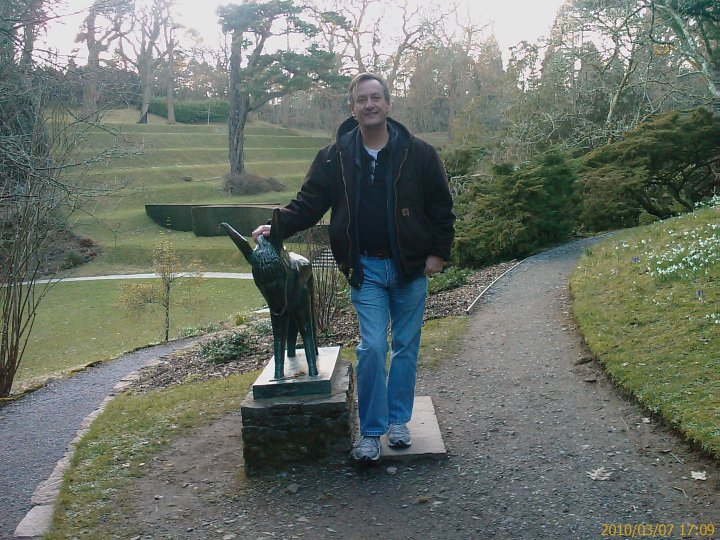
Alasdhair Campbell, 1953-2016
in Dartington Hall Gardens, one of his favourite places
Of all friends with whom I still maintained contact, Alasdhair was the one I’d known well longest. Though the contact was more tenuous in later years, it had never been broken; but because it was tenuous, its ending feels all the more unreal. I certainly haven’t accepted it yet, and still expect to write to him or hear from him at any time.

It’s a particularly strong feeling when I visit Oxford, as I still do frequently, and see the cricket ground and its pavilion. That leaves me smiling with pleasure at the memory of our picnic and ruefully at the fence that prevents any repetition of it. I feel it too whenever I travel by air, as it reminds me of the many long journeys Alasdhair used to take for work and which he would commentate on facebook. Indeed, it is on a plane that I’m writing this testimonial now.

Odd that he’s not around any more. Terribly unfair. And poignantly sad.