Showing posts with label Falklands. Show all posts

Friday, 27 December 2019

Not good for the Pope. Not good for Britain either

One thought can easily conjure up unrelated memories, can’t it?

I was reading about the present Pope the other day, and it brought to mind memories of the Falklands War. Or perhaps I should say Conflict, since war was never declared. And perhaps I should say Conflict over the Malvinas, to give the Spanish name for those islands, since that’s what the Argentinians call them.

What’s the link to Pope Francis? The Conflict brought to an end the military dictatorship in Argentina. That, incidentally, is why I always think the Argentinians won, even if they didn’t keep the islands: they got rid of one of the bloodiest and most brutal dictatorships in their troubled history, while we were stuck with Thatcher for another seven years, followed by further Tory government under John Major for another five after that.

It wasn’t just the supposed ‘victory’ in the Falklands that kept Thatcher in power and gave her a landslide election win the following year. She was helped by Labour having a brainstorm and going into that campaign led by the hard left, which played right into her hands. Sound familiar? Yes, just because we made that mistake 36 years ago doesn’t mean we’d learn from it and avoid it this year.

Francis, then Jorge Bergoglio and head of the Jesuit order in Argentina, lived through the dictatorship and its “dirty war”. Indeed, the darkest era in his past is that he may have contributed to two priests being tortured by the regime.
Esther Ballestrino
A significant influence on Pope Francis
A woman who played a major role in Bergoglio’s development was Esther Ballestrino. She headed the lab where he worked when he was still a chemist and hadn’t decided to become a priest. In 1977, her son-in-law and her pregnant sixteen-year-old daughter were abducted and tortured by the regime. In the absence of any news of them, Ballestrino joined with other women in founding the ‘Mothers of the Plaza de Mayo’ who would gather every week, demanding information, outside the presidential palace on that square in Buenos Aires.

Eventually, her daughter was released. But Ballestrino kept turning out with the other protestors. Unfortunately, the group was inflltrated by a man called Alfredo Astiz, from Naval Intelligence, nicknamed the ‘blond angel of death’. When the group published an advertisement listing the names of the ‘disappeared’ – the people abducted and about whose destiny no information was available – Astiz arranged for five women, including Ballestrino, to be arrested. They were tortured and eventually loaded, heavily drugged, onto a ‘death flight’: a plane that took them out to sea where they were dropped, hands and feet bound, out of the back of the aircraft.

So Esther Ballestrino died, one of the great sorrows in Pope Francis’s life.

And what memory did this conjure up in me?

I was conflicted over the Falklands War – conflicted over the Conflict. It strikes me as ridiculous that a group of islands off the coast of Argentina are possessions of a country, Britain, nearly 13,000 kilometres away. On the other hand, I loathed the Argentinian junta and deeply disliked the way they decided they could use military force to solve a territorial dispute. Above all, I disliked their obvious contempt for the views of the local population.

The use of military force and the trampling of the rights of the local inhabitants? It felt far too much like what the Israeli government does to Palestinians.

In any case, I can only be pleased with the way things worked out for Argentina, giving them a far more important victory than anything on the battlefield could have achieved: it freed them from a particularly nasty regime.

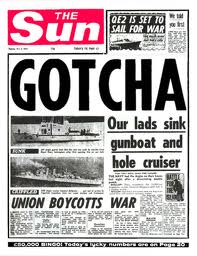
At the time, however, I remember being regularly sickened by the news. There was a day when I arrived in London from the suburb where I lived at the time, and caught sight of a startling headline in the local paper, the Evening Standard. The Argentinian cruiser Belgrano had been sunk by a British submarine, leading to the deaths of several hundred young conscripts. My stomach churned over that massacre, and even more over the gleeful celebration right-wing papers engaged in over it.
The Sun delighting in the deaths of conscript sailors
Then there was the recapture by British troops of the island of South Georgia. They took the surrender of the Argentinian garrison there. It was commanded by – Lieutenant Commander Alberto Astiz. Yes. The blond angel of death.

Both Sweden and France wanted to question him for the murder of some of their nationals. But the Thatcher government, pleading the Geneva Convention, had him questioned by a British policeman and, when Astiz refused to answer any questions, decided to release him and send him home.

So a torturer and murderer was treated with kid gloves, while the young conscripts on the Belgrano were sent to their deaths with callous indifference.
Alfredo Astiz, torturer, murderer, released by Thatcher
Funny to be reminded of all that by a book talking about Pope Francis. Funny but no fun. To me, that act of the Thatcher government ought to be remembered in perpetuity as a moment of glaring shame in the history of Britain.

Astiz was at last sentenced to life in prison in 2011. By the Argentines. Who again emerge from this sorry story, as they did from the war, with more honour than a deeply flawed Britain.

Saturday, 5 January 2013

Starting 2013, looking back at 2012

The story has it that Tsar Nicholas I once proudly proclaimed that Russia had two generals in which she could confide, Generals Janvier and Février.

Well, maybe. But this year, the English equivalent ‘Janvier’ is proving far too feeble to put up a fight on Nicholas’s behalf. Well, not unless he could persuade his enemies to stick to the North of the country and kept them out of doors, where they might get drowned.

Not that I’m complaining, mind. If I have to put up with the general dreariness of winter with its painfully short days and, in the wettest English year on record, the tiresome rain, I’d rather it was at 10 Centigrade than -10, any day of the week. Any year of the millennium.

The Russians will just have to make other arrangements to defend their territory.


We had our first badminton coaching session of 2013 today. We love the coach, who’s well into her seventies, with a level of fitness that would be enviable in someone twenty years younger, breathtaking in someone her age.

Like most sports coaches, she has a salty way of expressing herself.

‘Well, if you thought the shot was going out, why didn’t you call it out?’

‘You’d get to those shots a lot better if you didn’t superglue your right foot to the floor.’

‘If you think you’re supposed to play shots off the frame, why do you think they bother to string rackets at all?’

I suggested to one of the other players that she’d missed her calling in life, in diplomacy.

‘British Ambassador to Argentina perhaps?’ he suggested.

‘A perfect appointment. I can just see her saying to them: “You what? You wanted which islands from us? And you want them when?”’

Though, thinking about the advice she offered me repeatedly this morning, what she would probably be saying to Cristina Fernández de Kirchner would be ‘you need to get to your shot early. Otherwise your opponent will smash you straight back and you won’t know what hit you.’ Be warned Mrs Kirchner: that’s what happened last time.


Listening to a couple of 2012 retrospectives, I particularly enjoyed some remarks about the US elections.

‘There were moments in 2012 that made you proud to be British,’ said one commentator. I was already bracing myself for more self-congratulation about the Olympics, but instead he surprised me. ‘Like when Mitt Romney became a candidate for President.’


Great value at $18
A statistician pointed out that the US elections had cost an average of $18 per head of the US population. By contrast, the 2010 General Election in Britain cost only 50p a head. But I’m not a cheapskate: I’d be more than willing to fork out another ten or eleven quid to take me up to the US level if we could get rid of that dismal waste of space Cameron, and replace him with someone more like Obama.


Bad buy at 50p
Come to think of it, I still have some US dollars in my wallet. Where could I send them in the States so that we can get the Tea Party out of Congress and get things moving over there too?

Friday, 28 December 2012

Gotcha! How the Argentinians won the Falklands war

If I ever decided to pick a particularly inglorious day from within the span of my lifetime (not a pastime I’m inclined to indulge at all often), 4 May 1982 would be right up there with the worst.

At the time I was in the delightfully ironic position of teaching part-time in the French department of King’s College, University of London, where I had previously contrived to fail a physics degree. On Monday 3 May, as I was walking along the Strand towards the College, my eye was struck by the headlines in the evening papers: the Argentinian warship Belgrano had been sunk by a British submarine the day before.

As a rule, I tried not to talk politics in class, but on this occasion I couldn’t avoid an outburst.

‘Hang your heads in shame! A bunch of kids who had the misfortune to be doing their military service were killed by a sub yesterday, in our name, as part of the campaign to recapture a bunch of rocks we’d barely heard of a few weeks ago.’

My words were met by stony, embarrassed silence. That really shocked me. Students, in their late teens or just 20. And they cared that little?

But the worst mortification was reserved for the following day. In its issue of 4 May, the Sun, which likes to masquerade as a British newspaper and, inevitably, belongs to the Murdoch stable, carried the headline ‘Gotcha!’ 


The depths of infamy? Delighting in death

The then editor, Kelvin MacKenzie, later had a change of heart and came out with a different headline about how many Argentine casualties there had been, but since he used the word ‘Argies’ he’d barely moved a notch above the depths of playground language the original had plumbed. And ‘Gotcha’ was already out there.

It was a reminder of just what the glorious practice of war can do to an otherwise relatively civilised society. There are certainly needs so pressing that they can only be met by war, and perhaps the imposition of foreign military occupation on a bunch of peaceable islanders who’d done nothing to deserve it, falls into that category. But war remains a last resort, never a matter of joy or celebration. 323 young lives had just been snuffed out and we proclaim ‘Gotcha’? That’s pretty much the pits.

Why am I writing about all this today? Because the British thirty-year rule means that a large number of previously secret government documents have just been released. They include papers showing that then Prime Minister Maggie Thatcher was taken unawares by the Argentine invasion and was open to a negotiated end to the conflict, even if it involved a continued Argentinian presence on the islands, up to well after the sinking of the Belgrano.

That last piece of information rather does her credit, I have to admit, through gritted teeth. A diplomatic solution would have saved lives, though it would have cost her the credit she gained from being a ‘victorious’ war leader.

She never denied any of this information so it’s not really news. It simply comes as a reminder of a dismal time, specifically the tipping point in the Falklands war that came with the Belgrano sinking. That was the moment when the Argentinian victory was secured.

‘Argentinian victory?’ I hear you cry. 


Yes, because though they lost the Falklands, they gained freedom from a brutal military dictatorship. Many in Britain, on the other hand, completely ignored Thatcher’s unpreparedness for action and her willingness to negotiate, greeting her as the greatest female military leader since Elizabeth I, or perhaps Boudica. Her popularity sky-rocketed.

In 1981, Labour had been consistently in the lead in the opinion polls; as it tore itself apart in needless, senseless, in-fighting, it drifted into a position in which it alternated between a small lead and a small deficit in early 1982. It seemed that only if Labour pursued its insanity would Thatcher be re-elected; otherwise, she was going to be a single-term Prime Minister.

Then the Belgrano was sunk and some voters, indulging instincts as bloodthirsty as the Sun
’s, gave her a double-digit lead for the first time since the previous election. Within a year, that lead was firmly established, and at the next election, she was returned with a 15.2% majority in the popular vote.

The sinking of the Belgrano wasn’t just a shameful moment, it was the point at which the survival of the Thatcher government, with all its cruelty and divisiveness, was assured for another eight years.

So what is my prayer now, under another deeply unpleasant Conservative administration (masquerading as a coalition)? That no tin-pot dictator decides to invade any piece of territory held by Britain. Or at least, no tin-pot dictator this government could possibly hope to defeat.


Postscript. What to do about the Falklands?

It’s well known that the Falklands are known in Argentina as the ‘Islas Malvinas’ but not everyone knows that ‘Malvinas’ comes from the French word ‘Malouines’, identifying the islands as belonging to the glorious city of St Malo in Brittany. That port was one of the great centres of the long-haul shipping trade that opened up the prospect of globalisation, and it was malouin sailors who set up the first anchorage in the islands.

So it strikes me that the most imaginative solution to the Falklands problem is to hand them back to St Malo. That way neither Britain nor Argentina could gloat over the other. The French would be so taken aback that they’d forget to put on any airs either.

A neat solution, or what?