Showing posts with label Night and Day. Show all posts

Wednesday, 5 February 2020

The Media: be careful what you wish for. Or complain about

You cannot hope to bribe or twist
(thank God!) the British journalist. 
But, seeing what the man will do 
unbribed, there’s no occasion to.

Journalism attracts a lot of criticism for its seamier side. 

Just as ferocious as this verse by Humbert Wolfe from the 1920s is the powerful 1931 denunciation by then Tory Prime Minister, Stanley Baldwin, of the press barons who were, in his view, seeking:

…power without responsibility – the prerogative of the harlot throughout the ages

Clearly, the British press has had a lousy press for a long time.

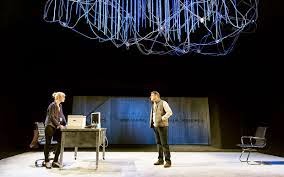
For a contrary view, the journalist Guthrie in Tom Stoppard’sNight and Day tells us:

I’ve been around a lot of places. People do awful things to each other. But it’s worse in places where everybody is kept in the dark. It really is. Information is light. Information, in itself, about anything, is light.
The Press: even the best can be irritating or infuriating
but would we really be better off it without it?
Information is light. Indeed it is. If you want a counter-example, just take Saudi Arabia. There too there was annoyance with a journalist, Jamal Kashoggi. So he was assassinated inside the Saudi Consulate in Istanbul. Five Saudis have been sentenced to death and three to long prison sentences for the crime, all of them junior figures.

The suspicion is that they are scapegoats for a crime ordered far higher up in Saudi government, quite possibly by the Crown Prince Mohammad Bin Salman himself. But with strict censorship in place in Saudi, there’s no way those suspicions can be tested there by public debate in the media, any more than they can by the government-controlled courts.

In Britain, there have been two significant events concerning the media this week. First, the government excluded certain outlets from a press briefing, a move which at least was met with resistance by other journalists, who walked out. The British journalist can, it seems, also behave in a principled way.

The second significant event was the announcement that the government is looking at changes to the licence fee system that finances the BBC. Whatever those changes are, and however plausibly they may be justified, it’s clear they will lead to a reduction in funding.

Nicky Morgan, Secretary of State for Digital, Culture, Media and Sport, has made it clear that:

As the world around us changes, our laws must change too. It will require the BBC to be innovative and to move with the times.

When the government starts telling the BBC that it needs to move with the times, it’s hard not to suspect that what it’s asking for is a move towards considerably less scrutiny of what government is doing.

That suspicion would be less strong if the government hadn’t already done so much to reduce scrutiny in the past. In the autumn, with the debate over Brexit raging in the House of Commons, Boris Johnson decided that Parliament should be prorogued. Suspending it in that way would indeed have greatly reduced the inconvenient oversight of government that Parliament was insisting on. Fortunately, the move was eventually judged to be illegal in the courts.

Today, with a more than comfortable majority in the House of Commons, Johnson no longer has to worry about parliamentary scrutiny. So now he’s rounding on the Press and the BBC.

Anyone interested in preserving an open society based on democratic values, should be opposing his moves. But there we have a problem of our own creation. The Left has been vociferous in its denunciation of the BBC and of the Press generally, contemptuously written off as the ‘MSM’ (mainstream media). That only plays into Johnson’s hands.

There’s no doubt that the BBC could be improved in many ways. That’s even truer of the Press: things certainly haven’t progressed much since Humbert Wolfe penned his lines and Stanley Baldwin denounced the Press Barons.

But “they say things I disagree with” isn’t a good enough basis for attacking the media. Especially when the effect isn’t really to drive them towards reform, but merely to reinforce attempts to muzzle them completely. When a right-wing government with autocratic inclinations is preparing a hole for the media, it would be a good idea for the Left not to help dig it any deeper.

Just remember: “Information is light. Information, in itself, about anything, is light.”

Things are a lot worse in the dark.

Monday, 4 May 2015

For a birthday present, no problem with this hard problem

It was my birthday back in January, but theatre tickets to popular plays are notoriously hard to book. It was my wife’s birthday in late April, much closer to today. And it’s my youngest son’s birthday in a couple of months’ time.

The upshot of all this was that a pair of longstanding friends of ours, one of whom is also godfather (a lay godfather, I should stress) to my son, decided to mark those three birthdays by taking us all to the National Theatre in London last Saturday. It was an inspired gift, particularly as the play they chose was Tom Stoppard’s The Hard Problem.

Stoppard is one of the finest English-language playwrights of our time. It’s nearly ten years since he last wrote a play, but now he’s come up with another classic.

Tom Stoppard has crafted another outstanding play
There was a time when he used to write plays that were brilliantly witty, crackling from start to finish with clever interplays of ideas and characters that were larger than life, to the point of being caricatures: think Rosencrantz and Guildenstern Are Dead or The Real Inspector Hound.

But he was also concerned with matters of political justice, of human rights, and came up with powerful denunciations of authoritarianism in all its Machiavellian slyness (Professional Foul) or the corruption of dictators (Night and Day). These were still plays of ideas, but the characters were more rounded and more human.

Then came a play like Arcadia which was nothing short of searing. The ideas are still vital, but the tragedy of a young girl and a young love gives the tale a poignancy that adds a dimension beyond the cerebral.

Now we have The Hard Problem. And humanity is on full display. Nine characters intertwine through love, or at least lust, through hierarchy, between superiors and subordinates or between tutors and students, or through differing outlooks. The “hard problem” is the issue of mind and matter: in a universe, increasingly viewed by many as containing only matter, what can produce thought?

Alan Turing, in his notion of the “imitation game”, suggested that if a machine appears to be thinking, then we must assume it is thinking. In this view, we’d have to say that we build simple thinking machines, made of electronic components, whereas we are ourselves much more complex thinking machines, made of organic matter. The difference is one of sophistication, and power, but not one of essential kind: machines are machines.

There is a reference to the ideas explored by Turing who, specifically, built chess-playing machines.

Leo Computers compute. Brains think. Is the machine thinking?

Amal If it’s playing chess and you can’t tell from the moves if the computer is playing white or black, it’s thinking.


But the central character, Hilary, sees thing differently.

Hilary: It’s not deep. If that’s thinking. An adding machine on speed. A two-way switch with a memory. Why wouldn’t it play chess? But when it’s me to move, is the computer thoughtful or is it sitting there like a toaster? It’s sitting there like a toaster.

Leo So, what would be your idea of deep?

Hilary A computer that minds losing.


It’s vintage Stoppard, challenging received notions, proposing another point of view, and doing it with sparkling humour. But it never concludes, never tries to force us down a particular avenue. Our group sat spellbound for 100 minutes (with no interval), though to us they felt like 30, and came out moved and thoughtful – nothing like a toaster.

Moved, incidentally, because though the ideas are vital, they aren’t the only hard problem. Hilary has her own: a child to whom she gave birth at 15 and who was taken from her, given up for adoption, immediately. A child she tries to keep in touch with through prayer. And then there’s the linked problem of coincidence, if there are coincidences, and how does one handle them well, with delicacy and love, even when they have to be directed to a man whose existence seems devoid of either?

There’s plenty of Arcadia here and not just Rosencrantz and Guildenstern. Sometimes explicitly:

Leo Why? Why are you wasting my time with this fan dance? Are you in love with her?

Hilary She’s in love with me.

Leo
(taken aback) Well! Finally, something I understand.


The Hard Problem:
Hilary (Olivia Vinall) confronts Leo (Jonathan Coy)
Always, and pervasively, we have that Stoppard wit to keep us amused as well as stimulated and affected. One of my favourites came when Amal, the hedge fund manager, talked about “watching the market bet on water flowing uphill and flying pigs farting Chanel No. 5.” That struck me as smartly summing up the behaviour of financial markets at their rational best.

An excellent play. Well worth seeing. So a fine birthday present.