Monday, 31 December 2012

The event of 2012: Obama's re-election

Before wishing everyone much pleasure and success in 2013, and in the midst of all the retrospectives for the end of the current year, I want to concentrate on just one of its many events: the re-election of Barack Obama to the Presidency of the United States.
Obama: his re-election the defining moment of 2012?
This was in a way more remarkable than his original victory in 2008. That was won in the shadow of the lamentable presidency of Dubya Bush, a front-runner in the race to be the worst in US history. Facing him was a ticket which included Sarah Palin as possibly the worst candidate for vice-President: Aaron Burr was even creepier, hard though that may be to believe, but was probably less intellectually challenged.

So the first Obama victory might have owed a little to chance. To be re-elected, though, was a confirmation that enough at least of the US electorate really meant it.

That’s a great outcome, and not just because Obama is one of the brightest US Presidents there have been – though certainly he benefits by comparison with his predecessor – and, if the Tea Party can be persuaded not to take the country over the Fiscal Cliff or some other precipice – he may yet achieve remarkable things. What’s even more fascinating is what it says about how far the US has come.

Back in July 1776, one of the outstanding figures in history, Thomas Jefferson, drafted the Declaration of Independence. The first couple of paragraphs are extraordinarily impressive – you’ll remember all that stuff about ‘we hold these truths to be self-evident, that all men are created equal, that they are endowed by their Creator with certain unalienable Rights, that among these are Life, Liberty and the pursuit of Happiness’ – but then comes all the stuff people tend to ignore because it is, frankly, rather dull: a long list of all the grievances of the British colonies against the British King.

Thomas Jefferson: admirable, though not without faults...
For instance, ‘he has called together legislative bodies at places unusual, uncomfortable, and distant from the depository of their public Records, for the sole purpose of fatiguing them into compliance with his measures,’ we’re told, and I have to say that as a rallying cry to armed revolution, it lacks a certain je ne sais quoi, doesn’t it? These days we have a European parliament that travels, with all its papers, from Brussels to Strasbourg ten times a year and though that’s led to some pretty horrible consequences (e.g. UKIP) it still hasn't gone as far as a descent into bitter war.

Interestingly, not all the grievances originally intended for inclusion by Jefferson were adopted by his colleagues. In particular, they left out one that starts:

‘He has waged cruel war against human nature itself, violating its most sacred rights of life & liberty in the persons of a distant people who never offended him, captivating & carrying them into slavery in another hemisphere, or to incur miserable death in their transportation thither. This piratical warfare, the opprobrium of infidel powers, is the warfare of the CHRISTIAN king of Great Britain.’

Great, isn’t it? Denouncing the slave trade as un-Christian. It’s like telling today’s Christian right to be nicer about the rights of, say, Moslems.

Now Jefferson of course never freed himself from slavery, even fathering several children on Sally Hemings, who as well as being his slave was even, by today’s standards, under age when he first began his long relationship with her. However, it is admirable that he at least rose far enough above the sentiments of his time to want to denounce the trade in slaves.

His colleagues would not go that far. Jefferson's denunciation was cut from the final draft of the declaration, and this was not without significant consequences.

In 1857, 81 years later, with the country Jefferson helped found slipping inexorably towards Civil War, a powerful push in that direction was provided by a majority decision of the Supreme Court in the Dred Scott case. In the judgement, Chief Justice Roger Taney pointed to the founding documents of the United States and in particular to the Declaration of Independence, declaring that they made it clear that blacks:

‘had for more than a century before been regarded as beings of an inferior order, and altogether unfit to associate with the white race either in social or political relations, and so far inferior that they had no rights which the white man was bound to respect, and that the negro might justly and lawfully be reduced to slavery for his benefit.’

Roger Taney: vilain of the piece. And doesn't he look it?
Hardly what Jefferson intended in his original draft, but what far less noble men among his successors made of the final version. Blacks had no rights in law; whites had no obligation to treat them with respect.

It took 155 years to achieve the re-election, and not merely the election, of a half-black President of the United States. But given Roger Taney’s words, the road travelled is still extraordinary, even in such a time.

Enough on its own to make 2012 a seriously important year.

And now, as promised, I wish you all every possible prosperity and joy in 2013. Wouldn’t it be good if it contained at least one event as outstanding as that one from 2012?

Friday, 28 December 2012

Gotcha! How the Argentinians won the Falklands war

If I ever decided to pick a particularly inglorious day from within the span of my lifetime (not a pastime I’m inclined to indulge at all often), 4 May 1982 would be right up there with the worst.

At the time I was in the delightfully ironic position of teaching part-time in the French department of King’s College, University of London, where I had previously contrived to fail a physics degree. On Monday 3 May, as I was walking along the Strand towards the College, my eye was struck by the headlines in the evening papers: the Argentinian warship Belgrano had been sunk by a British submarine the day before.

As a rule, I tried not to talk politics in class, but on this occasion I couldn’t avoid an outburst.

‘Hang your heads in shame! A bunch of kids who had the misfortune to be doing their military service were killed by a sub yesterday, in our name, as part of the campaign to recapture a bunch of rocks we’d barely heard of a few weeks ago.’

My words were met by stony, embarrassed silence. That really shocked me. Students, in their late teens or just 20. And they cared that little?

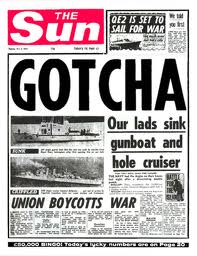
But the worst mortification was reserved for the following day. In its issue of 4 May, the Sun, which likes to masquerade as a British newspaper and, inevitably, belongs to the Murdoch stable, carried the headline ‘Gotcha!’ 


The depths of infamy? Delighting in death

The then editor, Kelvin MacKenzie, later had a change of heart and came out with a different headline about how many Argentine casualties there had been, but since he used the word ‘Argies’ he’d barely moved a notch above the depths of playground language the original had plumbed. And ‘Gotcha’ was already out there.

It was a reminder of just what the glorious practice of war can do to an otherwise relatively civilised society. There are certainly needs so pressing that they can only be met by war, and perhaps the imposition of foreign military occupation on a bunch of peaceable islanders who’d done nothing to deserve it, falls into that category. But war remains a last resort, never a matter of joy or celebration. 323 young lives had just been snuffed out and we proclaim ‘Gotcha’? That’s pretty much the pits.

Why am I writing about all this today? Because the British thirty-year rule means that a large number of previously secret government documents have just been released. They include papers showing that then Prime Minister Maggie Thatcher was taken unawares by the Argentine invasion and was open to a negotiated end to the conflict, even if it involved a continued Argentinian presence on the islands, up to well after the sinking of the Belgrano.

That last piece of information rather does her credit, I have to admit, through gritted teeth. A diplomatic solution would have saved lives, though it would have cost her the credit she gained from being a ‘victorious’ war leader.

She never denied any of this information so it’s not really news. It simply comes as a reminder of a dismal time, specifically the tipping point in the Falklands war that came with the Belgrano sinking. That was the moment when the Argentinian victory was secured.

‘Argentinian victory?’ I hear you cry. 


Yes, because though they lost the Falklands, they gained freedom from a brutal military dictatorship. Many in Britain, on the other hand, completely ignored Thatcher’s unpreparedness for action and her willingness to negotiate, greeting her as the greatest female military leader since Elizabeth I, or perhaps Boudica. Her popularity sky-rocketed.

In 1981, Labour had been consistently in the lead in the opinion polls; as it tore itself apart in needless, senseless, in-fighting, it drifted into a position in which it alternated between a small lead and a small deficit in early 1982. It seemed that only if Labour pursued its insanity would Thatcher be re-elected; otherwise, she was going to be a single-term Prime Minister.

Then the Belgrano was sunk and some voters, indulging instincts as bloodthirsty as the Sun
’s, gave her a double-digit lead for the first time since the previous election. Within a year, that lead was firmly established, and at the next election, she was returned with a 15.2% majority in the popular vote.

The sinking of the Belgrano wasn’t just a shameful moment, it was the point at which the survival of the Thatcher government, with all its cruelty and divisiveness, was assured for another eight years.

So what is my prayer now, under another deeply unpleasant Conservative administration (masquerading as a coalition)? That no tin-pot dictator decides to invade any piece of territory held by Britain. Or at least, no tin-pot dictator this government could possibly hope to defeat.


Postscript. What to do about the Falklands?

It’s well known that the Falklands are known in Argentina as the ‘Islas Malvinas’ but not everyone knows that ‘Malvinas’ comes from the French word ‘Malouines’, identifying the islands as belonging to the glorious city of St Malo in Brittany. That port was one of the great centres of the long-haul shipping trade that opened up the prospect of globalisation, and it was malouin sailors who set up the first anchorage in the islands.

So it strikes me that the most imaginative solution to the Falklands problem is to hand them back to St Malo. That way neither Britain nor Argentina could gloat over the other. The French would be so taken aback that they’d forget to put on any airs either.

A neat solution, or what?

Wednesday, 26 December 2012

Christmas time is outlaw time

Christmas has always been a season for families, and it was great to have a visit from our youngest son, Nicky, and our daughter-out-law, Nicola, together known as ‘the Nicks’. His parents-out-law joined us for Christmas Eve to Boxing Day, leading to much good cheer and amusement, for instance in the form of well-lubricated charades, a game that declines in quality but improves in enjoyment as the alcoholic content climbs.

My son also took the opportunity to introduce me to the logical conundrum known as the Monty Hall problem. It’s called after a game show host, who at the climax of the game, called on the contestant to select one of three doors, behind two of which there was a goat, while behind the third was a car. While I might prefer a goat to certain cars I’ve come to know though not necessarily to love, you’ll understand that the premise of the game was that the contestant would win whatever was behind the door chosen and the desired outcome was to find the car.

Monty Hall and the game that left a problem

The special feature of the game is that after the contestant had chosen a door, the host, who knew what was behind all of them, would leave it shut but open another that revealed a goat. He would then offer the contestant the option of sticking with the first choice or changing.

At the heart of the Monty Hall problem is the question whether it’s better to stick or switch, or whether it makes no difference.

It seemed clear to me that there was nothing to choose between the options. That the probability of choosing the car was initially one in three and, with the elimination of one losing option, it had improved to one in two. To my embarrassment, it took me the best part of two hours to understand why this is not the case.

In my defence, I was in good company, as shown by the reaction to the journalist and populariser of mathematical oddities, Marilyn vos Savant, when she published the explanation: thousands, including many specialists, wrote to point out that she was wrong. But she wasn’t.

Vos Savant argued that it made much more sense to switch than to stick. In fact, switching doubles the chance of finding the car from one in three to two in three. It took me ages to grasp that, offering Nicky manifold opportunities for gentle but nonetheless mocking derision.

It’s one of those particularly irritating truths in mathematics that is completely counter-intuitive but utterly obvious once you
’ve grasped it.

Over to you. If it takes you less than two hours to work out why in the Monty Hall game it’s twice as good a tactic to switch than to stick, then you’ll have beaten me and I congratulate you.

Not that you’ll have had as much fun as I did whiling away the dying moment of Christmas Eve over a few glasses with a mocking son and a bunch of outlaws.

Monday, 24 December 2012

Hopeful times

Hope springs eternal in the human breast, Alexander Pope told us. The Romans put it even more succinctly: dum spiro spero, while I breathe, I hope. It’s no accident that was was left in the chest Pandora opened, to console us for all the evils she’d released, was hope.

Like all human qualities, even hope isn’t completely impervious to the worst other humans can throw at it. One of the grimmest images I have of the extermination camps of the last world war is that they were places were spirits were so broken that hope was at last driven out. The worst of afflictions, as Dante knew: he put those most chilling words to go above the gates of Hell: ‘abandon all hope ye who enter here.’

Generally, though, hope keeps up going, making us believe there’s something to strive for, to plan for or at the very least to wait for. That deserves celebration, and when better than now? The nights are long, the days are cold and grey, the trees stand leafless, the flowers without blooms, but we know that, all things being equal, life is going to get better again. Quite soon.

So we choose this moment to make merry, to encourage each other to hang on a little longer as better times are just round the corner. That’s something we’ve done for millennia at this time of year: long before anyone had thought of Christmas, it was the Saturnalia or the birth of Mithras or Chanukah or some other winter festival near the solstice.

As it happens, it works perfectly well for Christianity to adopt it. Belief in a redeemer to save us all from our own sins is a doctrine of hope. It makes sense that the great festival of hope has become the key point in the Christian calendar, when it should have been Easter, the feast of the resurrection. It’s just worth remembering that the hope was there long before the Christianity.

That means it doesn’t matter whether I wish you a happy Christmas or a happy Saturnalia or, indeed, a completely secular happy Solstice time. Whatever festival we celebrate at this time of year, let’s all enjoy the fact that things are as bleak and miserable as they get and from now on they’ll be improving again. So – lots of season’s hope to you all.

Happy Saturnalia and a hopeful New Year

Of course, none of this applies in the Southern Hemisphere where everything’s back to front. All I can say to my Australian friends is don’t eat too much turkey in all that heat, make sure you’ve got the sun block on, and enjoy the summer. We’re looking forward to getting back to one of our own in the very near future.

Or, at least, that’s what we’re hoping for, here in England. Summer’s been the season of disappointment for years now. But who knows, next year might be different. We’re keeping our fingers crossed.

Hope springs eternal, you see.

Saturday, 22 December 2012

Ah well, it's not the end of the world

It’s wonderful how moments of high drama steal up on you, catching you unawares, springing out when you least expect them and overwhelming you with their scale and general awesomeness.

That’s how it was yesterday. The day dawned clear and bright; it was cold but not unbearably so, well above freezing, and walking the dog was pleasant.

There was of course a sense of ominous foreboding in the air, butI coped with it as best I could.

At lunch, the day continued pleasant and untroubled. Nothing untoward during the second dog walk of the day but obviously this could only be the calm before the storm. I was, however, finding it increasingly difficult to sustain any sense of dread. Complacency was setting in, and what could be more dangerous?

Infuriatingly, as it does at this time of year, the sun took its leave at around 4:00. Four o’clock? How can that be nightfall? It isn't even late afternoon.

Now that should have been the sign for things to turn seriously sinister, but all I could work up was a sense of mild irritation at the bad behaviour of December. Not smart if, as I said, catastrophe doesn’t necessarily announce itself hours in advance. It sneaks and takes you when you least expect it. By the evening, I was as vulnerable as one could be to sudden, massive cataclysmic events.

That’s it. The scene was set. Bring it on.

And that was precisely the moment when absolutely nothing happened. I turned in. I fell asleep. I woke up again when Danielle got home from the outstanding Christmas Party she’d organised for her colleagues. And then I slept through till this morning, when I woke up to pretty much uninterrupted rain, with standing water everywhere and rivers bursting their banks.

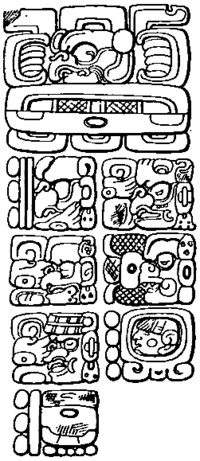
So what happened to the catastrophe prophesied for yesterday? The end of the world those self-appointed interpreters of Mayan calendars had announced for 21 December? Had I missed something?


The Mayan inscription that created
all the fuss in the first place

I did check up a bit on all that Mayan stuff. As it happens yesterday was just the end of the thirteenth toucan (it’s not really called that, but I can remember toucan and I can’t remember Baktun. I to do what I toucan). The way the Mayans saw it, the end of a cycle is also the beginning of the next cycle – it’s numbered zero. 

So what happened yesterday, and was always going to happen, wasn’t the end of the world but just the end of one era and the start of another. But that’s not as exciting a message as ‘it’s all coming to an end’, is it?

It’s a relief, of course. It means I can get on with griping about the crappy weather and the miserable days. But more importantly, instead of associating 21 December with some kind of calamity, it is the occasion of an excellent party for Danielle’s hospital department: zumba, karaoke, huge quantities of Indian food, dancing, smiles and laughter the whole evening through.

Danielle's colleagues showed how to mark the day of dread
Definitely not the end of world there
And, of course, there was the the solstice. The point at which, for this year, the days stop getting shorter, at least in this hemisphere (sorry, Australia). Proving the good old Mayans’ point: the end of one cycle is just the start of a new one. Day by day, the light will be lasting a touch longer. In two or three weeks, the difference will be appreciable. In a a couple of months we’ll be surging ahead.

Back towards the Spring. Bet the Mayans knew how to celebrate that.

Thursday, 20 December 2012

Newtown and free speech

Much of the debate since the Newtown shootings, as after every other such tragic incident in the States, has focused on the Second Amendment to the Constitution. Nothing surprising about that, because this is the amendment guaranteeing the right to bear guns.
The fundamental problem may however lie not so much in this amendment as in the First, which guarantees freedom of speech, belief and assembly. It’s a powerful illustration of how something that on the face of it seems entirely good, can produce terrible effects in certain circumstances.

The ten amendments to the US Constitution form the Bill of Rights

Kierkegaard got it right when he said ‘people demand freedom of speech as a compensation for the freedom of thought which they seldom use’. All the same, most of us would probably agree that free speech is an important right. Certainly, I regard it as crucial whenever I want to exercise it, though I have to say I wish I could occasionally selectively suspend it for certain other people.


Desirable though it may be, however, the right to free speech can’t be open-ended. The classic counter-example is that there’s no right to shout ‘fire’ needlessly in a crowded theatre. Civilised societies also prohibit libel, incitement or conspiracy, thought these are also constraints on free speech.

There are other, more subtle aberrations in the application of this right. The First Amendment was the basis on which the US supreme court chose to allow the so-called super PACs to operate. These are organisations that can channel unlimited sums of money into political activity, allowing them to make or unmake politicians.

It is also the first amendment that guarantees that politicians can continue to back their campaigns with TV advertising. Funding the astronomic expenditure that involves makes them more than ever dependent on donors.

Those two effects create circumstances in which political lobbies flourish. And here we are back with the problem of guns and tragedies such as Newtown’s: no political lobby is as well organised, and few are as well funded, as the NRA, the main pro-gun lobby.

It is currently following its usual tactics, of saying very little in the immediate post-massacre period. It can see the writing on the wall, and the head of steam generated by Newtown is such that the writing is powerful: there seems a real chance of some significant steps towards tighter gun control this time.
So watch the NRA, once the dust has settled. It is going to give a master-class in the use of lobby muscle in a political system more prone to it than any other in the world.

At which points its opponents will need to ponder the effect of abuse of not only the Second Amendment to the Constitution, but the First as well.

Tuesday, 18 December 2012

Unmissable anniversary of a missing link

Cast your minds back a century and imagine how different the world looked. 

It still seemed, particularly to people living there, that Britain ruled the roost, globally. It was sitting at the top of a colossal Empire. It was resting on some impressive laurels as a trading nation. It had a track record for innovation and scientific advance that led the world.

The reality was that the temple of British greatness was already nothing but an imposing façade. Inside, the rot had been working for decades and it would only take the impact of the First World War to bring down the whole edifice. As 1066 and All That points out, by the end of that war ‘America was thus clearly Top Nation, and history came to a .’

It sometimes seems to me that in the years leading up to the Great War, many in Britain could already see that full stop approaching. It may have made them a little defensive, anxious to find ways of bolstering their country’s prestige. Anything that seemed to detract from its air of superiority was an embarrassment and a matter to correct if at all possible.

The work of Darwin and his successors suggested that man had developed from apes and it was a matter of some interest to find the ‘missing link’ between apes and men. Many remains of early humans had been discovered, in particular in some of Britain’s neighbours in Europe – and, as is still the case today, ‘European neighbour’ is just a euphemism for ‘deadly rival’.

That made it galling that Britain had no such remains. None of those ancestors had chosen to come and live in this blessed country, superior to any other on Earth. Frankly, a bit off, my dear.

So it was a the best of news when, on 18 December 1912, a hundred years ago today, Charles Dawson, amateur archaeologist, told the Geological Society of London that he had found remains of a pre-human hominid in a gravel pit at Piltdown in Sussex.

This was simply marvellous news, don’t you know. Not only did Britain now have its own prehistoric inhabitant, within Britain he had chosen to inhabit England. And not any old bit England, either. Not the cold North where those working class people lived and kept ugly industry going to make the fortunes of the wealthy people wise enough either to have been born in the South, or to have moved there when they’d amassed enough money. No, he had chosen the delectable counties near London where those fortunes were spent. And not just any part of the South but the fragrant county of Sussex, all gentle countryside rolling prettily down to the English Channel to cock a snook at the French.

There are always killjoys, of course. Some character called David Waterston published an article in Nature suggesting that what Dawson had presented was an ape jaw and fragments of a human skull. But who was going to accept such a preposterous suggestion and lose their very own national missing link?

The party sadly came to an end in 1953. It took 41 years, which is pretty good going, but it couldn’t be kept up forever. To add insult to injury, the offending article was published in some American magazine called, I believe, Time. And to everyone’s astonishment it announced that what Dawson had presented was an orangutan jaw and fragments of a human skull. Who could have guessed?

By then, of course, Britain had already had to give up the jewel in its crown, India, and the rest of the Empire was rapidly unravelling. Giving up Piltdown man no longer really mattered. Just another one of the blows that accompany national decline.

Eoanthropus dawsoni: Piltdown man.
Not so much a missing link between apes and man
as a symbolic link between imperial grandeur and national decline

It had been a good hoax as hoaxes go. A lot better, say, than the hoax call to the King Edward VII hospital in London which drove a nurse to suicide ten days ago (coincidentally, she was buried yesterday, the eve of the Piltdown anniversary).

A hoax that worked and really did very little harm. Sounds like a centenary worth celebrating. I hope you enjoy it as much as I have.