Showing posts with label Belgrano. Show all posts

Sunday, 3 October 2021

Reminders

There are events that are startlingly vivid whenever they come to mind. What I was doing when I learned that John F Kennedy had been assassinated, or when planes flew into New York’s Twin Towers, for instance. Or other events that I learned with that sensation of shock.

Having made Spain my home, I’m still trying to master Spanish, a far slower process than I’d hoped. Not that Spain cares: while I’m very conscious of living here and enjoying it, Spain has reacted to my presence with no more than a few bureaucratic procedures. I’m not complaining. It’s best when nations pay you no attention, I feel, though that may be just my Jewish roots speaking.

To help my Spanish limp along, I read and listen to books in the language. Javier Marías, the latest author I’ve tried, has written several spy novels. Marías is no Le Carré, the king of the genre, but fortunately nor is he an Ian Fleming, the court fool. In the book I’m reading now, Berta Isla, he does something that Le Carré never tried (and Fleming wouldn’t even have considered). He tells the story from the point of view of Berta, the spy’s wife.

He husband, Tom Nevinson, is an Anglo-Spanish dual national, recruited into the British Secret Intelligence Service, or MI6 as it’s popularly known. He has let her know that much and made her understand that she’s unlikely ever to learn more. So she tells us of her concerns for a husband frequently away from home, without her knowing where he is or what he’s doing. She doesn’t know when he’ll be back. She doesn’t know whether he’ll be back. 

In 1982, he’s called to London on the outbreak of the Falklands War, as she decides to refer to a conflict usually called the war of the Malvinas by Spanish speakers. She’s in torment. Has he been sent to the islands with the British task force, perhaps to listen to Spanish-language messages? Or to interpret? Or is he safely in London? She can’t know and can only follow in her trepidation the daily reports of the events in the Spanish news, at her home in Madrid.

Life rafts pulling away from the sinking Belgrano
That’s how she learns of the sinking of the cruiser Belgrano by the nuclear-powered British submarine Conqueror. Her reaction is one of horror at all that death, but also, she admits, a sense of relief. It was an Argentine ship, so her husband could not have been on it. 

I found out about the sinking at Charing Cross station in London. I’d just travelled in by train. Shocked by the headline, I bought a copy and read the article. 

The General Belgrano had a crew of rather over a thousand sailors. The majority were simple conscripts doing their obligatory national service. The final tally is that 321 of them died, plus two civilians who happened to be on board.

There’s no doubt that the Belgrano, like other units of the Argentine navy, had orders to attack the British task force. I suppose that made the ship a legitimate target. I can hardly denounce the sinking, given that I found Argentine dictatorship indefensible in invading the Falklands – or Malvinas – against the will of the local population. I don’t like military action if it can be avoided, but the only way to reverse that unwarranted resort to violence was with force, and I could hardly object to its being used. 

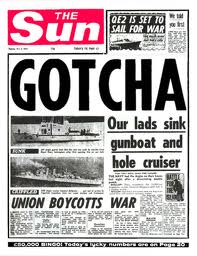
What turned my stomach, however, was the reaction in Britain. ‘Gotcha’ proclaimed the Murdoch newspaper, the Sun. By then, Brits were regularly referring to the Argentinians as ‘Argies’, as during the Second World War they’d referred to Germans as ‘Jerries’. But Nazi Germany had represented an existential threat to Britain. Argentina certainly didn’t.

The triumphalism of many in the media, and indeed in the population, was nauseating. Most of the dead on the Belgrano were kids. They were civilians stuffed into uniform with no option to refuse. Even if we felt the sinking was necessary, I could see no decent reaction to the killing other than grief. 

But back to Berta. There were, of course, also British ships sunk, or planes and helicopters downed. Each of those events leaves her more terrified than ever at the idea that her husband might have been in one of them. She begins to hope that he has been sent somewhere completely different, nowhere near the disputed islands. Perhaps, indeed, to Northern Ireland, which back then was still in the grip what we euphemistically referred to as the ‘troubles’. 

But then she remembers a shocking event in Northern Ireland. “I don’t know whether it was in Belfast, in Derry or in a village, a mob had attacked an English soldier and had skinned him, I’ve always hoped only once he was no longer alive”, her character tells us. It was “perhaps after 1982, but I think of it as earlier,” sha adds: the novel is set long after the event. 

I’m not sure which incident she’s referring to, but her words reminded me of the “Corporals Killings” of March 1988. That’s another of those events that have stuck in my mind and, frankly, in my throat, since I watched the TV reports nearly quarter of a century ago. 

Two young soldiers, in civilian clothes and an unmarked car, made the serious mistake of driving into an IRA funeral. When the crowd, which turned quickly into a mob, rounded on them they drew pistols and fired a shot to drive it off. That sealed their fate.

They were dragged out of the car, stripped and seriously beaten. They were then taken to a piece of waste ground where they were shot dead. A journalist, Mary Holland, witnessed the event and saw one of the soldiers being dragged by. 

He didn't cry out; just looked at us with terrified eyes, as though we were all enemies in a foreign country who wouldn't have understood what language he was speaking if he called out for help.

The only redeeming aspect of the whole event was the behaviour of a Catholic priest, Father Alec Reid, a man you might have expected to be the soldiers’ enemy, but clearly felt that doing what he could for suffering humanity mattered more. In the next decade, he contributed to the peace process that led to the Good Friday agreement for Northern Ireland in 1998. He later also worked for peace in the Spanish Basque territory.

Before the soldiers were taken to the killing ground, he went to the two bleeding men and put his arms around them. IRA men forced him away as they took them to the waste ground. He heard the shots that killed them, and ran over there.

He quickly realised that there was nothing he could do for the men anymore but administer the last rites to them, which he did. My memory is that he later drew a parallel for reporters between the two soldiers and Jesus Christ, stripped, tortured and murdered. I can’t confirm it was him, so maybe someone else spoke those words, but they struck me as particularly apt for a Christian. 

Father Alec Reid tending to one of the murdered men
What’s curious is that Father Reid, as he knelt by those dead men, had in his pocket a letter from Gerry Adams, Northern Irish leader of Sinn Fein, the IRA’s political wing, to John Hume, of the parliamentary wing of the Nationalist (Catholic) movement, the Social Democratic and Labour Party. The letter was a step in the process of working out a common position, which contributed massively to reaching the Good Friday Agreement. 

He was a man for peace kneeling with the victims of violence.

Two events. Both of shocking memory. But useful lessons, if only as reminders of just how appalling we can be if we don’t learn to control ourselves.

It’s quite a tribute to Javier Marías that, in a simple spy novel, he conjures up each of them, helping me with far more than just language learning.

Friday, 27 December 2019

Not good for the Pope. Not good for Britain either

One thought can easily conjure up unrelated memories, can’t it?

I was reading about the present Pope the other day, and it brought to mind memories of the Falklands War. Or perhaps I should say Conflict, since war was never declared. And perhaps I should say Conflict over the Malvinas, to give the Spanish name for those islands, since that’s what the Argentinians call them.

What’s the link to Pope Francis? The Conflict brought to an end the military dictatorship in Argentina. That, incidentally, is why I always think the Argentinians won, even if they didn’t keep the islands: they got rid of one of the bloodiest and most brutal dictatorships in their troubled history, while we were stuck with Thatcher for another seven years, followed by further Tory government under John Major for another five after that.

It wasn’t just the supposed ‘victory’ in the Falklands that kept Thatcher in power and gave her a landslide election win the following year. She was helped by Labour having a brainstorm and going into that campaign led by the hard left, which played right into her hands. Sound familiar? Yes, just because we made that mistake 36 years ago doesn’t mean we’d learn from it and avoid it this year.

Francis, then Jorge Bergoglio and head of the Jesuit order in Argentina, lived through the dictatorship and its “dirty war”. Indeed, the darkest era in his past is that he may have contributed to two priests being tortured by the regime.
Esther Ballestrino
A significant influence on Pope Francis
A woman who played a major role in Bergoglio’s development was Esther Ballestrino. She headed the lab where he worked when he was still a chemist and hadn’t decided to become a priest. In 1977, her son-in-law and her pregnant sixteen-year-old daughter were abducted and tortured by the regime. In the absence of any news of them, Ballestrino joined with other women in founding the ‘Mothers of the Plaza de Mayo’ who would gather every week, demanding information, outside the presidential palace on that square in Buenos Aires.

Eventually, her daughter was released. But Ballestrino kept turning out with the other protestors. Unfortunately, the group was inflltrated by a man called Alfredo Astiz, from Naval Intelligence, nicknamed the ‘blond angel of death’. When the group published an advertisement listing the names of the ‘disappeared’ – the people abducted and about whose destiny no information was available – Astiz arranged for five women, including Ballestrino, to be arrested. They were tortured and eventually loaded, heavily drugged, onto a ‘death flight’: a plane that took them out to sea where they were dropped, hands and feet bound, out of the back of the aircraft.

So Esther Ballestrino died, one of the great sorrows in Pope Francis’s life.

And what memory did this conjure up in me?

I was conflicted over the Falklands War – conflicted over the Conflict. It strikes me as ridiculous that a group of islands off the coast of Argentina are possessions of a country, Britain, nearly 13,000 kilometres away. On the other hand, I loathed the Argentinian junta and deeply disliked the way they decided they could use military force to solve a territorial dispute. Above all, I disliked their obvious contempt for the views of the local population.

The use of military force and the trampling of the rights of the local inhabitants? It felt far too much like what the Israeli government does to Palestinians.

In any case, I can only be pleased with the way things worked out for Argentina, giving them a far more important victory than anything on the battlefield could have achieved: it freed them from a particularly nasty regime.

At the time, however, I remember being regularly sickened by the news. There was a day when I arrived in London from the suburb where I lived at the time, and caught sight of a startling headline in the local paper, the Evening Standard. The Argentinian cruiser Belgrano had been sunk by a British submarine, leading to the deaths of several hundred young conscripts. My stomach churned over that massacre, and even more over the gleeful celebration right-wing papers engaged in over it.
The Sun delighting in the deaths of conscript sailors
Then there was the recapture by British troops of the island of South Georgia. They took the surrender of the Argentinian garrison there. It was commanded by – Lieutenant Commander Alberto Astiz. Yes. The blond angel of death.

Both Sweden and France wanted to question him for the murder of some of their nationals. But the Thatcher government, pleading the Geneva Convention, had him questioned by a British policeman and, when Astiz refused to answer any questions, decided to release him and send him home.

So a torturer and murderer was treated with kid gloves, while the young conscripts on the Belgrano were sent to their deaths with callous indifference.
Alfredo Astiz, torturer, murderer, released by Thatcher
Funny to be reminded of all that by a book talking about Pope Francis. Funny but no fun. To me, that act of the Thatcher government ought to be remembered in perpetuity as a moment of glaring shame in the history of Britain.

Astiz was at last sentenced to life in prison in 2011. By the Argentines. Who again emerge from this sorry story, as they did from the war, with more honour than a deeply flawed Britain.

Friday, 28 December 2012

Gotcha! How the Argentinians won the Falklands war

If I ever decided to pick a particularly inglorious day from within the span of my lifetime (not a pastime I’m inclined to indulge at all often), 4 May 1982 would be right up there with the worst.

At the time I was in the delightfully ironic position of teaching part-time in the French department of King’s College, University of London, where I had previously contrived to fail a physics degree. On Monday 3 May, as I was walking along the Strand towards the College, my eye was struck by the headlines in the evening papers: the Argentinian warship Belgrano had been sunk by a British submarine the day before.

As a rule, I tried not to talk politics in class, but on this occasion I couldn’t avoid an outburst.

‘Hang your heads in shame! A bunch of kids who had the misfortune to be doing their military service were killed by a sub yesterday, in our name, as part of the campaign to recapture a bunch of rocks we’d barely heard of a few weeks ago.’

My words were met by stony, embarrassed silence. That really shocked me. Students, in their late teens or just 20. And they cared that little?

But the worst mortification was reserved for the following day. In its issue of 4 May, the Sun, which likes to masquerade as a British newspaper and, inevitably, belongs to the Murdoch stable, carried the headline ‘Gotcha!’ 


The depths of infamy? Delighting in death

The then editor, Kelvin MacKenzie, later had a change of heart and came out with a different headline about how many Argentine casualties there had been, but since he used the word ‘Argies’ he’d barely moved a notch above the depths of playground language the original had plumbed. And ‘Gotcha’ was already out there.

It was a reminder of just what the glorious practice of war can do to an otherwise relatively civilised society. There are certainly needs so pressing that they can only be met by war, and perhaps the imposition of foreign military occupation on a bunch of peaceable islanders who’d done nothing to deserve it, falls into that category. But war remains a last resort, never a matter of joy or celebration. 323 young lives had just been snuffed out and we proclaim ‘Gotcha’? That’s pretty much the pits.

Why am I writing about all this today? Because the British thirty-year rule means that a large number of previously secret government documents have just been released. They include papers showing that then Prime Minister Maggie Thatcher was taken unawares by the Argentine invasion and was open to a negotiated end to the conflict, even if it involved a continued Argentinian presence on the islands, up to well after the sinking of the Belgrano.

That last piece of information rather does her credit, I have to admit, through gritted teeth. A diplomatic solution would have saved lives, though it would have cost her the credit she gained from being a ‘victorious’ war leader.

She never denied any of this information so it’s not really news. It simply comes as a reminder of a dismal time, specifically the tipping point in the Falklands war that came with the Belgrano sinking. That was the moment when the Argentinian victory was secured.

‘Argentinian victory?’ I hear you cry. 


Yes, because though they lost the Falklands, they gained freedom from a brutal military dictatorship. Many in Britain, on the other hand, completely ignored Thatcher’s unpreparedness for action and her willingness to negotiate, greeting her as the greatest female military leader since Elizabeth I, or perhaps Boudica. Her popularity sky-rocketed.

In 1981, Labour had been consistently in the lead in the opinion polls; as it tore itself apart in needless, senseless, in-fighting, it drifted into a position in which it alternated between a small lead and a small deficit in early 1982. It seemed that only if Labour pursued its insanity would Thatcher be re-elected; otherwise, she was going to be a single-term Prime Minister.

Then the Belgrano was sunk and some voters, indulging instincts as bloodthirsty as the Sun
’s, gave her a double-digit lead for the first time since the previous election. Within a year, that lead was firmly established, and at the next election, she was returned with a 15.2% majority in the popular vote.

The sinking of the Belgrano wasn’t just a shameful moment, it was the point at which the survival of the Thatcher government, with all its cruelty and divisiveness, was assured for another eight years.

So what is my prayer now, under another deeply unpleasant Conservative administration (masquerading as a coalition)? That no tin-pot dictator decides to invade any piece of territory held by Britain. Or at least, no tin-pot dictator this government could possibly hope to defeat.


Postscript. What to do about the Falklands?

It’s well known that the Falklands are known in Argentina as the ‘Islas Malvinas’ but not everyone knows that ‘Malvinas’ comes from the French word ‘Malouines’, identifying the islands as belonging to the glorious city of St Malo in Brittany. That port was one of the great centres of the long-haul shipping trade that opened up the prospect of globalisation, and it was malouin sailors who set up the first anchorage in the islands.

So it strikes me that the most imaginative solution to the Falklands problem is to hand them back to St Malo. That way neither Britain nor Argentina could gloat over the other. The French would be so taken aback that they’d forget to put on any airs either.

A neat solution, or what?