Friday, 3 April 2015

As we stifle in consensus over austerity, is the SNP the only hope for an alternative?

The great debate wasn’t that great. If it was even a debate.

Four men, David Cameron for the Tories, our current Prime Minister, Nick Clegg, his deputy for the Liberal Democrats, Ed Miliband, leader of the opposition for Labour, and Nigel Farage of UKIP, well for himself, and anyone who prefers bigoted belief over reason and evidence, faced off to three women, Leanne Wood for Plaid Cymru, Natalie Bennett for the Greens and Nicola Sturgeon for the Scottish National Party.

This was the single Prime Ministerial debate before the UK General Election on 7 May, televised last night. With seven contenders, no debate was really possible. Each candidate responded to a series of questions, and occasionally candidates cut across or challenged each other, but it was all a bit stilted.


The seven contenders in the Party Leaders' debate
So we learned little from the event. Except perhaps that the Celtic Fringe has a lot to teach England.

Leanne Wood persisted throughout in addressing Wales and Welsh voters. She seemed to have little to say to any other part of the United Kingdom, which seriously reduced the national impact of what she had to say. Even so, she did at least speak out against austerity, and for both the European Union and immigration, pointing out that leaving the former would do great damage, while threats to limit the latter were already harming her country.

That’s Wales, by the way, not Britain.

Nicola Sturgeon, on the other hand, was far more impressive. I’m sure that I’m far from the only Englishman who felt envious of the Scots, after listening to her. Why don’t we have someone so bravely and clearly articulating a message of the moderate left?

And I stress that word ‘moderate’. Many, and I include myself, have referred to Sturgeon as ‘radical’. But in reality she is not proposing anything revolutionary, or even particularly reforming: there’s no programme for mass nationalisation of industry here, or even of serious redistribution of wealth. Indeed, in many ways her programme is one for a conservative left wing: to maintain and protect the National Health Service, to keep access to tertiary education free. Even the most dramatic of the SNP’s positions is a demand for non-action, not for action: not to build the successor to the Trident nuclear deterrent.

This is a programme well to the right of the Attlee Labour government’s of 1945, which set up the NHS, along with the apparatus of the welfare state. It’s to the right of the programme of the Wilson Labour government of the 1960s, with its talk of storming the commanding heights of the economy. It’s telling that today the limited programme of the SNP seems to be the most daring on offer.

Amongst the representatives of the whole of Britain on show, only Natalie Bennett spoke for a similar anti-austerity view. A little dull, and representing a small minority of the electorate, she was never going to set this election alight.

Alongside her, we had Nigel Farage, beginning to sound far more wooden than he has in the past, certainly not the firebrand he once was and who won such massive support last year. To him, every question could only be solved by cutting immigration and leaving the EU – or was that leaving the EU in order to cut immigration?

And then we had Cameron proposing more and intensifying austerity, in the mistaken belief that all that matters is reducing national debt and eliminating the government deficit.

Against him, Miliband is at least speaking for the NHS, improving education and – at last – unequivocally denouncing the abomination of zero-hour contracts. This is the exploitative mechanism in which a worker is tied to an employee, but can’t count on any guaranteed level of work or earnings. That Miliband attacked it is welcome; but that he still seems committed to more austerity, if a lighter variety than Cameron’s, is dismal.

So it takes Nicola Sturgeon to speak out for the Centre-Left. The moderate Left, as I said. A little fresh air in the stifling atmosphere of the austerity consensus.

It’s sad that it should be so. But I suppose we can take some comfort that there is one voice, at least, clearly articulating arguments that badly need to be heard.

Wednesday, 1 April 2015

Misty's diary: does canine just mean crazy, or what?

Mistys diary: reflections on the insanity of dogs


April 2015

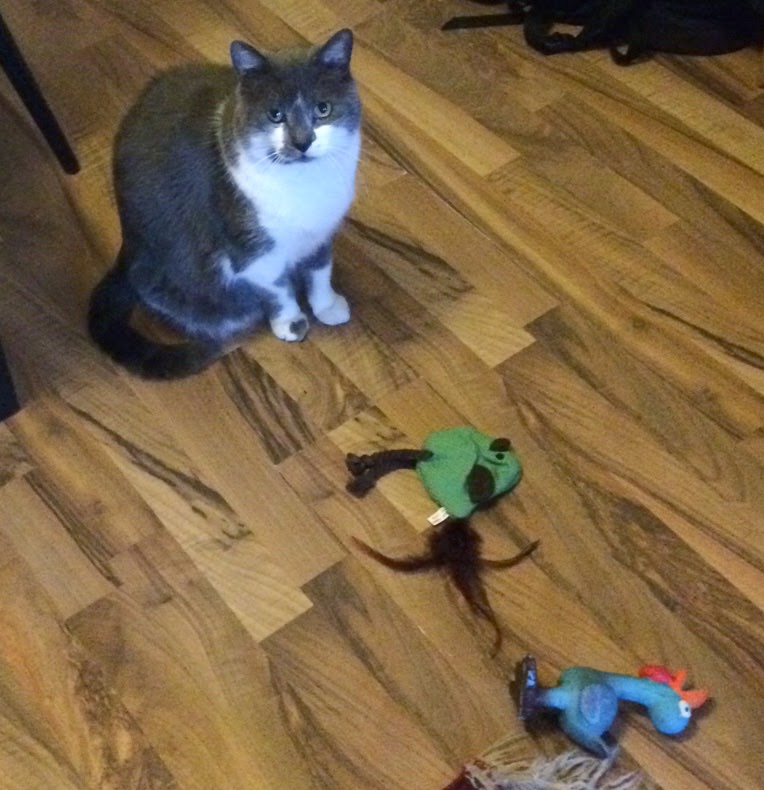
OK. Imagine a really ugly plastic toy. Some misshapen representation of a character from a nightmare perhaps. It is painted a nauseous blue, which some clashing red and yellow. Somehow all the more off putting for, rather than despite, being faded.

Basically, it has no redeeming features. I think it’s supposed to represent some kind of bird but, frankly, I’ve seen birds that looked more attractive, more cheerful even, while caught in my claws.


A toy? Or just an excrescence?
Seems to me bad enough to have one in your living room at all. But if you could bear its presence, would you care where it was in the room? Somewhere out of sight, perhaps. But at the kitchen or the front door end – who in their right mind would care?

Next imagine the mentality that makes you feel that fetching said toy from one end to the other is a matter of overwhelming urgency. Justifying the expenditure of frightening amounts of energy – and not to fetch it in calm and dignity, but at top speed, claws scraping and slipping on the floor, with two or three little leaps thrown in for sheer exuberance.

All this despite the fact that the toy is doing absolutely nothing. Lying on the ground. Motionless. Soundless.

Having caught it, thanks, you seem to believe, to your prompt and swift action, you pounce on it, growling with menace that would barely be frightening if it were twice as terrifying than it actually is. The growling, no doubt, is intended to overcome the last traces of the toy’s resistance. Which it isn’t offering.

That all seem senseless? You’ve not heard the half of it.

Because, having wrestled to the ground a foe who may be dastardly but, if you’re honest enough to admit it, also lifeless, and already lying on the ground anyway, you seize it in your mouth. And dash back to the other end of the living room with it firmly clutched in your jaws. No doubt this is to prevent its effecting its escape, though frankly nothing would be more welcome than to see it vanish into the remote distance, and it isn’t in any case making an attempt to get away.

Having courageously got it back to the sofa end of the sitting room, what do you do with the hapless adversary?

You hand it back to the very domestic who flung it to the far end of the room in the first place. And promptly does it again.

At which point the whole process starts over again.

Honestly, who invented dogs? Or, more to the point, why?

That being said, I’ve got to admit I’m getting used to having Luci around here. To be absolutely honest, she actually livens things up a bit: dull she isn’t, whether she’s chasing an ugly toy, or just trying to work out how to use the cat flap – my cat flap – she’s hilarious to watch. And I’ve got her trained, so she understands who’s due respect and who isn’t.


Beginning to get used to her
Not that the respect was ever the other way round. Whatever Domestic Number 2 says. He really thought I was scared of that little bundle of fluff? If I didn’t push past her in the doorway, it was because at the time she was new to the place and I thought she was a guest. Scared! Wash your mouth out.

Anyway, there’s no doubt who’s scared of who now. I’ve been on her back a couple of times now, let me tell you, and sunk my teeth into her neck.

Well, perhaps not her neck exactly. There’s so much hair there. But I sank my teeth anyway. It was quite satisfying. Especially when she ran away squealing.

That upset Domestic 2. Would you believe he kicked me? I don’t know if he thinks that’ll stop me training her. She needs the training, she’s going to get it. And I may deliver a little more to him. Doesn’t do him any good, evidently, but I enjoy it.

Meanwhile, at least I’ve got Domestic number 1. Who’s got me my own toy. A rather superior one, I’m happy to point out. A toy one can enjoy in a dignified and intelligent way.

There are good toys. And Luci's toys
No fool, that Domestic 1.


This is how playing should be

Monday, 30 March 2015

Luci's diary: getting to know my way around. And my family

Luci's Diary. She begins to learn the ropes. And gets to know the people round her a bit better.


End of March 2015

Wow, Misty, our cat, is just great! Isn’t he? I’m getting on really well with him these days. We’ve got a real rapport, I feel. Even if he still beats me up a bit. Well, a lot actually. But only when I’ve really stepped out of line and he needs to correct me.


We get on so well these days
He only beats me up when I really ask for it
And he’s just so exciting.

He wanders indoors and back out again without so much as a by your leave. All the comfortable places to sleep on are his by right (it took me a while to get my mind round that, but he’s very good at making things really, really clear). And, boy, he can jump! I thought I was good at it, but he’s so much better: his food is kept way up in the air, far out of my reach, but he just leaps up there to eat away.

Of course, he can get at my food too, and does, but it’s odd because the only time he doesn’t beat me up is when I push him away from my bowl when’s he’s trying it on. Could it be that he’s not altogether sure he’s being entirely honest? I like to think it’s just my tactful way of suggesting to him that the bowl’s mine and he really ought to move on. Perhaps show me how well he jumps again, to get at his own food.

There’s one thing I’ve worked out about him, though, where he’s not being quite as clever as I thought. There was a time I believed he could just walk straight though a solid, closed door. In from the garden. Silly me. It’s not like that at all. There’s a sort of flap in the door. You push it with your head from outside, and it opens up inwards and you can slip through.

I was really pleased when I worked that one out. Now I can get in myself if it gets a bit cold or wet, and they leave me outside on my own. Actually, even if it isn’t cold and wet: I don’t like being out on my own too long anyway.

But there’s still a trick I haven’t mastered. He seems to be able to get out through the door too. Smart operator. I haven’t sussed out how he does that. I can’t see another flap. Could it be magic after all? I wouldn’t put anything past our Misty.

The humans are fun too. She is, particularly. Tough, but you know, loving. Looks after me. Walks and all that. And food! She’s the one for food.

I spend more time with him, though. She clears off somewhere or other during the day, but he’s mostly there. So I can lie next to him. Get a lot of rest, actually. Mainly because he gets terribly shirty if I walk on his keyboard, and he seems to have a keyboard on his knees practically the whole time. Hits it with his fingers – you’d think it would hurt and he might stop after a while it. Why doesn’t he feel uncomfortable with it? I know I do. But, like I said, it’s no good telling him – he just gets irritated.

Still, he takes me for walks too. And I’m getting him reasonably trained: he takes me by car to the places we’re going to walk, instead of forcing me to get there along those nasty, smelly streets. Drives me to the park gates, you know, just as I like it. If he can just learn to give me food, he’ll be basically all right.

No better than all right yet, though. A couple of times he’s taken me to this dismal place. The house of lamentation, I call it. Full of unpleasant smells, lots of strange people, wailing dogs, even the odd cat I don’t know. There’s a weird woman there who takes me into a back room and does nasty things to me, prodding me and pushing me and even sometimes sticking needles in me.

Well, he took me there for the second time, just a few days ago. And afterwards, when he stuck me back in the car, it wasn’t to go home, it was to drive somewhere else. Driving for ages. Ages and ages. It made me throw up in the end, which I wasn’t very happy about, and nor was he when we stopped – which makes me wonder why we bothered at all, if it only put us both in a bad mood.

I got a couple of nice walks out of being wherever he took me, but no better than we usually have. Certainly not so much better that they were worth driving ages and ages for.


With such good places to walk near home,
why drive for ages and ages?
When we got back, we met up with her again – joy! – and we all went for another walk – double joy! – but then he started throwing a pine cone for me to chase.

After that day. Can you believe it? I was exhausted! The pummelling in the house of lamentation. And then all that driving. I had no energy left.

Still, I didn’t want to hurt his feelings. He was doing his best. So I fetched him his pine cone three times. But that, I thought, was enough. After the third time, I wandered off and pretended to be interested in some grass. He stopped throwing.

He’s nice enough, but he needs a bit more training. In empathy. And compassion.

It seems I still have some work to do…

Saturday, 28 March 2015

The red and blue wings of the purple party

Among its many other opinion polling activities, YouGov have carried out an intriguing study of “red” and “blue” supporters of United Kingdom Independence Party (UKIP).

UKIP is the party of the hard right which had something of a surge last year. Its support seems mercifully to be eroding these days, but it still stands far higher than is healthy for a nation that wants to remain a liberal democracy. It has yet to come up with anything much one could call policy, but it wants Britain out of the European Union and it really, really doesn’t like immigration.

That anti-immigration – and frankly anti-immigrant – stand really is unshakeable. It is certainly impervious to evidence. The fact that the net effect of immigration has been highly beneficial to the UK fails to sway them. That’s even though recent studies have suggested that close to the quarter of the growth being enjoyed by the country today is down to immigrants.

YouGov doesn’t say how many Ukippers are “red” (former Labour supporters) as opposed to “blue” (former Tories). It simply tells us that “although UKIP voters are more likely to be prior Conservatives, there are a significant number who have also switched from Labour.” What they do tell us, and it’s well worth reading, is who belongs to these two tribes, what beliefs they share and – more interestingly still – what aspirations separate them.

So what unites them?

Unsurprisingly, they all agree in their dislike of immigration and the EU. They’d also like to see a tougher approach to crime and more discipline in schools.

And who are they?

YouGov's presentation of the membership of the two UKIP tribes

Ukippers are relatively old in both groups, but there are more of them in the Blue camp: 54% are 55 and over, against 44% of the red variety, of whom 39% are aged 40-54 against 28% of the Blues. The Blue group tend to be more middle class (55% in groups ABC1 against 45% in C2DE, where for the reds, the percentages are 39% to 61%). None of them are particularly highly educated: 13% of the Blues are graduates, 6% of the Reds and only 15% of the Blues, 13% of the Reds have any other kind of higher education.

The ideas that separate them are curious. The Red trend favours renationalisation of both the railways and the public utilities, which is extraordinary: UKIP is led by Nigel Farage, former Tory, former stockbroker, bankrolled by former Tory donors. Do red Ukippers really believe that such a party, with such a leader, is going to take on private ownership of the economy? Does the fact that they can hold such a belief merely reflect their relative lack of education?

The distinctive views of the Blues (and they’re the majority, remember) are opposition to political correctness, which must be one of the great non-issues of our time, and to the Human Rights Act, reflecting the extraordinary achievement of the right wing, to have made the concept of Human Rights somehow unattractive. They also favour a more punitive justice system.


YouGov's identification of the views that link, or separate, UKIP tribes
What is most striking is how deep the differences are. The pursuit of nationalisation is a notion more usually associated with left wing, populist parties. The authoritarian streak, with its desire for harsher justice and its disdain for human rights, is more associated with the right.

Sadly, we’ve seen such parties before. They build themselves a mass following by adopting some of the rhetoric of the left. In power, though, all that is quickly lost. What remains is the authoritarianism. And as often as not, its earliest targets are the very members of the party who were first attracted by the more populist pretensions.

The reds put the blues in charge. And then become its first victims.

But let’s hope the erosion of UKIP support keeps eroding, so we never have to find out whether they’d go down the same path.

Thursday, 26 March 2015

Israeli and British thrillers: the good and the bad

Did you watch Prisoners of War, or Hatufim if I can allow myself to use the Hebrew name without the Hebrew characters? This was the original on which the American series Homeland was based.
Yoram Toledano and Ishai Golan in Hatufim
The US series had some excellent actors, but they had to make up for a painful thinness of plot. A Marine sergeant returns from eight years in terrorist captivity and, seemingly within days, he’s in Congress and frontrunner to be the next Vice President? Really? In the Israeli series, the equivalent character is seen scanning Jobs Vacant columns, looking for something he can go for after seventeen years (not merely eight) out of the employment market – years in which his friends have built careers.

In addition, in Ishai Golan Hatufim offers one of those truly memorable characters, ambivalent, vulnerable, terrified, courageous. The series would be worth watching just for him.

The only original spark that Homeland was the equivalent character, played masterfully by Claire Danes as a brilliant spy struggling with mental illness. She's great, but is that enough to support four seasons? I found it couldn’t get me through two.

Hatufim, on the other hand, compels from beginning to end, through two fine seasons (and there were no more). Who’s up to what? Who’s on whose side? Who’s gone over to the enemy, who’s stayed loyal? We’re forced to reconsider our judgements again and again, and not by artificial devices, but in ways that remain completely coherent with the overall narrative. Nor is the enemy entirely bad, with plenty of sympathetic characters (to be fair, as in Homeland), as well as a completely dire one, introduced in powerfully horrific fashion at the beginning of season 2.

So good was Hatufim, that I turned to the next Israeli series broadcast on the BBC with high expectations. Hostages ( Bnei Aruba) sadly disappointed them.


Hostages: no way to spend a quiet evening at home
The acting, I should say, was excellent and the series had Hatufim’s strength in creating atmosphere. Those two factors were compelling enough to keep me watching to the end. But the plot! My dear. It was as weak as Homeland. The event that kicks off the action is the kidnapping, in their own home, of the whole family of a leading surgeon who is slated to carry out a minor operation on the Israeli Prime Minister. The aim of her abductors? That she kill her patient on the operating table.

Throughout the series, a central theme is that the would-be assassins are able to watch the surgeon wherever she goes, such is their skill and their support from inside the security services. With such power, it’s hard to understand why they don’t just bump off the Prime Minister themselves, instead of going for a risky abduction that can (and does) go wrong, and relying on a proxy to act for them.

The answer is that was what it took to generate material for ten episodes.

More tedious still, characters keep being left in positions where they could phone the police or otherwise call for help. And somehow they never do. “Why,” I wanted to ask the producers, “do you demand that viewers believe that people taken captive in their home, and presented with an excellent opportunity to contact the police, would fail to do so?”

Again the answer is that the series wouldn’t have lasted beyond two episodes, and they needed ten. But I have to say that because we need to keep the series going strikes me as a poor justification or implausible plot devices.

On the theme of strong and weak plot devices, did you see Broadchurch?

Season 1 was extraordinary television. It proved in a British-made series what the Scandinavians had shown before: you don’t need a string of bodies to generate real tension in a thriller – just one will do.

The study of the impact of a violent death on a small community made excellent viewing, especially the way suspicion, leading to persecution, can fall unjustly on individuals whose only offence is to be different from those around them. And a particular atmosphere was created by the decision not to let even the actors know at the outset who the perpetrator was: it seems that making the revelation a shock to the actors made it all the more shocking to the audience.

Such was the success of season 1 that the producers had to make a season 2. Alas. It’s Homeland compared to Hatufim. Instead of gripping thriller we had meandering soap, at least as concerned with who bedded whom (and whether they still were) than with the central criminal concern – to which another one was added, presumably to give us more to get excited about, though the reality is that it just blurred the focus.

All this against the background of court proceedings which pit two allegedly outstanding lawyers against each other, one of whom conducts such a lamentable case that the eventual verdict becomes inevitable (note that I don’t mention which one: you’ll get no spoilers from me – the series spoils itself perfectly adequately on its own).


Broadchurch. Olivia Colman was superb as ever.
And whatshisname was OK
The only redeeming feature? The performance of Olivia Colman, incapable of taking on any part without investing it with a quality beyond most other actors.

If you haven’t seen Hatufim or season 1 of Broadchurch, then you could do a lot worse than to watch them. Hostages or season 2 of Broadchurch? Only watch them if the only alternative is re-runs of Jeremy Clarkson in Top Gear.

Tuesday, 24 March 2015

Plenty to laugh about, but a bit to regret, in fine entertainment by a tragic genius

There’s some satisfaction in a talented individual receiving some recognition in his lifetime, rather than none at all. Particularly if the talent in question is more like genius. But it has to be sad if that lifetime was short, and mostly consumed generating works that should have won acknowledgement but didn’t, with triumph coming only in its last few weeks.

This is the sad background of The Magic Flute, the first piece that gave Mozart really widespread popular acclaim. Its premiere was on 30 September 1791, and such was its success that it reached 100 performances just over thirteen months later. But Mozart had died nearly a year before, on 5 December 1791, without reaching his 36th birthday, just over two months after the opera opened.

That, however, is the saddest thing about it. Otherwise the opera is an extraordinary piece of almost Monty Pythonesque fun and silliness. We have a fairy tale, complete with beautiful princess who falls in love at first sight (of course) with the dashing prince who sets out to rescue her. As for him, he doesn’t even wait till first sight to fall for her, instead being captured by just looking at her picture.

In parallel, we have a clown in the form of a bird catcher, a loveable rogue and fool, always getting into trouble, whose only aim is to find a woman who can be his mate. Does he find one? Is he going to have to marry the old lady he meets? Or will she turn out to be the gorgeous young woman of his dreams? You’ll not get a spoiler from me, though I will reveal that his name is Papageno and there’s a female character called Papagena.

No spoiler! But this is Papageno and Papagena
from the Welsh National Opera production

They have some pretty good songs, too.

And just who’s the adversary the dashing prince must take on to rescue the princess? Could it be the wicked sorcerer who has abducted her, or is he really the good and generous leader of an order devoted to the pursuit of nature, reason and wisdom? Is her mother really the wretched parent deprived of her child, or is she the wicked Queen of the Night? Is the opera about a rescue from the clutches of a kidnapper, or is it about the triumph of reason over the forces of darkness? Or the conflict of freemasonry (good, for Mozart) against the Catholic Church (not so good)? 

Who knows. It could be any of those things or none of them.

That’s how tense it gets. Imagine. We were on the edges of our seats.

One of the things I particularly like about this opera is that Mozart wrote for actual, real people. Individuals. His friend whose company would put it on in his own theatre, who wrote the libretto and was the first Papageno. The rest of the cast, made up in part of actors who could sing a bit, for whom Mozart had the orchestra playing the tune so they could sing along to it; singers for whom he had the orchestra playing a true accompaniment while they found the tune themselves; and some outstanding singers for whom Mozart wrote devilishly difficult bits, including what’s generally thought of as the hardest aria for any soprano (written for his sister-in-law).

Queen of the Night, in the Welsh National Opera production
And, boy, is that aria by the Queen of the Night extraordinary to hear.

So we had a great evening when we went to see the Welsh National Opera perform The Magic Flute at Milton Keynes theatre. Even the set was good, all pale blue sky with fluffy white clouds, which reminded us of a Magritte painting – an impression made all the stronger when we saw the male singers in bowlers.

Magritte Bowler-clad men and fluffy skies
Male singers in the Welsh National Opera production of
The Magic Flute
The voices were excellent, the whole performance well-paced and wittily staged. A great way to spend a few hours.

I only wish Mozart could have seen a little more of his great success.

Sunday, 22 March 2015

Luci's Diary: I'm getting to like the place.

Luci's Diary. In which she seems to be settling in and learning her way round the new place. And its occupants.


March 2015

Well, I seem to have fallen on my four feet. Or at least my new owners’ four feet. 

Things are OK.

These two both have grey tops. I’ve learned that this means they’re incredibly ancient. That has its plusses and its minuses. Not so good for playing, like the little people in my last family, but a lot easier to get your own way with. In fact, I’ve been told I shouldn’t call them owners. I should think of them as domestics. But they like to boss me around and, hey, since they feed me, and don’t expect me to feed them, I play along with it, doing what they say. 

Some of the time.

One of the first things they did when we got here was take me into the garden. Outside, would you believe. Just big open sky above me. Which anything could come out of. 

Still, it’s got fences round it. I suppose that makes it reasonably safe. Took a while, all the same, before I got comfortable. By yesterday, though, when the sun came out, and it was quite warm, I actually got quite glad to lie in it. Till the woman came out and told me to get off the vegetables. No idea what she meant – it was just a patch of brown earth, but she seemed to think it was important. It was no skin off my snout though, so I got out like she asked.

The man keeps giving me orders too, but he’s got the concentration of a goldfish (well, that’s what I’ve been told, though to be honest I don’t really know what a goldfish is). He tells me to do something, or stop doing something, and then gets buried in one of his books or his laptop computer, so I just get on with whatever I was doing anyway.

Silly thing that laptop, by the way. After all, it takes up his lap. The woman keeps saying I’m a lapdog, which is fine with me, but that means the lap’s mine. Walking on his keyboard, I find, is generally a good way of getting his attention. He gets a bit shirty, but he usually makes me some space.

So, yes, I’m settling in. Though there was a bit of an odd thing during the first few days. I had this growing sense that the three of us weren’t alone in the place. There were odd noises from time to time, and a passing scent that certainly wasn’t either of them. They’d say strange things too.

“He must be out in the garden, sulking.”

“Yes, and coming in at night when there’s no chance of meeting Luci, having a bite to eat, sleeping in the front room and getting out again in the morning.”

Imagine my horror when I was confronted one day, inside the house, by this enormous cat. A gigantic beast. I gave him the bark, of course, and then – I really don’t know what came over me – I dashed at him, instead of hiding behind the sofa like I should have done: he must have outweighed me three or four times over.

To my amazement, he made a beeline for the garden door. And ran straight through it! I’ve not yet worked out how he did that. There was a great clattering sound as he went, and the woman pushed me through the door myself later, telling me I’d soon learn how to do it, but it still beats me. How do you get through a solid door? I don’t mind learning, but she’s going to have to show me again.

Later on I met the same cat in the garden. And my natural caution once more abandoned me, as I went after him, dong some of my best barking. He disappeared over the fence.

But a few hours later he was back in the house. One of the owners was saying “I’ve shut the cat flap,” and this time he didn’t decamp. Instead he tried to hide from me, on one of the chairs under the big table. I was dancing around the chair, jumping up at him, until he reached out one of his paws and gave me such a biff on the nose! It suddenly occurred to me that the rumbling sound he’d been making wasn’t to do with playing, it was him growling. 

Weird. No kind of growl I’d have recognised.

And then an even stranger notion began to grow on me. This wasn’t an intruder – he belonged here. The owners were talking to him, trying to stroke him on the chair he seemed rooted to.

“Now, come on Misty, Luci’s nice. You just need to get to know her. She’s not going anywhere, you know.”

Eventually, he came off the chair, and I decided to treat him with a bit more respect. Especially if he’s here to stay. And all the more so since he packs a heck of a wallop in that paw of his. 


Sometimes he feels like playing. And sometimes he just doesn't
Sometimes he doesn’t mind playing, and that’s fun. But sometimes he’s had enough, and boy, does he let me know it. He makes a funny sort of low howling sound and comes after me, both front paws flailing. I find the best thing to do when that happens is to lie somewhere and look unthreatening. That usually makes him stop.

He can be quite nice, then. It was he who explained that the humans weren’t owners, they were domestics. I’m sure he’s right, but I’m happy to pretend otherwise. He also explained about the man having the concentration of a goldfish, and that you can get away with biting him.

That’s proved useful. Usually the woman gets up in the middle of the night and lets me out for a pee. But if she doesn’t, all I have to do is find the man’s elbow and gnaw on it a bit. That wakes him up quite quickly. And instead of batting me with a paw, like Misty would, he takes me downstairs to let me out.

A good arrangement.

It was Misty who told me about keeping a diary too. He’s had one for ages. Long before I was around.

I think I’ll do the same. This is an interesting place where lots of things happen. More than enough to fill a diary.

Though, quite honestly, I don’t need any more mysterious intrusions into the household. OK with Misty: he’s proved great fun, when he’s in a good mood. But that’s quite enough, thanks. The owners do keep letting other people in, which is a pain – they’re all so big. It makes you wonder what the point is of having walls around the place, and fences round the garden, if you don’t stop strangers wandering inside them.

Still, none of them has stayed long. There’s only the man and the woman and – joy and fun! – Misty. If that’s how things remain, I’ll have nothing to complain about. 

And this diary will be a happy place.