Showing posts with label Greens. Show all posts

Saturday, 29 February 2020

Hamburg after Bologna, or glimmers of hope when prospects are dire

With the far right dominant in so many countries, we need to take what pleasure we can from the glimmers of hope that show up every now and again in certain places.

I wrote recently about the surprising but heartwarming achievement of a popular movement called the ‘Sardines’ in keeping the hard populist right out of power in the Italian region of Emilia-Romagna. That’s the area that includes Bologna and Parma, and I’d learned to respect it already as the home of Bolognese sauce, Parmesan cheese and Parma ham.

“Also the best mortadella,” my wife Danielle admonished me, when I made the mistake of buying some of the Spanish variety in our local supermarket.

Emilia-Romagna doesn’t have a coastline, so I wouldn’t have expected sardines from there. The human variety, however, so-called because their rallies are so well attended they have to squeeze into public squares, have proved even more appealing than the mortadella.

Their impact? Matteo Salvini, homophobic and xenophobic leader of the far right League movement, was denied a much anticipated victory in the region despite having personally devoted significant time and prestige to the campaign. A rare upset to a rampant right, still in the ascendancy across a world where even someone who has done as much as Donald Trump to torpedo his own prospects, nonetheless stands a good chance of re-election.

This week produced another glimmer of hope to set alongside Reggio Emilia. Another regional election, this time in the great German city and federal state of Hamburg, on 23 February.
SPD members celebrating the Hamburg results
Curiously, the standard party of the centre left, the Social Democrats or SPD, lost four seats. They were left with 54 out of 123 seats in the state chamber, eight short of a majority.

That, however, was more than made up for by the Greens gaining an extraordinary 18 seats, more than doubling their representation to 33.

The party of the far left, simply called ‘The Left’ (Die Linke) also increased its presence by two seats to 13.

If you’ve been adding up these numbers as we go, you’ll have seen that the three parties of the Left between them accumulated 100 seats, a huge majority of the Chamber. So what happened to the Right?

The traditional conservative party, the Christian Democrats or CDU, lost five seats to emerge with just 15. That was the CDU’s worst-ever result in the city. It was probably being punished for having flirted with the far-right Alternative for Germany party or AfD in another State recently. 

The party that likes to present itself as liberal, the Free Democrats or FDP, was reduced to a single seat. 

But the best result of all was what happened to the hard-right AfD itself.

Far from making any advance, it lost a seat to just seven and its vote share fell to 5.3%. The threshold for a party list to win any representation is 5%, so it is teetering on the brink of exclusion from the State Parliament. That was the price of having maintained unremitting anti-immigrant rhetoric which was rightly seen to having contributed to a right-wing terrorist attack in Hanau a few days earlier. 
Mourning the ten victims of right-wing terrorism in Hanau
That made the slap in the AfD’s face all the more deserved. And all the more welcome. Couldn’t have happened to a better bunch.

Two such results so far this year. It’s not much. Straws in the wind and no more. But they’re encouraging straws in a wind blowing in the right direction.

They show it can be done. Which means we can do it again.

Thursday, 23 January 2020

Thinking of choosing the hard left? You'll end up with the hard right

According to a leftie who keeps on at me on Twitter, the problem for Labour is that the 2019 election merely represents a continuation of its decline over many years now, with the 2015 result an anomalous blip in that downward trend.
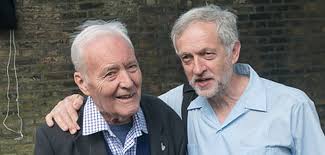
Tony Benn and Jeremy Corbyn: architects of Labour misfortunes
That stance got me interested in taking a longer-term view of British politics. So I looked at percentages of the popular vote in eleven elections over the forty years between 1979 and 2019. Clearly, the relative strengths of the two main parties, Labour and the Conservatives, would be of interest. It struck me, though, that it might also be useful to set them in the context of the overall landscape of parties of the broad right (the Conservatives, but also the hard right parties of today or their earlier embodiments, Brexit Party, UKIP, the British National Party) or of the broad left (Labour, the LibDems and their earlier forms, the Alliance or Liberals, the Greens or Ecology Party, the SNP and Plaid Cymru).
How the left (broadly) performs against the right
compared with Labour alone
What emerges is a curious picture. The ‘left’, in this broad definition (orange line), consistently outperformed the ‘right’ (black line) except in 2015. That surge for the right was principally down to UKIP’s 12.6%; the Conservative result was still an anaemic 36.8%.

With either proportional representation or some arrangement between the constituents of the ‘left’, the ‘right’ would have had a majority of the popular vote for only two years out of the last forty.

Now popular votes don’t necessarily translate into Parliamentary majorities. But if big enough, they can deliver victory, and the ‘left’ tends to be significantly ahead of the ‘right’ most of the time. That suggests that if Labour, the SNP, the Liberal Democrats and the Greens could have pulled together, the Tories would have been out of power for most of the last 40 years, instead of in power for 27 of them.

Interestingly, Labour alone (red line) only outpolled the combined right for three elections – unsurprisingly, the three when Blair was leader and in government. The leftie on Twitter, and others of his ilk there or on FaceBook, are also constantly assuring me that Blair was the lowest of the low and worthy of nothing but contempt. However, if we’re interested in keeping the Tories out of power, it’s worth remembering that he was the only leader in four decades able to ensure that Labour could do that on its own.

For the rest of the time, it would have had to work in partnership with others to oust the Tories. That’s clear from the second graph comparing Labour’s performance (red line) directly with the Tories’ (blue line). Again, only under Blair did Labour outperform the Tories. Otherwise, we’re consistently behind.
Labour performance alone against the Conservatives
Interestingly, the worst results are not under Corbyn. The worst of all, naturally, is 1983. Then Labour was led by Michael Foot, although Tony Benn, the deputy leader, was the main architect of our overwhelming defeat.

Since then, our lowest percentages of the popular vote came in 2010 and 2015. The Tories, however, were down then too, winning by small margins. Looking instead at the gap between Labour and the Tories, the worst elections of all were 1983 and 2019, Benn’s and Corbyn’s. Indeed, it is Corbyn’s greatest achievement to have gifted the Tories their second-highest vote share in that forty-year period. The only higher result was Maggie Thatcher’s first win in 1979.

The significance is that her victory was the first in a series. Johnson’s was the fourth in a row for the Tories, and the first time since the nineteenth century that any party has increased its Parliamentary representation in a fourth election victory.

Corbynists always said that Jeremy would do something remarkable. He has. Although I’m not sure this is what they meant.

This takes us to the nub of the problem for the hard left. One told me recently that whatever we learned from the 2019 election, we should not on any account ‘abandon the programme’. For Corbynites, no compromise is possible on Corbynist policies. That makes any hope of collaboration with other parties impossible. And that, as the last eleven elections demonstrate, means that the right would continue to outperform us.

Above all, with the kind of programme championed by Corbynites now or Bennites in 1983, we ensure not just a Tory win, but a colossal one. Why does this happen? Because Bennites and Corbynites want Labour to mirror their views, not those of the electorate. And the electorate has no time for their policies.

In the current leadership election, we need to choose a leader who reverses that. We need a leader who listens to the voters and goes to them with a programme that they can endorse, even though that means compromise, even giving up on some cherished policies. That way we can win back Labour voters. And if, in addition, we can compromise enough to attract other parties to our banner, why, we could kick the Tories out for a generation.

The alternative is to choose Bennite or Corbynite orthodoxy.

And we know what that gets us: the likes of Maggie or Boris.

Friday, 3 May 2019

Spain and England, a leader and a ditherer, a victory and a defeat

It’s been an interesting few days, watching a general election in my new home country, and local elections in my old one.

In the former, Spain, the right was routed. It’s true that the hard nationalist party Vox won 24 seats in the new parliament. This was presented as a lurch to the right by some in the foreign press, but the reality is that where the two main parties of the right had 167 seats in the previous parliament, now all three together – including Vox – have only 147.

Essentially, therefore, the election redistributed the votes of the right and then cut them back. It’s as though the hard wing and the more liberal wing of British conservatism broke off to form their own parties, and all three parties were returned with a total of fewer MPs than the Conservatives previously held on their own.

So it was a conclusive victory for the left. In particular, it was a major success for the incumbent Prime Minister, Pedro Sánchez, who gets to form a new government. Under the Spanish proportional system, he won’t be able to do so alone – he doesn’t have an overall majority – so he’ll have to come up with accommodations and agreements with other groupings. But he should be able to do some good.
Sánchez: the leader who won
My prediction? That’s exactly what he’ll do – some good. It won’t be enough for those on the left who believe all we need to achieve a Socialist utopia, is to elect a Socialist and have him wave a magic wand. That Sánchez won’t do, any more than Tony Blair did in Britain. I only hope that the result won’t be that Spain in turn has to suffer another ten years of conservative rule, and learn the hard way that demanding too much of your allies can let in your opponents, who give nothing at all and, indeed, take a great deal.

What about the elections in England?

Brexit continues to poison the atmosphere there. And the first victim has been the Conservative Party. Theresa May promised to deliver Brexit and has spectacularly failed to do so. The party was punished in the local elections, losing 1334 seats, over a third of those contested that it held before the election.

It’s normal for a party in power for nine years to lose local council seats. But on this scale? That’s a rout.

And yet it wasn’t quite the rout it should have been. The Labour Party, the official Opposition, should have been romping home. The seats lost by the Conservatives should have fallen to them. But they didn’t. Instead, Labour too lost 83 councillors – far fewer but a massive loss when it should be winning big against a government party in such disarray.
Corbyn: the ditherer who lost
Labour’s led by a man entirely after the heart of those who hanker for a magic wand. His supporters view him as a socialist and a man of principle. Neither claim seems particularly supported by the facts.

Those supporters like to claim that Labour, by not taking a position either for or against Brexit, has become the party of both those who believe in remaining in the European Union and those who want to leave. In other words, Corbynism refuses to back the EU and, instead, takes a non-committal line. As it admits itself, it does so in the hope of not putting off Leave supporters.

It’s not clear to me that sitting on the fence in this way is a principled position. On the contrary, it strikes me as the rankest opportunism, of just the kind that Corbynists like to allege against Tony Blair.

Nor does it seem to me to be particularly socialist. Opposition to the EU is a key view of the right, and especially the far right, anti-internationalist, xenophobic and insular as it is. What on earth is a socialist doing in that company?

In any case, this opportunist, electoral calculation isn’t paying off. As was predictable and predicted. By trying to please both sides of a deep divide, you end up pleasing neither.

The local election results make the point. Brexiters see Corbyn taking a lukewarm stance so they don’t vote Labour; they see May failing to deliver and don’t vote Conservative; so they stay home and vote for no one. Meanwhile, Remainers see Corbyn refusing to back the EU, so they too either don’t vote or vote for a party that explicitly endorses their stance – the Liberal Democrats, the biggest winners in this election, with a gain of 703 council seats, and the Greens, the second biggest, gaining 194 seats.

Corbyn’s paying the price for his lack of integrity.

The contrast between my two homelands is powerful. A real leader, with clear positions, won the Spanish general election. A fence-sitter, dithering on the great question of his time, lost the English local elections.

Oh, for a British Sánchez to lead Labour. Oh, for the chance to win a victory like his. And oh, for the chance to watch the wishful would-be wand wavers leave the scene.

Tuesday, 29 November 2016

Sheffield's trees: a maze worthy of Kafka

Have you been following the scandal that I like to think of as Sheffield-street-tree-gate? No? You don’t know what you’re missing.

Let me start by giving a little background. This may seem a bit of a roundabout way of setting the context, but bear with me – it will make sense in time.

It’s his novel The Trial that made an adjective, Kafkaesque, out of Kafka’s name. In it, the protagonist K (and, no, the choice of that single letter is unlikely to be mere coincidence) comes under investigation for a crime without ever being told what it is. And yet, even if he doesn’t know what crime he’s accused of, he somehow knows that he’s guilty – a neat way of expressing the universal sense of guilt, over the harm that each of us has somehow done. In The Ballad of Reading Gaol, his contemporary Oscar Wilde said “each man kills the thing he loves.”

As any of us would, K does try to deny his guilt. But the policemen who arrest him make it clear there’s no point:

”Our authorities, as far as I know, and I only know the lowest grades, don’t go out looking for guilt among the public; it’s the guilt that draw them out, like it says in the law, and they have to send us police officers out. That’s the law. Where do you think there’d be any mistake there?”

“I don’t know this law,” said K.

“So much the worse for you, then,” said the policeman.


Near the end, K explains his predicament to a priest.

“But I’m not guilty,” said K. “there’s been a mistake. How is it even possible for someone to be guilty? We’re all human beings here, one like the other.”

“That is true,” said the priest, “but that is how the guilty speak.” 


Kafka's Trial: a vortex that sucks us in and grinds us down
The Sheffield street-tree scandal concerns the activity of a private company, Amey’s, that has been contracted by Sheffield City Council to look after its trees. It has started by felling a number of them, and in one particularly notorious incident, showed up at 5:00 in the morning, demanding that residents move their cars or have them crushed by falling trees. Two women aged 71 and 70 found themselves arrested for the first time in their lives when they tried to prevent the felling, prompting protests from Nick Clegg, the local MP, who denounced “scenes you’d expect in Putin’s Russia.” I suppose that, given the President Elect’s admiration for Vladimir, one might be tempted to add “or Trump’s America”.

This is the same Clegg who, as leader of the Liberal Democrats, made a pact with the devil by entering a coalition with the Tories. That kept David Cameron in power for five years with nothing achieved for himself but the reduction of his parliamentary presence from 62 to 8. 

But I digress. 

The Save Sheffield’s Trees group told the Guardian that if Amey’s people “blitz the city’s trees in the first five years of their 25-year contract, they can spend the next 20 years with much lower maintenance costs”. I suppose some will see that view as unduly cynical. Not implausible, though, is it?

Another person arrested over the battle of the city’s trees is a Green Party member, Simon Crump. He apparently was held by the police for eight hours, but he believes it took that long because the police simply couldn’t find the right charge to bring against him in their computer.

“It was quite Kafkaesque,” he informed Helen Pidd of the Guardian. “I was being imprisoned because they couldn’t work out what to charge me with.”

He’s right. And no doubt, whatever it was the police thought he’d done, he was guilty as charged. 

Kafka would have been proud.

Friday, 3 April 2015

As we stifle in consensus over austerity, is the SNP the only hope for an alternative?

The great debate wasn’t that great. If it was even a debate.

Four men, David Cameron for the Tories, our current Prime Minister, Nick Clegg, his deputy for the Liberal Democrats, Ed Miliband, leader of the opposition for Labour, and Nigel Farage of UKIP, well for himself, and anyone who prefers bigoted belief over reason and evidence, faced off to three women, Leanne Wood for Plaid Cymru, Natalie Bennett for the Greens and Nicola Sturgeon for the Scottish National Party.

This was the single Prime Ministerial debate before the UK General Election on 7 May, televised last night. With seven contenders, no debate was really possible. Each candidate responded to a series of questions, and occasionally candidates cut across or challenged each other, but it was all a bit stilted.


The seven contenders in the Party Leaders' debate
So we learned little from the event. Except perhaps that the Celtic Fringe has a lot to teach England.

Leanne Wood persisted throughout in addressing Wales and Welsh voters. She seemed to have little to say to any other part of the United Kingdom, which seriously reduced the national impact of what she had to say. Even so, she did at least speak out against austerity, and for both the European Union and immigration, pointing out that leaving the former would do great damage, while threats to limit the latter were already harming her country.

That’s Wales, by the way, not Britain.

Nicola Sturgeon, on the other hand, was far more impressive. I’m sure that I’m far from the only Englishman who felt envious of the Scots, after listening to her. Why don’t we have someone so bravely and clearly articulating a message of the moderate left?

And I stress that word ‘moderate’. Many, and I include myself, have referred to Sturgeon as ‘radical’. But in reality she is not proposing anything revolutionary, or even particularly reforming: there’s no programme for mass nationalisation of industry here, or even of serious redistribution of wealth. Indeed, in many ways her programme is one for a conservative left wing: to maintain and protect the National Health Service, to keep access to tertiary education free. Even the most dramatic of the SNP’s positions is a demand for non-action, not for action: not to build the successor to the Trident nuclear deterrent.

This is a programme well to the right of the Attlee Labour government’s of 1945, which set up the NHS, along with the apparatus of the welfare state. It’s to the right of the programme of the Wilson Labour government of the 1960s, with its talk of storming the commanding heights of the economy. It’s telling that today the limited programme of the SNP seems to be the most daring on offer.

Amongst the representatives of the whole of Britain on show, only Natalie Bennett spoke for a similar anti-austerity view. A little dull, and representing a small minority of the electorate, she was never going to set this election alight.

Alongside her, we had Nigel Farage, beginning to sound far more wooden than he has in the past, certainly not the firebrand he once was and who won such massive support last year. To him, every question could only be solved by cutting immigration and leaving the EU – or was that leaving the EU in order to cut immigration?

And then we had Cameron proposing more and intensifying austerity, in the mistaken belief that all that matters is reducing national debt and eliminating the government deficit.

Against him, Miliband is at least speaking for the NHS, improving education and – at last – unequivocally denouncing the abomination of zero-hour contracts. This is the exploitative mechanism in which a worker is tied to an employee, but can’t count on any guaranteed level of work or earnings. That Miliband attacked it is welcome; but that he still seems committed to more austerity, if a lighter variety than Cameron’s, is dismal.

So it takes Nicola Sturgeon to speak out for the Centre-Left. The moderate Left, as I said. A little fresh air in the stifling atmosphere of the austerity consensus.

It’s sad that it should be so. But I suppose we can take some comfort that there is one voice, at least, clearly articulating arguments that badly need to be heard.

Tuesday, 13 January 2015

Solving the NHS crisis: it's the staff, dummy

It’s pretty widely known, even beyond British shores, that the NHS is in crisis (even though the crisis is denied, within these shores, by the government chiefly responsible for provoking i).

A recent NHS England document summed up the problem. An ageing population and the changing conditions the NHS has to treat, generate a 1.3% increase in demand each year. Add to that the arrival of new, often far more effective but significantly more expensive treatments, and the increase is more like 3%. In response to that upward pressure to do more, the government is demanding that the service keep finding ways to save money, by doing things more efficiently.

That’s from a service which has been squeezed on pay for years. In the current year, 2014/15, the independent pay review body set up by government recommended a 1% increase, which was derisory. But the government refused to implement even that: staff have been told to make do with no increase, and therefore a real-terms pay cut.

The staff hit back: sign at Hinchingbrooke Hospital
This isn’t to deny that there are ways the NHS could do things more cheaply. 

The big change is to prevent avoidable admissions to hospitals. Treatment in hospital is much the most expensive way of delivering care, and in the current year – which ends in March – we are already running 4% over plan. Clearly, something’s not right.

Keeping people out of hospital isn’t easy, however. What it requires is the provision of significant levels of care out in the community. For instance, a lot of care could be delivered by district nurses, who travel to patients’ homes, provide some of the care they need as well as helping the patients look after themselves. Since a district nurse visit costs in the region of £50 as opposed to £500 as pretty much the minimum for a hospital stay, it clearly makes sense to push this option – especially as most people prefer to be treated in their own home and often recover far better there than in hospital.

So it seems contradictory that from 12,000 district nurses in 2003, we’re down to 5500 today.

Equally, a lot of hope is being expressed on having some of the burden taken up by social care (care homes, domiciliary visits, social workers, etc.), run not by the NHS but by municipal government. But local councils have been hit particularly hard in the last few years, so social care budgets are down by 26%.

In other words, we know what needs to be done, but we take away the resources to do it. 

Sadly, Labour, while saying it would do more for healthcare, is also trying to cultivate an image of fiscal prudence, claiming that while it might not hammer public service as savagely as the Tories, it is still going to make cuts. Which may help explain why Labour has been haemorrhaging support among the young to the rather more radical Green party.

But let us come back to the question of that pay freeze in the NHS.

Things haven’t been particularly good in the private sector either, where pay rises over the last few years have tended be anything between nothing at all and a couple of percent or so, except at the very top: the people who’ve been loudest in proclaiming the necessity for pay restraint at the bottom have been more than happy to help themselves to 10, 20 or 30% increases in their own pay packets.

But even with small increases, over time the gap in salary between the health service and private industry, for the same skill level, has been growing steadily. Just as the constant increase in demand for healthcare has put staff under increasingly severe pressure. All of which makes a transfer out of the service more and more attractive, year by year.

That’s a step my wife has just made.

The same NHS England document I mentioned before assures us that “Our staff are our most precious and expensive resource, accounting for around two thirds of provider expenditure. There are opportunities to improve efficiency and the quality of care through better retention of our existing staff…”

Indeed. It might be good if the people who control the purse strings heeded that kind of notion.

The Tories will never listen. But Labour: are you listening? The NHS is one of your strongest vote winners. You have to get behind the changes that are needed: extending community care, reversing the decline of social care – and, above all, backing the staff.

Tuesday, 27 May 2014

After an Earthquake, reconstruction

So now we’ve had the earthquake in Britain. UKIP topped the poll for the European elections. We know the worst, and we know its extent.

After an earthquake, the first task is rescue and recovery. But actually this one wasn’t that scary. It’s nasty to see success for a party which, while strenuously declaring itself to be neither racist nor homophobic, somehow keeps turning up spokespeople who express thoroughly racist and homophobic views. Nevertheless, these were elections for the European Parliament, and though UKIP ran a campaign claiming that 75% of our legislation is made in the EU, the reality is that power still remains in London.

Victory in a forum which exerts little power over us? It’s not as catastrophic as success in Westminster elections would have been.

So no rescue or recovery. Instead we move straight to the next phase: reconstruction. And there we certainly have a lot of work to do.

While UKIP came top, it took just over 2% more of the vote than Labour. The last time the elections were held, in 2009, Labour fared miserably; it has rebounded into a perfectly respectable position. It has even forced the Conservatives into third place. That’s the first time they’ve fallen so low in a national poll. Not the first time for ages, the first time ever, in their entire history.

All that’s good. What’s much more worrying is that Labour took under 1.5% more of the vote than the Conservatives. That’s far too anaemic a lead for an Opposition party a year out from a general election: there tends to be a swing back towards government in the last few months and Labour is perilously close to losing its lead.

It isn’t clear whether that wisdom remains true in the new environment created by UKIP, with four parties in contest. Or five, if we include the Greens, and we should, since they overtook the Liberal Democrats, junior partners in the present government, last week. 


Maybe there will be less of a resurgence of government popularity in these circumstances than in the past, but I don’t think Labour should rely on that faint hope. Especially as a lot of UKIP supporters in these elections are likely to return to backing the Conservatives next year.

No, reconstructing a politics in Britain based on simple liberalism and tolerance is going to depend on Labour taking positive action itself. And the big question is going to be, what sort of action?

Commentators are all saying that UKIP’s success is going to force the other parties to consider its agenda more seriously. And that agenda has just two points: anti-immigration and anti-EU. The Tories will find it easy to move closer to those positions, but what about Labour?


Ed Miliband's task for Labout
win support back from UKIP without adopting its positions

Adopting a similarly little-England and xenophobic stance would be wrong in itself. Labour stands for inclusiveness and for international collaboration. Coming down hard on immigrants and opposing the EU means betraying fundamental principles.

But in any case it would do Labour no good. If I’m going to vote for a party which has those views, why would I vote for one that has only adopted them recently and doesn’t really believe in them? I might as well vote for the real thing. No, Labour needs to do something much harder. It needs to take on the UKIP discourse and show how profoundly misguided it is.

It has to argue the case for the EU, a reformed EU by all means, but the EU all the same; and it has to argue the case for Europe’s open borders – surely one of the great extensions of human liberty the European experiment has given us. And also deeply necessary, at a time when we need immigration to shore up an ageing workforce.

Labour needs to argue that case with conviction to win back enough supporters from those tempted by UKIP to give it a 5 or 6 point lead. That would be sufficient. But it isn’t going to be easy.

Put off by the scale of the challenge? 


Marine le Pen: the French have a real, devastating earthquake
Think of our friends in France. There the elections were won by a Front National which even UKIP is shy of, because of its racism. And the Socialists, far from coming second, came a poor third, massively diminished by a weak and ineffective President Hollande.

At least reconstructing after our own earthquake is a much more manageable task.

Monday, 26 May 2014

European Elections: the earthquake finally happened for UKIP. But it wasn't that big...

Well, it’s been an interesting night here in Britain, as it has throughout Europe, as we counted the votes for the European Parliament.

The results in Britain, as shown by the BBC
In Britain, UKIP came first. And that means that the commentators who’ve been talking up a UKIP earthquake, will feel justified. They’re not entirely wrong: UKIP have never previously won a national election of any kind, so we have to say well done to them. Even if it’s between gritted teeth.

Then, however, we can qualify that a bit.

First of all, and it’s part of the problem with the European Union, no one cares very much about the European Parliament. So they don’t mind voting strangely in European elections, handing the mainstream parties a kicking when it’s not actually going to change very much. There were indications of that in the fact that the elections were held in Britain on the same day as the Europeans, and in those local elections – which can actually affect voters’ real lives – they handed the victory to Labour.

Indeed, though UKIP came second in terms of new council seats gained, that still left them fourth in terms of representation, and in control of no councils. It seems that UKIP could only gain its victory in an election that voters felt wouldn’t affect them. 


Besides, the victory wasn’t that big: they have a lead of only 2.1% over Labour.

In many ways, what matters more was what happened to the other parties.

The Liberal Democrats are down to just one seat and saw their percentage of the vote halved. It seems that they’re being punished for having won themselves a great reputation sniping from the left at Labour when it was in power, and then joining a government of the right led by the Conservatives. We all saw it coming – I’m sure even they did – and now it’s on them.


The Greens overtook the LibDems, taking three seats and moving to near 8% of the vote and fourth position.

The Conservatives came third. That’s the first time in the entire history of the party, since its foundation, that it has come below second in any national election. Quite a record to break.

And then there’s Labour. It was only given a clear advantage over the Conservatives by the London result, a massive victory for Labour that left UKIP in third place. A result which made me feel less bad about staying up till 3:15 to see it announced. But Labour
’s lead over the Tories is under 1.5%.

Labour leading by 1.5% a year out from a General Election? That’s far too tight. As I wrote about the local elections, there’s one big lesson for Labour to come out of these elections: the party needs to lift its game and lift it big.

Meanwhile, of course, this wasn’t an election just about Britain. The saddest aspect of it? A huge victory for the Front National in France, despite its deeply xenophobic message: even UKIP, itself frequently suspected of racism, regards the FN as too racist to work with. A victory for the far right in Denmark, and in numerous other countries around the Continent. Perhaps the most worrying for its symbolism, small though it is numerically, is the election of a neo-Nazi from Germany.

There are difficult times ahead for the whole of Europe. And Britain’s problems are just part of that big picture.

Thursday, 22 May 2014

Euro elections, curious elections

Just been to vote. For the European Parliament. A curious election.
Where the action happened
On the one hand, we had the Conservatives, David Cameron’s Party. 

As usual, there’s the smell of corruption around them. The most recent scandal concerns the bright idea they had to encourage private colleges to spring up all over the place to offer higher education courses to anyone who could pay their fees. The London School of Science and Technology in Wembley has been signing up students as though they were going out of fashion, without getting too obsessed with banal details like qualifications or talent. 

The students pay the college £6000 a year for the privilege of registering. They collect £11,000 a year in dirt cheap student loans underwritten by the taxpayer. Rather a lot of them then don’t bother with any of those boring aspects of student life, like actually attending classes. It’s win-win: they gain, the college gains. OK, win-win-lose if you include the taxpayer, but hey, why bother about them if the government is applying its ideology.

This comes on top other wonderful experiences with privatisation, such as Serco failing to deliver on its contract to provide out-of-hours GP services, or G4S artificially inflating its invoices. None of that has stopped the government pursuing its privatisation agenda, with one of the most sensitive of services, child protection, the next in the firing line.

The main opposition to the Conservatives is Labour. Sadly, its leader Ed Miliband prefers substance over appearance. I say “sadly” because not many people seem all that interested in details of tedious hard work, like the drawing up of policy, and that’s what he seems best at. The policies are often good, but then he goes for an interview where it turns out he doesn’t know the name of the local representative of his own party or, when discussing the terrible standard of living problems he’s rightly identified as besetting ordinary people, the amount it costs most of them to shop for food.

That plays into the hands of those who want to write him off for his looks or how he talks, rather than listen to what he says.

What used to be the third party is rapidly becoming an also-ran. The Liberal Democrats used to be a great ginger group, snapping at Labour’s heels and occasionally helping to keep them honest. Now they’ve sold their soul to the devil, joining a coalition with the Conservatives, losing two thirds of their electoral appeal in the process and rapidly disappearing into irrelevance.

The great unsung story of the last few years is the rise of the Greens. Their share of the vote climbs slowly but steadily. It would be surprising if they don’t move ahead of the Liberal Democrats in this election.

And finally we have the great shocking spectacular of this campaign, the United Kingdom Independence Party, UKIP. They are the reverse of Labour. They have lots of image but practically no policy at all.

You might think this might weaken their position but it has the opposite effect. Firstly, they don’t bore those people who find substance tiresome. Second, you can’t tie them down to anything. Every time an opponent says, “ah, yes, but UKIP want to do such and such,” a spokesman will reply “oh, no we don’t. That’s not our policy.” And that’s true, since they have no policy.

Instead they rely entirely on the politics of appearance over substance. Above all, that means the appearance of their leader, Nigel Farage. He seems friendly, approachable, honest. Where the operative word is “seems”.

The reality is that in the absence of any policy, he has concentrated on peddling a position based only on attitudes. And those attitudes are entirely negative. He and his party are against the EU, they’re against immigrants. They don’t seem to be in favour of anything much, unless it’s taking Britain – or more likely just England – back to a golden past, which is doubly impossible, firstly because you can never get back to the past, and secondly because it never existed in the first place.

As for honesty, you should watch Farage when he’s being quizzed about his own behaviour as a Member of the European Parliament. He started by declaring that he would have his expenses subjected to an independent audit. He then decided that actually he wouldn’t, unless the other parties did the same. When it was pointed out to him that the other main UK parties did just that, he said that it would be a decision to be taken by the entire UKIP group as a block.

Anyone else, in any other party, would be regarded as thoroughly shifty for dodging around like this, changing his ground and avoiding the issue. Farage seems to be allowed to get away with it, for reasons that escape me.

So what’s this election going to give us?

The most likely outcome: a thumping win for UKIP.

What will that show? That a sizeable proportion of the electorate prefers form over substance. And that it’s happy to be driven by a politics of fear and hatred, of reactionary nostalgia.

Quite a tribute to the deviousness and tactics of UKIP. Not much of a tribute to the good sense and good judgement of the British electorate.