Wednesday, 1 May 2019

Valencians celebrating but not partying

When Valencians celebrate, they like to drink a lot of wine and make a lot of noise. In particular, they enjoy letting off fireworks – not necessarily the ones that fly up into the air and explode in joyful colours, but often the ones that just make a massive noise, at which they express hilarious delight while anyone trying to sleep nearby expresses bitter resentment.

It's as though living in their charming and pretty city leaves Valencians hankering for the challenges and excitement of a war zone.

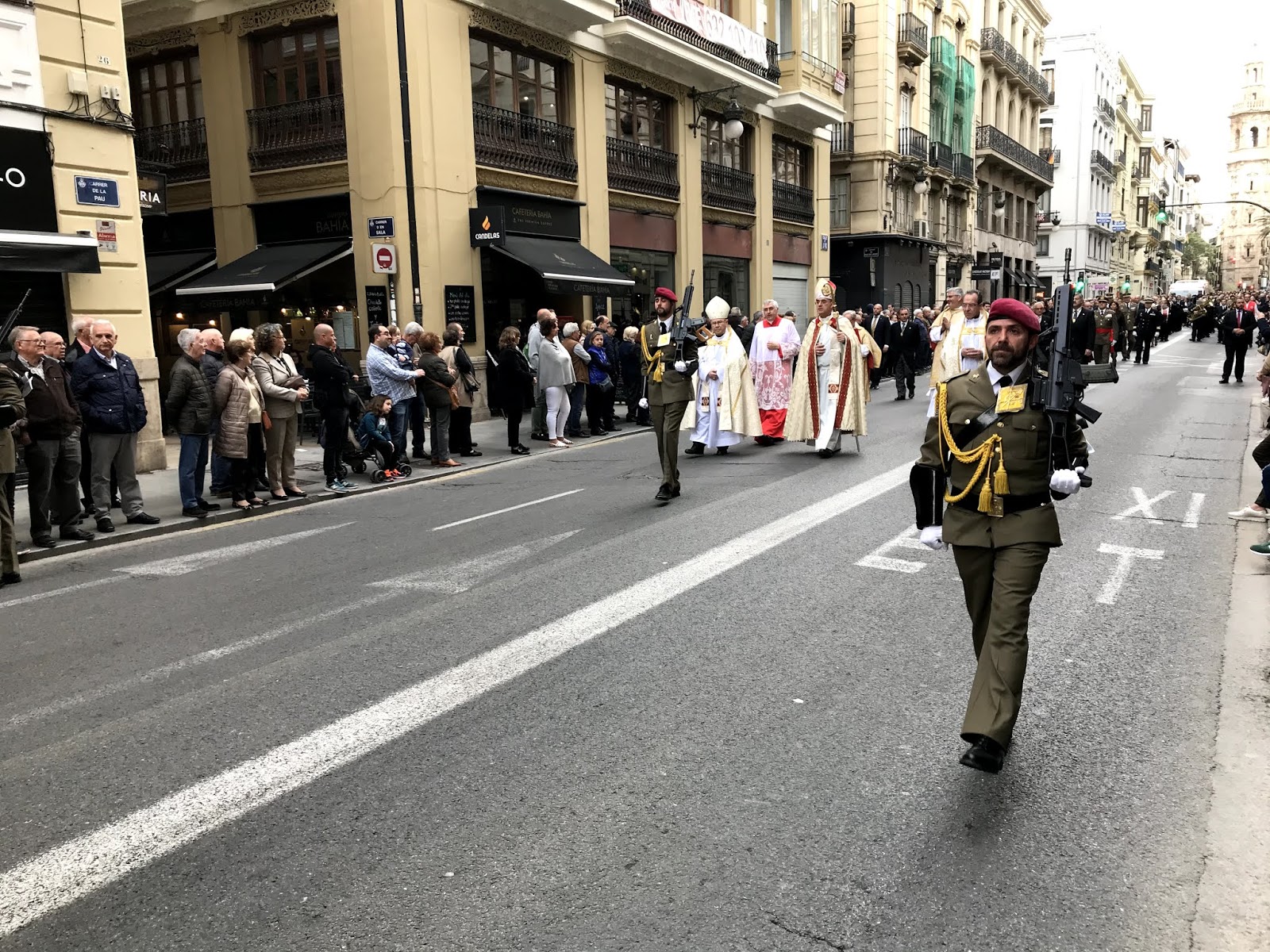
So the procession in honour of St Vincent Ferrer, one of the city’s patron saints, was a curious anomaly which was all the more worth seeing for that very reason.

It was much more solemn. Quiet even. People genuinely processed, they didn’t sing or dance let alone drink. There weren’t that many of them, even, possibly a testimony to the fact that religious observance, even in Catholic Valencia, is not quite as widespread as one might imagine. And maybe also that spiritual events tend to be predominantly patronised by the wealthy, a suspicion rather underlined by the quality of the clothes many of the participants were wearing.

Still, it was fun.

Horsemen. Or, more correctly, horsepersons
At the front of the procession were a couple of horsemen, though one of them, in fact, was a horsewoman.

He deserves the honour. Or was he just working?
Immediately behind came a member of a crucial band in Valencia: a street cleaner. I’m not saying that you could eat a meal off the city’s streets – not, at least, safely, and I don’t just mean because of the traffic – but they are busily swept and scraped by devoted hordes of cleaners on every working day and quite a few holidays too.

Seeing a street cleaner near the front of the procession struck me as an appropriate honour. Though I think it would honour these valuable people still more if Valencia’s dog owners made more of a point of cleaning up behind their dogs – certainly, our local cleaner, a lovely lady called Marian, complains of how little they seem to care and how quickly they allow their pets to foul the pavements after she’s passed by.

On the other hand, it’s possible that the cleaner wasn’t there to be honoured. He may just have been tasked with clearing up behind the horses.

The costumes were mostly sober black.
Sombre in black, but spritely with it. Great to be that fit at that age
Even black, though, isn’t bleak if you’re young enough.
On some people, black's not so dismal
In any case, many were in traditional dress which was far more colourful.
Traditional dress
Sometimes they came in larger groups, too, to underline the principle that celebrating a saint needn’t be a dire business.
Traditional dress, massed
Why, we even saw a group of what were apparently young Dominicans. Accompanied, it would seem, by minders, though I’m not quite sure why they needed them.
Young friars. Or novices. Apparently
And, of course, where the national religion goes, the national military can never be far behind: the more senior clerics duly escorted by armed men.
Goose-stepping along
Neatly confirming the link between Church and State
More senior representatives of both the military and police were there too, though apparently unarmed. The top brass doesn’t do the dirty work: it has far more junior and less well-paid underlings to do it for them.
The senior officers were there too
All branches of the services and the police were represented
Away from the procession itself, there were stages set up on street corners, where children under 13 were performing miracle plays.
Street theatre miracle plays. By children
The celebration gave us an unexpected view of a certain section of Valencian society. And an interesting contrast to the way most festivities take place in this city. 

It was amusing, and a little surprising, to see Valencians engaging in a celebration without turning it into a party.

Friday, 26 April 2019

Shetland: exactly as it ought to be

There’s something satisfying about going to a place for the first time and finding it exactly how you’d expect it to be.

That’s how I felt on my first visit to Shetland this week.
There wasn’t much sun, but when it appeared, it was truly a burst
We – that is, my colleague Katie and I – due to hold three training sessions in the local hospital, arrived by tiny plane, just three seats wide. There was only one cabin attendant, which meant that there were more crew members in the cockpit than in the cabin. The plane was driven by propellers, which isn’t something I’ve seen all that often in recent times.

It came down low on its approach to the airport, so we were practically skimming a slate-grey sea that looked bitterly cold. And suddenly, looming out of the water to our left, was a first island – a mound of rock crowned with grass, uninhabited and sinister in its sheer black sides.
We saw more fog than sun.
And no puffins, though we looked and looked
Just then the wind caught us shaking us from side to side until we were a foot or two above the runway. As soon as we touched down, the pilot hammered the brakes, and we stopped just before the runway ran out – as we turned away I could see the black sea just beyond the end of the runway, too close for my liking.
Not sure whether they were Shetland ponies
but they were ponies, and on Shetland
As we got off the plane, straight onto the tarmac, the wind came howling back. There were even airport staff holding the propeller tips on both sides of the aircraft to stop them being whipped round by the wind and potentially injuring someone.

“Really?” a Scotswoman behind me wittily remarked, “Shetland and there’s wind?”

“Quite,” her companion quipped back, “who’d have expected that?”

There’s only one carousel for luggage inside the terminal, and it was out of action. So a woman standing by the door hauled our bags in, one or two at a time, and we collected them from her.

On our way, Katie and I had debated whether we ought to hire a car. We’d been told taxis were expensive. So we went online looking for car rental sites. The one she generally used announced that the driver had to be aged 30-65, and I’m just outside that range (for clarification, I’m not 29). So it wouldn’t hire me a car, but I had to be the driver, as she was only staying one night while I was staying three.

We decided to take our chance on arrival.

The car hire counter was inside the terminal baggage hall. But then the baggage hall is also the arrival lounge and the departure lounge. In fact, the whole terminal building is one long hall with various bits playing various roles. One door leads in from the tarmac for people arriving, and another, for departing travellers, leads out to the same tarmac by way of a security scanner. Indeed, at one end of the hall, behind a gaily decorated partition, there is even the Caffé Volare, which looked cheerful enough.

No surprise, then, that the car rental counter is also inside the building. We approached it while we were waiting for our bags. I explained we wanted a car but I was just a tad over the age range.

“Oh,” said the man behind the counter, who looked little younger than me, “I expect we’ll be able to come to an arrangement.”

We did.

One of the annoyances of hiring a car is that you’re supposed to return it full of fuel. I asked whether there was a filling station nearby.

“There is,” he said, “but don’t worry. If it isn’t full, we’ll fill it for you. And it won’t cost you any more than if you did it yourself.”

This was unusual. And unusually pleasant.

“In fact,” he went on, “seeing how early you’re going to be leaving, I doubt you’ll find the filling station open. Just fill up in Lerwick and don’t worry about the drive here.”

Lerwick, the main town on the islands, is about 40 km from the airport.

We got to the hotel at about 8:30. It was a physician who’d put Katie in contact with the people at the island hospital and he’d also recommended somewhere to eat: The String, he’d assured, us was outstanding. She rang.

“We stop serving at 8:00,” they told us.

Having turned up in Shetland from Spain where people look at you as though you’re mad if you want to eat before 8:00, this was a curious experience.

We had the same response from two other places. There were only two or three places prepared to serve us after 8:00. Since one was our hotel, we ate there.
Eventually we made it to the String
But for lunch. And very good it was
I felt slightly awkward about that because my boss has a rule for us when we’re away from home: “never eat in your hotel, never eat in a restaurant that’s part of a chain, and never eat in the same place twice.” It’s a good rule, and I try to stick to it. But it wasn’t made for Lerwick on a cold weekday evening.

As we were finishing our meal, the cheerful and friendly woman who was doubling up as reception clerk and waiter in the dining room, asked us whether we were planning to go out for the evening at all. We told her we were considering the possibility.

“Oh,” she said, “there’s live music in one of the pubs. Shetland music. If you feel up to it, you might try that.”
Live Shetland music
Though the woman with the fiddle is Danish and the man
holding the guitar beyond her is her husband, from Indonesia
We did. And it was excellent. Although I was amused to discover, from talking to him, that one of the musicians was from Indonesia and his wife, who was playing one of the fiddles (they may look like violins, they may even sound like violins, but when it’s playing a jig, Irish or Shetland, it’s decidedly a fiddle), was from Denmark.

We had a great evening. And Shetland got another opportunity to show its worth: as I left the pub, I realised I’d left my bag behind, with my wallet and my passport in it. But I’d barely started to climb the stairs again before I met a man clattering down them holding my bag out to me.

“Did you forget this?” he was saying.

Nothing was missing from it.

And that wasn’t the last opportunity for Shetland to display what it’s made of. As we walked back, we were hit by the cold of the wind off the North Sea (Lerwick is on nearly the same latitude as Bergen in Norway, which is closer to it than Edinburgh, ostensibly the capital, Shetland being part of Scotland). Rain was spitting down too, and as we emerged on to the harbourside, we could taste salt in the water hitting our faces. The sea, sleekly black and cold, looked troubled, uneasy even, as though it was a bit irritated by this lump of rock sticking out of it and troubling its flow. So it was going to have a go at worrying it a bit.
Practically in Norwy
Pure Shetland. Exactly as I would have expected. And I wouldn’t have had it any other way.
The view from my hotel room
Great to wake up to. If it were always this sunny...

Tuesday, 23 April 2019

General election excitement. And good sense

Exciting times in Spain these days.

We’re in the run up to a general election on Sunday 28 April. 

Yes, they hold their elections on Sundays. I know that in Britain we like to have the suspense and excitement of having to get up stupidly early to vote on a Thursday before going to work, school or college, or to dash back afterwards to get to the polls before they shut. But as is well known, Spaniards aren’t that excitable. Or possibly don’t go in for that kind of excitement much. They vote on a day when most people aren’t working at all. So they can do so at leisure.

Dull, I know, but hey, that’s what common sense looks like.

The main street near where we live has been taken over, for its whole great length, by banners advertising the Partido Popular or Popular Party. That’s the equivalent of the British Conservatives. Or at least it was until the Conservatives lurched rightwards and joined a harsher grouping in the European Parliament.

The popular party isn’t actually all that popular at the moment and, unless the polls have got it completely wrong, they’re not likely to do well. In fact, as things stand, it looks as though the PSOE led by the current Prime Minister, Pedro Sánchez, may pip them to the post.

The PSOE is the equivalent of British Labour. Or at least it was until the Labour Party lurched into left wing rhetoric and Brexit appeasement of the hard right.
Isabel Bonig's face dominating our main street for the (not-so) Popular Party
‘Valor Seguro’ the banners along the main street proclaim, with photos of Pablo Casado, running for Prime Minister of the nation, or Isabel Bonig, running for President of the region that includes Valencia. 

‘Valor Seguro’ isn’t that easy to translate. Maybe the sense is best conveyed by a free translation as ‘Sound Values’.

I can’t help feeling that has something of a Theresa May ring to it. Do you remember the 2017 UK election and her slogan ‘strong and stable’? It didn’t do her much good. And I don’t think Mr Casado’s sound values will do him much good either, especially since, however strongly he may hold them, the banners dont tell us what they are. After all, ‘enrich the financier and beggar the unemployed’ are values, aren’t they? I’m just not sure that most of us are all that happy about governments that are sound about those values, as God knows far too many are at the moment.
Valor seguro: the slogan is from Bonig's party leader, Pablo Casado
To be fair to Ms May, at least you can’t accuse her of lying in her promise to be ‘strong and stable’. Not, at least, if you accept that the words apply only to her and to neither the government nor the party she nominally leads. And even then the terms apply only in the rather restricted sense of ‘obdurate and inflexible’. Certainly, that’s been her approach to the Brexit negotiations, for instance. She has a solution. She presents it to the rest of us, politely at first. And when it’s rejected, she waits a bit and then presents it again, a little more forcefully. As so it goes, until she’s practically shouting in our ears. She’s apparently incapable of understanding that the problem isn’t our inability to hear her, but her inability to listen to us.

Still, that’s strength and stability of a kind, isn’t it?

Thats the problem with soundbite slogans  ‘Strong and stable’ sounds good, but only if you interpret the slogan in a certain way. Give it a different slant, and it’s not so hot. Just like ‘Sound Values’. It all depends on what you mean by them…

Anyway. We’ll see on Sunday how the parties fare in Spain. Fingers crossed that the country may prove once more that sane good sense still prevails in some nations.

The kind of good sense that led to them holding elections on a non-working day in the first place.

Sunday, 21 April 2019

The rain in Spain

It was wonderful having so much of our family with us this week. That’s all three boys, with both daughters-in-law and a granddaughter. The only one missing was our daughter-out-law, whom we’d have been delighted to see too, but she’s a doctor and you know how hard it is for them to get time off.

Our granddaughter’s family came to us from Scotland. It was good to be able to welcome them to our new home in Valencia not just because Valencia’s such a lovely place, but also because it gets such wonderful weather.

Except when it doesn’t.

And it didn’t this week.

Three days of unbroken rain and frankly chilly conditions preceded their return to Scotland. Where the temperatures are pleasantly warm and the skies enchantingly clear. Spring at its best, in fact.
Rain in Valencia is rain with a vengeance
When I talk about unbroken rain, I’m not talking about the kind of fine drizzle that often spoils an hour or two in England, but only returns after a break for better conditions when one can actually get out with the dogs in the dry. No. I’m talking about rain that’s flooding down when one wakes up in the morning and is proceeding exactly the same way when one goes to bed at night. Great sheets of water that the drainage system simply can’t cope with, so that the streets gradually flood and it’s dangerous (as I discovered) to walk past a puddle as a bus races up the road.

I can safely attest that the rain in Spain is too much for the drain.

Ah, well. At least I know it won’t last. In fact, the forecasts are absolutely explicit on the subject. On Tuesday, the fine weather returns. Temperatures in the twenties (that’s the real twenties, none of that ropey Fahrenheit stuff) and sunny skies again.

A return to springtime, in fact. Just as I’m about to leave for Scotland myself. Where the lovely weather is due to break on Wednesday, with steady rain starting on Thursday. Right through to my return on Saturday.

Ah, well. They do say that into every life, a little rain must fall. Looks like my life is set for quite a lot of the dripping stuff for some days. 

In my view, it’s all down to Karma. As I said, I’m not due home until Saturday. Quite late, as it happens. And that’s Danielle’s birthday.

I suppose I can’t expect meteorology to look kindly on me if I treat my wife’s birthday with such casual indifference. I clearly brought it on myself. And this week Im going to pay.

Note to self: plan work better next year.

Friday, 19 April 2019

Cockup not conspiracy. Comedians not clowns

One of the problems with conspiracy theories is that they require a belief in human ingenuity that is way beyond me. Not just ingenuity but also discretion. The latter is an even rarer quality.

The belief that the moon landings were faked, still firmly held by certain people, would have required the active participation of some 400,000 people (as calculated by James Longuski). It seems inconceivable to me that anyone could have maintained that huge a conspiracy, all working to a single end for a twelve-year period. But still more unbelievable is the notion that not one of those people would ever have told the story to anyone else.

Surely some journalist out there would have been able to offer a handful of them sufficient inducement to spill the beans?

What I have far less difficulty crediting is the opposing cockup theory of history. Call me a cynic if you want, but I find it inherently plausible that most of the things that go wrong around us are down to sheer incompetence rather than to ingenious scheming. Human stupidity, it seems to me, is fully capable of explaining most human-made catastrophes.

Take the difficulties the Labour Party is currently facing over anti-Semitism. Now I’m absolutely convinced that there are some vicious anti-Semites in Labour who ought to be kicked out. But the failure of the leadership to act isn’t, I suspect, down to their sinister complicity with the small numbers of real anti-Semites, but simply down to their ineptitude.

Why am I so convinced of that notion?

Well, take a look at the tweet the British Labour leadership sent out – and then had to delete minutes later – to wish Jews a happy Passover. It’s clearly intended to be cheerful, friendly and encouraging. An olive branch, if I can use a Christian image, towards the Jewish community.
Labour leader trying to mend fences with the Jewish Community
and cocking it up...

Alas, one of the festive little icons is a loaf of bread. As rather a lot of Jews immediately tweeted back, the whole point of Passover is that Jews don’t eat bread over the feast. Instead they eat an unleavened equivalent, matzos.

To be fair, I wouldn’t have spotted the error myself, despite my own Jewish heritage. I don’t keep Passover any more than I celebrate Easter, the Christian equivalent. But I don’t run the Labour Party. And I’d like to think that the Labour leadership has the Jewish contacts to ask about this kind of tweet before it sends it out, and the gumption to check with them.

Well, clearly not. Which suggests that their weakness on Jewish issues probably isn’t down to racism, but merely to incompetence. Which is a relief, since it would be appalling to have a racist leadership. Though, frankly, an incompetent one is only marginally preferable.

Similarly, I have no difficulty believing that no evidence exists that Trump actively colluded with Russia during the 2016 election. I think such collusion would require a greater level of skill – Machiavellian skill, certainly, but skill anyway – than I’ve seen him demonstrate at any time before or since. The man who could repeatedly proclaim his enthusiasm for Wikileaks during the campaign, and even call on the organisation to release more of Hillary Clinton’s emails, and now claims he knows nothing about it, is simply too flaky to see a conspiracy through.

That he might have been the beneficiary of one I find far less difficult to believe. That people conducted one and kept him deliberately out of the loop is certainly plausible. But that he conducted one? No chance.
Trump: cockup par excellence. But in the White House anyway
No. Trump’s an exemplary cockup artist, not a fiendishly clever conspirator. Again, however, as with Labour leadership incompetence, that’s not a hugely preferable alternative. After all, he’s in the White House anyway, however he got there.

All this puts me in mind of what’s happening in the Ukraine. It looks as though a comedian, known for playing the role of President on TV, may be about to be elected President for real. A genuine comedian in charge.

Volodymyr Zelenskiy, Ukrainian comedian playing President
and now on the brink of being elected
A change, I suppose, from the clowns at the top of the US government or the British Labour Party. Though, once more, it’s not clear that it’s much to be preferred.

Tuesday, 16 April 2019

Faith and politics

Faith-based politics can be a hell of a pain. As heretics frequently discovered at the hands of their fellow Christians, of a faintly different shade, in the Renaissance. Or as gays are likely to discover in Brunei, for instance, since that fine country chose to make gay sex an offence punishable by stoning to death.
Forgiving the trespasses of others
When Christians dealt vigorously with differences in faith
But even before it reaches that point, before it comes to power, a political movement based on faith is pretty dire. After all, there’s always the fear that once in power, it’ll behave as badly as the Sultan of Brunei or Renaissance Christians. You start off thinking that the leader cannot err, and the next thing you know he’s decided you have been erring unpardonably, and torturing you prior to your execution, as many a Russian Stalinist discovered to his cost.

The starting point for these aberrations is to take belief as a starting point instead of evidence. Indeed, any notion that contradicts belief has to be discounted, even if it was previously an article of faith. So for instance I was told recently by a Corbyn supporter (I’m resisting the temptation to write “cultist” or even “worshipper”):

For the first time in decades the poor are dying younger than they used to. Deciding to Remain or to Leave will not do a sausage to help the weak. You used to care. A socialist and redistributive government will help everyone whether we are in or we are out. Jeremy Corbyn is fixated on the main prize.

It’s certainly true that someone hungry is entirely indifferent to whether Britain is in the EU or not. At least, in any general sense. But such such people do care about whether there will be any wealth to distribute in their direction.
Whoops! Did I say that?
Corbyn: object of reverence with no evidence to justify it
Whatever harm he did to socialist thinking, Marx can at least be congratulated for realising that its bedrock has to be economic. What economic principle can be simpler to grasp, than the notion that what makes the nation poorer, makes it harder to haul individuals out of poverty?

So while the poor may not care about the EU, leaving the EU will make it far harder to tackle their problem, because it will make Britain as a whole poorer. That really does matter to the hungry. It doesn’t matter how “fixated” Corbyn may be on the main prize (and this is the first time I’ve seen the notion of fixation presented as a good thing), if the resources for reaching it are reduced, it will be all the harder to achieve it.

To put it in simpler terms, the more you reduce the wealth of the nation, the less there is to redistribute and the less likely you are to end poverty.

My Corbynist friend has clearly chosen to ignore such simple truths. Instead, he has a request for me:

Please do not abuse a man who is working for the many and is trying to reconcile Leave voters and Remain voters.

Another fan of the revered leader added:

I fully support Jeremy’s philosophy of moving the conversation away from Leave/Remain, to what is it that we’re actually looking for out of this situation.

Now I think it’s smart politics to move a national conversation away from a subject that isn’t doing you any good, to more favourable ground. So Corbyn’s not wrong to make the attempt. Equally, trying to reconcile leave and remain voters is a wonderful intention.

But let’s try to remember what the road to hell is paved with. Good intentions? No use to anyone if they don’t deliver. They certainly don’t feed the poor.

And are those good intentions leading anywhere useful? Britain has never been more divided between pro- and anti-Brexit camps. The gulf deepens daily. And as for changing the topic of conversation – does anyone really believe that Corbyn has managed to stop the country talking about Brexit?

Well, maybe his fans believe he has. But then they don’t look at evidence. What they’re proclaiming is simple faith.

Sadly, at the moment, I see no sign of its moving even the smallest of hillocks.

Saturday, 13 April 2019

England their England

It’s been fun to re-read Ben McIntyre’s biography of Kim Philby.

These days, Philby’s name may not be as well-known as it was in my youth. He was the man once tipped to lead Britain’s counter-espionage service, MI6, and who was involved in practically every major operation it had run between 1940 and 1951. Then he fell under suspicion of being a spy for the Soviet Union, and having therefore betrayed every single one of those operations, but the charges weren’t proved at the time. Indeed, four years later he was back in British intelligence and spying for both his masters – MI6 and the Russian KGB – until he was finally and conclusively exposed in 1963 when he defected to Moscow.

The biography’s title is apt: A Spy among Friends. Philby was recruited by the Russians in the 1930s, but waltzed into MI6 in 1940 with barely a question to answer. He had been educated at one of Britain’s great public schools (as we confusingly call our major private schools) and one of the ancient universities, Cambridge. He belonged to an elite of friends or at worst friends-of-friends, who knew that each could trust each of the others.
Kim Philby: a joy to his friends. Whom he joyfully betrayed
His closest friend, and the man he therefore duped most comprehensively, was Nicholas Elliott, who explained his own recruitment into MI6:

There was no serious vetting procedure. Sir Nevile [Bland, a senior diplomat] simply told the Foreign Office that I was all right because he knew e and had been at Eton with my father.

Membership of this elite group simply opened all doors and Philby, like Elliott, simply slid through them into the very heart of Britain’s secret world, where he could betray and harm the most.

That leaves me with some contradictory feelings. I find that sloppy, incompetent elite deeply unpleasant. It runs the country still, chiefly through its control of the top positions in business, the services and politics (principally through the Conservative Party). A fine example of that elite would be David Cameron, who was Prime Minister from 2010 to 2015 and whose legacy is Brexit.

In a sense, then, I suppose I should approve rather than censure Philby. He acted out of communist conviction. A man of the left taking on a deeply entrenched, massively incompetent and shamefully complacent group of rulers firmly anchored to the right. But I just can’t see anything admirable in what he did.

Perhaps it’s because of the cold-bloodedness and cruelty of his treachery. For instance, several hundred young Albanians were sent by the CIA and MI6 into their homeland to foment unrest against the then Communist government of Enver Hoxha. It strikes me as a brainless thing to have done, undoubtedly illegal, and violent in intent. But I can’t bring myself to like the action taken by Philby, who ensure that they went to their deaths by betraying them to the Soviets. Still worse, several thousand others died with them: relatives, friends, sometimes even people unfortunate enough to share a surname with one of the infiltrated subversives.

I don’t know. I don’t find anything admirable in that. In much the same way as I find it hard to admire a murderer, however unpleasant the victim.

Then there’s another reason. Because another possible title for McIntire’s book could have been An Englishman Abroad, had the title not already been taken by an excellent TV film about another of the Soviet spies who worked inside MI6, Guy Burgess. Even when Philby made it to Moscow, he never stopped hankering for English things. Phillip Knightley, from the spy-hunting service, MI5 – MI6’s rivals – claimed to know what Philby longed for in Moscow:

He’s a totally sad man, dreaming of a cottage in Sussex with roses around the door.

When Philby’s third wife left him in the Soviet Union, his gift to her was telling: the school scarf he had kept since his time at Westminster. He clearly felt a deep bond of loyalty to the very institutions he was betraying.

The Soviets recognised his Englishness. When Philby married his fourth wife in Moscow, the KGB’s present was a quintessentially English tea set in bone china. Even Philby himself described himself as “wholly and irreversibly English”.

Strangely enough, I too feel profoundly English. But mine is a different England from his. I recently watched The Happy Prince, a TV film on Oscar Wilde’s decline into death. In it, Wilde at one point describes England as the natural home of hypocrisy. That’s the England that Philby belonged to, champion of deception that he was.

Sadly, it seems to me that Brexit Britain has chosen to become that kind of nation. Certainly, the like of Boris Johnson or Jacob Rees-Mogg, leaders of the Brexit movement, belong to precisely the same type of entitled, self-selected, public-school and ancient university-educated elite that spawned Philby.

I belong, in some deeply-rooted sense, to England. But that kind of England is not where I want to live. Which is why I don’t live there any more.

The story of Kim Philby reminds me of exactly why.