Showing posts with label Catholicism. Show all posts

Wednesday, 1 May 2019

Valencians celebrating but not partying

When Valencians celebrate, they like to drink a lot of wine and make a lot of noise. In particular, they enjoy letting off fireworks – not necessarily the ones that fly up into the air and explode in joyful colours, but often the ones that just make a massive noise, at which they express hilarious delight while anyone trying to sleep nearby expresses bitter resentment.

It's as though living in their charming and pretty city leaves Valencians hankering for the challenges and excitement of a war zone.

So the procession in honour of St Vincent Ferrer, one of the city’s patron saints, was a curious anomaly which was all the more worth seeing for that very reason.

It was much more solemn. Quiet even. People genuinely processed, they didn’t sing or dance let alone drink. There weren’t that many of them, even, possibly a testimony to the fact that religious observance, even in Catholic Valencia, is not quite as widespread as one might imagine. And maybe also that spiritual events tend to be predominantly patronised by the wealthy, a suspicion rather underlined by the quality of the clothes many of the participants were wearing.

Still, it was fun.

Horsemen. Or, more correctly, horsepersons
At the front of the procession were a couple of horsemen, though one of them, in fact, was a horsewoman.

He deserves the honour. Or was he just working?
Immediately behind came a member of a crucial band in Valencia: a street cleaner. I’m not saying that you could eat a meal off the city’s streets – not, at least, safely, and I don’t just mean because of the traffic – but they are busily swept and scraped by devoted hordes of cleaners on every working day and quite a few holidays too.

Seeing a street cleaner near the front of the procession struck me as an appropriate honour. Though I think it would honour these valuable people still more if Valencia’s dog owners made more of a point of cleaning up behind their dogs – certainly, our local cleaner, a lovely lady called Marian, complains of how little they seem to care and how quickly they allow their pets to foul the pavements after she’s passed by.

On the other hand, it’s possible that the cleaner wasn’t there to be honoured. He may just have been tasked with clearing up behind the horses.

The costumes were mostly sober black.
Sombre in black, but spritely with it. Great to be that fit at that age
Even black, though, isn’t bleak if you’re young enough.
On some people, black's not so dismal
In any case, many were in traditional dress which was far more colourful.
Traditional dress
Sometimes they came in larger groups, too, to underline the principle that celebrating a saint needn’t be a dire business.
Traditional dress, massed
Why, we even saw a group of what were apparently young Dominicans. Accompanied, it would seem, by minders, though I’m not quite sure why they needed them.
Young friars. Or novices. Apparently
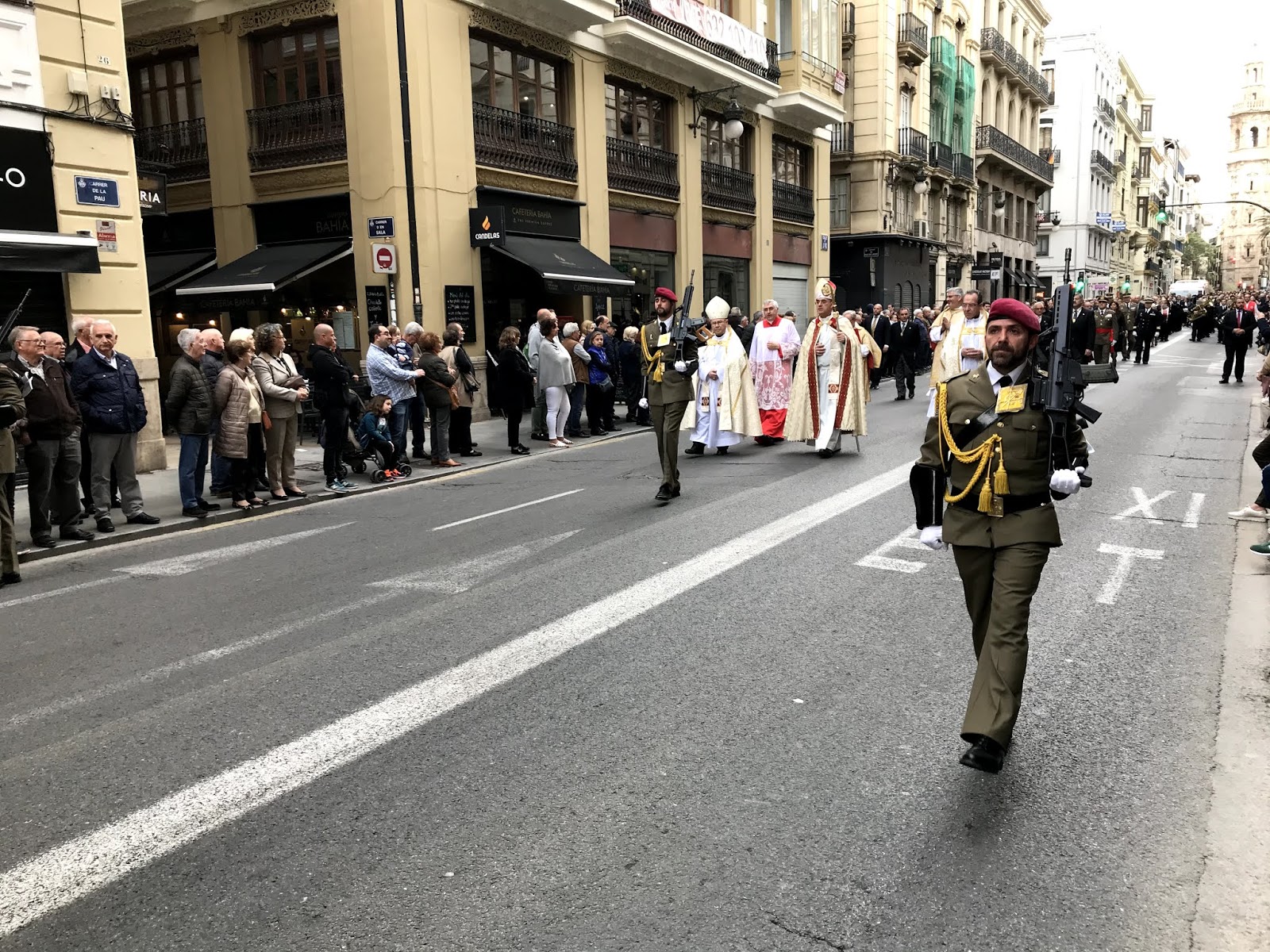
And, of course, where the national religion goes, the national military can never be far behind: the more senior clerics duly escorted by armed men.
Goose-stepping along
Neatly confirming the link between Church and State
More senior representatives of both the military and police were there too, though apparently unarmed. The top brass doesn’t do the dirty work: it has far more junior and less well-paid underlings to do it for them.
The senior officers were there too
All branches of the services and the police were represented
Away from the procession itself, there were stages set up on street corners, where children under 13 were performing miracle plays.
Street theatre miracle plays. By children
The celebration gave us an unexpected view of a certain section of Valencian society. And an interesting contrast to the way most festivities take place in this city. 

It was amusing, and a little surprising, to see Valencians engaging in a celebration without turning it into a party.

Tuesday, 28 June 2016

A smile for brexit, Storks like San Francisco Chinese, a fountain flowing with wine. And much more besides

A French policeman flagged us down as we crossed the border from Germany. He walked over to us, his face set, his air threatening. As we let down a window, he leaned in.

“Brexit or no Brexit?” he asked, having spotted our British number plates.

“No Brexit, no Brexit,” we chorused.

“OK, passez,” he assured us.

We’ve just spent a few packed days in the town where we used to live. That’s Kehl, in Germany, which has been a district of the great German city of Straßburg, or a market town opposite the great French city of Strasbourg, depending not so much on the geography but on the history of the region.

One place we visited was Basel, where there’s a celebration going on in honour of the sixth centennial of the publication the translation of the New Testament by Erasmus of Rotterdam, who lived the latter part of his life in the Swiss city. Among the many quotes from the great scholar, I particularly liked one in which he says that he wants to be a citizen of the world, at home anywhere or, better still, nowhere.

One of the Erasmus quotations scattered around Basel
Now there’s a thought for the dividing world we live in.

We visited cousins in Basel, and were struck by the storks’ nest on the chimneys of the house opposite.

“The council sent people up to destroy the nest as soon as it was made, but the storks rebuilt it within three days. By the time the authorities sent back people, there were already eggs and it was too late.”

This reminded me of a story we were told in San Francisco’s Chinatown years ago.

When the Chinese community first arrived it was granted some fairly lousy, worthless land outside the city limits. But then San Francisco grew and had to spread all around, forcing the price and desirability of the Chinese area up.

In 1906 came the devastating earthquake and fire. Chinatown was destroyed. The whites of San Francisco saw a way of making something positive of the disaster. They summoned a meeting of the council to take back control of the Chinese district.

Alas, it took two weeks for the council to meet. And in that time the Chinese had completely rebuilt their homes and businesses and it was too late to drive them out.

Hence today’s Chinatown.

Just like the pair of storks we saw in Basel.

We also visited a village in deepest Alsace, in the wine country.

That’s Alsace, the great province of eastern France, not Elsaß, which was more than once a flourishing province of western Germany.

In between some of the vines, we found cherry trees rich in fruit, ridiculously late, because of the lousy weather this year. We weren’t complaining though, as we picked and ate handfuls of different varieties of glorious cherries at every tree we reached.

Joy on a country walk
In the local village, we visited the fountain which will, at the annual feast day in a couple of weeks’ time, be flowing with wine instead of water. The sign above the fountain informs the visitor that it celebrates the moment when, by decree of the royal court in Colmar, the people of the village were freed of the feudal requirement to pay a tax in wine, in 1897.

Royal decree? In 1897? When France was firmly republican? Well, Alsace was Elsaß then and anything but firmly French. Colmar was a provincial city of the German Empire.

The village has a massive Protestant church and an only slightly less massive Catholic one. It also boasts are well-restored synagogue, though no real Jewish community any more. Still, the building’s impressive.

At the end of the nineteenth century, the Jews of the village were pretty poor (few of any community were particularly wealthy). So many of the boys and young men would set out for the ‘fifth voyage.’ Their parents would find them enough money to get to the French coast somewhere, where they’d take menial service in one of the great transatlantic liners. Five crossings would allow them to pay for their passage, and at the end of the fifth they would leave the ship in the States and set out to make their fortunes.

Many did, and sent back funds to support their families and also endow their home village with a good synagogue. Which stands there to this day, near the Protestant and Catholic churches, as a mute monument to a fine state of affairs when three great faiths were able to live side by side without tearing each other apart.

Erasmus I suspect would have approved. As do I. It was an arrangement that should attract a smile as fulsome as the French policeman gave us, after he’d finished ribbing us about the Brexit vote.

That was a good experience. Brexit hasn’t given me much else to smile about.

Wednesday, 12 June 2013

Persecuting the Irish: icon of our times

Noble, that’s the word for the Colegio de los Irlandeses, now part of the prestigious university of Alcalà de Henares near Madrid. 

Quiet, understated but self-assured, it is a fitting tribute to the offer of Spain to the persecuted Catholics of Ireland, to a refuge where they could safely study within the tenets of their faith.

Colegio de los Irlandeses, Alcalà de Henares
Makes you wonder what the ancestors of today’s Brits were up to, oppressing Irish Catholics. What good did it do them? Today Ireland is still Catholic and, what’s more, it’s independent of Britain. All that pain and suffering Britain imposed, and it gave neither nation anything benefit at all. You’d think we might learn.

The truth, of course, is that some people did very well out of the arrangement. A tiny number of people, but they were powerful. The holders of great fortunes in Ireland, particularly in the form of land, were doing just fine and saw no reason to loosen the reins. On the contrary, they felt they were absolutely entitled to see the army doing whatever it took to put down anyone uppity enough to question their right to enjoy what they, and their ancestors, had always enjoyed.

Meanwhile, in Spain the founding of the College had nothing to with preserving liberty from persecution. Far from it. Spain itself was more than happy to do its full share of persecution. Protestants: burn them. Moors, Jews: drive them out. And if they don’t go: burn them. Just like the Mayflower pilgrims, Spanish Catholics weren’t out to obtain religious freedom, just the freedom of their own religion to persecute anyone who belonged to a different one.

And in just the same way, a handful of people did very well out of the arrangement: the owners of the great fortunes, in Spain, Latin America or anywhere else controlled by force of Spanish arms, were convinced that this was right and proper and the preservation of their way of life was a divinely ordained duty.

That’s what makes the College in Alcalà so eloquent a monument. So eloquent today, I mean.

When a couple of crazed, misfit Muslims, who can’t distinguish between an act of political courage and a simple piece of barbarism, hack to pieces a British soldier in Woolwich they are perpetuating the attitudes that drove Britain to impose its will by force on the Irish. Or Spanish Catholics to force the conversion of Spanish Jews. Or Pakistani Sunnis to murder Pakistani Shiites. Or orthodox Jews to deny the right of Jewish women to pray like their male counterparts at the Wailing Wall.

What they are perpetuating is the mindset of anyone who is so sure of being right that it justifies inflicting suffering or even death on those who disagree.

That goes just as much for those, in the English Defence League and outside, who’ve reacted to the Woolwich murders with violence against Muslims and their institutions. Less obviously, it also applies to organisations that don’t themselves promote violence, like the United Kingdom Independence Party. They may not actively condone persecution, but by their attacks on immigration, they sustain the belief that a nation is better for being homogeneous.

Homogeneity was what all those persecuting powers, driving out Muslims, Jews, Catholics or Protestants were trying to do, too. Looking back on their attempts in the past, as I did when I saw the Colegio de los Irlandeses, I had to ask myself ‘why did they bother?’

Though, seeing how many people seem to be rallying to the banner of intolerance again today, perhaps the question ought to be, ‘why do they still bother now?’

Monday, 5 April 2010

The St Peter Plot: has the Vatican been infiltrated?

There is a classic response to a question to which the answer is obviously ‘yes’, which is to question the Catholicism of the Pope.

For instance, you might get the following exchange:

‘Do the Tea Party people proclaim Christian values but still want to deprive the poor of healthcare?’

‘Is the Pope a Catholic?’

It's a bit like the expression about teaching your grandmother to suck eggs, which occupied me in my previous blog.

However, recent events make it far less obvious that the Pope really is a Catholic. I mean, he clearly is, in the formal sense that he heads the Catholic Church, but is he a Catholic at heart?

It is a central tenet of Catholicism that the Grace of God is obtainable by any sinner – and every one of us is a sinner, ever since the Fall in the Garden of Eden – eating apples wasn’t always the healthiest of activities – but we have to seek forgiveness through the process of confession, which starts with sincere contrition followed by full confession (contritio cordis, the contrition of the heart, followed by confessio oris, the confession of the mouth).

This distinguishes Catholicism from Protestantism. Calvinists, in particular, believe that Grace is entirely arbitrary, in the literal sense of the word ‘arbitrary’ – it is an act of will, in this case God’s will, and cannot be influenced by any action of ours. They build a strong case for this view based on the omniscience of God. Follow this carefully, it’s quite complicated.

Because God knows all, he knows not only everything that happens but everything that ever will happen. He therefore knows what we are going to do throughout our lives, and he knows long before we do anything, whether we are saved or ultimately lost, whether we are destined for heaven or the other place. Now if something is known before it happens, then it's predetermined. God's knowledge of everything from the start of time, means everything is predetermined.

Consequently nothing we do, or fail to do, can possibly affect whether we make it to heaven or not. We may not know whether we're predetermined for salvation or damnation, but we certainly can't do anything about it – either way.

This view received its fullest expression in James Hogg’s The Private Memoirs and Confessions of a Justified Sinner in which the protagonist learns that he is one of the Elect, and can therefore do whatever he likes including commit murders and other heinous offences, because he’s bound to be saved anyway.

Many Calvinists argue that this is a travesty of their view, but hey, they would, wouldn’t they?

Anyway, the point is that the Pope refuses point blank to issue any kind of apology for the abuse scandals now rocking the Church. Instead, he attacks the media for their frenzy in trying to undermine his credibility.

You can see his point. The Pope’s neighbour, Italy’s revered Prime Minister, Silvio Berlusconi, feels the same about the media. He denounces them for their vicious and unfounded attacks against him. Some parts of the media have alleged, for example, that the fact that British lawyer David Mills has been found guilty of accepting a bribe from Berlusconi suggests that Berlusconi must be guilty of having paid it. Extraordinary, isn’t it, the way people sometimes leap to conclusions on the scantiest of evidence?

So the Pope may have every reason for complaining of persecution by the media. Nevertheless, it’s hard to see in his behaviour either contritio cordis or confessio oris. The latter, you might think, could take the form of an apology, of the kind so many other Church leaders have been issuing lately.

Instead the papal position seems to be that the Church is above question, that because it is the Church, it speaks for God and deserves respect, whatever it or its servants may have done.

Now doesn’t that sound like the Confessions of a Justified Sinner?

Could it be that the Catholic Church has been infiltrated at the highest level by Protestants?

But let’s pursue this further. The Protestant Anglican Communion is torn at the moment between liberals who favour the ordination of gay priests and traditionalists who oppose this as unspeakable blasphemy.

A lot of the recent scandals concern Catholic priests abusing boys. So in not denouncing them, isn’t Benedict in effect condoning a gay priesthood?

Now the liberal Anglicans aren't keen on the abuse but they'd certainly go along with the tolerance of a gay priesthood. Doesn't this suggest that the views of liberal Anglicanism may have taken over the very top of the Catholic Church?

Now that would be a turn-up for the books, wouldn’t it? Imagine what Henry VIII, who founded the Anglican Communion in his celebrated split from Rome, might have thought. And doesn’t this just put into the shade all the trivial little conspiracies that Dan Brown makes his millions exposing?

So the question for Easter 2010 has to be: is Benedict XVI a closet liberal Anglican?

Just remember: you read it here first.