Saturday, 4 July 2020

Mad dogs and Englishmen. And dogs less mad

“Mad dogs and Englishmen go out in the midday sun.”

A good line from a Noël Coward song. Performed as background when we see Coward himself, playing the British – I should say English – spy chief stalking along a Cuban street in the classic film of Our Man in Havana.

It’s an inverted boast, of course. It sounds self-deprecating. The English poking fun at themselves, for walking out under the strongest of suns when everyone is sensibly horizontal for a siesta, or at least under cover in the shade. Crazy, right? Except that it’s an endearing fault. And there’s even a suggestion that it’s proof of a certain rather admirable courage and strength. Unique to the English.

You know, the qualities – if such they are – which made the Empire:

At twelve noon the natives swoon
And no further work is done
But mad dogs and Englishmen
Go out in the midday sun

Indeed, when we see Coward in the film, he’s carefully buttoned up, with tie and hat, in a classic English suit entirely appropriate for the City of London, but rather less so for the noonday streets of Havana.

Noël Coward in Our Man in Havana


I like the film. And I like Graham Greene’s book, on which the film is based, even more. It’s about an intelligence fabricator. When the undisputed master of the spy genre, John le Carré, came to write his own book about an intelligence pedlar, The Tailor of Panama, he had to pay homage to Greene’s Our Man in Havana. It’s the exemplar of this sub-genre, and it sets the bar high. I’m not quite sure that The Tailor of Panama, fine though it is, entirely clears that bar.

However, I digress. It does sometimes occur to me that, implied boast or not, I too sometimes slip into the category of Englishmen who go out in the midday sun. Partly, perhaps, because I was born and spent my early childhood in Rome, and that has left me a constant hankering for heat. Blistering summer? It powers my batteries.

And blistering summer is upon us here in Spain, with the temperatures in the thirties already (no, no, American friends – that’s in real degrees – the nineties in your outmoded system). I revel in it.

Not everyone agrees. Our neighbour Isabel, hearing that our granddaughter Matilda was coming to stay, put all her skills to work to make her a doll. And a wonderful doll it is, too. Then, given the heat we’re experiencing, she decided to make the doll a hat too. It’s much needed in current conditions.

Well, we haven’t tried it on Matilda’s new doll yet. But we have tried it on Matilda herself. It’s maybe not quite her size, but it strikes me as just right for her in every other way. Don’t you agree?

Matilda modelling her doll's hat
assisted by her grandmother


I had a useful lesson in how not everyone sees the heat my way this very morning. I plunged into our local woods with our dogs, striding confidently and comfortably along the paths.

But then I suddenly noticed that Toffee was no longer with us.

This is worrying. Luci, our black toy poodle, never goes too far. Even if she’s put off by a much larger dog (and practically every dog is larger than she is), she’ll just run off a short way into the undergrowth, following along a parallel path, always aware of where we are, so she can rejoin us just as soon as the immediate threat has passed.

Not so Toffee. She can be distracted by many things she shouldn’t go near. A pile of fresh horse dung (yep, we have riders in the woods too). The mouldering remains of a discarded sandwich. Anything she could eat or roll in, to deplorable effect.

The worst is that, being a kind of tan colour – officially, it’s apricot, but basically it looks tan – she tends to blend into the countryside. And since she’s living proof that there’s none so deaf as them that doesn’t want to hear, she can disappear for just as long as she likes, while I rush around searching and calling for her uselessly, in growing panic.

Not this time though. I simply backtracked along the way I’d come. And there she was. She’d found a patch of shade along the sun-drenched path. And she’d simply stretched out in it.

Thus far and no further. Pal.
With Luci in the background, already heading home


The message was clear. “You want to keep walking? Be my guest. But in this temperature, this is more than far enough for me. I want to go home.”

Of course, I went along with her, and took us all three home again. After all, I was in debt to her for an invaluable lesson.

Mad dogs and Englishmen may indeed go out in the midday sun.

But sane dogs don’t.

Wednesday, 1 July 2020

Identity crisis

To say that someone was “looking for themselves” was a common and, in my view, profoundly irritating, statement during my student days. Whenever I was told that this was what someone was doing, I was inclined to answer, “well, they should try the library. I’m sure that’s where I saw them last”. Or possibly the canteen. Or more likely, the pub.

But that was when I was a callow student. These days I’ve realised that finding one’s true identity really is a legitimate challenge. One that sometimes faces serious obstacles. The biggest being becoming a parent. Or, indeed, a pet owner.

There’s little difference between parents and pet owners, as it happens, since kids are just pet substitutes anyway.

The identity crisis occurs when you get converted into the parent – or theoretical owner – of the child or pet.

I say ‘theoretical’ because even with dogs, thinking that you’re in charge is a touching but fantastic illusion. After all, dogs don’t take their ostensible owners out for a pee, do they? When has a dog prepared a nutritious and inspiring meal for a human? And when has a dog ever had to shout at humans to get them to come out from a bush where they’re devouring some mouldy remains of food that would have been bad for them to start with?

And if you think you’re in charge of a cat, I can only reply with a hollow laugh. I’ve been the assistant domestic to a string of cats since 1983. Assistant because the person in charge of delivering the domestic service has always been Danielle. In that role, she has found the means to tell our cats, metaphorically and sometimes literally, to go take a running jump. I, on the other hand, jump to attention when called to duty.

Misty. “I’ll have my bowl now, I think.” 


“Food, sir? Why, of course,” I say, in my role as Mistys footman, “would you like it in the red bowl or the blue?”

“Time to go out? Please, allow me to open the door for you,” I say, trying desperately to ingratiate myself with the boss, even though there’s a perfectly usable cat flap in said door. And even though the cat has just had the back door opened for him (all Danielle’s cats are male, as all her dogs are female) and has refused to go out, on the basis that it’s raining (or, on one memorable occasion, snowing), but, hope springing eternal in the feline heart, hes now trying that front door on the basis that the weather might be better there.

The architect of my conversion into “Michael’s Dad”
With my long-suffering wife, his long-patient mother, next to him

in my case, it was kids that got my identity crisis going. For years, indeed, I had a split personality. I was both “Michael’s Dad” and “Nicky’s Dad”. I kid you not: people – little people – would actually address me that way. “Can I have something to drink, Michael’s Dad?” they’d say, or possibly, “Nicky’s Dad?” They may have added ‘please’ at the end of a request, but I have no memory of that.

Looks innocent, right? But he’s the one who turned me into
“Nicky’s Dad” for years on end


This was a time when I had to give up on the idea of a being a human being in my own right, endowed with will and my furrow to plough in life. I mean, take Saturday mornings. These had once been sacred. A blessed time of leisurely lie-ins. They became the time of enforced, unpaid chauffeurdom.

I don’t know whether swimming is supposed to be a sadistic sport. Have you noticed how many coaches start classes at 8:00 on a Saturday morning?

Have you also noticed that if you have two kids swimming, they will always be in classes two hours apart – just too long to be convenient, just too short to allow you to get anything else done. So it’s kid 1 to swimming at 8:00, kid 2 to gym at 8:45, pick up kid 1 at 9:00, drop him off at dance class at 9:30, pick up kid 2 from gym at 9:45, drop him off at swimming at 10:00, pick up kid 1 from dance class at 10:30, can I get him home in time to pick up kid 2 at 11:00? Or can I stand him moaning about being hungry instead?, pick up kid 2 at 11:00 with or without kid 1, get them both home, take the dogs out, and then – time for shopping!

Ah, yes, from being the high point of the week, Saturdays became for several years an excellent introduction to the joys of Purgatory.

As it happens, the identity damage had begun some years earlier. You see, while Danielle is my first wife, I’m her second husband. She embodies the Oscar Wilde principle that “Second marriage is the triumph of hope over experience”. Thanks to that boundless optimism, I had the honour of becoming “David’s Dad” even before I became “Michael’s” or “Nicky’s”.

David who turned David into David’s Dad
Confused? So was I


This was confusing, since I’m David too. Or was when last I looked, in the days when I had my own independent identity. So being referred to by a name that might suggest that I was my own Dad was disconcerting.

And David was also the first to have promoted me to the next level of parenthood. That’s grandparenthood. I’ve had the honour, and pleasure, of being “Ayas granddad” for fifteen years now. Since we don’t live nearby, this has involved me in little additional work, though it did force me to come to terms with a disturbing change in terminology. That was having to get used to “Daddy” meaning someone other than me. At first, I’d jump to comply when I heard Aya asking, “can I have a chocolate, Daddy?” But then I realised that Aya’s Dad wasn’t the same as David’s Dad. What a relief! I could slump back in my chair and let David deal with the issue.

Aya being taught by her grandmother how to blow eggs


All this stuff came to me the other day when I was walking the dogs – sorry, being walked by the dogs – in our local woods. I came across someone I should have recognised, out with a dog I like, called Alfie. And I was shocked to realise I’d recognised the dog before the ‘owner’.

The same was probably true the other way around. Toffee and Luci are far more easily recognisable than I am. He’d probably worked out not who I was, but who they were.

Toffee and Luci taking me for a walk
and defining yet another identity for me


Again, my identity had been subverted, to be replaced by a personality defined by ‘my’ dogs.

And, of course, today we have Matilda staying with us. As she lives in Madrid, only a few hours drive from here, I suspect we’ll be seeing more of her than I did of Aya.

She’s a joy to spend time with. But it will confirm the impossibility of my developing an independent identity.

Getting my identity redefined as Matilda’s Granddad
or possibly as “Who Is This Weirdo?”


“Matilda’s granddad.” Oh well. There are worse things to be…


Saturday, 27 June 2020

The keys to an unsolved mystery

After a few weeks, I feel the trauma of the experience has receded enough for me to tell this story.

It all started a little while before the lockdown. Remember those times? When we thought we could handle objects on supermarket shelves with no threat to life? When we used to shake people’s hands? Chat to them without masks? We were in the little town of Manises, not far from our home outside the fine old city of Valencia.

We were there to complete the latest round of formalities that Spanish residents have to go through, in order to obtain some document, whose precise nature I can no longer clearly remember, though it was doubtless immensely important and an essential ingredient for a happy life in 21st century Spain.

On the other hand, it may have been to pay some tax or other. That’s another activity that’s popular with the Spanish bureaucracy.

We took the opportunity to wander around the place a little and find out what it offered in the way of exciting amenities. This was useful, because we had only been there in the evenings to play badminton (another receding memory, still banned in these Coronavirus times). We hadn’t seen much of the rest of the town.

Then we returned to the car. Only to discover that the keys had vanished. Both of us had seen them go into Danielle’s bag. Neither of us had seen them come out. We’d been to few places where they could have been expected to fall from the bag. In fact, really the only place was the tax office (yes, I think it was that). We went back, but there was no sign of the key. We tried the police, but they hadn’t had anything handed in either.

So we had to accept the inevitable. Neither of us had ever lost a key before, but now we somehow had. It was a sad record to break but, hey, life is full of things that just happen.

Getting the car back was a little awkward, involving a return trip home by taxi to collect a spare car key, with the help of our neighbour, who holds a copy of our house keys. But it was done in time, and we quickly ordered another key for the car.

Two weeks later, it still hadn’t arrived, but the lockdown had. The garage shut down. We couldn’t collect the new spare key even when it did arrive.

Fast forward 100 days to the end of the strict ‘confinement’ we crawled though in Spain.

The glorious day eventually came when we could return to the beach. And with friends. Things weren’t quite back to normal, so if we had travelled in the same car as the friends, we would all have had to wear masks. So we took two cars. Which turned out to be quite fortunate.

Because after a seven or eight kilometre walk through a nature reserve and along a beach, we got back to the cars, only to discover again that the keys were no longer in Danielle’s bag. We all searched. We took everything out of the bag, turned it upside down and shook it. No keys fell out.

We went back over the walk, with no greater success.

It seemed extraordinary. Having never previously lost a key in our lives, we had now managed to lose two in just over three months. I won’t hide it from you: it was a pretty depressing discovery.

To misquote Oscar Wilde, to lose one key may be regarded as a misfortune, to lose two looks like carelessness.

Our friends were immensely kind. They took us first to the garage. The new key was available, but not usable, since it has to be programmed first. We had to find a way to get the car to the garage, which isn’t easy without a working key. While there, we ordered yet another key, to make sure we had a spare again.

Then our friends took us home, which at least didn’t take them too far out of their way: they live just half a dozen doors away from us. We walked disconsolately indoors. Danielle decided to get something out of my bag.

And found – the car keys.

It remains a complete mystery how the keys moved from her bag into mine. But somehow they did. We’ve decided that this is an enigma we’re never going to solve. Any more than the mystery of how it never occurred to any of the four of us on that walk to look in my bag for the keys, after not finding them in Danielle’s.

Another lift from our friends enabled us to collect the car. And the very next day, we had a call from the garage. The new key had turned up just 24 hours after we’d ordered it, unlike the previous one which took at least two weeks. So we couldn’t cancel it.

Three of a kind: an insurance policy


I’ve been back to the garage and got both new keys programmed and usable. So we now have three keys for the car.

Which may be just as well. With our track record, a bit of an insurance policy against key loss feels like a good investment.

Thursday, 25 June 2020

The thing about lying is that it works

The very people who most complain about lying politicians, seem to be the most inclined to believe their lies.

Trump’s supporters, in particular, went along with his slogan about ‘draining the swamp’. That suggested that it was Washington DC that was the breeding ground of all the ugliest and most dangerous lies. Now, since Trump has been in place, with a mandate of sorts to drain that swamp, he has massively raised the level of mendacious toxicity of the very swamp he occupies, which is clearly his most suitable habitat.

Hardly a day goes by without his coming up with some new lie. The latest was to nearly double the number of attendees at his Oklahoma rally, and to claim he was satisfied with the outcome, despite his obvious expression of crushed dejection.

Trump defeated by the poor turnout in Oklahoma
Hope for us all in November


Despite all that, some people keep on backing him. They swallow the lie.

The same is true in Britain.

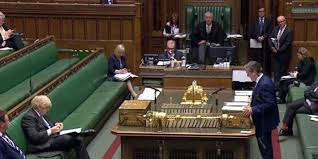
In my view, Keir Starmer, as leader of the Opposition, had much the better of his exchanges in Parliament with the Prime Minister, Boris Johnson, at Prime Minister’s Questions (PMQs) on the 24 June. Above all, Starmer took the approach so many of us have demanded from our politicians for years or decades: calm, well-informed, moderate. He offered praise for where things had been done well in combating Coronavirus, and then focused on a genuine problem on which he called for clarity from the government.

Keir Starmer, on his feet, questioning
Boris Johnson, left


In other words, like the American voters who wanted the swamp drained, he rose to the challenge many UK voters have set politicians.

He asked:

Yesterday, the Government announced the next stage of easing lockdown restrictions. If that plan is to work—and we want it to work—we need an effective track, trace and isolate system. The Prime Minister promised that a world-beating system would be in place by 1 June. The latest figures from yesterday’s press conference hosted by the Prime Minister show that 33,000 people are estimated to have covid-19 in England. The latest track, trace and isolate figures show that just over 10,000 people with covid-19 were reached and asked to provide contact details. I recognise the hard work that has gone into this, but if two thirds of those with covid-19 are not being reached and asked to provide contact details, there is a big problem, isn’t there?

Did the Prime Minister respond in kind? Did he heck. Here’s what he said:

On the contrary. I think that the right hon. and learned Gentleman has been stunned by the success of the test and trace operation. Contrary to his prognostications of gloom, it has got up and running much faster than the doubters expected. They are getting it done—Dido Harding and her team have recruited 25,000 people and so far they have identified and contacted 87,000 people who have voluntarily agreed to self-isolate to stop the disease spreading.

In other words, he gave a purely old-style politician’s answer: on the attack, and dodging the question altogether. As Starmer pointed out:

The Prime Minister just has not addressed the question I put to him. I was not asking about those who have gone into the system—the 10,000—or those who have been contacted; I was asking about the two thirds of the 33,000 with covid-19 who were not reached. That is a big gap.

Clear, simple and focused on the key matter. If only 10,000 are being tested then, on the government’s own figures of 33,000 infected, two-thirds are not being reached. This is bad news. And Johnson’s response? He went back on the attack: “I hesitate,” he claimed without hesitation, “to accuse the right hon. and learned Gentleman of obscurantism. He is misleading on the key point.”

The accusation of misleading is serious in Parliamentary terms and the Speaker had to call on him to withdraw it.

The exchange moved on to the matter of the tracking app, promised for 1 June, then abandoned, now promised again, using commercial software, perhaps some time after September.

Boris Johnson was having no criticism on that front:

I wonder whether the right hon. and learned Gentleman can name a single country in the world that has a functional contract tracing app—there isn’t one.

Strangely enough, the right honourable and learned Gentleman Keir Starmer certainly could name one:

Germany. It had its app working on 15 June and it has had 12 million downloads—I checked that overnight.

So now the decks were cleared for Johnson to move from the lie circumstantial to the lie direct:

I am afraid that the right hon. and learned Gentleman is completely wrong, because no country in the world has a working contact tracing app.

Faced with a clear, verifiable fact, Johnson merely resorted to denial. A blatant, easily refuted lie.

And here’s the sad thing. He won’t be called on it.

Many have demanded that politicians find more honest ways of doing their job, for instance denouncing Blair for lying over Iraq.

They claim to want them more straightforward and thorough.

They called for less aggressive exchanges between them, more focused on solid, reliable information.

Yet a large number of them will rally to Johnson now. They will claim he bested Starmer. They’ll praise his style instead of denouncing his lies.

My only hope? That in neither the United Kingdom nor the United States will they constitute a majority.

So we really can drain the swamp and move to a healthier brand of politics.

Sunday, 21 June 2020

A tour that revealed so much by showing us so little

It was a curious guided tour we went on through the old city centre of Valencia. In two ways.

The first curious thing was the reception we twice received from locals, as we stood listening to our guide, Marisa, talking to us through her loudspeaker. In English.

“Welcome back, tourists!” the first cried.

The second even went so far as to applaud us for returning to the city.

Valencia is as beautiful as ever, of course. But it is strangely quiet. Despite the hot weather, and the profusion of tables outside cafés and restaurants, they had few clients.

We heard one frustrated restaurant manager swearing, “this is complete shit”. A glance inside showed food ready for ordering, and no one ordering it. The main problem isn’t that locals are afraid to eat out, though there may be some of that. It’s that the influx of tourists we would expect at this time of year has simply not turned up.

The Coronavirus restrictions are gradually being lifted, but there’s still only a trickle of visitors from abroad. That’s throttling a lot of the business the city depends on.

Hence the applause on seeing us.

We hadn’t the heart to tell them that we all lived here. We might be on a tour, but we weren’t tourists. We didn’t want to spoil their celebration, brief as it was likely to be.

The other thing that made the tour strange was what we were visiting. It was the ‘Judería’, the Jewish quarter of the old city. What made it strange was that it is, physically, all but non-existent.

There was once a thriving Jewish community in Valencia. Many of its administrators and financiers were Jews. When James I took the Kingdom of Valencia from the previous Moorish rulers, he used Jews to help him run the place. In return, he gave them a large chunk of the city to be their own. They prospered so much that before long the Jewish quarter had to be extended still further.

It wasn’t just in administration and finance that the Jews distinguished themselves. In the course of our tour yesterday, we stopped to admire the (modern) bust of Luis Vives, one of Valencia’s most significant scholars, a contemporary and friend of Erasmus of Rotterdam.

Luis Vives, descendant of Jews, 
not honoured in his own land


His major contribution was to the foundation of what we now know as psychology. However, he did that work not in Valencia, but in the Netherlands. An inscription behind the bust explains that the honour he couldn’t receive in his own land was afforded to him in another. Why? He was from a family of converted Jews, most of whom fell to persecution by the Inquisition. He was wise to get out.

A fine building in its own right
But it rather disguises the Jewish cemetery underneath it


Most of the tour was like that. We saw the rather fine palace built on part of the site of the main Jewish graveyard, but we saw no graves. We looked at where the principal Synagogue once stood, but not a trace of it remains. The closest we came to any physical sign of the previous Jewish presence was at the site of a major restoration project on the Valeriola Palace in the centre of the city. An old street runs through the site to the remains of a wall that marks the limits of the Jewish neighbourhood. A recently discovered oven too probably belonged to it.

Shoemaker Street in Valencia
A restoration project revealing a rare trace of the Jewish quarter


It’s extraordinary to see how utterly the community, and even any trace of its previous existence, has been wiped out.

It’s not just the Jews. Valencia was Arab for five centuries. There are more remains of that time than there are of the Jews, but still they’re rare and in ruins – odd stretches of wall, for instance, mostly underground.

And yet Jews offered some of the most important intellectual skills that Spain enjoyed, in administration, finance and even, as we’ve seen, philosophy, science and medicine. Meanwhile, the Muslims provided equally powerful intellectual contributions (one of the key figures leading to the European Renaissance was Averroes, a Moor from the Spanish city of Cordoba) and also some of the most sophisticated agricultural techniques the country possessed. Getting rid of these communities might indeed have made Spain more religiously homogeneous, but what was the price?

Judge for yourselves. In 1492, with the Columbus expedition to the Americas, Spain was launched on an adventure that would make it Europe’s, possibly the world’s, most powerful and wealthiest Empire. In that same year, it expelled its Jews. Twenty years later it was the turn of the Moors.

Within little more than a century, it was being challenged by France and the upstart Protestant powers of northern Europe, the English and the Dutch, the latter of whom won their independence from Spain in a long and bitter series of revolutionary wars.

By the early eighteenth century, Spain’s fate was being dictated to it by fighting between other countries to decide who would be its King, in the so-called War of Spanish Succession. By the start of the next century, it lost its dominance at sea at the Battle of Trafalgar. And by end of that same century, another upstart nation, the United States, had relieved it of its last major colonial possessions.

Perhaps it would have been the same even if it had kept its Jews and its Arabs. But I think they could have held their position a lot longer by drawing on those talents and applying them wisely, rather than driving them out. Accepting a little religious diversity might have done them a lot of good.

And that was the object lesson we drew, from the very fact that our tour showed us how little remained that we could actually look at...

Friday, 19 June 2020

Boris Johnson, latter-day Churchill. In all the worst ways

Boris Johnson famously likes to see himself as a latter-day Winston Churchill. But he may be emulating only the worst aspects of his role model.

“Anyone can rat, but it takes a certain amount of ingenuity to re-rat.”

Winston Churchill may have said that himself, but if not, it was certainly said of him.

He was originally elected a Member of Parliament as a Conservative, in 1900. But in 1904, he joined the Liberals, just in time to take part in their electoral triumph of 1906. He enjoyed considerable political success with his adopted party until, once they were a spent force, he returned to the Conservatives in 1924.

Ratting and re-ratting meant that for nearly quarter of a century, he enjoyed a glittering career with each of the two main parties of his day. Among many ministerial appointments, he was a Liberal Home Secretary and a Conservative Chancellor of the Exchequer within a fifteen-year period.

There is an argument to say that both of Churchill’s defections reflected deep-seated convictions. In the circumstances of the two different times, he may have been closer to one party in 1904 and the other in 1924. But many saw his swinging back and forth as no more than rank opportunism.

Indeed, doubts about his trustworthiness were expressed early in his career. His first party leader in the Conservative Party, the Prime Minister at the time of Churchill’s first election win, was Arthur Balfour. He said of him, “I thought Winston Churchill was a young man of promise, but it appears he is a young man of promises.”

Now, it’s not clear to me that Boris Johnson has ever taken any political position as a matter of principle. Indeed, the only purpose I can see he has for taking any kind of stance is to further his career prospects. We know that as he prepared to take part in the campaign over Brexit, Johnson prepared three draft articles, two in favour of Brexit, one against.

He wanted to see the arguments before deciding which would play best. Which position most served the national interest was no concern of his. Which would be better received most certainly was.

Isn’t that just the kind of readiness to switch position, depending on where the main chance lies, that can lead to ratting and re-ratting?

As for men of promises, it’s hard to imagine anyone who has made as many promises as Johnson has. At the beginning of the Coronavirus crisis, he promised Personal Protective Equipment for health and social care staff, which he conspicuously failed to deliver. He promised 100,000 tests a day by the end of May, a promise only achieved by sending out 120,000 tests to 70,000 people, only on 31 May itself, falling back immediately afterwards.

Finally, he promised a track and trace system based on a bright new app backed by a heavily staffed manual service, by 1 June. That deadline too was missed and now the app itself has been abandoned.

Promises, promises. But no delivery.

Winston Churchill
A smile to go with the iron will


The difference between Churchill and Johnson is stark, in any case. Nothing reveals the nature of a leader so powerfully as their handling of a crisis. Churchill rose to the challenge of the Second Word War with conspicuous brilliance and courage. It is that which gives him his stellar reputation today, allowing most people to forget the ratting and re-ratting, the missed promises, the many blunders.

Johnson’s crisis was Coronavirus. And it has revealed him to be as weak and mendacious as the Second World War showed Churchill to be courageous and endowed with an iron will to win. 

It really does feel as though Johnson has only the capacity to imitate what was least creditable in Churchill. Both men relied on their sense of humour. But in Johnson, it is the clowning of a weak-willed and ineffective buffoon, whereas in Churchill, it was the wit of a man who could smile while he deployed the leadership his nation needed.

Boris Johnson
Self-deprecating because there's so much to deprecate


It makes me want to slightly adapt a remark of Karl Marx’s and say, “history repeats itself, the first time as drama, the second time as farce”.

Wednesday, 17 June 2020

Upsetting the neighbours

For a few weeks now, we’ve been sharing our house with another family.

To be honest, I’m not sure they see it as ‘sharing’. I think to them, our presence is a thoroughly unwelcome intrusion. “What are they doing here, in our place?” I’m sure they say to each other. Certainly every time, we appear they chatter very loudly to each other about the matter and, though I understand not a word of what they’re saying, I know it isn’t complimentary.

This is all a bit awkward, because we can hardly avoid disturbing them. Every time we step out of our front door, in fact. This is because they’ve built their nest right over that door.

Ah, sorry. I see. You thought I was talking about a human family. No, no. It’s the house martins, the ones I’ve mentioned before.

Three fledglings living above our front door

They have three fledglings now. As it happens, we’re far from convinced that they’re all the offspring of the original pair of inhabitants, the ones acting as parents. This is because we twice found broken eggs lying on the ground. It seems it’s not unusual for house martins who don’t find a nest, or who are too lazy to build one, to make space in someone else’s and lay their eggs there instead.

That hasn’t stopped the parents bringing up all three of the young as their own. They’ve worked tirelessly – and, boy, it must have been tiring – to keep them fed. And now all three are flying and on the brink of adulthood. In other words, unbearable to their parents.

Danielle's great photo of a parent returning to the nest

Danielle saw all three on the telephone cable outside the house, loudly demanding food. And the parents were bringing them what they wanted. Honestly. Too bloody soft, in my opinion.

“Old enough to fly up here,” they should be saying, “you’re old enough to catch your own mosquitoes.”

Danielle can testify that there are more than enough mosquitoes around. She has the infuriatingly itchy bites to prove it.

But the adults keep feeding the three kids. Ah, well, young parents. With adolescent kids. Always a difficult combination.

Today there was even a bit of a crisis. We were sitting outside on the patio, having just had lunch. Danielle was sleepy and ready for a rest.

Suddenly there was some heavy fluttering behind us, inside the sitting room, followed by a couple of dull thuds.

Danielle was suddenly out of her torpor and rushing indoors. There were two house martins flying around the sitting room, one of them banging head first into the picture window between the room and the patio. Like a shot, Danielle collected the young bird – the one doing the head banging – and then pushed Misty, our cat, outside.

Misty, I should point out, is a venerable pensioner of a cat. Now fifteen, he thinks our move to Spain was the best we’ve made. He likes to spend some of his time in the front yard, lying on the couch out there. From time to time, he summons us to let him in so he can have a snack. And then he heads out into the back garden to lie on the warm grass in the sun. Until he decides he needs another snack.

A fine retirement, in fact.

But a little bird knocking itself out in his sitting room? And falling to the floor? That’s enough to return him to his best three-year old form. A snack with a difference, he sees.

But Danielle got him out of the way. Then headed for the front door, the head of the small bird poking out of her hand. She released him and off he flew, loudly proclaiming his relief. Immediately, the adult that had followed the prodigal into the house, flew straight out to take a look at the newly freed child.

So, all’s well as end’s well. At least, as far as we know it’s ended well. Let’s hope the whole family (related to each other or not) is doing well and they’ve recovered from the trauma.

Meanwhile, we’ve learned to keep the front door shut. And, of course, apologised for springing such a dirty trick on one of the family’s children. Talk about disturbing their peace…

One of our neighbours in flight