Showing posts with label Germany. Show all posts

Thursday, 25 June 2020

The thing about lying is that it works

The very people who most complain about lying politicians, seem to be the most inclined to believe their lies.

Trump’s supporters, in particular, went along with his slogan about ‘draining the swamp’. That suggested that it was Washington DC that was the breeding ground of all the ugliest and most dangerous lies. Now, since Trump has been in place, with a mandate of sorts to drain that swamp, he has massively raised the level of mendacious toxicity of the very swamp he occupies, which is clearly his most suitable habitat.

Hardly a day goes by without his coming up with some new lie. The latest was to nearly double the number of attendees at his Oklahoma rally, and to claim he was satisfied with the outcome, despite his obvious expression of crushed dejection.

Trump defeated by the poor turnout in Oklahoma
Hope for us all in November


Despite all that, some people keep on backing him. They swallow the lie.

The same is true in Britain.

In my view, Keir Starmer, as leader of the Opposition, had much the better of his exchanges in Parliament with the Prime Minister, Boris Johnson, at Prime Minister’s Questions (PMQs) on the 24 June. Above all, Starmer took the approach so many of us have demanded from our politicians for years or decades: calm, well-informed, moderate. He offered praise for where things had been done well in combating Coronavirus, and then focused on a genuine problem on which he called for clarity from the government.
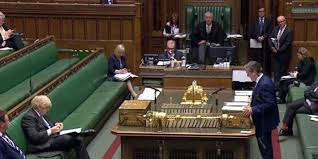
Keir Starmer, on his feet, questioning
Boris Johnson, left


In other words, like the American voters who wanted the swamp drained, he rose to the challenge many UK voters have set politicians.

He asked:

Yesterday, the Government announced the next stage of easing lockdown restrictions. If that plan is to work—and we want it to work—we need an effective track, trace and isolate system. The Prime Minister promised that a world-beating system would be in place by 1 June. The latest figures from yesterday’s press conference hosted by the Prime Minister show that 33,000 people are estimated to have covid-19 in England. The latest track, trace and isolate figures show that just over 10,000 people with covid-19 were reached and asked to provide contact details. I recognise the hard work that has gone into this, but if two thirds of those with covid-19 are not being reached and asked to provide contact details, there is a big problem, isn’t there?

Did the Prime Minister respond in kind? Did he heck. Here’s what he said:

On the contrary. I think that the right hon. and learned Gentleman has been stunned by the success of the test and trace operation. Contrary to his prognostications of gloom, it has got up and running much faster than the doubters expected. They are getting it done—Dido Harding and her team have recruited 25,000 people and so far they have identified and contacted 87,000 people who have voluntarily agreed to self-isolate to stop the disease spreading.

In other words, he gave a purely old-style politician’s answer: on the attack, and dodging the question altogether. As Starmer pointed out:

The Prime Minister just has not addressed the question I put to him. I was not asking about those who have gone into the system—the 10,000—or those who have been contacted; I was asking about the two thirds of the 33,000 with covid-19 who were not reached. That is a big gap.

Clear, simple and focused on the key matter. If only 10,000 are being tested then, on the government’s own figures of 33,000 infected, two-thirds are not being reached. This is bad news. And Johnson’s response? He went back on the attack: “I hesitate,” he claimed without hesitation, “to accuse the right hon. and learned Gentleman of obscurantism. He is misleading on the key point.”

The accusation of misleading is serious in Parliamentary terms and the Speaker had to call on him to withdraw it.

The exchange moved on to the matter of the tracking app, promised for 1 June, then abandoned, now promised again, using commercial software, perhaps some time after September.

Boris Johnson was having no criticism on that front:

I wonder whether the right hon. and learned Gentleman can name a single country in the world that has a functional contract tracing app—there isn’t one.

Strangely enough, the right honourable and learned Gentleman Keir Starmer certainly could name one:

Germany. It had its app working on 15 June and it has had 12 million downloads—I checked that overnight.

So now the decks were cleared for Johnson to move from the lie circumstantial to the lie direct:

I am afraid that the right hon. and learned Gentleman is completely wrong, because no country in the world has a working contact tracing app.

Faced with a clear, verifiable fact, Johnson merely resorted to denial. A blatant, easily refuted lie.

And here’s the sad thing. He won’t be called on it.

Many have demanded that politicians find more honest ways of doing their job, for instance denouncing Blair for lying over Iraq.

They claim to want them more straightforward and thorough.

They called for less aggressive exchanges between them, more focused on solid, reliable information.

Yet a large number of them will rally to Johnson now. They will claim he bested Starmer. They’ll praise his style instead of denouncing his lies.

My only hope? That in neither the United Kingdom nor the United States will they constitute a majority.

So we really can drain the swamp and move to a healthier brand of politics.

Thursday, 28 May 2020

The Spanish fighters again: liberation achieved. And denied.

When we last saw our gutsy Spanish Republican fighters in the French Foreign Legion, they were rather twiddling their thumbs in North Africa waiting for something to change.
Well they did eventually change. And in a big way.
Men of the Nueve with their halftrack Guadalajara
In 1943, the Americans landed in Morocco and, together with British forces, in Algeria. The local French military was still ostensibly supporting the Vichy regime of Marshall Pétain and serving under its orders, which meant Nazi orders. They put up a bit of a fight but soon caved, though not before some three thousand men had been killed and a lot more injured.
At that point, the local leadership, specifically the commander of the French forces, Admiral Darlan, suddenly realised they had always been lifelong democrats and switched to the Allied side. They required little in return, except being kept in office, which might have led to some friction with the Free French and in particular with de Gaulle.
Fortuitously, a young royalist decided the best way to secure the return of the rightful King to the French throne was to assassinate Darlan, which he duly did. It turned out he was wrong, as far as getting the King back was concerned, but he certainly removed a major irritation for de Gaulle.
Meanwhile the Allies, advancing from Morocco in the West and Algeria in the East, eventually drove the German army to defeat in Tunisia. The French, having switched sides, fought with the Allies, and that included the French Foreign Legion, who saw some tough battles, in which its Spanish Republican forces played a key role. And lost many men.
Not all the French forces had had to switch sides. Some soldiers had been with the Free French right from the start. In particular, one idealistic young officer had raised a small force in the French colonies south of the Sahara, marched it across the desert and joined the British effort against General Rommel in Libya.
Leclerc with his Armoured Division, during the liberation of France
His name was Leclerc (well, it was Philippe de Hautecloque, really, and Leclerc was just a nom de guerre which he’d adopted in the hope that it would deflect the attention of the authorities from his family back in occupied France). De Gaulle made him a major general and gave him the Second Armoured Division, the iconic Deuxième DB, to command. It was selected to be the only French unit to be included in the Allied landings in Normandy when they eventually came.
Unfortunately, he only had 4000 men and he needed 15,000. He set out to recruit new soldiers. One group from whom he found it easy to recruit were the Spaniards, who transferred in droves out of the Foreign Legion and into his Deuxième DB. Manuel Fernandez, whom I quoted yesterday, summed things up:
“The ideas of de Gaulle corresponded more to ours than those of the others who’d stayed with Pétain. The officers of the Legion considered us as red Spaniards, as revolutionaries… The senior officers would say to us, ‘you’re not in Spain here. You’re not going to make a revolution here.’ We’d keep quiet. The officers with de Gaulle, on the other hand, said ‘oh, did you fight in Spain? Good… The men the officers wanted were Spaniards. We had a certain experience, not just in Spain, but in the campaign in Tunisia too.”
Spanish recruits to the Deuxième DB
parading on the beach in Morocco
From the many Spaniards mobilised into Leclerc’s division, one company, the ninth, was almost exclusively Spanish: 146 out of 160 men. Commanded by a Frenchman, Raymond Dronne, and his number 2, the Spaniard Amado Granell, from Valencia, who had commanded a division in the Civil War, it passed into legend as ‘La Nueve’, ‘The Nine’.
The Deuxième DB landed in France in August 1944. The American high command had committed to allowing French troops to lead the Allies into the French capital.
On the 20th, an insurrection broke out in Paris, with Resistance units taking action against the Nazi occupiers. De Gaulle asked for and obtained authority to press on to their support as quickly as possible. On the 24th, Leclerc told Dronne and the Nueve leave and go to Paris. They left at 7:30 that evening and by 9:30 the company, supported by a squadron of tanks from the French 501st armoured regiment, arrived at the Paris Town Hall. There, the first ‘French’ soldier to make contact with the Resistance forces that had taken control was Lieutenant Granell, the officer from Valencia who had held general rank in the Spanish Civil War.
The next day, as well as attacking several key points around the City, Spanish soldiers also accepted the surrender of the German Commander and took him into custody, before handing him over to French authorities.
The men who had fought so hard to keep Spain free, at least had the satisfaction of leading the liberation of France’s capital.
One of the halftracks in the parade down the Champs-Elysées
celebrating the liberation of Paris

The action in Paris wasn’t the Nueve’s last. They fought on through the rest of the war, even reaching Berchtesgaden and Hitler’s hilltop eerie, the Eagle’s Nest. By then though, only 16 of the 146 Spaniards of the combat were still fit for combat. They had lost 35 dead and 97 wounded.
Captain Dronne, their commander, said of them:
Some of them are experiencing a clear moral crisis due to the losses we've suffered and above all to the events in Spain.
The Spaniards who fought with the French had hoped that after overthrowing Fascism in Italy and principally in Germany, the Western Powers would turn their attention to Spain and finish it off there too. It wouldn’t happen.
The best slant to put on that decision is that the Western Powers had bled enough in the war and they didn’t want to fight another. That may be partly true. But Franco was no Hitler, the Army he led no Wehrmacht. Overthrowing his regime would not have required anything like the force or the losses that the battle against the Nazis had cost.
The less honourable explanation is that the West was already turning its attention against the Soviet Union. Far from wanting to take on Franco’s rather eccentric brand of Fascism – he was always more of a Franquist than a Fascist – they preferred to concentrate their efforts against Communism. In that fight, Franco could if anything be something of an ally, just as soon as he could be brought out of his pariah state. Which happened in the fifties, when the easing of measures against his regime was the price paid for stationing American forces in Spanish territory.
Ultimately the thousands of Spanish Republicans who fought and died for France and for the freedom of their own country, would be let down. “We weren’t fighting for a flag,” Manuel Fernandez would tell the 2017 documentary makers, “we were fighting for ideas”. They were fighting for freedom, in their country as well as France.
Well, they were cheated of that goal. But at the very least, we owe it to them to remember their sacrifices and their courage.
The lesson for me? Even in Europe, the Second World War didn’t start on 1 September 1939. It began on 17 July 1936, with the nationalist uprising against the Second Spanish Republic.
Nor should it have ended when it did. Once they’d finished off Hitler and Mussolini, the Western Powers should have seen off their ally Franco. Which means the war would not have ended in Europe on 8 May 1945.
But it did. With the work not quite done. Sadly.

Wednesday, 27 May 2020

The Spanish fighters who changed my views

After four years of Nazi occupation, Paris was finally liberated by Allied armies on 24 August 1944. Units of the mythic French force, the ‘Deuxième DB’, the Second Armoured Division, led the way into the city. They had raced there to support the population that had risen against the occupying forces.
In the evening, the first half tracks pulled into the square outside the Paris town hall. As in all such units, the vehicles had all been given names by their crews, names that were painted on their sides:
Gudalajara
Brunete
Ebro
Santander
Teruel
If you’re thinking “those don’t sound like French names”, you’d be right. They were great battles of the Spanish Civil War. And the language the crews were talking was Spanish.
These were the men of the ‘Nueve’ (‘nine’ in Spanish), the ninth company of the Deuxième DB, almost exclusively Spanish. Their commander, the French Captain Raymond Dronne, wrote of them later:
The Spaniards fought remarkably. Commanding them is a delicate matter but they have enormous courage and experience of combat.
That ‘delicate’ is a glorious piece of French understatement. It chimes with what Dronne was told when he was first given command:
Everyone’s afraid of them. They’re good soldiers. They won’t give you any problems.
The halftrack Guernica of the Nueve in Paris in 1944

Moving to a new country certainly gives you a new perspective on many things you thought you knew.
For instance, I’ve had to rethink some of the most elementary facts I felt I knew about the Second World War. I’ve long accepted that it didn’t start on 1 September 1939 with the Nazi invasion of Poland, as is generally taught in schools. The first shots were fired on 19 September 1931, when Imperial Japanese forces invaded the Chinese territory of Manchuria.
OK, you might think, but that was the Pacific Theatre. In the European theatre, the war started in September 1939, surely? Well, that too is an idea I’ve had to revise, under the gentle guidance of Marisa, a friend we’ve met out here in Spain, who’s frighteningly well-informed on history.
My view was always that the Spanish Civil War, which started in July 1936, was a sort of preamble to the World War. In reality, however, with the Soviet Union supporting the Spanish Republic, while Nazi Germany and Fascist Italy backed the military uprising that brought Franco to power, it offered a first opportunity for three of the major powers of the coming World War to test each other’s strengths and weaknesses and, indeed, to expose some of their forces to combat.
That feels more like the first Act of the wider war rather than merely a preamble to it.
In any case, it wasn’t just the Germans and Italians, or to a smaller extent the Russians, who emerged from the Spanish Civil War with trained and battle-hardened veterans ready for the next stage of the conflict. There was also quite a lot of the Spanish Republican army. The Republic itself had been defeated and overthrown, but many of the soldiers survived.
Large numbers joined the flood of over 450,000 refugees fleeing across the Pyrenees into France. They rightly feared the retaliation that Franco’s victorious regime would exact from them if they were caught. The regime proved they were right by what it did to those it did in fact catch.
In France conditions were, however, not particularly better. They were held in what the French called “internment camps”, but the Spanish, especially the ones who were there, unequivocally referred to as “concentration camps”. Lack of food, poor sanitation and inadequate housing led to huge numbers of deaths. This was 1939, after all, when France and Britain still hoped that their policy of appeasing Hitler might avoid war. That desire, combined with the xenophobia and right-wing beliefs of a significant current amongst Frenchmen, conspired to ensure the refugees were shockingly badly treated.
Offered the option of returning home, about 100,000 chose to go, mostly women and children. Few of the combatants, understandably, took up that offer, however. Some paraded in front of French officers hoping to be taken into the army, but the generals, who were to be humiliatingly defeated the following year, decided they didn’t need these experienced troops whose political loyalties they weren’t sure of (they were generally left wing, some extremely).
Some 10,000, however, were recruited into the Foreign Legion. And, once war with Germany broke out, others were taken into ‘Foreign Labour Companies’ who were set to work on the Maginot line, the great string of bunkers and fortresses along the border with Germany. Life there was certainly preferable to the camps, though in the end it worked out little better. After defeating France, the Nazi authorities captured many of the Spanish workers. Refusing to treat them as prisoners of war, and working with the Franco government’s agreement, they transferred them to concentration camps. Over 7000 were sent to the Mauthausen camp and fewer than 2500 were released at the end of the war.
Chillingly, some of the survivors later said that their experience in the French camps helped them to prepare for the Nazi ones.
Those who were able to avoid capture, joined the resistance. And among those who had taken part in the fighting, many decided to carry on the battle. One Spaniard in the Foreign Legion, Manuel Fernandez, described his feelings on the defeat of France to a 2017 television documentary:
“It was the greatest disappointment of my life. There were moments when I cried like a child. I’d fled Spain and here I was going to fall into the hands of the Germans.”
One answer was to join General de Gaulle who was setting up Free French forces in London. Of his initial 2000 men, 300 were Spanish.
Alternatively, those who were in the Foreign Legion could cross the Mediterranean with their units. In North Africa, however, they were under the orders of the government in Vichy, a puppet regime of the Nazis, set up after the defeat of France. There they were left to wonder how they’d managed to escape Franco, only to find themselves in a military unit whose orders were dictated by a government collaborating with Franco’s most powerful ally, Hitler.
It would take over two years. Though then things would change dramatically.
But more of that in another post. Just click here...

Friday, 15 May 2020

Coronavirus Contrasts

It was a great start to the day to read a piece about the behaviour of a group of parents and teachers in Madrid. Not in a Spanish paper but in the Guardian. And it’s a story that deserves to be known in other countries.

The parents recently ran a confidential survey of the whole parent body, to identify who was suffering the worst economic effects of the lockdown. Then they raised money from amongst themselves and the teachers to help out those most affected.

That included a woman who had lost her job as a cleaner and could no longer afford to feed her daughter. The help of the group meant that they could eat again. What’s more, the group supplied the daughter with a tablet, so that she could follow online teaching and therefore start following the virtual classes her school was providing.

In Britain too people are helping out
A food bank in Bury

This is by no means a unique example. Many of these groups to help the most vulnerable are emerging in response to the epidemic. And there are other examples of strangely community-related behaviour. Taking another example from Spain, I was astonished to read that Juan Roig, owner and Chief Executive of the supermarket chain Mercadona, has decided to take no salary or dividends this year, and to give 70 million Euros to relaunching the Spanish economy.

There’s nothing like a crisis to bring out the best in people. Sadly, it can also bring out the worst.

A US protestor against lockdown
Isn't freedom from fatal disease pretty essential?


There are actions that contrast starkly to this kind of community kindness and mutual support. In particular, in the US there are those groups who are turning out, sometimes heavily armed, but in thankfully small numbers, to demand lockdown restrictions be lifted. They claim to be speaking in the name of freedom. However, since they are clearly not interested in protecting vulnerable people who might be struck down by the virus, they’re only concerned with their own personal freedom.

Presumably, they calculate that they won’t fall victim to the virus.

As it happens, theirs could turn out to be a shortsighted outlook. The virus may disproportionately affect the elderly and those with underlying health conditions, but it has also killed plenty of healthy, young people. In pursuit of one kind of freedom, these protestors are jeopardising another: the freedom to live in safety from a killer disease.

So we see two profoundly different attitudes by individual people. One is community-oriented and altruistic. The other is an affirmation of individual concern and without empathy for others.

What’s true of individuals is true of governments.

The Madrid school group may well find its burden reduced before long. The Spanish government plans to start paying a minimum basic income so that, at least, no one should face homelessness or hunger as a result of the measures it has taken to combat the virus.

The German government, and with even greater success, those of South Korea and New Zealand, acted on time against the virus and applied highly intelligent measures. They seem to have brought the epidemic under control or to be close to doing so, and they have heavily limited deaths.

A nation like the UK, on the other hand, has stumbled from crisis to crisis within the pandemic. The Boris Johnson government was unforgivably slow to react to the growing signs of the scourge about to be unleashed on the nation, and hopelessly inept in its response once it finally woke up. Even today, care workers have insufficient protective equipment and testing is way behind schedule.

Now the Johnson government is trying to force citizens back to work even though little has been done to ensure the safety of workplaces. In other words, it is acting with indifference to human life and it’s no surprise that the death count there is now the highest in Europe and growing.

Worst of all, of course, is Donald Trump in the US. Utterly uncaring of the lives of his fellow citizens, he drives on towards reopening the economy for no better reason than to enhance his hope of re-election. Anyone who questions his views is dismissed as dangerously wrong and a purveyor of fake information, while the greatest disseminator of such information continues to turn his once great nation into an object of pity, and ridicule, internationally.

With the highest coronavirus death count in the world.

When this crisis is over, we shall have to start making some choices. The biggest will be between starkly opposed views of our societies.

Do we prefer the kind of community-oriented approach of the Madrid school group, and the attitude of governments that make protecting the lives of their citizens their first priority?

Or do we prefer the attitude espoused by Trump and the US protestors who place their own desires above those of the society in which they live?

If crises provide a great test of personality, that applies to all of us. Not just occasional heartwarming groups, or even governments whether heartwarming or not. Each of us will be called on to choose between two such profoundly different attitudes towards human life and collective needs.

A lot will ride on the choice we make.

Tuesday, 7 April 2020

Coronavirus: the truth. So far as we know

They say that the first casualty of war is truth. There’s no reason why the war against Coronavirus should be any different.

Generally, the problem is that governments are lying about what’s going on. You know, claiming to have shot down more planes than the enemy ever had, or claiming that a retreat is a strategic withdrawal to more defensible positions. Today, though, the mist over the truth is just the lousiness of the information.

For instance, we’ve been counting total numbers of infected cases. But we know that no country has the means to test every one of its citizens. So how can we know what the true figure is?

The number of infections in Germany is currently at about 70% of the number here in Spain. But the number of deaths stands at about 12%. Is that simply because they’re testing much more widely, and therefore identifying far more cases than don’t lead to death?

I’ve seen conflicting estimates of the true number of Spanish cases. Some authorities say they should be four times higher, others twenty times. Four times or twenty? How do you get anywhere near the truth with that kind of variation?

The same is true of the number of deaths. Some countries don’t count deaths in certain contexts. Maybe someone died outside a hospital and wasn’t tested. So they’re not included in the figures. On the other hand, if someone with CVid dies they may be counted as one of the deaths, even though they had underlying conditions, one of which may have been the real cause of death.

There are certain phenomena that are particular to certain nations. For instance, in the UK death figures can be reported over several days. The number of deaths reported for one day may therefore climb later.

In Spain, too, there’s a problem with weekends, when reporting may be delayed. That means figures may be low for Saturdays and Sundays, but exaggerated on Mondays. And that may or may not happen. 

That’s how exciting this all is.

Still, perhaps one can make a couple of assumptions, just as long as one remembers that they are assumptions and they are open to challenge as any assumption is.

The first is that however bad the figures may be, within a single country, they’re likely to be just as bad any day as they are on any other – or just as good. So if the case figures are a twentyfold underestimate on one day, then they’re likely to be a twentyfold underestimate on another. That means that comparing the figures over time may at least give a view of where we’re heading.

The second assumption is that the figures for a single day can jump about a bit. They may be up or down by chance. So it’s best to look at what happens over several days or a week.
Coronavirus cases (left) and deaths (right), by day, in Spain
Rolling seven-day average as dotted line
The black line marks the lockdown-start date
In the graphs, I’ve shown the daily figures for cases and deaths in Spain. I’ve also included a trend line based on how the average for the previous seven days has been changing. The trend line only starts on day seven, because no seven-day average can be counted before. The black line marks the day on which the Spanish lockdown began in earnest, 16 March.

Both lines show an uptick right at the end, but remember what I said about not putting too much weight on a single day’s figure. In any case, they’re for a Monday, so it’s possible they reflect late reporting at the weekend. Still, it’s possible there’s a real uptick. The lesson is that both figures can start growing again, whatever the prior trend may show.

That trend itself is at least a little encouraging. It does look as though both lines may at last be dipping. The deaths have not dropped as much as the cases, but that’s to be expected: patients dying today were probably first counted as cases a week ago.

It has, however, taken three weeks of strict lockdown to get here. Far stricter, for instance, than in the UK. As strict as Italy, where the figures also seem to be showing a tendency to drop.

This is, however, only the start of the drop. How long will it be until we get to figures so low that we can sensibly think about relaxing restrictions?

The Spanish government has started planning for that moment and one decision has already been taken: work regarded as non-essential, currently suspended, will start again on 11 April. But when will parks reopen? Or schools? Or bars and restaurants? That’s still unclear, but we do know that Wuhan, where the epidemic started, is only just beginning to relax, after eleven weeks of lockdown.

What this says to people in other countries is that lockdowns aren’t quick fixes. This is a long battle; restrictions have to be tough; they have to be in place for a longer period than any of us would like; and they can only be removed gradually.

Still, if we can trust the Spanish figures at all, they do seem to work.

Eventually.

Tuesday, 31 March 2020

The joy of the self-deprecating smile

There’s something exceptionally attractive about self-deprecating humour.

That’s true even if we sense that behind it is something of a disguised boast – you know, “look at how self-deprecating I can be”. Did you see the pictures of Boris Johnson hanging from a zip wire? What might have been seen as a PR disaster was something he worked for all it was worth. “Look what fun I am,” he seemed to be saying, “happy even if I look the buffoon. I’m obviously the kind of fine fellow you want running the country, because someone you can share a laugh with is bound to be on your side.”
Look what fun!
Despite such self-serving examples, self-deprecation remains welcome. That’s particularly so in a world dominated by figures that take themselves far too damned seriously and who are far too damned inclined, with little justification, to think themselves good at what they do.

Did that immediately bring to your mind an image of the present tenant of the White House? It should have.

A few weeks ago, Trump was swift to claim success for a visit he made to the Centers for Disease Control, as part of his then non-campaign against Coronavirus:

“I like this stuff. I really get it. People are surprised that I understand it. Every one of these doctors said: ‘How do you know so much about this?’ Maybe I have a natural ability. Maybe I should have done that instead of running for president.”
Trump fascinating his hosts at the CDC with his scientific insights
While I think it would have been great if hed done pretty well anything rather than run for President, I’m far from convinced that medical or scientific research would have suited him. Let’s not forget that this was the man who thought that Coronavirus was like the flu, and now thinks he’d be doing well if he kept US deaths to within 100,000.

As for his ‘natural ability’, it clearly doesn’t extend to being able to laugh at himself. He leaves it to the rest of us to laugh at him, although our laughter’s never wholehearted – we laugh more at how bad the joke is than at the joke itself.

Fortunately, there are examples of Americans who are, or were, much better able to laugh at themselves.
William Seward
William Henry Seward was a remarkable American politician from the nineteenth century, a rival for the presidency to Abraham Lincoln though he ended up serving him, with outstanding loyalty and ability, as Secretary of State. As a young man, he was less than effective as a public speaker, something he needed to correct, not only for his later career in politics but even for his first choice of profession, as a lawyer.

This was brought home to him painfully when he joined a group of trainee lawyers in New York that would conduct mock trials in front an audience who would evaluate their performances. Time and again, despite all the effort he put into writing his quite brilliant briefs, he would find himself winning less applause than one of his friends who seemed able to outperform him with ease.

The friend pointed out that it was nothing to do with what Seward said, and all about how he said it. He suggested they swap briefs for the next competition, which they duly did.

Seward delivered his friend’s argument with all the skill he could muster, to only mediocre results. Then his friend delivered Seward’s own argument, and according to Seward himself, the applause could have been heard all the way down Broadway.

A useful lesson. And a pleasure to me that it was Seward himself who later had fun retelling the story.

It reminded me of an anecdote of my mother’s.

She found the atmosphere in Britain in 1940 deeply depressing. Life was becoming highly restricted, a little like today with Coronavirus. After the surrender of France and with Hitler apparently unstoppable on the Continent, the future looked bleak for the country. It was badly in need of something to raise its spirits.

In these circumstances, the writer, singer and actor Noel Coward stepped forward. He persuaded a group of friends to come together to put on a variety show at ‘Underneath the Arches’, a club that was, indeed, underneath the arches behind Charing Cross Station. I went there myself a few years back and, for all I know, it’s still there today.
Noel Coward.
Not always the best at delivering the great songs he wrote
For that show, Coward wrote all the songs but had them all performed by his friends, except or one, which he did himself. To his disappointment, while all the others were well received by audiences, his and only his song flopped night after night. Until he developed a cough and sore throat and had to ask someone else to step in for him.

Yes, you guessed it. His replacement sang the same song to huge success.

Noel Coward decided that his rather special style of singing wasn’t as widely appreciated as he had hoped. It was better for him to write the songs than perform them. A bitter lesson but a useful one, and a story he retold in his autobiography.

Self-deprecation at its best. The genuine kind. Such a refreshing change.

Thursday, 19 March 2020

Coronavirus: fighting the war and facing an enemy together

So it’s going to be war.
Soldiers from the Spanish 'Military Emergency Unit' (UME)
deploy outside the main station in Valencia
The leaders of nation after nation have assured us that what we’re going into now is war against Coronavirus. Which neatly covers two of the horsemen of the Apocalypse, War and Pestilence. Coronavirus itself provides us with Death, but since shops are still being restocked at the moment, Famine hasn’t put in an appearance yet. Long may it stay that way.

Curiously, that was a remark made by one of Danielle’s aunts, who lived through the Second World War. 

“We have enough food, but otherwise, it’s just like back then,” she told Danielle.

War. Both my grandfathers had their lives profoundly affected by World War One. Both served, in different ways: my paternal grandfather in the artillery, my maternal grandfather in gaol, as a conscientious objector. Both displayed admirable courage and both paid a high price – my paternal grandfather carried shrapnel in his hand until the day he died.
My mother Leatrice, my grandfather Nat and, well, me (a while back)
Nat served two years in Dartmoor Prison as a pacifist
Leaders have taken to using the vocabulary of war too. Pedro Sánchez, Prime Minister of our adopted nation, Spain, declared the other day that “we shall leave no one behind”. It’s an encouraging thought, especially in the light of the idea that Boris Johnson was toying with in the UK, of letting people become infected to build ‘herd immunity’, though his experts calculated this might leave up to 500,000 dead.

Rather a lot not merely left behind, but left in the ground.

It’s ironic, too, that the US is dragging its feet over combating the epidemic. The notion of ‘leaving no one behind’ is one I associate with the US marines. Odd to see that nation having to be dragged into awareness of the threat, against a spirit of denial to which Trump clung as long as he could.

The Spanish Prime Minister’s commitment to leave no one behind reminded me of my parents’ description of life during World War 2. My father served in the air force, my mother was secretary to a Labour MP. She told me how moved, and how strengthened, she was, by a speech of Winston Churchill’s. It included the words:

We shall go on to the end. We shall fight in France, we shall fight on the seas and oceans, we shall fight with growing confidence and growing strength in the air, we shall defend our island, whatever the cost may be. We shall fight on the beaches, we shall fight on the landing grounds, we shall fight in the fields and in the streets, we shall fight in the hills; we shall never surrender.

He made the speech in May 1940 at a time when the possibility of surrender was very much in the air. Hearing the Prime Minister declare that “we shall never surrender”, she said, stiffened her resolve and that of most of her compatriots. There were, of course, the profiteers and the black marketers, but overall the nation pulled together. A sense of solidarity for a time overcame extreme individualism.
My father Leonard, with his mother and his father, also Leonard
My father is in his RAF uniform for service in World War 2.
My grandfather served and was injured in World War 1.
The spirit of war. With grandparents who experienced World War One and parents who lived through World War Two, I had always expected as a child that I would, on reaching adulthood, have to face it myself. It’s been not just a pleasure but a relief that I never have.

Until now, at any rate. It’s a bit of a surprise, and not without a grain of excitement, to be facing my own war this late in my life. And, at least, it isn’t one in which man is being called on to kill man.

Which doesn’t mean it isn’t lethal. As with any war, we go in not knowing how many will die. We don’t even know whether we ourselves will make it through – any more than my father did. It took him a long time to understand how he survived when so many of his friends didnt. 

This war, like any war, is a harrowing experience.

On the other hand, if we can recapture the spirit of solidarity, it won’t be entirely bleak. If we all pull together, if we show we can serve a common goal with at least patience and some courage, what a welcome change that will be in societies more divided than they have been for decades.

It strikes me that Italy, Spain, France and a number of other countries are beginning to get things right. Social distancing, unnatural and painful though it may seem for a species that thrives on social contact, is probably the best way to beat the epidemic.

We’re going into battle with an intelligent strategy. We’re going in together. We’re going to suffer losses, but may be uplifted by our sense of common purpose.

Because that too is part of war, probably the best part, as well as an essential ingredient of our top shared objective.

Beating this damn thing.

Tuesday, 3 March 2020

Thoughts of the victims of war in a Valencia air raid shelter

If you’re sightseeing around our local city, Valencia, the saddest sight you can see is an air raid shelter. I’ve visited two and there are many others.
Inside the air raid shelter under the Valencia town hall
They date from “the war”. However, I believe when most of us say “the war” we probably still mean the Second World War, if we’re from countries that took part in it. In Spain, “the war” means the Civil War the raged from 1936 to 1939, led to the overthrow of the Spanish Republic and ushered in 36 years of dictatorship under Francisco Franco, ending only in his death.

On the other hand, there are many people, inside and outside Spain, who would reckon that the Spanish Civil War was a part of the Second World War. That makes some sense. After all, despite signing the same non-intervention treaties as the democracies, Germany and Italy, then under Nazi and Fascist control respectively, sent not just weapons but military forces to support the Franco rebellion. Only the Soviet Union supplied the Republic, and then only with toxic strings attached.

So major players in the Europe-wide conflict that was about to break out were involved in the Spanish war. The air raid shelters in Valencia were built to withstand attack by Italian forces, chiefly in the form of bombing raids from bases they had set up on the island of Mallorca.

One of the striking aspects of our visit was a video they played us. At several points, I realised that I wasn’t listening to Spanish any more, but to Italian. What was being played was Fascist propaganda about how ‘heroes’ from the Italian air force were taking part in raids on Valencia to make civilisation safe from ‘Soviet communism’, in a fight many saw as a Christian crusade.

Down in that air raid shelter, that irony was particularly bitter. These were shelters for civilians, and they were the main victims of the raids. The propaganda claimed the bombers were targeting armament factories and military concentrations. In reality, they were dropping their bombs on civilian dwellings.

No one puts that better than the great New Zealand cartoonist David Low, who has Franco being told that his Arab troops are concerned by the ‘unchristian’ behaviour of his army.
David Low has an officer reporting to Franco, Mussolini and Hitler
“Excellency, the Moorish troops are disturbed.
They say our conduct of the war is unchristian.”
The assault on civilians would become the hallmark of the long struggle that the Spanish Civil War announced: heavy bombing of civilian centres, often described as a means of ‘weakening enemy morale’. Killing civilians to undermine morale? There’s a word for that. It’s terrorism.

And I was particularly struck by one of the photos in the air raid shelter. A mother with her child. Both faces are paralysed with fear. And it’s perfectly obvious that neither has been guilty of an act that merits the punishment they’re undergoing.
Part of the display in the air raid shelter
Left, a bombed home. Right, a terrified mother and child
Sadly, this kind of terror bombing was by no means limited only to the enemies of the democracies in those years of war. In fact the worst bombing was carried out by the Western powers themselves, something they should perhaps bear in mind when they denounce terrorism today. Dresden, Cologne, Hamburg all but destroyed, with tens of thousands of dead.

And, to top it all and inflict still greater destruction, there were the atom bombs dropped on the civilian populations of Hiroshima and Nagasaki.

Mentioning those Japanese cities reminds me of the only reason I disagree with those Spaniards who say the Second World War started with the conflict in Spain. That same David Low I mentioned before had a different view, which I share. After all, there was a Pacific Theatre to World War II as well as a European one. Fighting started there in 1931, when Japanese troops invaded Manchuria, five years before the uprising in Spain and eight before the Nazi invasion of Poland.
In the background, the “Japan-China mixup” as a mugging
In the foreground, the USA, France, Britain,
Germany and Italy are walking away
One is saying, “Don’t you think, after all, there
may be something in the idea of having a police force?”
Another replies, “Tut Tut! Too risky! Much wiser and cheaper
to wait until we’re all murdered in our beds
Just as in Spain, the democracies stood back and did nothing. And, just as Low warned, they paid the price. All the enemies they would face in the official Second World War – Japan in the Pacific, German and Italy in Europe – were using the earlier conflicts to get into shape to fight the big one.

A tragedy. Which makes visiting the Valencia air raid shelters such a sad moment. Though perhaps a necessary one.

Sunday, 28 July 2019

The immigrant in Spain: the joy of officialdom

In our continuing exploration of the exciting experience of being immigrants, we are discovering – or rather, rediscovering – the joys of dealing with public authorities. Because, you see, their procedures differ significantly from one country to another.
The ticket for your turn
Vital
whatever you're after
For instance, when we moved to France, we knew we were going to be dealing with one of the most bureaucratised nations in Europe. The “village postmistress” is the iconic representative to the French of the worst kind of public service: she’s rude, dismissive and profoundly unhelpful. You know, the type who tells you that you needed Form 31B completed and signed by a doctor and then, when you return with Form 31B duly signed and completed, that it had to be the version in green not the version in buff.

So imagine my surprise when we moved to Strasbourg. I knew we had to register with the local authorities but didn’t know how soon. In the end, I went four months after we arrived. The interview went well, the young woman dealing with my case being polite, good-humoured and apparently efficient.

I know one should never offer anyone in authority any information for which they haven’t asked. For instance, like an experienced border crosser, I never show my passport unless told to produce it. But somehow on this occasion my conscience was bothering me, so I asked a question I never should have.

“Oh, by the way, just how long does one have to register? Is it three months or six?”

She looked up from the paperwork with an expression as cool as it was level.

“You have a week,” and paused dramatically. “But did I ask you when you got here?”

Later we moved just across the border into Germany. That’s the country of ‘Ordnung muß sein’, perhaps best translated as ‘order is to be respected’. So we were a bit worried about how the authorities would react when we decided we wanted a wood-burning stove.

“You need a chimney sweep to give your chimney a safety certificate and you can go ahead.” I had visions of complex inspections, failed on technicalities, and mountains of paperwork. But she went blithely on. Heres a list of local sweeps; personally, I was always find this one least demanding when it comes to the certificates.”

Now we’re in Spain. The land, we were told of ‘mañana’, where everyone prefers the easy life, where “laid-back” is a national pastime.

The first shock was to discover the punctuality of the people we’ve met. Not just for business meetings, either. We’ve found that friends are always on time simply to go out for a walk – and punctual not because they’re on time, but because they turn up ten minutes early to be sure they’re not late.

And then there are the authorities.

To be fair, despite a small number of exceptions, they’re uniformly friendly and kind. Even one who wasn’t to start with, ended up wreathed in smiles at the end of our interview. It was either that she’d had a lousy client just before us and it took a while for her to recover her equanimity, or that she was charmed by my delightful selection of Dad jokes – a little laboured in my halting Spanish but still up to the same remarkable standard as I achieve in English (OK, please resist the comment, it’s much too obvious).

The problem isn’t the people, it’s the process. I’ve already remarked that you can never do anything in a single visit in Spain. The first visit is so that you can be told that, although you followed the steps outlined on their website pretty well exactly, you failed to take one crucial step, or failed to bring one crucial document, or possibly failed to go to the right building in the first place, so that you have to plan for another visit. Or possibly more than one.

Most recently, it was the payment of a duty. We’d followed the online instructions carefully, including printing the document and taking it to the bank to make the necessary payment. But it turned out that, had we ticked another box (for, so the form claimed, a ‘supplementary’ payment, and we thought we only need the basic service), we’d have been charged a couple of euros more, and that was the sum we should have paid. Fortunately, they told us that this time we wouldn’t need a new appointment, but should just bring in the reprinted form with the bank’s certification that we’d paid the correct sum.

That was good news. Because this was a police office and if you showed up without an appointment, you had to take a ticket and wait your turn. But when your turn came around, all it enabled you to do was to make an appointment – and for two months down the line, the pressure on that service being so intense. To go through that again would have been soul-destroying.

As it happens, even with an appointment, we weren’t seen at the allotted time. Instead, just after the specified time, someone came out and gave us – a ticket. So we had to wait for our turn to come up on the display just like anyone who didn’t have an appointment.
You had an appointment? So what?
Wait your turn like anyone else.
So what was the point of having an appointment, you may well ask? Well, it meant that this time around, we actually had a proper interview. The one when they told us we’d paid the wrong level of duty.

But, hey, the man who told us did it politely and with a smile. Which makes all the difference, doesn’t it? A cold, unsmiling bureaucrat, of the kind we have in England, is so much harder to deal with.

So I can now confidently say that, of the countries I’ve had to deal with, Spain certainly has the most complex and time-consuming of administrative systems. But ironically, it’s quite pleasant.

Because the people are.