Saturday, 30 August 2014

My country right or wrong?

Dr Johnson described patriotism as the last refuge of a scoundrel, but we still seem to treat “patriot” as an inherently favourable term to this day.

It seems to me that George Bernard Shaw got it right, when he said that “patriotism is your conviction that this country is superior to all others because you were born in it.”

One of my favourite writers is Ursula Le Guin, whose books present themselves as Science Fiction, but only use the genre as a vehicle for searing insights into humanity.

“How does one hate a country, or love one?” asks a character in one of her best novels, The Left Hand of Darkness, “I know people, I know towns, farms, hills and rivers and rocks... but what is the sense of giving a boundary to all that, of giving it a name and ceasing to love where the name ceases to apply? What is love of one’s country; is it hate of one’s uncountry?”

A glorious landscape that I love
But if Scotland votes "Yes" it'll be abroad
Should I love it less then?
That’s the central issue. Love of country is closely linked to hatred of other countries. We call the latter nationalism rather than patriotism: Charles de Gaulle claimed that “Patriotism is when love of your own people comes first; nationalism, when hate for people other than your own comes first.” Curiously, though, I’ve recently had a personal experience showing that how little separates them.

I recently posted about how government, in Britain but not in Britain alone, is reacting to terrorist threats from abroad by trying to weaken key rights at home. An (inevitably anonymous) commenter wrote:

“My god are you the most un nationalistic individual in the entire UK not a single patriotic instinct in your entire body or mind.”

The writer’s tone suggests we can take him for a patriot. Indeed, for a him: his aggression suggests masculinity. Or is it perhaps that I suspect he tends to talk a load of balls?

He feels I have no nationalism or patriotism – note that he makes no distinction – but hasn’t realised that I regard such a judgement as a compliment. Britain isn’t better than anywhere else because I was born there (as it happens, I wasn’t – I’m certainly English by birth, but I was born abroad. Has that influenced my viewpoint? I rather suspect it has).

Britain’s better than many places because, among other things, it has a legal system which aspires, at least, to such principles as the presumption of innocence, and a political system which, when it resists attack from government or a particularly debased press, upholds freedom of thought, speech and assembly. It is no better than anywhere else that tries to apply those principles; and if it gives then up, it will be a lot worse.

We do Britain, or any other country, a disservice when unthinking patriotism allows our leaders casually to take such liberties away.

It seems the author of the comment on my post has grasped none of that. Like Ursula Le Guin, I see no good reason to draw an artificial boundary at a geographical line and stop my love there. That doesn’t stop me loving what is most admirable in my country.

But my country seems intent on undermining much of what gives it most value, a health service free at the point of care, a willingness to look after the vulnerable, a commitment to educate our children. As it seems intent on whipping up a climate of fear to undermine our rights. Just yesterday, the terrorist alert level was raised to severe, though no one expects any kind of terrorist attack and deaths from terrorist action can be counted on the fingers of one maimed hand; by contrast, 1730 people died on the roads in the year to june 2013.

However, what David Cameron announced yesterday wasn’t a new initiative against bad driving, it was a move to make it possible to take away people’s passports on suspicion of terrorism. On suspicion.

All this is because of the violent success of ISIS in the Middle East. For which, I might add, the United States and Britain bear a major share of responsibility, through their invasion of Iraq. And yet we surely know which Britons have travelled to fight with ISIS and come back hardened jihadists, ready for action in Britain.

If we don’t know, then I’m at a loss to understand what purpose all that snooping by our spooks serves.

It seems to me that good intelligence is the answer to a terrorist threat – it’s what defeated the IRA in Northern Ireland – not further restrictions on human rights. That may not be a patriotic view, but it’s certainly one that upholds the very values that make Britain worth loving in the first place.

My answer to the anonymous commenter on my blog? Nothing sums it up better than the words of Carl Schurz, the first German-born American to be elected to the US senate:

My country, right or wrong; if right, to be kept right; and if wrong, to be set right.

If you can’t see that, my dear patriotic critic, you really don’t understand what a legitimate love of country is.

Thursday, 28 August 2014

Give me a break, if only to cut through the medical jargon

As we all know, or if we don’t know, are likely to discover by bitter experience, all professions are a conspiracy against the laity.

As the man who coined that phrase, that fine Englishman and native of Dublin, George Bernard Shaw, was all too aware – he advanced the conspiracy charge in his play The Doctor’s Dilemma – the medical profession is one of the worst offenders. And it has made a fine art of one of the great tools of such conspiracy, the use of opaque language to baffle and mislead the uninitiated. 


The patient's friend
No reason to suspect him of
using obscure terms deliberately
Take, for example, that terrible, debilitating and fatal condition known as Motor Neurone Disease (MND).

I wouldn’t quibble with the word disease. MND certainly is one, and a particularly nasty one to boot.

Motor is a bit confusing. It usually represents something that’s noisy, smelly, expensive to fuel and even more expensive to maintain. Just like the human body. But the human body doesn’t contain one.

Still, it doesn’t take long to work out that the word motor is linked to motion. As for neurones, we all know people who seem to have none, and from that it’s not hard to deduce that MND is a ghastly condition that attacks bits of the brain that keep you moving.

So not immediately obvious, but you can work it out in time.

But now consider ALS. This is the thing that’s pouring cold water on so much good cheer these days. It’s the term the medical profession has come up with to replace MND, presumably because they felt the old name wasn’t obscure enough. It stands for Amyotrophic Lateral Sclerosis.

What the heck?

Nasty trick. It
’s all wrong from the outset, because it combines Latin and Greek terms in the same expression. CP Scott, legendary editor of the Guardian, said “television? The word is half Latin and half Greek. No good can come of it.” He may have been wrong about TV, but he was right about the word.

That first “A”. It’s Greek for “Not”. So basically we’re saying it’s not myotrophic lateral sclerosis. I don’t know about you, but I find it slightly suspicious when someone tells me what something isn’t. Presumably there are lots of things it isn’t. Tell me what it is, I’m inclined to ask.

What about “myotrophic”? More Greek. For muscle and feeding. So we
re being told it’s non-muscle feeding. Seriously? It’s Motor Neurone Disease. Did anyone imagine it might have the same effect as some kind of body-building drug?

Lateral? We
’ve switched to Latin, and it’s obviously wrong. The condition affects everywhere, not just the sides.

And sclerosis? Back to Greek. The word for hardening. Yeah, right.

The poor guy is coming apart at the seams and we say he’s hardening?

ALS: the term’s obviously designed to mislead. Go along with it, and you might end up doing any kind of crazy thing. Like, say, getting a bucket of iced water dumped on your head.

But stop! Here
’s a pleasant surprise. Precisely because the medical profession’s so sneaky in its designations for things, I was delighted to discover that the abbreviation for a fracture is a hash sign (#). Like a sharp in music. 

Unlike such underhand terms as ALS, isn’t that just beautifully transparent and honest? When you break a bone, it’s usually because you’ve made a hash of things, like my wife reaching for a shuttle too far on the badminton court, tipping over and cracking a foot. And boy, the pain is sharp, as she discovered.

The medics got that one right.

So here’s my plea to all physicians. End your conspiracy against the laity. Go for limpid language, not the learned and obscure. More of the #, please, less of the non-muscle-feeding-sideways-hardening.

Monday, 25 August 2014

What we really need is a politician with a sense of humour, a willingness to be self-deprecating, and the sense to realise that there’s more to life – more even to his life – than politics.

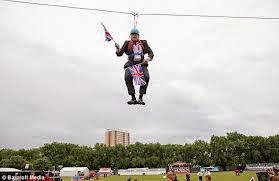
London has got itself a mayor who entirely fits the bill. Boris Johnson likes to make a fool of himself in public and share the joke. He’s a fine classical scholar and writes and broadcasts in an amusing and engaging, if slightly superficial, way on Roman history. 


Boris Johnson, Mayor of London
"What a great sport I am!"
Sadly, he also provides living proof that we actually need a politician with those qualities like we need a hole in the head.

Terrorists achieve their primary aim when they terrorise us. And that happens when we panic so much that we’re prepared to give up our own values in response to their actions. Yesterday, it was demonstrated by that same jocular, amusing, bumptious London Mayor.

Boris Johnson has called for a “minor” change in the law so that anyone travelling to the war zones in Iraq and Syria would be presumed to be a terrorist, and liable to prosecution unless they can prove otherwise.

In other words, with this “minor” change he would like to undo a value won and upheld through centuries of agitation for basic rights: the presumption of innocence. The principle means that in any criminal case, it is for the prosecution, backed as it is by all the apparatus of the state, prisons, security services, the police, to prove its case against the solitary individual in the dock, usually supported only by a lawyer.

For Johnson, doing away with this right is a small matter. As a man educated at Eton and Oxford and in possession of a significant fortune, he of course has little to fear from the state. If anything, as a leading Conservative politician, he’s far more likely to be exercising that power against others. What is truly worrying is that he speaks for a constituency within the broader electorate that is all too ready to believe him and give up rights that protect it, in order to seek safety from a supposed terrorist threat.

Why are we talking about such a threat? Because the voice-over on the video that Islamic State released of the murder of American journalist Jim Foley had a British accent. That touched a nerve among many in Britain. But if the result is that we cease to defend fundamental rights, then we shall have given Islamic State a far greater victory than it could have imagined.

Fortunately, Johnson’s suggestion has already been denounced by another leading Conservative, Dominic Grieve, the former Attorney General. He called it “draconian” and said that it would criminalise much legitimate behaviour. However, it’s insignificant that Grieve is the former Attorney General, believed by many to have been sacked for being too liberal for the current government.

That government includes the Home Secretary Theresa May, who intends to bring in new legislation against people and organisations who advocate extremist views.

Interestingly, that’s an even more pernicious intention than Johnson’s, because banning extremism sounds eminently sensible. But who will decide just what’s extreme? Let’s remember that there was a time when campaigning against slavery, or for women to be given the vote, or for Ireland to win its independence, was regarded as extreme. 


Do we really want government to decide what is or isn’t extreme? Do we want to give it the power to act against the views people advocate? Might it not be better to have it concentrate only on extreme actions rather than views? Most such actions are illegal already.

These are Tories, who are prompt to talk the language of “British values”, which they insist immigrants must endorse. It seems that they don’t regard presumption of innocence, freedom of thought or freedom of speech as fundamental among such values.

In addition, they proclaim their commitment to small government. It’s curious how easily, then, they advocate initiatives that massively increase government’s capability to intervene in all our lives. And then disguise what they’re doing behind a veil of good sense or, as in Boris Johnson’s case, one of engaging good humour.

It strikes me that as well as needing to deal with actions by Islamic State militants, we in Britain need to be ready to confront another threat far closer to home. And far more pernicious.

Saturday, 23 August 2014

David Cameron's bright idea: privatising the NHS

It’s curious to be sitting in the Accident and Emergency Department of our local (NHS) hospital, waiting for someone to see my wife for a sports injury she received this morning.

No one has asked us to provide evidence of ability to pay. The treatment will be delivered based only on the state of her health, the extent of her injury, and not her financial status.

No one stands to profit financially from her care. I’ve just heard a nurse explaining to an East European couple that they would not be receiving antibiotics. There is no financial incentive to prescribe any particular medication, and so it’s possible to get strict about what drugs are handed ou.

Sadly, Britain seems to be trying to move away from this admirable model, with doctors warning that the principle of service being free at the point of care is unlikely to survive more than another ten years if there’s no let up in the pressure on the NHS. It’s hard to overstate how shameful that is: the notion that when we’re ill or hurt, we can count on care immediately whoever we are and whatever our social position, is precious. It seems extraordinary that anyone can seriously question it or want to do away with it.

This isn’t to say that a health service has to be based on it. The United States, for instance, takes the opposite approach: there is no presumption of treatment without payment. I’m always impressed by the number of Americans I’ve known who assure me that the system is the world’s best, whereas it’s my feeling that it’s simply the world’s most expensive.


US Healthcare leads the world.
At least in expenditure
Far too much of the US population has no cover at all, a lamentable state of affairs Obamacare is only beginning to address, and a great many more have no adequate cover; highly expensive care is often provided, but it’s often entirely inappropriate: costly hospital treatment for conditions which could have been dealt with far more cheaply by a GP if one had been available earlier; and no follow-up after hospitalisation, so there’s a high risk that the underlying condition will continue to get worse and the patient will be back in hospital before long.

Considering how much it costs, that’s a damning indictment of the US system.

Which leads me to wonder why it is that some in Britain, most deplorably many in government, are so keen to see us move in that direction. And yet they do. Increasing numbers of services are being put out to tender to private companies. Currently £5.8 billion worth, a 14% increase over last year. And yet there’s no evidence that they’re provided either better or more cheaply than by the NHS itself: one of the biggest privatisation companies, Serco, was involved in a major scandal when it was forced out of its contract to provide out-of-hours GP services in Cornwall. And then just a week ago, it announced that it was going to see out the contracts it still has left and then withdraw from the UK market for healthcare services. It has racked up multi-million pound losses, and has had enough.

So privatised services aren’t particularly good. They aren’t particularly cheap. And they don’t even generate much of a profit for their providers.

Not that they don’t try to make one. When Care UK took over services to people with severe learning difficulties in Doncaster and absorbed a group of employees from the NHS, their first move was to cut wages by up to 35%, leading to a long-running strike. If profits don’t come, it certainly isn’t for want of trying. 


Why are they so hard to achieve? Because the NHS runs a tight ship: Britain may not have the world’s best health service, but many studies have found that it has the most cost-effective. In the profligate environment of the US, healthcare service companies can make a fortune, but over here it’s a lot more difficult.

Why then is the government so intent on maintaining the headlong drive towards privatisation?

There’s much debate about the nature of politics. Should it be oriented towards personalities, image, soundbites, charisma? Or instead towards ideologies, principles, fundamental philosophy?

Well, image gave us Cameron, a man whose incompetence as Prime Minister is only rivalled by his indolence. With a major crisis in Iraq he had to be called back from holiday – twice. He seems not to understand that he has a post that requires not just a full-time commitment but a lot more dedication than ordinary jobs. Dubya was like that, too, taking sixty or seventy days leave a year and working short hours. That’s the man who took us into the Iraq War, for God’s sake (and he probably thought it really was for God’s sake).

As for ideology, well that’s just what’s leading to NHS privatisation. It makes no sense: it benefits no one, not patients, not the taxpayer, not even the privatising companies. But that same Cameron has made up his mind, as a matter of principle, that it needs to be done. Against any evidence. As a matter of sheer belief.

In the debate between image and ideology, I choose neither. Competence, pragmatism and a willingness to take evidence into account, are the qualities that matter. And we need them badly, especially if we’re to save the NHS.

An old man has just been discharged in the hospital.

“Would you like a taxi home?” asked the nurse. “We’ll pay for it.”

The gesture would cost under £10. A trivial sum. But what a difference it would make to a lonely old man, worried about his health.

Money alone can
’t measure the value of a health service ready to provide such care to that man. We need to hang on to it as though our lives depended on it. 

Because they do.

Thursday, 21 August 2014

Isis and the mission of the unaccomplished

There’s so much to learn from Iraq. In particular, the truth of the old saying that the road to hell is paved with good intentions.

I’m prepared to go out on a limb here, and say that I’m prepared, for the purposes of argument at least, to give Tony Blair the benefit of the doubt. I’m prepared to allow that he might actually have been sincere in believing that Saddam Hussein was “a profoundly wicked, I would say almost psychopathic, man” and that, in consequence, he was right to do what he could to bring him down.

Saddam. A vile dictator. Bringing him down was a great idea
if only what followed hadn't been still worse
Now, however, even Blair admits that overthrowing Saddam Hussein may have contributed to the situation today. On 23 June, he told the Independent, “of course the Iraq of 2014 bears, in part, the imprint of the removal of Saddam Hussein 11 years ago. To say otherwise, as a recent editorial in this newspaper implies that I do, would be absurd.”

Indeed. Bringing down a vile dictator sounds like a fine plan, but you have to be sure that you’re going to replace him with something better. Whereas the intervention of 2003 has inflicted on the region, and on the world, something far worse. The massacres, the enslavements, that expulsions of innocent people by Isis give the measure of the utter barbarity of that movement. And yet, perhaps on Stalin’s principle that a single death is a tragedy and a million merely a statistic, the gruesome beheading of Jim Foley has brought it home far more powerfully still.

Jim Foley reported on horrors which have now claimed him
A single murder can be more blood curdling than a massacre
Why, it even dragged the British Prime Minister back from holiday. For the second time. On the first occasion, he authorised limited British military action in Iraq. but then shot off again as quickly as he could. It’s possible that his family stop him reading the papers or watching TV while he’s away (nothing about David Cameron suggests he regards being Prime Minister as a full-time occupation), because on his return it seems the security services had to make him watch the video of Foley’s death. Apparently to make him understand the gravity of the situation.

I imagine quite a few people had grasped how serious it was even without watching the video (I, for instance, feel no inclination to watch it). But perhaps Cameron’s just not that quick on the uptake.

A man who certainly isn’t quick is George Dubya Bush. It probably hasn’t occurred to him yet that there’s trouble in the same Iraq that he invaded. He may indeed not know that there’s trouble at all. Let’s not forget that he was unforgivably slow in his response to the devastation of New Orleans by Hurricane Katrina, although he was on holiday (yes, there’s a pattern here) in Texas, the state next door.

He probably still believes that he accomplished his mission in Iraq, as he proclaimed on the deck of an aircraft carrier. He may not have grasped that the murder of one of his compatriots, Foley, is a direct consequence of the mission he botched, with Blair’s faithful support. Less of a mission accomplished than a mission bungled by the unaccomplished.

Just how bungled is shown by what the West is reduced to hoping for these days.

The US heavily armed the Iraqi army it set up to replace Saddam’s. As a result, Isis has been able to seize enough weapons to arm five divisions, when that army turned tail and bolted from its advancing enemy. Now we have to hope that the Iraqi military can learn some effectiveness from the Iranian officers who are trying to get it back into some semblance of order.

And yet one of the justifications for the invasion of Iraq was to protect us from the still greater threat of Iran.

Meanwhile, Isis continues to make serious advances in Syria, using the US weapons it captured in Iraq. The country’s biggest city, Aleppo, is in danger of falling to its militants. The only hope of stopping them? The army of Bashar al-Assad, the man Blair still feels we ought to have bombed last year.

We may well have gone into Iraq with excellent intentions. But what a mess we made. We’ve woken a far worse, far deadlier, far more monstrous enemy. We’ve put weapons in his hands. And now we have to rely on highly unsavoury regimes to help us defeat him.

Yep. Good intentions. They take you straight to hell.

Monday, 18 August 2014

Islamic State: history repeating itself? Without redeeming features?

Explaining increased British involvement in action to stop the Islamic State in Iraq, David Cameron points out that the alternative was to allow the emergence of a “terrorist state on the shores of the Mediterranean and bordering a Nato member.”

The Nato member in question is Turkey. And, curiously, seeing that region threatened by a militant Islamic movement is a repetition of history – though, as often happens when history repeats itself, the second time round is even more painful than the first.

When the prophet Mohammed died in 632, he left the Arabian peninsula united as it had never been before. His successors discovered an energy and a military drive that would astonish and, generally, overwhelm their neighbours. To their North, two great Empires had been battling with each other for centuries: the Byzantines, successors of Rome, and the Persians. Within a generation, the Persian Empire had been completely overrun by Islamic forces and the Byzantines had lost huge territories, principally in the regions that now make up Iraq, Syria, Lebanon – and Turkey.

See the repetition?

Their sudden irruption on the scene wasn’t the only remarkable aspect of the Muslim conquerors. Their behaviour after victory gave them some unusual redeeming features. Instead of massacring their defeated foes, or even crushing them, they usually recruited them. So, for example, when they’d stretched their Empire along the whole of the North African seaboard, they decided it might be worth crossing the straits into Southern Spain and trying their luck in Europe. Tariq ibn Ziyad, who led their first landing on the rock off the Spanish coast which bears his name, Tariq’s mountain, Jebel Tariq, now Gibraltar, was in all likelihood a Berber, rather than an Arab, and the son of a former prisoner of war.

Once in Spain, the Arabs made allies of the Jews, long oppressed by the Visigothic Christian rulers. Jews held the captured cities on behalf of the Muslim armies, which could therefore move on to capture some more. The tradition of coexistence with other communities inspired one of the world’s great cultural centres in Cordoba. Muslims ran the show, but Jews – who were allowed to settle in pride of place right next to the Mosque – and Christians were tolerated and allowed to debate with Muslim scholars in one of the richest periods of intellectual development in Europe.

When Saint Thomas Aquinas wrote the works that would transform Christian thinking and underpin the Renaissance, he drew heavily on the thought of the Greek pagan Aristotle, as interpreted by a Muslim scholar from Cordoba, Averroes (Ibn Rushd).

That was then. Today a new Islamic military force is threatening the borders of what were once the Persian and Byzantine Empires. Given the opportunity, it would no doubt be more than happy to take the whole Mediterranean littoral and even threaten southern Spain. However, based on their track record so far, you can be pretty certain that they wouldn’t want to found a community in Cordoba that would win an international reputation for the free exchange of ideas.

Islamic State: attempting to reproduce the Muslim conquests
but without any of the redeeming features


On the contrary, it has proved to be a life-threatening condition to be non-Muslim, or even simply the wrong kind of Muslim, in the presence of the Islamic State. 1500 Shia prisoners of war were executed in a single day; Christians or Yazidis have been murdered, enslaved or driven from their homes in huge numbers.

The militants of Islamic State are trying to reproduce the great conquests of Islam in its early days. But as I said before, the second time round tends to be less admirable, less glorious than the first.

In Islamic State’s case, a lot less admirable and a lot less glorious.

No bad thing if we can help stem their attempt to repeat history.

Saturday, 16 August 2014

Better together. For us, certainly. Perhaps even for you.

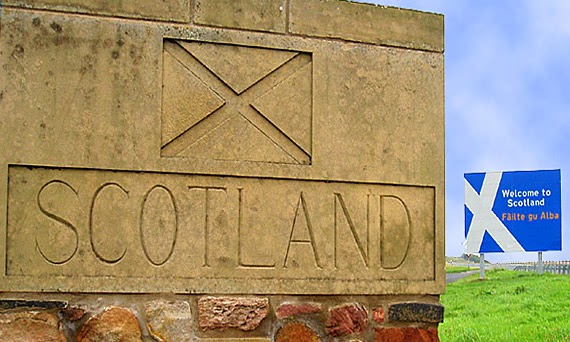
Driving northwards, towards Scotland, for a few minutes from that fine historic town, Berwick-upon-Tweed, will bring you to the sign welcoming you to Scotland. And thereby hangs a tale: for Berwick was a Scottish town for a long time. Every time I drive into Scotland from Berwick, as I just have, the town’s capture by England strikes me as emblematic of the history of the two nations: England has always grabbed more than it was entitled to, in its long history of battles, or negotiations, with Scotland.

Always a great welcome.
Though resentment would be understandable
So I can understand the sentiments of the campaigners for a Yes vote in next month’s referendum on Scottish independence. England’s never really treated Scotland fairly; why maintain a relationship in which the same injustice is likely to occur again?

An even stronger argument is voiced by many Yes campaigners: there is just one Conservative MP from Scotland, and yet Scotland groans under a Tory government like the rest of us.

It’s that “rest of us” which make me sympathetic to the argument, but also leaves me hoping that Scotland will vote No on 18 September. Because I didn’t vote for Cameron either, but got him anyway. A lot us in England are as keen as anyone in Scotland to see the back of him. And the departure of Scotland, with its 41 Labour MPs at Westminster, will make it all the harder.

Which puts me in this difficult position of feeling that, while Scottish independence is a perfectly comprehensible aspiration for the Scots, it will make life a lot tougher for us in England.

As it happens, I don’t really understand what kind of independence the Scots are looking for. They’re talking about keeping the pound as their currency. But by leaving the union, they would lose all say over how it’s managed. Why would they want to do that? And what kind of independence is it they’ll get, with their currency still managed by England?

So, while I couldn’t help feeling a surge of sympathy for the Scots as I drove past that sign 4 km on the Scottish side of Berwick, I take some relief at the apparently widening lead for the No vote in the polls.

“Better together” is the official name of the No campaign. I’m sure we in England would be far better off together. And, given the kind of independence on offer to the Scots, I’d like to say to them – you might be better off too.