Showing posts with label Terrorism. Show all posts

Wednesday, 20 March 2019

Hey, New Zealand: couldn't you lend us Jacinda for a while?

It’s a tale of two accidental leaders…

Jacinda Ardern was never meant to be Prime Minister of New Zealand. Or at least not yet, not so early as to make her the youngest in a century and a half. She was serving as Deputy Leader of the New Zealand Labour Party when, just seven weeks ahead of the 2017 General Election, the then Leader, Andrew Little, stood down in the face of the dire poll standing of the party.

That’s not an issue for the British Labour Party under its present leadership. It trails a thoroughly discredited Tory government in the polls, at a point when it needs to be well ahead to stand any chance of winning the next election. But Corbynists shrug such matters off. There’ll be a surge, they say, as there was last time. They ignore the fact that the surge wasn’t enough to win and only produced a defeat less drastic than had been feared.

Funnily enough, Corbyn was an accidental leader too. He only stood for the leadership because no one else on the left was prepared to throw his name into the hat. He had no expectation of winning and, indeed, only made it onto the ballot because political opponents within Labour agreed to nominate him as a way of giving the left a chance to be in the game. They didn’t think he’d win either, and how they must be regretting it now.

As it happens, Ardern didn’t win the General Election. She came second with 46 parliamentary seats to the National (conservative) Party’s 56. But coalition negotiations allowed her to assemble a government and she took office. Since then, she’s impressed again and again, including in her personal behaviour: giving birth while in office in a way that charmed the nation.

At no time has she been more impressive than in response to the dire events that took place last Friday, 15 March. A new and far more dreadful Ides of March than those that marked the assassination of Julius Caesar. In Christchurch, a terrorist opened fire in two Mosques killing 50 worshippers and injuring many others.

Her statement to Parliament moved me to tears. She found an extraordinarily powerful way of expressing her total solidarity with the victims and their friends or relatives. It was a moving statement that said that these Muslim immigrants belonged to New Zealand and New Zealand belonged to them. It was a highly effective way of rejecting the views of anyone who might be inclined to nurse  xenophobic feelings towards the victims, a sense that it was tragic but nonetheless, they were somehow wrong to have come to New Zealand, that they were in some sense responsible for the attack on them.

She said:

We cannot know your grief, but we can walk with you at every stage. We can. And we will, surround you with aroha, manaakitanga and all that makes us, us. Our hearts are heavy but our spirit is strong.
Jacinda Ardern with the victims
Showing aroha, manaakitanga and ... leadership
She spoke of “us”, embracing all New Zealanders. And she underlined the message by using the Maori words for love and a much deeper sense of hospitality. The Prime Minister was saying categorically and clearly that the victims belonged in New Zealand and deserved its welcome.

Talking of the presumed perpetrator who, following her example, will not be named here, she said:

A 28-year-old man – an Australian citizen – has been charged with one count of murder. Other charges will follow. He will face the full force of the law in New Zealand. The families of the fallen will have justice.

He sought many things from his act of terror, but one was notoriety.

And that is why you will never hear me mention his name.

He is a terrorist. He is a criminal. He is an extremist.

But he will, when I speak, be nameless.

And to others I implore you: speak the names of those who were lost, rather than name of the man who took them.

He may have sought notoriety, but we in New Zealand will give him nothing. Not even his name.


I find it hard to read these words, courageous, outspoken, resolute, without feeling a pricking of tears in my eyes.

Compare them with what Jeremy Corbyn said when asked whether, in a second referendum, he might vote for Brexit:

It depends on what the choice is in front of us. If we’ve got a good deal in which we can have a dynamic relationship with Europe which is all the trading relationships and so on that might be a good way forward that unites the country.

“It depends”. A prevaricating, vacillating reply. And why does he make it? Because he thinks there is a Brexit deal that can unite the country. Which means he wants to pull in the xenophobes who voted to leave the EU out of a dislike of immigrants. Where Ardern tells xenophobes that New Zealand stands for different values, Corbyn tries to appease them.

He must know he can’t. Any deal that he would call ‘good’ would involve a softer Brexit that leave voters would regard as a betrayal. He’s making the same error so many others have made before him, not least David Cameron who called the Brexit referendum: he’s throwing raw meat to people who will only demand more, when they see that pushing their demands gives results.

Ardern stood firm and she’ll be admired for it. Corbyn yielded and he’ll be despised. Two accidental leaders, but only one is truly a leader, showing that accidents can turn out well on some occasions and pitifully badly on others.

How I wish we could borrow her for Britain, to lead Labour, and eventually the country. And send Corbyn back to his allotment to tend to his vegetables. He’d be much happier. As would Britain.

Alas, New Zealand wouldn’t let her go. But can we perhaps can find her like ourselves? At least she’s shown us what to look for.

Wednesday, 13 June 2018

Pleasure, and a timely lesson, from the Hamburgers

There are more bridges in Hamburg than there are in the whole of Venice and Amsterdam. Taken together.

How do I know that? I was told by a taxi driver. And the word of a taxi driver is not to be doubted, is it? Like the word of a US President. So I haven’t checked. I have to admit, though, that if I havent looked, it’s partly just because I wouldn’t want to find out that it wasn’t true.
The Elbe in Hamburg
In any case, it’s highly plausible. The city has water everywhere. It’s a great port, after all, at the mouth of the river Elbe, and with many channels of its tributary, the Alster, flowing through parts of the city centre. Water, hills and parks make a city, in my view, and Hamburg has the first and last of these.
Water, water, everywhere
Many of the waterways are lined with old warehouses, a reminder that the city was once one of the chief centres of a great trading association of northern Europe, the Hanseatic League. Most German cities like to have their car number plates identified by a single letter – B for Berlin or F for Frankfurt, for instance – because a short abbreviation indicates a great city. Hamburg insists on two – HH for Hansestadt Hamburg, recalling its long commercial traditions.

Hamburg warehouses. And more water, of course.
‘England is a nation of shopkeepers,’ Napoleon once said. I realised just what he meant, and just why he said it, when I was recently reading some material on Britain in the eighteenth-century. In the Napoleonic wars, Britain tried for as long as possible to avoid getting involved in fighting on land in Europe, preferring to limit its military commitments to the sea (trade needed the sealanes kept open, after all). Instead, it offered subsidies to its allies to do the actual fighting. It could offer those subsidies because it was a powerful trading nation, though as I argued here recently, even Britain suffered as embargoes and counter-embargoes were imposed.

Hamburg, like Britain, prospered by trade. A message Brexiters and Trumpistas would do well to remember. Erecting barriers makes nations poorer. Knocking them down makes them richer – all of them: this isn’t a zero-sum game, both sides gain from trade. And war damages them.

Alongside parks and waterways, spires help a city too. My eye was caught by a tall church tower as I was walking between meetings, but I couldn’t get to it just then – I was in the city for work, after all. However, later, having seen a colleague off at the station, I found that my route back to the hotel took me close to it. “I could take a look,” I thought.
The ruined church of St Nikolai in Hamburg
It turned out to be the tower of the St Nikolai church. Only the tower and the chancel survive. The main part of the nave was destroyed in 1943 when the Allies bombed the city, in the aptly – and vengefully – named ‘Operation Gomorrah’. The Royal Air Force bombed at night, the US Air Force by day; the RAF carpeted the city indiscriminately, the USAF targeted military works (such as a submarine factory); a fire storm engulfed the city, leaving a number of dead that has never been precisely determined, some of the corpses having been completely incinerated in the flames.
Picasso evoked the terror of the Nazi bombing of Guernica
The museum in the crypt of the ruined church makes it clear that the chief blame for the horror belongs to Hitler and Nazism, that none of this would have happened had they not set Germany on a vain road to world power, and that the Nazis indeed had pioneered the use of mass bombing of civilians before the Allies did: the museum mentions Guernica during the Spanish Civil War, Warsaw, Coventry and, indeed, London, all bombed long before 1943.

That’s generous of the German historians.

However, it hardly lessens the guilt of the Allied strategists. The exhibition quotes Air Chief Marshall Arthur ‘Bomber’ Harris saying ‘There are a lot of people who say that bombing cannot win the war. My reply to that is that it has never been tried… and we shall see.’

Let’s be clear: the bombing of civilian targets has only one aim. In World War 2, the Allies called it ‘breaking the morale of the population’. Today we call such attempts by a single and simple word: terrorism. The destruction of Hamburg by fire was absolutely clearly an act of state terrorism, something we would do well to remember whenever we throw up our hands in horror at state terrorism practised by our enemies today.
Hamburg ablaze during Operation Gomorrah
St Nikolai has been left ruined, like the Memorial Church in Berlin or Coventry Cathedral in England. There is a quiet, stately mournfulness about these monuments to those moments when we get things wrong and build walls instead of bridges. 

Salutary in this city of so many bridges and which has suffered so much.

Are you listening, Trumpistas and Brexiters?

I suppose it would have been appropriate to have had a hamburger
among the Hamburgers. But I resisted the temptation

Friday, 30 June 2017

London Bridge and Borough Market: intelligence in the response to terrorism

There are two fine responses to terrorism, one military and one civilian, and two that are far less intelligent – though far from uncommon.

Shrine to the victims of terrorism on London Bridge
The unintelligent military response is to go to war. For years, we’ve had a “war against terrorism”. It’s a meaningless notion. War can be directed against a territory (which may be a nation) or against its armies: war against Nazi Germany, against the rebel American States, against the Vietcong army or North Vietnam – whatever you think of their justification, these are meaningful concepts one can comprehend.

But war against terrorism? Who or what’s the target? Where do you invade?

The answer to that last question has been Afghanistan and Iraq. Neither war has been won and both have led to a far greater threat of terrorism, indeed a far higher number of outrages. The military action was gesture politics: it showed governments doing something, with no concern as to whether it was the right thing.

The intelligent military approach requires – well, it requires intelligence. Excellent security work has foiled terrorist plot after plot in Britain. As a way to keep us safe, it has proved far more effective than, say, invading Iraq.

Even so, not all outrages can be stopped. Which takes us to the civilian response.

The less intelligent reaction is to start enacting new legislation. This is rather like invading Afghanistan. It shows governments to be doing something, but with no concern as to whether what it’s doing is useful. After all, little that a terrorist does is legal anyway – murder doesn’t need new legislation against it, and conspiracy to commit murder or complicity in murder are also crimes. Collecting the weaponry for a terrorist attack is illegal too, as is incitement to commit a crime, or perversion of the course of justice to cover it up afterwards.

Most legislation proposed in the wake of an attack is concerned with limiting thought, not action. I don’t like the idea of a worldwide caliphate being established and would do everything legal within my power to prevent it. But how can ban people from believing it’s a good thing? Why, there are people who think Trump is a good thing. How can we make it a crim to try to persuade others of their point of view? It’s the very attempt to regiment thought that excites my dislike of the notion of a caliphate.

Let me be clear: trying to persuade people that a Caliphate is desirable should not be a crime; trying to persuade people to take up arms to make it happen is a crime, as it should be.

The biggest problem with attempts to limit thought by legislation is where do you stop? In Russia, for instance, it’s becoming increasingly difficult to speak out in favour of rights for homosexuals. That’s because many – possibly a majority – in the population and certainly in power see homosexuality as an abomination. But then banning belief in a Caliphate would be based on a sense that it too is an abomination.

Limiting freedom of belief opens the door to regressive, and repressive, behaviour which is likely to have far more damaging consequences than its backers imagine. Ill though-out, unintelligent reaction is unlikely to be effective against terrorism, but is highly likely to inflict wounds on ourselves. Let’s not forget that Maggie Thatcher, in my view not maligned anything like enough, made the attempt to ban teaching in schools if it was deemed to “promote” homosexuality. Putin would have been proud.

It’s a slippery slope and it goes a long way downhill.

So how about the intelligent civilian response to terrorism? It’s the reaction that says, “it’s not going to stop me living the life I choose to live”. Fortunately, it’s a widespread attitude and one that reveals an inherent strength in our populations. That makes it probably the best guarantee of our long-term success against the attempts to undermine us by terrorist means.

I was struck forcibly by that truth when I recently wandered through Borough Market, near London Bridge. Not a month ago it was the scene of a vicious and brutal terrorist attack: three men drove a van into a crowd on London Bridge, and then chased victims enjoying the evening in the pubs and restaurants, or just the streets, around the market. They killed eight and injured 48 before being gunned down themselves by police.

There’s still a shrine to the memory of the victims on the bridge. But I was inspired by the activity in Borough Market as I walked through at 8:00 in the morning. Things were only just getting going, with stall holders beginning to open their stands, food beginning to cook, and a few passers-by beginning to appear, to stop and look and occasionally to buy (breakfast, in my case).

Normality reasserted: Borough Market reopening for business as usual
Life was already back to normal. No one had forgotten the attack. But the rights of the living had been reasserted. So the terrorists had failed..

For that I’m profoundly grateful. And hopeful.

Despite the lack of intelligence of so much else of what we do.

Monday, 5 June 2017

Voting Tory – you know it makes sense. Well, some kind of sense

If you’re not voting Tory at the general election on Thursday, it’s clearly because you’re just too obtuse to understand the elementary logic that makes it the obvious choice. So, as a public service, I’m going to explain it in simple terms.

Theresa May champion of simple logic. The simplest
Let’s start with austerity.

You’ve got to understand that Gordon Brown, Labour Prime Minister, single-handed and alone, or at least alone apart from all the other Labour politicians who were his accomplices, brought about a major international financial crisis in 2008. Yes, yes, it started in the US, but it was still Brown’s fault. And the depth of his incompetence is measured by the fact that it left the country massively in debt.

You can’t have that. A huge national debt is just a burden on our kids and grandkids. It’s intolerable, immoral even, to leave them to bear it.

So we have to cut public spending. Of course we do. Because overspending only increases debt.

Less on schools, for instance. Because if we’re trying to spare our kids the crushing burden of debt, why bother them with an education?

Less on the NHS, because only sick people need healthcare, and sick people aren’t our concern.

Less on the police, because who needs policemen to protect them against, say, terrorist attacks, which hardly ever happen, or at least not more than once or twice a month? In any case, when it comes to terrorism, the trick isn’t to spend more on policing and intelligence, it’s to make some new laws. That’s so much cheaper.

Who cares if we don’t have the people to enforce the new laws? The trick with laws like that isn’t to apply them, it’s to make them. Or, more to the point, to be seen to make them, because that’s where the votes are.

Anyway, even if we do enforce them, we’ll only be chucking a few people in gaol who are obviously dangerous. Because, say, they have neighbours who can swear that they’re almost certain they once heard them say that at times they got so angry, they could understand people wanting to blow a politician up. And who cares about them? They’re like the sick – in fact, they’re really sick – and needn’t concern us any more than the other kind.

Of course, sacrifices do have to be made in the pursuit of the common good. It must be quite uncomfortable for the ten million people who are now in insecure employment – temporary or on zero-hours – but hey, that’s only one in three of the workforce. And one in three isn’t a majority, is it?

And why do we do all this? Because austerity works. It cuts debt, which was the whole aim of the exercise. Look at how dramatically seven years of Tory rule have impacted on national debt: it first went through the trillion-pound level in 2011 – and by 2017 it was a mere 1.73 trillion!

Now that’s the kind of awe-inspiring achievement that we’ve come to expect from the Tory party.

And that’s the logic behind a vote for the Tories.

Got it now?

Monday, 25 July 2016

Outrages all around. And outrageous lack of thought in response

When it comes to making the world safer, the complete – but unsurprising – failure of Dubya and Bush has now been dramatically demonstrated. These days, it seems barely a day goes by without some new outrage, generally linked with the vile genie the invasion of Iraq let out of the bottle, the terrorist so-called Islamic State.

When it comes to size and spectacular impact, the French seem to be suffering the most, but just for now, at least, it’s the Germans who seem to be at the wrong end of a long, grinding, agonising repetition.

Another day, another outrage
Not, of course, that all those attacks are actually terrorism. It was almost with relief that I learned that a machete attack in Reutlingen was a ‘crime of passion’ and not terrorist-related. It seems awful to feel relief over what was, after all, a murder, but I suppose it’s a bit like the Northern Ireland police at the time of the troubles. They had the notion ‘Ordinary Decent Crime’: with so many crimes literally atrocious, it must have been comforting from time to time to come across a common-or-garden, civil crime unrelated to the sectarian conflict.

As it happens, it wasn’t only the machete attack that was unconnected to ISIS. That was also the case of Friday’s shootings in Munich, when 18-year old David Sonboly killed nine people.

Apart from the horror of the event itself, it was also interesting to see the reactions to it. A great many people, not least the British Foreign Secretary and semi-professional bungler, Boris Johnson, assumed immediately that it must have been an act of terrorism. Boris began pontificating about the need to tackle terrorism at its roots in the middle east, as well as in the many countries it affected, which at least had the merit of being true – it just wasn’t relevant. He would have discovered that for himself had he waited until he’d had a little more information before sounding off.

Boris is a wonderful illustration of the truth that no one can be quite as stupid as an intelligent person. He has the brains to work out an astute message on terrorism, just not the self-control to wait until he finds out whether terrorism played any part in the act he’s commenting on.

It was in any case interesting to see who else jumped the gun and started running their mouths off about terrorism, with a mere skip to immigrants as the causes of terrorism, before they knew what had actually happened. “Oh, Mrs Merkel, is it time for you to have second thoughts about letting all those people in last year?” they chanted, only too happy to be able to give their xenophobia free rein.

Let’s set to one side the fact that Merkel let in a million desperately wretched people. That a handful of them turn out to be pretty rotten is unfortunate but hardly shocking. Are we really to turn our backs on over 999,990 of them because of what the rest may do?

Let’s instead concentrate on David Sonboly himself. Of the nine he killed, seven were migrants: three Turks, three Kosovans and one from Greece. It seems his victims were disproportionately immigrants, while he was German born.

Yet he was of immigrant stock: his parents were Iranian refugees. The son of immigrants rounding on immigrants isn’t that unusual, with one wave of immigration resenting the next, which it sees as destabilising its own situation, the way of life it has established with the native population. We’ve had some celebrated examples of this kind of behaviour in Britain. Leading Conservative politicians Michael Howard and Michael Portillo both backed measures to restrict asylum rights, even though the former was the son of a Jewish refugee from Nazism and the latter the son of a Republican refugee from Franco’s Fascist coup in Spain.

The people who used the Munich shooting to decry immigration were, it seems, lining up with the perpetrator against his victims. They didn’t mean to, of course, but it’s curious to see where you end up when you talk first and think later.

Either way, the incident was an outrage and a tragedy. Though it wasn’t itself linked to terrorism, it underlines a greater familiarity with violence in our societies which terrorism has probably fanned. We’re in for difficult times over the next few years or even decades.

Another case of reaping the bitter fruit of acting without thought or sufficient information, just as Dubya and Blair did. We’ll be consuming the toxic harvest of the Iraq invasion for a long time yet. The worst of is that the ill-judged reactions to Friday’s events, whether Boris’s or those of simple social media users, show that we’re still a long way from putting that kind of lazy, ill-informed and frankly bigoted thinking behind us.

Tuesday, 29 March 2016

Reacting to atrocities

Thirty-five people are killed and many more injured in Brussels, and we react, rightly, with revulsion. Nothing justified their deaths: they were wholly random victims. They were killed by men who claimed to speak in the name of Islam but, though their victims might have been dedicated enemies of Islam, it would have made absolutely no difference had they all been devout Muslims, leading lives wholly in keeping with Islamic teaching – they would have been killed or hurt anyway.

We react, first, emotionally. Monuments across Europe are lit in the colours of the Belgian flag. Crowds attend vigils or simply express their sadness and horror. And that’s perfectly commendable if, sometimes, a little excessive. After all, far more people are killed or injured on the roads, with nothing like the reaction; but as Simon Jenkins pointed out in the Guardian, we aren’t talking about rational but emotional responses. We feel, correctly or incorrectly, that we have control over whether we’re involved in a car crash; we have no control over whether a pitiless bomber chooses us as his next, random victim.

Next we react politically. But, in fact, our political reaction is emotional too. In Britain, the outrage in Brussels is informing the debate about whether we should leave the EU (in the hope that this would erect a barrier against these vile persons) or stay (in the belief that this would enhance cooperation between security services against such attacks). It also inspires a still more sinister discourse, which would have us give up more liberties in the name of security, sacrificing privacy, for instance, to allow government to spy on our e-mails or internet browsing. That argument is made though the security is against an extremely unlikely and probably temporary threat, while the loss of freedom is massive and likely to prove long term.

Then we learn of another outrage. Seventy people killed this time, as well as hundreds injured, in a park in Lahore. And our reaction is interesting. It’s nothing like as intense. The deaths matter far less to us when they happen in Pakistan. No monuments are lit up in the green and gold colours of that country’s flag. When we’re shocked at the senseless loss of human life, we really mean the loss of life among humans who look a bit more like us, and don’t live that far away. Remoteness and difference lessens the feel of shock.

That’s true even though the bombers deliberately chose to blow themselves up in an area where large numbers of children were gathered and would inevitably suffer.

And how about another example? Several hundred killed in London, and many more injured. Again, by merciless bombers who felt they were doing good work for an excellent cause. Again, the victims were random, depending on where they were at the time a bomb struck. And again, many were women or children.

Why aren’t we horror-struck by this devastation? The answer is once more remoteness. Not in space, on this occasion, but in time. That particular bombing outrage took place during the night of 7 to 8 September 1940, the first day of Hitler’s air campaign that Britain came to know as the Blitz.

That, of course, is just history, as Lahore’s just geography. But curiously, there’s a lesson to learn from it. British spirits weren’t broken by the terror that fell from the sky – any more than German spirits were broken by the same treatment, in Cologne, Hamburg, Berlin or Dresden. The raids on that last sad city claimed up to 25,000 lives in just three days. A single night’s bombing of Hamburg took 42,000 lives, against a total of 40,000 killed in London in all 57 raids of the Blitz.

But whether in Britain or in Germany, whether inflicted by the Nazis or the Allies, what all these attacks have in common is that they were far more extensive than anything we’re seeing today.

An image of the London Blitz
And of the spirit that saw people through it. Which we need to rediscover
Eventually, though, our countries emerged from those terrible experiences and built far better structures for the defence of liberties and human rights than had ever existed before.

Wouldn’t it be a pity if, in our responses to the current wave of outrages, we were to sacrifice them all again?

Sunday, 6 December 2015

The potential dangerous terrorist I met this luchtime

Have you read Elaine Morgan’s The Descent of Woman

There is little acceptance these days of her fundamental notion about human evolution. That's the “aquatic ape” hypothesis, according to which the species at one time headed back to the sea, along with various others which, like us, have streamlined residual hair and subcutaneous fat (a much more useful way of retaining body heat in water than fur): pigs, elephants, hippos, etc. Indeed, she reckoned that other land species went back to the sea and stayed there – dolphins, for instance. Who knows whether we mightn’t have done better to follow their example.

Still, all that is questioned these days. On the other hand, I stick with her overall stance, that woman must have contributed more, and perhaps a great deal more, to the development of the species than man. That makes sense if only because the rearing of young is key, especially in a species such as ours, where the young are so vulnerable for such a long time.

I haven’t tracked down the quotation, but I think it was Morgan who, in combating the prevailing macho theories of anthropology – the theories of the “Tarzanists” for whom the key development in mankind is the emergence of the hunter, strong, tall, farsighted, courageous, deadly and inevitably male – came up with a great little thought exercise. When faced with such a sentence as “humans are the most lethal predators the Earth has seen”, apply it to some individual human from your daily experience. This will give you give you something along the lines of “that postman coming up my front path is the most lethal predator the Earth has seen.”

It’s a great antidote to over-generalised thinking. And, as well all know thanks to William Blake, “to generalise it to be an idiot.”

It was just this lunchtime that I was reminded of Morgan’s inspiring and lucid thinking. I bought a few bits of food at Marks and Spencer. I was called over to a till by a young woman with a shy but kind smile, who dealt with me politely, efficiently and with friendliness. As it happens, she was wearing a Muslim headscarf.

Two thoughts occurred to me.

The first, why are we who happen to be white entitled to tell a woman like her what she should or shouldn’t wear on her head? It appals me that France, my second nation, full of so many people I like and admire, nonetheless feels it’s entitled to tell the Muslim minority what aspects of its perfectly harmless behaviour are tolerable and which aren’t.

The hijab doesn't even rule out belief in basic
French republican principle
The second was just how appalling a society we will have created if we ever allow ourselves, in our necessary and legitimate pursuit of vigilance, to suspect of terrorism anyone whose dress identifies them as Muslim. What an atmosphere that would be to live in. Besides, if there’s one sure way to create a large pool of alienated and antagonised people, it’s to suspect them of hostility towards you – there’s no better example of a self-fulfilling hypothesis.

“That timid and deferential young woman may be a vicious and callous terrorist?” Yeah, right. I’m really not prepared to live a life in which that’s the first thought that crosses our minds.

Thursday, 19 November 2015

Terrorism: hardly a tactic refused by the West, and by no means an expression of power

The atmosphere today is febrile with the fear of terrorism. 

Not without reason. If the attacks on Paris prove anything, they prove that terrorists are capable of reaching right into the places we think of as safest and hit us there. That’s a prospect that makes ISIS seem frighteningly powerful.

We’d do well, however, not to be carried away by our natural fear. In particular, we mustn’t overstate the power of a terrorist movement. In reality, terrorism is precisely the opposite of the expression of power – it is a blind lashing out in impotence, by a movement incapable of exerting real power against its foes.

Nor should we make the mistake of thinking the West incapable of acting in equally terrorist ways. Indeed, we should remember that when the Western democracies went for terrorism, they wreaked incomparably more harm than ISIS ever has.

After the defeat of France by Nazi Germany, Britain was briefly left to fight on alone – although it wasn’t quite as isolated as that sounds, since it could draw on the support of a still substantial empire. However, Britain was in no state to wage an effective ground war against Germany. Indeed, when France and Britain together had decided to strike at Germany using ground forces, it was through an invasion at Narvik in Norway, designed to win access to Swedish iron ore supplies, and deny them to the Nazis. The campaign ended in the ignominious retreat of the French and British forces, and the defeat of Norway by Germany, which promptly occupied the country (as it had Denmark on the way).

At sea, British dominance was unchallenged. But Germany wasn’t fighting a naval war, apart from the submarine campaign against convoys supplying Britain – in which it was giving the Royal Navy a tough battle.

So, in its inability to achieve any kind of success on land, and fully committed in a defensive battle at sea, Britain could only turn to air power to produce some evidence to its population of effective action against the enemy. Hence was born what came to be called the strategic bombing campaign. Cutting through technical and apparently neutral terms, that was the mass bombing of German cities.

The thing about bombing cities is that the only thing it will certainly do is kill a lot of civilians. Indeed, something like 305,000 Germans were killed by this campaign. Nearly 800,000 were wounded. 7.5 million were made homeless.

Aftermath of the bombing of a German city in World War 2
Naturally, the campaign wasn’t openly described as terrorism in Britain (it was, equally naturally, in Germany). It was justified as a way of degrading German industrial capacity, in which it was a failure: production continued to grow throughout the war. However, it was also presented as a means of breaking the population’s willingness to support the war. The Area Bombing Directive of Valentine’s Day 1942 (history is full of ironies) which began the carpet bombing of cities, set as its objective “to focus attacks on the morale of the enemy civil population and in particular the industrial workers.” That really is the textbook definition of terrorism: deliberate targeting of a civilian population in order to destroy its morale.

The Germans used the same approach. Over 60,000 British deaths were caused by German bombing. The Germans were just as happy to adopt terrorist tactics as the British; only lack of resources prevented them causing the same level of damage.

So a first observation: it would take over 2000 attacks like last Friday’s in Paris to inflict on the French the kind of destruction the Allies wreaked in Germany. When it came to terror, we had the resources to be a lot more effective at it than ISIS is or ever will be.

And a second observation: it was no evidence of strength on the part of Britain, and later the USA. It’s hard to point to any advantage to the Allied cause that came from bombing German cities. Indeed, it often did us harm. As military historian Correlli Barnett has argued, the campaign diverted resources from providing air cover for convoys, driving Britain nearly to starvation at the height of the U-boat campaign. When it came to depleting German capacity, far more was achieved by bombing railways and canals. No, the bombing was the reaction of a nation that could see no way to win significant victories for the time being, lashing out at its enemies in the only way it could. It hardly mattered whether it did anything useful.

The use of terror tactics by ISIS is of the same order. It had some spectacular success initially in Iraq and Syria but now it’s bogged down. Terror is a way of venting its hatred against its enemies, whether in Lebanon, at Sharm El Sheikh, or in Paris, and it matters little whether it achieves anything for its cause.

In fact, it looks strongly as though ISIS is doing itself harm. It has brought down a Russian airliner and attacked Paris. That has suddenly brought together people who were having real trouble reaching any kind of common ground. We may even see NATO and Russia finally coordinating their actions in the Middle East to defeat ISIS, before considering the questions on which they have differences.

Rather like Japan attacking Pearl Harbor, ISIS may have woken a sleeping giant. That may seal its fate.

See what I mean? The use of terrorism doesn’t show power, it shows weakness. In this case, a possibly fatal weakness.

Saturday, 14 November 2015

Paris attacks: how we might react, and how we should

Yesterday morning, 13 November, the British media were dominated by one story: the probable killing by a US drone strike in Syria of “Jihadi John”, British citizen Mohammed Emwazi. He became notorious around the world when he executed, on camera and with cruel delight, six captives of the ISIS group.

Jeremy Corbyn, leader of the UK Labour Party, responded to the news of Emwazi’s likely death, with the comment, “it appears Mohammed Emwazi has been held to account for his callous and brutal crimes. However, it would have been far better for us all if he had been held to account in a court of law.”

Indeed. Being killed in the streets of Raqqa by a US weapon turns him into a martyr of the fight against imperialism; in front of a court, he could have been exposed as the cruel, small, cowardly man he really was.

The point was made more strongly still and, for me, more movingly by Diane Foley, mother of one of Emwazi’s victims, James Foley.

Diane Foley: It saddens me that, here in America, we’re celebrating the killing of this deranged, pathetic young man…

ABC (Brian Ross): It gives you no solace?

Diane Foley: No. Not at all. Had circumstances been different, Jim [James Foley] probably would have befriended him and tried to help him. It’s just so sad that our precious resources have been concentrated to seek revenge, if you will, or kill this man when if a bit of them had been utilised to save our young Americans... That’s what our country should be doing, I think, is protecting our citizens and the vulnerable, the people who are suffering, and not trying to seek revenge and bomb… I’m sorry… Jim would have been devastated with the whole thing. Jim was a peacemaker. He wanted to know how we could figure out why, why all this is happening.

ABC: For you there’s no sense of justice then, in this strike?

Diane Foley: Justice? No. It’s just sad. We have to be careful … not to glorify this deranged young man. I mean, he’s a sad individual, filled with hate for us. I hope our country can choose to lead in ways of peace and valuing young Americans who are trying to protect… our best ideals. That’s the part of America I’m proud of... I don’t like this bully part, I’m sorry, no.

She’s so right. We went to war in 2003 to wreak revenge for 9/11 on someone, anyone – after all, Iraq had nothing to do with the attacks – and the result has been twelve years of more disasters including the rise of ISIS, the ravaging of the region, a huge flow of refugees which we’re struggling to cope with, and further terrorist outrages. Twelve years, with no end in sight.

Yesterday morning, though, the talk was all about how significant the likely death of Emwazi would prove. Since he was not a significant player in ISIS, it was generally felt that his death would not be a body blow to the organisation, though it would be a major propaganda coup.


Parisian emergency services going into action
at the Bataclan concert hall, where most victims were killed
And then we had the Paris attacks. When it comes to propaganda effect, it leaves the killing of Emwazi firmly in the shade. It was a way of saying to the West:

Firstly, that we are all targets – ISIS doesn’t attack individuals like Emwazi, it attacks whole populations, with no interest in guilt or innocence (or rather, on the assumption that we are all guilty).

Secondly, the attack shows that our twelve years of fighting, with all the investment of lives and treasure, have had no impact at all on degrading our enemies’ capacity to strike us. The Paris attack is the worst France has undergone since the Second World War.

There’s quite a message behind this.

Lesson number 1 is the easy one: ISIS is a present and growing threat, and we need to combat it.

Lesson number 2 is that the approach we’ve taken so far has only been partially successful. Excellent intelligence work in a number of countries has prevented attacks within their territory. France probably needs to do a great deal better in this field. But when it comes to snuffing out the movement at its roots, in Syria and Iraq, we’ve done little more than nibble around the edges of the problem. Indeed, we created many of the difficulties in Syria and Iraq ourselves when, in our pursuit of the kind of revenge Diane Foley criticises, we incompetently waged war in the region. Remember the prisoner abuses in Abu Ghraib prison in Iraq, and ask yourself what they did to attract recruits to ISIS.

Lesson number 3 is the lamentable one. The most common reaction to the events in Paris will probably be to want to do more of precisely the things that have proved ineffective in the past. There’ll be more Islamophobia. There’ll be more calls for curbs on immigration. There’ll be more pressure to go to war.

What there’s unlikely to be is any attempt to follow Diane Foley’s advice, to stop wasting our resources on seeking revenge, and instead focus on protecting our people and upholding our values. That doesn’t mean ducking the issue of war if military action really is necessary, but only taking it when we know exactly what we’re doing, it’s limited to necessary and defensible goals, it’s legal and we know it can achieve what we need.

If I’m lucky, I’ll be proved wrong. The West will adopt a different and far more intelligent approach to the problems that 9/11 and the ill-thought out Western reactions have caused. And at last we’ll see effective action taken.

Well, we can always hope...

Wednesday, 5 August 2015

Grim anniversary, of exceptional terrorism. By the West.

This is an excellent time to pause and think about terrorism.

We in the democracies rightly fear terrorism and want to do everything we can to prevent further terrorist outrages. We’d like to get into a position where no one any longer resorts to terrorism, because they realise that it cannot succeed and will always be defeated.

Sadly, however, our own nations are responsible for one of the worst ever acts of terrorism the world has seen. It was carried out with impunity – none of those responsible was ever made to answer for it – and it proved successful, which might rather encourage than discourage others down that route.

We’re at the seventieth anniversary of the dropping of an atomic bomb on the city of Hiroshima, on 6 August 1945. It had a population of perhaps 350,000 at the time. Between 100,000 and 150,000 died, the vast majority civilians.

The A-bomb dome in Hiroshima
Stark and poignant memorial to a horrifying act of war
The deliberate killing of civilians for political ends is pretty much the textbook definition of terrorism.

Of course, the defenders of the decision to drop the bomb argue that they were not intending to kill civilians. There were indeed military targets in the city. But that’s a bit of a sophism. If you use the most massively destructive weapon ever developed against a city of a third of a million people, you know you’re going to kill a lot of them. If you were trying to take out Field Marshal Shunroku Hata, who was stationed at Hiroshima, and perhaps his general staff, would you really need to destroy 70% of the city’s buildings and so much of the population?

Hata, by the way, didn’t die in the bombing.

In any case, the way military authorities in the democracies described this kind of action – the same terms were used for the bombing of German cities – was that they were designed to break the spirit of the civilian population. The idea was that with that spirit gone, the enemy nations would have to give up the fight. 

Isn’t that a bit of a giveaway? It sounds terribly like the kind of objective a terrorist movement might set itself.

President Truman, despite being one of the better holders of the position, declared on the occasion of the Nagasaki bombing, three days later: “I realize the tragic significance of the atomic bomb ... It is an awful responsibility which has come to us ... We thank God that it has come to us, instead of to our enemies; and we pray that He may guide us to use it in His ways and for His purposes.”

So we have appeals to divine justification for our use of a terrifying weapon.

What’s more, its use succeeded. Most authorities agree that the bombing of Hiroshima and of Nagasaki brought the war to a rapid close. Churchill believed that the bombing saved a million American lives and half that number of British ones. He was estimating casualties on the basis of having to invade the main Japanese islands, but many who claim that there were other ways to win the war without using the bomb or invading, estimate that the resulting Japanese casualties would have been still worse.

So the message is clear. If you’re powerful enough and can be sufficiently devastating in your action, you can get away with terrorism. You can achieve your aims by it. And, what’s more, God might even be on your side.

Not the best message to put out there. Not one that’s doing us much good today.

Tuesday, 7 July 2015

Remembering the 7/7 attack, in Luton with its constant reminder

7/7. The tenth anniversary of Britain’s worst terrorist attack since the 1988 bombing of Pan Am flight 103 over Lockerbie in Scotland. Oddly, though, living in Luton I really don’t need an anniversary to be reminded of that attack.

The bombs, detonated entirely at random, killed 52 innocent people and injured 700 others. It was a gratuitous act, pointless and ultimately futile: nothing was gained and only damage was done.

Although the perpetrators claimed to act in the name of Islam, their victims included Muslims who don’t have anything in common with their point of view. To add insult to injury, as one Muslim survivor pointed out in the Guardian, there is a tendency to treat all Muslims as somehow associated with the guilt of that day, which is particularly hard when one is in fact a victim.

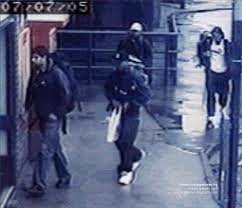
The most awful scenes from the day were naturally of blood-soaked remains or weeping survivors. However, for personal reasons I’m particularly struck by a grainy, indistinct image from a surveillance camera, of a fly-blown, unsightly car park.

That’s because it shows the open parking area outside Luton station. Which was where the bombers left their cars before heading for London, on 7 July 2005.


Surveillance camera shot of the bombers' two cars at Luton station


Another surveillance camera shot: the bombers enter Luton station
Travelling to London to end their own lives while
killing 52 innocent civilians and injuring 700 others
At the time, I wasn’t living in Luton. But I arrived a few years later, and the station is one of the places that I tend to go to or through pretty frequently, whether I’m going to London or just into the town centre. And it always bothers me that this was the place, fifteen minutes walk from my home, where the last stage of that fatal voyage started. It’s almost as though I ought to feel guilty, or at least partly responsible, for what happened next.

The place doesn’t look anything like it did then. It’s hardly become breathtakingly attractive – it’s an open-air bus station – but at least it isn’t quite as run down as it was. Not quite as dishevelled. Not quite as appropriate a setting for such shameful deeds.


The same area today.
Hardly a scene of beauty, but somewhat less desolate
But it still acts as a baleful reminder to me each time I pass.

Thursday, 15 January 2015

France and Britain: defending our freedoms. Aren't they?

Now that the first outburst of grief and solidarity’s past, we’re beginning to see what the longer-term impact of the terrorist action against Charlie Hebdo is going to be.

Make no mistake: they may be dead, the magazine may be publishing five million copies, the cartoons may be travelling round the world, but the terrorists haven’t failed completely. And sadly the measure of victory they’ll have gained will be through our self-inflicted defeat.

First of all, France that has proclaimed most loudly its passionate determination to defend free speech against this attack, has arrested 54 people and summarily jailed several of them, for voicing support for its enemies or merely criticism of the nation and its principles. It seems, for instance, that three men have been jailed in Toulouse, for shouting obscenities at the police, including in one case the sentiment that the Kouachi brothers (the Charlie Hebdo murderers) were “just the start.”


The police protect precisely those freedoms
governments feel we should be allowed
It’s a vile sentiment, and also a vacuous one – this is by no means the first terrorist attack the West has suffered, so it certainly isn’t the start, and if he was saying that there would be others, he was teaching us nothing we didn’t already know: we surely all realise there will be more attacks, and our jobs is to learn to resist and to face with fortitude whatever they throw at us. In any case, vile though the statement may be, we’ve rightly been loud in proclaiming that there is no right not to be offended, and indeed that the right to be offensive is essential to freedom of speech.

We should be above taking offence at such inept comments. But, above all, even if allow them to offend us, we should be asking ourselves about what right we have to jail anyone for voicing them.

This is part of a pattern. It was only last November that France tightened the law on what could be posted on the internet. In common with a number of other nations, it also has a law against Holocaust denial, a particularly bizarre limitation on freedom of speech: to deny the Holocaust is massively stupid but, taking my cue from A Few Good Men, being a moron isn’t against the law. Or at least it shouldn’t be.

In Britain, in the meantime, the security services have been quick to demand additional powers, “to protect us.” The government is calling for an end to encryption on the internet (which as well as being an unwarranted intrusion into our privacy, would destroy e-commerce that depends on passing encrypted credit card details). All this to ensure that the spooks can collect even more information about us all.

This is despite the fact that the French authorities knew about all three the terrorists, just as the British agencies knew the men who literally butchered Fusilier Lee Rigby, with knives and a cleaver. It isn’t that they have insufficient information, it’s that they haven’t found a way yet to identify the information that really matters from the mass at their disposal – or rather, not to identify it each and every time: a great many plots are foiled, but it seems impossible to stop them all.

Meanwhile the British government is calling on the British people to acquiesce in further erosion of its rights, on the grounds that this is the way to make them safer. While the French government, no doubt with popular support, sets out to mark its commitment to free expression by jailing men for expressing views it dislikes.

The fact that neither I not the vast majority of my compatriots on either side of the Channel (I’m a citizen of both countries) don’t like the views either, doesn’t make their repression any less of a blow against free speech.

Be careful. The terrorists will have won if we go along with our governments’ instinctive reaction to such an attack, which is to limit freedoms further. Now that the dust has settled, it’s our job to resist not just the terrorists, but government overreach too.

Tuesday, 9 December 2014

Torture: a good case for just saying "no"

When measures to defend a society undermine its fundamental values, just what are they defending?

The revelations by a US Senate committee of the extent of torture carried out by the CIA in the so-called “war against terror” is shocking, but hardly surprising. Anyone who believed that the CIA had been engaging only in “vigorous interrogation” – presumably intense questioning with the occasional resort to limited physical violence – was living in a dream world. It was obvious that the CIA, and no doubt MI6 and the security services of other US client states, were engaging in the most serious forms of torture they felt they could get away with.

It now turns out that these included not merely waterboarding, but “rectal rehydration” and even “rectal feeding” by the CIA itself.

It’s hard to see how any society that adopts these methods can claim to be civilised. If we are behave with the same brutality as the very enemies we denounce, how can we claim to be preferable to them? Are we not just two ugly bruisers slogging it out to decide who will dominate the other? Where does that leave our claim to moral or political superiority?

Upholding democratic values. Or undermining them?
The Senate report doesn’t even find the methods justified by the results. According to the Guardian:

After examining 20 case studies, the investigators found that torture “regularly resulted in fabricated information”, said committee chairwoman Dianne Feinstein, in a statement summarising the findings. She called the torture program “a stain on our values and on our history”.

“During the brutal interrogations the CIA was often unaware the information was fabricated.” She told the Senate the torture program was “morally, legally and administratively misguided” and “far more brutal than people were led to believe”.


The ineffectiveness of the torture may seem to make it even less defensible. But that would be a wrong direction for the argument to take. Three years ago, I felt obliged to admit my admiration for one of Britain’s leading spooks, Eliza Manningham Buller who had recently stepped down from the top post in the British MI5 security service. Here’s what I said about her then:

On the use of waterboarding by the United States, she said ‘torture is illegal in our national law and in international law. It is wrong and never justified.’

Like quite a few opponents of the use of torture, I’ve tended to argue that it doesn’t generate good intelligence. She on the other hand believes that it sometimes does, but points out that the argument that lifesaving intelligence was sometime obtained by it, “and I accept it was, still does not justify it. Torture should be utterly rejected even when it may offer the prospect of saving lives. I am proud my Service refused to turn to the torture of high-level German prisoners in the Second World War, when, in the early years, we stood alone and there was a high risk of our being invaded and becoming a Nazi province. So if not then, why should it be justified now?”


That’s the only wholly moral position to take. There are certain things that we decide, as societies based on rights and laws, never to do. We should never target civilians in war, even if we believe it might be effective, and the carpet bombing of German cities or the use of nuclear weapons against Japan simply cannot be justified. We should never target children and the relatives of enemy combatants, and the British use of concentration camps in the Boer War was indefensible. And we should never torture.

It’s that simple. We want to be better than our enemies. We should never stoop to using their weapons.

Whether or not they might advance our cause.