Showing posts with label Eurosceptics. Show all posts

Thursday, 17 March 2016

The sorows of poor Mr Osborne

You’ve got to feel sorry for that poor Mr George Osborne, the British Chancellor of the Exchequer. He’s been having rather a torrid time of it lately. As he explained in this touching personal confession.

I mean, I’m a longstanding friend of David Cameron. The one who’s Prime Minister. For now. I mean, friends from way, way back. We’ve both been members of the Bullingdon Club at Oxford, so we know what it is to have a few drinks, and trash a restaurant or a friend’s room. It builds character, that kind of behaviour, makes a leader of you. And forges a friendship.

Anyway, we had a deal, Big Dave and me. I’d do a few years in the number 2 slot and then he’d stand aside and let me have a go at the top job. And he’s doing his bit: agreeing to stand down before the next election and all that. But now it’s all going wrong.
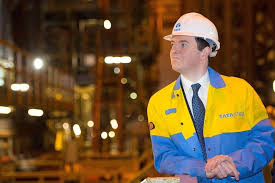
Fetching, isn't he? Our George? In his trademark hard hat
It's his tribute to the nobility of hard work. Which he admires from afar
I mean, big Dave wants me to keep helping when I can, so I do. I’ve come out all keen as mustard for Britain staying in the EU and all that. Hasn’t done me any favours. Turns out that lots of people in the Tory Party – including in parliament – don’t like that idea at all. They’re feeling a bit riled, basically. And that creep Boris Johnson’s been slipping in with his bloody Eurosceptic position, taking advantage of the mood.

Everything ought to be going swimmingly, but it isn’t. I’ve just given my eighth budget. You’d think that’d be a bit of a high point. But we don’t seem to be able to get rid of the deficit completely, however much we cut the army, the police and support for the poor. So instead of coming down, debt’s a bit high, really. A bit of a record, actually, to be strictly honest. Which is embarrassing, seeing how I always used to have a go at the other side for having got debt so high on their watch.

That all makes even my best moves, well, a bit moot to be strictly truthful. I do try. Take this budget, for instance. I couldn’t give away as much as I’d like, of course, not in the trying situation we’re in, but I did what I could. Raised the income level at which people have to start paying tax. Raised the level at which they have to pay the next level up of tax. Got to help, hasn’t it?

OK, it helps the people who pay the most tax more than the ones who don’t pay much, but still, it’s helping people, isn’t it?

OK, maybe not the people who earn so little they don’t pay tax at all, but I don’t know any of that kind of people – they’re the ones who used to clean up behind us when we were in the Bullingdon Club, right?

OK, maybe 85% of the benefit goes to the top 50% of incomes, or so some pundit or other claims, but hey, help’s help, isn’t it? No matter who it goes to.

Some people are moaning that I’m taking £4 million out of benefit payments to the disabled at the same time as I’m reducing taxes. What’s their problem? Let’s be clear. A lot of the disabled don’t vote. And many of the ones who do, vote Labour. Get real, guys. I’ve got a career to nurture here.

The one good thing is that those sad fellows who lead Labour, Jeremy Corbyn and John McDonnell, are even less trusted to run the economy well than I am. A joke, right? A really funny one. Which made it a bit annoying when Corbyn came out with that line about the budget having unfairness at its core. How did he work that one out? No one on my side has.

Though, to be honest, it’s my side that’s the problem. What a bunch. All baying to get out of the European Union. God only knows why. It costs next to nothing compared to, say, a bombing campaign in the Middle East. And the Yanks like it. But those backwoodsmen have got a bee in their bonnet about it. And those bees are all swarming around smarmy Boris now.

Makes you want to weep, doesn’t it? I’ve done everything you’d think you’d need to do to follow my mate into the top job. Well, everything short of actually balancing the books, but just because I said we could do it doesn’t mean it was possible. And despite all that, bloody Boris is giving me a damn good run for my money.

What’s a fellow supposed to do? Do you think it’s all down to my having gone to St Paul’s School? Boris was at Eton with Big Dave. Is that what’s going on?

Sunday, 10 May 2015

Disunion and disarray, or is Cameron just too sly for his own good?

One of the most remarkable result of the British General Election on Thursday was what happened in Scotland.

The Scottish National Party or SNP won 56 of the total of 59 seats in the UK parliament. The Conservatives, Labour and Liberal Democrats have precisely one seat each. Whoever had formed the government in Westminster – as it happens, it’ll be the Tories – they would come from a party practically unrepresented in Scotland.

This state of affairs is far from unprecedented, even in these islands. To see where it’s likely to lead, it’s worth looking at what has happened before. Let’s start with a foreign case.

In 1971, Pakistan was still formed of two wings. In East Pakistan, today’s Bangladesh, the more populous component of the country, a protest movement had been building for decades, led above all by a nationalist party, the Awami League.

In that year’s elections, the League won all but two of the 169 seats in the Eastern Wing – and not a single seat in the West. On the other hand, the 169 seats it held gave it a majority in the 307-seat parliament of the whole country, entitling it to form the next government – rather as if the SNP were now in a position to form the government of the UK.


Mujibur Rahman:
iconic figure who achieved Bangladesh's Independence
and was promptly murdered
The West Pakistanis, used to controlling most of the wealth and all of the power – particularly the military – weren’t going to wear that. So war broke out – and, with help from India, East Pakistan won. Pakistan broke up into its two separate wings and Bangladesh was born.

Now let’s return to Britain, but a little further back in the past.

At the 1918 General Election, immediately following the First World War, Ireland, still a part of the United Kingdom, elected 73 Sinn Féin MPs. They were committed to full independence from Britain. They replaced the Irish Parliamentary Party, down from 67 to 5 MPs – shades of the what happened to the Liberal Democrats last Thursday – which had been campaigning for a much more limited programme of Home Rule. The Unionist tendency, favouring maintenance of the existing relationship with Britain, won only 26 seats.

The Sinn Féin MPs refused to take up their seats at Westminster and instead met separately in what came to be known as the Dáil Éireann or Assembly of Ireland. It proclaimed the formation of a Republic of Ireland, which achieved independence four years later, with a great deal of bloodshed and ugly violence in between.


Michael Collins
Iconic figure who helped achieve Irish Independence
and was promptly murdered
Don’t these precedents rather suggest that, when component nations of a larger state, elect dominant blocs of politicians actively campaigning for independence, it is only a matter of time before they achieve it? The best that can be said for the situation in Scotland is that it unlikely we shall face the violence that poisoned independence in Bangladesh and Ireland.

Nicola Sturgeon, leader of the SNP, stated before the election that it was not about a new referendum on independence. Since the election, she has made it clear that she intends to stick to her commitment. Consequently, her party’s victory, however extensive it was, did not deliver a mandate for another referendum.

The SNP has, however, also stated that a significant event might trigger a campaign for an independence referendum again. It’s fairly clear that a decision by Britain to withdraw from the European Union would be such an event. And David Cameron, in one of his many attempts to be sly, specifically to draw the sting of the Eurosceptics in his own party and in UKIP, committed himself to there being a referendum on Britain’s continued membership of the EU before the end of 2017. He’s repeated that commitment since his re-election.

So imagine this scenario. Britain votes for withdrawal from the EU, because a substantial majority chooses that option in England. But Scotland votes to stay in. As a result, the SNP campaigns again for independence, this time achieving it. That seems pretty likely anyway, but on this scenario it would happen much earlier than it might otherwise.

Cameron, and Tories generally, like to big up Britain and its role on the world stage. It’s one of the reasons they want to hang on to Trident nuclear weapons (another view opposed by the SNP), in the hope that the international community will take them more seriously as a result.

In this scenario, however, Cameron would have presided over the United Kingdom’s isolation from the rest of Europe – and then the loss of its second biggest constituent nation, with over 8% of its population. On his watch, his nation would have been severely reduced in stature around the world. He might have to wonder whether he’d really been so sly after all, and many of those who voted for him would have to ask themselves whether they had really taken the most judicious of decisions.

A conundrum for him. Particularly as he still has to mollify his Eurosceptics. He must be hoping against hope that he can persuade the electorate to vote against leaving the EU – without actually campaigning openly for that outcome.