Wednesday, 11 March 2015

The Clarkson story: a parable for our times

It’s amusing to follow the ferment about Jeremy Clarkson, star of motoring programme Top Gear, that led to his being suspended by the BBC after what it called a “fracas” with a producer.

The rumours are that, in this instance, a “fracas” meant a punch thrown.

What makes the story more interesting than a banal news item about crass behaviour, is that Clarkson represents something quite profound in English society, indeed in society of most developed economies today. Considering that he’s spent years cultivating an appeal based on shallowness, it’s even remarkable that he can represent anything profound on anything.


Jeremy Clarkson
Some find him appealing
He’s regularly in trouble for using derogatory, even racist language, or just for slurring other people or even whole nations. He had to leave Argentina in a hurry after sporting a number plate (H982 FLK) which some thought was a reference to the 1982 Falklands conflict. He had to apologise to Mexicans for describing them as lazy and feckless. He riled India too with some tasteless comments.

What these incidents all have in common is that they’re delivered in a humorous way, which makes it hard to criticise them without seeming humourless oneself. My difficulty is that comments whose only effect is to offend don’t strike me as all that funny, and making them sound funny, only makes them more offensive.

In passing, I feel exactly the same about some of the more tasteless cartoons of the prophet Muhammad published by organisations such as Charlie Hebdo.

What the attitude reflects is a sense that it’s OK to be offensive about other people, and whole groups of other people. Those who think like Clarkson will assure you that they’re not racist, they’re merely upholding the right to say what they think (so they’re actually staunch protectors of free speech, not just bullying boors), and reject Political Correctness (to which they’ll usually tack the words “gone mad”).

It’s those attitudes that have led to the rise of parties such as UKIP in England or the Front National in France. They too would claim not to be racist, but to speak simple common sense for ordinary people. But dig a little deeper and you’ll discover that behind their rejection of Islamist extremism, say, there’s actually a dislike of anyone espousing Islam, and behind that, as a recently-former UKIP Councillor revealed, a dislike of anyone black (she claimed she couldn’t bear to look at black people).

So it’s a racism that generally dare not speak its name.

What makes its role so sad is that often the people who admire it most, the fans of Jeremy Clarkson, for instance, admire it for its strength. Clarkson has the courage to speak out and say the things many believe but don’t dare express. His boldness is admirable to them.

Taken to its extreme, this attitude can become deeply dangerous and corrupting. If three young girls from East London chose last month to travel to Syria to join ISIS, I can’t help believing that much of the attraction was to a movement with the courage to say out loud what others merely feel but are too timid to voice. And ISIS of course goes still further: it takes cruel action, instead of limiting itself to cruel words.

There’s no comparison in degree between a Clarkson bullying jibe and an ISIS beheading, but they’re still linked, by indifference to hurt, by a breaking of the normal bonds that prevent us acting on such aggressive impulses, and by the sense in many others that this is an expression of courage.

What’s particularly interesting about the Clarkson case, however, is the money aspect. As well as having made a fortune from it himself, under his tenure Top Gear has become one of the BBC’s most successful programmes. That touches on another problem in our present societies, the power of money. Given what he brought in to the Corporation, Clarkson must have felt himself to be immune to any kind of action against him. Whatever his behaviour, the BBC could never part company with him – they’d be cutting off the hand that fed them.

So it’s striking that the BBC has suspended him. They’ve even cancelled the last three programmes in the present series of Top Gear. And that really is a major step.

Because it says “there are certain forms of behaviour that we simply won’t tolerate. And it makes no difference how wealthy you are, or how much wealth you generate.”

It’ll be interesting to see where this story goes next…

Tuesday, 10 March 2015

Poodles, poodle crosses, and strange new breed names

There are fashions in dog ownership, as there are in nearly everything. And for the last few years, the fashion has been for poodle crosses. That, of course, is a cross between a pure-bred Poodle and pure-bred dog of another breed.

Some of these crosses look absolutely wonderful. But whether they’re beautiful of not, what really attracts me more than anything else is their name.

Probably the most common is the Labradoodle, a cross between a labrador and a poodle. But we also have Bordoodles (Border Collie mix), Goldendoodles (Golden Retriever), or Dalmadoodles (one could imagine a cartoon film about 202 of them).

Labradoodle puppy
But not all the names follow this pattern. There’s another much less euphonious one, based on the first syllable of the poodle’s name. A Cockapoo is a cross with a Cocker Spaniel, a Pekepoo is a cross with a Pekinese, and my personal favourite is the Bossipoo, which has nothing to do with an authoritarian effluent, but a Poodle cross with a Boston terrier (and, to be honest, I have no idea what a Boston terrier is).

Danielle and I had our granddaughter in stitches when we were told her that we were looking for a Shihpoo.

“What are you looking for?” she gasped between giggles.

“It’s a dog,” we explained, “a cross between a Poodle and a Shitsu.”

“Between a poodle and … a ... what?” she spluttered.

It dawned on us that our explanation hadn’t made things any better.

Shihpoo: much more attractive than its name
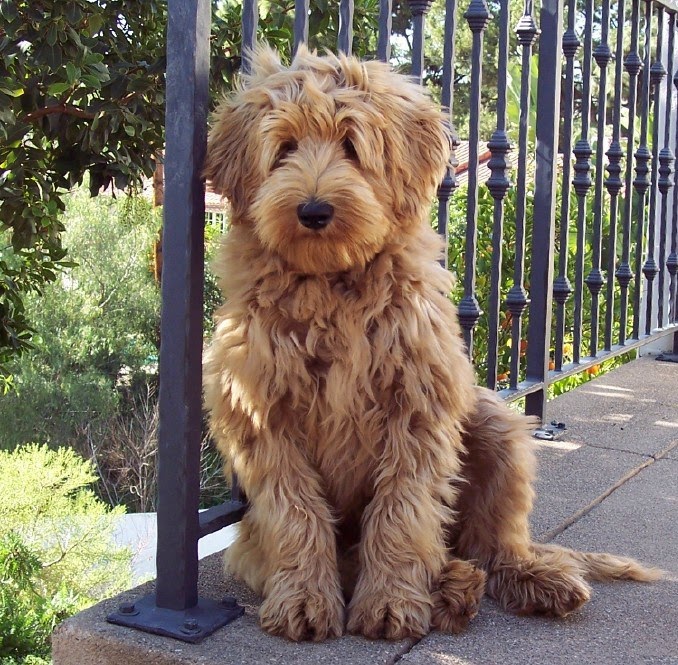
Well, in the end we went for an actual poodle, rather than a cross. And she’s great. In fact, I only have one disappointment: her breed, though it’s contributed to so many others, doesn’t have a striking new name for itself.

So I’ve decided to come up with one of my own.

A Poodle cross with another Poodle, which is what we’re proud to have sharing our home with us now, is to be known, henceforth, as a Poodledoodle.

Lucy: our new poodledoodle
OK? Got it? All right with the name?

I mean, we really wouldn’t want to refer to her as a Poopoo.

Sunday, 8 March 2015

Misty's Diary: a bundle of irritation called Lucy

Another entry from Misty’s diary. In which he has to come to terms with an existential shock.


March 2015

He thinks he’s so damned smart, that domestic number 2. And he’s actually so damned dumb. He may find that out later today.

He was off getting thrashed at some silly sport or another this morning, and then number 1 headed out too, so I was left alone. Again. Not that I’m complaining or anything, just that I think when they go on about my unfriendly behaviour and all that, they ought to think what it’s like being left on my own with no idea how long that’s going to last.

Amazing they whinge about my using claws on them so much.

But when number 2 got back, while I was quietly having my late mid-morning snooze, he decided to disturb me with some incomprehensible rambling. 


“You’d better get ready for a shock, Misty my boy,” he announced. “A big shock.” 


Quietly minding my own business
But what were the domestic staff up to?
He delivered this weird pronouncement with some satisfaction. You can imagine, can’t you? As though he was getting something over me, just for once.

Well, I didn’t say anything. Partly because I can’t see any point letting him know I can speak. It’s bad enough he knows I can write. But in any case, I didn’t want to say the only thing that would make any sense.

“You can’t prepare for a shock, you poor fool, can you? If you could, it wouldn’t be a shock, would it? It’s like checking with a friend whether Thursday night would be convenient for his surprise party. The whole point about shocks is that they take you by surprise. And so there’s no preparing for them, except by just being generally alert, but I’m alert all the time anyway.”

Instead, I just gave him my look. You know, the baleful one. Should leave him withering on the floor, but it never does: you can’t imagine how weak on sensitivity he is.

But then, when number 1 got in at last, I realised what he
’d been on about. A shock? This was nothing short of majorly infuriating.

She’s foisted on me… this… this smelly, runny-aroundy bundle of fluff. A… a… well, I can’t think of any other way of putting it. An animal of the canine persuasion. A bloody dog.

Now I can imagine people might say to me, “well, you liked Janka, didn’t you?”

First of all, I didn’t like Janka. I just got used to having her around. I thought it would make her feel better if from time to time I walked round her, rubbing myself against her, and purring. Even if her response when I did that was to stand rooted to the spot looking, poor clumsy oaf that she was, a smidgeon uncomfortable. I knew that at heart it mattered to her that she should feel appreciated by the boss, so I’d give her a little appreciation from time to time.

I was used to Janka. A companion, not a dog
And I’ll admit it left a bit of a Janka-shaped hole in our lives when she decided to clear off and not come back. Without a word of goodbye or anything. Just there in the morning, gone in the evening.

So if Domestic number 1 brought Janka home again, I’d not complain. I was used to her. I’d be happy to see her back again.

But, and I can’t stress this too much, she wasn’t a dog. She might have smelled like a dog, and barked like a dog, and behaved a bit goofily like a dog, but that didn’t mean she was a dog, it meant she was Janka.

This new arrival? This thing that’s just been dumped on me? They call her Lucy to make it sound like she has a personality, but in reality she’s just all dog, through and through. The little variety, I think, a puppy, but honestly, I can’t really tell one dog from another. Either way, she means I have a chore ahead I wasn’t planning for.


Interloper. Imposition. In my house.
The so-called Lucy
I’ve got to start out on my training work all over again. Breaking her spirit. Cowing her pride. Cutting the crap, basically, sorry for the language.

Hard work, and not what I want to start off on at my time of life.

What an imposition. They really have no idea. I think I’ll pop out. You never know, if I stay out long enough, things may be back to normal when I get back in.


And if they’re not, then it’ll be time for Domestic Number 2’s lesson.

Saturday, 7 March 2015

How the Limeys beat Scurvy. Eventually

At a recent workshop on healthcare, a speaker quoted Professor Dermot Kelleher, Dean of Imperial College London:

If we did what we know and did it well, we would have a 20-30% improvement in patient outcomes.

It’s particularly striking that this view was expressed by Kelleher, who has won an international reputation as a researcher in medicine. Because what he seems to be saying is that sometimes we could achieve as much progress in medicine by just taking the knowledge we already have, without expensive research, and making sure we use it everywhere.

One of the best illustrations is in the treatment of Scurvy. It took a long time to get the research done. And we were slow to extend best practice. 

Scurvy used to be a major scourge among populations deprived of sources of vitamin C. Most notably, it affected sailors who were away from land for long periods of time and therefore deprived of fresh fruit and vegetables. Estimates suggest that as many as 2 million sailors died between 1500, as the age of European discovery got under way, and 1800 when an effective method of prevention was finally adopted.

It seems Scurvy was the main cause of the death of 116 out of 170 of Vasco da Gama’s crew, 208 out of 230 of Magellan’s and 1400 out of the 1900 the Royal Navy's George Anson took with him to circumnavigate the globe in the 1740s.

Yet already in 1593, a British Admiral was recommending the drinking of orange or lemon juice as a means of avoiding the disease. 


John Woodall: pioneer in the treatment of Scurvy
And one of the first to make a fortune from Pharmaceuticals

Then in 1614, John Woodall, surgeon-general of the East India company, published his handbook for apprentice ship’s surgeons, where he advocated combating Scurvy with fresh food, citrus fruit juices, or failing any of those, sulphuric acid: he shared the popular view of a time before the vitamin was known, that it was the acid element of citrus juices that produced the benefit.

Incidentally, Woodall became wealthy stocking medicine chests for the ships, proving that big Pharma has been an excellent business to be in for a long time now.

When the story gets most interesting is nearly a century and a half later, with the arrival on the scene of James Lind. While serving as a surgeon on HMS Salisbury in 1747, he treated twelve sailors who had been afflicted with Scurvy after two months at sea. He divided them into six groups of two, each receiving a different treatment (one of them being sulphuric acid). Only the two receiving citrus juice showed real benefit from the treatment, one of them fully fit to return to service and the other nearly recovered before the fruit ran out. The only other group to show improvement were the two being treated with cider.

Lind’s experiment is now generally seen as the world’s first ever clinical trial. Nowadays, we’d probably want slightly bigger groups than two, of course. Still, at least it was a serious empirical test.


James Lind. The world's first clinical trial
showed the efficacy of citrus fruit juice against Scurvy
It was greeted by the medical profession ashore in exactly the way one would expect such a trial to be received: medics stuck to their old view that Scurvy was a disease of “putrefaction” best treated by giving the body a bit of a fillip with such compounds as sulphuric acid.

Eventually, in 1794 senior officers were successful in demanding a daily ration of two-thirds of an ounce of lemon juice, apparently just about enough to provide the daily intake of Vitamin C required, for the crew of HMS Suffolk on a passage to India. Over the 23-week crossing, not a single crewman developed Scurvy.

The following year, the use of citrus juice became official policy throughout Royal Navy. By 1800 problems of supply had been resolved so that it could be made compulsory. Because the juice was often extracted from limes, it became quite common to refer to Brits as “Limeys” over the next century or two (perhaps occasionally with affection).

Five thousands sailors a year were dying of Scurvy. And yet John Woodall’s handbook was published in 1614. Even after James Lind’s clinical trial of 1747, it took another 48 years before the practice of using citrus juice became officially adopted, and then only in Britain.

That time lapse represents nearly quarter of a million lives lost to a disease whose treatment was known.

A good story, isn’t it? Doesn’t it make the point clearly about the need for good research? And even more strongly, for doing what we already know, doing it well, and doing it now?

Friday, 6 March 2015

The great debate debate

Two months out from the UK general election, and one question seems to be dominating the headlines.

We are nearing the end of five years of a government that has pursued austerity policies which were promoted as the way to reduce national debt, though they haven’t. What they have done, on the other hand, is increase poverty, with multifold growth in dependency on food banks in this First-World nation, and growing numbers of vulnerable people being driven to despair and sometimes suicide by denial of any kind of support.

At the same time, those policies have entrenched the mindset that views the wealthiest as the most valuable, the most admirable, the most entitled to protection.

And against that background, what are we debating? Why, debates.

The Prime Ministerial variety. The idea is that anyone with a chance of winning the premiership, or even anyone leading a parliamentary party however remote the likelihood of their getting to Downing Street, should be lined up on TV to bang away at each other about what they or their Party bring to the party.

Most people find these events colossally dull. It’s not at all clear that they have any effect on the outcome of the election. Last time round, Nick Clegg, leader of the Liberal Democrats, seemed to gain most support from the debates, but he ended up losing five MPs at the election.

David Cameron clearly wants no debates. His opponents are accusing him of cowardice, of running scared.

Frankly, I think they’re wrong. I believe his advisers have spotted what a lot more voters should have seen: the man is profoundly lazy and hates having to master a brief. That’s why he frequently gives the impression that he makes up policy on the hoof, without thinking through the consequences. For instance, he slashed spending on flood defences on assuming office, by nearly 20%. Then there was serious widespread flooding in 2013, and he had to dig up some emergency funding, so as not to look heartless.

Last time round: David Cameron, left, with Nick Clegg and Gordon Brown
This time he's too idle. And, amazingly, it seems to be working for him
Note that “look” is the key word there: being heartless is fine for this self-declared Christian Prime Minister, but he doesn’t want to look it.

Interestingly, by coming up with funds which went some of the way towards replacing those he’d cut, he won plaudits and was seen as statesmanlike. Instead of being perceived as inept in the first place, and slow to fix his error.

And all that explains why he doesn’t want to debate. It doesn’t matter how incompetent his actions are, he can still emerge from the mess looking good. Which is partly a reflection on the way of thinking of far too many voters, and partly a measure of the effectiveness of the opposition to him.

In those circumstances, why would his advisers inflict all the trouble of debate prep on a man as disinclined as he is to hard work? When he doesn’t seem to need it?

So instead he’s found excuse after excuse for not having the debates. He wouldn’t take part unless the Greens were invited, as though he cared about the Greens, a party far more firmly of the left than the official Labour opposition. When the Greens were included, he then insisted that the Democratic Unionist Party from Ulster should be invited too. Now he’s saying he would only do one debate at most.

What’s happened? The press and the opposition have walked straight into the trap. They’re all raving about whether there should be debates, whether Cameron should take part, whether they should take place without him if he refuses to turn up.

So we obsess about a process issue. While people out there are being exposed to real and unbearable suffering – truly unbearable in some cases, as people die of it. And the proportion of the electorate that is apathetic about the whole business of politics continues to grow, regarding it as essentially irrelevant to their lives.

Which, if the great debate on debates is all politicians can offer, it certainly is.

Wednesday, 4 March 2015

Jihadi John and the horror of beheadings

We’re shocked, in the West, by the actions of ISIS in beheading its victims. 

The mass executions are horrifying, but the individual killings are strangely more horrifying still: it’s easy to identify with the single man, bound and unresistant, as Jihadi John deliberately and without compunction uses a knife to hack into his neck, inflicting deliberate suffering and then death on an innocent victim.

We’re right to be shocked. But we have no basis for feeling superior – or at least, that our nations are superior. Beheading has a long and time-honoured tradition in our societies too, often carried out in public, and until relatively recent times.

Beheading: a long tradition in our countries too
and until not that long ago...

The last beheading in Britain took place in 1747. Funnily enough, the man executed, Simon Fraser Lord Lovat, paid for his life for involvement in the 1745 uprising of Scots against the Hanoverian dynasty in London. It’s a measure of some progress that Scots were able to express their views on separation from England last year without any of them being beheaded for it, or indeed having to take up arms in the first place.

Though Lovat’s execution was the last by beheading, it was by no means the most spectacular. That sordid tyrant Henry VIII decided in his paranoia, in the last decade of his reign, to do away with any remaining descendants of the Plantagenets, the dynasty his own Tudors had supplanted from the throne. It has to be said that quite a few of them had shown themselves less than supportive, but given the way he dealt with any opposition, who can blame them?

One of the last was Margaret Lady Pole. Henry had her imprisoned, under sentence of death, for two and a half years. Finally, when she was rising 68, he decided to have the sentence carried out.

There’s probably no truth to the story that Pole, furious at being sentenced without even a trial, ran away from the axeman who came after her, swinging his weapon, until it at last made contact and brought her down. However, what does seem to be true is that he was incompetent, that his first attempt to cut off her head missed and struck her shoulder, after which it took another nine strokes before he finally completed the decapitation.

So basically he tortured her to death. Shades of Jihadi John, wouldn’t you say?

Other countries kept beheading far longer. France made the process more clinical with the guillotine, but the application of engineering doesn’t make the basic thing any less dire: it’s still the violent removal of someone’s head from their body. The last state beheading in France took place in 1977, so well within living memory.

And of course there are countries which still engage in the charming practice, not least our great and staunch ally Saudi Arabia. It not only likes beheading people, it likes to do it in public, no doubt for the edification of the bystanders and passers by. And it is even a member of the international coalition against ISIS.

Presumably it doesn't feel that ISIS is wrong to behead people, perhaps just that it goes a little too far in the number it beheads. Saudi in its moderation kept to just 87 last year. Then again, maybe Saudi just feels ISIS is beheading the wrong people.

In the West, we feel shocked by the beheadings by ISIS. And we rightly support efforts to put an end to their dire regime, by force if necessary. Still, we’d do well to remember that our own track record isn’t that glorious. Let’s finish off ISIS by all means, but then take a look at our friends too – and remember our own history.

Of course, ISIS does even more abominable things. It burned that Jordanian pilot alive. Not something that we’d ever do. Or not that we’ve done for nearly 300 years: we liked to use this punishment against women, mainly. And the last woman burned alive in Britain? Catherine Hayes in 1726.

Rather too uncomfortably recent for anyone with a little sensitivity to history…

Monday, 2 March 2015

Amazing: a good political story. But then it's about an amazing character

You might not have spotted a significant political moment yesterday.

A man with enough humility to make anyone proud, José “Pepe” Mujica was certainly the world’s humblest politician. Yesterday he passed on the presidency of Uruguay to his elected successor Tabaré Vázquez who, as it happens, was also his predecessor. Vázquez has an excellent track record: he and Mujica between them have made their country the most successful in the region.

But it’s Pepe who’s extraordinary. This is a time when, in Britain, two of our most senior politicians, both former Foreign Secretaries, one from each of the two main parties, fell into a ridiculous trap: journalists posing as representatives of a fictitious Chinese company persuaded them to offer to work on its behalf for sky-high fees (one suggested £5000 a day), with no concern as to whether their duties as members of Parliament would allow them to take on such a commitment (one suggested that he was free 95% of his time).


Pepe Mujica at work
By way of contrast to this cupidity, Pepe gave up 90% of his salary as President, asking for it to be paid to a range of charities supporting poor people and small businesses. He and his wife, a Uruguayan Senator, refused to move in to the Presidential palace, but stayed in their modest farm on the edge of the capital, Montevideo, where they make a little money growing chrysanthemums, and live with their three-legged dog.

What makes this still more remarkable is that Pepe wasn’t always so peaceful. In the mid-sixties he joined the Tupamaros guerrilla organisation, a movement we would no doubt regard as terrorist today. In 1970, he was involved in a gun battle which left two policemen injured and himself riddled with six bullets. His life was only saved by a highly competent surgeon who put dedication to his professional duties above any political views he may have held.

Despite three escapes, each leading to recapture, Mujica spent thirteen years in gaol, two of them at the bottom of an old horse trough. The experience wrecked his health, mentally as well as physically.

As President, not only did he build on the economic success of Vázquez, he also legalised gay marriage and oversaw the legalisation of abortion. He even introduced a government-backed cannabis market. I saw him interviewed, and it’s clear he regards cannabis as an abomination. But there are so many users and it makes no sense to leave them as prey to criminal drug dealers. Legalising the trade makes it controllable.

There are so many morals to this story it’s hard to know where to begin.

Perhaps the first is to do with rehabilitation. In Europe or the United States, Mujica would have been in gaol for the rest of his life, or possibly executed. But Uruguay amnestied the Tupamaros after the restoration of democracy, so it was able to enjoy this extraordinary man’s enlightened presidency.

As the cannabis story showed, he can recognise that there are others who see things differently from him, and they deserve protection too. The mere fact that he disapproves of the drug they consume doesn’t mean the government has to suppress it, or oppress them. He’s right to point out that it’s not disapproval that matters but control, and that’s a lot easier within the framework of law.

Finally, he showed that success doesn’t have to mean ostentation and the flaunting of wealth. His trademark was the 1987 blue Volkswagen Beetle he insisted on driving instead of an official car. He served his people, and did it for a modest income.


Great picture from the Independent
Such a common scene: security agents by a Presidential car –
but with a beat-up blue Beetle instead of the black Cadillac?
Practically all the things he did would spell electoral disaster in most of the apparently advanced democracies. Why, he even showed up for the investiture of his successor in his usual black suit, with no tie, and wearing brown rubber-soled shoes.

And here’s the question. Who’s got it right? The people of our wealthier nations or those of Uruguay?

Here’s a clue to the answer. Today’s Independent quotes Charo Baroni, a 66-year-old housewife, saying “he’s the best president we’ve ever had.”

How many ordinary electors of our nations would speak so warmly of their leaders?


Thanks for everything dear old man
How many of our politicians get that kind of a send off?