Showing posts with label Bob Diamond. Show all posts

Thursday, 24 September 2015

VW, News UK, Barclays Bank: ignorance isn't cheap

On 3 July 2012, we learned that Bob Diamond had stepped down from his position as Chief Executive of Barclays Banks. The Bank was beset by scandal, specifically charges that it had rigged the London interbank lending rate LIBOR.

A week later, we learned that he had generously waived his right to some £20 million of bonus payments, so he would be leaving with the pittance of a year’s salary, amounting to £2 million. That would barely cover the pay of 195 people on minimum wage, such as the cleaners who made sure that he had a physically clean environment to work in, however morally polluted it might have been.

Diamond made it clear that he knew absolutely nothing about the LIBOR rigging.

In 2002, the voicemail of a missing thirteen-year old schoolgirl, Milly Dowler, was hacked by journalists working for Rupert Murdoch’s News of the World. Because they were listened to, messages on the voicemail were automatically deleted, giving Milly’s parents the hope that she might have deleted them herself and therefore still be alive, when in fact she had already been murdered.

In July 2014, Rebekah Brooks, editor of the News of the World at the time Milly Dowler’s and great many others’ phones were hacked, was cleared of all charges arising from the criminal activity. She claimed that she knew nothing of the practice, although she was editor at the time it happened.

Despite her blessed ignorance, Rebekah Brooks had to suffer the indignity of seeing the closure of the newspaper that she edited while it was hacking phones. She also had to step down as Chief Executive of News International, the representative on Earth, or at least in Britain, of the equally blessed Rupert. In consolation, all she could turn to was the £10.8 million payoff that Murdoch’s organisation gave her. That’s quite a long way short of what 1000 workers on minimum wage might make in a year.

Fortunately, however, the Sun on Sunday has filled the gap left by the loss of the News of the World. And, equally fortunately, we heard just this month that Rebekah herself was to be appointed as Chief Executive of News U.K., as News International is now known. It seems that the industry she graced for so many years is not to be deprived of her special skills any longer.

VW: a dirtier story than we'd been led to believe
On 23 September this year, the then Chief Executive of Volkswagen, Martin Winterkorn, stood down from his post, following the scandal over emissions test rigging. That took the form of fitting special software on the emissions monitoring system of diesel VW cars, so that it could detect when tests were being carried out, and run emission control systems that were turned off in normal driving.

He went despite claiming that he had absolutely no knowledge of the fraud. He was paid a little more than 15 million euros last year. That’s the equivalent of around 850 German workers on minimum wage.

What do these cases all have in common? They involve people who took massive salaries. Such payments are generally justified by the responsibility accepted by the senior executives who are paid that much. Responsibility, some might feel, requires an understanding of the organisation these people lead. But that’s the other point all three have in common: on their own admission – claim, actually – they had no knowledge at all of the wrongdoing in their teams.

Still. Who are we to question whether our major enterprises are making any rational link, between the remuneration they offer their top people, and their competence?

Sunday, 22 December 2013

The things we do to Africa...

We used to rape the continent, for gold and slaves, and we still keep kicking Africa around like a football. We dump our worst products on it. We charge it more in loan interest than we give in aid. And every now and then we send in troops to various bits, usually from the former colonial power, to make sure the locals know they’re not really in charge.

Why, we even use it from time to time as a source of photo ops for our failing politicians. Did you see David Cameron, at the Mandela funeral, trying to get in on the Danish PM’s selfie with Barack Obama? The man’s shameless.

Is that Cameron trying to muscle in on Helle Thorning Schmidt's 
selfie with an actual world leader?
Now it’s emerged that ‘Boris Bikes’ are beginning to turn up in the Gambia. For the uninitiated, ‘Boris Bikes’ are bicycles available for hire in various places in London, which can be ridden to other places and dropped off again. They’re called ‘Boris Bikes’ in honour of the modest and self-effacing Mayor of London, Boris Johnson.

You get what honour you can, I suppose.

It seems they’re now being stolen in large numbers and shipped off to the Gambia where they’re being spotted in villages. Perhaps we should be grateful that Britain is at last making a little restitution for all the exploitation of the past, even if only unofficially and as a result of criminal action.


Photo from the Daily Telegraph of a Boris bike in the Gambia
My only regret is that they’ve only taken Boris’s bikes, and not Boris himself. Still, the Gambia is run by an unhinged egomaniac convinced he’s God’s gift to mankind, so they really don't have a need for Boris, unlike his bikes.

Someone who does seem to be invading Africa in the near future is former Barclays Bank Chief Executive, Bob Diamond. You may remember that he had to leave Barclays under a bit of a shadow: the bank had just been caught fiddling the rates at which banks lend money to each other.

Diamond provided a striking demonstration of the principle by which senior executives only receive their astronomical remuneration because they take responsibility for what happens in the organisations they lead. On his watch, the bank lost about half its share value, and he claimed not to have known anything about the rate rigging. So he suffered the penalty of giving up some £20 million of bonus, meaning he left with only about £3 million. Practically destitute.

And now he’s back. He and a mate have launched a new company, Atlas Mara Co-Nvest, which is designed to go looking for exciting new prospects in Africa.

Aaah. Doesn't Bob Diamond look like an amiable rogue?
But I'm not sure of the amiability
Things don’t look promising. I mean, the company’s an investment vehicle and they can’t even spell ‘invest’. And it’s likely to focus on Financial Services, the field in which Diamond has won such a reputation. Or do I mean notoriety?

We blessed Africa with the trans-Atlantic slave trade, constant colonial wars, borders that don’t correspond to ethnicity, a white regime in South Africa that gave the world apartheid. 

And now we’re sending them Bob Diamond. Haven’t they suffered enough?

Wednesday, 31 October 2012

Sandy and the fair value of people

It was great to get this picture from friends in the States, in the wake of super-storm Sandy. 


As always in such cases, if there is a positive message to come out from a disaster, it’s that of human courage and selflessness. And in this case, the humans are manual workers many of whom are unionised. 

The unions are the organisations that, somehow, it has become fashionable to belittle. Bureaucratic. Obstacles to progress. Sinister even.

So they’re easy game. To a governor of Wisconsin, for instance, intent on dismantling all collective bargaining arrangements. And the onus of proof seems to be on those who oppose him, who say that rights should be defended, while the common view seems to back his onslaught on them.

It’s as true in Britain. The latest government wheeze is to buy out rights: smaller companies could offer share options in return for workers giving up for example, on suing over unfair dismissal. Odd that government seems to view unfairness as something of a good thing.

Which ought to be a warning to anyone in the States who depends on employed work and who’s tempted to vote Romney. Take a look at what his brother-in-outlook Cameron is doing in Britain, and think again. Just how well will you do out of unfairness?

There’s certainly plenty of unfairness around. When Bob Diamond stepped down as Chief Executive of Barclays Bank, he had the decency to waive £20 million of bonus. Perhaps that’s not unreasonable: after all, the justification for high pay is the responsibility its recipients take, and on his watch Barclays had lost half its share value and engaged in practices that are still the subject of investigation that may lead to criminal proceedings.

That left him with only the relative pittance of £2 million to soften his departure in disgrace.

Which is only 80 times the yearly salary of a fully qualified nurse and only 25 times the salary of a top nursing manager in the NHS. And the NHS is in the second year of a pay freeze.

So that picture really is quite a useful reminder. After all, when a storm hits, I think I’d much rather have those workers up the pylons repairing the lines, rather than rely on a banker. And if I’m ill I’d much rather see a nurse. It may be heretical to say it, but when things get tough, I
’d value those low-paid workers rather more than the prosperous financier.

Which suggests that it would be no bad thing to redress the balance a bit, to stop making quite such a virtue of unfairness. And if the unions can help make things fairer, the playing field more level, well, perhaps it’s time to review our image of them too.

Monday, 10 September 2012

The Winslow Boy: come back, we need you again

Courtroom dramas, even the ones that don’t actually have a scene set in a courtroom, I just can’t resist. 

But I have to admit that my real weak spot is that I’m an absolute sucker for sentimentalism. An apparently deeply unsympathetic character who suddenly breathes some noble sentiment finds a sure way to my heart, if not my tear ducts.

So Terence Rattigan’s The Winslow Boy, whether as a play or a film, is my kind of show. A fourteen-year old wrongly accused of stealing a postal order; a father prepared to court ruin to clear his name; the hard-boiled lawyer, perhaps a little taken by the boy’s radical sister, persuaded to be his advocate.

It’s that lawyer who, faced with the quandary of a subject trying to sue the Royal Navy, and therefore his monarch, turns to the archaic device of a petition of right. Whenever I hear him explain that the words on the petition read ‘let right be done’ it brings a lump to my throat.

In other words, the play has everything you could possibly want. Or at least that I could possibly want.

Curiously, however, this is a wonderful illustration of the principle that fact can be far stranger than fiction. Behind the play stands the real case of George Archer-Shee. The defence of young George, who was indeed a Cadet at the Royal Naval College at Osbourne on the Isle of Wight and expelled for stealing a postal order, was taken up by one of the great barristers of the day. His name? Edward Carson.


Martin Archer-Shee with his son George
Now there’ll be plenty more talk of Carson at the end of this month, in Britain but above all in Northern Ireland. For the moment, let me just say that it is instructive to compare his history with that of another dominant figure in Irish politics of the time, Roger Casement. The latter took support and weapons from Germany during the first World War to arm an illegal, insurgent force of Irish Nationalists for an uprising to end British rule. He was convicted of treason and hanged. 

Carson took support and weapons from Imperial Germany to arm an illegal, insurgent force of Irish loyalists, for an uprising to maintain British rule. If not in the whole of Ireland, at least in six counties of the North. His action didn’t take place in wartime which perhaps explains why he escaped the death penalty, but it might seem surprising that he wasn’t gaoled. But only until you realise that the establishment he was railing against in large part sympathised with him.

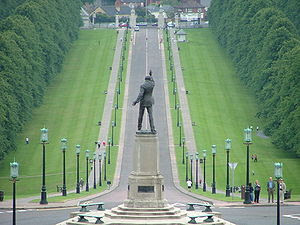
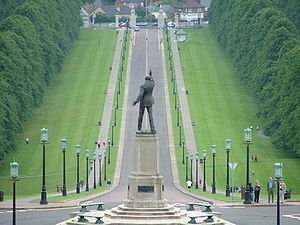
Instead, he was given a statue that stands to this day outside the parliament of Northern Ireland at Stormont. Larger than life, it’s a dominant sight, and to me at least a deeply ironic one: a legislature honouring a man to whom it owes its existence, thanks to his illegal act.

Carson: dominant as ever
And yet it wasn’t any of this that struck me as I was reading about The Winslow Boy this weekend. No, the words that sprung off the page at me came from a Wikipedia entry on the Archer-Shee case. Talking about the boy’s father, who worked at the Bank of England, it told us that one of the reasons he campaigned so hard to clear his son was that his ‘background in bank management meant all the sons had been brought up to regard misuse of money as sinful.’

Well. These days, that’s an idea as extraordinary as Carson being honoured by the establishment for rising against it. I’d nearly forgotten that there was a time when banking was much duller than today but a lot safer and a lot straighter, making a virtue of prudence, reliability and absolute honesty.

Those were the days, weren’t they? Feel long gone now, when the likes of Bob Diamond and Fred Goodwin can find themselves heading those formerly august institutions. 


Can’t imagine Terence Rattigan writing a play about one of them risking all in the pursuit of justice.

Postscript: what happened next

You might be wondering what became of the original Winslow boy afterwards.

He won his case in 1910, and his family was awarded substantial compensation. He didn’t go back to the Navy – that, as it were, was a ship that had sailed – but completed a civilian education before heading to New York to work in a Wall Street bank: yes, they too enjoyed rather more honourable reputations then than now.

But if you’ve doing any arithmetic on dates, you’ll have worked out that 1910 was a bad year to be a teenager. By August 1914, when the guns of the First World War first roared out, George Archer-Shee was nineteen and old enough to serve. He came back to join the army and lasted only a couple of months: he was killed at the first battle of Ypres in October.

He suffered injustice, but then right was done by him. And finally an irremediable wrong. All at the hands of the same establishment.


Couldnt make it up, could you?

Tuesday, 14 August 2012

Bankers: the wise man who saw them coming...

Words of extraordinary wisdom: talking about different types of human activity, the speaker mentions ‘the various ways of money-making – these do us good but we regard them as disagreeable, and no-one would choose them for their own sakes, but only for the sake of some reward or result which flows from them.’

If I were being really picky, I might question whether financial services do us good or whether they’re just a necessary evil, something we put up with just so that commerce can keep going and we can get the things we need to make life liveable. Or at least survivable.

But the rest – spot on. The only motivation for going into that shady sector is for the sake of the rewards. It’s almost as though the speaker had met the Bernie Madoffs of our days, the Fred Goodwins, the Bob Diamonds. To say nothing of those fine upstanding people at Standard Chartered.


Bob Diamond: sacrificing himself for all our sakes
with nothing but astronomical pay to show for it
These are the people who sacrifice themselves to do those disagreeable things which most of us wouldn’t touch with a bargepole, but which are necessary to ensure society keeps going. And who nobly reward themselves out of their clients’ or the taxpayers’ pockets because, hey, someone has to do that too, and why shouldn’t it be them?

So, you may be asking, whose wise words was I quoting? Why, Plato’s. In The Republic, from 2500 years ago. Smart guy, wouldn’t you agree? You certainly can’t fault his prescience.


The author of The Republic.
Saw it all coming
And what a testament to all the progress we’ve made since his primitive times.