Showing posts with label Dominic Grieve. Show all posts

Thursday, 10 January 2019

A little humour, a little much-needed bloody-mindedness

Many years ago, I enjoyed watching the French film Ridicule, which focuses on how the court of Louis XVI – yes, the one who ended up losing his head on the guillotine – had made a cult of wit, deemed to be fiendishly clever though it was often also fiendishly cruel. 

The film contrasted such wit with a more British quality, which it called  ‘humour’, and clearly viewed as greatly superior.

At one point, the protagonist, a celebrated wit, meets the King who asks him to say something funny, there, immediately, on the spur of the moment.

“Be witty this minute!”

But on what subject could he be spontaneously witty? The King has a suggestion.

“Use me, for example.”

The wit has the perfect answer.

“Sire, the king is not a subject.”

I thought that was brilliant, but I suppose you could argue that it is perhaps spoiled by a deferential quality verging on the obsequious.

The contrast is emphasised at the end of the film by a French aristocrat, by then in exile in England while the revolution is running wild in his country, walking along a cliff path above a breath-taking seascape. A gust of wind takes his hat. He cries out.

“My hat! I’ve lost it.”

“Better than your head,” his English companion replies.

“Humour!” replies the Frenchman, “it’s marvellous!”
Ridicule: A hat is lost, but a head is spared
To me, that is as witty as the first rejoinder. But there is indeed a difference: it doesn’t establish any kind of hierarchy between the speakers, it shows neither deference to the other person or superiority over him, but merely shares a smile between equals. If that’s humour rather than wit then, yes, I too prefer it.

Sadly, in the last two or three years that famous British sense of humour has been a little scarce in public discourse. The leadership of both the Labour and Conservative parties take themselves far too seriously to allow of any smiles. So it was good to see something of the spirit reappear a little, even though it was  on the Tory side at the expense of Labour, and it felt more like wit than humour: the comments were designed to belittle opponents.

It seems that Environment Minister Michael Gove, even though he’s generally someone to laugh at rather than with, showed some elegance when he described MPs who hope Theresa May can get a better Brexit deal than she has so far, as swingers in their fifties hoping that Scarlett Johansson would show up at one of their parties. Quite amusing though I was glad to read that Amber Rudd, speaking up for the female side, suggested “or Pierce Brosnan”.

The Justice Secretary, David Gauke, went one further and described the official Labour Brexit position as hoping for Johansson to show up on a unicorn. Cruel but hardly unfair: Jeremy Corbyn keeps suggesting that if elected, he will somehow bring home a hugely preferable deal to May’s, with absolutely no evidence to suggest that he could do any such thing.

At least the comments were worth a smile, not something that marks British politics much these days.

But there’s another quality my compatriots regard as quintessentially British. It’s a certain cussedness, if not downright bloody-mindedness, which refuses to allow power to do just what it likes. “Over my dead body,” it seems to say, or even “over your dead body” – after all, we cut off our King’s head nearly a century and a half before the French more famously did the same to theirs.

It’s particularly welcome to see that spirit stirring again.

Twice in 24 hours, the May government has been defeated in the House of Commons by MPs across parties working to prevent a cliff-edge, no-deal Brexit. It is heartening, in this parliamentary democracy, to see parliamentarians asserting their right to resist the government.

What’s more, the initiatives came from the backbenches, not the party leaderships. Yvette Cooper, leadership candidate defeated by Corbyn led one attack. Dominic Grieve, ex-Tory Minister, guided the other. The leaders merely opposed, in the case of May who was defending her deal, or followed, in the case of Corbyn who is, well, Jeremy Corbyn.

The government was particularly angry over the second defeat, with the Speaker of the House of Commons, John Bercow, who allowed the vote to take place. Precedent was against him, and it was a decision that seriously threatened the government’s usual prerogative to decide what gets discussed and what gets voted on. But what it showed was a Speaker intent on seeing all parliamentarians able to decide national policy, and not just the minority of them that form the government.

A refreshing notion.
The Speaker, though originally a Conservative himself,
getting right up Tory noses by asserting the authority of Parliament
And there’s a delicious irony to it, too. Brexiters keep saying that the aim of leaving the EU was to ‘take back control’. I don’t think this is what they had in mind, but I’m revelling in the spectacle of Parliament reasserting its authority over the Executive, which had been allowed to erode away far too far.

Now, that’s the kind of control I’m only too glad to see us taking back.

Especially as it’s so cussed. And gives us a lot to smile about.

Wednesday, 27 May 2015

David Cameron: aiming high in the indolent politician stakes

On being told of US President Calvin Coolidge’s death, Dorothy Parker famously said, “how do they know?”

Coolidge was known as “Silent Cal.” A young woman who sat next to him at dinner one evening is said to have told him that she’d taken a bet that she would get more than two words out of him. “You lose,” he replied, and never addressed another word to her.

Silent Cal
Cameron sadly seems as little inclined to rise to challenges
Even more sadly, he can't emulate him in keeping quiet about it
To be fair, Coolidge was probably not quite as awful as his successor, Herbert Hoover, who presided brainlessly over the great crash of 1929. He concentrated on balancing the budget, and left the economy in free fall. It could only be rescued once he’d been voted out of office and replaced by Franklyn Roosevelt.

Interestingly, David Cameron is nothing like Coolidge in that he keeps on talking. But like him, in all other ways, he seems hopelessly unable to make a good judgement. And, like Hoover, he’s so fixated on balancing the budget, that he can’t see what he’s destroying on the way to doing it.

He behaves like a man who doesn’t want to have to read his briefing documents.

On coming to office, he oversaw the bold decision to slash spending on flood defences by £125m a year, from Labour’s spendthrift level of £665m. No doubt he felt this bolstered the macho image he was cultivating, of a Prime Minister with the guts to take the tough decisions to balance the books.

Then there was serious flooding in 2012. And – lo and behold – he found £120m to plough back in, all but restoring the cut, to relaunch delayed projects.

You could be forgiven for wondering whether he hadn't thought through the consequences of his actions.

This is just one of a series of half-baked decisions over which he’s presided. He dropped Labour’s plans for a new generation of planes to fly from aircraft carriers, preferring a different model. But there were problems with that model. So he had to revert to the Labour approach.

That bright fellow, Michael Gove, then Cameron’s Education Secretary came up with a smart idea. The GCSE, a state exam taken by most school pupils at 16, would be replaced by something far better. Except that it turns out it wasn’t – the boards that oversee exam qualifications, most educational experts and even the Tories on the parliamentary select committee on Education, pointed out all sorts of flaws in the plan, and five months later it was dropped.

David Cameron
And when you think he's half asleep, he's really half awake
It seems Cameron is starting his second term exactly how he started his first: with wild, ill-thought through proposals. And, curiously, Gove’s involved again, on the latest and most egregious of them. He’s now Justice Minister and therefore closely bound up in the Cameron wheeze to repeal the Human Rights Act.

Cameron was at it again in the parliament this afternoon: “Be in no doubt: we will be introducing legislation and legislating on this issue because I want these decisions made by British judges in British courts, not in Strasbourg.”

It seems that once more he hasn’t completely mastered his brief. Britain is a signatory to the European Convention on Human Rights. As a result, British citizens can bring human rights cases to the European Court of Human Rights in Strasbourg.

Incidentally, this is not an institution of the European Union, but of the Council of Europe, a much bigger but looser grouping of countries. Britain’s leaving the EU would not take it out of the Council.

The idea of the Human Rights Act was to incorporate the legislation into British law, so that citizens wouldn’t have to appeal to Strasbourg, but could instead have their cases heard in Britain. In other words, to have “decisions made by British judges in British courts.”

It’s hard not to conclude that Cameron really hasn’t done his homework. Again.

Fortunately, though, he seems to have woken up to his mistakes slightly more quickly this time than he has on previous blunders. The Queen’s Speech today, where the government announced its legislative programme, contained no reference to repealing the Human Rights Act, just a vague reference to bringing in “proposals for a British Bill of Rights.”

It’s just as well. Even Conservative MP Dominic Grieve told Sky News that “I am wholly unpersuaded that the benefit outweighs the really substantial costs that will come with this.”

As for Labour, the former Justice Minister Lord Falconer was firm: “It increasingly looks like the Tories are making it up as they go along. What is clear is that if they suggest completely scrapping people’s human rights protections, Labour will oppose them all the way.”

Making it up as he goes along. Sounds like Cameron. Sounds like any lazy man.

He may not be as silent as Coolidge, but Cameron’s seems to be rivalling his inertia. As well as Hoover’s ineptitude.

Monday, 25 August 2014

What we really need is a politician with a sense of humour, a willingness to be self-deprecating, and the sense to realise that there’s more to life – more even to his life – than politics.

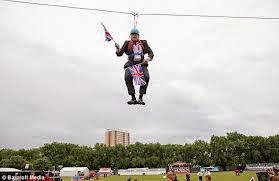
London has got itself a mayor who entirely fits the bill. Boris Johnson likes to make a fool of himself in public and share the joke. He’s a fine classical scholar and writes and broadcasts in an amusing and engaging, if slightly superficial, way on Roman history. 


Boris Johnson, Mayor of London
"What a great sport I am!"
Sadly, he also provides living proof that we actually need a politician with those qualities like we need a hole in the head.

Terrorists achieve their primary aim when they terrorise us. And that happens when we panic so much that we’re prepared to give up our own values in response to their actions. Yesterday, it was demonstrated by that same jocular, amusing, bumptious London Mayor.

Boris Johnson has called for a “minor” change in the law so that anyone travelling to the war zones in Iraq and Syria would be presumed to be a terrorist, and liable to prosecution unless they can prove otherwise.

In other words, with this “minor” change he would like to undo a value won and upheld through centuries of agitation for basic rights: the presumption of innocence. The principle means that in any criminal case, it is for the prosecution, backed as it is by all the apparatus of the state, prisons, security services, the police, to prove its case against the solitary individual in the dock, usually supported only by a lawyer.

For Johnson, doing away with this right is a small matter. As a man educated at Eton and Oxford and in possession of a significant fortune, he of course has little to fear from the state. If anything, as a leading Conservative politician, he’s far more likely to be exercising that power against others. What is truly worrying is that he speaks for a constituency within the broader electorate that is all too ready to believe him and give up rights that protect it, in order to seek safety from a supposed terrorist threat.

Why are we talking about such a threat? Because the voice-over on the video that Islamic State released of the murder of American journalist Jim Foley had a British accent. That touched a nerve among many in Britain. But if the result is that we cease to defend fundamental rights, then we shall have given Islamic State a far greater victory than it could have imagined.

Fortunately, Johnson’s suggestion has already been denounced by another leading Conservative, Dominic Grieve, the former Attorney General. He called it “draconian” and said that it would criminalise much legitimate behaviour. However, it’s insignificant that Grieve is the former Attorney General, believed by many to have been sacked for being too liberal for the current government.

That government includes the Home Secretary Theresa May, who intends to bring in new legislation against people and organisations who advocate extremist views.

Interestingly, that’s an even more pernicious intention than Johnson’s, because banning extremism sounds eminently sensible. But who will decide just what’s extreme? Let’s remember that there was a time when campaigning against slavery, or for women to be given the vote, or for Ireland to win its independence, was regarded as extreme. 


Do we really want government to decide what is or isn’t extreme? Do we want to give it the power to act against the views people advocate? Might it not be better to have it concentrate only on extreme actions rather than views? Most such actions are illegal already.

These are Tories, who are prompt to talk the language of “British values”, which they insist immigrants must endorse. It seems that they don’t regard presumption of innocence, freedom of thought or freedom of speech as fundamental among such values.

In addition, they proclaim their commitment to small government. It’s curious how easily, then, they advocate initiatives that massively increase government’s capability to intervene in all our lives. And then disguise what they’re doing behind a veil of good sense or, as in Boris Johnson’s case, one of engaging good humour.

It strikes me that as well as needing to deal with actions by Islamic State militants, we in Britain need to be ready to confront another threat far closer to home. And far more pernicious.