Showing posts with label Jo Cox. Show all posts

Friday, 1 November 2019

Poignancy

All Saints Day. The day after Halloween. You could tell here in Madrid, if only because some of the people we saw had clearly not finished celebrating from the night before.
Halloween revellers in the Madrid metro
Heading home late the morning after
We were in Madrid because that’s where my company’s offices are. My ex-company. That ‘ex’ is the reason I had to visit the office at all. Because, while an event that should have happened on Halloween didn’t, one that shouldn’t have, did.

31 October was the latest date that Britain was to leave the EU. This was absolutely clear. To Boris Johnson, Prime Minister, it was a matter of ‘do or die’. Indeed, he said he would rather die in a ditch than accept that he had to get a further extension to the Brexit timetable.

But he didn’t do Brexit by the deadline he set. Nor did he die. A ditch? No trace of one in his existence yet. It’s enough to make one wonder whether one can entirely trust his word. Many tell me that you know that Boris is lying by the fact that he’s breathing. However, as my American friends can no doubt testify, you just don’t get pathological liars leading major nations.

Do you?

So no Brexit. Or at least not yet.

On the other hand, the event that wasn’t supposed to happen was my brusque and involuntary departure from the company. Halloween was the day of my latest redundancy. But at least, on this occasion, I’m going out on a high. This was undoubtedly the best job I’ve had, with the best boss and the best team. What’s more, a great many people with whom the team worked have written to say how much they’re going to miss us. My quarrel isn’t with anyone I know but only with people who haven’t the faintest idea about what the team was doing. Just a pity that, despite knowing so little, they were the ones taking the decisions.

Good memories accompany my departure, and contacts I hope will endure, with former colleagues who are also good friends.

We took advantage of our presence in Madrid to see our sons and their partners and, in particular, our new granddaughter Matilda.
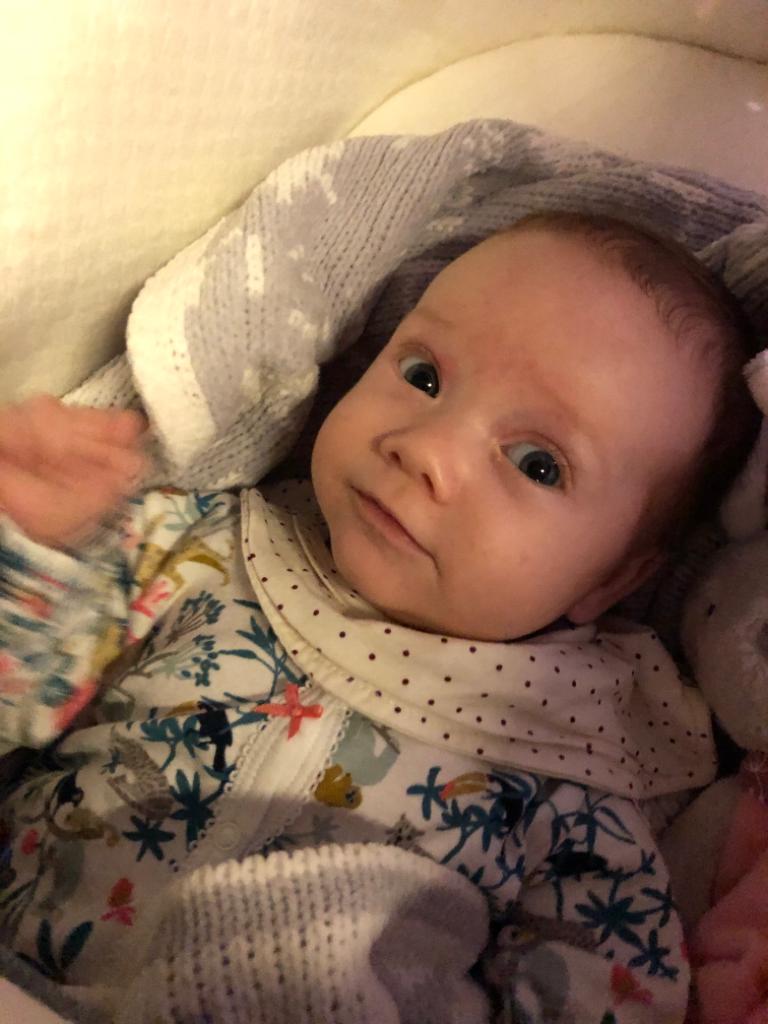
Matilda appreciating life
It was on our way to one of those visits that I was struck by a statue near the metro station we were using. It’s dedicated to the “Atocha lawyers”. They were members of a group involved in the defence of workers’ rights in the early years of democracy, after the death of the dictator Franco. On 24 January 1977, far right terrorists attacked them, leaving five dead and four injured.
Monument to the Atocha Lawyers
The main targets of the attackers were trades union leaders from the Communist Party, at that time still banned. Ironically, its legalisation was accelerated by the attack. That’s the response we should all have to terrorism: when our rights are attacked, we should respond by strengthening of those rights. That’s not always the case: since the murder of Labour MP Jo Cox in England, the momentum for Brexit, which she loathed, has if anything increased.

The statue in Madrid is a moving reminder of how costly it can sometimes be to defend rights. And how important.

Equally touching was a pair of paintings I saw in one of my favourite galleries, the Thyssen-Bornemisza. The first was a portrait of Quappi in a Pink Jumper, full of affection but also of forceful personality. 
Powerful, intriguing portrait by Beckmann
Quappi in a Pink Jumper
I hadn’t previously come across the painter, Max Beckmann. He was German, but he died in the US, and the painting was dated 1932-1934. Which places it in just the time Hitler was coming to power.
Max Beckmann in one of his many self-portraits
Later, I looked him up. When Hitler denounced ‘degenerate art’ in 1937, many of Beckmann’s canvasses were seized and some were included in the degenerate art exhibition of that year. He fled with his wife to Amsterdam, where he somehow managed to survive the war and German occupation, in the course of which the attempt was made to force him into the German Army, even though he was 60.

In 1948, they left Europe for the US where he renewed a successful career not just as an artist, but as a teacher. Far too short a career, as longstanding heart disease killed him in 1950 at the age of 66 (my own age, so I can testify that it’s far too young to die).

According to his widow, he had been on his way to see one of his paintings in an exhibition at the Metropolitan Museum of Art in New York.

And who was that widow? Why, the Quappi of the painting. It seems that the affection it radiates isn’t simply art. It reflects a real sentiment.

Degenerate art? How could the failed painter Hitler have any idea of what was good or what wasn’t? And what a disgraceful abuse of power it was to oppress men like Beckmann, as it was to murder the Atocha lawyers.

The US gained by Germany’s attempt to crush Beckmann. As the Spanish Communist Party benefited from the right-wing attempt on some of its leaders. A lesson worth remembering at a time when many in America, or Britain, seem indifferent to the value of tolerating opposing views to one’s own.

My Halloween trip was full of poignant moments. Leaving a much-loved job. Seeing some much-loved family members. And admiring two works of art dedicated to the protection of much-loved freedoms.

Sunday, 19 June 2016

Voting Remain: it's about a lot more than a point or two on GDP

When German troops entered Alsace in Eastern France in 1940, the Gestapo arrested a great many potential opponents. One of these was the father of a friend of mine. The friend was four at the time and never saw his father again. Indeed, he never found out what had happened to him.

He told me this story soon after the introduction of the Euro, holding a Euro coin in his hand, with tears in his eyes, as he said, “I never thought I’d see the day when we had the same currency as them.”

A fluent German speaker living just a few kilometres from the border, he was a regular visitor to the other side of the Rhine. He had nothing but the most cordial feelings towards the erstwhile enemies of his country. In the Euro, he saw the embodiment of a determination that they would never be enemies again.

That’s why I find the EU debate in Britain today so lamentably trivial.

The EU isn’t about a few points on or off GDP, or the cost of holidays in continental Europe, or even whether immigration can be reduced or will rise still further. The EU and even the Euro, which is far more than merely a financial instrument, are about a political will to prefer peace over war and cooperation over conflict.

Just some coins – or something rather more significant?
That’s after a millennium and a half, since the end of the Roman Empire, regularly punctured by increasingly destructive wars.

How can we bear to make it about the accent of the woman serving us breakfast in a hotel? Or whether a Polski Sklep has opened where there used to be an Italian tailor’s? Or whether those young men cleaning our car so efficiently are Bulgarian rather than East Anglian?

That being said, there will naturally be economic consequences if we leave the EU. There would be short-term disruption. The currency is likely to fall. Unemployment would probably rise. Inward investment would fall. Tariff barriers might be erected, making it harder to export our goods to the Continent, and more expensive for us to buy imports from it.

None of this would spell catastrophe for Britain. The country would muddle through the short-term pain. It might be a little poorer, but it wouldn’t go under.

In the longer term, though, this is a world increasingly for the big battalions. China is a dominant power. India isn’t far behind. The US, smaller in population than either, remains the financial powerhouse. In such company, the European Union, the world’s biggest trading bloc with a population of half a billion, can hold its own. It will be taken seriously. Britain will not – and it may not even be Britain if, as seems likely, Scotland made a second and successful bid for independence, followed by re-entry to the EU.

Britain would be with the also-rans. The countries that get included in deals that others have negotiated. Brexiters often point to Norway as a successful European nation outside the EU. They fail to mention, or may not know, that Norway makes substantial contributions to the EU, as Britain does, and has to accept EU rules, including freedom of movement. That’s the price of trade with the EU.

So the difference between Norway and Britain is that Norway has no say in the rules it has to obey. Brexit will deprive Britain, or England-and-Wales, of its say too.

Naturally, England-and-Wales might decide not to accept EU regulations, and deal with the major economic powers alone. It could do that, but when China has to prioritise negotiations with the US, EU, Russia, India or England-and-Wales, it’s unlikely to be the minor off-shore European player that will preoccupy it most.

What this all means is that on its own, England-and-Wales would continue its decline from world power to minor island. We’ve been there before. 300 years ago a French visitor to England wrote a traveller’s book about the country: people knew little about this little, fog-shrouded island to the North West.

That was when England was on the way up, becoming a major economic power, not in its decline.

Far from spelling the end of British values, I therefore see in the European Union a way of preserving them within a structure that we can help make far more than the sum of its parts. The alternative, it seems to me, is continued descent into irrelevance. And relative poverty.

That’s my positive case for staying in the EU. 

There’s a negative case against Brexit too. It came out most clearly when Nigel Farage unveiled a new poster campaign on the theme “Breaking Point.” It showed a queue of people trying, apparently, to get into Britain, taking us to the point where we might break under the strain.

Nigel Farage showing off his poster
The photo is of Syrian refugees in Slovenia. None of them is ever likely to get anywhere near Britain. On the other hand, they’re all dark-skinned.

That makes explicit something semi-hidden inside the Brexit campaign. It draws a great deal of its strength not from economics, not from a commitment to Britain’s culture and its prospects for the future. Instead, it draws on something much uglier than that: a hatred of other people, of foreigners, above all, of other races.

As Brendan, husband of murdered MP Jo Cox, said, “She would have wanted two things above all else to happen now, one that our precious children are bathed in love and two, that we all unite to fight against the hatred that killed her. Hate doesn’t have a creed, race or religion, it is poisonous.”

Hatred is poisonous. Even if there were a compelling argument for Brexit, that bitterness is enough to put me off. There’s a toxic drive behind the Leave campaign from which our nation, or any other nation, can only suffer.

That, more than anything, needs to be resisted.

Jo Cox, murdered pro-EU MP
Her husband launched an appeal for love, and against hatred.