Showing posts with label Neil MacGregor. Show all posts

Saturday, 24 January 2015

Germany: memories, but also a lesson for the rest of us

Yesterday, we went to the British Museum, to visit the “Germany: memories of a nation” exhibition before it shuts on Sunday.

It was also the opportunity to catch up with an old friend we don’t see anything like enough. She joined us at the show and we went for a drink with her afterwards, which made the evening especially pleasurable.

The show is part of a tryptic with a series of BBC Radio 4 broadcasts (now available as downloadable podcasts, for free, and well worth listening to), along with a book, all credited to Neil MacGregor, director of the British Museum, who led the team that produced them.

Hans Schlottheim's golden Mechanical Galleon
or Nef moves around by clockwork, cannon firing
The exhibition has wonderful pieces, such as a golden mechanical galleon or the best known portrait of Goethe, as well known in Germany as the bust of Shakespeare in Britain: on radio, McGregor put this to the test by stopping people in the street in Frankfurt and asking them to identify the subject – no one was in any doubt. Even so, as our friend pointed out, the show ends disappointingly: after tracing the horror of the Nazi period and the Holocaust, and the division of the nation after the war, it takes us up to reunification in the early 90s and leaves it at that.

Tischbein's portrait of Goethe, recognised throughout Germany
It fails to cover the emergence of Germany as Europe’s leading nation, not merely financially, but in its striving to cultivate a society based on rights and tolerance. That’s a story worth telling, not least because it has by no means been straightforward: there’s been many an attempt to turn the clock back. Recently we’ve seen the emergence of the xenophobic PEGIDA movement, as unpleasant as France’s Front National or Britain’s UKIP. PEGIDA’s leader recently had to resign after having posted on Facebook a picture of himself in a Hitler hairstyle and even the toothbrush moustache.

To make up for the gap in the exhibition, I’m going to tell one of the stories from the book and series but only hinted at in the show: the tale of the Jews of Offenbach.

Back in 1916, a magnificent Synagogue was opened in Offenbach, a suburb of Frankfurt. But on Kristallnacht in November 1938, when Nazi crowds attacked Jewish properties throughout Germany (crystal night because so many windows were smashed), the Synagogue was desecrated. By 1945, few Jews remained in Offenbach, mostly not German but from further east, and even they had little intention of staying, but were merely waiting for the opportunity to move on to the US or Israel.

By the fifties, however, the community there began to feel that they were obviously going to be around for a while longer, so perhaps they really ought to have a Synagogue again. At least for as long as they were still there.

The authorities offered them their old synagogue back, but it was much too big, and had too many bad memories. So instead the municipality granted them a new plot of land across the street. The British Museum exhibition included a small architectural model of the buildings. Architect Alfred Jacoby told MacGregor “It was as far from the street as possible; it looks as if the architect squashed the building as far as he could to the back of the site.”
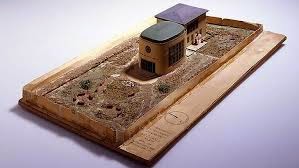
The Offenbach Synagogue of the fifties: keeping well out of the way
This was a community that didn’t feel safe and preferred to be inconspicuous.

But Jews kept coming. One of them was Rabbi Mendel Gurewitz, who moved there from New York. He makes a telling point in the series: “There was a Jewish history, a very Jewish history, here in Germany, and it’s a shame just to decide, because of Hitler, they don’t want the Jews here any more, that you should completely close that country, close it for the Jews.”

Most of the new arrivals came from the East and, in particular, after the fall of the Soviet Union, huge numbers came from Russia. Some of the emigrants decided that Israel simply didn’t have the climate for them, so they came to Germany where, paradoxically, they felt at home – and above all safe. Germany has the most rapidly growing Jewish community in Europe.

Suddenly, the Offenbach synagogue, charming though it was, was too small. The community that decided to extend it wasn’t living in fear any more and felt no need to keep itself invisible. The new Synagogue is imposing and it fronts the street. “We are here,” it says, “this is our home, we belong here as much as anyone else.” And it’s beautiful.

The Offenbach Synagogue as extended in 1998
A self-confident community, proud to be Jews in Germany
The detail that particularly caught my attention comes again from Alfred Jacoby, who designed the new building:

You have a new multi-purpose hall, you have a kindergarten and so on. In fact our kindergarten is interesting because it is a completely interreligious kindergarten with a Jewish base. We have one third Muslim children, one third Christian children and one third Jewish children, yet children will all sit and sing Jewish festival songs and so on. It actually works.

Yes. It actually works. You can mix people with different faiths and have them do joyful things together, even the things of one of the faiths. Start with the kids and, who knows, one might set a pattern for life.

A feel-good story. About multi-culturalism. With Jews at the centre.

From Germany.

Saturday, 13 December 2014

Remembering the loss of war

2014 is the start of a four-year period of centenaries, as we mark the hundredth anniversary of each of the main events of the First World War, as it turns up. 

We commemorated the outbreak of war back in August; for the war as a whole, in Britain we had the moatful of poppies at the Tower of London; now we’re on the brink of celebrations for the Christmas truces, with their attendant football games and exchanges of gifts between the front lines, a moment of hope which soon gave way to deeper despair than ever.


Poppies for the British dead at the Tower
As this process unfolds, there will be increasing debate on the war, on what it achieved, on what it cost in lives. 

There was a radical revision in assessments of the war back in the sixties, perhaps best characterised by the musical and then film, Oh What a Lovely War. The tone of the time is summed up by Adrian Henri’s line “Don’t be vague, blame General Haig”. That parody of an advert of the time (“don’t be vague, ask for Haig”) was particularly neat since the General owed his wealth to the Haig whisky business.

Where Haig's wealth came from
Judging by the results, perhaps his inspiration too
Now, though, there are signs of a new mood that would revise the revision. The war wasn’t all bad, the domination of Europe by Germany had to be broken (ironic, given where we live now), the victory was one for democracy and not just for imperialism. 

In the face of that backlash, it was illuminating to learn this week about Käthe Kollwitz (and my thanks are due, for far from the first time recently, to Neil MacGregor’s series Germany: memories of a nation). Kollwitz was an expressionist painter and sculptor and the first woman to be admitted to the Prussian Academy of Arts, though when the Nazis came to power, she was driven out as a creator of “degenerate art”.

Back in 1914, on the outbreak of war, her son decided to enlist in the German Army. Because he was under age, he needed his parents’ authority. His father refused, but Käthe came down on the boy’s side and persuaded her husband to let their son go. Within days of his reaching the front line, he was dead.

Käthe’s grief was made far more bitter by her harrowing sense of guilt. She decided to sculpt a monument to her son. The torrent of emotions she had to contend with made her reject idea after idea, and in the end it took her seventeen years to finish her work. it was unveiled in 1931.

The memorial she produced now stands in a Belgian cemetery, not far from where her son is buried. And what does it show?

Her son doesn’t appear.

There is no reference to war, neither the glory and courage of a warrior, nor the bitterness of injury and death.

All we see is two figures, for which she took herself and her husband as models, both kneeling and mourning.


Käthe Kollwitz. Grieving parents
It’s an image worth calling to  mind, especially each time we’re told that the losses of the war were a cost worth paying.


Postscript

I’m indebted to the Plough website for quoting from Käthe Kollwitz’s diary, towards the end of her life, days before the end of the Second World War, in April 1945.

One day, a new ideal will arise, and there will be an end to all wars. I die convinced of this. It will need much hard work, but it will be achieved... The important thing, until that happens, is to hold one’s banner high and to struggle... Without struggle there is no life.


Second postscript

Adrian Henri’s Great War Poems from which I quoted above, is worth reading in full. I particularly like “the ghost of Wilfred Owen selling matches outside the Burlington Arcade”. I have a childhood memory of old soldiers selling boxes of matches.

Great War Poems

I. The same old soldiers walking along the same old skyline

2. Dead hand through the sandbags reaching out for the cream­and ­white butterfly

3. Mud/water under duckboards/mud/rats scamper in starshell darkness/mud/smell of shit and rotting bodies/mud/resting your sweaty forehead on the sandbags OVER THE TOP the first men in the lunar landscape.

4. “What did you do to the Great Whore, Daddy?”

5. Poppies slightly out­of­focus and farmcarts bringing in the peaceful dead.

6. The ghost of Wilfred Oven selling matches outside the Burlington Arcade.

7. Seafog. Red flaring lights from the shore batteries. The roar of shells rattle of machineguns. Water running in the bilges. My feet slipping on the damp cobbles of the quayside.

8. DON'T BE VAGUE ­ BLAME GENERAL HAIG.

9. Four white feathers clutched in a blood­stained envelope

10. A skull nestling in a bed of wild strawberries/boots mouldering green with fungus/saplings thrusting through rusting helmets/sunken barges drifting full of leaves down autumn rivers.

Monday, 8 December 2014

We don't have to let the elite roll back our achievements, but if we don't stop them, they will

“Very well, alone!” exclaims the lone Tommy, standing on a rock amid raging seas and shaking his fist at a stormy sky with warplanes heading towards him. David Low’s cartoon of June 1940 captures the spirit of dogged defiance in Britain at that time, when France had surrendered to Nazi Germany, the Soviet Union was allied to the aggressor, and the United States, while well-inclined towards Britain, was firmly attached to its neutrality.

Britain wasn’t really alone. It had what was then still the Empire behind it, with its vast resources of wealth and manpower. Indeed, even Low himself was a New Zealander. But Britain was alone in resisting Germany in Europe.

Curiously, Britain defying Germany mirrored what had happened in Germany itself 134 years earlier. Then the aggressively expansionist power had been France, under its Emperor Napoleon. A series of devastating victories had crushed all German resistance, ended the Holy Roman Empire and left only one power, Prussia, still standing out despite – or in part because of – having lost a large proportion of its territory and population to the invader.

Rather like Britain in 1940, Prussia wasn’t strictly alone. Britain continued to be a thorn in Napoleon’s side, maintaining dominance at sea and using it to blockade the Continent of Europe (no wonder, with such a tradition, that Britain is a truculent member of the EU today). But Prussia was alone on the Continent to refuse to bow down at last to Napoleon.

It’s been fascinating to listen to Neil MacGregor of the British Museum discussing how Prussia reacted. It did away with ostentation and luxury in dress. Ladies were urged to hand over their gold, and receive in return – iron jewellery, worn with pride as a sign of patriotic spirit.

Iron is a common metal, used in industry and labour generally. It isn’t noble.

The Prussian King also decided to do away with all military decorations, and replace them with the single Iron Cross. As well as being likewise made of that common metal, it had another vital and new characteristic: unlike previous decorations, it wasn’t limited to officers, but could be won by any soldier, irrespective of rank.

The old, egalitarian Iron Cross
Before the Nazis got hold of it
So the response to invasion and defeat was retrenchment, economy and egalitarianism.

That spirit saw Prussia through to a complete turnaround in its fortunes, defeating France with support from Russia, which as in 1941 switched sides after its ostensible ally attacked it, and then from other Germans that came rallying to the Prussian cause. Prussia led the successful campaigns on the Continent, with Britain, winning victories in the Iberian Peninsula, little more than the hero of a sideshow.

Even during the final struggle, after Napoleon escaped from his first exile to return and terrorise Europe again, it was Germans, the bulk of them Prussians, that secured his final defeat: Prussian troops came to the rescue of Wellington who was battling it out with the French army, at the head of a British, Dutch and German force, at Waterloo.

And then? Once the war was over, all the egalitarianism went right out of the window. Why, even the Iron Cross was discontinued, not to be re-introduced until the 1870s. The old reactionary crowned heads of Europe took up their previous positions and began to rule in the traditional way, crushing all liberal, democratic opposition.

Sad, isn’t it? The egalitarian spirit was great when the country needed everyone to join in and kick out the French. But once the job was done, it was dropped, and back went the masses to their old subordination by the self-proclaimed elite.

Fortunately, that didn’t happen to Britain after it stood alone against the Nazis. In 1945, it elected a great reforming Labour government which ensured there were profound changes in the structure of society to protect those most in need of it.

No, in Britain we did things differently. It took 65 years before we found ourselves ruled by people who want to undo all the measures that had been taken in favour of those who made the victory possible. That’s happening now, with a vengeance. And in the wings is another party, UKIP, as intent as the Tories on taking us back to the 1930s, and which is in any case the natural heir of the British Union of Fascists which made so much noise in the country at that time.

I suppose it’s progress of a kind. Reaction that reversed social advances in a few years in Germany took as long in Britain as it takes a newborn to reach pension age.

There’s one other big difference. We elected the government that’s doing the damage to us. And we can still, if we choose, make sure that it can’t finish its job.

That the Prussian people couldn’t do, back in 1815. But we can. In elections in 2015.

Friday, 5 December 2014

Holiday destination, Walhalla

Mad King Ludwig of Bavaria, I’m told by my brother who tends to know about these things, was perhaps not really as mad as his reputation suggests.

Ludwig II of Bavaria
Not mad I'm assured. Despite the eyes
This is good news, if only because one feels such a man deserves to be more kindly remembered. Without him, millions of children, and one key man, Walt Disney, would have been deprived of a most enchanting dream. It was Ludwig who built Neuschwanstein, beating Disney to the idea of the perfect fairytale castle, by well over a century.

Neuschwanstein. Looking particularly magical
But I’ve decided where I’m going if I ever I return to Bavaria. 

I’m going to Walhalla. Not the fabled banqueting hall of the Gods and dead heroes of Norse myth. To be frank, I have over the years developed a certain cynicism concerning the existence of mythical places, and growing suspicions that I might in any case not be regarded as entirely fitting the hero mould (I don’t have long blonde whiskers, and I can’t find a horned helmet that goes with my complexion).

No, this is the really existing building called after the Norse original, built by King Ludwig, to honour the most outstanding figures of Germany. I’d never heard of it until I listened to a podcast in the Germany: memories of a nation series made for the BBC by Neil McGregor, curator of the British museum. Now I want to see it.

It seems Ludwig made his wishes entirely clear:

“No condition, not even the female sex, is excluded. Equality exists in Walhalla. There are the busts only of illustrious Germans, executed by German artists or, if there are no contemporary likenesses, their names in bronze on plaques.”

Inside the real Walhalla.
Less carousing than in the mythical one
Ludwig applied a definition of “German” that can only be regarded as generous. As well as quite a few Dutch and Swiss figures, we have the Russian Tsarina Catherine, the English King Egbert of Wessex and even Charlemagne, which must be a delight to French visitors. Still, I suppose it’s enough to extend the definition of “German” a bit, to make it non-exclusive of people who have a link to the German world even if it’s a bit tenuous (Charlemagne, by the way, probably isn’t one of them: it’s likely that he spoke a Germanic language).

In any case, if not even being a member of the female persuasion is enough to bar one, this must be a pretty remarkable place. However, there aren’t many women among those honoured. And there are other gaps.

Not even Luther got in at the start: the super-Catholic Bavarians didn’t want to honour the founding figure of the Reformation. Even if he more or less created the German language single-handed. Eventually, they added him in 1848, just six years after the place opened, and right next to Goethe, so they made amends.

There’s still no one with a Turkish name. And I doubt very much that if we had photographs alongside the busts, we’d see many dark complexions. Ah well, you have to be dead twenty years before you can get in, so maybe in a while the inhabitants will start to be a little more ethnically diverse.

The process may already be under way. One rather important community in German history was excluded from Walhalla for nearly 150 years. The first Jew, Einstein, only appeared among its residents in 1990. Even more amazing is that there was controversy over the inclusion of the next Jew. Most Germans can quote the first few lines of what has practically the status of a folk poem, the Lorelei. Its author, Heinrich Heine even converted to Christianity but, even so, getting him into Walhalla was a matter of anguished debate.

There’s one Jewish woman, Edith Stein, though she’s there as a Catholic martyr and Saint: she was another convert, but that didn’t stop the Nazis killing her. A German Jewish woman who had rather more impact on the world, Hannah Arendt, isn’t there. Nor are quite few Jewish men we might consider reasonably significant, such as Kafka or Freud.

So it must be a curious place. I can’t wait to get there. That old Ludwig: he’s certainly left us a lot to wonder at.

Mad or not.

Saturday, 19 February 2011

Tea, time and transport

Have you ever listened to the BBC Radio 4 series A history of the world in a hundred objects? If not, I strongly recommend you go to the website, download the podcasts and start listening at soon as you can.

The broadcasts are just 13 or 14 minutes long, an ideal length for a quick trip to the shops or the last dog walk of the day, while three or four will fill in a gym session nicely (OK, three for me). In each of 100 episodes, Neil MacGregor, director of the British Museum, picks an object from its collections and uses it to illuminate an aspect of the development of humanity and its culture that never fails to be fascinating.

More great radio from the BBC
I was particularly struck by two programmes I listened to recently.

One was about an English tea set that became the pretext for talking about the trade routes that brought in tea from China and later the Indian subcontinent. In London, it was met by ships from the Caribbean bringing in sugar, in many cases produced using slave labour. These two alien products finally met up on our tea tables with domestically produced milk to make a quintessentially British drink.

Then MacGregor made a point about the impact of the railways that was a real eye-opener for me. For a long time, the only way milk could be made available to city dwellers was to have cows nearby, but from the mid-nineteenth century we’ve had milk trains travelling in to our great cities at the crack of dawn of every day, allowing the cows to move back to the country, which must have been a great relief to them.

Even more fascinating was another change brought about by the railways, mentioned in a programme about chronometers and accurate measurement of time. From 1855, the railways’ need for timetables made it impossible to continue with the immemorial custom of each place working to its own local time, based on the position of the sun. Even in a small country like ours that could lead to significant time variations, which didn’t matter when transport was slow, but mattered a lot when it became rapid.

Extraordinary to think that it took the railways to align our time zones. Before that happened, places like Surrey, where the nice people still live and set the standards for the rest of us in the name of God, Queen and the Conservative Party, were some two minutes behind London.

That was then. The discovery amazed me because these days they seem at least half a century behind most of the country.

Wonderful what you can learn from the BBC.