Showing posts with label Roman Polanski. Show all posts

Wednesday, 27 March 2019

Nations divided against themselves

Have you read Robert Harris’s novel An Officer and a Spy?

Great book. From an idea suggested by Harris’s friend Roman Polanski, who’s about to release the film, to be called J’accuse, with a screenplay also written by Harris.

Imagine a young man, married with two children under three, from a wealthy background and pursuing a military career full of promise, thanks to his intelligence and devotion to duty. This is Captain Alfred Dreyfus of the French Army.
J'accuse:
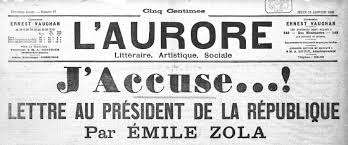
the novelist Emile Zola's ringing denunciation of the Dreyfus scandal
Now the title of Polanski's film from Harris’s novel
Without warning, he’s arrested for treason. The accusation is that he sold his country’s military secrets to its sworn enemy, Germany. The major piece of evidence against him is a handwritten note reconstituted from a waste paper stolen from the German embassy by a cleaner who is also a French agent. One handwriting expert says it wasn’t written by Dreyfus, another that it was. This is enough to condemn him in light of the most damning testimony of all: the captain is a Jew.

This is the story that Harris tells. He’s written a novel but sticks closely to the historical events. The protagonist of the book, and the hero of the story, is Colonel Georges Picquart. He wasn’t unduly fond of Jews, but he hated the idea of a traitor at large in the French Army, as he hated the idea of an innocent man suffering a terrible sentence in his stead.

Because that’s the cruel twist of this tale: Dreyfus had nothing to do with the treason. Picquart discovered the real spy and denounced him. But the establishment couldn’t bring itself to admit its error, far less when the innocent victim of its miscarriage of justice was Jewish. So they preferred to let Dreyfus rot on Devil’s Island. Why, they even ensured that the real culprit, a Major Esterhaze, was acquitted at his court martial.

Picquart, meanwhile, faced persecution nearly to the point of death: I don’t want to spoil the novel for anyone who hasn’t read it, but the French Army went so far as to try to send Picquart on a mission which would almost certainly have led to his death. But he fought on for a cause which must often have seemed hopeless.

Harris is an excellent writer of gripping novels, in particular of the spy or thriller variety, and And Officer and a Spy is in my view his best. So I’m enjoying rereading it. But it isn’t just a good read. It’s also a curious mirror to our own time.

France was torn apart by the Dreyfus Affair. The nation was divided into Dreyfusards and anti-Dreyfusards. The debate was long and often vicious, with anti-Semitic riots and even some deaths in (then-French) Algeria.

There have been no riots in Britain over Brexit, but the divisions are as heartfelt as in the Dreyfus Affair. The two sides are as diametrically opposed, the hopes of unity are as forlorn, the chances of compromise are as vanishingly feeble.

Compromise? What compromise could there have been over Dreyfus? Could he have been exonerated but left in gaol – perhaps under slightly less inhumane conditions – in order not to upset the anti-Dreyfusards? Surely he was either guilty and rightly condemned, or innocent and needing to be released (as he eventually was).

And how’s Brexit different? Britain either stays inside the EU or it leaves. There may have been endless debate over what kind of Brexit might be adopted, but any form means the country leaving the EU. Like Dreyfus being left in gaol: whether under softer or harder conditions, and for a longer or shorter time, it would still have left an innocent man being punished for someone else’s offence. Ironically, the argument for a softer kind of Brexit is often presented, often by no less a person than Labour’s Jeremy Corbyn, as a way to avoid upsetting the Brexiter, or more exactly anti-Immigrant, vote – just like keeping Dreyfus in gaol would have been a way of appeasing anti-Semites.

The big difference between the two conflicts is that the Dreyfus case is over 120 years old. We know today that no compromise would ever have made sense between the two sides. One side had the issue broadly right – Dreyfus was innocent and needed to be released – and the other was deeply and perniciously wrong – it couldn’t bring itself to believe that the Jew wasn’t a traitor to France.

And a century from now? I suspect people will be looking back and wondering how Britain could have been so misled as to leave the EU for a generation before rejoining on less favourable terms. The Brexiters, like the anti-Dreyfusards, will be seen as bigoted and profoundly deluded.

But what a pity if it takes so long, and at the cost of so much damage, for that truth to be recognised.

Saturday, 8 December 2018

J'accuse revisited for our time

When he saw all the books his friend Roman Polanski had on the subject, the author Robert Harris asked the film maker, ‘have you ever considered doing a film on the Dreyfus Affair?’

That was back in 2012. According to Harris, Polanski told him that he’d wanted to for a long time but had never found the right way it. Inspired, Harris, author of major bestsellers such as Fatherland and Enigma, set to work at once.

The Dreyfus affair tore France in two in the late 1890s. On the one hand, there were the ‘anti-Dreyfusards’ who were convinced that a young officer, Alfred Dreyfus, convicted of espionage and drummed out of the French Army before being exiled to Devil’s Island off South America, where he was held in conditions close to torture, deserved his fate.

On the other hand, were the ‘Dreyfusards’ who believed that the conviction of Dreyfus was based on rigged evidence. Ultimately, they felt, it reflected the fear of a solid, Catholic and often royalist establishment that hated the changes that were being forced on French society and identified their source as the sinister figure of the ‘outsider’ – men such as Dreyfus, an ambitious Jew from a family that had the gall to be prosperous.
An excellent novel and an excellent history
The brilliant perception of Harris in writing a superb and compelling novel – An Officer and a Spy – was to frame it as a thriller and present the story not through the eyes of Dreyfus, but those of Georges Picquart.

Why a thriller? Harris tracks the painful process of establishing who had really been selling military secrets to the Germans. And still was, since one of the consequences of Dreyfus’s conviction was that the real spy was left free to continue his treasonable work. These are the elements of a great thriller, and Harris wrote a fine one while sticking closely to well-documented and closely researched historical evidence.

Why Picquart? He may not have been an anti-Semite but he certainly wasn’t particularly fond of Jews. But what he had was a powerful sense of justice and of his duty. An army officer, he was transferred into intelligence where he was tasked with tying up the loose ends of the framing of Dreyfus. But, unfortunately for his superiors, who went right up into the government, the closer he looked at the case, the more convinced he became that Dreyfus was innocent and a Major Ferdinand Walsin Esterhazy was the real culprit.

Picquart was subjected to pressure to the point of persecution. His liberty and even his life were threatened. But he battled on and ultimately Dreyfus was released while Esterhazy escaped into exile in England. He spent the rest of his life in Harpenden, just seven miles from where I live now. Though that’s not why we moved here.

As well as his novel, Harris also delivered a script to his friend in 2013. Polanski was delighted. Though the action was to be set in Paris, the financial conditions were better for making the film in Poland, so the director headed there in 2014 to start planning the film.

Sadly, as you know, Polanski has problems of his own, chiefly with the law back in the US over having sex with a thirteen-year old, in the scandal that led some to suggest he make a film to be called Close Encounters with the Third Grade. Once Polanski had travelled from France to Poland, the US authorities could launch extradition proceedings against him, which they promptly did. Eventually, the proceedings failed, but in the meantime the film project had suffered serious delay.

In the meantime, France had introduced new tax incentives for film makers. After further delays to wait for certain actors to be available, filming started in Paris this year and the film is due for release in 2019. Polanski changed the title to J’accuse, the famous headline printed above an open letter novelist Emile Zola wrote denouncing the case against Dreyfus.

The celebrated headline over Zola's open letter to the
 French President, denouncing the anti-Dreyfusard conspiracy
The film might prove topical. After all, roll on nearly twelve decades from the Dreyfus affair and we find, in Britain, a nation just as irreconcilably divided over a major question of the times. Brexit has shattered British society from top to bottom and neither camp can see any merit in the other.

But because there is division, does this mean the truth is somewhere in between, in the middle ground between Brexiters and Remainers? Some might think so. But, in the Dreyfus case, was justice somewhere in the middle ground between Dreyfusards and anti-Dreyfusards?

The answer’s obvious. Dreyfus was not guilty of the charges against him. His treatment was indefensible. It even gave cover to the real criminal, Esterhazy.

There isn’t a half-way house, the sides are irreconcilable. You can’t release Dreyfus and keep him in prison. You can’t play a key role in Europe and turn your back on it.

Worse still, as we look back on the affair now, it’s clear the anti-Dreyfusards were driven by the worst of motives. They hated the Jew, the man whose presence in their army questioned their primal beliefs about the nature of France. They saw those who came to Dreyfus’s defence as despicable, because they put belief in the rights of man over the authority of the establishment and the grandeur of France. And they were happy to spread and believe lies to support their stance.

In the same way, Brexit has been based on lies deliberately spread and willingly believed. Brexiters are driven by hostility to outsiders, to those who arrive from abroad and work harder and often with more talent than they do. They must know, because after two years of debate it’s hard to deny the evidence, that there is no form of Brexit that will not leave Britain economically worse off than staying in the EU. But Brexiters are prepared to pay that price for the sake of ‘taking back control’, sometimes and revealingly expressed as ‘taking back control over our borders’, in other words making sure they can keep out people who look different or speak differently from them.

If only it were their economic wellbeing they were sacrificing to this goal. We live in a world in which the greatest powers are run by autocrats – Russia has had the authoritarian Putin in power for a generation, China’s Xi Jinping is turning increasingly dictatorial in a nation which is emerging as the great power of our century, and the United States has elected a narcissistic adolescent president once and may do so again.

What counterweight is there? Only Europe which, beset by populists and xenophobes, is struggling to maintain an oasis of democracy and human rights. And that’s the aspiration that Brexiters are setting out to undermine.

It’s not hard to imagine a film maker and a writer twelve decades from now turning their attention to the Brexit debacle. I think they’ll have little doubt that, like the anti-Dreyfusards, the Brexit camp got things desperately wrong because they were driven by base motives. Remainers, like Dreyfusards, fought a long battle for a more generous, more open and more equitable society.

At least, I can imagine that conversation if there is still a space in the world next century where liberal thinking is possible. Which I very much hope. Though I don’t think anyone can guarantee it.

Sunday, 18 July 2010

Roman Polanski and overturned prejudice

It can be a terribly painful process to have your prejudices overthrown. You know, for years you believe that the US Republican Party is incapable of putting anyone into the White House who isn’t either a crook or a fool, and then suddenly you find a Republican President who’s decent, tolerant, honest and reasonable. You’d have to go through a fundamental realignment in your views and a probably quite painful reassessment of all your most deeply held opinions – or rather prejudices, as you would have to redefine them.

I’m not saying that anything like that is going to happen any time soon, of course - the Republicans don’t seem to have finished plumbing the depths of inadequacy that they seem to have made peculiarly their own. I’m just trying to illustrate the depth of readjustment that I’d have to go through if they ever did find a wholly human candidate with more than half a brain.

Just recently, I’ve had to review some pretty fundamental prejudices in a different area. Specifilly, I’ve had to reconsider my views of Roman Polanski. For a long time I thought that he was simply experiencing the legal troubles of a convicted paedophile trying to escape the consequences of his acts, and there was no reason to expect him to be treated more leniently just because he’d made some indifferent films.

Now I discover that his judicial issues aren’t quite as clear-cut as they seemed. I hadn’t realised that he’d had a deal with the prosecutors in his case, and only fled the States when it became clear that the judge was unlikely to abide by its terms. In other words, he went on the run when he realised that the judge was about to impose a far harsher sentence than had been agreed.

More fundamental still, I’ve had to revise my view of his films. They weren’t all Oliver Twist. First of all, I saw The Ghost some months ago and had to admit it was a good piece of work, close to the book, well acted, well adapted and well directed. I had to start rethinking my assessment.

Now I’ve finally got around to seeing The Pianist. It always takes me a long time to see films about the Holocaust: I just find them hard to take any more. A little girl in a red coat trailing along behind long lines of people heading for the gas chambers: I can’t bear that kind of image any more.

So it took me the best part of five years to see the film. And it has completed the overthrow of all my earlier prejudices. There are many brilliant details, not least the point at which a guard allowing the protagonist to flee shouts ‘don’t run’. In the book the instruction, on the contrary, is ‘run’. Polanski changed it because he had the experience himself and had been told not to run, not to attract attention – and it’s much more forceful to have that sharp reminder that survival can sometimes mean behaving counter-intuitively.

But much more powerful still than the detail is the overall structure. You have to wade through all the pain of the Holocaust material, the usual casual murders, the cruel humiliations, the transports leaving for the death camps. But it’s all made worthwhile by the climax, a moment of calm poignancy, of beauty and pathos, that not only justifies the pain of the build up to it, but actually needs it to generate its full force.

So now I have to say – congratulations, Roman, on your escape. And thanks for a great film.

Sunday, 7 March 2010

Polanski and Blair, so many questions, so many fascinating answers

It’s been instructive, during a swift trip to France, to go and see Roman Polanski’s film Ghost Writer. It is based on the novel Ghost by Robert Harris, and the novelist’s involvement in preparing the screenplay no doubt helps explain why the film is so close to the book – the only significant changes are on those points which really can’t be translated to the screen.

The experience was instructive because it prompted two sets of questions.

First, the content. Book and film concern a fictitious former British Prime Minister, Adam Lang. When we discover that during a ten-year period in office, Lang took Britain into an unprofitable war in Iraq at the behest of a right-wing American Administration, we can presumably all make an educated guess at the real-life figure behind the fiction.

Essentially, the book and film raise a question, perhaps best summed up in what one of the characters asks: is there any single act carried out by Lang that was not completely in line with US interests? I’d put it even more strongly: how would things have been different, at least in foreign policy, had Blair been operating entirely under the control of Washington?

But there’s a second series of questions raised by the film, and particularly by seeing it in France. It is extraordinarily popular out here. An afternoon showing was packed, and as we trooped out at the end, the crowd was already pressing to get in for the next one. With a theme so British, or at any rate ‘Anglo-Saxon’ (as the French put it), it was hard to understand why France had taken to it so strongly. The friends who came with us explained that it’s the Polanski angle: an adoptive Frenchman, in trouble with the law, attracts French interest and probably sympathy.

So question number one is, why should a fugitive from the law, convicted of sexual abuse of a minor, be a focus of sympathy if he’s an internationally celebrated film director, when he wouldn’t be if he were, say, an unemployed inhabitant of the tough districts of our post-industrial cities who had himself been a victim of abuse?

But perhaps a far more interesting question is why we’re so tough on people regarded as paedophiles – there have been many cases of vigilante action against them – when there are no doubt other people, like Polanski, who committed a single offence, and one involving no violence, and have gone on to live productive and enriching lives ever since?

I suspect it says a lot about each of us which of these questions we feel needs answering first.

The film is good by the way, and I found the book enthralling.