Showing posts with label Sudetenland. Show all posts

Wednesday, 9 April 2014

Russia, Ukraine, Germany, Czechoslovakia: an exciting historico-geographical-political quiz. With a lot riding on it.

A first! A quiz for my readers! Is that thrilling, or what?

Below are two extracts from major British dailies. One is from yesterday’s Independent, the other from the Guardian of 30 July 1938. I’ve disguised both to make it a little less obvious what circumstances each article is talking about.

One of them is an account of the way the Russians of 2014 or the Germans of 1938 are preparing to use military force to come to the aid of their “compatriots”, i.e. speakers of the same language, across the border in Czechoslovakia – or do I mean Ukraine? 


Yep, that’s how gripping this gets...

The other extract quotes a speech from a nationalist leader, of the ethnic Russians of Eastern Ukraine in 2014, or possibly of the Sudeten Germans in Czechoslovakia in 1938.

Moving against Ukrainian troops still nominally in control, 
Russian troops deploy in Crimea
with strong civilian support
And here’s question 1: which is the 1938 piece, which the one from 2014?

Extract 1

And yet, the latest protests in [the Sudetenland/Eastern Ukraine] show far more organisation and determination compared with those of just a few weeks ago. They sing the same verses from the hymn sheet in [the main cities]; they call for a [referendum/plebiscite] and a plea for [Russian/German] “peacekeepers” to defend them. This strikes a chord with the repeated demands from [Berlin/Moscow] that [Ukraine/Czechoslovakia] should give a voice to the [regions/minorities] and adopt a federal structure and pledges that ethnic [Germans/Russians] will not be abandoned: the [Kiev/Prague] government does not need reminding that [President Putin/Chancellor Hitler] [has been authorised] to deploy troops not just for [Austria/Crimea], but [Ukraine/Czechoslovakia].

Extract 2

“On behalf of the largest group of [German/Russian] people ... outside [Russia/Germany], also in the name of all other [Russians/Germans] living abroad, I declare that we are all inseparable parts of the great [German race/Russian nation]. Efforts to make national boundaries and spiritual boundaries between members of one people have collapsed.

“[Germans/Russians] living abroad render unto the nation what is the nation’s, and to the people what is the people’s. As true [Russians/Germans] we are accustomed to fulfil the duties we have shouldered. So we take seriously our duties towards the country to which we belong, but as members of different nations we remain members of the [German/Russian] people.”


German troops move into the Sudetenland in Czechoslovakia
with strong civilian support
Question 2, on the other hand, is “does it matter which text is which? aren’t they pretty much interchangeable?

Which leads to Question 3
given that the 1938 problems led to Hitler occupying the Sudeten areas of Czechoslovakia in one of the major steps towards World War 2, isn’t it time we got a little more worked up about what’s happening in Ukraine?”

Tuesday, 18 March 2014

Crimea: flashpoint towards another war?

I’ve been taken to task by a friend for not backing the obvious will of the people in Crimea, for reintegration with mother Russia. That will was expressed in the referendum held there on Sunday 16 March. The result, we’re told, was a 97% vote in favour of leaving Ukraine and joining the Russian Federation.

It seems likely to me that there really is a majority in favour of joining Russia in Crimea, which is 58% ethnically Russian. And I’m in favour of determining this kind of question by the will of the people: if it looks as though a majority of the Scots, for instance, want independence from the United Kingdom, I’d be strongly in favour of their being able to leave, though personally, as an Englishman, I’d dread their going: we’d be stuck with Tory governments for years or possibly decades.

In addition, Kruschev’s cavalier decision in 1954 to hand the region to Ukraine, without logic or reason and certainly without consulting the population, was high-handed and ill-advised. It makes sense to correct that abusive action now.

However, only a year ago, polls showed just 41% of Crimean voters favouring reintegration. And 24% of the population is Ukrainian, while 12% are Tatars, descendants of the original inhabitants, known to be strongly opposed to joining Russia. It seems highly unlikely that many of those groups voted ‘Yes’ on Sunday.

Indeed, even among the Russians, it seems unlikely that the proportion in favour of leaving Ukraine has grown quite so much in just a year, despite local misgivings when the Kiev government of Viktor Yanukovych, ethnically Russian strongman, elected legally though behaving abusively, was brought down.

So the chances that the vote really was 97% in favour strikes me as utterly unbelievable. Especially as no observers were allowed to supervise the voting or the counts. And as we all know, it isn’t the votes that count, it’s who counts the votes.

Besides that, with the Russian Navy still using the peninsula as its Black Sea headquarters, and with its soldiers in the streets – pretending to be local self-defence militias – it’s not clear to me that the referendum in any way represented an exercise in democracy. More of a simulation of democracy under the barrels of a gun. Indeed, the only concession to democracy seems to have been the Kremlin’s willingness to allow that 3% voted against; in Soviet days, majorities generally exceeded 99%.

Guardian picture of Russian forces on Ukrainian territory:
'democratic' muscle for the 16 March referendum
If that’s progress, it only shows how far today’s Russia still has to go.

Even more sadly, however, Putin’s behaviour doesn’t just recall the excesses of the Soviet Union. It recalls an earlier and even more disastrous spell in our recent history. As does the weakness of the Western response to Russia’s behaviour.

In 1936, long before Germany had rearmed, Hitler sent troops into the Rhineland, demilitarised by Treaty since the end of the First World War. The democracies protested but took no action.

In the spring of 1938, he annexed Austria to the Reich. The democracies protested but took no action.

In the autumn of 1938, he occupied the German-speaking areas of Czechoslovakia. The democracies had protested, but instead of taking action, had agreed to allow him to take over those areas. The agreement was the now infamous ‘peace in our time’ document.

In the spring of 1939, Hitler occupied the rest of Czechoslovakia. The democracies protested even more loudly but again did nothing else.

Finally, in September 1939, he invaded Poland and the democracies at last reacted. This was the start of the bloodiest conflict in history, the Second World War (well, the European bit: it had been raging in the Far East for several years already).

The question remains, would that have been avoided had France and Britain, even maybe the United States, reacted powerfully to the occupation of the Rhineland?

Putin has in effect annexed Crimea. Now he’s talking about the calls of ethnic Russians in Eastern Ukraine for reunification with the motherland, just as Hitler had justified his actions in Czechoslovakia in the name of the rights of the Sudeten German-speakers.

We’ve probably left it too late to do anything about Crimea. But if we do nothing about Eastern Ukraine, will we just slip further down the same slippery slope that took us to war in the thirties? And might a more powerful response stop that? Say, economic sanctions that bite, even if they cause us pain too, perhaps even the stationing of token troops in Ukraine, so that it’s clear that an invasion would bring Russia into conflict with far more than merely the Ukrainian army?

After all, surely we’ve learned from the Second World War, that the pain that awaits us at the bottom of slippery slopes may sadly be a lot worse than taking effective action now.

Sunday, 9 March 2014

Simply comparing a political opponent to Hitler is a terribly cheap ploy. It’s generally horribly unfair, not to say misleading. However, the reason we dislike such comparisons is that when we think of Hitler, we think of extermination camps, the Holocaust, the millions of murdered civilians guilty of no crime.

But there’s much more to Hitler than his murderous behaviour. There are other aspects of his time in power with which comparisons are well worth making. Especially when they can teach us lessons about today.


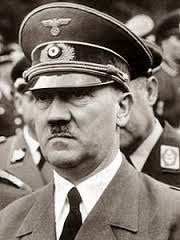
Not just a mass-murderer.
He had plenty of other faults
In 1938, a party close in sympathy to the German Nazis, was campaigning actively for the rights of the German minority in Czechoslovakia for redress of their alleged grievances against the majority. Hitler took up their cause. Leaders of the other Great Powers of Europe, Neville Chamberlain in Britain and Edouard Daladier in France, consulted with Hitler (though not with the Czechs...) and agreed to allow him to occupy the German-speaking areas, the so-called Sudetenland.

That agreement, signed on 30 September 1938, was to guarantee ‘peace in our time’. Hitler wanted the Sudetenland but no other part of Czechoslovakia, he assured the other statesmen. Granted his wish to occupy just those parts of the country, he would leave the rest alone and Europe need not fear war.

On 16 March 1939, German forces occupied the rest of Czechoslovakia. Britain and France took no action. 


Less than six months later, the German army rolled over the border into Poland. Though bound to defend Poland by Treaty, it took two more days of heart-searching and indecision, before Britain and France at last declared war on Germany, and the European theatre of World War II got fully under way.

Now roll forward three-quarters of a century. 


Vladimir Putin feels himself honour bound to come to the defence of his compatriots, the Russian-speakers of Ukraine. ‘Self-defence’ forces, that look extraordinarily like Russian troops without their insignia, have seized control of Crimea. Optimists may believe that Russia can be persuaded to hand the region back to Ukraine; realists, and that includes the main governments of the West, know that there’s no prospect of that happening. It was, after all, a traditionally Russian area, and there’s overwhelming local support for a return to the motherland, undoing a unilateral decision of Nikita Kruschev sixty years ago.

Will Putin stop there? Maybe. And if he does, we can no doubt learn to live with that. Perhaps Ukraine, too, can lick its wounds and come to terms with its loss.

This is where the comparison with Hitler becomes illuminating. Making concessions to Hitler meant feeding his appetite. Handing him territory only made him push his luck further and try to get still more.

There are Russian speakers in Eastern Ukraine too, including its second biggest city, Kharkiv, and the great industrial centre at Donetsk. Will Putin feel the same obligation to ‘defend’ them as he has ‘defended’ Russian speakers in Crimea? And Hitler ‘defended’ the German speakers in Czechoslovakia?

There’s also another lesson. When we did stand up to Hitler, it cost us a bloody war – the bloodiest the world has seen. War with Russia today, however, would probably put the war against Hitler into the shade. It might, indeed, threaten the very existence of humanity.

The fact that no one seems keen on the idea of military intervention against Putin strikes me as thoroughly welcome. On the other hand, appeasement doesn’t work either, if we can learn anything from the experience of Hitler.

But between war and appeasement there are surely a great many other possibilities. What is much less edifying about the behaviour of Western governments today, is the rapidity with which they seem to be ruling out any kind of economic action, even though such measure might actually get Putin’s attention: imagine if he and his oligarch friends found themselves hurting in their wallets.

Instead, the message from Western capitals seems to be that we’re prepared to do whatever it takes, as long as it doesn’t cost us anything.

The only worry? If we’re not prepared to pay any cost today, the cost we may face later might be far higher.

That’s another lesson to learn from our experiences with Hitler.


Putin may not be a mass murderer
but he still needs to be stopped