Showing posts with label The Guardian. Show all posts

Saturday, 25 April 2020

Time for more women leaders?

Two impressive performances have left me wondering whether we need more women at the top of politics. Not just because equality of rights is desirable, which it is, but also because they seem to be doing a lot better than most of the men.

That’s not all women leaders. Theresa May was convinced that she was right and, impervious to all calls to change course, steered her government straight onto the rocks. And Margaret Thatcher set a new benchmark in the kind of sociopathic government that has no compassion for the victims of the suffering it inflicts. No. Some women leaders are admirable, others anything but.

The two women who impressed me this week did so because the greatest measure of a politician’s worth is how they react to a crisis, and they have risen strongly to the challenge Coronavirus presents.

Neither of them is Jacinda Ardern. As I’ve written before, Ardern may be the most outstanding leader the world has today. My only regret is that, in New Zealand, she leads a country of just 5 million people. Imagine if she were leading the country of 330 million, currently mismanaged by the overgrown toddler in the White House?

So here are the two other women I feel are handling things well.

One was Nicola Sturgeon, Scottish First Minister. I was impressed by her quiet, firm and yet encouraging way of delivering bad news. She tweeted:

I know lockdown gets tougher as we head into the weekend, and the weather gets better (even by Scottish standards). But it really matters that we stick with it – we’re seeing some progress but it will be quickly reversed if we ease up. So PLEASE, #StayHome – it will save lives.

A little humour helps communicate a message – we all know the (not entirely undeserved) reputation of the weather in Scotland. As for the message itself, it’s firm but optimistic. It’s what one expects from a true leader.

She reminds me of a particularly potent speech by Churchill. He made it after the British victory at the battle of El Alamein, significant because it was the first time the German army had been defeated on land in World War 2, but still minor because the North African theatre was something of a sideshow compared to the titanic clashes that were taking place in Russia.

Churchill knew how to present the success in a way that was encouraging without exaggerating its importance:

Now this is not the end. It is not even the beginning of the end. But it is, perhaps, the end of the beginning.

Isn’t that what Sturgeon was saying? The lockdown’s getting tougher, but we’re seeing progress. It isn’t time to relax, but there’s reason for hope.
Merkel, Ardern, Sturgeon
Good to have more of them
Funnily enough, the other woman leader who impressed me used words even closer to Churchill’s. Angela Merkel, Chancellor of Germany, told her Parliament:

We are not in the final phase of the pandemic, but still at the beginning. Let us not now gamble away our achievements and run the risk of a setback.

Now there’s a tough statement. Germany’s not even at the end of the beginning, but still at the beginning itself. I’m sure she’s right. I wish some of the men we have leading major nations were prepared to be as open about where we stand.

Donald Trump, for instance, keeps trying to undermine the lockdown restrictions, even supporting demonstrators who (rashly) turn out to protest against them. We know that he believes he needs the economy humming again if he is to have a chance of re-election in November, and to achieve that, he seems willing to sacrifice more lives. That’s despite the US already having more Covid-19 deaths than any other, country in part because of his delays in launching counter-measures.

In the UK, Boris Johnson also worked hard to undermine social-distancing steps. On 3 March, he boasted that he was still shaking hands, even in the hospital he’d just visited where CVid-19 patients were being treated. Providing a useful demonstration of how irresponsible that was, he fell sick with the virus himself. Since he refuses to hand over to someone else even temporarily, but hasn’t been able to work for the last three weeks, the UK is now facing this crisis with no one to exercise the authority of a Prime Minister.

Not that I’m calling on him to hand over to a woman. That might mean the present Home Secretary, Priti Patel. If anyone could make Maggie Thatcher look like an exemplar of gentleness and empathy, it would be Patel.
Thatcher, May, Patel
No need for any more of them
No, not all female leaders are admirable. Just as not all male leaders are as lamentable as Bush or Boris: Sánchez in Spain or Conte in Italy, among others, have shown guts and determination in dealing with the virus, even if they were late getting started. But the women have been more uniformly impressive.

I’m not alone in noticing this. Jon Henley and Eleanor Ainge Roy in the Guardian, for instance, point out that only some of the male leaders, but all of the women, have handled the epidemic well.

That sounds like a lesson we ought to learn.

Thursday, 28 November 2019

BBC or Better Be Careful what you wish for

“Democracy,” wrote the American journalist and wit HL Mencken, “is the theory that the common people know what they want, and deserve to get it good and hard.”

There are times when some on the left seem convinced that they know what they want, and getting it good and hard might refocus their minds. Not that I’d like it to happen: we’d all suffer if they did.

What makes me say this is the internet meme I keep seeing, with a picture of Peter Falk as Columbo, making his trademark comment: “Excuse me sir… just one more thing” and then asking the (apparently) killer question, “why does the BBC never quiz the Tories about doubling the national debt to £1.9 trillion?”

Back in 2010, the Tories had promised that their austerity programme was a necessary evil to reduce the national debt. It is indeed ironic, at the very least, that after nearly a decade of the evil, the debt, far from being reduced, has doubled. So why doesn’t the BBC quiz the Tories about this sad state of affairs?

The BBC is primarily a news organisation. The doubled debt may be deplorable, but it isn’t news. It isn’t because nobody is quizzing the Tories about it. Not Labour, for instance. If Labour took up the issue in the current general election campaign, it would become newsworthy.

Why doesn’t Labour do that?

Because it would face a counter-attack demanding to know how it intends to reduce the debt. Since Labour is more concerned with some urgent spending commitments – on the NHS, Education and the Police, among many others – the last thing it wants to do is to paint itself into a corner as committed to debt-cutting.

The truth is that the national debt is not an issue in the election campaign. The NHS is. Education. The Police. Housing and homelessness. Workers’ rights. The issues, in fact, on which Labour is quizzing the Tories and on which the BBC also should.

That the BBC were planning to make life difficult for Boris Johnson on such matters is reflected in Johnson’s apparent reluctance to be interviewed by Andrew Neill. Jeremy Corbyn was badly mauled by Neill. Boris would doubtless prefer to be called gutless for ducking the same experience than run that risk. Not honourable or courageous, but wily.

If he doesn’t face the same inquisition as Corbyn did, that’s not the BBC’s fault. It’s Boris showing how deviously he plays the political game.

But back to the national debt. Let’s be clear: for instance, it would be wrong to think that the BBC doesn’t talk about it at all. It took me about three minutes to find a recent piece on the subject. It included a graph showing how the debt has climbed. It’s true that it shows £1.8tn rather than 1.9, but that seems to be down to its reasoning in terms of ‘net’ national debt. Don’t ask me what the difference is – at best I’d be guessing.
The BBC on rising national debt, in a piece from 6 November
It’s true, though, that the national debt isn’t front and centre of the BBC’s news coverage. We don’t get news bulletins telling us that “with the national debt at £1.9tn, double the level when the Tories came to power, rescue workers are still struggling to rescue survivors or recover bodies from the earthquakes in Albania”.

A TV channel that behaved in that way wouldn’t be providing news, it would be peddling propaganda. That’s the way things are in the US.

There’s nothing wrong with propaganda, as long as it doesn’t pretend to be news. This blog is propaganda, for a specific point of view (mine). If you don’t like it, that’s fine. There are plenty of others to choose from – the Skwawkbox on the left, for instance, or Guido Fawkes (or the Daily Mail) on the right. What those channels have in common is a lack of journalistic standards. We publish what we believe to be true, or in some cases would like to be true, without verification or evaluation.

If you’re more comfortable with reading material that confirms what you believe, stick to the propaganda. But I think we’d all do far better to have independent organisations publishing seriously checked material, which we can interpret as we wish. As C P Scott, the iconic editor of the Guardian put it, “Comment is free but facts are sacred”. I’d like to have my facts served up to me as accurately as possible. Then I’ll make up my mind.

The BBC doesn’t always get things right. But it does one hell of a lot better than most. For that, I’m hugely grateful.

By way of contrast, take a look at Hungary. It has just announced that it’s pulling out of the Eurovision competition. In itself, that’s hardly world-shattering. What makes the decision importance is its motivation: it’s undoubtedly because the Hungarian authorities see Eurovision as “too gay”. The Hungarian government is increasingly homophobic. There’s little doubt that’s why the nation has pulled out of the competition.

But the decision isn’t the government’s to take. It’s up to MTVA, the national TV network. The problem is, MTVA does what the government tells it to do.

See? What happens when you start demanding that your national broadcaster serves one side more than it currently is? There’s no guarantee it’ll support yours.

Knocking the BBC in Britain doesn’t necessarily serve the cause of the left. It’s far more likely to assist the hard right, which is just as critical of the organisation and far more powerful.

Be careful what you wish for. You may get it a lot harder than you wanted. And there may be nobody out there to cover your denunciations when that happens.

Friday, 6 September 2019

Boris Coup: Day 10

Day 10. And Boris keeps giving the lie to Karl Marx, who talked about history repeating itself, first as tragedy and then as farce. With Boris, it happens only once, is a farce throughout but is perfectly likely to end as tragedy.

A tragedy for him perhaps. At least, we should hope so. Otherwise it could be one for the rest of us.
BoJo: not so happy these days
Let’s see what he’s been up to.

Well, he’s had to contend with more resistance to his high-handed behaviour, in particular his expelling of Conservative MPs for voting against him. The worst resistance came from his brother Jo, who will stand down as an MP as well as a minister, because of the “unresolvable tension” between loyalty to his family (i.e. his brother) and the national interest. How tough it must be to have your own brother declare your actions not in the national interest...

Boris laughed at Ed Miliband’s victory over his brother David for the Labour leadership back in 2013:

...only a socialist could do that to his brother, only a socialist could regard familial ties as being so trivial as to shaft his own brother

It seems that fraternal shafting isn’t restricted only to the left after all.

What else has Boris been doing? 

He attended a police training academy in Wakefield, in the North of England. The understanding was that it would be a celebration of his decision to recruit another 20,000 police officers, without a word of politics being breathed. But Boris treated that as a firm commitment, so he broke it.

First he kept the police officers and trainees waiting an hour, standing around in the sun. A fine illustration of how deeply he cares about ordinary people. Then he made a wholly political speech, part of his campaign for an election which, much to his frustration, he hasn’t yet been able to call.

In true Trump style, he took advantage of having police as a backdrop to make the speech. Something the police themselves resented, since they value their reputation, or at least the appearance, of being politically neutral. But Boris doesn’t pay much attention to protocol and procedure. If the regulations get in his way, he simply ignores them.

It was the same when he was an undergraduate in the Bullingdon Club at Oxford University: if he felt like trashing a restaurant, he just did it. Mere conventions suggesting that kind of behaviour was unacceptable were never going to deter him then. They don’t deter him now.

It’s interesting that he’s campaigning for an election, given that one of the votes he lost in Parliament, as I mentioned yesterday, was a motion to call a poll. The latest news is that the Opposition parties don’t intend to give him that election until after the Brexit date.

That’s more bad news for poor Boris. A new poll by ICM for Represent Us, a group campaigning for a second referendum, suggests that the Brexit Party’s vote would double from 9 to 18% if an election were held after 31 October and Britain still hadn’t left the EU. That would leave Corbyn and Johnson level pegging on 28%, whereas in an earlier election BoJo would be ahead by 37 to 30% (according to the Financial Times, which has a paywall).

No wonder the Opposition parties want the vote in November.

Especially as the Lords have now ratified the bill requiring BoJo to delay Brexit if he hasn’t negotiated a new deal by Halloween. “I’d rather be dead in a ditch,” he told the Guardian when asked whether he’d request a delay in Brexit.

He keeps claiming he’s making good progress towards a deal, but since the EU says there’s been no progress at all, like the boy who cried wolf, Boris finds few who believe him.

So he could be heading for 31 October with no deal. Then his choice would be to ask the EU for a delay to Brexit, and comply with the new law. Or he could break the law, which would be a serious extension to his coup and might have some difficult consequences. Or of course he could die in a ditch.

By happy chance, it seems that Parliament may well be digging one for him.

Friday, 30 August 2019

The Boris coup: day 3

Boris has announced that he’s now going flat out to get a deal with the EU.

Why now particularly?

Because now he’s doing away with the interference of those pesky members of parliament. Of whom he happens to be one. And by no means the least pesky (ask Theresa May).

If anyone was in any doubt of the plans of the Downing Street junta, a source from inside the bunker cleared them up on Thursday, as Heather Stewart tells us in the Guardian:

We’ve been very clear before that we will deliver Brexit by any means necessary and that remains the case.

Any means that they deem necessary. If that means trampling mere constitutional niceties, say by removing the only means of democratic oversight of government that Britain has, well, you can’t make brain soup without breaking heads.
Citizens out in the streets to resist the coup
And where was the Leader of the Opposition? Nowhere to be seen
Boris Johnson, we have come to learn down the years, may not always be entirely truthful in his public pronouncements. Few can have been naïve enough to believe him when he announced he was proroguing parliament to give himself time to refine his domestic agenda. If they were that innocent, there was a lovely hot-mike moment, also on Thursday, when, as Heather Stewart also points out, the defence secretary Ben Wallace was caught saying:

”Parliament has been very good at saying what it doesn’t want. It has been awful at saying what it wants. That’s the reality. So eventually any leader has to, you know, try.”

He continued: “Our system is a winner-takes-all system. If you win a parliamentary majority, you control everything, you control the timetable. There’s no written separation, so … you pretty much are in command of the whole thing. And we’ve suddenly found ourselves with no majority and a coalition and that’s not easy for our system.”


Ah, yes. He belongs to the lazy right that believes things should be easy. 

In a democracy, when parliament can’t decide what it wants, you wait until at last a majority emerges for one solution or another. A system where one man decides he can do without a majority, and does away with parliament to impose the decision himself, is called an autocracy.

But Boris can dress up what he’s doing as democratic because there is widespread voter support for him. And that shouldn’t surprise anyone either: whenever an autocrat takes power, he does so with a large minority, or even a majority, backing him among the people. Right now, the Tories enjoy a lead over Labour in the low double figures, small but enough to encourage him down the road he’s taken. Indeed, add in the Brexit Party vote, which he would get if Farage’s party chose not to stand candidates against Tories, and he’d be sitting on 45%, a dream level of support for an autocrat.

Also enough to win him a sizeable majority in parliament if he decided to go back to ruling through it. Which, as Ben Wallace indicated, he would probably do if he had the majority that gave him the control he wants.

His strong position isn’t only down to Boris. It equally depends on the sad weakness of the official opposition to him. It’s interesting watching all these developments from abroad, in Spain. One of the better Spanish papers, El País, had this to say about developments in Britain:

A triple offensive, with appeals to the courts to overturn the prorogation, calls to citizens to block the streets and a final attempt in Parliament to prohibit by law a disorderly exit from the EU, are laying the groundwork for a decisive week in the history of the country.

Well, the appeals to the courts have started badly, with a Scottish judge refusing an interim order reversing the prorogation. Still, the efforts proceed, under the leadership among others of the doughty, impressive Gina Miller.

Citizens have been taking to the streets to try to block BoJo’s coup. Now here’s where one might expect a radical left-winger to prove his credentials. A man from that political tendency would, one might imagine, be a strong proponent of direct extra-parliamentary action by the population, to reinforce any action in parliament.

In other words, the protest action called ‘stop the coup’ gave Jeremy Corbyn, the official Leader of the Opposition, the opportunity to prove his worth. Sadly, it has proved exactly that. His is a business-as-usual approach, and instead of joining the protestors, he preferred to go campaigning in a Scottish constituency.

Most of us already knew this about him, but his failure to pick up the baton offered him by ‘stop the coup’ proves it: he’s a Leader of the Opposition who can’t lead, and who doesn’t even oppose much.

No wonder BoJo is opening up a commanding lead in the polls.

That leaves Corbyn with only the legislative route open. To push a bill – or help push someone else’s bill, since there are real leaders in the House of Commons – through Parliament, in the brief time it’s allowed to meet before it’s prorogued.

Then hope for the best against the odds, since BoJo has already shown his readiness to ignore Parliament.

Oh, well. As El País says, it’s a historic moment for Britain. And, given the quality of the leadership on display, a pretty dire one.

Saturday, 15 June 2019

Fake news and 'The Truth'

Terry Pratchett was one of the finest English writers of recent years. That’s not as widely understood as it might be, perhaps because he wrote fantasy novels and too few people realise that they are, in reality, not concerned with his invented ‘Discworld’ but with our own life here on Earth, to which he held up a revealing mirror. Or a searchlight.
Terry Pratchett: excellent writer whose insight we sadly miss
The Guardian recently published an article on the Pratchett biography due to be released next year by Marc Burrows. He discovered that Pratchett, who started his professional career as a journalist, conducted an interview in 1995 with Bill Gates of Microsoft. Pratchett correctly foresaw the arrival of fake news; Gates mistakenly countered that there would be an authority on the net which would classify material and allow readers quickly to establish that certain items were simply untrue. How wrong that was…

Pratchett had said:

Let’s say I call myself the Institute for Something-or-other and I decide to promote a spurious treatise saying the Jews were entirely responsible for the second world war and the Holocaust didn’t happen. And it goes out there on the internet and is available on the same terms as any piece of historical research which has undergone peer review and so on. There’s a kind of parity of esteem of information on the net. It’s all there: there’s no way of finding out whether this stuff has any bottom to it or whether someone has just made it up.

Lisa Forbes, newly-elected MP for Peterborough
Confused about the anti-Semitism of posts she decided to like
It’s ironic that he chose an instance of anti-Semitism to illustrate his point. Today, we see a great deal of anti-Semitic material on the internet, masquerading as anti-Zionism, and plenty of people are empty-headed enough to endorse it unthinkingly. That’s what Lisa Forbes did, before becoming the new Labour MP for Peterborough in its recent by-election. But there’s Islamophobic material out there, and anti-vax material, as well as stuff about conspiracy theories concerning 9/11, the moon landing or pretty much anything else you care to mention, so that the right can fall for it just as readily as the left or the simply naïve.

Pratchett also wrote a novel to explore these problems, aptly entitled The Truth. It focuses on William de Worde who launches the Discworld’s first daily newspaper, the Ankh-Morpork Times. As William comes to grips with his new profession of journalism, he begins to discover some of its more curious aspects.

In the Palace of Ankh Morpork, William attempts to collect information about an offence alleged to have been committed there. But the Commander of the Watch (the Chief of Police), Sam Vimes, refuses to tell him anything useful. However, when William needs something from the kitchens, Vimes is at least good enough to point him in the direction. William decides to poke around there, until he’s challenged.

‘… who are you, askin’ me questions?’

‘Commander Vimes sent me down here,’ said William. He was appalled at the ease with which the truth turned into something that was almost a lie just by being positioned correctly.

He’s absolutely right. Nothing helps a lie gather momentum so much as having it transmitted through a statement that is strictly true. Vimes did indeed send him that way. But Vimes gave him no permission to interview anyone or, indeed, continue his investigation of a crime on which the police were working. And yet, isn’t that exactly the impression William’s words give?

The problem, in William’s view, is summed by an old saying about lies and the truth: ‘…lies could run round the world before the truth could get its boots on.’ But what gives that statement its power is the thought with which he follows it up:

And it was amazing how people wanted to believe them.

Here’s a lovely example of both these notions: that a dash of truth makes fake news more palatable, and that it will be more quickly accepted and spread by people who want it to be true.

In the recent Peterborough by-election I mentioned before, Labour surprised most commentators by holding the seat. Many had expected it to be won by Nigel Farage’s Brexit Party. For Labour to hold it after the previous MP, also Labour, had been forced out following criminal action, was remarkable. And many remarked on it. One such remark I saw on social media, claimed that it was a great success, especially as Labour not only held the seat but increased its majority.

Clearly, the writer really wanted to believe in a Labour triumph in the seat. And since the candidate had indeed increased the majority, the justification for this belief might seem solid. Until we look at more evidence. A little more truth, in fact.

The Labour majority at the previous election had been 607 votes. At the by-election the majority had climbed to 683. So it’s perfectly true that it had increased. But it had increased from a wafer-thin majority, by a wafer-thin amount, to another wafer-thin majority.

And what triumphalism over the election result doesn’t take into account is that Labour’s share of the vote fell, and by a far from wafer-thin amount: from 48.1% to 30.9%, a drop of 17.2%.

Indeed, taken together, the vote of the right-wing parties – Conservatives and the new Brexit party – took 50.3% of the votes, an absolute majority. Labour only won because the right-wing vote was split.

Labour had something to celebrate in holding a difficult seat. But triumphalism? That was hardly called for.

Unless you’re ready to believe a distortion made possible by, as Pratchett shows, positioning the truth in a particular way. Which you’ll be all the happier to do if you just want to believe the lie in the first place.

Just as Pratchett warned.

Saturday, 3 November 2018

What we can learn from the Tories: professionalism

You don’t have to support the Conservatives to learn a thing or two from them.

After all, in amongst the many things they do badly – being decent, principled or equitable spring to mind – there’s one thing they do exceptionally well. That’s winning and holding on to power. That were in government, mostly alone but sometimes in coalition, for two-thirds of the last century, and they look set, barring accidents, to overtake Labour quite soon in this one.

It wasn’t always so. Between 1846 and 1874, the Conservatives never formed a majority government. But that was the time of one of the most exceptional men every to lead that Party, Benjamin Disraeli.

He had to fight antisemitism and the taint of being on the liberal wing of his Party, but he presided over the conversion of the eighteenth-century Tories into the modern Conservatives with their election-winning machine.

In particular, he played a major role in redefining the role of a party in opposition. Disraeli believed that the goal of the party out of government was to take office at the earliest opportunity. Granting the government easy victories, by voting with it, only made the task harder. The opposition had to oppose.

Getting that lesson across wasn’t easy.

Part of the problem, writes Richard Aldous in the Lion and the Unicorn, his brilliant account of the battles between Disraeli and Gladstone, was Disraeli’s innovation. Rank-and-file Tories in mid-century did more than most to justify the Conservatives’ earlier reputation as the ‘stupid party’. What they failed to grasp, or at least appreciate, was Disraeli’s original approach to opposition. He was perhaps the first political leader to demand that the foremost role of the opposition was to oppose. This may seem obvious now, but it was a novel approach in Victorian Britain. Even his most recent predecessors, Lord John Russell and Sir Robert Peel, had maintained a gentlemanly and statesmanlike detachment in the House, challenging legislation only if they really thought ill of it.

We’re under no obligation to stick with a tradition simply because it is a tradition – Voltaire once wrote that what we call a tradition is just an abuse that we’ve maintained for centuries. On the other hand, if a particular approach works, and the Tories’ record shows how well theirs does, we abandon it at our peril.

Indeed, it should be in the kitbag of any professional politician.

Some people have suggested that I’ve been unfairly critical of John McDonnell this week. He’s the Shadow Chancellor, in other words the opposition politician directly focused on financial policy. And my annoyance was caused by his decision not to oppose the government over tax cuts designed to overwhelmingly benefit the rich rather than the poor.

McDonnell is from the left of the Labour Party. He’s a self-proclaimed socialist. This kind of regressive tax ought to be anathema to him.

But, in any case, simply applying the Disraeli maxim that the opposition’s role is to oppose – as Aldous says, ‘this may seem obvious now’ – meant he had to oppose these cuts.
If her were in the same league, McDonnell (right)
could learn a thing or two from Disraeli
The only argument I’ve seen for his not doing so is that the measures would benefit some people who need the support, even though it would deliver far more to people who need it much less. Opposing the cuts would have led to headlines such as ‘Labour: taking money out of the pockets of headteachers and doctors’.

This is a remarkable position to take. Even an amateur commentator on politics knows that the right-wing press will always publish headlines attacking Labour. Try to accommodate Conservative editors? They’ll just change line of attack whereas you’ll have abandoned a principle. A professional should know that.

McDonnell’s failure to oppose the cuts merely attracted derision from the government front bench. He gave Liz Truss, Chief Secretary to the Treasury, a glorious opportunity to mock him, as Heather Stewart pointed out in the Guardian:

”… even the shadow chancellor has welcomed our tax cuts”. She joked that it’s a “shame his party don’t agree with him … you can almost hear Momentum sharpening their pitchforks”.

She added: “I want him to know that all is not lost. Shadow chancellor, you have friends on this side of the House and there is space for you on our front bench. You might have to sit on the home secretary’s knee.”


In attempting to dodge a bad headline, McDonnell opened himself up to ridicule. 

Guess which is more damaging in politics.

Some have asked me what I might have done better. My first answer is that I’m not a politician but, as a literary critic once said on being attacked for not being able to write a book himself, I may not be able to cook but I know when a meal is good. And the one McDonnell cooked certainly isn’t.

My second answer is that I know that I’m an amateur with no experience of executive responsibility in a major party. I know my limitations and I have no illusions about being able to act as Shadow Chancellor, a position to which no one would elect me in any case.

Unfortunately, McDonnell and his party leader Jeremy Corbyn, have as little experience of executive authority as I do. The difference is that they don’t realise it. They don’t admit that they too are amateurs trying to play a game in which Disraeli showed the need for professionalism.

And, boy, does it show.

Thursday, 16 August 2018

Traditional triumph in the board room

It seems that top executive pay in Britain rose by 11% last year, while on average pay packets rose by only 1.7%. That 1.7% is a pay cut in real terms since it isn’t enough to cover inflation.

In 2016 it would have taken a worker on the median wage 157 years to earn as much as a top executive would pick up in a year. There has been progress since those dark days, however. In 2017 the figure had risen to 163 years.

It’s not for me to suggest that a top director isn’t worth 163 times any ordinary person. So I’ll leave it to someone much closer to all these matters. The Guardian quoted Andrew Ninian from the Investment Association, a body representing Fund Managers, not generally amongst the lowest paid themselves:

Investors have repeatedly highlighted their concerns with excessive CEO pay, so it is frustrating that the message does not appear to be getting through to some FTSE 100 boardrooms. This year we have seen more FTSE 100 companies get significant votes against their remuneration reports than in previous years.

So even though shareholders have been voting against these colossal increases, they go through anyway.

If shareholders can’t stop them and executives, who benefit from them, won’t, then who could? 

Government maybe.

Sadly, though Theresa May spoke out loudly for executive pay moderation while she was campaigning for election, she’s been back-pedalling hard ever since becoming PM again. She has, for instance, dropped the proposal to put worker representatives on boards.

So there’s no prospect of any slowing in the drive for ever-higher boardroom pay any time soon. Something that people who backed Brexit ought to think about. You wanted control brought back home? Just look who you’re handing it to.

Not that there’s anything new about any of this. Following my mother’s recent death, I have a huge quantity of photos and correspondence to go through, and even a few books (we gave most away but I kept some). One was a collection of cartoons by the American Peter Arno from the 1940s. I happened to be glancing through it today and came across this one.

‘The motion has been made and seconded that we give
ourselves a raise in salary. All those in favour say “Aye”.’
It seems that the triumph of the board room is by no means unique to our times or indeed to Britain. A tradition honoured by time, you might say.

After all, there’s very little else to honour it, is there?

Saturday, 22 July 2017

Austerity: is it really a Tory blind spot?

A joke frequently told against Gordon Brown, when he was Chancellor of the Exchequer in the Labour governments led by Tony Blair, that he was having an extramarital affair. The object of his affections was a mystery woman known as Prudence. He simply couldn’t stop himself mentioning her whenever he spoke, so that the catchword for everything he did in dealing with the country’s finances was that it was down, he claimed, to Prudence.

“Mock on, mock on”, he might be saying today. And “what side of your face are you laughing out of now?”

After David Cameron brought the Conservatives to power, Prudence was unceremoniously dumped for a much less attractive siren known as Austerity. Far from seducing the Chancellor alone, Austerity seems to have bedded most of the senior figures of the Tory Party. Which isn’t to say they weren’t warned. Anyone at all familiar with the ideas of Maynard Keynes pointed out that there was a paradox at the core of the notion Austerity: when a government puts the brakes on spending the result isn’t necessarily a saving, but often the exact contrary. Reduced spending leads to reduced economic activity, and therefore reduced taxation, and far from emerging from indebtedness, the government merely sinks further into debt.

UK Debt as % of GDP: steadily growing under austerity
Source: BBC
Seven years on, it’s clear that this is exactly what has happened. Back in 2010, Cameron made a great deal of the supposedly unbearable cost of debt Labour had amassed, a toxic burden being passed on to the future generations. It was approaching the trillion-pound level at that time. Seven years on, it is now projected to reach £1.8 trillion by next March, but curiously the Tories have stopped talking about it.

Despite years of austerity, with constant cuts to essential public services, even the government’s deficit – the amount by which spending exceeds income – is rising again. In June, it was nearly 50% higher than it was in the same month last year. Keynes’s paradox of thrift is being verified with a vengeance: thrift cuts revenue and not just cost, so it can make things worse rather than better.

Anyone reading this piece might feel there’s nothing new in my making this claim. I’ve said it all before, haven’t I? So why am I saying it again now?

Because now we learn that the Tories are not only persisting with their austerity policies in the face of evidence that they aren’t working, but even in the face of evidence that they’re costing them votes

Now that’s truly odd. Because if the Tories are anything, they’re an election-winning machine, hypersensitive to any chance to win a vote, or any risk of losing one. It’s quite extraordinary that they’re sticking – for now – to a policy they know might lose them power.

Which leads to a further question. If it isn’t working financially; if it’s costing them votes politically; then why on earth are the Tories continuing to pursue austerity?

Could it really be that they are, ultimately, entirely heartless? Do they truly believe that the poor need to be punished for the offence of being, simply, poor? And the best way of punishing them is to impoverish them further?

I find it hard to believe that any but a few of the Tory leaders are quite that ruthless. Sadly, though, that leaves only one explanation: that they simply can’t see what they’re doing. Which suggests that the Parliamentary Conservative Party has simply lost all contact with reality.

Surely we wouldn’t want to suggest that Tories might be that benighted, would we?

Tuesday, 9 May 2017

How eating cheese helps puncture overbearing medicine

Doctors aren’t generally known for their modesty.

There are noble exceptions, of course, and they’re all the more impressive for being self-effacing. But in 34 years’ experience in healthcare informatics, I can tell you that they’re in the minority. For most, it’s a matter of where on the arrogance spectrum they fall, between barely tolerable and downright monstrous.

Now it has to say that they often have plenty to be arrogant about. They’re usually bright and well-informed. Unfortunately, however, a lot of them arent quite as bright or well-informed as they think.

It’s the quiet form of arrogance that amuses me most. This is where the doctor makes no claim to superiority but his – or her – quiet demeanour, the tilt of her head, the tone of his voice, simply floats that superiority out there as an unstated presumption of any conversation. None of us questions it, least of all her, because it’s simply beyond question.

This isn’t an attitude limited to medicine. It’s found at the rarefied top of many walks of life. Ever had a passport query abroad? Embassy and consulate staff make it clear that they’re doing you a favour by allowing you the privilege of being with them; why, they go so far as to be gently and ever so condescendingly polite to you. You see it too in the upper reaches of business in the leadership of political parties. These people are at the top because they deserve to be and, in a neatly circular demonstration, we know they deserve to be there because they are.

What I particularly enjoy about this attitude in medicine is that I know that, however authoritatively convinced they may seem today about, say, the dangerous effect of cholesterol, their predecessors spoke with exactly the same conviction two or three centuries ago about the benefits of leeches or bleeding. Aspirin was a panacea, then a dangerous toxin that wrecked your stomach lining, now a remarkable drug to be taken to avoid cardiovascular disease. Smoking was good for you until it was found to be lethal. Opium had a salutary effect on the system until it was deemed a dangerous drug.


Just as sure of themselves then as they are now
but marginally more likely to be wrong
There were doctors as patronisingly convinced of the good effects of a substance before it was found to be noxious as they were of its bad effects afterwards. Often, it was the same doctors.

That’s why I’d like to see them using phrases such as “I think” or “in the present state of our knowledge”. It’s not going to happen, though, and for two good reasons.

In the first place, a doctor taking a decision that might affect a patient’s life chances, or chances of quality of life, needs to feel confident that the decision is correctly based. Even if it isn’t.

Secondly, in most cases doctors are actually right, or as right as the state of science allows us to be. For instance, most of them know that childhood inoculation is vital both for the children inoculated and for the population as a whole: by maintaining general (“herd”) immunity, we prevent outbreaks of a disease, and therefore those who for one reason or another aren’t immunised (e.g. because they’re too young). Doctors’ defence of inoculation is strongly to be supported; populist refusal of it by prominent figures in some cases, including most recently the US president himself, is dangerous and needs to be resisted.

On the other hand, it is fun to see the arrogance punctured from time to time. I greatly enjoyed reading an article in the Guardian reporting on a study that shows that there is no evidence of increased risk of cardiovascular problems associated with consuming dairy products, including cheese.

All that skimmed milk? Forget it.

Low-fat yoghurt? You can have the stuff that actually tastes right.

Avoiding cheese? Get right in there and indulge. Well, in moderation…

This merely reinforces my long-held belief that, far though medicine has progressed in the last couple of centuries, it’s still in its prehistory. We’re constantly making new discoveries, but there’s still a lot more to discover than we already know. Besides, a lot of what we think we know is wrong.

It seems to me, for example, that if there are still people around a century or two from now, they’ll be looking back at our treatments for cancer as we look back on leeches. “What?” they’ll say, “they pumped patients full of toxins? As a curative measure? Didn’t it kill them?”

Having lost a friend to chemotherapy, I’d have to answer “yes” to that question.

This makes me pleased to be doing my present job. It’s based on a service aimed to put the latest, most reliable information at the disposal of physicians and nurses. The information may be superseded later – we update the system every single day – but at least it’s as good today as it can possibly be.

My job is to get clinicians to use it. I’d like to succeed, because I’d like them to admit, at least to themselves, that they don’t actually know everything. That it’s worth checking from time to time.

Meanwhile, when you’re next with a doctor and you find him arrogant, try to humour him. He may well be right. And even if he isn’t, he needs to think he is.

Still, it can’t do any harm to check your doctor’s opinion if you can. Her arrogance may be a defence mechanism that allows her to do her job. But don’t forget that one of the people she’s defending herself against may well be you...

Thursday, 13 April 2017

Science comes to my rescue

It’s a privilege to witness the achievement of a truly significant breakthrough in science. It must have been wonderful to be around when Newton discovered that apples fall from trees, something which no one had apparently noticed in all the previous history of human existence. Or, equally, when Einstein came up with his celebrated theory that time can apparently distend to appalling lengths in the company of certain relatives.

However, t’s particularly gratifying if a discovery happens to have a direct impact on one’s own life.

I’m glad to say that such a breakthrough has just occurred.

It’s sadly the case that I have won myself an undeserved reputation for being unable to do up my shoelaces effectively. Well, perhaps a deserved reputation. Nevertheless, I would like to reject out of hand, as a monstrous libel, the suggestion that I may have to stop five or six times during a walk to retie my laces. Sadly, I can’t, but only because I don’t believe the truth can be construed as a libel.

Oh, blast. Again
So, it was with unmitigated delight that I learned from a Guardian article, that a team led by Professor Oliver O’Reilly, a mechanical engineer at Berkeley, had established beyond doubt that knots unravel under the simple effect of the impact of a foot on the earth, followed by the swing of a leg while walking.

In other words, my problems with shoelaces are nothing to do with personal ineptitude. We are up against a universal law here. It’s as inevitable and ineluctable as the law of gravity. I can no more be blamed for my shoelaces coming undone than I can for weighing.

Well, I mean, I can be blamed for how much I weigh, but not for weighing at all.

And I have the full power of science to support my position.

The Guardian gives us the background

Tuesday, 29 November 2016

Sheffield's trees: a maze worthy of Kafka

Have you been following the scandal that I like to think of as Sheffield-street-tree-gate? No? You don’t know what you’re missing.

Let me start by giving a little background. This may seem a bit of a roundabout way of setting the context, but bear with me – it will make sense in time.

It’s his novel The Trial that made an adjective, Kafkaesque, out of Kafka’s name. In it, the protagonist K (and, no, the choice of that single letter is unlikely to be mere coincidence) comes under investigation for a crime without ever being told what it is. And yet, even if he doesn’t know what crime he’s accused of, he somehow knows that he’s guilty – a neat way of expressing the universal sense of guilt, over the harm that each of us has somehow done. In The Ballad of Reading Gaol, his contemporary Oscar Wilde said “each man kills the thing he loves.”

As any of us would, K does try to deny his guilt. But the policemen who arrest him make it clear there’s no point:

”Our authorities, as far as I know, and I only know the lowest grades, don’t go out looking for guilt among the public; it’s the guilt that draw them out, like it says in the law, and they have to send us police officers out. That’s the law. Where do you think there’d be any mistake there?”

“I don’t know this law,” said K.

“So much the worse for you, then,” said the policeman.


Near the end, K explains his predicament to a priest.

“But I’m not guilty,” said K. “there’s been a mistake. How is it even possible for someone to be guilty? We’re all human beings here, one like the other.”

“That is true,” said the priest, “but that is how the guilty speak.” 


Kafka's Trial: a vortex that sucks us in and grinds us down
The Sheffield street-tree scandal concerns the activity of a private company, Amey’s, that has been contracted by Sheffield City Council to look after its trees. It has started by felling a number of them, and in one particularly notorious incident, showed up at 5:00 in the morning, demanding that residents move their cars or have them crushed by falling trees. Two women aged 71 and 70 found themselves arrested for the first time in their lives when they tried to prevent the felling, prompting protests from Nick Clegg, the local MP, who denounced “scenes you’d expect in Putin’s Russia.” I suppose that, given the President Elect’s admiration for Vladimir, one might be tempted to add “or Trump’s America”.

This is the same Clegg who, as leader of the Liberal Democrats, made a pact with the devil by entering a coalition with the Tories. That kept David Cameron in power for five years with nothing achieved for himself but the reduction of his parliamentary presence from 62 to 8. 

But I digress. 

The Save Sheffield’s Trees group told the Guardian that if Ameys people “blitz the city’s trees in the first five years of their 25-year contract, they can spend the next 20 years with much lower maintenance costs”. I suppose some will see that view as unduly cynical. Not implausible, though, is it?

Another person arrested over the battle of the city’s trees is a Green Party member, Simon Crump. He apparently was held by the police for eight hours, but he believes it took that long because the police simply couldn’t find the right charge to bring against him in their computer.

“It was quite Kafkaesque,” he informed Helen Pidd of the Guardian. “I was being imprisoned because they couldn’t work out what to charge me with.”

He’s right. And no doubt, whatever it was the police thought he’d done, he was guilty as charged. 

Kafka would have been proud.

Monday, 7 November 2016

Thatcher and Brexit: voters sometimes get it wrong

Here’s an article not to miss: Larry Elliott in The Guardian on a study into the hollowing-out of manufacturing in Britain. From a peak of 8.9m jobs, industrial employment has fallen to 2.9m jobs over fifty years. That trend and, in particular, its harshest period in the 1980s, has cost the nation dear. Indeed, the authors maintain they can quantify the cost as between £20bn and £30bn a year.

A lot of the cost is in benefits being paid in communities where there is no longer a hope of a job, together with the corresponding loss in income tax revenue.

Back in March 2009, I wrote about the town of Conisbrough in South Yorkshire, where I had lived and taught for seven months in 1971. It was a mining village and, when I was there, it had a population of 16,000. By the time I came to write about it, the mine had closed and the population had fallen to 10,000. Within that population, close to 30% were either unemployed or classified as disabled or ill, often a way of veiling unemployment. A thriving community had been broken.


Cadeby Main, Conisbrough. Drew its last coal in 1987
So Larry Elliott’s article struck a chord for me. What I hadn’t realised was the extent of the harm the destruction of Britains industrial base had caused. That figure of £20-30bn represents about half of the government’s deficit. We have been through six years of devastating austerity policies that have generated mover poverty, ostensibly to reduce the deficit, and yet we could have avoided half of it just by not wrecking our industrial bedrock back in the 1980s.

Who was in government at that time? When the worst damage was done? When mining was effectively ended? Why, the sainted Margaret Thatcher. The woman still revered today, and certainly supported by a sufficient numbers then to give her healthy majorities in parliament at election after election. That fixation among voters has left a legacy of deep economic damage and, as a result, far more acute suffering now as we struggle to recover from the crash of 2007–8.

It seems that the electorate doesn’t always get things right.

That’s why I smile wryly when people tell me that we who oppose Brexit have to go with the will of the people expressed in the referendum of 23 June. My view is that Brexit too is going to have devastating economic consequences.

Many are saying that the catastrophe forecast by the Remain campaign in the runup to the vote hasn’t materialised. But those forecasts were always nonsense. They were propaganda weapons used by ministers, in particular David Cameron and his Chancellor of the Exchequer George Osborne, who lacked the energy or the intellectual horsepower to make a cogent case for remaining in the EU. Instead, they resorted to fear tactics, and failed.

Economic damage doesn’t manifest itself in a few weeks or months. It can take years. Inflation hasn’t taken off yet but we can already see the upward pressure caused by a falling pound. Unemployment has barely moved but we can see a big increase in businesses delaying investment decisions. We don’t yet have to contend with the loss of trade that our actual departure from the EU will entail (let’s remember that we are still members for now) but we’re already seeing Narendra Modi, Indian PM, pressurising Theresa May to relax visa restrictions in return for new deals – Brexiter claims that Britain will be negotiating from a position of strength are due to be sorely disappointed.

Incidentally, there is a delicious irony in May offering concessions on visa regulations for India – a move I favour, incidentally – since many Brexiters claim that leaving the EU would allow the UK to strengthen border controls.

But the biggest point of all is that the damage to the economy will be similar to what we experienced when Thatcher wrecked our manufacturing base. It wasn’t immediately obvious how deep the harm would be, though many warned about it. Now, thirty years on, we’re living with the consequences and the study Larry Elliott talks about quantifies them for us.

In thirty years’ time Britain will be living with the consequences of Brexit on top of the legacy of Thatcher. The pain will be all the greater.

And you’re telling me I’m being anti-democratic to oppose going down that route because 52% of the population against 48% think we ought to?

Voters have a democratic right to make a mistake and I raise no objection to that. However, the Thatcher experience shows us that they sometimes get it disastrously wrong. Then we all have to pay the price, even if we were in the minority. In the Thatcher case, and I expect the Brexit case, even if weren’t born at the time. 

So why shouldn’t those of us who don’t agree keep saying No?

Monday, 25 January 2016

What has the EU ever done for us?

It was quite an experience, spending a weekend in Cracow – or perhaps I should write Krakow? And pronounce it so the second syllable rhymes with cough and not with bough? Or am I being too political correct?

Well, no, actually. I’m just enthusiastic about the visit and that just makes me a little shamefaced about using an old-fashioned spelling, and German pronunciation. Somehow, I feel that such a vibrant place deserves better from me.

Vibrant it certainly was. Even when the temperature dropped to -16 C, the night was alive with revellers wandering from restaurant to bar to club and back. Even the shops were open, apparently most of the night. The place just breathed vitality.

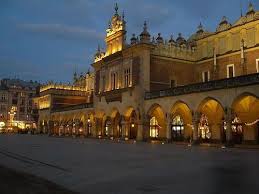
Krakow: as lively as it’s attractive. And it’s both
You can’t possibly build a serious view of a country from 48 hours spent in one of its cities. But, hey, politicians make ridiculously sweeping generalisations in that way, so why shouldn’t I? After all, out of 330 mass killings in the US last year, one was committed by a pair of lunatics claiming allegiance to ISIS, but that was more than enough for Donald Trump to call for the exclusion of all Muslims from the US, and be applauded for it.

So based on the experience of an entire weekend, I’m happy to proclaim that Poland is young, dynamic, thrusting and going places. Interestingly, 100% of our sample (an old friend – old in terms of time since we first met her, not actually old, I hasten to add – talking to my wfie but, hey, that’s a sample, isn’t it?) pointed to a feeling among Poles that the country is doing remarkably well, and this is due above all to membership of the European Union.

It’s well known, on the other hand, that others have gone off the European project. They resent the loss of national independence it implies, and don’t realise that this is the price they pay for the prosperity. Nothing new there, though. People quickly forget a benefit they’ve already secured, and focus only on what they gave up for it. In Britain we’re seeing the same phenomenon. The Guardian today, for instance, reports on an analysis produced by one Michael Burrage for the British anti-EU campaign. He reckons the country grew much more quickly from trade with the old Common Market than it has from trade with the single market that replaced it.

But isn’t that the way of things? The quickest benefits come in the early days. And the wealth that came from that initial growth has never been lost. We gain less now, but we’re still gaining. As Britain Stronger in Europe replied, for the other side of the debate, membership of the EU was worth about £133bn in 2014, which is no trivial sum. But easy to forget if you only focus on what the country has had to give up to obtain it.

It was fun being Krakow. It was encouraging to see what a lot of good EU membership can do. And that sent me home more than ever determined to resist the trend to take Britain out.