Tuesday, 9 December 2014

Torture: a good case for just saying "no"

When measures to defend a society undermine its fundamental values, just what are they defending?

The revelations by a US Senate committee of the extent of torture carried out by the CIA in the so-called “war against terror” is shocking, but hardly surprising. Anyone who believed that the CIA had been engaging only in “vigorous interrogation” – presumably intense questioning with the occasional resort to limited physical violence – was living in a dream world. It was obvious that the CIA, and no doubt MI6 and the security services of other US client states, were engaging in the most serious forms of torture they felt they could get away with.

It now turns out that these included not merely waterboarding, but “rectal rehydration” and even “rectal feeding” by the CIA itself.

It’s hard to see how any society that adopts these methods can claim to be civilised. If we are behave with the same brutality as the very enemies we denounce, how can we claim to be preferable to them? Are we not just two ugly bruisers slogging it out to decide who will dominate the other? Where does that leave our claim to moral or political superiority?

Upholding democratic values. Or undermining them?
The Senate report doesn’t even find the methods justified by the results. According to the Guardian:

After examining 20 case studies, the investigators found that torture “regularly resulted in fabricated information”, said committee chairwoman Dianne Feinstein, in a statement summarising the findings. She called the torture program “a stain on our values and on our history”.

“During the brutal interrogations the CIA was often unaware the information was fabricated.” She told the Senate the torture program was “morally, legally and administratively misguided” and “far more brutal than people were led to believe”.


The ineffectiveness of the torture may seem to make it even less defensible. But that would be a wrong direction for the argument to take. Three years ago, I felt obliged to admit my admiration for one of Britain’s leading spooks, Eliza Manningham Buller who had recently stepped down from the top post in the British MI5 security service. Here’s what I said about her then:

On the use of waterboarding by the United States, she said ‘torture is illegal in our national law and in international law. It is wrong and never justified.’

Like quite a few opponents of the use of torture, I’ve tended to argue that it doesn’t generate good intelligence. She on the other hand believes that it sometimes does, but points out that the argument that lifesaving intelligence was sometime obtained by it, “and I accept it was, still does not justify it. Torture should be utterly rejected even when it may offer the prospect of saving lives. I am proud my Service refused to turn to the torture of high-level German prisoners in the Second World War, when, in the early years, we stood alone and there was a high risk of our being invaded and becoming a Nazi province. So if not then, why should it be justified now?”


That’s the only wholly moral position to take. There are certain things that we decide, as societies based on rights and laws, never to do. We should never target civilians in war, even if we believe it might be effective, and the carpet bombing of German cities or the use of nuclear weapons against Japan simply cannot be justified. We should never target children and the relatives of enemy combatants, and the British use of concentration camps in the Boer War was indefensible. And we should never torture.

It’s that simple. We want to be better than our enemies. We should never stoop to using their weapons.

Whether or not they might advance our cause.

Monday, 8 December 2014

We don't have to let the elite roll back our achievements, but if we don't stop them, they will

“Very well, alone!” exclaims the lone Tommy, standing on a rock amid raging seas and shaking his fist at a stormy sky with warplanes heading towards him. David Low’s cartoon of June 1940 captures the spirit of dogged defiance in Britain at that time, when France had surrendered to Nazi Germany, the Soviet Union was allied to the aggressor, and the United States, while well-inclined towards Britain, was firmly attached to its neutrality.

Britain wasn’t really alone. It had what was then still the Empire behind it, with its vast resources of wealth and manpower. Indeed, even Low himself was a New Zealander. But Britain was alone in resisting Germany in Europe.

Curiously, Britain defying Germany mirrored what had happened in Germany itself 134 years earlier. Then the aggressively expansionist power had been France, under its Emperor Napoleon. A series of devastating victories had crushed all German resistance, ended the Holy Roman Empire and left only one power, Prussia, still standing out despite – or in part because of – having lost a large proportion of its territory and population to the invader.

Rather like Britain in 1940, Prussia wasn’t strictly alone. Britain continued to be a thorn in Napoleon’s side, maintaining dominance at sea and using it to blockade the Continent of Europe (no wonder, with such a tradition, that Britain is a truculent member of the EU today). But Prussia was alone on the Continent to refuse to bow down at last to Napoleon.

It’s been fascinating to listen to Neil MacGregor of the British Museum discussing how Prussia reacted. It did away with ostentation and luxury in dress. Ladies were urged to hand over their gold, and receive in return – iron jewellery, worn with pride as a sign of patriotic spirit.

Iron is a common metal, used in industry and labour generally. It isn’t noble.

The Prussian King also decided to do away with all military decorations, and replace them with the single Iron Cross. As well as being likewise made of that common metal, it had another vital and new characteristic: unlike previous decorations, it wasn’t limited to officers, but could be won by any soldier, irrespective of rank.

The old, egalitarian Iron Cross
Before the Nazis got hold of it
So the response to invasion and defeat was retrenchment, economy and egalitarianism.

That spirit saw Prussia through to a complete turnaround in its fortunes, defeating France with support from Russia, which as in 1941 switched sides after its ostensible ally attacked it, and then from other Germans that came rallying to the Prussian cause. Prussia led the successful campaigns on the Continent, with Britain, winning victories in the Iberian Peninsula, little more than the hero of a sideshow.

Even during the final struggle, after Napoleon escaped from his first exile to return and terrorise Europe again, it was Germans, the bulk of them Prussians, that secured his final defeat: Prussian troops came to the rescue of Wellington who was battling it out with the French army, at the head of a British, Dutch and German force, at Waterloo.

And then? Once the war was over, all the egalitarianism went right out of the window. Why, even the Iron Cross was discontinued, not to be re-introduced until the 1870s. The old reactionary crowned heads of Europe took up their previous positions and began to rule in the traditional way, crushing all liberal, democratic opposition.

Sad, isn’t it? The egalitarian spirit was great when the country needed everyone to join in and kick out the French. But once the job was done, it was dropped, and back went the masses to their old subordination by the self-proclaimed elite.

Fortunately, that didn’t happen to Britain after it stood alone against the Nazis. In 1945, it elected a great reforming Labour government which ensured there were profound changes in the structure of society to protect those most in need of it.

No, in Britain we did things differently. It took 65 years before we found ourselves ruled by people who want to undo all the measures that had been taken in favour of those who made the victory possible. That’s happening now, with a vengeance. And in the wings is another party, UKIP, as intent as the Tories on taking us back to the 1930s, and which is in any case the natural heir of the British Union of Fascists which made so much noise in the country at that time.

I suppose it’s progress of a kind. Reaction that reversed social advances in a few years in Germany took as long in Britain as it takes a newborn to reach pension age.

There’s one other big difference. We elected the government that’s doing the damage to us. And we can still, if we choose, make sure that it can’t finish its job.

That the Prussian people couldn’t do, back in 1815. But we can. In elections in 2015.

Sunday, 7 December 2014

The emancipating effect of confronting the undecidable

Pretty well everyone knows of some of the great breakthroughs that occurred in the twentieth century. We’re all aware, even if we don’t understand, the work of Albert Einstein, Erwin Schrödinger, Sigmund Freud, James Watson (or should that be Rosalind Franklin?)

Curiously, though, hardly anyone seems to have heard of the work of Kurt Gödel, and yet he made a discovery that seems to me even more disturbing and transformational than those others.

Kurt Gödel
A devastating but liberating truth
Gödel established that there are certain so-called “undecidable” questions in mathematics. Such questions are unanswerable, by which I don’t mean unanswered: it’s not a matter of a lack of knowledge – we don’t know the answer – but a matter of full, exhaustive knowledge – we know they can’t be answered. Indeed, if we’re good at enough at maths, we can prove they can’t be answered.

These are often simple questions, which is not to say their subject matter is simple: the only one I know about concerns transcendental mathematics, and the word “transcendental” is a bit of a give-away, isn’t it? Something transcendental isn’t likely to be easy. The particular question I’m thinking of concerns the relative size of different infinities, and I imagine that you would agree with me in thinking that the idea that two things can be infinite but one is bigger than the other, is pretty mind-blowing in itself.

The question is simple only in the sense that the answer is yes or no. Which is where Gödel comes in. Because there’s no third answer, and he showed that both answers are wrong. Rigorously proved it: answer “yes” and you get to a logical contradiction, answer “no” and you get to another logical contradiction. So the question is simply unanswerable or, to use the preferred term, undecidable.

Think about that for a moment. There is no other field which, like mathematics, always has a right of a wrong answer. And yet even in mathematics, there are areas where there is neither right nor wrong.

These days we’re frequently told that our societies are paralysed by a terrible moral relativism. People beat pulpits, metaphorical or real, and bewail the passing of absolute truths. They hanker for the days when we knew, always and undeniably, right from wrong and could teach it to our children.

And Gödel showed that the quest isn’t just unachievable, it’s meaningless. In even the most abstract of all fields, mathematics, there is ultimately no absolute truth. If that’s true of mathematics, how much more so must it be the case for the messier disciplines in which all the uncertainties of reality cloud the picture further.

So that means we’re forced back onto our own resources. There is no simple guide that can tell us what’s right, at all times, under all conditions. Which is what those of us who rather suspected that relativism made more sense had always suspected. In the end, you have to go with what works, in any particular set of circumstances.

“Thous shalt not kill”? Well, as a general rule, thou shouldn’t indeed. But maybe in certain circumstances euthanasia, or abortion, or military action, or even execution can be justified – may, indeed, be the only option.

Which means that instead of a helpful if inflexible, general if monolithic guide to behaviour, we’re forced back on to the need to exercise judgement in the light of real circumstances. Forced to take our own decisions. Then live by the consequences.

That this may be not so much a choice as essential to the very nature of our lives is the breakthrough Gödel made. It seems to me more people should know about it.

Because I, at least, I find the notion liberating.

Saturday, 6 December 2014

Joyless Jews, a victim and his torturer, breaking codes

The Israelis are extraordinarily good at making films that shine a flashlight into the corners of their existence. Prisoners of War (Hatufim) is several leagues better than the rather pedestrian Homeland that was based on it (the latter only relieved by Claire Danes’ performance as a CIA agent with mental health problems – but doesn’t even that begin to wear thin after the novelty’s gone?). 

As for Waltz with Bashir, it’s hard to imagine an enemy of Israel making such a searing indictment of the horror and shame of the 1982 invasion of Lebanon – and it also shows just how good animation can be if one only allows it to take on a profound and adult subject.

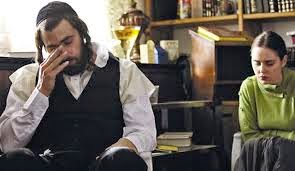
Now a film by an Israeli director, Rama Burshstein, has opened my eyes again, with Fill the Void. Burshstein is the first Orthodox Jew to have made a film for general distribution, and she’s merciless in the way she probes the life of an Orthodox (Haredi) community in Tel Aviv. What emerges is a harrowing picture, at least to the eyes of this Western outsider, of claustrophobia and denial of anything remotely resembling freedom of choice, above all to women. The community should naturally have the right to live its life as it wishes, but this sensitive film left me feeling “sooner you than me.”


Fill the void: powerfully grim and claustrophobic
Talking about merciless, the Railway Man, directed by Jonathan Teplitzky, seems at first to be just another study of the pitiless treatment of prisoners of war by their Japanese captors, on the Burma railway in the Second World War (you’ll remember, The Bridge of the River Kwai, and if you don’t, make a point of watching it, or watching it again, soon. It’s a classic.) It works on two time planes: the adult Eric Lomax, the Railway Man of the title, back in his native Scotland and obsessively interested in railways still, partly as a means of dealing with the effects of his wartime sufferings, and his younger incarnation, taken prisoner in Singapore and then brutalised by his captors. 

It’s no spoiler to tell you he survived: the film starts with his post-war existence.

Colin Firth as the Railway Man, appropriately in a train
The scenes of his later life are in many ways more interesting than those from Burma, since they give an insight into the effects of post traumatic stress, not just on him, but on his fellow survivors. The film is based on the real-life Lomax’s autobiography, and it isn’t strong on self-criticism, which makes the material on his courage under torture slightly less easy to take at face value. Nonetheless, the film takes a fascinating turn from the point that Lomax discovers that one of his tormentors is alive and atoning for his sins by acting as a tour guide back at the camp where torture had occurred, making the last part of the film more than good enough to justify sitting through the POW scenes that lead up to it.

And then there’s Morten Tyldum’s The Imitation Game.

Not enough has yet been said about Alan Turing. We tend to talk most about the work he did breaking the German Enigma code during World War Two. What we perhaps don’t appreciate enough is that the principles on which he based the machines which he built to crack the cypher formed the basis of computing as we now know it. As well as contributing to saving the world from potential Nazi domination, he therefore prepared it for the culture we now enjoy. And before you say “well, there’s not much to be thankful there then,” just remember that an awful lot of computing is highly beneficial, and the fact that the Tea Party or, indeed, the US Republicans generally, can make use of the internet for their own nefarious ends, is just the price we pay for a great enhancement to our lives generally.

Benedict Cumberbatch as Alan Turing
with one of the machines that broke Enigma and launched modern computing
The other code that Turing broke was societys rejection of homosexuality that had, in his time, barely begun to recede. It wasn’t until a great reforming Labour government came to power in Britain in the 1960s, that the law against homosexuality was repealed. Too late for Turing, who fell foul of that law viciously applied by men who couldn’t begin to appreciate the quality of his genius. The experience destroyed him.

Not the least quality of the film is its portrayal of one of the policemen and his gradually awakening horror at what he has, for initially completely different motives, found himself dragged into forwarding.

Good films, all three. Perhaps not out-and-out classics, but well worth a couple of hours or so. And, if you have a couple of hours to watch any of them, you’d be unlikely to find you’ve wasted your time.

Friday, 5 December 2014

Holiday destination, Walhalla

Mad King Ludwig of Bavaria, I’m told by my brother who tends to know about these things, was perhaps not really as mad as his reputation suggests.

Ludwig II of Bavaria
Not mad I'm assured. Despite the eyes
This is good news, if only because one feels such a man deserves to be more kindly remembered. Without him, millions of children, and one key man, Walt Disney, would have been deprived of a most enchanting dream. It was Ludwig who built Neuschwanstein, beating Disney to the idea of the perfect fairytale castle, by well over a century.

Neuschwanstein. Looking particularly magical
But I’ve decided where I’m going if I ever I return to Bavaria. 

I’m going to Walhalla. Not the fabled banqueting hall of the Gods and dead heroes of Norse myth. To be frank, I have over the years developed a certain cynicism concerning the existence of mythical places, and growing suspicions that I might in any case not be regarded as entirely fitting the hero mould (I don’t have long blonde whiskers, and I can’t find a horned helmet that goes with my complexion).

No, this is the really existing building called after the Norse original, built by King Ludwig, to honour the most outstanding figures of Germany. I’d never heard of it until I listened to a podcast in the Germany: memories of a nation series made for the BBC by Neil McGregor, curator of the British museum. Now I want to see it.

It seems Ludwig made his wishes entirely clear:

“No condition, not even the female sex, is excluded. Equality exists in Walhalla. There are the busts only of illustrious Germans, executed by German artists or, if there are no contemporary likenesses, their names in bronze on plaques.”

Inside the real Walhalla.
Less carousing than in the mythical one
Ludwig applied a definition of “German” that can only be regarded as generous. As well as quite a few Dutch and Swiss figures, we have the Russian Tsarina Catherine, the English King Egbert of Wessex and even Charlemagne, which must be a delight to French visitors. Still, I suppose it’s enough to extend the definition of “German” a bit, to make it non-exclusive of people who have a link to the German world even if it’s a bit tenuous (Charlemagne, by the way, probably isn’t one of them: it’s likely that he spoke a Germanic language).

In any case, if not even being a member of the female persuasion is enough to bar one, this must be a pretty remarkable place. However, there aren’t many women among those honoured. And there are other gaps.

Not even Luther got in at the start: the super-Catholic Bavarians didn’t want to honour the founding figure of the Reformation. Even if he more or less created the German language single-handed. Eventually, they added him in 1848, just six years after the place opened, and right next to Goethe, so they made amends.

There’s still no one with a Turkish name. And I doubt very much that if we had photographs alongside the busts, we’d see many dark complexions. Ah well, you have to be dead twenty years before you can get in, so maybe in a while the inhabitants will start to be a little more ethnically diverse.

The process may already be under way. One rather important community in German history was excluded from Walhalla for nearly 150 years. The first Jew, Einstein, only appeared among its residents in 1990. Even more amazing is that there was controversy over the inclusion of the next Jew. Most Germans can quote the first few lines of what has practically the status of a folk poem, the Lorelei. Its author, Heinrich Heine even converted to Christianity but, even so, getting him into Walhalla was a matter of anguished debate.

There’s one Jewish woman, Edith Stein, though she’s there as a Catholic martyr and Saint: she was another convert, but that didn’t stop the Nazis killing her. A German Jewish woman who had rather more impact on the world, Hannah Arendt, isn’t there. Nor are quite few Jewish men we might consider reasonably significant, such as Kafka or Freud.

So it must be a curious place. I can’t wait to get there. That old Ludwig: he’s certainly left us a lot to wonder at.

Mad or not.

Wednesday, 3 December 2014

A dire anniversary, which calls for action

Thirty years ago today, on 3 December 1984, the people of Bhopal in Central India woke up to the realisation that their city had been the victim of perhaps the worst industrial accident the world has seen.

Overnight, the toxic gas Methyl Isocyanate leaked from the local fertiliser plant run by Union Carbide. Estimates of deaths vary, though it seems likely that 8000 died within a fortnight and 8000 later on as a result of the poisoning. The Indian government counted nearly 600,000 injuries, some 42,000 of them serious including nearly 4000 permanently disabling.


Bhopal victims lie where they fell, on 3 December 1984
To this day, there are children in Bhopal struggling with serious disability that most experts attribute to the accident, though the allegations is impossible to prove.

Eventually, Union Carbide paid $470 million in compensation, which works out at around $900 million in today’s terms. Taking only the deaths into account, that works out at about $56,000 per life, about $3000 more than US median salary currently. It seems that the worth of an Indian life takes a relatively low-paid US worker just over a year to earn, and that’s if we think the injuries to survivors count for nothing.

Union Carbide now belongs to Dow Chemical. For the year up to the third quarter of 2014 its earnings (profit) were about $2.3 billion, approximately twice the compensation paid for Bhopal. It paid its Chief Executive, Andrew N. Liveris, a little over $20 million last year, or a tad under the equivalent of 360 Bhopal lives.

In 2013, Dow Chemical paid over a million dollars in political contributions, getting on for 20 Bhopal lives’ worth. They contributed to both main parties in the US though, if we exclude the sums going to ostensibly non-party Political Action Committees and the like, Republicans received nearly four times as much as Democrats.

Like most large corporations, Dow is buying itself politicians, and is principally favouring its natural allies in the Republican Party.

By coincidence, today, as well as being the anniversary of the Bhopal disaster, also saw newspaper stories about the physicist Stephen Hawking. He was diagnosed with Motor Neurone Disease at 21 and given two years to live; this year, he celebrated his 72nd birthday.

He owes his survival to his doctors. But he owes his ability to communicate, given that he now can only do so through moving a cheek muscle, to Intel with whom he has collaborated for many years. The work the company has done with him will benefit many highly disabled people.

Comparing the Intel and Dow stories teaches a key lesson: corporations are neither good nor bad, any more than guns are. What matters, in both areas, is what use we make of them. Helping Steven Hawking and others afflicted by a terrible debilitating disease? Good. Poisoning Bhopal? Bad.

It’s the same with guns. Sometimes we just have to use them, whether it’s to defeat the Nazis or ISIS. At other times, we’d like them securely locked away somewhere. Over here in Europe, we have taken strict steps to make sure they are, steps the US would do well to imitate.

Sadly, however, though we haven’t allowed the US to influence us out of gun regulation – we have, you might say, stuck to our guns – we seem to be having trouble breaking with US thinking on regulating our corporations.

Putting that right, so that we move towards a society in which a bunch of reckless bankers can’t put our entire finance system at risk, or a bunch of inept managers poison an entire city in India, feels to me to be as urgent for the world as gun control is in the US. And a lot more important than cutting immigration.

Besides, what better tribute could there be to the suffering citizens of Bhopal?

Monday, 1 December 2014

Immigration: aiming at the wrong target

We never seem to stop talking about immigration these days. And yet the real problem we face isn’t immigration – it’s precisely all that talk about it. Or more generally, the someone-else-to-blame mentality that lies behind all the hot air and bad temper.


Anti-Immigration: it's all the rage
Even among people descended from immigrants
One of the more remarkable women I know of was Emilie du Châtelet. She became a champion, in the eighteenth century, of what the best recent student of her life, calls “feminine ambition”: she forced the scientific world to take her seriously, publishing extensively on physics, including a translation of Newton’s Principia which she raced to complete before her premonition of death was verified.

She had a servant called Sébastien Longchamp, who would ultimately be dismissed from the household she shared at the time with Voltaire. Decades later, after his own death and even that of the man who published them, Longchamp’s Memoirs of his time with the illustrious couple appeared. One has to question the reliability of such a source; even so, there are some stories he tells in his ‘what the Bulter saw’ document, that ring true.

He tells, for example, of a summons to her bathroom, to fetch more hot water from the fireplace and pour it into the bath. As he came to edge, he realised that she was entirely naked, and the water completely transparent. To avoid being scalded, she parted her legs so that he could pour the water safely away from them. When he tried to do so with his eyes averted, she admonished him for getting the hot water too close to her body, so he was obliged to watch what he was doing and therefore view her naked.

Mme du Châtelet was by no means promiscuous. She would certainly not have appeared naked before a man. But that precisely is the point: Longchamp was not a man. He was a servant, and to a noble such as Emilie, that is less than a man. There was no need for modesty before him.

An outspoken champion of rights – hers at least – against the stubborn conservatism of her time could harbour such views. That may make it less surprising that men who took their commitment to freedom and equality so far as to engage in armed rebellion against British rule in North America, could nonetheless condone slavery. There’s no doubt that men like Thomas Jefferson were made uneasy about keeping slaves, but not enough to free them, at least in their own lifetimes.

Surely the answer is that they didn’t see their slaves as truly men or women (they certainly saw them as women in some measure: Jefferson fathered several children on one). Like Longchamp, the slaves were lesser humans, different enough from the masters to warrant denying them their liberty.

Now fast forward two and a half centuries.

We live in a world that is more unequal than at any time since the end of the Second World War. In England, 1.4 million people have an annual income of under £6000 a year; 6000 have an income over £1 million. On their own, the income of each of those super-rich is worth over 150 times that of the people at the bottom. And there many hundreds of people who take many more times still that lowest level.

With that excess money, they can fund politicians and buy them. They can threaten to move their wealth elsewhere to get their way. They have in particular bought the British Tory Party, and are now buying UKIP; it is no accident that while their earnings have grown over the last four years, those of the poorest have fallen still further.

The people who take that money and exercise that power know they deserve it. They know they are exceptional. They excel those who have, and receive, less. In other words they know themselves to be superior. The rest of us may be human, but we are a lesser kind of human. 

 There are 6000 of them which, funnily enough, was the size of the French aristocracy in the eighteenth century too. Like them, their position is based entirely on wealth. It’s no surprise that they preserve and maintain the same attitudes.

There are so many more of us. And we have votes. Why don’t we put an end to their domination?

Because instead of opposing them, we aspire to be like them. We protect the rights of the wealthy in the hope that some day we’ll join their ranks, and enjoy that protection.

However, since we certainly don’t want to blame ourselves for our troubles, we have to find someone else to blame. How about immigrants? There are relatively small numbers, they’re relatively easy to spot, and it’s easy to come up with some kind of justification based on our being the true possessors of this land while they are interlopers in it. Though the English took the country from the Celts, as did the French, and the Americans took it from the Natives who were there before them.

That’s the trap that UKIP or the Tea Party or the Front National in France lure us into. Blame the other, the foreigner, the alien. The lesser human.

The death of Michael Brown in Ferguson, and above all the fact that his killer has avoided any kind of justice, shows how those ideas are as strong today as they ever were. American Blacks may not be slaves, but who can say that Whites regard their lives as equally valuable?

Here one in six of our voters rally to the xenophobes of UKIP, and a higher still proportion of French voters flock to the Islamophobic Marine Le Pen. So we talk endlessly about the perils of immigration and do nothing about those who steal the bread from our mouths.

What of those people, the ones who really run the show and cause our problems? 

They’re laughing at the lot of us. All the way to the bank.