Showing posts with label Torture. Show all posts

Monday, 25 November 2019

The Torture Chamber that wasn't

What was that strange place, we wondered, each time we passed it in our walks through the local woods?
One of the gates. With a Levantina car parked inside it
A high wall surrounded the whole plot of land. It was pierced in two places by tall wrought-iron gates, decorated with representations of fruit or leaves, and in one case, topped by an impressive coat of arms. The iron was rusty, though, and the grounds were overgrown. There was just one building inside and, despite its fearsome defences, with close-mesh bars at all the windows, and the high mast of aerials and satellite dishes at the top, it looked distinctly uninhabited.

Inside one of the gates, adorned with a sign proclaiming that the place was protected by Levantina security company, stood several cars from that company.

My first thought was that it was the estate of some minor noble of earlier times, now abandoned and left to go to rack and ruin.

“Old nobility?” scoffed Danielle. “The gates are set in simple cement-block gateposts. Whoever spent a fortune on the gates spent nothing on the frame he mounted them in. And it certainly isn’t old.”
Danielle inspecting the estate through the main gate
Note the heraldic decorations. And the concrete gateposts
You can just see Toffee on her back legs, also looking inside
Meanwhile Luci’s wondering why they’re bothering
I had to admit she was right. There was nothing ancient, venerable or even aristocratic in the plain concrete pillars on either side of the gate. How could I have been so naïve? After all, even the one building we could see was just a concrete blockhouse. Too big to be a gatehouse, and not close to a gate anyway, it was far too small and unsightly to be some kind of baronial hall.
The blockhouse. Note the aerial and satellite dishes
And the wire
The most striking feature of the place was its security. The wall came with an iron-bar fence, and further in, there was the line of barbed wire. I’ve already said that the building looked like a blockhouse, dour, featureless, undecorated.

But there were no watch towers, no guards, no manicured parade ground. So not a prison camp or anything like that. Going past with a group of friends, we debated other possibilities.

Could it be a drug lord’s highly secure location for storing his product? It’s true that it looks too much the part, but might that not be brilliantly devious double-camouflage? Make it look too much like a drug lord’s hideaway, and no policeman would ever suspect that it could be one.

“Too obvious,” they’d all say, and go and look somewhere else.

That didn’t feel too plausible. I preferred the theory that it was a top-secret site operated by the Spanish intelligence service. Underneath that apparently uninhabited blockhouse, there were deep basements equipped with sophisticated torture devices where, even as we spoke, orange-suited prisoners suspected of criminal subversion were screaming out their confessions to crimes of which they were entirely innocent.

That seemed possible until we considered that any self-respecting Spanish spook would want to be based in Madrid. The woods of La Vallesa somewhere outside Valencia? Much too far from the metropolitan delights that make life bearable to the senior servants of the Spanish state.

The mystery all ended the day we turned up and found a Levantina car outside the gates, with its driver at the wheel. He was pleasant, polite and friendly.

“The place belonged to some guy who was crazy about security,” he explained, “and his son, who inherited it, can’t sell it. It suits us, though, as a place to keep our cars. So we rent it as a car park.”
A Levantina Seguridad car
A security guards’ car park? What a let-down.

No minor noble entertaining his superiors to lavish dinners in the hope of an appointment further up the aristocratic ladder.

No drug lord bawling out an indolent underling who has yet again failed to liquidate an upstart competitor on a Valencia street corner.

No sadistic inquisitor pointing out that the electric dial setting has to be kept below five if his powerless victim’s survival is to be guaranteed, and then cackling insanely as he turns it up to six.

Just a car park.

“The mystery’s gone,” Danielle pointed out to me as we walked past recently. She was right. It had. Fortunately, the beauty of the woods around are more than enough to compensate.

Otherwise, how would I cope with the loss of my fantasies?

Thursday, 11 December 2014

Cheney, the torture report – one of them is full of it

“The report's full of crap. Excuse me. I said ‘hooey’ yesterday. Let me use the real word.”

That’s how the man who was Dubya’s Vice President, Dick Cheney, dismissed the US Senate’s report on torture by the CIA, in the measured terms to which he owes his reputation for eloquence and moderation.

Dick Cheney: Aaron Sorkin's Colon Jessup
with the charm surgically excised
He reminds me of no one so much as Colonel Nathan Jessup, from A few good men who, at the end of the film, explains behaviour which – and I’ll pick my words more carefully than Cheney – was reprehensible if not criminal. The end, he suggests, “absolutely” justifies the means. “I’d do it again in a minute.”

No, no. Sorry. That wasn’t Jessup. That was Cheney. Jessup said “I did my job. I'd do it again.”

Jessup explained “I have neither the time nor the inclination to explain myself to a man who rises and sleeps under the blanket of the very freedom I provide, then questions the manner in which I provide it.”

According to Cheney, “what happened here was that we asked the agency to go take steps and put in place programs that were designed to catch the bastards who killed 3,000 of us on 9/11 and make sure it never happened again, and that's exactly what they did.”

Jessup also made clear the rationale behind a strict chain of command: “We follow orders, son. We follow orders or people die. It's that simple. Are we clear?”

Jack Nicholson as Colonel Nathan
the marginally more appealing version of Dick Cheney
Cheney made it clear that the same approach operated in his boss’s administration. To the suggestion that the CIA were out of control and didn’t keep the President informed, he replied “He was in fact an integral part of the program. He had to approve it before we moved forward with it.”

With wisdom as clear-sighted as we all associate with the august figure of Dubya, who can doubt that the torture service was being directed with a sure hand and enlightened judgement? And if Dubya was napping or on holiday, there was always his friend Dick to make sure that guidance was maintained.

“You have the luxury of not knowing what I know: that Santiago's death, while tragic, probably saved lives,” Jessup declares, talking of the victim of the crime central to the film, Willy Santiago, “and my existence, while grotesque and incomprehensible to you, saves lives.”

Talking of the arrest of Khalid Sheikh Mohammed, who is believed to have been behind the 9/11 attack, Cheney asked, “what are we supposed to do, kiss him on both cheeks and say, ‘Please, please tell us what you know?’ Of course not. We did exactly what needed to be done.” And it does need to be done, because otherwise people die: “what are you prepared to do to get the truth against future attacks against the United States?”

Fortunately, this kind of tale often has a happy ending. What a way to dismiss a vicious bully with no respect for the rule of law than to tell him “you're under arrest you sonofabitch.”

Sadly, though, such a happy ending tends to be limited to the world of fiction. Jessup is the target of the words, not Cheney.

But we can always dream….

Tuesday, 9 December 2014

Torture: a good case for just saying "no"

When measures to defend a society undermine its fundamental values, just what are they defending?

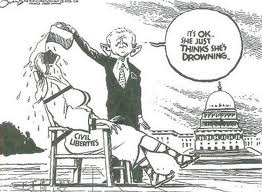
The revelations by a US Senate committee of the extent of torture carried out by the CIA in the so-called “war against terror” is shocking, but hardly surprising. Anyone who believed that the CIA had been engaging only in “vigorous interrogation” – presumably intense questioning with the occasional resort to limited physical violence – was living in a dream world. It was obvious that the CIA, and no doubt MI6 and the security services of other US client states, were engaging in the most serious forms of torture they felt they could get away with.

It now turns out that these included not merely waterboarding, but “rectal rehydration” and even “rectal feeding” by the CIA itself.

It’s hard to see how any society that adopts these methods can claim to be civilised. If we are behave with the same brutality as the very enemies we denounce, how can we claim to be preferable to them? Are we not just two ugly bruisers slogging it out to decide who will dominate the other? Where does that leave our claim to moral or political superiority?

Upholding democratic values. Or undermining them?
The Senate report doesn’t even find the methods justified by the results. According to the Guardian:

After examining 20 case studies, the investigators found that torture “regularly resulted in fabricated information”, said committee chairwoman Dianne Feinstein, in a statement summarising the findings. She called the torture program “a stain on our values and on our history”.

“During the brutal interrogations the CIA was often unaware the information was fabricated.” She told the Senate the torture program was “morally, legally and administratively misguided” and “far more brutal than people were led to believe”.


The ineffectiveness of the torture may seem to make it even less defensible. But that would be a wrong direction for the argument to take. Three years ago, I felt obliged to admit my admiration for one of Britain’s leading spooks, Eliza Manningham Buller who had recently stepped down from the top post in the British MI5 security service. Here’s what I said about her then:

On the use of waterboarding by the United States, she said ‘torture is illegal in our national law and in international law. It is wrong and never justified.’

Like quite a few opponents of the use of torture, I’ve tended to argue that it doesn’t generate good intelligence. She on the other hand believes that it sometimes does, but points out that the argument that lifesaving intelligence was sometime obtained by it, “and I accept it was, still does not justify it. Torture should be utterly rejected even when it may offer the prospect of saving lives. I am proud my Service refused to turn to the torture of high-level German prisoners in the Second World War, when, in the early years, we stood alone and there was a high risk of our being invaded and becoming a Nazi province. So if not then, why should it be justified now?”


That’s the only wholly moral position to take. There are certain things that we decide, as societies based on rights and laws, never to do. We should never target civilians in war, even if we believe it might be effective, and the carpet bombing of German cities or the use of nuclear weapons against Japan simply cannot be justified. We should never target children and the relatives of enemy combatants, and the British use of concentration camps in the Boer War was indefensible. And we should never torture.

It’s that simple. We want to be better than our enemies. We should never stoop to using their weapons.

Whether or not they might advance our cause.

Friday, 22 June 2012

Liam Holden: slow steps towards civilisation

My father was anything but a radical lefty. In his life, most of which was spent away from Britain, he took part in only one election, in 1945, when he voted for the Conservatives or more precisely, for Winston Churchill.

Nevertheless, he held views that most conservatives would have found unorthodox. In particular, he loathed the death penalty. I think he was as moved as anyone by arguments against the cold-blooded taking of life, or against the facile equation between two lives embodied in the principle that someone who kills another deserves to die himself. But the argument that clinched it for him was judicial fallibility.

‘Death is the only sentence you can do nothing to correct,’ he would say. ‘Get it wrong and you can’t undo it.’

We can debate all the other arguments but that one does indeed seem unanswerable. Since you can never even begin to make amends to a dead man, then quite apart from any moral consideration, the only judicial system that can use the death penalty must be one that guarantees never to make an error.

So it was fascinating to read about the case of Liam Holden in the Guardian. He was the last man condemned to hang in the United Kingdom, for the terrorist murder of a soldier in the troubles in Northern Ireland. Back in 1973 his sentence was commuted, so instead he served eighteen years in gaol. Now his conviction has been overturned. Those years can never be given back to him, but at least he’s alive. As his lawyer puts it, the family are grateful ‘that they are dealing with a quashed conviction and not a posthumous pardon.’

My father would have been pleased about that, but he might also have had a comment to make about the grounds for the successful appeal.

Soon after the Second World War, having been recently demobbed, he worked with the British occupation administration in Germany. At dinner one evening with compatriots who were complaining about Nazi atrocities, my father mildly pointed out that the British too had not been above ‘taking a pair of scissors’ to captives who were suspected of having useful information they were refusing to divulge.

Soon after that unfortunate comment, he found himself being energetically thrown, fully clothed, into the hotel swimming pool. His dinner companions’ had just underlined the inanity of the statement that the truth never hurts. Only the truth has the capacity to hurt.

Liam Holden’s conviction was overturned because, among other things, he was held and interrogated illegally by the British Army in Northern Ireland. In particular, he was subjected to what we now call ‘waterboarding’. As the Guardian points out, Holden ‘loathes the term waterboarding.’ In his view, ‘It wasn't waterboarding. It was torture.’

Curious way to fight for freedom

In the West, we like to present ourselves as the moral superiors of those, in particular Moslem fundamentalists, whom we fight in places like Iraq or Afghanistan. It’s interesting to find that our habitual use of torture gores back a long way. We might do well to learn a little humility.


Doing away with torture and the death penalty would be the kind of advances my father would probably have classified, using one of his favourite terms, as ‘civilised values’.

Nearly 30 years after his death, it’s good to see civilisation taking another small step towards adopting some of them.