Thursday, 1 November 2018

How the hard left embraces the right

The trouble with the hard left is that it has no anchor.

The hard left, including the group that currently controls the British Labour Party, is the ideological wing of the left. So where others are more pragmatic and look to evidence to guide their thought, the hard left is driven principally by its beliefs. It has faith in the leader, for instance, or faith in its purity of principle.

The trouble with faith is that it depends on nothing but one’s own thinking. Change your mind, which is pretty easy, and your political stance changes with it. This can lead to some serious dysfunctions.

The most painful currently is the British hard left’s stance on Brexit. This is apparently ambivalent. The reality, which the leadership will not admit, is that they back Brexit. Recently, interviewed by Robert Peston of the ITV channel, Chuka Umunna from the right of the Labour Party referred to ‘whether Brexit actually happens.’ John McDonnell, Shadow Chancellor of the Exchequer and a leading figure of the hard left, replied ‘It will’.
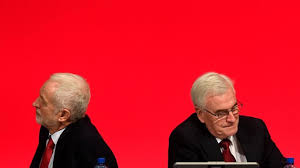
John McDonnell (right) with his pal and ally Jeremy Corbyn
That ‘will’ may not be the expression of a wish, but it certainly does not show any kind of attachment to the official Labour position of backing the EU, which is supported by some 80% of the membership. At one level, veiling one’s true position seems to undermine the claim of people like McDonnell, the most senior parliamentary lieutenant of Labour leader Jeremy Corbyn, to represent political integrity on the one hand and a full commitment to representing members’ views on the other.

At another level, though, it puts these people in strange company. Brexit is chiefly backed by the hard right, specifically by a xenophobic and anti-immigrant right. These are the tendencies that Labour is expected to oppose with all its strength.

Some attempt to justify this position by arguing that many Labour MPs represent constituencies which voted for Brexit. Again, this is a curious position to take by people who claim to stand for strict principle. Electoral calculation when it involves compromising a fundamental tenet of the left? Not what one would expect from self-proclaimed socialists.

That the hard left finds itself in bed with those who oppose everything it ostensibly stands for should, one might imagine, cause it to question itself. But it doesn’t. Because it is unanchored, it can drift anywhere, even into the arms of the xenophobes and nationalists.

Still, Brexit’s just one question. It could be a one-off.

That’s why the latest development by the same John McDonnell is so interesting.

The Conservatives, currently in government, generally try to lighten the burden of taxation on the richest and shift it to the people least able to bear it. That has been a main thrust of the latest budget proposed by the British Chancellor Philip Hammond. He has proposed income tax changes that will greatly benefit the wealthiest while delivering far less to the poorest, who desperately need it.

In other words, it’s a deeply regressive approach to taxation, making the poor pay more while the rich pay less. The Labour Party is normally committed to the opposite, a progressive policy that makes the rich pay higher taxes while lightening the load on the poor.

So it’s curious to find McDonnell declaring that Labour would not be opposing the Hammond measures.

One of the principal roles of an Opposition is to oppose. I suppose the clue is in the name. An Opposition should never back a government unless it absolutely has to, perhaps because it would endanger national security if it did not.

Certainly, the reason I’ve been given for not opposing the budget tax cuts is indefensible: the suggestion is that they provide some benefit to the poor, even though far less than to the rich, and therefore opposing them would be presented as ‘robbing me of my tax break’. This comes down to setting party policy by what the hostile press would say about it.

In other words, it’s handing control over Labour policy not to the members, not even to MPs, but to Labour’s opponents.

There’s another irony here. It is the hard left that never stops denouncing the media – the ‘mainstream media’ or ‘MSM’ – for its perverse behaviour towards Labour. So allowing what it might or might not say about a policy to determine the behaviour of its leaders in parliament defies belief. What’s more, the result is the same as over Brexit: it puts Labour in the same bed as the right.

Their intentions may be good. But we know which road is paved with good intentions. And what matters is less the road than the destination.

That’s the trouble with having no anchor in reality. That’s the hard left’s problem. But sadly, because it controls the leadership, it’s a problem for the whole of Labour.

Well. It controls the leadership for now.

Monday, 29 October 2018

A road more travelled

It wasn’t just fun to visit our friend Ana in Zagreb over the weekend. It was also highly entertaining. I particularly enjoyed learning a little of her history. And felt one bit of it at least deserved to be shared here.

Ana was born in Podbila, Herzegovina, now a constituent part of the state of Bosnia and Herzegovina. Podbila was a mountain village which had one shop, a church and a primary school.
Podbila, nestling in the mountains
‘Sometimes you’d see the men outside the grocery having a beer.’

‘Because there was no bar or café?’

‘Oh, no. There was no bar or café. Just the shop.’

Most of the men worked holdings that took the form of patches of land scattered across wide distances, sometimes as much as a kilometre apart.

In such villages, intellectual society consisted of the teacher, the doctor and the priest. But Podbila was too small even for that: the doctor was in the next town and the priest only came to hold services.

‘In a little church surrounded by a cemetery. You have the same in England. I saw one in the middle of Birmingham, right in the centre of the city. It looked very strange. We had the same, but it was in the country.’

Ana’s father Jakov was a joiner and building worker. He moved to Germany to make a better living. It was a temporary arrangement but, as Ana pointed out, most of those who went abroad stayed there. Jakov was no exception, living out his life in Frankfurt.

There came a time, however, when Jakov and Ana’s mother Mara decided that Podbila might not offer the most glittering opportunities for a truly world-class education. Which was what they wanted for their two daughters and their son. So Jakov set out to find them a new home.


Ana (left) with Mara and Jakov and her siblings
A little while before she became an eminent research scientist
Mara was clear. She wasn’t prepared to give up growing her own vegetables. She made it clear he was to look for a place in one of the villages outside Osijek, in eastern Croatia, an area known as Slavonia, which was then quite wealthy.

Jakov caught the local bus to the small town of Posusje, where the farmers of the outlying villages used to bring their produce to market. There he mounted the intercity coach travelling to Osijek.

Everything went to plan until the coach reached the town of Okučani. Here it was to turn right, eastwards, and head for Osijek. And here Jakov was seized by doubt.

‘Osijek?’ he thought. ‘We want to educate our children? Osijek’s a great university city, but it isn’t the capital, is it?’

Now in those days there was no such state as Croatia, but there was a nation. Croats, even the ones in Herzegovina, felt a bond to it. And Zagreb was its capital. True, it was only the capital of a constituent republic of the uneasy federation of Yugoslavia, but the Croat capital it nonetheless was.

It was the work of a moment. Jakov changed his ticket. He made for Zagreb. Not a village nearby, but the city itself, as close as possible to the schools and universities.

Except for several visits abroad, Ana has been living in the capital ever since 1979. Now a research chemist and a professor at the University of Zagreb, she’s living proof that her father’s strategy worked out.
The eminent chemist today
On the other hand, Mara never got a proper field to cultivate. Jakov ultimately built the apartment block in which we stayed with Ana, and in which Mara has had a flat ever since she returned from Frankfurt. True, she has a back garden which she can cultivate; true, too, that her brother living in another house Jakov built has a garden and her son-in-law has an allotment both of which Mara has taken over; but it’s urban market gardening rather than anything like real farming as she’d hoped.

As for Jakov, he bought himself a plot in a Zagreb cemetery.

‘This will be my apartment when I return,’ he told his family.

When they asked whether he wouldn’t prefer to be buried back in Herzegovina, he couldn’t see the point.

‘Why? Zagreb’s our home now. This is where my coffin will go.’

And it has.
Jakov a little while later than the previous photo
How might things have been if Jakov had stayed on the bus to Osijek? It’s hard not to believe that they would have been different. But we shall never know.

That puts me in mind of the Robert Frost poem The Road Less Taken.

Two roads diverged in a yellow wood,
And sorry I could not travel both
And be one traveler, long I stood
And looked down one as far as I could
To where it bent in the undergrowth;

Then took the other, as just as fair,
And having perhaps the better claim,
Because it was grassy and wanted wear;
Though as for that the passing there

Had worn them really about the same,

And both that morning equally lay
In leaves no step had trodden black.
Oh, I kept the first for another day!
Yet knowing how way leads on to way,
I doubted if I should ever come back.

I shall be telling this with a sigh
Somewhere ages and ages hence:
Two roads diverged in a wood, and I—
I took the one less travelled by,
And that has made all the difference.

Just like Jakov. Though he took the road more travelled. And, because we could visit Ana, we – like chemistry – have profited by his decision.

Saturday, 27 October 2018

A lovely city. An excellent meal. Great conversation. And some invaluable insights

The soft glow of gaslights in Zagreb's Upper Town
It’s curious being back in a country I haven’t visited for over half a century. 

A lot has changed. Starting with its name. Back then, it was just a constituent republic of a state called Yugoslavia. Today, it’s the independent republic of Croatia.

My first visit was in 1964. Among the few memories that have remained with me was the port of Dubrovnik, with three US warships docked in it. Even at eleven years old, it struck me as fascinating to see a ‘Communist’ nation hosting the US navy. It was testament to Tito’s wit in playing off the great powers against each other, as it was to a more intelligent side of US foreign policy, cultivating better relations with a supposedly enemy power, rather than going to war with it as in Vietnam.

After all, the US won the game in Yugoslavia. Vietnam inflicted their first ever defeat on them.
Flower market in Zagreb's old centre
We did get to Zagreb in 1964, but only to the suburbs. I remember a good lunch and little else. That made it all the more pleasurable to discover how much the city has to offer, as our friend Ana showed us around it on this visit. A beautiful old centre with a huge market offering every imaginable ware, streets offering fine prospects at every turn and glorious views from an upper town whose streets are still lit by gas in the evenings.
Roofs and spires, seen from the Upper Town
It’s a fine, and above all European, city. And the lunch was as good as back then.
With Danielle (left) and Ana
And Marija Juric Zagorka, Croatia's first female journalist
But our conversation was even more interesting than the city.

I’d already discovered in Valencia than when people talk about ‘the war’ they don’t mean the same thing everywhere. In Britain, France or Germany, it generally means the Second World War. In Spain, it’s the war against Franco’s Fascists in the late 1930s. But with a chill up my spine, I realised that when Ana speaks of ‘the war’ she means something that she suffered directly herself, where she saw and heard air raids coming in over the city in which she lives.

She’s talking of the war the Serb-led Yugoslav army waged against Croatia to prevent its becoming independent.

‘Not a civil war,’ she assures us, ‘because Croatian forces never set a foot on Serbian territory. It was a war started by the Serbs and fought in self-defence by the Croatians.’

We first met Ana in Strasbourg. She reminded us of the quaint habit there of sounding air raid warnings at noon on the first Wednesday of every month, as a test of their civil defence readiness. The first time she heard it, she froze with terror at hearing the familiar wail with its blood-curdling associations. Only when a colleague realised what was happening to her and explained that it was only a test of equipment, was she able to regain her composure.

To me, such memories belong to my parents’ generation, not mine. And certainly not to Ana’s: she’s significantly younger than we are.

‘For years,’ she told us, ‘I wasn’t allowed to be Croatian. The state tried to force us all to be Yugoslavs, but we never were and never wanted to be.’

The right to self-determination was asserted for all peoples after the First World War. In Yugoslavia, as in Czechoslovakia and other nations, it was never truly applied. Only now can Croats, Slovenes, Macedonians, Montenegrins and even Kosovans at last begin to live their own lives, free of the authoritarian tutelage of Belgrade.

Bosnia and Herzegovina remains a mess, of course. Something Ana feels particularly strongly, as she was born there – only 200 metres from the Croatian border, but still inside Herzegovina. For now, there’s a fragile peace, but it’s hard to know whether it will strengthen in the future or break down into renewed conflict.

And what about Croatia itself? Doesn’t Ana fear a new outbreak of hostilities?

‘I don’t think so. After all, we’re members of NATO now.’

At a time when it’s fashionable to write NATO off as the work of the devil – a position shared by Donald Trump and the far left – it’s a salutary reminder that there are people who rely on it for the defence of their freedoms. Maybe the organisation, for its many faults, isn’t entirely without redeeming features.

Nor is it the only international organisation to which Croatia belongs. Another, as important as NATO, is the EU. Coming here is a useful reminder that one of the major purposes of the EU, far greater than its economic role, is to begin to put an end to violence between states, at least in Europe. That’s a continent that has seen more than enough blood flowing from its internal strife down the centuries.

Right up to as recently as the 1990s in former Yugoslavia.
Croexit? No thanks
The Croatian flag flies with pride next to the EU’s
Croatia’s proud of being in the EU. I wish more people in the UK could understand that. Before they undermine the organisation and deprive themselves of its benefits by an intemperate, ill-thought out and self-harming Brexit.

Wednesday, 24 October 2018

Walking no dogs

The thing about dogs is that they get you out of doors. Which is just as well, because indoors they’re good at interrupting, or at least restricting, your work. You don’t believe me? Try typing with a dog resting her head on your elbow.

Luci being endearing. But making it hard to do much work
Getting me out of doors is a fundamentally good thing. I’ve taken to heart the injunction to take 10,000 steps a day, even though I’m far from convinced that this limited form of exercise does me all the good that’s claimed for it. In fact, because when I get one of these fixations I generally go way over the top, I try to do 15,000 steps. Even though, in my heart of hearts, I know that even that level is unlikely to be that beneficial.

Still, if you set yourself a target, the least you can do is try to hit it. For that the dogs are invaluable. Rain or shine, summer or winter, day or night, they have to go out. And when you’re out, well you’re racking up the steps. Great.

But what happens if you’re deprived of the dogs, even temporarily?

This happened when my wife, now happily retired, decided to take them to Ashridge Forest the other day. When lunchtime came around and I realised I was terribly short of my daily step target, I felt strangely embarrassed at the notion that I might go for a walk without the dogs. It felt as though I was proposing to go out naked.

How could I justify my presence in the park without Luci or Toffee?

It was only at the price of some serious soul-searching and internal debates that I convinced myself that people do, after all, often go out on walks. Admittedly, mostly they’re with friends, or family, or indeed dogs, but some of them walk on their own. ‘You’ll never walk alone’ the song proclaims, but the most enthusiastic singers of that song are fans of Liverpool Football Club, among whose number I have to admit I’m not to be counted.

What was there to stop me getting out there? Even alone?

So I went.

At least I could walk more quickly than I usually do with the dogs. I feel no inclination to keep my nose on the ground, or to dart off into the bushes in pursuit of a squirrel, the remains of a mouldy sandwich or, quite often, as far as I can see, absolutely nothing at all. That makes for significantly better forward progress.

It meant I could even see a few things that I hadn’t counted on. In Wardown Park, surely the most prestigious of the parks which are Luton’s best feature, I popped into the museum and, specifically, the room in which we attend occasional Sunday concerts. On this occasion, there were no musicians, but an artist, Nicola Moody working on a loom, creating a piece to be called Running with Thread.

Nicola Moody working on her jack loom
in Wardown House
Every Saturday, there’s a 5 km Park Run in Wardown Park. One of my sons, Nicky, has taken part three times, winning once and placing in the top three on all those occasions. A number of my friends also run, though they tend to place less far up the leader board, especially when pushing a buggy around with a child in it. It’s a great illustration of the joy of simply taking part. That’s something to celebrate, though I don’t participate myself as it happens, preferring to watch the illustration and celebrate it from the finishing line.

Nicola Moody’s weaving will produce three pieces incorporating the length of stride, heart rate and running time of three participants. She tells me that her kind of weaving is now recognised as a true art form. Indeed, the Tate Modern is running an exhibition of one of its major exponents, Anni Albers, right now.

Back outside, I went on to the old cricket field nearby. This was where, nearly a quarter of a century ago, I came to watch that same son Nicky playing a match against a team which, if I remember, consigned them firmly to the position of second best. But I was as always simply pleased to see the place, with its stone banks of seats on two sides and a pavilion on the third, and a perfectly even, smooth surface for this noble game between them.

For my recent dogless walk, I had chosen a fine day, with a clear sky and bright sunshine. There was however a touch of sharpness to the air that made me grateful I’d chosen to take a jacket. Autumn was definitely on us, summer was no more.

That was an impression confirmed by the sight that greeted me when I reached the field. In the winter, it’s given over to football instead of cricket. And, indeed, a game was in progress when I got there.

The cricket ground in its winter manifestation as football pitch
Ah, well. The tougher time for the walks is coming fast. But the thing about dogs is that they make you go out. Rain or shine, summer or winter, day or night. Soon it’s going to be a lot more rain than shine, a lot more night than day. The dogs won’t mind, because they just like to go out. For us? Not so much fun. But at least they’ll ensure we do our steps.

So my walk without dogs made clear what awaits me with them. Far, far too soon. But that didn’t stop me enjoying it.

Sunday, 21 October 2018

The people spoke, and I spoke with them

It was the second biggest march in Britain this century.

670,000 people filed through the streets of London to say ‘no’ to Brexit and demand a second referendum – well, the third really, counting the one that voted to stay in in 1975. Why? So that people who voted Brexit in 2016 without knowing what it would look like, would have a chance to reconsider now that it’s become painfully clear.
The march stretches down London’s sun-filled streets
The march was cheerful and friendly under warm autumn sun. There were people of every age – grandparents pushing grandchildren in their buggies, the middle aged, young adults, students. There were people from every party, even the Tories – I talked to a couple of them and they seemed a little embarrassed, I suspect because they’d never taken part in a demonstration before.

It was uplifting just to be there.

There were also absences. The police presence was almost invisible: these weren’t people who were going to make trouble. Those weird fringe cults from the far left weren’t there either – Class War or the Socialist Workers Party or the Labour leadership. It seems they have trouble with the notion that leaving the EU will cost jobs and depress wages, and this isn’t generally an unmixed blessing for the working class the claim to represent.

Jeremy Corbyn, the Labour Party leader, was missed by some.

A good question. With a sadly predictable answer
He couldn’t be there. As at the last March, he was abroad, this time in Geneva. Though he hadn’t lost sight of the cause, as he assured us by tweet: he was talking to the former President of Chile Bachelet, now a UN Commissioner, telling her about workers’ rights and human rights. I’m not fully convinced that, as a former victim of the Pinochet regime, she really needed a tutorial from Jeremy but he provided one anyway.

Jeremy Corbyn: talking to a UN official about the harm of Brexit
rather than actually opposing it
In Geneva, too. Somebody had to go. And it's a safe distance from London
And while I don’t want to be picky, I can’t help feeling that doing something to stop Brexit might be more constructive than talking to a UN Commissioner about how awful the Tories are going to make it. But he clearly believes that he could make a far better job of Brexit than Theresa May is, which is odd considering that the other 27 countries of the EU are unlikely to change their position just because he takes charge.

What’s odd is that anyone still thinks Brexit is going to deliver benefits. In the nearly two and a half years of negotiation since the Brexit vote, no one has come up with a formula that might actually work. That’s ‘work’ in the sense of delivering Britain benefits greater than membership does.

Nor have they found a formula for which they can build majority support.

There’s a form of wisdom which it’s hard to master. Part of the difficulty is that it requires the courage to admit to a mistake, one of the rarest forms. Here’s how it goes.

You have a pet plan. It might be Brexit. It might be a challenging new plan at work. You build a case for it, but it doesn’t work – sometimes it doesn’t even convince you. So you compromise a bit and try again. You still can’t make a case that’s really persuasive, even to yourself who wrote it. Now you can keep on going, from rewrite to rewrite, tweaking the assumptions, changing the approach.

The wisdom is to accept at a certain point that the problem isn’t in the way you’re building the arguments. It’s that your pet project, however attractive it seemed to you initially, really wasn’t that good. That the only intelligent conclusion is that you have to drop the idea altogether and try something different.

Now, I know that it would be hard for Brexiters, like May or Corbyn, to admit they got it wrong. Neither has shown the guts to accept that they sometimes need to question even their most cherished opinions. There’s an easy solution: put the question back to the people. If the people vote for Brexit again, we have no choice. We accept it for better or for worse (and there’s little chance it’ll be for the better). If they vote against, the politicians are off the hook.

Jacob's crackers are cheese biscuits and Jacob Rees-Mogg,
leading Brexiter in the Tory Party, certainly seems crackers
670,000 people gave them that opening on 20 October. If that many turned up for a march – and only 1200 took part in the pro-Brexit event in Harrogate – it says there’s a far larger reservoir of such feeling across the country. That’s an opportunity for a party to step forward, take the leadership of a growing and dynamic swell of opinion, and lead it to victory. Victory as much for itself as well as for the movement. What an opportunity for Labour if it chose really to oppose the current government. And we saw on the march that there are plenty of Labour figures prepared to take that leadership – just not the current leader who preferred to be in Geneva.

The People’s vote march was the second-biggest of the century. The biggest of all mobilised something between 750,000 and 2 million people, depending on who you believe. It failed to stop the Iraq war. If none of our politicians has the guts to step forward in response to this one, it too will fail.

And a lot of people, mostly the people Labour should be representing, will be paying a high price for that failure for at least a generation.
Tee-shirt on the march
Yes. Labour has had better times

Wednesday, 17 October 2018

My remembrance of things past

Objects sometimes bring back many lost memories, don’t they?

In Proust, it was the flavour of the little cake known as a Madeleine that – he fictionally claims – brought back his Remembrance of things past. With me, it has been two much more solid, and far less edible, items.

One of my most painful characteristics, certainly from adolescence into middle age, was fecklessness about money. I don’t entirely regret it – my boys had some memorable holidays as children – but I remember with horror the struggle to cope with a mountain of credit card debt and the harrowing conversations with bank managers about badly-managed overdrafts.

That only ended when I was made redundant for the second of the three occasions in my career. Fortunately, because my boss (and friend) had persuaded me to come back from abroad to take the job from which he later dismissed me, I’d negotiated myself a long notice period, as an insurance policy that served me well when I now had to call it in.

This meant that my redundancy pay was substantial. Indeed, it covered not just the seven weeks for which I was out of work (unlike my third and last redundancy, this one led to a very short gap in employment) but also enabled me to pay off all my debts. Since then, helped by Danielle who was always much more effective at managing our affairs, I’ve learned to live within my means and avoid new debts.

Redundancy, a hurtful experience, turned out to be beneficial in this instance.

Looking back on the period before I learned that lesson, I can see that I had mistakenly modeled myself on a misinterpretation of my father’s behaviour. He was generous and he cultivated an appealing air of carelessness towards money. The reality, I now realise, was different and he managed his affairs far more wisely than I understood. He had a good income but I’m sure, now, that if he avoided debt it was because he combined it with intelligent self-control.

But that’s not the image he liked to present. On the contrary, he affected a devil-may-care, big-spender image. I’m not blaming him for my own poor behaviour, but I admired him and may well have been influenced by his supposed attitude, which he buttressed with tales of his youth.

He told us, for instance, of the occasion during his life in Paris when he decided he fancied a little smoked ham. He popped out to his local charcuterie, but once there he let the silver-tongued shopkeeper talk him into buying not merely a few slices, but an entire ham, at huge cost. He convinced himself that if made it last two months, buying the whole ham instead of the occasional slice, would save him money. But, with ham readily available, he couldn’t prevent himself popping into the kitchen, at any time of day or night, to cut just one more slice. Again and again. In the end, the ham lasted only a few days.

Something similar happened when he caught sight of a Russian Orthodox cross in an antique shop. He simply couldn’t resist the impulse to buy it, though it took a big chunk out of his salary.
My father's Russian cross
Today, it hangs on a wall at home. And very attractive it is too. It moves me to see it and remember that it was something my father valued. Though I’d have to question whether anyone else would value it as highly: Danielle checked it out on eBay, and you’d have to be on a pretty poor salary for the price of such a cross to make a significant dent in it, even in a single month.

Might he have paid a little over the odds for it?

Seeing the cross also inspires other memories. Of the day when, though he’d told me not to touch it, I couldn’t resist and brought it tumbling to the ground. My father was a man of exceptional equanimity but he had an effective way, without raising his voice, of making it clear when he was displeased. I’ve never fully recovered from his careful explanation of just how displeased he was on that occasion.
Honest, guv. A genuine ancient Roman oil lamp
Another powerful reminder comes from a second object we have on our shelves today. It’s a little clay oil lamp. No genie emerges if you rub it – I’ve tried – but it does make me smile. Wryly.

It was sold to us as a Roman antique during a family visit to Pompeii. I was around eight and we were living in Rome. We visited Pompeii on a Saturday before driving home. A guide attached himself to us and gave us a rather good tour – including, inevitably, some obscene graffiti – before, as we were about to leave, offering my parents the exceptional of buying this antique oil for a knock-down price.

Maybe it was genuine. I’ve never checked, and nor did my parent. Neither of my parents believed that it was anything but a fake, but they also felt that it was a way to offer the guide a bit of tip and leave him convinced that he’d pulled off rather a brilliant trick. Which would make it ironic if it ever turned out to be a priceless antique after all.

Unfortunately, cheap though it was, it left my parents with too little cash to pay the motorway fees for the drive home. Credit cards weren’t as ubiquitous as they are today. There were no automated till machines yet. On a Saturday, there was no way to get any money out.

So we drove home on ordinary roads. Which was fine. It was a pleasant trip in good weather. But I was gnawed the whole way with anxiety over my parents having allowed their reserves of money to dip so low they couldn’t even afford motorways.

It strikes me as shameful today that, young as I was, I’d allowed middle-class values to take so firm a hold of me that I suffered anxiety over such a trivial cause.

Perhaps that was another factor that influence me into spending too much as soon as I could – disdaining money to overcome my fears of not having any.

Either way, the modest little oil lamp provides me with an even more chilling warning against my illusions than the Orthodox cross.

So I’ve inherited two objects that produce a powerful and salutary effect on me. Good to have them around. Among many other things, that’s another cause of gratitude towards my father.

Sunday, 14 October 2018

England: the redeeming features

It was a wonderful day on Saturday, and we took advantage of it to go walking with a friend in one of most charming places we know: Ashridge Forest, about a forty-minute drive from where we live.

Ashridge Forest: lovely in autumn, lovely in any season
Our return to England, after five weeks of warmth and sunshine as well as clear roads, was made painful by the lousy weather and appalling traffic. Fortunately, England does have many glorious aspects to compensate. Saturdays weather was one. As for Ashridge, where one can walk for miles though woods and fields, with occasional glimpses of deer, its right up there with the best of them.

These are the aspects of England, along with the friends we shall be leaving behind, that I shall miss when we complete our Brexit exit before the axe falls at the end of next March.

After Ashridge, our friend suggested we might like to head for the nearby market town of Tring, where there was an apple festival that day. That sounded like a good plan. I could already picture myself eating a sausage washed down with a pint of cider – I was planning to ask for pear cider, just to be perverse – at what I assumed would be cheerful, bustling fair.

Sadly, it was not to be. There’d be an apple parade in the morning, but by the time we showed up in town the festival was all over. Indeed, pretty much all that was left was to watch another friend and her Morris dancing group perform outside the Church.

Morris Dancing: more appealing than I'd expected
I’ve never been a great fan of Morris dancing, the rather strange custom mocked by many foreigners – indeed, by many English people – in which the dancers wear elaborate costumes decorated with bells, so they tinkle through the complex steps of the dances, accompanied by folk music played on traditional instruments, such as fiddles, guitars, squeezeboxes and tambourines. All a little weird. And yet, I have to admit, the group we saw was pretty impressive, the dancing spellbinding and highly skilful.

I think I could develop a taste for it, a discovery I’ve perhaps made a little late given that we’re about to leave the country where it has its roots.

The Morris dancing was outside the church, and it was inside it that I discovered the only trace of the apple festival: large sheets of paper on which people – children, I assume, for the most part – had glued cutouts of apples which they’d then coloured. I suppose it was gratifying to find some reminder of the festival, though it hardly made up for the brimming pint I’d promised myself and, in the absence of the sausage stand I’d been sure to find, it left me feeling hungry.

The closest we got to any apples. Let alone cider
The church smelled of incense, which suggested to me that it was probably High-Church: the Church of England isn’t content with being merely Protestant, it has currents running from the most Protestant Low-Church at one end of the spectrum, through Middle Church to the quasi-Catholic High Church at the other end. Fortunately, they don’t burn each other’s adherents anymore, so all these distinctions are now just part of the quaintness of English life.

Along with activities like Morris Dancing, festivals that are over so fast that you can miss them if you blink or pretty little market towns like Tring, which means places for the prosperous Middle Class to live and cultivate its charm.

The Church of St Peter and St Paul, Tring
I shall miss them all. Though perhaps not the church, fine though it was. If there’s one thing we’ve already found Spain isn’t short of, it’s Churches. Catholic, of course, almost without exception, but then the Church of St Peter and St Paul in Tring, with its scent of incense, isn’t really that different.

As for apples, well Danielle has plenty from her allotment. She'd turned a whole bunch of them into apple stew which we had with yoghurt when we got home. Pretty well made up for the lack of cider...