Showing posts with label Trump. Show all posts

Monday, 23 March 2026

Unintended consequences, or the West's blunder in Iran

As war rages in Iran, it’s worth pausing to imagine a different kind of leadership.

Smoke over Tehran following an Israeli attack on 13 June 2025
By Mehr News Agency, CC BY 4.0, from Wikimedia Commons
Think of it as a kind of fantasy exercise — like fantasy football — assembling the best possible team, while knowing it won’t be perfect.

So let’s imagine a leader of Iran not simply appointed by a bunch of religious figures, backed by armed groups whose main role is suppressing opposition. The leader we’re looking for owes his position to the support of the country’s secular parliament. And among the pledges to which he owes his election is putting an end to power built on brutal repression. Equally, he’s committed to working to limit the power of the clergy over wider society.

On the positive side, he’d be set on improving social benefits across Iranian society, ensuring that poorer Iranians, in towns and countryside alike, have the jobs and land they need to prosper. To fund that kind of programme, he’d use the revenue generated by Iran’s immense oil industry as well as by a progressive taxation system, in which the wealthiest contribute a greater share to government spending than the poor.

He needn’t be some kind of secular saint. What might his faults be? I suspect that in his hurry to achieve his laudable goals he might want to take emergency powers and would ask them to be granted to him by the very parliament that put him in office. That would reduce parliamentary authority. He might even go further and start to act against people who oppose him, leading to fracturing in his support.

So by no means a perfect leader. Even one who might in the long run prove the architect of his own downfall. But wouldn’t that be preferable to what both the Iranians and we, citizens of other countries, are having to deal with today?

Well, that was actually no fantasy. What I’ve been giving you is a thumbnail picture of Mohammad Mossadegh. He was Prime Minister of Iran, for a little under two and a half years, between 1951 and 1953. 

Mohammad Mossadegh
Public domain picture from Wikimedia Commons
This was the time when the British Empire was going into its terminal decline. India had already won its independence. The fifties would be when, in the phrase of British Prime Minister Harold Macmillan, a wind of change began to blow through Africa as colony after colony in that continent left the Empire too.

Iran was never a colony. Most of its oil, however, was controlled by the Anglo Iranian Oil Company (AIOC, which later became British Petroleum and today is known as BP). The British government had a controlling stake in the company so, in effect, Britain held undue authority over Iranian affairs.

When Mossadegh decided to nationalise the oil industry, to deliver the revenues he needed for his ambitious social programmes, the news was badly received in London. Declining power though it was, Britain still had the capacity to do damage, and it also had close ties with the power that was growing to replace it, the United States. The British put a blockade on Iranian oil and, with the Americans, persuaded Saudi Arabia to step in and increase production so the West wouldn’t suffer as a result. 

The effect was massive. Iran’s oil revenues collapsed, Mossadegh’s programme was doomed to failure, and the Iranian people condemned to poverty. As opposition grew, Mossadegh found himself becoming increasingly dictatorial in his moves to hold on to power. 

Now the American CIA, far better resourced than Britain’s spy agency MI6, began to take the lead role. Supported by Britain, US intelligence agents organised and funded a movement against Mossadegh. In August 1953, it succeeded, he was brought down, and with that, Iran returned to rule by the Shah — but now more dependent than ever on Western support.

In return, the western powers regained control of the oil.

It would prove to be a decision with long and far-reaching consequences.

A rare opportunity, to move towards a stable, secular and at least slightly democratic system in Iran, was lost. Over the next 26 years, the Shah steadily increased his power. That became particularly significant after the oil shock of 1973, when a surge in oil revenues seemed to put the Shah in a stronger position than ever. The growth in wealth gave him unprecedented power, allowing him to pursue rapid and far-reaching modernisation.

But the pace of change unsettled Iranian society. Economic disruption, social tensions, and growing opposition forced the regime to rely increasingly on repression to maintain control.

Even so, he could not hold the line. Opposition spread across the country, and in the end the army, though still intact, would not act decisively to keep him in power. In 1979, it was his turn to fall.

What replaced him?

Well, another Mossadegh regime might have been something to celebrate. But that wasn’t to be. Instead, out of the many currents that had opposed the Shah, many of them secular, it was the one led by the leading cleric, Ruhollah Khomeini, that took power. Iran was converted into a theocracy, the Islamic Republic. 

A few months later, supporters of the new regime had seized the US embassy in Tehran. Embassy staff were held hostage for 444 days, well over a year.

Within a year of the embassy seizure, Iran was at war with Iraq. It was a horribly bloody war that would last eight years. Despite Iraq’s powerful military, at the time still being armed by the US (who’d be fighting it themselves within twenty years), Iran emerged badly hurt but having lost no territory – effectively a victory from the Iranian point of view.

Khomeini died in 1989 and was succeeded by Ali Khamenei, who would rule for the next 37 years until he was killed at the outbreak of the present war. 

He headed a nation shaped and militarised by the war with Iraq and steeped in anti-American feeling, to which was added hostility towards Israel. It’s his nation which, despite the loss of its leader, is now putting up far stronger resistance to American and Israeli forces than many expected.

The war has inflicted severe damage on Iran and caused major disruption to the global economy, driving up oil prices and restricting the supply of key products such as fertiliser and helium.

Led by Donald Trump and Benjamin Netanyahu, the United States and Israel appear to have entered the conflict without a clear and agreed set of objectives. So far, the gains are hard to discern.

And the tragedy is that it’s hardly the West’s first error over Iran. It flows from its much earlier mistake. The blunder made 73 years ago. 

Ousting Mossadegh in 1953 certainly benefited oil interests in Britain and the United States. But the price of those short-term gains has been a long chain of consequences — from the Shah’s increasingly repressive rule, to his overthrow, to the establishment of a far more rigid regime — leading to yet another destructive conflict today.

It’s impossible to know what would have happened if Mossadegh had been left in place. There would, I’m sure, have been serious problems. But would they have been as bad as what has actually happened?

I seriously doubt it.


Friday, 6 February 2026

Grandparenting in the time of the kings

A few days before the New Year, Matilda and Elliott came to see us in our home in La Cañada, near Valencia. 

Well, they brought their parents too – at six and four, irritating rules concerning who’s allowed to do what on the highway meant they needed an adult to drive the car. Besides, it’s always good to have their parents nearby, so they can turn to them whenever they need a break from the company of their grandparents. 

Not that this often happens with Danielle, their Mamama. Nor with their uncle Michael, who was also with us. During a walk in the woods, he and Elliott had an ultimately unsuccessful attempt to reverse roles in a shoulder carry.

Nice try. But not wholly successful
Winter visits naturally require respect for winter traditions. They arrived a couple of days after Christmas but, hey, what’s so special about one date rather than another? A Christmas tree, especially one with Christmas gifts underneath it, is just as wonderful on the 27th of December as on the 25th. And so it proved.

Just as enjoyable on the 27th as on the 25th
Another tradition we indulged in was the fine French winter dish of Raclette. This comes from Savoie, up in the Alps, so well suited to cold conditions. You grill slabs of the Savoyan cheese, Raclette, and then pour it over potatoes, to be eaten with pickles or ham. I like the underlying principle of this kind of meal which, like its cousin Fondue, has the diners doing some of the cooking. Besides, it’s a great dish – if you don’t know it, you should give it a try (come to think of it, even if you do know it, you should give it another try). But it’s even more fun with children happily learning to toast their cheese and use the special spatulas provided to scrape it onto their potatoes.

A dab hand at Raclette
Much less conventional but doubtless as much fun, was Mamama Danielle’s visit to the woods with the children to paint tree stumps. The idea is to colour the exposed surface of the stump, with enthusiasm and imagination, and demonstrate that in a woodland environment, not only will art imitate nature, nature and art also mix well.


Painting the forest

Nor did Danielle limit her activities with the children to painting. On the contrary, with their Dad Nicky, she took them to a bouncy castle paradise, where Matilda amazed everyone by her daring in tackling obstacles and slides even some adults feared to attempt. Elliott was never far behind her.


Matilda and Elliott: bouncy castle adventures
I too took the kids on an outing. This was to the next town, La Eliana. It has a playground that has long been a favourite of Matilda and Elliott’s, and it still attracts them. That’s despite the local council's apparent intent to wind it down, taking out pieces of equipment from time to time and not replacing them, so that it becomes increasingly denuded of sources of fun. That didn’t stop them enjoying themselves, however, even doing simple things like using bits of plastic they found lying around to decorate the sad site of a long-departed swing.

Art replacing boisterousness:
decorating the site of a long-gone piece of playground equipment
In any case, I’m not sure that it isn’t the travelling to get there and back that gives them their real fun, more than the playground itself. We go by metro and they love that. This time they made a new discovery: standing in the rubber-sided connection between carriages, which twists as the train goes around curves. Exciting stuff. At least as enjoyable as a vanished piece of playground apparatus.

Fun between the carriages
Then it was back to tradition. Mixed traditions, come to that. The great feast of the Christmas period here in Spain is the Feast of the Kings – los reyes – on the 6th of January, twelfth night. With unfaultable logic, that’s when Spaniards give children gifts, the idea being that the three kings in the Christian narrative brought gifts to the infant Jesus at that time. 

We had to take some liberties with the dates again, since the kids were going home with their parents in tow on 3 January. So we had the celebration a few days in advance. I can only say that the dating inaccuracy again did nothing to reduce the enthusiasm of the celebration.

With slightly less scriptural basis, the Spanish, like the French, celebrate the feast of the kings with a specific type of cake. In Spanish, it’s called a roscón de reyes (cake of the kings). In French, it’s a galette des rois (same). There’s a baker’s near us that makes the French variety rather well.

Roscón de reyes

Galette des rois
Danielle’s a good Frenchwoman at heart (well, as good as she can be: she’s from Alsace in the far east of France, on the border with Germany, and there’s some doubt about how good they are at being French, except as a way of not being German). She prefers the French version. Apparently, Elliott agrees, though Matilda would rather go for the Spanish variety. But in our house, our rules apply, and we had a French galette.

As the galette des rois protocol prescribes, the youngest person present (in this instance Elliott) sat under the table and called out the names of the people to receive each slice of cake as it was cut. That’s a way of ensuring that the slice with the little token in it – as often as not a figurine of one of the biblical kings – goes to someone selected entirely at random. This is important, I should point out, because the person who gets the token becomes the king or queen of the day and wears a fine cardboard crown, almost Trump-like in its golden glory. 

Whether we were quite as fair in the distribution of slices as these rules suggest I can’t claim with unqualified integrity. This year the crown went to Matilda, who duly became queen, just as last year, Elliott became king. 

He was less than enchanted with being usurped this year. He made clear his disapproval of this manifestly unfair choice (i.e. one that didn’t favour him) in the way that a four-year-old does best, though in his defence, he did that briefly before recovering his equanimity. Funnily enough, this is another common point with that fine President Trump, who also likes to express dissatisfaction with decisions that deny him what he feels is his entitlement (Nobel Peace Prizes come to mind). Unfortunately, unlike Elliott, Trump’s dissatisfaction comes backed up with serious armed force and powerful economic weapons. He also makes much more of a fuss and makes it for far longer.

Besides, in the grandkids’ case, Matilda had the generosity ultimately to give her crown to Elliott. Which is nothing like María Corina Machado handing over her Nobel Peace Prize medal to Trump. Matilda wasn’t expecting anything in return, so wasn't as disappointed as the Venezuelan opposition leader.

Elliott enjoying the crown

As for us, we all had a fine evening. Not spoiled even by the passing disagreement about the crown (Shakespeare was wrong: it’s the head that doesn’t wear the crown that doesn’t lie easy). And, even though Matilda might prefer a Spanish roscón, we all took great pleasure from our French-style, Spanish-baked galette.

All in all, it was a good visit, and a fine way to celebrate the season.

Friday, 5 July 2024

What a relief it was to have it confirmed by an exit poll last night that Labour, led by Keir Starmer, was on its way to a massive win over the Conservatives in the election of 4 July. 

The BBC projecting of the exit poll for the Labour landslide
July the fourth. Celebrated in the US as Independence Day. In Britain it was the occasion that the electorate marked its independence of a Conservative government that had nothing more to give. Another moment to celebrate.

I may have overstated when I said that it had nothing more to give. With most governments, including ones we don’t like, we can usually point to one or two achievements and have to admit, even if between gritted teeth, ‘well, it’s true, at least they did that.’ I can think of nothing, in all honesty, which fourteen years of Conservative rule have left in a better state than when they came to office.

That’s even on their own terms. The Tories were obsessed with public debt when they came to power, but they leave it higher now than back then. They were also obsessed with immigration, ignoring the overwhelming evidence that many sectors of the economy need immigrants – healthcare, agriculture, catering for instance – just to keep turning over. But even they admit that illegal immigration is out of control.

The health service is in crisis. Schools are crumbling, literally, with ceilings falling in due to dud cement. The Tories presided over the terrible self-inflicted wound of Brexit. The party of law and order has seen prisons releasing inmates early because they can’t handle the numbers. The police force hasn’t the resources for its task. And the nation’s rivers and the sea off its beaches are flooded with untreated sewage.

As you can imagine, that’s why it’s a relief to see that government go.

But in 1997, when Tony Blair came to power, I reacted with joy, not just with relief. That’s because, whatever his faults, he was a man that inspired. And indeed his government, despite its many errors, the most appalling of which was the Iraq War, did much to be proud of: huge improvements in the health service, freedom of information, devolution to the constituent nations of the United Kingdom, the Good Friday Agreement over Northern Ireland, and much more. 

In 1997, we could sense all that promise and, boy, it felt good to be alive.

But Blair’s government was elected by 13.5 million people. They represented 43% of the votes cast. Britain uses a first-past-the-post system, by which it only takes one more vote than any other candidate, without necessarily having a majority of the votes cast, to win election in a parliamentary constituency. That’s why a government can win a landslide majority in the House of Commons on a minority of the votes, as Blair did in 1997. 

Taking 43% is actually quite respectable.

The 2024 election also gave Labour a landslide majority in the Commons, but this time it took only 9.7 million votes, 3.8 million fewer than won by Blair in 1997. And that represented only 33.8% of the votes cast, not a great deal more than one vote in three. Putting it another way, there were very nearly two votes against Labour for every vote for it.

What makes those figures particularly stark is that at the previous election, in 2019, Labour had its worst result since 1935. It took just 202 seats in the Commons, under half its haul this time. And yet it took 32.1% of the votes cast – so though it has more than doubled its total of seats, Labour only added 1.7% to its percentage of the popular vote.

That’s the difference between the catastrophic defeat last time and the historic landslide victory at this election (Starmer will have more Labour MPs behind him than Blair did).

What this means is that what has taken Starmer to Downing Street isn’t a huge wave of support. It’s a tsunami of dissatisfaction, even bitterness, directed against the Tories. A well-deserved tsunami. But it leaves Starmer with a massive task to win positive support for Labour. He has to do it quickly. His majority of over 170 looks unassailable, enough to carry him through to victory at the next general election too. However, if you look at the percentages of votes cast, you can see that it’s a lot more fragile than that, with a couple of percentage points marking the difference between massive victory and crushing defeat.

After all, looked what happened between 2019 and this year. Back then, it was the Tories who won a landslide. This year, they’ve lost 250 seats and emerged with the lowest number of MPs in their history. That’s how quickly and how massively things can switch around.

Starmer understands all that. In his first speech as Prime Minister, he explained:

our country has voted decisively for change, for national renewal and a return of politics to public service. When the gap between the sacrifices made by people and the service they receive from politicians grows this big it leads to a weariness in the heart of a nation, a draining away of the hope, the spirit, the belief in a better future. But we need to move forward together. Now, this wound, this lack of trust, can only be healed by actions, not words. I know that. But we can make a start today, with the simple acknowledgement that public service is a privilege and that your government should treat every single person in this country with respect. If you voted Labour yesterday, we will carry the responsibility of your trust as we rebuild our country. But whether you voted Labour or not – in fact, especially if you did not – I say to you directly my government will serve you. 

He knows he needs to rebuild trust and he can only do that by serving the electorate, especially the two-thirds of electors who voted against him. I wish him well with that task. It’s a big one, and Britain needs him to succeed in it.

Before I leave, I have to mention the man he defeated, the outgoing Prime Minister, Rishi Sunak. When he announced his resignation, he said:

Whilst he has been my political opponent, Sir Keir Starmer will shortly become our Prime Minister. In this job, his successes will be all our successes. And I wish him and his family well. Whatever our disagreements in this campaign, he is a decent, public-spirited man who I respect.

It’s refreshing to hear a politician talking about an adversary as someone he can respect. One of the worst aspects of politics today – especially in such campaigns as Trump’s in the US – is the apparent belief that it’s not enough to defeat the other side, you have to eliminate them.

Adapting a phrase from Macbeth, I can say of Sunak that nothing in his time in office became him like the leaving of it. 

Wednesday, 29 November 2023

Popularising an ugly game

If you think that football is the international game, think again. If you think it’s athletics, or chess, or tiddlywinks, well, you’re still on the wrong track. Today, the great game in country after country, is ‘get the immigrant’.

It’s the one thing that seems to unite large, and growing, numbers across nations and cultures. They all hate anyone from other nations or cultures. And they’re keen to keep them well away, especially if they’re being badly treated and escaping persecution or back-breaking poverty.

Here’s what a British Conservative MP, William Evans-Gordon, had to say on the subject, talking about the horror of finding aliens taking over areas of London: 

East of Aldgate, you walk into a foreign town

Even further to the right, Nigel Farage told a UKIP conference about how upset he was on a train in the outskirts of London:

It wasn’t until after we got past Grove Park that I could actually hear English being audibly spoken in the carriage. Does that make me feel slightly awkward? Yes.

Returning to Evans-Gordon, he also declared:

Not a day passes but English families are ruthlessly turned out to make room for foreign invaders 

And another Conservative MP from the far right of the party, at the time Home Secretary and responsible for action on immigration, Suella Braverman, used the same kind of language about invaders when she told the House of Commons:

The British people deserve to know which party is serious about stopping the invasion on our southern coast, and which party is not

Keeping that kind of invasion out requires a solid barrier, and the Dutch politician Geert Wilders claimed he knew what was needed:

We must have the courage to restrict legal immigration instead of expanding it, even if we sometimes have to build a wall

Naturally, his is not the only, or most famous, call for a wall against immigrants. Who could forget Donald Trump, with all his typical self-deprecating modesty:

I would build a great wall, and nobody builds walls better than me, believe me, and I’ll build them very inexpensively. I will build a great, great wall on our southern border and I’ll have Mexico pay for that wall.

Trump got four years as president to show what he could do and got a few miles of wall built, not an inch of it paid for by Mexico.

Before we go any further, I should admit that I’ve cheated a little. 

Farage, Braverman, Wilders and Trump are all contemporary politicians. Evans-Gordon isn’t. He was a Conservative MP from 1900 to 1907. I quoted him only to show how little the rhetoric of these characters has changed in over a century. The only shift has been in the targets of their attacks. In the early years of the twentieth century, the great concern, not just in Britain but across Europe and in the United States, was with Jewish immigration. Persecuted within the Russian empire – which back then extended right into most of Poland – Jews were fleeing westward, often destitute and in terrible health. Far from being greeted with open arms and assistance, most of the countries to which they turned tried to keep them out.

These days, anti-Semitism has faded somewhat, though it’s making a bit of a comeback thanks to the pursuit of violence by both Hamas and the Israeli state. What has grown into that same space is Islamophobia. As Geert Wilders assures us:

I am not ashamed to say that our culture is far better than the Islamic culture, which is a culture of barbarism.

What’s interesting about these views is the paradoxes they often contain. For instance, there were several hours of violent rioting in Dublin on 23 November, in protest against a knife attack which left three children and an adult injured, some hours earlier in the city. The rioters burned buses and cars, including police cars, and looted shops.

Police at the riots in Dublin
Rioters shouted anti-immigrant slogans.

Curiously, the Guardian tells me that the Irish have also raised nearly 350,000 euros for a young man who intervened against the knife-wielder, at considerable risk to himself. Clearly his action was appreciated by many in the country. And who was this heroic young fellow? Why, a delivery driver by the name of Caio Benicio. Where’s he from? Brazil.

He wasn’t alone in his intervention. A seventeen-year-old student joined him, taking minor injuries to his hands and face. He was from France.

In other words, the riots were triggered by the actions of a man who, it seems, was a naturalised Irishman and long-term resident of Ireland. He was overpowered by two foreigners. Both recent immigrants to the country.

A similar irony emerges from the recent history of Geert Wilders. He won the most seats in the recent Dutch general election but is having a bit of trouble trying to put together a government coalition he could lead. The man he appointed to conduct negotiations with other parties, Gom van Strien, had to stand down before he’d even started because of fraud allegations against him. That’s quite useful evidence about Wilders, showing that it isn’t only in his political stance that he resembles Donald Trump, but also in the company he keeps.

What’s more, despite his virulently anti-immigrant views, he strangely takes a populist or even left-wing stance on various social and economic matters, such as healthcare, pension entitlement, the minimum wage and public housing. According to two Dutch economists, Marcel Klok and Marieke Blom, if it pursued such policies, a coalition including Wilders might well have the effect of stimulating the economy. But Dutch unemployment is low. So the economists told the Guardian: 

Given the current strains in the labour market, we expect this to result in more demand for foreign workers.

Wilders espouses economic policies that may well lead to more immigration, while continuing to spout his bitter anti-immigrant rhetoric. But there’s nothing unusual about that, as the Irish have shown, or indeed experience in Britain. Anti-immigrant language is common across the British political spectrum, while huge areas of the economy, particularly agriculture, the catering sector and healthcare are in desperate circumstances for lack of foreign workers.

Ah, well. Anti-immigration remains the great international sport. But that doesn’t mean that it necessarily makes any sense. 

Presumably that’s why it attracts spokesmen who talk nonsense, like Wilders, like Trump, like Braverman. Or William Evans-Gordon. Spouting the same bile for over a century, even if the ethnic group targeted has changed.


Saturday, 1 August 2020

Making our nations laughable again

It’s always good to have a laugh, isn’t it? Laughter’s the great natural therapy for humans, in the state technically known to psychiatrists as ‘down in the dumps’. That’s a sad condition particularly common in our hard times.

Unfortunately, the laughs these days, precisely because times are so difficult, are sometimes a little bleak. We smile, but on occasion, more than a little wryly. The laughter, when it comes, is often hollow.

That’s true, for instance, of our amusement over the dark irony that those leaders, from the radical, populist right, whose proclaimed aim it is to make their countries world leaders, in fact make them into laughingstocks.

Cummings (l), the organ grinder, and Johnson
The mini-Trump combo currently running Britain


This week that has been particularly true of Great Britain. That benighted country has a government headed by Dominic Cummings, the Prime Minister’s principal adviser, a man who led efforts to put in place the country’s lockdown regulations, but immediately broke them himself when he found that they inconvenienced him personally.

His decision to travel several hundred miles around the country while ill with Coronavirus, potentially infecting rather a lot of people on the way, was curious enough, but what was truly fascinating was his apparent inability to understand that anyone might find that behaviour reprehensible. He explained that he had problems organising childcare while he and his partner were in quarantine. It was as though no one else had ever faced similar difficulties, and his case should be treated as exceptional, because his circumstances were unique.

The Cummings government is fronted by Boris Johnson, a man often referred to as mini-Trump. He owes the nickname to his apparent desire to emulate the mega-Trump across the Atlantic. Why he should want to do that is hard to understand. It may be that he belongs to the shrinking band of people around the world who think Trump shows deftness of decision-making and sureness of vision, capable of inspiring people like Johnson with a desire to emulate him.

Anyway, this week the Cummings-Johnson duopoly went seemingly out of its way to provide us with material for laughs, if of the slightly grim kind. Johnson announced policy U-turns, on quarantining visitors returning from Spain and on tightening Coronavirus restrictions in the North of England, in the late evening and without anything like proper notice.

This gave the impression of a government without a strategy or any kind of ability to adopt measures in a rational or controlled manner. An impression which, if its track record is anything to go by, is entirely accurate.

One of Maggie Thatcher’s iconic sayings was in relation to U-turns. “You turn if you want to,” she told the 1980 Conservative Party conference. Then she paused for the inevitable applause and followed up with, “The Lady’s not for turning.” And the applause turned ecstatic.

Well, the Cummings-Johnson show clearly is for turning. Gyrating in the breeze, indeed.

So we laugh, grimly, at the irony of a government whose stated aim is to make Britain’s response to Coronavirus ‘world-beating’, while in fact it has succeeded only in making it laughable.

Trump:
braying can be quite funny but is no substitute for planning


Meanwhile, what’s the latest on mega-Trump? As he constantly assures us, researchers and drug companies in the US are working at speed (warp-speed, indeed, to adopt the administration’s own term, a reference to a form of travel in science fiction which corresponds to nothing real). Their efforts to develop a vaccine against Coronavirus are such that one may yet be available before the end of the year. But, it has now emerged, the administration has developed no plan to manage the distribution of the vaccine if one is developed, or to decide who should receive it first and who should wait as supplies ramp up.

As the received expression has it, fail to plan, plan to fail.

Another hollow laugh then, at yet another example of incompetence from Trump. Not, of course, that we expect anything else from him. Or indeed from Johnson.

I suppose it’s that complete fulfilment of expectations that makes Trump and Cummings-Johnson something to laugh at. Not a merry laugh. But a laugh all the same.

We should take some comfort from that much at least. See the funny side. Find a smile as an alternative to tears.

Though perhaps we might also pause a moment to learn an actual lesson. Which we might sum up quite neatly, as:

Plan to vote Populist, plan for disaster.

Thursday, 30 July 2020

Trump: ready to steal what he can't win

Nothing Trump does surprises me anymore, but it’s still saddening to read that he’s now proposing a delay to the presidential elections.

It’s unsurprising because the US economy is in terrible condition. At the same time, deaths from Coronavirus have risen above 150,000 and are running at around 1500 a day. By way of contrast, Spain, where I live, is struggling to contain the epidemic but has a daily death toll in single figures.

The US has going on seven times the population but perhaps as much as 300 times as many daily deaths.

No wonder, then, that Trump would like the election held later, when the news, both on the economy and the epidemic, may be less damning for him.

What is even more depressing is that he’s challenging the validity of postal voting. Many prefer voting by post precisely because they don’t want to expose themselves to Coronavirus infection by attending polling stations in person. It’s true, too, that historically such votes tend to break more for the Democrats than the Republicans. That doesn’t make them fraudulent, as Trump claims against all the evidence, just less favourable to him.

Why that’s so particularly worrying is that it sounds far less like an argument for delaying the election, as for challenging the validity of the results if it’s held as planned and he loses. It’s by no means certain Biden will win, but it does look as though Trump is preparing a plan B, in the event of his losing. 

In other words, it feels as though Trump is preparing to steal the election.

Biden (left) working to win by the rules
Trump: preparing to rob him?


He could. Just imagine the following scenario.

The Democrat wins the presidential election by a small but nonetheless clear majority of the popular vote, say 50.9% to 47.9%.

And he wins the electoral college by a similarly small but conclusive margin of 39 votes over his Republican opponent.

Then things turn murky. Republicans challenge the votes of four states amounting, between them, to 20 electoral college votes, all of them for the Democrat. Removing those disputed votes from his total would leave him, exasperatingly, just one vote short of a majority – still 19 votes ahead of his rival, but not able to clinch the election.

Of course, he only needs one of the disputed electors to win. Things still look good for a Democratic victory. Republicans are worried.

After long weeks of negotiation, the two Parties agree to arbitrate the result. A special commission will adjudicate on the votes cast. It will include five members of the House of Representatives, five Senators and five Justices of the Supreme Court.

And that’s when the wheels start to come off the bus. Because on every vote, the commission splits 8:7 in favour of the Republicans. As a result, every single one of the disputed votes is awarded to the Republican candidate who emerges with an electoral college majority of just one and is duly sworn in as President.

The Democrats needed just one of those votes. They received none. And so they were defeated.

The worst thing about this scenario is that, far-fetched as it might sound, it’s no fantasy. In fact, it’s already happened.

What I was describing was the 1876 Presidential election. Samuel Tilden, the Democrat, was defeated, or rather robbed of victory. His Republican opponent, Rutherford Hayes, won the election, or rather had it stolen and handed to him. He became the nineteenth President.

Never heard of him? No surprise there. He deserves his obscurity. He achieved little and left little trace. Sadly, the same can’t be said of Trump. As the death toll from Coronavirus, and the damage to the economy, of the US and the world, have shown, his legacy is assured. Another four years, and there’s every chance it’ll be far more devastating still. And all the more difficult to recover from.

The only way to make it hard for Trump to steal the election is to make sure his defeat is so comprehensive that a challenge to any votes would not change the result.

Back in 2016, a lot of people, including friends of mine, couldn’t bring themselves to vote for Hillary. Let’s hope that this time around, whatever misgivings they may have about Biden, they understand the importance of backing the candidate best placed to beat Trump.

Electing Rutherford Hayes was a dirty business. But re-electing Trump would be a real catastrophe. And be warned: he’s preparing the ground to steal what he can’t win.


Postscript

Though Samuel Tilden was, no doubt, robbed back in 1876, his campaign could hardly claim to be pure or admirable. Many of his wins came in the deep south, and were only obtained because white agitators physically threatened black voters to prevent them voting. Eleven years after a Civil War during which a Republican President, Lincoln, had freed them from slavery, the vast majority of blacks voted Republican.

In other words, had Tilden won, his victory would not have been that much cleaner than Hayes’.

Rutherford Hayes (left), the Republican
Samuel Tilden saw his victory stolen and handed to Hayes


Still. This time, though, Biden is trying to play by the rules. Let’s hope that doesn’t cost him victory.

Tuesday, 7 July 2020

The great Bill Gates conspiracy. A bit of context

In my previous post about the strange case of the Bill Gates conspiracy theory, I talked about those curious aspects of it that are, when all’s said and done, common to all such theories.

They’re impervious to lack of evidence. The fact that there’s nothing at all to prove that Gates is engaging in some sinister plot against the whole of humanity only shows how clever he is at covering his tracks.

Equally, no contrary evidence has any value. Any story showing that it simply isn’t true that Gates is doing any of these things, or even that they’re actually impossible in the present state of technology, are obviously wicked inventions by his acolytes, insidiously fed out to the gullible individuals who believe his protestations of innocence.

Well, as I said, this is the stock in trade of any conspiracy theory. But there is another specific aspect of the Gates story that’s worth looking at. That’s the global context in which it has emerged. Which is almost enough to make me want to launch a conspiracy theory of my own.

Look around the world today.

In China, we have Xi Jinping. He has had the constitution of his country changed so that he can remain in power more or less indefinitely. He’s been in the news recently for the way he has, at a legislative stroke backed by violent police power, wiped out the partial liberties that Hong Kong had enjoyed before.

More sickening still, around a million Uighur people, Muslims from Western China, are being held in what the regime calls re-education camps, and anyone else calls concentration camps. The figure of a million is a bit of a guess and the real figure may be much higher: the regime isn’t particularly forthcoming with the statistics.

Meanwhile, in the United States we have a Donald Trump for whom nothing matters other than his own advancement. He works to divide people, he advances racism, and he incites violence from some of the most despicable individuals in the country. And all the time, he has presided over the worst economic collapse the nation has known at least since 1929, and the deaths by Coronavirus of over twice as many Americans as were killed in the whole of the Vietnam war.

His own incompetence contributed to both those disasters.

Turning to a less significant country (but don’t tell its conservative voters – they like to think otherwise), we have Boris Johnson in Britain. He has in recent weeks defended, and ultimately failed to take any action over, Coronavirus lockdown breaches by his chief adviser, Dominic Cummings, and one of his Ministers, Robert Jenrick. Again, the mortality due to the virus in the UK is far higher than in might have been, entirely down to the incompetence with which Johnson has addressed it.

Top right: Mark Zuckerberg, the enabler
Then, clockwise: Trump, Putin, Bolosonaro, Xi, Johnson


And the list goes on. Brazil has Jair Bolsonaro, a man presiding over the devastation of his country by Coronavirus, and who, after months of denying there was a problem, and refusing to wear a mask, has now tested positive himself. Or Vladimir Putin in Russia who has gone down the Chinese road, of a constitutional amendment to keep him in power for a lot longer, and who is almost certainly involved in a real conspiracy, to try to influence the US Presidential election through dirty tricks on social media.

Talking about social media takes us, of course, to the dominant figure in that world. Mark Zuckerberg continues to refuse to act against hate speech and incitement to violence on Facebook. There are allegations that the massacre of the Rohingya in Burma was promoted through Facebook. And Zuckerberg can play his role, unaccountable to anybody, and free from any kind of control, regulation or sanction. He is one man, elected by no one, and running on his own authority a communications system that feeds information, or disinformation, to 2.6 billion people around the world.

So we we see these characters at work across the globe. Some of them are preparing conspiracies. That’s likely to be true of Putin, and his people will use the means provided by Zuckerberg. But others aren’t even trying to work conspiratorially. We know what Trump’s up to, we have a pretty good idea what Xi Jinping’s doing too.

And in this world, we pick on Bill Gates? Because he correctly predicted that pandemics might be more serious than war? And contributed money to combating the present one?

Why, it’s almost as though someone were trying to deflect attention from some real villains. Distracting us because they’re working to a hidden agenda we know nothing about. Spreading disinformation, perhaps through Facebook, so we don’t look at the people who really deserve our suspicion and distrust.

Curious, isn’t it? Is it just a coincidence that Gates conspiracy theorists are putting this kind of stuff out right now? Or is it something more sinister?

Thursday, 25 June 2020

The thing about lying is that it works

The very people who most complain about lying politicians, seem to be the most inclined to believe their lies.

Trump’s supporters, in particular, went along with his slogan about ‘draining the swamp’. That suggested that it was Washington DC that was the breeding ground of all the ugliest and most dangerous lies. Now, since Trump has been in place, with a mandate of sorts to drain that swamp, he has massively raised the level of mendacious toxicity of the very swamp he occupies, which is clearly his most suitable habitat.

Hardly a day goes by without his coming up with some new lie. The latest was to nearly double the number of attendees at his Oklahoma rally, and to claim he was satisfied with the outcome, despite his obvious expression of crushed dejection.

Trump defeated by the poor turnout in Oklahoma
Hope for us all in November


Despite all that, some people keep on backing him. They swallow the lie.

The same is true in Britain.

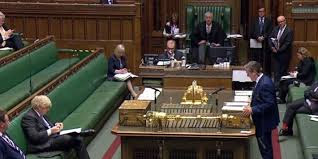
In my view, Keir Starmer, as leader of the Opposition, had much the better of his exchanges in Parliament with the Prime Minister, Boris Johnson, at Prime Minister’s Questions (PMQs) on the 24 June. Above all, Starmer took the approach so many of us have demanded from our politicians for years or decades: calm, well-informed, moderate. He offered praise for where things had been done well in combating Coronavirus, and then focused on a genuine problem on which he called for clarity from the government.

Keir Starmer, on his feet, questioning
Boris Johnson, left


In other words, like the American voters who wanted the swamp drained, he rose to the challenge many UK voters have set politicians.

He asked:

Yesterday, the Government announced the next stage of easing lockdown restrictions. If that plan is to work—and we want it to work—we need an effective track, trace and isolate system. The Prime Minister promised that a world-beating system would be in place by 1 June. The latest figures from yesterday’s press conference hosted by the Prime Minister show that 33,000 people are estimated to have covid-19 in England. The latest track, trace and isolate figures show that just over 10,000 people with covid-19 were reached and asked to provide contact details. I recognise the hard work that has gone into this, but if two thirds of those with covid-19 are not being reached and asked to provide contact details, there is a big problem, isn’t there?

Did the Prime Minister respond in kind? Did he heck. Here’s what he said:

On the contrary. I think that the right hon. and learned Gentleman has been stunned by the success of the test and trace operation. Contrary to his prognostications of gloom, it has got up and running much faster than the doubters expected. They are getting it done—Dido Harding and her team have recruited 25,000 people and so far they have identified and contacted 87,000 people who have voluntarily agreed to self-isolate to stop the disease spreading.

In other words, he gave a purely old-style politician’s answer: on the attack, and dodging the question altogether. As Starmer pointed out:

The Prime Minister just has not addressed the question I put to him. I was not asking about those who have gone into the system—the 10,000—or those who have been contacted; I was asking about the two thirds of the 33,000 with covid-19 who were not reached. That is a big gap.

Clear, simple and focused on the key matter. If only 10,000 are being tested then, on the government’s own figures of 33,000 infected, two-thirds are not being reached. This is bad news. And Johnson’s response? He went back on the attack: “I hesitate,” he claimed without hesitation, “to accuse the right hon. and learned Gentleman of obscurantism. He is misleading on the key point.”

The accusation of misleading is serious in Parliamentary terms and the Speaker had to call on him to withdraw it.

The exchange moved on to the matter of the tracking app, promised for 1 June, then abandoned, now promised again, using commercial software, perhaps some time after September.

Boris Johnson was having no criticism on that front:

I wonder whether the right hon. and learned Gentleman can name a single country in the world that has a functional contract tracing app—there isn’t one.

Strangely enough, the right honourable and learned Gentleman Keir Starmer certainly could name one:

Germany. It had its app working on 15 June and it has had 12 million downloads—I checked that overnight.

So now the decks were cleared for Johnson to move from the lie circumstantial to the lie direct:

I am afraid that the right hon. and learned Gentleman is completely wrong, because no country in the world has a working contact tracing app.

Faced with a clear, verifiable fact, Johnson merely resorted to denial. A blatant, easily refuted lie.

And here’s the sad thing. He won’t be called on it.

Many have demanded that politicians find more honest ways of doing their job, for instance denouncing Blair for lying over Iraq.

They claim to want them more straightforward and thorough.

They called for less aggressive exchanges between them, more focused on solid, reliable information.

Yet a large number of them will rally to Johnson now. They will claim he bested Starmer. They’ll praise his style instead of denouncing his lies.

My only hope? That in neither the United Kingdom nor the United States will they constitute a majority.

So we really can drain the swamp and move to a healthier brand of politics.

Saturday, 6 June 2020

Governments losing against Coronavirus: it's no coincidence

“One of the things that makes novels less plausible than history, I find,” says a character in Tom Stoppard’s play Night and Day, “is the way they shrink from coincidence.”
We do try to reject coincidence. “This happened after that other thing happened, so it must have been that other thing that caused this one.” Post hoc ergo propter hoc, the Romans used to say, after that so because of that.
And yet there really are things that are simply coincidence, in the sense that they happen together, or after each other, purely by chance.
London had a population climbing towards seven million over the decade I was a student there (yep: I was once the proud owner of ten University of London student cards). And yet I hadn’t been there many years before I had my first experience of meeting people I knew, without arrangement, on the street. It happened to me several times over the period I lived there.
What? The chances of meeting any particular person out of 6.5m is, naturally, 6.5m to 1. And yet I several times met individuals I knew?
We are not intuitively good at handling statistical reasoning, as the psychologist and economist Daniel Kahneman has pointed out. I had a wide network of acquaintance, which immediately increased the chance of meeting any one of them by chance. And it was not as though I only ever crossed the path of one other person in any one day – on the contrary, commuting from home to work or to college brought me close to hundreds or even thousands of people (hence the difficulty of maintaining social distancing today).
Take that into account, and the probability of meeting someone I knew was significantly higher than I might have imagined. Certainly, high enough for it to be perfectly reasonable that it should happen several times over a ten-year period. Particularly when you consider that most frequently the encounters were in places which act like people-funnels, such as the main railway stations.
In fact, the most surprising such event I witnessed was just last year, as I was catching up with a Turkish friend, Muharrem, who was about to enter Victoria Station ahead of me. I found him in lively conversation, in Turkish, with a woman. After she had left, Muharrem explained to me, “she’s one of the most famous novelists in Turkey, and I met her when I was working at a library where she came to give a talk”.
Despite this kind of experience, we do shrink from coincidence. Indeed, that shrinking becomes a weapon in the armoury of people trying to build certain kinds of argument. They might, for instance, say:
“My friend Sally took that medication. And exactly two years, five months and 17 days later, she had a series of terrible migraines. Coincidence? I think not.”
It’s a great debating trick, because it establishes in advance that only the most naïve and credulous people could possibly respond, “well, actually, yes, I reckon it probably is a coincidence.” As, of course, it is.
After all, Sally probably took other things than that medication before getting her migraines. If anything that happened before them could be regarded as a potential cause, might it not have been the chocolate she had the day before, or the overindulgence in wine, or the fact she drove through a polluted neighbourhood? After that so because of that isn’t an argument, it’s a sloppy and unreliable way of reasoning.
To establish that there’s more than chance at play, we have to show some causal connection between the two incidents.
To take a different example, naturally chosen entirely at random, consider lousy government. Faced with a major and fatal pandemic disease, a lousy government fails to take it seriously. It may attempt to put in place measures to protect its healthcare workers, and even promise to do so, and then take far too long and under-deliver. It may, rightly, identify track-and-trace as the best way to combat the virus, promise to put a system in place and then fail to meet its own deadline.
Or lousy government might just be far too glib in attitude. It may be scornful about simple and effective measures like wearing masks. It may pay lip service to other measures, such as social distancing or quarantining, while flouting them itself and turning a blind eye to infringements by friends or supporters. It may be halfhearted about its lockdown measures and end them too soon.
Now which governments around the world have been most guilty of some or all of these kinds of behaviour?
Why, the governments Trump’s United States, Johnson’s UK and Bolsonaro’s Brazil. Which makes it fascinating to look at the latest figures published by Worldometers. Imagine which are the governments with the highest numbers of deaths due to Coronavirus:
The three nations with the worst Coronavirus death totals
Note that Johnson's UK has the worst death rate per million

A coincidence? I think not.