Saturday, 23 December 2017

Little Britain

At last! The Brexiteers have an achievement to their name. Not before time. Something real. Concrete. Tangible.

Britain is going back to old-style blue passports.
New old-style passport to the left
Old new-style passport to the right
Well, actually, not exactly. The blue isn’t quite so dark. A bit like the roar of the British lion, it’s going to be a tad more subdued.

That’s not where the parallel stops either. Unlike the old passport – indeed, unlike any British passport up until Brexit day in 2019 – it isn’t going to be quite as good for crossing borders. Currently, the passport allows us free passage to thirty or so states in Europe. But that, in the great foot-shooting exercise that we know as Brexit, the citizens of this sceptred isle have decided in their wisdom to give up.

So the new passport is both deep-hued and de-valued.

But then, that’s the way of Britain on the world stage these days. The US has already issued instructions to Britain as to what the country needs to do to get a trade deal (basically, lower standards). Bullying by the EU itself has only just started, as the brave government of Theresa May keeps finding as it tries to insist on the fulfilment of its demands.

To see the extent of the nation’s decline, we have only to look at the nature of our Foreign Secretary, Boris Johnson.

He’s a former member of the notorious Bullingdon Club, of wealthy young men at Oxford University who would inflict criminal damage on the places they visited. They did so in complete impunity, shielded by parents with the status to protect them and the means to cover any repairs required. It made them intensely indolent, as entitled men inevitably are: if everything comes to them because of what they are rather than for what they do, why would they make an effort to do anything much?

A fellow Bullingdonian, David Cameron, used to be probably the laziest Prime Minister the country has seen. He would go unbriefed into meetings, notably with the EU, relying, I suppose, on his charm and wit to carry him through. That led to his coming out with the most ridiculous inanities. A fine example was his veto on the nations of the Eurozone using EU premises to discuss closer ties. He soon discovered he had no authority to top them, leading to his being forced to back down with bad grace when they met anyway.

It’s no surprise, then, that Boris Johnson also likes winging things. His specialism is playing the buffoon. So when he showed up in Moscow for discussions with his Russian opposite number, Sergei Lavrov, he talked about the rapid rise in exports of Kettle Chips from Britain to Russia. Lavrov looked on unsmiling, allowing Johnson his attempt at humour, but unmoved by it.
Palmerston used guboats
BoJo has Kettle Chips as a key tool of his diplomacy
To show his commitment to democracy, Johnson also met some human rights activists. Their comment? He “could clearly benefit from learning more and following the situation more closely”. 

Uninformed? Well, of course he was uninformed. Being properly informed would have required him to read something. That takes time and, if you’re to learn anything from the process, effort as well.

Some of the things Foreign Secretaries have done in the past have been shameful or at least reprehensible. But many holders of the post have been giants. Palmerston using gunboat diplomacy to ensure that Britain’s voice was truly heard around the world. Anthony Eden resigning in disgust at Neville Chamberlain’s craven behaviour towards Hitler. Ernest Bevin swallowing his pride to negotiate a humiliating but vital loan from the US. David Miliband representing Britain at the adoption of the EU Lisbon Treaty.

Well, now we have a midget in the post. A diminished role for a diminishing country. With a diminished passport.

But at least it’s blue. Hardly a major assertion of sovereignty, but perhaps we shouldn’t begrudge the Brexiteers their celebration. They are going to find precious few opportunities for cheer when Breixt really begins to bite. 

Thursday, 21 December 2017

A little of what you like often comes at a price

A little of what you like does you good, they say. Sometimes, doing yourself a little good also seems to involve what you don’t like much.

Pilates is a case in point. Danielle has persuaded me to join her there twice now. Two weeks in a row. But it takes a while to get the hang of it. Take the scoring system. I mean, how do you know when you’ve won?

Well, I’ve discovered now and, let me tell you, it’s perverse. You win in Pilates when your muscles really ache. When it hurts, preferably intensely, you’re doing it well.

You read that right. It’s a sport where it’s supposed to hurt and you do it for pleasure. Talk about organised masochism. What’s more, the worse it hurts, the more good it’s doing you.

To take another example, there’s heading off on holiday. Leaving grey wet England for somewhere that ought to be warmer and brighter. Without appointments and deadlines. In pursuit of pure relaxation. But that comes at a price: the stress of making sure that everything that needs doing is done before one puts the out-of-office message up and shuts down the laptop. A painful rush. It means that once you finally get to go on holiday, you really need one.

The worst of it was that there weren’t only work tasks to complete before departure. I had a responsible domestic job too: putting a new clasp for a padlock on the gate to the garden. This was principally needed because of Toffee. She mostly behaves quite well but provoked, say by the passage of a cat, she could be tempted to rush straight through an open gate and into the road, whether a car was bearing down on her or not.

Toffee (on the right) with her friend Luci
The picture of innocence. Until she gets into trouble (again)

It was brought home to me just how carefully she needs protecting when I was on a walk with her in one of our local parks the other day. She slipped through the railings around the lake, because she’s still small enough. When I saw what she’d done, I called her over, thinking that she’d go back out by the way she’d got in, and come around to me. After all, between her and me was a tongue of lake water, with a drop of a metre or more down to it. 

She surely wouldn’t come straight towards me, ignoring the deep drop into a drop of deep water? I had barely time to think the thought and notice that she was looking straight at me and ignoring the hazard in front of her, before she came trotting in my direction, all innocent obedience, and went straight off the edge and, with a plop, into the freezing water.

Fortunately, Luton Council in its wisdom and kindness had set a steel ladder in the wall on my side of the water. I was over the fence in a second and down the bottom of the ladder calling to her as she swam round and round, looking far from comfortable with her impromptu dip. She was a little confused, swimming towards me and then away – well, who can blame her? She’d just tried coming to my call and look where that had got her – but eventually she came close enough for me to grab her collar and pull her out and on to dry land.

A wet cold poodle on cold dry land.

With a dog like that, who wouldn’t be afraid to leave her with a garden – accessible through her dog flap – not properly sealed from the road?

The clasp had to go up. But that involved doing things with screws and screwdrivers. On a wooden gate full of knots. This is not a skill in which I particularly shine. I had trouble getting more than half the screws more than half the way in.

Even with a power drill, the screwdriver bits just spun on the screw heads, driving them in not one jot. Since the failure of this exercise couldn’t possibly be attributed to the workman, I had to blame the tools. Naturally. So I ordered a new set of screw bits for the drill.

Just wonderful. They arrived the following day. And by that afternoon the clasp had been mounted, thus proving that I had no trouble getting the job done once the proper tools had arrived.
Having the right tools is crucial for a good job
Though having an actual building worker around's even better
Coincidentally, a building worker was in the house that morning, finishing off the last job outstanding on the work we started in the autumn (what a relief: finally done). It’s true that he happened to have his own power drill and screwdriver bits. It’s equally true that he has some skill with driving screws into ancient wood made hard by its knots. But that’s not the point: the job needed doing and by the afternoon it had been done.

Surely that was the extent of my responsibility, wasn’t it?

I now feel I can dedicate myself to holiday mood, with a clear conscience.

Monday, 18 December 2017

Winter: season of contrasts. Some of them traditional

One of the few advantages of the short days in winter is that it’s not that hard to see both sunrise and sunset.

Sunsets are often breathtaking, even in winter.


Winter sunset in Wardown Park, Luton
But sunrise too can be extraordinary.


The sun rises over winter trees in People's Park, Luton
Indeed, bare trees in low winter sunlight in the middle of the day can be starkly striking.


Low but strong winter sun in People's Park
The contrasts that mark winter aren’t limited, though, to the physical world but affect human society too. Take, for instance, the tale of King Wenceslas, sung so often at this time of year in allegedly Christian nations. It seems he was quite comfortable enough to be able to stand at a window, of his castle one assumes, and look out even though the frost was cruel (or cru-el).

Doing so, he was able to spot someone from altogether the other end of the social spectrum: a poor man struggling through the cold to collect some winter fuel (fu-el).

Wenceslas was well enough off to be able to spare a few of the pleasures of life. So he could require his page to bring him flesh and bring him wine, and even a few pine logs hither, so they could go and see the poor man dine, when they bore them thither (or thi-ith-ther).

Now we like to maintain our traditions. And so we’ve preserved that one, at least in part.

I read today about a charity in the Wirral, in North West England, which makes up packages to give to poor people at this season. It’s common, when making Christmas presents to give out luxuries – electronic games, perhaps, or toys guaranteed to hold the attention of even the most spoiled child for minutes and minutes. But the group in the Wirral makes up hampers that include toilet rolls, toothpaste and sanitary towels, as well as toys.

These are not gifts designed only to enhance pleasure but to relieve want. Four years ago, this organisation handed out 70; this year they are handing out 3000. In the world’s fifth biggest economy in the world.

It seems the poor seeking winter fuel are still with us.

Another story made it clear to me that we still have the successors of King Wenceslas with us. Take the case of Jeff Fairburn. He’s the chief executive of a housing company called Persimmon. He’s done a fantastic job building the company’s profitability of the company, even if admittedly he had help from a government that poured in subsidies to companies like his to encourage the building of houses that the relatively wealthy can rent to the poor.

With that generous gesture by us all – let’s at least admire our Christian charity in helping out of pockets such fine companies as Persimmon – Mr Fairburn has been able to take a bonus worth £110m.

Now that may sound like a lot. But Britain’s biggest hospital, Bart’s in London, has a deficit of nearly £140m. Mr Fairburn’s bonus wouldn’t even cover all of it.

We have the poor. We have the wealthy. All we’d need to complete the tradition is to see the Wenceslas figure set out across the snow to help.

Ah, unfortunately, that’s where things break down. Mr Fairburn won’t be contributing to help Bart’s, for instance. I mean, he needs that money. He has a lifestyle to maintain, and it’s unaffected by the fact that people are lying on hospital trolleys for want of hospital beds or being denied treatment.

King Wenceslas we have still, it seems, but the latter day isn’t all that Good.

Still, at least we can enjoy the wonderful sights winter provides. As long as we’re not too ill to go wandering around our parks and streets. Or too busy trying to find a little food for our family – to say nothing of luxuries such as toilet rolls, toothpaste or sanitary towels.

Saturday, 16 December 2017

Liberal Democrats: trying the same thing and hoping for a different outcome...

“My girlfriend,” the comedian we were watching told us, “is a Liberal Democrat. So she really is one in a million.”

We all laughed. In truth, though, it’s no laughing matter to see what’s become of the Liberal Democrat Party.

It was a while back now that the forerunner of that party, the Liberals, bestrode the British political scene. A while but hardly a time lost in the mists of history: my grandfather was two years into an apprenticeship as a lithographic artist and well into his teens – school leaving age was 14 at that time – when the Liberals won a landslide majority in parliament and opened ten years of apparently unassailable, and certainly unassailed, rule in the country.

That only ended in 1916 when the last Liberal Prime Minister, Herbert Asquith, was forced out of office for his supposed mishandling of the First World War. He was replaced by his Chancellor of the Exchequer, David Lloyd George, whose political guile clearly outweighed his loyalty. However, Lloyd George headed not  a Liberal government, but a coalition with the Conservatives.


David Lloyd George
Led the Liberals into coalition with the Tories
and sealed their fate
This was the national government, intended to rise to the challenges of the war, though it continued to 1922, well into the peace. Then the Conservatives won a majority on their own. The Liberals, split between the followers of Lloyd George and Asquith, never formed another government. The legacy of coalition with the Tories wiped them out for decades. Instead, they were replaced as the main opposition to the Conservatives by the Labour party, then barely a generation old.

From the time I first became aware of politics, I’ve watched the Liberals struggling to re-emerge onto the political scene. They would win occasional by-elections to loud fanfare in the press, much of it orchestrated by themselves. But when a general election came round, they would be reduced to a handful once more, often losing the very seats they had won in the by-elections.

In my youth, we used to talk about the “taxi Liberal Party”, since all its MPs could have fitted into a single London cab.

Then came the eighties. Labour decided to try its luck under a leader from the Left and a manifesto with a radical bent to it. In 1983, it went down its worst defeat since the 1930s.

Out of this brief flirtation with the far Left came a breakaway group, the Social Democratic Party. It won a few seats and made a few waves. But essentially it was battling for the same voters as the Liberals; the two parties at first collaborated and then eventually merged into the Liberal Democrats. And prospered.

At the 2005 General Election, they peaked at 62 parliamentary seats. Small compared with Labour’s 418 that year, or the Liberals 397 in 1906, but a huge improvement over the taxi cab days – in 1970, they had just six seats.

And then, in 2010, they went into coalition with the Tories.

You’d have thought they’d have learned, wouldn’t you? They apparently thought they could go back into coalition with the Conservatives in 2010 and come out with a different result from 1916.


Nick Clegg
Led the Liberal Democrats into coalition with the Tories
and sealed their fate
Well, they were wrong. In 2015 they were reduced once more to just eight seats. At the election this year, they won a few back and reached 12. They’d need two cabs rather than just one, or three if they wanted to be a little more comfortable. But anywhere near power? Not a chance.


It’s a loss. Often, particularly on matters of human rights, the Liberal Democrats were out to the left of Labour and acted as a useful antidote to the occasional illiberal inclinations of some in my party.

I remember at the time of the coalition getting into lively debates with Lib Dems on Twitter. One assured me that having a Lib Dem influence on government was worth even a price as high as a generation of irrelevance.

Well, they had their chance between 2010 and 2015. It’s not clear they exercised much influence, and today what influence they had has left little trace. Now we’re well into the period of irrelevance; I wonder if my adversaries from back then still feel the price was worth paying.

It seems to me the political landscape has been impoverished by the fate of the Lib Dem party. Especially in so far as it has benefited the Tories. Even if it occasionally provides some good one-liners for standup comics.

Thursday, 14 December 2017

Outstanding standup

If you’re anything like me, what you need after some particularly drudge-ful drudgery is entertainment that doesn’t just pass muster but pushes the bar higher. 

The kind that can combat the effects of tasks as tiresome as completing expense reports. Oh, boy. What a task. To be fair, it’s been made a tad easier for me because I’ve been issue with a fine piece of software to deal with it. I won’t name it here, however, as a matter of discretion with which I’m sure you’ll concur. 

Let’s just say that, like most fine software, it works well when it works and drives me mad when it doesn’t.

To raise my spirits takes something out of the ordinary. What better than fine standup comedy? Especially standup by women. And specifically Jewish women.

I have two fine examples, one fictional, one real.

First the fiction. We watch quite a few shows, but this year none, I feel, has been as good the recent Amazon series, The Marvellous Mrs Maisel. At times, I come across writing that simply makes my jaw drop, and this series was full of such  moments. “How did she think of that?” I kept asking myself, bowled over by the talent of the series creator, Amy Sherman-Palladino.
Rachel Brosnahan as the marvellous Mrs Maisel
Set in 1958, the series tells the story of a wealthy New York Jewish wife and mother, Miriam ‘Midge’ Maisel, who finds herself increasingly drawn into making a career for herself in standup. The framing story is peopled with a range of highly distinctive but entirely Jewish characters each played by an excellent actor (Kevin Pollak is outstanding as the sweatshop-owning father-in-law), all of them endowed with their own skilfully comic lines.

Their story is chaotic, noisy and even subversive of its own genre (the severe paterfamilias, for instance, comes across as genuinely authoritarian until we discover he seldom gets his way). In powerful contrast, the standup sessions, and there is at least one per episode, while seeming even more anarchic than Midge’s life, are highly disciplined, tightly timed, and perfectly paced. Each is a jewel of the art.

The shows fairly bristled with great lines. Because it has no fear of being anachronistic, they frequently feel more like comedy from today than from 1958. I particularly liked “why don’t they serve drink here? I need a stiff drink. I need a drink so stiff I could blow it.”

How about the real comedian?

We saw her a few weeks ago at our local, council-run comedy venue, the Luton Comedy Bar. It charges a ridiculously low amount to get in, which means it must pay its artists a pittance. You wouldn’t tell from the quality, though, which was of the finest – the best value for money for entertainment I can think of.

The headline artist was Daphna Baram. She introduced herself by pointing out that we would all know from her accent (Israeli) that she wasn’t from around here.

Pause. 

She was from Walthamstow.

Daphne Baram: a remarkable background,
an irreverent approach and extremely funny
That was one of her least successful lines of the evening, not particularly appreciated by an audience of Lutonians who don’t sound that different from people from Walthamstow, only 35 miles away. But I enjoyed comparing the Walthamstow and Luton accents with hers, which was nothing like either.

Baram has an extraordinary background: a former human rights lawyer as well as a former soldier, she apparently took up standup when friends bought her a comedy course after she had a heart attack.

On the evening we saw her, she told the audience that she had just learned that she’d been successful in winning British citizenship (or is that subjecthood?) Taking the test meant learning a great deal more about Britain than most native Brits know. For instance, Jewish or not, she had to learn all about Christmas. And what gets her about that festival? Well, the serving of turkey, the dullest of meats.

“Where,” she asked us, “was Jesus born?”

Cautiously a few voices volunteered the answer “Bethlehem”.

It seems that Baram has been there several times, and not always with an Israeli Defence Force tank. And in that town she came to know an outstanding restaurant that served superb lamb dishes. Sadly, the restaurant has since been razed by the IDF, but its signature dish remains the main specialty of the town.

“Jesus would have been a lamb eater,” she assured us earnestly.

So?

“Offer him turkey and he’d have climbed up the cross himself.”

A line as good as any of Maisel’s. And as good an antidote to hours of drudgery as any drink. However stiff it may be.

Wednesday, 13 December 2017

Doug Jones: a key victory. One to emulate in Britain

What a relief – an unexpected one, to me at least – to see Doug Jones beat the alleged sex abuser and paedophile Roy Moore for a Senate seat in Alabama.

A famous victory. We need more of them. Here too.
The state is solidly Republican, so for a Democrat to win is extraordinary in itself. But Doug Jones isn’t just any Democrat. He proclaimed on his campaign website that, “I will defend a woman’s right to choose and stand with Planned Parenthood”.

He adds, “I believe in science and will work to slow or reverse the impact of climate change” putting a gulf between himself and Donald Trump. And, again flying in the face of far right views including the President’s, he proclaims that, “discrimination cannot be tolerated or protected. America is best when it builds on diversity and is welcoming of the contributions of all”.

These are bold statements of a liberal outlook. Just the kind of views that sink most candidates in the US, especially in the Bible Belt. But despite all that, Jones was elected.

Of course, he was helped by the fact that his opponent was mired in shocking, disgraceful scandal. But then, Trump had made claims to have engaged in much of the same behaviour in his past, and that didn’t stop him getting to the White House. It seems that the mood has changed in the United States, and when moral bankrupts like Moore run, it takes only courage and decency to beat them.

That’s great news. Congratulations to the US for a step back towards a more civilised polity. But also a comfort for the rest of us, who still have to strike out along that road.

Because in Britain we too face a government that is weak and indefensible. Not because it has been engaging in shameful sexual behaviour – some Members of Parliament have but most MPs seem not to have been caught up in that scandal, including the current Ministers, with one exception (Damian Green, deputy Prime Minister in all but name, is having a torrid time at the moment).

No, in Britain, the tribulations of the government are down to the ineptitude with which it’s handling the biggest question of our time for this country: Brexit. Again and again, Ministers and not least the Prime Minister, Theresa May, find themselves ill-prepared, inconsistent in their approach, incapable of presenting an argument effectively.

As a result, the other EU nations – the EU 27 – constantly out-negotiate the government and leave it having to make concessions.

I’m not particularly upset about that. The concessions seem to take us towards softening Brexit. They may in the end leave us able still to enjoy many of the benefits of EU membership (at the cost of having to comply with some of its obligations), making Brexit a somewhat less damaging prospect.

On the other hand, it leaves the government looking like damaged goods. Weak. Adrift. Inept. Bereft of leadership.

In other words, for different reasons, the British government looks like a target easy to strike. Ripe for an effective campaign from its adversaries. An open goal, virtually.

If that puts the government in the role of Roy Moore, who do we have to play Doug Jones? That, sadly, is where the analogy breaks down.

Up against the British government we have an excellent shadow Brexit secretary, Keir Starmer, putting up a powerful, coherent narrative and, frankly, running rings around the incumbent Brexit secretary, David Davis.

However, this is an issue of such importance that the Prime Minister, rightly, has taken a directing role in the negotiations. Her Brexit Secretary handles the detail, but the broad thrust is in her hands. What we need in front of her is a figure capable of running rings round her like Starmer does round Davis.

And what do we have? Jeremy Corbyn. Who seems to have taken a Trappist vow of silence on Brexit. He has nothing to say. Even when journalists pressure him to take a stance, he refuses to do so. Doug Jones proclaiming his commitment to a woman’s right to choose? Sadly, nothing that bold, radical or powerful is coming from Corbyn.

A friend and Corbyn supporter tells me he’s “keeping his powder dry”. The words “put your trust in God, my boys, and keep your powder dry” is often attributed to Oliver Cromwell, as an exhortation to his soldiers.

If they’d kept their powder dry by never using it, Cromwell would have died on the scaffold instead of Charles I.

Trust me. If the powder is ever going to help, you have to keep it dry, certainly. But then you actually have to open fire with it.

Doug Jones did. Look at the result. When will Jeremy?

Monday, 11 December 2017

A tale of four seasons

A few minutes’ walk from where we live is Luton’s People’s Park. The name’s a pleasant reminder of a time when popular ownership of certain assets was thought of as a good thing, as it will, I hope, some time again when the present craze with rampant individualism passes. In the meantime, it’s a place many go for simple pleasure, and among them various members of our household, human and canine.

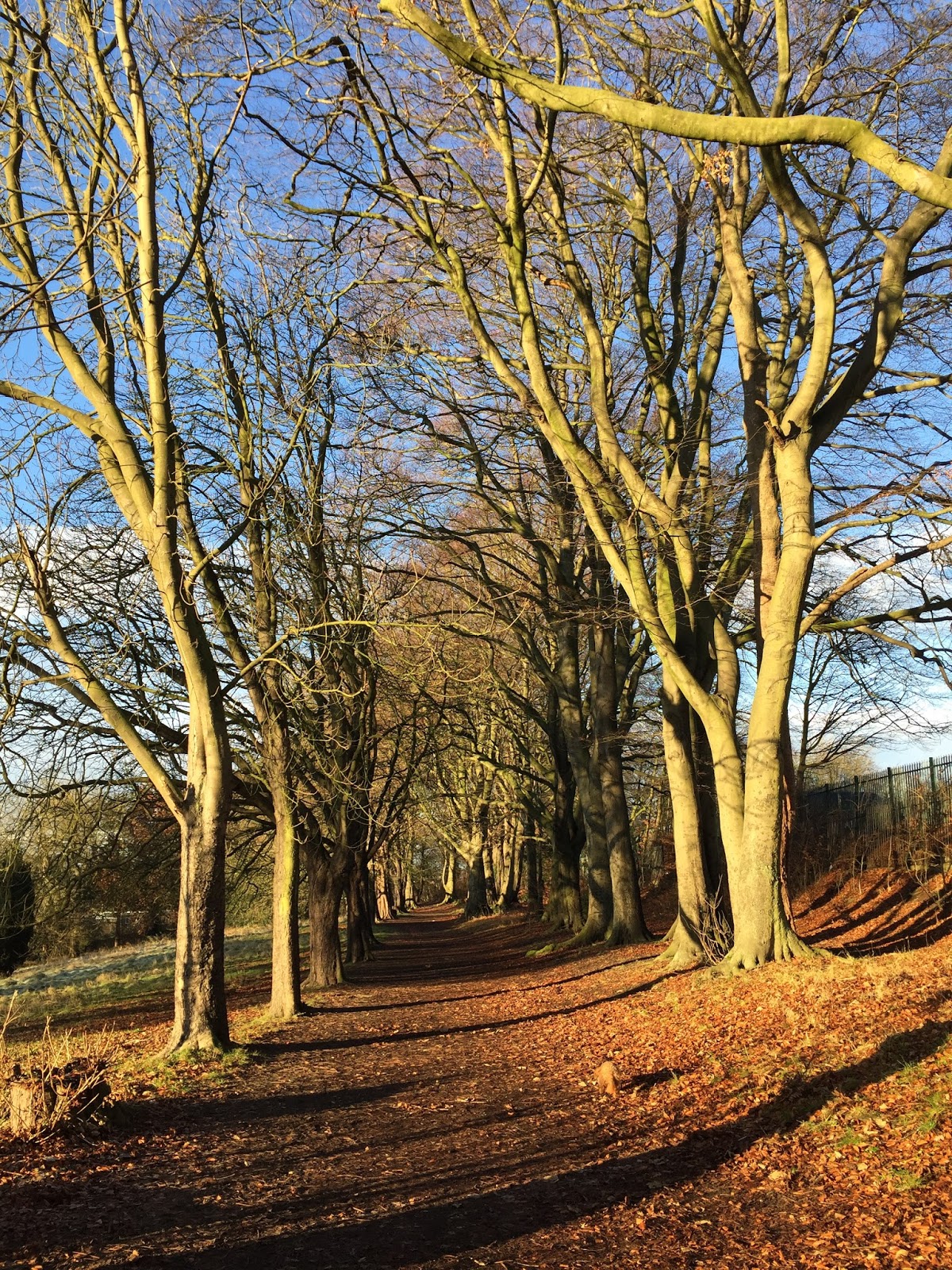
At the top of a park is a tree-lined avenue. It is strikingly beautiful at any time of year. The fact that it is comes as a celebration of the cycle of the seasons, of the way that even when things are as cold and as dark as they can be, sunlight and warmth aren’t that far away.

It’s never short of charm, however. For instance, since it’s a snowy December now, here’s the walk in winter.


A little earlier, in autumn, it can look like this.


Does that feel too cold and dismal? Don’t worry, it too shall pass. Before long the trees will be racing again to clothe themselves for spring – on this occasion with the left hand side wildly outstripping the right.


Before long, the sides fall into line with each other. Then we get glorious summer. The walk goes quiet and warm and green.


We wander through in shirtsleeves or, in the dogs’ case, panting, soaking in the warmth. What they don’t know, but we do, is that this too is transient and soon we’ll be back to something much more austere. But no less striking.


Who cares if it turns cold again? It’s still stunning. And – who knows? – we might get snow again. 

Followed, once more, by the leaves unfurling.

In People’s Park. Where beauty awaits the people. And, of course, any dogs that come along with them to enjoy it.