Friday, 17 May 2019

The fallen angel: not an example to follow

“This is the only city in the world,” our Madrid taxi driver told us a few weeks ago, “which has a statue of the Fallen Angel.”

Well. Taxi drivers don’t deliver their sententious statements under oath. And they’re not known for their strict impartiality when talking about their cities. Even so, it does seem true that Madrid is the only major city with a statue to this particular fallen figure, and it is only one of a handful of any such statues around the world.
The Fallen Angel: a beautiful spot on a fine day
Having an hour to spare in Madrid, in glorious weather, I decided not to resist the temptation to wander around the Retiro Park and track down the statue.

And there indeed it was.

He still has his wings, although the myth has God tearing them from him. But he’s falling fast, and far from happy about it. Especially as a snake is about to haul him downwards into the nether regions where he is to spend eternity. A sad fate for the greatest of the angels.

Detail of the Angel: not having a good day
For he was the bearer of light, or Lucifer to give the name in Latin. 

The story isn’t entirely logical. I mean, it claims he led a rebellion against the Almighty. It’s not quite clear to me why anyone would. How do you delude yourself sufficiently to believe that such a rebellion might succeed? Surely the clue is in the word. Almighty. All mighty. Not much point trying your luck against that, is there?

Besides which, how do you even get the conspiracy going? You’re talking about an all-knowing being. You could hardly chat to a fellow disgruntled member of the entourage without the principal knowing. All knowing. Again, the clue’s in the words. Why, you couldn’t even think about it yourself without his being entirely informed of your intentions.

Before you’d even formed them.

No, I reckon Lucifer should have just said to himself, “I’m the greatest of the angels, the bearer of light. That’s pretty impressive gig, quite honestly. And I want for nothing. What would I jeopardise all that for?”

Naturally, one could come up with all sorts of down-to-earth explanations of the myth. That the story is designed to demonstrate that greed for power is a passion that drives us all, maybe. And that there’s no greater sin than to rise up against the ruler. You can imagine how those might be messages that it suited powerful elites to communicate to their subjects, above all their over-mighty ones.

But that’s all psycho-babble, or socio-babble, and I had no intention of getting into that kind of thing on a fine morning in a lovely park.

In any case, we owe Lucifer thanks on at least one count. He did provide the Madrid sculptor Ricardo Bellver with the theme for a pretty good statue. Not too big, delicately carved, full of movement and emotion. On a sunny day, well worth seeing.

And maybe more people should. Because today too far too many people seem to be inclined to delude themselves that powerful forces can be overcome just by wishing it were so. And maybe we need a few more statues of the Lord of the Underworld, only to warn us not to elect too many of his followers into powerful positions. A lesson we need to think about in the US, Russia, Brexitland and other places.

Remember. Their role model may have been an angel, but he fell. It’s a long way down and not a comfortable ride to get there.

As the statue shows.

Tuesday, 14 May 2019

Distrust the man who talks of freedom

It always seems wise to distrust anyone who claims to be striving to set you free.

“Setting me free? You’re really interested in my freedom, are you?” strikes me as the good question to ask.

For example, the US likes to celebrate the Mayflower pilgrims, the refugees from religious persecution in England who created the first successful European settlement in Massachusetts. Their admirers tell us the pilgrims struck a blow for freedom of worship. Which in a sense they did – a blow for their own freedom of worship. But they were members of a particularly harsh Protestant sect, and they weren’t interested in establishing freedom of worship for Muslims, Jews or – still worse – self-styled fellow Christians such as Anglicans or, even more abominable, Catholics.

Indeed, these fine apostles of liberty were far from above doing a bit of energetic persecuting of their own. They regarded it as a duty to God, even. Extirpating heresy and all that. Within a lifetime of their arrival, some of the descendants of the Pilgrims were conducting witch trials in Salem and other local towns, that led to the hanging of nineteen people for the perfectly fictional offence of witchcraft. In some instances, the cases turned on ‘spectral’ evidence, testimony provided by spirits in apparitions to some of the witnesses.
Contemporary denunciation of the use of
‘spectral’ evidence in the Salem trials
Or take the example of Hungary. 

It was part of the Austrian Empire into the nineteenth century. A movement for equality with the German speakers led to revolution in 1848. For a brief spell, power fell to Lajos Kossuth, outspoken and internationally celebrated liberation leader. Counter-revolution eventual crushed the uprising. He had to flee his country and spent the rest of his life in exile, where he was lionised and feted in many nations. Why, he even has a bust in the US capitol building.
Bust of Kossuth in the US Capitol building
And yet. While in power he showed little sympathy for the national aspirations of non-Hungarians, including the minorities inside Hungary. He did nothing for the Slovaks, for instance, though his own father was one. Indeed, Kossuth lost some support in the US when he showed himself unable to back either Catholics or the anti-slavery movement.

His keenness to liberate downtrodden communities clearly didn’t extend to all such minorities. Just to his own.

This all came to mind for me when I saw a piece of graffiti in Valencia. “Valencia is not Catalonia,” it pointed out, in English, “Valencian language is not Catalan”.
Will Catalonia work for freedom for Valencians too?
It’s certainly true that the Valencian language, although similar to Catalan, is a different language. More generally, there is little appetite in Valencia, either the city or the region, for independence from Spain. Let alone for absorption into Catalonia.

A few months ago, I heard the story of a public servant in the Balearic island of Menorca. As well as what most of us call Spanish – Castlilian – he’s a native speaker of the local language, Menorquí, which like Valencian is closely related to Catalan, but different from it. So imagine his annoyance when, in pursuit of promotion, he had to sit an examination that was written in Catalan and required answers in the same language.

The leaders of the fight for the independence of Catalonia are outspoken in their advocacy of Catalan rights. They have less to say about the rights of other, smaller minorities. Indeed, they’re happy to treat those minorities with exactly the same insensitivity, or even arrogance, that they claim they suffer at the hands of the national Spanish authorities.

Just like the Massachusetts Puritans, or the Hungarian nationalists, they’re long on their own freedom, much less concerned about anyone else’s.

Which is why I tend to distrust anyone who proclaims his commitment to liberty from oppression. I think a few follow-up questions are always in order. Like, “yes, but would you stand up for my rights against oppression by you?”

Or, to put in other words, “are we talking about freedom for me, or should I be more concerned about freedom from you?”

Sunday, 12 May 2019

Going Nordic in the South

Before we left England, Danielle and I had taken to the sport of Nordic walking. You do it with sticks and, in principle, at speed. The idea is that the sticks keep your posture better than walking without them, and mean that the exercise affects 90% of your muscles, including arms, shoulders, back and abdominals, as opposed to only your legs.

It’s also quite fun.

We thought we’d try it here in Valencia too. A long way south of the Nordics, but hey, latitude doesn’t count, does it? We went out several times on our own, in the park the city has made where the river Turia used to run before it got directed outside the city. But it seemed a good idea to join a group, so we went for an initiation session this weekend.

It was in a lovely location, outside the town of Riba Roja, on that same river Turia, but where it actually still runs today.

One of the people going offered us a lift and suggested we meet at 4:00. We were there bang on time, even a little before, as was she – it keeps surprising me that the Spanish people we meet completely belie the reputation of the nation for lateness, summed up in the word ‘mañana’. That’s become an internationally recognised synonym for delay, procrastination and downright tardiness.

By meeting at 4:00, we turned up the rendezvous point a good half-hour early. Not everyone else was as punctual, so the actual session didn’t get started until a while after 5:00. And it didn’t start with the walk. Instead, a representative of the municipal council gave us a brief talk about the castle where we’d met, which was worth hearing, since the place had been built as a fortress by the Moors during Arab rule in Spain, before becoming a noble’s home and then falling into disrepair until the council restored what it could and added new – and rather spending – modern building elsewhere.


The castle explained to the group: a striking venue
That interesting talk was followed by another that was was far less so. It was given by the Nordic walking instructor, who spent an inordinate time getting his PowerPoint slides to project and, even worse, a video (have you noticed how often presentations with video in them seem to fail?) I learned that I’d been holding the sticks wrong, which was a useful lesson, but frankly could have been communicated in five minutes rather than the hour it took.

Finally, we got on the walk at rather after 6:00. Well, I say ‘walk’ but it was more of a Nordic stroll, frankly. Though those of us who complained (not in words but by getting out in front and moving a little faster) were soon given a taste of our own medicine (proving you should be careful what you wish for): the instructor’s friend got out in front and he had that capacity of tall men to walk in a leisurely manner but, with colossal steps, set a punishing pace we struggled to keep up with.

In the end it took an hour and a quarter to do four and a half kilometres, which is pretty dire. But, with the pace so much quicker in the stretches between pauses to allow others to catch up, by the end I was exhausted.
Pack of Nordic walkers in the southern sunshine
That made it great that the organisers chose to finish with a snack in a local bar. We were given beers and (rather good) sandwiches. Danielle and I sat with people we’d never met and enjoyed a conversation with them, though conversing is something of a challenge – a double challenge, indeed, since in our broken Spanish, we have to work to find the words to express what we want to say, and then they have to work to mentally translate what we’ve just said into the words we would have used if we’d said what we meant correctly. But we still got on swimmingly, despite the difficulties.

And then we headed home, having taken rather over five hours for what, left to our own devices and staying local, would have taken under one. Still, we saw some wonderful places. The walk was along the river, where it flows strongly in its old course (it was to guard that precious water that the Arabs built their fortress in Riba Roja). The sights were wonderful, as we walked between vegetable plots and wild flowers, with glimpses of the river every couple of minutes.

Then to finish with beer, sandwiches and good company – what more could we want?
A glimpse of the Turia on our walk

Wednesday, 8 May 2019

Brief contacts

There’s something invaluable about those occasional moments of contact we have with strangers, however brief. When they go well, they leave precious memories.

Some weeks ago, Danielle and I went for dinner in a small restaurant in Alcalá de Henares, near Madrid. We ordered too much food, including ‘patatas’ which we thought would be a side dish of potatoes. It turned out to be a near tray-sized plate of chips. Fortunately, a bunch of students came in and we gave them the dish, virtually untouched by us, and they devoured its contents with great joy. And speed.
Not just a side dish of chips
Food for a whole bunch of students
To my amazement, we discovered that despite the excellent Spanish of the student who talked to us, they were in fact Americans. And, what’s more, from the deep South – Alabama.

I was so astonished by their apparent mastery of Spanish that I wondered whether they’d perhaps spent time in Latin America. Unfortunately, I chose the wrong way to frame my question.

“Do you know Mexico?” I asked.

“Mex… Mex… Mexico?” answered the principal wag amongst them. “Do you know, the name rings a bell.”

I decided to reply in kind.

“Yes. You know the place. Long wall along its border.”

“Not yet!” they all chorused immediately and together.

I thought if young people, even from the deep South, could be so keen to establish their opposition to Trump, there was hope for the US yet. And for us all. It was a good moment. An encouraging moment.

A couple of weeks later I was in Milan on business and decided to have lunch in a small restaurant which looked fun. It wasn’t upmarket – in fact, it was surprisingly cheap – but it seemed cheerful and attractive.

In the more expensive places, once you’re at a table, even alone at a table for four, no one else joins you. Not so at this place. Only a few minutes after I’d arrived, the waiter brought a young couple over towards me.

“Do you mind if these people have lunch with you?” the waiter answered, but in a way and a tone that made it clear that the answer “no” wasn’t an option.
With my unexpected lunch companions in Milan
Much more entertaining than a Kindle
They weren’t from Milan but had moved there recently, for work. But they enjoyed the city. However, they also knew Rome, the city where I was born. We had fun comparing the two. Rome is known for its corruption and its inefficiency, to the point that anger is beginning seriously to boil these days: there are too many potholes in the streets, too much rubbish uncollected, and there are even three stations on the underground system closed for repairs with no sign of them reopening.

Milan, by contrast, is brisk, efficient, wealthy, well-kept. But, to those of us who know and love the capital, just a tad soulless. I always regard it as a city of Austria’s deep south, rather than of Italy’s north.

How much corruption, how many potholes, how much ineptitude is it worth putting up with for the greater warmth and relaxed attitudes of Rome? I don’t know the answer to that question. But I think it’s worth pondering, because I don’t think the answer is “none at all”.

As I write this, I’m in a plane on my way back from Wiesbaden in Germany, a city I didn’t know and which astonished me by its beauty. No wonder the Americans chose it as a major centre for their occupation forces.

I’d been warned that there wasn’t much accommodation available, so when I logged onto a hotel booking site I was ready to take whatever came up. A message flashed up on screen to say that an apartment had just become available near the park in the city centre; I jumped at the chance and booked it at once.

I landed at Frankfurt airport and rang the number I’d been given.

“Welcome to Germany!” said by soon-to-be landlord. “How do you plan to get to Wiesbaden? Don’t take a taxi!”

“You suggest I travel by train?”

“Surely. The station is right underneath the airport. Ring me when you get to Wiesbaden and I’ll come and fetch you.”

“Are you sure? Isn’t that too much to ask of you?”

It turns out that he regarded it as a pleasure. And, as it happened, he was already at the end of the platform when my train pulled in.

The flat was fine and I told him so, which seemed to please him. Then I asked what I should do with the key when I left.

“Don’t worry,” he assured me, “there’s no tenant after you so you can leave your things in the apartment until the afternoon, and I’ll come and meet you and run you to the station.”

I was astonished, but he seemed keen so I accepted the offer with pleasure.

There was only one minor hitch in the arrangement. I told him I would meet him at “half-two” on the day of my departure, forgetting that in German that means half-past-one. They call 2:30 half-three. But he was unfazed by the problem.

“No problem,” he said when he rang to ask where I was, “I’ll come back.”

He was as good as his word. But he had an announcement to make.

“Before I take you to the station, I will make a detour so you can see something special. Our Russian Orthodox cathedral with its golden-roofed spires. Built by a prince in mourning for his Russian princess wife, who died in childbirth.”

When we got there, he suggested I get out and wander around, even taking a look inside. I was a bit worried about missing my plane and said so.
Russian Orthodox cathedral in Wiesbaden
Quite a tribute from a widower to his lost wife
“Oh, no. You must see the place.” He thought a moment. “It’ll be no problem. I’ll take you to the airport.”

Which he did. So I got to see the cathedral. And make it to the airport on time.
My host in Wiesbaden, Karl
“Charlie. No one calls me Karl.”
Which explains how it happens that I’m writing this on the plane. And also why. Because there’s something special about these brief moments of friendly contact with a stranger.

Sunday, 5 May 2019

My cockup, their conspiracy

It’s not easy being relatively chaotic if you’re trying to live an organised life.

That was confirmed on a recent trip to Germany. I couldn’t find a direct flight from Valencia, where I now live, to Frankfurt. That isn’t quite the same thing as saying that there is no such flight, only that if there is, I haven’t found it yet. So instead I decided to take the train to Madrid and fly from there.

The train service is remarkable. An hour and forty minutes for a trip that takes three to three-and-a-half hours by car. Far, far beyond anything being achieved in Britain, the nation that pioneered railway travel in Europe.

The other great thing about travelling via Madrid was that I could go up the evening before and have dinner with my sons, who live there, and my daughter-in-law and my daughter-out-law. Who live there too.

The plan was to travel at 4:15, to have drinks and dinner in the evening.

I bought the ticket on line. Sadly, I must have been thinking too hard about the flight because when I came to travel, I discovered that I’d booked myself onto a train for the same day as the flight – which would have meant missing the plane – and not for the evening before.

“Thinking too hard about the flight?” my son Nicky interjects. “You mean not thinking at all.”

Ah, well. His judgement is harsher but perhaps more accurate than mine. Which is a little kinder.

In any case, I decided there wasn’t really a problem. I’d taken a flexible ticket, perhaps unconsciously aware that I was screwing up, so I had only to go to the station early and change the reservation.

It wasn’t that simple. There wasn’t a 4:15 that day, so the first train I could get on was the 5:10. But then the ticket agent corrected himself.

“Sorry – no. That train’s fully booked. And – oh, dear – so’s the 7:15. The first I can get you on is the 8:15. The last seat.”

“OK,” I said, “but every train I’ve ever caught in Spain has no-shows. Could I wait by an earlier train and if, just before it’s due to leave, there’s a spare seat, grab it?”

He shrugged.

“If they let you onto the platform, you can try.”

That wasn’t going to happen. Renfe, the national railway operator in Spain, posts staff at the entrance to platforms to check tickets, and there was no way they were going to let me near a train I wasn’t booked on. I’m not sure how to say “more than my job’s worth” in Spanish, or whether there is any such expression in the language, but that was absolutely the attitude they were taking.

It seems that against me all fate had conspired. Or at least, all Renfe.

In the end I had to take the 8:15.
Renfe's high-speed AVE trains
Fast, efficient, comfortable. With flexible service? Not so much
Now I know that the cockup was entirely my fault. But I find there’s something attractive about company employees trying to help out even someone who’s created his problems himself. You know, the “let’s see if we can find a solution” attitude as opposed to the jobsworth mentality.

After all, what does it cost them?

They could have helped had they wanted to. You’ll remember that I’d been assigned the last available seat on the 8:15. And yet, when I got on, I found a dozen seats, just in my carriage and the next, which stayed empty for the whole trip. I’m sure there were empty seats on the 5:10 and the 7:15 too.

It’s funny. A French high-speed train once stopped at a station it wasn’t due to call at, just to help my wife Danielle by allowing her to leave it there. A friend of mine who got on the wrong high-speed train in Germany was allowed off at an abandoned station, and was picked up there by the next high-speed train – the one he should have been on – although the station had been out of use for years.

Ah, well. Not everyone has the same view of customer service.

At least the sons and the partners stood by me. They turned out to meet me, not at 6:00 as intended, but at 10:00, which in Spain is the traditional time for dinner anyway. So we ate well in a restaurant near the station. Their warmth and sympathy made me feel a lot less foolish and a lot less annoyed. In any case, hanging around at the station in Valencia for four hours had been less painful than might be imagined – Danielle stayed with me until she had to go and walk the dogs, and I did some work afterwards. A longer wait in the station than I’d planned, but not a waste of time.

Still. I’ve got to learn to overcome my chaotic inclinations and live the organised existence I crave. Especially in Spain, where Renfe conspires so majestically against such sad little cockup merchants as me.

Friday, 3 May 2019

Spain and England, a leader and a ditherer, a victory and a defeat

It’s been an interesting few days, watching a general election in my new home country, and local elections in my old one.

In the former, Spain, the right was routed. It’s true that the hard nationalist party Vox won 24 seats in the new parliament. This was presented as a lurch to the right by some in the foreign press, but the reality is that where the two main parties of the right had 167 seats in the previous parliament, now all three together – including Vox – have only 147.

Essentially, therefore, the election redistributed the votes of the right and then cut them back. It’s as though the hard wing and the more liberal wing of British conservatism broke off to form their own parties, and all three parties were returned with a total of fewer MPs than the Conservatives previously held on their own.

So it was a conclusive victory for the left. In particular, it was a major success for the incumbent Prime Minister, Pedro Sánchez, who gets to form a new government. Under the Spanish proportional system, he won’t be able to do so alone – he doesn’t have an overall majority – so he’ll have to come up with accommodations and agreements with other groupings. But he should be able to do some good.
Sánchez: the leader who won
My prediction? That’s exactly what he’ll do – some good. It won’t be enough for those on the left who believe all we need to achieve a Socialist utopia, is to elect a Socialist and have him wave a magic wand. That Sánchez won’t do, any more than Tony Blair did in Britain. I only hope that the result won’t be that Spain in turn has to suffer another ten years of conservative rule, and learn the hard way that demanding too much of your allies can let in your opponents, who give nothing at all and, indeed, take a great deal.

What about the elections in England?

Brexit continues to poison the atmosphere there. And the first victim has been the Conservative Party. Theresa May promised to deliver Brexit and has spectacularly failed to do so. The party was punished in the local elections, losing 1334 seats, over a third of those contested that it held before the election.

It’s normal for a party in power for nine years to lose local council seats. But on this scale? That’s a rout.

And yet it wasn’t quite the rout it should have been. The Labour Party, the official Opposition, should have been romping home. The seats lost by the Conservatives should have fallen to them. But they didn’t. Instead, Labour too lost 83 councillors – far fewer but a massive loss when it should be winning big against a government party in such disarray.
Corbyn: the ditherer who lost
Labour’s led by a man entirely after the heart of those who hanker for a magic wand. His supporters view him as a socialist and a man of principle. Neither claim seems particularly supported by the facts.

Those supporters like to claim that Labour, by not taking a position either for or against Brexit, has become the party of both those who believe in remaining in the European Union and those who want to leave. In other words, Corbynism refuses to back the EU and, instead, takes a non-committal line. As it admits itself, it does so in the hope of not putting off Leave supporters.

It’s not clear to me that sitting on the fence in this way is a principled position. On the contrary, it strikes me as the rankest opportunism, of just the kind that Corbynists like to allege against Tony Blair.

Nor does it seem to me to be particularly socialist. Opposition to the EU is a key view of the right, and especially the far right, anti-internationalist, xenophobic and insular as it is. What on earth is a socialist doing in that company?

In any case, this opportunist, electoral calculation isn’t paying off. As was predictable and predicted. By trying to please both sides of a deep divide, you end up pleasing neither.

The local election results make the point. Brexiters see Corbyn taking a lukewarm stance so they don’t vote Labour; they see May failing to deliver and don’t vote Conservative; so they stay home and vote for no one. Meanwhile, Remainers see Corbyn refusing to back the EU, so they too either don’t vote or vote for a party that explicitly endorses their stance – the Liberal Democrats, the biggest winners in this election, with a gain of 703 council seats, and the Greens, the second biggest, gaining 194 seats.

Corbyn’s paying the price for his lack of integrity.

The contrast between my two homelands is powerful. A real leader, with clear positions, won the Spanish general election. A fence-sitter, dithering on the great question of his time, lost the English local elections.

Oh, for a British Sánchez to lead Labour. Oh, for the chance to win a victory like his. And oh, for the chance to watch the wishful would-be wand wavers leave the scene.

Wednesday, 1 May 2019

Valencians celebrating but not partying

When Valencians celebrate, they like to drink a lot of wine and make a lot of noise. In particular, they enjoy letting off fireworks – not necessarily the ones that fly up into the air and explode in joyful colours, but often the ones that just make a massive noise, at which they express hilarious delight while anyone trying to sleep nearby expresses bitter resentment.

It's as though living in their charming and pretty city leaves Valencians hankering for the challenges and excitement of a war zone.

So the procession in honour of St Vincent Ferrer, one of the city’s patron saints, was a curious anomaly which was all the more worth seeing for that very reason.

It was much more solemn. Quiet even. People genuinely processed, they didn’t sing or dance let alone drink. There weren’t that many of them, even, possibly a testimony to the fact that religious observance, even in Catholic Valencia, is not quite as widespread as one might imagine. And maybe also that spiritual events tend to be predominantly patronised by the wealthy, a suspicion rather underlined by the quality of the clothes many of the participants were wearing.

Still, it was fun.

Horsemen. Or, more correctly, horsepersons
At the front of the procession were a couple of horsemen, though one of them, in fact, was a horsewoman.

He deserves the honour. Or was he just working?
Immediately behind came a member of a crucial band in Valencia: a street cleaner. I’m not saying that you could eat a meal off the city’s streets – not, at least, safely, and I don’t just mean because of the traffic – but they are busily swept and scraped by devoted hordes of cleaners on every working day and quite a few holidays too.

Seeing a street cleaner near the front of the procession struck me as an appropriate honour. Though I think it would honour these valuable people still more if Valencia’s dog owners made more of a point of cleaning up behind their dogs – certainly, our local cleaner, a lovely lady called Marian, complains of how little they seem to care and how quickly they allow their pets to foul the pavements after she’s passed by.

On the other hand, it’s possible that the cleaner wasn’t there to be honoured. He may just have been tasked with clearing up behind the horses.

The costumes were mostly sober black.
Sombre in black, but spritely with it. Great to be that fit at that age
Even black, though, isn’t bleak if you’re young enough.
On some people, black's not so dismal
In any case, many were in traditional dress which was far more colourful.
Traditional dress
Sometimes they came in larger groups, too, to underline the principle that celebrating a saint needn’t be a dire business.
Traditional dress, massed
Why, we even saw a group of what were apparently young Dominicans. Accompanied, it would seem, by minders, though I’m not quite sure why they needed them.
Young friars. Or novices. Apparently
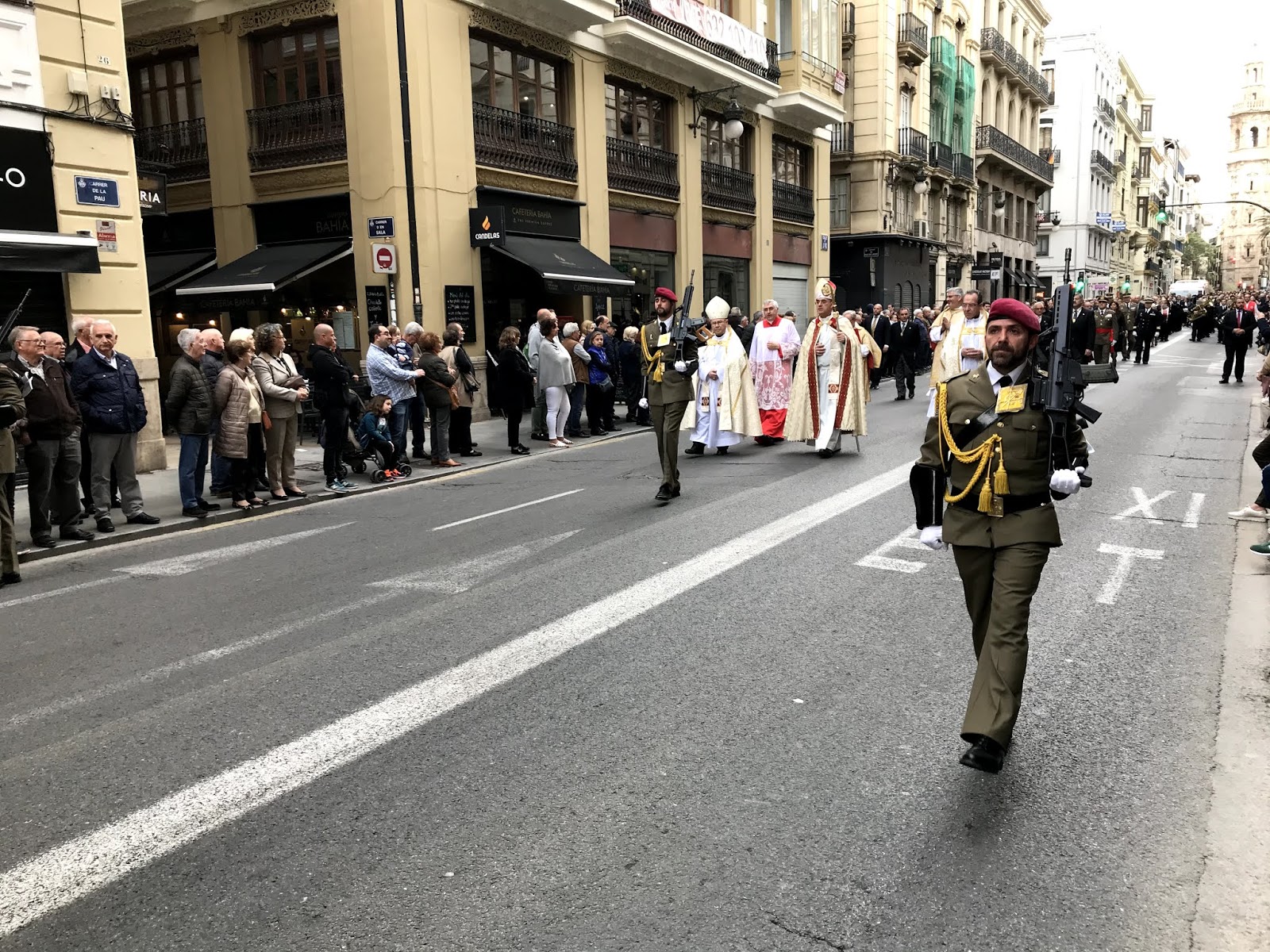
And, of course, where the national religion goes, the national military can never be far behind: the more senior clerics duly escorted by armed men.
Goose-stepping along
Neatly confirming the link between Church and State
More senior representatives of both the military and police were there too, though apparently unarmed. The top brass doesn’t do the dirty work: it has far more junior and less well-paid underlings to do it for them.
The senior officers were there too
All branches of the services and the police were represented
Away from the procession itself, there were stages set up on street corners, where children under 13 were performing miracle plays.
Street theatre miracle plays. By children
The celebration gave us an unexpected view of a certain section of Valencian society. And an interesting contrast to the way most festivities take place in this city. 

It was amusing, and a little surprising, to see Valencians engaging in a celebration without turning it into a party.